This is a weekly series with things I’m reading and pondering from Oswald Chambers. You can read the original seed thought here, or type “Thursdays With Oswald” in the search box to read more entries.
Character Development
God can put a saint into a right relationship with Himself, but He cannot make him work out that relationship, the saint must do that himself. …
God alters our disposition, but He does not make our character. When God alters my disposition the first thing the new disposition will do is to stir up my brain to think along God’s line. As I began to think, begin to work out what God has worked in, it will become character. Character is consolidated thought. God makes me pure in heart; I must make myself pure in conduct.
From Conformed To His Image
I like to think of the word sanctification this way: saint-ification. Through His Holy Spirit, God is making me a saint, by making it possible for me to demonstrate Christlike conduct.
Are you allowing the Holy Spirit to make a saint out of you? What’s holding you back?
(If you are in the Cedar Springs area this Sunday, I will be talking more about the Holy Spirit’s role in this saint-ification process. Please join me!)
Some good reading (and watching) from today…
GREAT NEWS! The FBI rescued 168 child victims of sex trafficking.
John Maxwell talks about the value of concentration.
“Don’t fornicate with your body. Worship with your body. The Apostle Paul even says that the body is a temple, that is, a place of worship. The body is a place for meeting God, not prostitutes. This doesn’t mean sex is bad. It means that sex is precious. Too precious to be treated cheaply. God means that we put it in a very secure and sacred place—marriage. There it becomes the expression of the love between Christ and the church. It shows the glory of the intensity of God’s love for His people. It becomes worship. ‘Glorify God in your body.’ And not doing sex outside marriage also shows the preciousness of what it stands for. So chastity is worship.” —John Piper, commenting on 1 Corinthians 6:18-20
“Here’s a piece of advice: admit it when you mess up. Don’t lie or plead ignorance. Don’t try to make yourself out to be a victim. And above all, don’t throw your wife (or anyone else) under the bus. If you did it, own it. Any other choice will lead you into deeper problems than you already have, both in the here and now and the hereafter.” Read more from Mark Atteberry in his post The IRS Scandal: Eden Revisited.
[VIDEO] …speaking of the IRS scandal, Rep. Trey Gowdy grills IRS commissioner John Koskinen.
Some fascinating statistics that show a stable marriage leads to better performance in school for kids, and more stable employment options after school: How Churches Can Bridge The Marriage Divide.
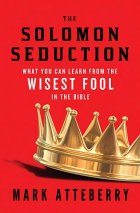
The Solomon Seduction is a biography on King Solomon, a Bible study, a book for men to overcome temptation, a leadership book, and a great discussion starter for a men’s group. In other words, there are lots of reasons for guys to read this book! You can read my full book review by clicking here, and below are some of the quotes I highlighted from this book.
“Moderation can be a great thing. But the idea that anything is okay as long as it’s done in moderation has given rise to some of the wackiest notions known to man. … One of the big problems with using moderation as a justification for whatever you want to do is that it’s almost impossible to take just a bite when you’re really hungry.”
“Are you just a guy who goes to church, or are you serious about growing spiritually and acquiring discernment? satan’s chances of seducing you will rise or fall on your answers to these questions.”
“Solomon is the perfect example of the fact that you can have your cranium crammed full of discernment and still end up embarrassing yourself. Keep in mind, he not only knew the book of Proverbs, he wrote the vast majority of it! And then ended up doing many of the very things he himself said were foolish!”
“All of satan’s various attempts at seducing believers must include an attempt to undermine Scripture.”
“What we have here is a case not of ignorance or confusion or misinterpretation, but of satan subtly and artfully manipulating Solomon’s thinking to the point where he felt the commands of God seemed out of touch with his real-world experience.”
“satan doesn’t try to get you to forsake your good priorities. He just encourages you to mix in a few lesser priorities that will compete with those good priorities.”
“Mark it down. When the word I starts replacing the word we in your speech, something ugly is happening in your heart. Your ego is swelling.”
“Big-ego people almost never back up and take another look at their actions. Why should they? They’re convinced that everything they do is right. It never occurs to them that they might be on the wrong track. They’re so infatuated with themselves that they can see nothing but that beautiful image in the mirror.”
“‘What’s the big deal?’ If ever a question spoke to the attitude of our generation towards sin, that one does. We shrug off sin as though it’s just a little harmless fun. You know, boys will be boys. Everybody sows some wild oats, right? Or, if we don’t play the what’s-the-big-deal card, we claim that the sin we are indulging in is actually necessary.”
“Instead of repenting, instead of exterminating, illuminating, or correcting their bad behavior, [sin managers] try to manage it. They believe that if they can keep the behavior from getting out of hand, keep people from being hurt or offended, keep the status quo from being upset, keep the ugliness under wraps and out of sight, they can hang on to their sin and everything will be fine. … This is typical of sin managers. Instead of seeing sin as the problem, they see the awkwardness the sin creates as the problem and believe, therefore, that if they can find an answer for the awkwardness, they will have solved the problem.”
“In the category of cold, hard truths, this is a doozy: God doesn’t share the throne of your heart with anybody or anything. You either give it to Him wholly and completely, or He vacates it. You can tell yourself that God comes first and that the sin you’re harboring is just a little something you need to work on, but if you choose a lifestyle of sin management over repentance, you’ve pledged your allegiance to your sin, not to God.”
“Repentance is not what saves us; grace is. But repentance is a response to grace that makes what we are after having received grace different from what we were before. … Repentance concerns itself with how things are while sin management only worries about how things look. Think of a messy closet. Repentance cleans out the closet. Sin management straightens up the closet. Repentance throws away the junk. Sin management rearranges the junk. Repentance gives you a better closet. Sin management only gives you a better-looking closet.”
“When we see Solomon at the height of his idolatrous lifestyle, marrying and buying and indulging like an out-of-control sailor on a weekend pass, what does he say over and over again? ‘I said to myself…’ (Ecclesiastes 1:16, 2:1, 2:15, 3:17, 7:23). Solomon was talking to himself about a lot of things he should have been discussing with God. Who can argue that the reason why he was seduced and eventually reduced to an object of scorn and pity was because he excluded God from so many areas of his life?”
I was at the University of Michigan with a friend who is on the list waiting for a liver transplant. We spent a half-day listening to doctors, nurses, dietitians and others tell us what to expect through this process.
One social worker really emphasized the care of the patient’s body prior to the transplant as a way to help with recovery from the surgery. He said, “Pre-habilitation helps rehabilitation.”
I like that!
It’s sort of a variation on Benjamin Franklin’s maxims, “An ounce of prevention is worth a pound of cure,” and “A stitch in time saves nine.” Even wise King Solomon wrote, “A prudent person sees trouble coming and ducks; a simpleton walks in blindly and is clobbered” (Proverbs 22:3, The Message).
To help things go better later, we need to start working sooner. Later things go better with helpers that begin sooner.
Here are a few helpers I thought of:
Pre-habilitation helps rehabilitation.
Preparing helps repairing.
Exercise helps recovery.
Proaction helps better reaction.
Accepting responsibility helps apologizing.
Praying helps working.
Daily study helps studying the night before a test.
What other helpers would you add to the list? (Add them in the comments below….)
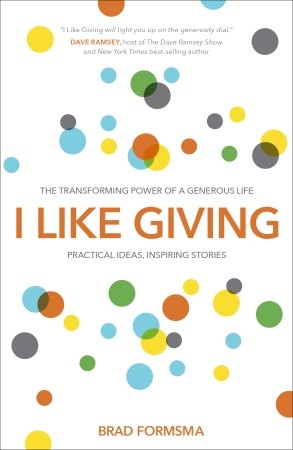
When you read a title like I Like Giving you might immediately think, “This is a book telling me to tithe, or give bigger offerings to my church, or support my local charity.” And you would be dead wrong. Brad Formsma’s book isn’t really about giving money away, it’s about giving yourself away.
Brad writes, “When we choose to give, we change, and the people around us change. When we move from awareness to action, miracles happen. When we allow giving to be our idea, a world of possibilities opens up before us, and we discover new levels of joy.”
Indeed, Brad weaves together his own personal stories, with stories from other givers, and even a healthy dose of medical and psychological research data to show us just how life-transforming and joy-producing it is when we are giving people. Not only are the gift receivers benefitted, but so are the gift givers.
Let me state it again: this book isn’t about giving your money to a charitable organization or a church; it’s about you seeing a need and finding a way to take care of that need. If everyone took on this mindset, just imagine how our communities would change!
One final thought from author Brad Formsma—“I don’t think we can ever overestimate just how profound the effects of giving can be. You can give without loving, but you can’t love without giving. The reality is that other people are watching how we live our lives, and what we do can have extraordinary effects in our communities. Generosity is for all of us. It is available to all of us, even when the cultural tide is moving in the opposite direction. Why not be brave and live differently?” (emphasis added)
Let I Like Giving be a springboard for you to live differently and to make a difference where you live!
I am a Waterbrook book reviewer.
I love Bible character studies that read like a biography, and in The Solomon Seduction by Mark Atteberry, that’s exactly what I got. Not only that, but this book is an excellent discussion book for men and a pretty good leadership lesson as well.
Pastor Atteberry uses the life and writings of King Solomon to show us that even someone called the wisest man can be reduced to a fool. Solomon was given a gift of wisdom unequaled in any other man, but his gift was misused and mismanaged by Solomon, and led to his downfall.
This is a timely book for men today. Atteberry wrote early on in the book—
“Simply put, Solomon was better equipped to see through satan’s deceptions than any man who has ever lived, other than Jesus. But in the end, he became just as blind to them as everyone else. This, of course, is quite a tribute to satan’s cleverness. If he were an author, his blockbuster best seller would be How I Made A Fool Out Of The Wisest Man Who Ever Lived (And Why The Program Still Works). And it does still work.”
It’s true: satan’s seductions still work today, and Atteberry gives us ten seductions that worked on wise King Solomon, and will work on men today if we don’t pay attention to them.
I hope men not only read The Solomon Seduction, but that they use it as a springboard for discussion with other men too. This is a needed book for our time.
I am a Thomas Nelson book reviewer.
Some good reading from today…
“There is not a single instance in history in which civil liberty was lost, and religious liberty preserved entire.” —John Witherspoon
Religious persecution alert: ISIS is eliminating Christians in Iraq.
“It is a serious fault if a believer is in want, and thou knowest it, or if thou knowest that he is without means, that he is hungry, that he suffer distress, especially if he is ashamed of his need…. If he is in prison, and—upright though he is—has to suffer pain and punishment for some debt (for though we ought to show mercy to all, yet we ought to show it especially to an upright man); if in the time of his trouble he obtains nothing from thee; if in time of danger, when he is carried off to die, thy money seems more to thee than the life of a dying man; what a sin is that to thee!” —Ambrose
[VIDEO] Detroit Tigers radio announcer Ernie Harwell broadcasting his last game.
Interesting: Why The First Hospital To Do Sex-Reassignment Surgeries No Longer Do Them.
“When the Middle East is fragmented in this horrible war, this savage, savage war between militant Shiites and militant Sunnis … the only place where you have freedom, tolerance, protection of minorities, protection of gays, protection of Christians and all other faiths is Israel,” said Benjamin Netanyahu, Israeli Prime Minister. Read more about the wrong-headed decision of the Presbyterian (USA) Church to divest in Israel.
More young adults are having kids outside of marriage, and that is creating a dangerous environment for the kids.
“Kind words are the music of the world. They have a power which seems to be beyond natural causes, as if they were some angel’s song which had lost its way and come on earth. It seems as if they could almost do what in reality God alone can do—soften the hard and angry hearts of men. No one was ever corrected by a sarcasm—crushed, perhaps, if the sarcasm was clever enough, but drawn nearer to God, never.” —Frederick William Faber