It’s amazingly sad to realize the devaluation the crowd puts on people who are different from them 😔
In Luke 18, the crowd devalued the blind man because he was poor and blind.
In Luke 19, the crowd devalued Zaccheus because he was rich and a tax collector for the Romans.
Both men—in the crowd’s jaded eyes—weren’t worth much to anyone.
But Jesus sees people so differently!
He was moved by compassion to heal the son of Timaeus of his blindness. He was moved by compassion to redirect the hostility of the crowd away from Zacchaeus and put it on Himself.
Jesus invited Himself to lunch at Zacchaeus’ house, and “when they saw it, they all began to grumble.”
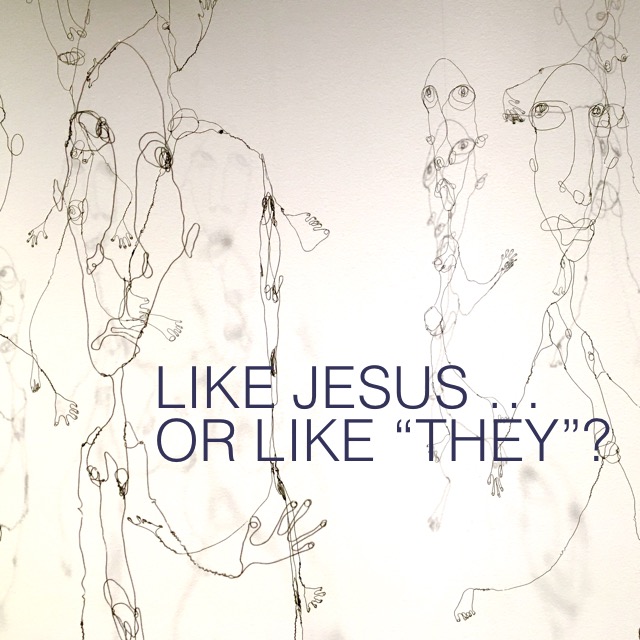
What will my response to be to the sick, the beggars, the rich, and the schemers when they want to come to Jesus? Will I (like Jesus) be moved by compassion to bring them close to Him? Or will l (like “they”) grumble about their unworthiness?
Six days before His crucifixion and burial, Jesus was prepared for His burial by the most unlikely of people. This story takes place in Bethany, where Jesus spends a lot of time during His earthly ministry.
As was customary, the most influential men in the village would try to entice visiting guests to join them for dinner. Simon—a Pharisee and a former leper—was the one who extended the invitation to Jesus. Simon is a former leper because one who still had active leprosy wouldn’t have been allowed in his own home, let alone allowed to host guests. I think (as you will see in a moment) that Simon had been healed of his leprosy by Jesus.
Although it was customary for someone like Simon to host visiting guests, in this case, the religious leaders were scheming to arrest Jesus. In other words, there was an ulterior motive for Simon to have Jesus in his home.
Which is probably why Simon neglected his host’s duties: No welcoming kiss, no foot-washing, no anointing. All normal hospitality is ignored. Jesus appears to ignore the snub and simply recline at the table. But another guest takes Simon’s incredible rudeness personally.
Mary was standing or sitting along the wall in Simon’s house, as many common villagers would in that day. Luke tells us that Mary hadlived a sinful life. But while sitting at Jesus’ feet earlier she heard the good news that Jesus could forgive sins, she placed her faith in Him, and her lifestyle changed 180-degrees
Mary is overcome by emotion at the inhospitable—rude!—way Jesus is being treated and tears began to well up in her eyes. Since Jesus is reclining at the table, His feet would have been pointed in her direction, and she began to use her tears to wash His feet. Then—horror of horrors—she uncovers and lets down her hair in public(!) and begins to dry His feet.
Simon the Pharisee judges Mary by her past. Simon twice says, “Does Jesus even know what kind of woman she is? Does He know she is a sinner?” Mary is in big trouble: she is publicly pointing out the rudeness of the host, she is touching a man that is not her husband, and she has uncovered and let down her hair in public.
Jesus responds not to Mary, but to Simon: “Simon, I have something to tell you,” He says and then shares a short but powerful parable of a creditor who had two debtors. One owed him the equivalent of a year-and-a-half’s wages, and the other owed about two months’ wages. Since neither could pay, the creditor forgave both of them.
Jesus asked Simon, “Which of the two forgiven debtors do you think would be most grateful?” Simon correctly responds, “The one who was forgiven more.”
Jesus points out that Mary’s acts didn’t bring her forgiveness, but that her acts were a loving response to the forgiveness she had already received. Jesus said things like, “You have been forgiven,” and “Your sins are forgiven,” and “Your faith has saved you.”
Jesus took the anger that was focused on Mary and redirected it to Himself, as Isaiah prophesied the Messiah would do (see 53:4-5).
At the same time He is also challenging Simon, “Don’t you have something to be grateful for? Weren’t you once a physical leper? Mary was a spiritual leper, but she has been forgiven and is now overwhelmingly grateful. What about you?”
Mary was forgiven. She gave all she had in worship. Her anointing oil was lavishly poured out. It was worth a year’s wages, but she spent it all on Jesus. She anointed Him for His burial. The aroma of the oil remained on Jesus throughout His Passion Week and through His crucifixion. The aroma remained on Mary’s hands and hair. The aroma remained in Simon’s house. The memory was fixed in the memories of everyone in that room.
What about Simon? Did he ever acknowledge his gratitude? Or was he more concerned with receiving praise from men?
Have you received the forgiveness Jesus offers you? Can people tell you’ve been forgiven by your willingness to stand up for Him? Can people tell you’ve been forgiven by your willingness to give up everything for Him?
I hope you can join me this Sunday as we continue our slow, deliberate walk alongside Jesus on His passionate journey to the Cross and the resurrection.
Erwin McManus leads us through the codes that define a true God-honoring warrior. It’s a fascinating journey of discovery! Check out my full book review by clicking here.
“There will never be peace on earth until there is peace in us.”
“We have no control over the reality that in this world we will have trouble, but we have control over whether we decide to allow our hearts to be troubled.”
“Every battle is first fought within. Jesus was never powerless. He was the epitome of controlled strength. While He was always meek, He was never weak. He knew His power but He never abused it. The warrior knows that peace does not come from control but from relinquishing control. Everything in life that you try to control that is outside your control will steal from you your peace. You must choose to take hold of what you can control and let go of what you cannot. You cannot control your circumstances, but you can control your character. You cannot control the actions of others, but you can control the choices you make. You cannot control the outcome, but you can control the process.”
“The warrior does not wield a weapon; they are a weapon. Their strength does not come from the weapons they hold but from the wisdom that has taken hold of them.”
“Wisdom is the warrior’s greatest weapon. When you have wisdom, you are never unarmed, you are never defenseless, and you are never powerless. You need skill to know how to shoot an arrow straight, but only wisdom can teach you how to never need to shoot it.”
“While the warrior is informed by the past, they are not formed by it. The warrior is not formed by what has been done and what can’t be done; the heart of the warrior is formed by what must be done.”
“The warrior is always first a servant. … The warrior does not serve because they cannot lead; they know that a person cannot lead if they do not serve.”
“We are to do nothing out of selfish ambition or vain conceit, but without ambition we will find ourselves doing nothing and calling it humility.”
“Whatever God has placed within you that could ever be described as great was never meant for you, anyway. It’s a stewardship that has been given to you. Greatness never belongs to the one who carries it; it belongs to the world that needs it.”
More quotes from The Way Of The Warrior are coming soon!
This is a weekly series with things I’m reading and pondering from Oswald Chambers. You can read the original seed thought here, or type “Thursdays With Oswald” in the search box to read more entries.
Christ’s Idea Of Social Reform
Humility and holiness always go together. Whenever hardness and harshness begin to creep into the personal attitude towards another, we may be certain we are swerving from the light. The preaching must be as stern and true as God’s Word, never water down God’s truth; but when you deal with others never forget that you are a sinner saved by grace, wherever you stand now. If you stand in the fullness of the blessing of God, you stand there by no other right than the sheer sovereign grace of God. …
Today the great craze is socialism, and men are saying that Jesus Christ came as a social reformer. Nonsense! We are the social reformers; Jesus Christ came to alter us, and we try to shirk our responsibility by putting our work on Him. Jesus alters us and puts us right; then these principles of His instantly make us social reformers. They begin to work straightway where we live, in our relationship to our fathers and mothers, to our brothers and sisters, our friends, our employers, or employees. “Consider how God has dealt with you,” says Jesus, “and then consider that you do likewise to others” [Matthew 7:12].
From Studies In The Sermon On The Mount
Jesus taught us to pray, “Your kingdom come, Your will be done on earth as it is in Heaven.” Our lives are meant to be living answers to this prayer.
We must be so immersed in God’s grace and love that we have a burning passion for everyone else to know this grace and love for themselves. I want to do for others what God has done for me. So as Jesus has changed my heart and my paradigm, I now become a “social reformer” in the places God has placed me—in my family, at my workplace, in my community.
Jesus isn’t going to change society. The Holy Spirit changes us, and then we can lead God-honoring social reforms right where we are.
“Consider how God has dealt with you, and then consider that you do likewise to others.”
In some of our favorite action movies, when the crucial moment for our hero has finally arrived, filmmakers will often switch into slow motion filming. They want you to feel the tension. They want you to see the emotion etched on the face of our hero. They want to make sure you don’t miss a single detail of this pivotal moment in the story.
The same thing happens in the life of Jesus.
The four Gospels record 3+ years of the life of Jesus on earth. But when Jesus is approaching the Cross—the crucial moment of His ministry—all the Gospel writers go into slow motion.
For example, Mark doesn’t mention anything about the birth of Jesus and only gives us one verse to tell about satan’s temptation of Jesus in the wilderness. But he uses nearly 40% of his writing to describe the last week of Christ’s life. The numbers are similar for Matthew and Luke, with John devoting almost one-half of his account to Christ’s Passion Week.
Clearly, there is something happening here that the Gospel writers want to ensure that we don’t miss a single detail!
Jesus knew all that was about to happen to Him. When Peter swung his sword at the soldiers that came to arrest Him, Jesus said, “Do you think I cannot call on My Father, and He will at once put at My disposal more than twelve legions of angels? But how then would the Scriptures be fulfilled that say it must happen in this way” (Matthew 26:53-54).
Every step that Jesus took toward the Cross was a step of love. Every word He spoke in His final moments before His death was calculated to sink deep into the memories of all who observed this story.
We are going to go into “slow motion” as well as we look closely at each day of Christ’s final week of ministry. From His dinner in Bethany to His resurrection, we’ll slow down and ponder deeply the love message Jesus is still conveying to us.
Listen to the podcast of this post by clicking on the player below, and you can also subscribe on Apple, Spotify, or Audible.
It’s inescapably true: We let fears limit us when we listen to them.
John Piper wrote, “I call you today to stop defining and limiting your future in terms of your past and start defining it in terms of your God.”
When we have a spirit of fear instead of the confidence that comes from a right relationship with God through Jesus, the smallest of things sends us ducking for cover! “As for those of you who may be left, I will also bring weakness into their hearts in the lands of their enemies. And the sound of a driven leaf will chase them, and even when no one is pursuing they will flee as though from the sword, and they will fall.” (Leviticus 26:36 NASB)
God says, “Fear not—there is nothing to fear—for I am with you; do not look around you in terror and be dismayed, for I am your God. I will strengthen and harden you to difficulties, yes, I will help you; yes, I will hold you up and retain you with My victorious right hand of rightness and justice.” (Isaiah 41:10 AMPC)
“When God calls you to be free from fear (to overcome this natural emotion and have peace), He does not leave the command hanging in the air. He puts pillars under it. Five of them in Isaiah 41:10. That’s the nature of all biblical commands. They come with divine support.
Fear not . . . God is with you.
Fear not . . . God is your God.
Fear not . . . God will strengthen you.
Fear not . . . God will help you.
Fear not . . . God will uphold you.” —John Piper
When we grasp that God is with us, that God is helping us, that God is bigger than the things we wrongly fear, there is nothing we cannot do!
As Jonathan said to his young armor-bearer, “Come, and let us go over to the garrison of these uncircumcised; it may be that the Lord will work for us. For there is nothing to prevent the Lord from saving by many or by few.” (1 Samuel 14:6 AMPC)
O Sovereign Lord! You made the heavens and earth by Your strong hand and powerful arm. Nothing is too hard for You! (Jeremiah 32:17 NLT)
“Because you’re not yet taking God seriously,” said Jesus. “The simple truth is that if you had a mere kernel of faith, a poppy seed, say, you would tell this mountain, ‘Move!’ and it would move. There is nothing you wouldn’t be able to tackle.” (Matthew 17:20 MSG)
When I was a kid, I couldn’t wait for “Martial Arts Theater” on Saturday afternoons! My friends and I would gather at my house with our snacks and watch a movie with outstanding martial arts action, and then run outside to try to practice what we had just watched. In these movies, I was always intrigued by the reluctant hero—the guy who had enough skill to snap your neck with his little finger, but who didn’t want to fight. When the bad guys finally crossed the line, our hero would instantly spring into action to restore peace. These are the memories that came flooding back into my mind as I read Erwin McManus’ latest book The Way Of The Warrior.
The warrior is a peaceful man living in a hostile world. He is prepared to fight, but will only fight when it is the only option to restore peace in his community. The warrior is nobody’s fool, but neither does he flaunt his knowledge before fools. The warrior doesn’t seek honor for himself, but fights to secure a better future for those he loves.
In short, the warrior is vividly portrayed on the pages of Scripture as the kind of man God delights to bless. McManus interweaves all of these concepts masterfully in his book. As I read, I found my mind flipping between images of my childhood martial arts movies, and heroes in the Bible, and the opportunities I have right now to be a warrior for peace.
Like the ancient samurai, McManus instructs us in the eight codes of the God-honoring warrior. This type of warrior fights only for peace, seeks to become invisible, finds honor in serving others, gains mastery over his own thoughts, owns defeat, harnesses and channels his strengths, becomes one with all that’s around him, and stands unmoving in his pain.
As is the case with all of McManus’ books that I have read, I find myself invigorated mentally, emotionally, and spiritually. After reading The Way Of The Warrior, I have a clearer picture of the type of warrior God has called His men to be.
Guys, this is an excellent book for you to read on your own, but I would highly recommend that you read with other warriors. The concepts in this book will spark some much-needed conversation about how godly men should live in today’s culture.
The patellar reflex is a helpful diagnostic tool for a doctor to check the health of your central nervous system. It’s commonly called the knee-jerk response. But beyond the medical world, it’s also come to mean “an immediate unthinking emotional reaction to certain stimuli.” This has implications for the health of our prayer life too.
When Jesus talked about praying He never said, “If you pray,” but always “When you pray.” He assumed it would be a vital part of a Christian’s life. He also used a verb tense which would add an “ing” to the verb, so He was really saying, “When you are maintaining an ongoing dialogue with your Father.”
So when something unexpected happens to us, Jesus wants us to say, “Why, my Father already knows about this!” This is the knee-jerk reaction Jesus wants to see.
We see this on full display when Peter and John are told by the Jewish religious authorities not to talk about Jesus publicly anymore. When these men reported this threat to the rest of the church, notice their knee-jerk response: “When they heard this, they raised their voices together in prayer to God.”
There are two interesting things I notice in their prayer. The first thing is how they used the Lord’s Prayer (Matthew 6:9-13) as the template of their prayer.
Our Father in Heaven—Sovereign Lord.
Hallowed be Your name—You made the heaven and the earth and the sea, and everything in them.
Your kingdom come, Your will be done on earth as it is in heaven—Your power and will decided beforehand what would happen.
Forgive us our debts, as we also have forgiven our debtors—“Consider their threats”was like saying, “Forgive us for inappropriate thoughts and forgive them for speaking ignorantly against Your name.”
Give us today our daily bread—Enable Your servants to speak Your word with great boldness today.
Lead us not into temptation, but deliver us from the evil one. For Yours is the kingdom, and the power and the glory forever—Stretch out Your hand to heal and perform miraculous signs and wonders.May Your name be glorified!
The second thing I see in their prayer is that they stood on a biblical promise. They quoted the words of David from Psalm 2—words that had been penned nearly 1000 years earlier—and applied them to their present situation.
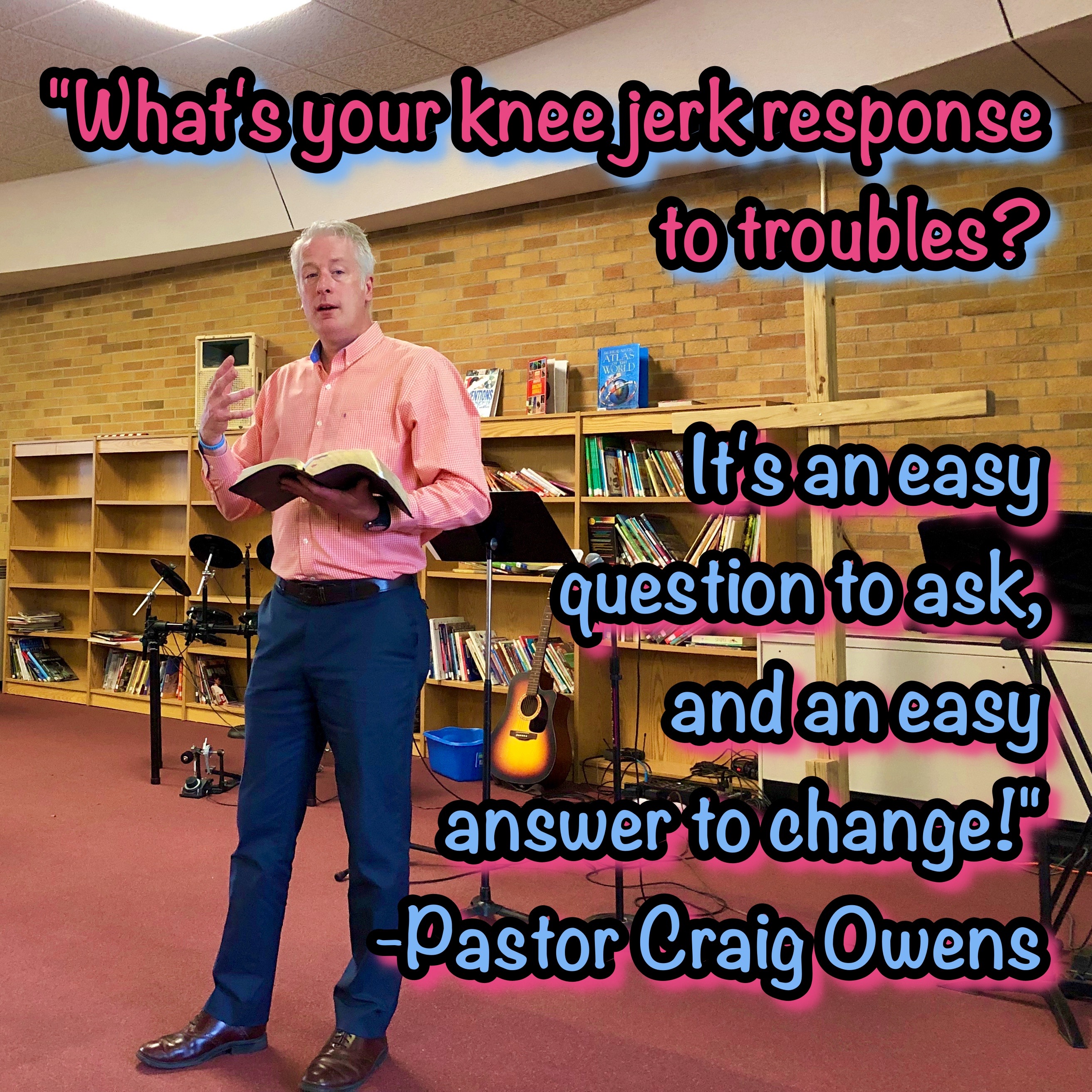
What’s your knee jerk response to troubles? It’s an easy question to ask, and an easy answer to change.
When something comes at you from out of the blue, learn to say, “Why, my Father already knows about this!” Then find a biblical promise you can claim and turn that promise into a prayer modeled on Christ’s prayer. Pray that again and again until God provides the answer.
Let’s make prayer our first response and not our last resort!
“Often it is simply the answers to our prayers that cause many of the difficulties in the Christian life.
“We pray for patience, and our Father sends demanding people our way who test us to the limit, ‘because…suffering produces perseverance’ (Romans 5:3). …
“We pray to be unselfish, and God gives us opportunities to sacrifice by placing other people’s needs first and by laying down our lives for other believers. …
“We pray to the Lord, as His apostles did, saying, ‘Increase our faith!’ (Luke 17:5). Then our money seems to take wings and fly away; our children become critically ill; an employee becomes careless, slow, and wasteful; or some other new trial comes upon us, requiring more faith than we have ever before experienced.
“We pray for a Christlike life that exhibits the humility of a lamb. Then we are asked to perform some lowly task, or we are unjustly accused and given no opportunity to explain….
“We pray for gentleness and quickly face a storm of temptation to be harsh and irritable.
“We pray for quietness, and suddenly every nerve is tested to its limit with tremendous tension so that we may learn that when He sends His peace, no one can disturb it.
“We pray for love for others, and God sends unique suffering by sending people our way who are difficult to love and who say things that get on our nerves and tear at our heart. …
“The way to peace and victory is to accept every circumstance and every trial as being straight from the hand of our loving Father.” —Lettie Cowman, in Streams in the Desert (emphasis added)



 It’s amazingly sad to realize the devaluation the crowd puts on people who are different from them 😔








 Craig T. Owens