5 Quotes On Law & Grace From “Transforming Grace”

Transforming GraceJerry Bridges wrote a book that was an eye-opener for me called Transforming Grace. I’ve shared a couple of other posts with quotes from this book (you can read them by clicking here and here), but these quotes zero-in on the battle some people have in their minds between law and grace.

“Under a sense of legalism, obedience is done with a view to meriting salvation or God’s blessing on our lives. Under grace, obedience is a loving response to salvation already provided in Christ, and the assurance that, having provided salvation, God will also through Christ provide all else that we need.”
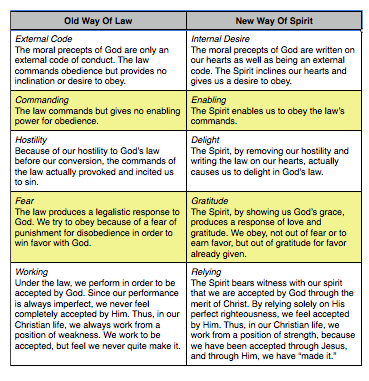
(click for a larger view)

(click for a larger view)

You can download a PDF version of this chart here → Law and Grace  ←

“Do you view God’s moral precepts as a source of bondage and condemnation for failure to obey them, or do you sense the Spirit producing within you an inclination and desire to obey out of gratitude and love? Do you try to obey by your own sheer will and determination, or do you rely on the Spirit daily for His power to enable you to obey? Do you view God as an ogre who has set before you an impossible code of conduct you cannot keep, or do you view Him as your divine Heavenly Father who has accepted you and loves you on the basis of the merit of Christ? In other words, in terms of your acceptance with God, are you willing to rely solely on the finished perfect work of Jesus, instead of your own pitifully imperfect performance?”

“We are much more concerned about someone abusing his freedom than we are about his guarding it. We are more afraid of indulging the sinful nature than we are of falling into legalism. Yet legalism does indulge the sinful nature because it fosters self-righteousness and religious pride. It also diverts us from the real issues of Christian life by focusing on external and sometimes trivial rules.” 

“That is the way a lot of manmade ‘dos and don’ts’ originate. They begin as a sincere effort to deal with real sin issues. But very often we begin to focus on the fence we’ve built instead of the sin it was designed to guard against. We fight our battles in the wrong places; we deal with externals instead of the heart. … For all of us, it may be good to have some fences, but we have to work at keeping them as just that—fences, helpful to us but not necessarily applicable to others. … I’m not suggesting you jump over fences just to thumb your nose at the people who hold on to them so dearly. We are to ‘make every effort to do what leads to peace and mutual edification’ (Romans 14:19). Use discretion in embracing or rejecting a particular fence. But don’t let others coerce you with manmade rules. And ask God to help you see if you are subtly coercing or judging others with your own fences.”

“Spiritual disciplines are provided for our good, not for our bondage. They are privileges to be used, not duties to be performed. … I do think we should actively promote spiritual disciplines. They are absolutely necessary for growth in our Christian lives. And since ours is a largely undisciplined age, many believers are losing out on the benefits of those disciplines that could help them grow to maturity in Christ. But we should promote them as benefits, not as duties.” 

You can read my full book review of Transforming Grace by clicking here.

Links & Quotes

link quote

Some good reading from today…

Here is something scientists have completely overlooked before: microbes on the ocean floor that eat the “greenhouse gas” methane.

I like this from Thom Rainer: 7 reasons why church leaders should practice fasting.

Tim Elmore always finds great ways to encourage teachers and parents in working with young people: 8 lessons about leading kids from Derek Jeter’s dad.

Chuck Colson has a fascinating commentary: Judaism’s Sexual Revolution.

Lincoln’s Battle With God (book review)

Lincoln's Battle With GodI’m a big fan of the historical and biographical work of Stephen Mansfield. His books are thoroughly researched but they don’t read like scholarly works, but have a more storytelling feel to them. This is especially true in his book Lincoln’s Battle With God.

I have read several biographies about our 16th president, Abraham Lincoln, but this is one of the most innovative angles of this great leader’s life. Mansfield tells the story of Lincoln as a boy growing up in an overly-strict, hyper-Calvinistic home where religious observance was demanded and oppressive. Lincoln’s father was distant and didn’t have satisfactory answers for his young son when life was painful.

This contributed to Lincoln as a young man who, while searching for answers, went the opposite direction of his father’s faith, and became immersed in rationalism and even agnosticism. Through it all as Lincoln searched for answers, he and his friends had to cope with Lincoln’s “hypo” (his word for deep, almost debilitating, depression).

When rationalism didn’t help him discover the answers he so desperately desired, Lincoln came full circle to begin to explore the tenants of Scripture once again. But this time he looked at the Bible through a different paradigm, being much more thoughtful and circumspect.

His journey to the White House where he had to deal with a nation torn apart by Civil War and the premature death of his young sons exposed him once again to events which would have caused the younger Lincoln to spiral into depression. But his faith in God now had grown rock solid and sustaining.

This book is a fascinating journey through Lincoln’s spiritual struggles, and it’s one that I think many will benefit from reading. Those who are admirers of Abraham Lincoln, those battling depression, and even those searching for life’s answers will find a lot to learn in these pages.

Putting Your Money Where Your Hair Is

SavannahEveryone is probably familiar with the phrase, “Putting your money where your mouth is.” Quite simply we mean, “I believe what I’m saying strongly enough that I would back it up with my money.”

A young lady at Calvary Assembly of God, Savannah Tolar, is taking this one step further. She’s not only putting her money on the line to back up what she says, but she’s putting her hair on the line too!

Savannah, like many people, has been impacted by cancer in her immediate family. As a mother of a beautiful baby boy, she has also been troubled by the lack of funding for childhood cancer research. Savannah wants this lack of funding changed so that a cure for this dreaded disease can be found as soon as possible.

In fact, she believes this so strongly that she is willing to put her beautiful hair on the line. As you probably know, many children undergoing intensive cancer treatments end up losing their hair as a side effect of their chemotherapy or radiation treatments. Savannah is standing in solidarity with those brave kids by allowing her head to be shaved.

Although Savannah has set a goal to raise $3000 for childhood cancer research, I believe we can help her go way beyond this. Please click here to go to Savannah’s page, read her story, and then make a generous donation. On November 26, Savannah will be shaving her head as she stands with those kids who are fighting back against cancer.

Let’s all get behind this!

Way to go, Savannah … I am so proud of you!

UPDATE: To see how Savannah did in her fundraising please click here.

Links & Quotes

link quote

Some good reading & watching from today…

“What can we say then when Christian men vie with one another for place and position? What can we answer when we see them hungrily seeking for praise and honor? How can we excuse that passion for publicity which is so glaringly evident among Christian leaders? What about political ambition in Church circles? What about the fevered palm that is stretched out for more and bigger ‘love offerings’? What about the shameless egotism among Christians? How can we explain the gross man-worship that habitually blows up one and another popular leader to the size of a colossus? What about the obsequious hand kissing of moneyed men by those purporting to be sound preachers of the gospel? There is only one answer to these questions; it is simply that in these manifestations we see the world and nothing but the world. No passionate profession of love for ‘souls’ can change evil into good. These are the very sins that crucified Jesus.” —A.W. Tozer

“There is more true eloquence in ‘God be merciful to me a sinner,’ than in all the books of devotion which bishops, and archbishops, and divines ever compiled.” —Charles Spurgeon

[VIDEO] John Maxwell on the power of conviction.

“Many things—such as loving, going to sleep, or behaving unaffectedly—are done worst when we try hardest to do them.” —C.S. Lewis

Thanks to Obamacare, health care costs are skyrocketing.

Make A Holy Rest

Sabbath = do somethingWe are an on-the-go-all-the-time society. It seems to be a status symbol to be always “on.” If not a status symbol, maybe there’s a fear of what we might miss, “If I don’t keep up on the latest TV shows [sports team, books, music, Dancing With The Stars], I’ll feel out of place when my friends are talking about it.”

Even when we do slow down, often what we call a “rest” really isn’t. (Have you ever needed a vacation to recover from your vacation?)

This all-go, never-stop lifestyle is not only unsustainable and unhealthy, it’s also displeasing to God. In His love for us, God says we need to take a Sabbath rest (see Exodus 20:8 and Deuteronomy 5:12). The problem is: we think “Sabbath” means doing nothing, and we feel guilty for doing nothing when there is still so much to do.

Here’s the good news: Sabbath ≠ doing nothing.

Take a look at the origin of the Sabbath—And on the seventh day God ended His work which He had made; and He rested on the seventh day from all His work which He had made. (Genesis 2:2 KJV)

That’s an unusual phrase—His work which He had made—which is repeated twice, so let’s dig into two specific words: work and made.

The verb tense for work is imperfect, which means God still had work to do. But the verb tense for made is perfect. So instead of trying to find more time in His week, God made His “To Do” list fit the timeframe. Then far from doing nothing on the Sabbath day, God reviewed His work, appreciated the beauty of Creation, and celebrated all that had been made.

This is what He calls us to do as well. Genesis 2:3, Exodus 20:8 and Deuteronomy 5:12 all tell us the Sabbath is to be holy = special, withdrawn from the usual … unique. God doesn’t want us to do nothing on the Sabbath, but to do what we don’t normally have the time to do the rest of the week.

Our modern cliché says, “You never appreciate what you have until it’s gone.” But the Sabbath says, “Stop, appreciate God’s blessings, and celebrate them while you can still enjoy them.”

God doesn’t ask you to take a rest. Instead He asks you to make your “To Do” list fit into six days, so that there can be a unique day of appreciation and celebration.

So … how are you doing on making a Sabbath?

If you have missed any of the messages in our series The Love In The Law, you can find them all by clicking here.

Poetry Saturday—I Met God In The Morning

photo 1I met God in the morning
When my day was at its best,
And His Presence came like sunrise
Like a glory in my breast.

All day long the Presence lingered,
All day long He stayed with me,
And we sailed in perfect calmness
O’er a very troubled sea.

Other ships were blown and battered,
Other ships were sore distressed,
But the winds that seemed to drive them
Brought to us a peace and rest.

Then I thought of other mornings,
With a keen remorse of mind,
When I, too, had loosed the moorings
With the Presence left behind.

So I think I know the secret,
Learned from many a troubled way;
You must seek Him in the morning
If you want Him through the day. —Ralph Cushman


12 Additional Quotes From “Transforming Grace”

Transforming GraceI already shared a few quotes from Transforming Grace by Jerry Bridges (you can read them by clicking here). Bridges also extensively quoted other authors in this amazing book, so I wanted to share a few of those quotes as well.

“Grace ceases to be grace if God is compelled to bestow it in the presence of human merit…. Grace ceases to be grace if God is compelled to withdraw it in the presence of human demerit…. Grace is treating a person without the slightest reference to desert whatsoever, but solely according to the infinite goodness and supper and purpose of God.” —Dr. C. Samuel Storms

“The most shining deeds and valuable qualities that can be found among men, though highly useful and truly excellent, when set in their proper places, and referred to suitable ends, are, as to the grand article of justification treated as nonentities…. For divine grace disdains to be assisted in the performance of that work which peculiarly belongs to itself, by the poor, imperfect performances of men. Attempts to complete what grace begins, betray our pride and offend the Lord; but cannot promote our spiritual interest. Let the reader, therefore, carefully remember, that grace is either absolutely free, or it is not at all: and, that he who professes to look for salvation by grace, either believes in his heart to be saved entirely by it, or he acts inconsistently in affairs of the greatest importance.” —Abraham Booth

“Perhaps the most difficult task for us to perform is to rely on God’s grace and God’s grace alone for our celebration. It is difficult for our pride to rest on grace. Grace is for other people—for beggars. We don’t want to live by a heavenly welfare system. We want to earn our own way and atone for our own sins. We like to think that we will go to heaven because we deserve to be there.” —R.C. Sproul 

“A lawdriver insists with threats and penalties; a preacher of grace lures and incites with divine goodness and compassion shown to us; for he wants no unwilling works and reluctant services, he wants joyful and delightful services of God.” —Martin Luther, commenting on Romans 12:1

“The great mistake made by most of the Lord’s people is in hoping to discover in themselves that which is to be found in Christ alone.” —Arthur W. Pink

“In the person of Christ God beholds a holiness which abides His closest scrutiny, yea, which rejoices and satisfies His heart; and whatever Christ is before God, He is for His people.” —Arthur W. Pink

“Only what God has commanded in His Word should be regarded as binding; in all else there may be liberty of actions.” —John Owen

“Let us never surrender our judgments or our consciences to be at the disposal and opinions of others, and to be subjected to the sentences and determinations of men. … It is my exhortation therefore to all Christians to maintain their Christian freedom by constant watchfulness. You must not be tempted or threatened out of it; you must not be bribed or frightened from it; you must not let either force or fraud rob you of it. … We must not give up ourselves to the opinion of other men, though they be never so learned, never so holy, merely because it is their opinion. The apostle directs us to try all things and to hold fast that which is good (1 Thessalonians 5:21). It often happens that a high esteem of others in respect of their learning and piety makes men take up all upon trust from such, and to submit their judgments to their opinions, and their consciences to their precepts. This should not be so.” —Samuel Bolton (1645)

“So God supplies perfectly measured grace to meet the needs of the godly. For daily needs there is daily grace; for sudden needs, sudden grace; for overwhelming needs, overwhelming grace. God’s grace is given wonderfully, but not wastefully; freely, but not foolishly; bountifully, but not blindly.” —John Blanchard

“For men have no taste for God’s power till they are convinced of their need of it and they immediately forget its value unless they are continually reminded by awareness of their own weakness.” —John Calvin

“Yet the duties God requires of us are not in proportion to the strength we possess in ourselves. Rather, they are proportional to the resources available to us in Christ. We do not have the ability in ourselves to accomplish the least of God’s tasks. This is a law of grace. When we recognize it is impossible for us to perform a duty in our own strength, we will discover the secret of its accomplishment. But alas, this is a secret we often fail to discover.” —John Owen

“Christian humility does not consist in denying what there is of good in us; but in an abiding sense of ill-desert, and in the consciousness that what we have of good is due to the grace of God.” —Charles Hodge

You can read my full review of Transforming Grace by clicking here.

Links & Quotes

link quote

Some very good reading from today…

The Heritage Foundation has an amazing interactive site to guide you through the United States Constitution.

“No man is worthy to succeed until he is willing to fail. No man is morally worthy of success in religious activities until he is willing that the honor of succeeding should go to another if God so wills.” —A.W. Tozer

Prayer is not a privilege for the pious, nor the art of a chosen few. Prayer is simply a heartfelt conversation between God and His child. When we invite God into our world, He brings a host of gifts: joy, patience, resilience.” —Max Lucado

An infographic and some really interesting (and funny) statistics on how and why Americans pray.

John Piper reminds us of 5 ways our joy in God depends on the Bible.

Tim Elmore shared a great photo for parents:

Parenting success

13 Quotes From Jerry Bridges In “Transforming Grace”

Transforming GraceI think Transforming Grace by Jerry Bridges is one of the best books about God’s grace I have ever read! You can read my full book review by clicking here. There are way too many quotes for me to share from this book, so here are a few that really zero-in on grace (I’ll be posting more quotes soon).

“I think most of us actually declared temporary bankruptcy. Having trusted in Christ alone for our salvation, we have subtly and unconsciously reverted to a works relationship with God in our Christian lives. We recognize that even our best efforts cannot get us into heaven, but we do think they earn God’s blessings in our daily lives.” 

“It was because of His grace that God the Father sent His only Son to die in our place. To say it another way, Christ’s death was the result of God’s grace; grace is not the result of Christ’s death.”

“The gospel is addressed to those who have no money or good works. It invites us to come and ‘buy’ salvation without money and without cost [Isaiah 55:1]. But note the invitation to come is addressed to those who have no money—not to those who don’t have enough. Grace is not a matter of God’s making up the difference, but of God’s providing all the ‘cost’ of salvation through His Son, Jesus Christ.” 

“We can never rightly understand God’s grace until we understand our place as those who need His grace.”

“We were dead in our transgressions, but God intervened. We were in bondage to sin, but God intervened. We were objects of wrath, but God intervened. God Who is rich in mercy intervened. Because of His great love for us, God intervened and made us alive with Christ, even when we were dead in our transgressions and sins. All this is summed up in one succinct statement: ‘it is by grace you have been saved.’ Our condition was hopeless, but God intervened in grace.” 

“God’s grace, then, does not supplement our good works. Instead, His grace overcomes our bad works, which are our sins. God did this by placing our sins on Christ and by letting fall on Him the wrath we so richly deserved. … That’s the way His grace operates. It looks not to our sins or even to our good deeds but only to the merit of Christ.”

“The apostle John wrote that Jesus was ‘full of grace and truth,’ and ‘from the fullness of His grace we have all received one blessing after another’ (John 1:14, 16). The idea portrayed in verse 16 is analogous to the ocean waves crashing upon the beach. One wave has hardly disappeared before another arrives. They just keep coming from an inexhaustible supply. So it is with the grace of God through Christ. He is full of grace and truth, and it is from His inexhaustible fullness that we received one blessing after another.” 

“God often does bless people who seem to us to be quite unworthy. But that is what grace is all about, because we are all unworthy.”

“We all want grace, but we cannot enjoy grace when there is an attitude of comparing.” 

“Under a sense of legalism, obedience is done with a view to meriting salvation or God’s blessing on our lives. Under grace, obedience is a loving response to salvation already provided in Christ, and the assurance that, having provided salvation, God will also through Christ provide all else that we need.”

“All Christians look to Christ alone for their justification, but not nearly as many also look to Him for their perfect holiness before God. … Holiness should be an objective for your daily life. But to live by grace, you must never, never look to the work of the Holy Spirit in you as the basis for your relationship with God. You must always look outside of yourself to Christ. You will never be holy enough through your own efforts to come before God. You are holy only through Christ.” 

“When our Father looks at us, He does not see our miserable performance. Instead, He sees the perfect performance of Jesus.”

“We died to the observance of the law as a requirement for attaining righteousness before God. We died to the curse and condemnation that resulted from our inability to perfectly keep the law. … Being under law implies the wrath of God, whereas grace implies forgiveness and favor. Law implies a broken relationship with God, whereas grace implies a restored relationship with Him. So when Paul said we died to the law, he meant we died to that entire state of condemnation, curse, and alienation from God.”