Keeping The Ten Commandments (book review)

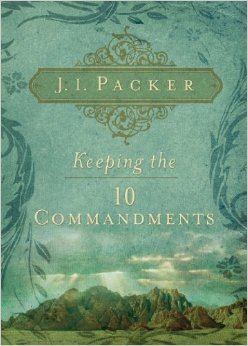
Keeping The Ten CommandmentsI am just completing a series of messages at my church on the Ten Commandments. This was no small undertaking, and one that I undertook with great reverence. I knew I needed some scholarly resources to guide my study time, and there is none who fits the bill better than J.I. Packer and his work Keeping The Ten Commandments.

Packer is indeed a most-learned man, but he has a God-given gift to discuss doctrine and theology on a level that is accessible to even someone like me! He doesn’t water-down the biblical doctrines contained in the Ten Commandments, but he presents God’s intent in them in a way that the reader can immediately grasp and then put into action.

Before looking at each of the commandments individually, Packer opens the book with a couple of chapters giving us a bird’s-eye view of how the Ten Commandments fit in with the balance of Scripture. Then he walks us through the commandments one-by-one, and concludes with a couple of chapters that help us live out the commandments today. Each chapter includes a “for further study” list of questions and Bible verses, which I highly recommend.

For getting to know the Ten Commandments better, Keeping The Ten Commandments should definitely be on your reading list.

Links & Quotes

link quote

Some good reading from today…

“Just because no one complains, it doesn’t mean that all parachutes are perfect.” —Anonymous

“I am not young enough to know everything.” —Oscar Wilde

“It is better to know some of the questions than all of the answers.” —James Thurber

More appalling misery created by the pro-abortion crowd: Planned Parenthood’s Horrible Treatment.

Very good: 7 Things All Great Friends Do.

“I must pray for the strength and courage to be truly obedient to Jesus, even if He calls me to go where I would rather not go.” —Henri Nouwen

“One of the greatest mercies God bestows upon us is His not permitting our inclinations and opportunities to meet. Have you not sometimes noticed that when you had the inclination to a sin there has been no opportunity, and when the opportunity has presented itself you have had no inclination towards it? satan’s principal aim with believers is to bring their appetites and his temptations together….” —Charles Spurgeon

“This is not Predestination: your will is perfectly free: but all physical events are adapted to fit in as God sees best with the free actions He knows we are going to do.” —C.S. Lewis

Blessing Or Burden?

Blessing or burdenGod’s commandments aren’t a bunch of Don’ts. If we look at them through the perspective of a loving Lawgiver, they are really Dos that will keep us in a place that God can bless.

Take the 9th Commandment: You shall not give false testimony against your neighbor (Exodus 20:16; Deuteronomy 5:20). This is the first of two commandments that emphasize the damage that can be done to our neighbor if we violate the law. Speaking falsely against someone does real harm to our neighbor, so in a sense God says, “Don’t do it!

But God also tells us what to Do so that He can bless us—

  • How good and pleasant it is when brothers live together in unity! … For there the Lord bestows His blessing, even life forevermore (Psalm 133:1, 3).
  • Psalm 15 says that he who will live in God’s presence is the one who speaks the truth from his heart and has no slander on his tongue, who does his neighbor no wrong and casts no slur on his fellowman (vv. 1-3).

The word for false in this commandment can mean: (1) an untruth; (2) insincere or deceptive words (e.g. flattery); (3) being purposely vague; or (4) speaking words that are true but harmful. So we Don’t want to do those, but what should we Do?

Jesus said that the way we speak is an indication of what has been going on in our heart and mind (Luke 6:45), so the way to fulfill the Do part of the commandment starts inside. A good guide is Paul’s list in Philippians 4:8—are my thoughts about my neighbor focused on what’s true? noble? right? pure? lovely? admirable? excellent? and praiseworthy?

In the New Testament, the word “blessing” is a compound word that literally means good words. So here’s the question I’m asking myself: Are my words to and about my neighbor a burden to them or a blessing?

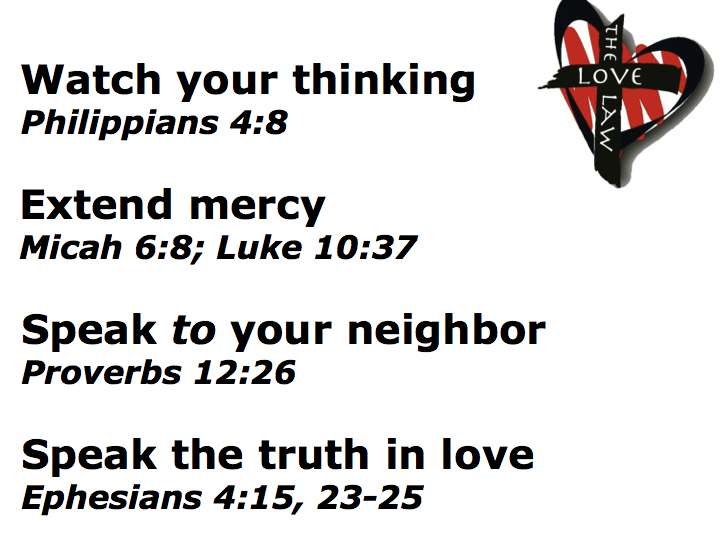
If you have missed any of the messages in our series The Love In The Law, you can find them all by clicking here.

Keeping The Ninth Commandment

4 ways to give true testimonySome folks asked that I post a couple of things I shared in my message this morning about the ninth commandment: You shall not give false testimony against your neighbor.

Here are 4 ways to observe the positive side of this 9th commandment:

Good name in man and woman, dear my lord,
Is the immediate jewel of their souls.
Who steals my purse steals trash; ‘tis something, nothing;
‘Twas mine, ‘tis his, and has been slave to thousands;
But he that filches from me my good name
Robs me of that which not enriches him,
And makes me poor indeed. —Iago, in William Shakespeare’s Othello

Links & Quotes

link quote

Some good reading & watching from this weekend…

[VIDEO] John Maxwell has some good insight on dealing with skeptics, even if the skeptic is you!

The begging in ministries today is a result of men doing good things without being sent by God’s voice. Their own desires are being mistaken for God’s bidding.” David Wilkerson shred 4 ways to know you are correctly hearing the voice of God.

“The heart knows so much more than the mind.” —Henri Nouwen

“Lord, grant we may always keep between the two extremes of distrusting or tempting Thee.” —George Whitefield

“The principle virtue of music is a means of communication with God.” —Igor Stravinsky

“Where would you have been but for grace? To repeat the old saying of John Bradford, when he saw a cartful of men going off to Tyburn to be hanged, ‘There goes John Bradford but for the grace of God.’ When you see the swearer in the street, or the drunkard rolling home at night, there are you, there am I, but for the grace of God. Who am I? What should I have been if the Lord, in mercy, had not stopped me in my mad career?” —Charles Spurgeon

“There can be no such thing as chance from God’s point of view. Since He is omniscient His acts have no consequences which He has not foreseen and taken into account and intended.” —C.S. Lewis

[VIDEO] This short film is based on a true story from the front lines of a World War I battlefield on Christmas Eve 1914…

Poetry Saturday—My Strength Is Gone

Charles WesleyMy strength is gone, my nature dies;
I sink beneath Thy weighty hand;
Faint to revive, and fall to rise:
I fall, and yet by faith I stand.
I stand, and will not let Thee go,
Till I Thy Name, Thy Nature know.
Lame as I am, I take the prey;
Hell, earth, and sin, with ease o’ercome;
I leap for joy, pursue my way,
And as a bounding hart fly home,
Through all eternity to prove,
Thy Nature and Thy Name is love. — Charles Wesley, on what he conceived to be Jacob’s prayer as he wrestled with God (see Genesis 32:22-30)

Links & Quotes

link quote

Some good reading from today…

15 good quotes from Soren Kierkegaard.

For the singles, here is 10 guys you should never date and 8 types of women you should never date.

“I can neither teach nor live by the faith of others. I must live by my own faith as the Spirit of the Lord has taught me through His Word.” —Menno Simons

Pretty cool! We just landed a robot on a comet!

Coaches & Parents, Tim Elmore tells us how athletes hide behind their talent and what we can do about it.

Human touch is just as nutritious as the food we eat. So go hug someone!

“The notion that the careless sinner is the smart fellow and the serious-minded Christian, though well-intentioned, is a stupid dolt altogether out of touch with life will not stand up under scrutiny. Sin is basically an act of moral folly, and the greater the folly the greater the fool.” —A.W. Tozer

Our Definition Of ‘Christian’

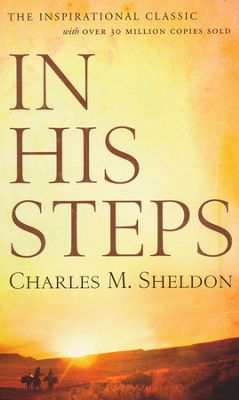
In His StepsIn His Steps by Rev. Charles Sheldon challenged me to really look at my personal definition of being a Christian. One of the characters in Sheldon’s book hit me with this—

“It is the personal element that Christian discipleship needs to emphasize. ‘The gift without the giver is bare.’ The call of this age is a call for a new discipleship, a new following of Jesus, more like the early, simple, apostolic Christianity when the disciples left all and literally followed the Master. Nothing but a discipleship of this kind can face the destructive selfishness of the age, with any hope of overcoming it. … But if our definition of being a Christian is simply to enjoy the privileges of worship, be generous at no expense to ourselves, have a good, easy time surrounded by pleasant friends and by comfortable things, live respectably, and at the same time avoid the world’s great stress of sin and trouble because it is too painful—if this is our definition of Christianity, then surely we are a long way from following the steps of Him who trod the way with tears of anguish for a lost humanity.” 

You can read my full book review of In His Steps by clicking here. And I quote another thought-provoking passage from this book here.

Thursdays With Oswald—The Discipline In Faith

Oswald ChambersThis is a periodic series with things I’m reading and pondering from Oswald Chambers. You can read the original seed thought here, or type “Thursdays With Oswald” in the search box to read more entries.

The Discipline In Faith

     The element of discipline in the life of faith must never be lost sight of, because only by means of the discipline are we taught the difference between the natural interpretation of what we call good and what God means by “good.” …

     At times it appears as if God has not only forsaken His word, but has deliberately deceived us. We asked Him for a particular thing, or related ourselves to Him along a certain line, and expected that it would mean the fullness of blessing, and actually it has meant the opposite—upset, trouble and difficulty all around, and we are staggered, until we learn that by this very discipline God is bringing us to the place of entire abandonment to Himself.

From Not Knowing Where

Probably every follower of God has experienced what Oswald Chambers describes: We follow God wholeheartedly, fully believing He called us to something, only to get knocked around by trouble.

I’ve been there and done that. It was a whole lot of no-fun while I was in it. And now, looking back on it, I still can’t say that I enjoyed those times. But here’s what I do enjoy now:

  • A closer intimacy with my Savior
  • A greater empathy for others in troubling times
  • An increased sensitivity to the voice of the Holy Spirit
  • A deeper appreciation for God’s Word
  • A strength I wouldn’t have gained without going through that time
  • Discernment and insight I wouldn’t have learned without that trouble

If God calls you, He will not leave you. No matter how painful or difficult your circumstances, if He called you to walk through it, He will do something in it. Discipline yourself to remain totally abandoned to God!

What Would Happen…?

In His StepsIn His Steps by Rev. Charles Sheldon is a timeless classic that every Christian should read (you can check out my book review by clicking here). This quote is a part of the final message that one of the main characters, Pastor Henry Maxwell, delivers at a prominent church in Chicago.

What would happen if in this city every church member should begin to do as Jesus would do? It staggers our minds to imagine the results! We all know that certain things would be impossible that are now practiced by church members. What would Jesus do in the matter of wealth? How would He spend it? How would Jesus be governed in the making of money? Would He take rentals from saloons? From tenement property? 

What would Jesus do about the great army of unemployed who tramp the streets and curse the church, or are indifferent to it, lost in the bitter struggle for the bread that tastes bitter when it is earned on account of the desperate conflict to get it? Would He say it was none of His business? 

What would Jesus do in the center of a civilization that hurries so fast after money that the girls employed in great business houses are not paid enough to keep soul and body together without fearful temptations? Where the demands of trade sacrifice hundreds of lads in a business that ignores all Christian duties toward them in the way of education and moral training and personal affection? Would Jesus, if He were here today as a part of our age and commercial industry, feel nothing, do nothing, say nothing in the face of these facts that every businessman knows?

How would you answer Pastor Maxwell’s questions?