[0:55] What’s one of the biggest attributes that sets leaders apart from their peers?
[1:56] Check out why Stephen Covey’s definition of responsibility is so important in our discussion
[3:02] Why do people like to play “the blame game”?
[4:18] Accountability must be a partner with healthy responsibility
[4:52] Greg learned the blame game early on with his younger sister
[5:57] I worked in an unhealthy organization where the senior leader never accepted personal responsibility
[8:04] How do leaders “own it” in a healthy way?
[9:22] Exemplary leaders demonstrate how to accept consequences in a healthy way
[10:34] Responsibility and coachability strengthen a team and unleash greater potential
[11:27] Blame is “so dang easy” and makes the blamer a laughingstock
[13:27] What things contribute to blaming?
[14:14] How Greg handled the compliments and complaints from his clients
[15:11] Blaming is a spreading cancer in your organization
[15:44] Being a control freak isn’t the same thing as taking responsibility
[17:01] There is a balance for leaders so they don’t “fall on their swords”
[18:49] Team sports give us a good analogy of what shared responsibility looks like
[21:07] What’s on the other side of responsibility and blame?
[21:47] Leaders can enhance the benefits of responsibility through self-reflection
[23:51] Greg has a memorable and disarming way of helping people accept responsibility
[24:27] Our coaching huddles can help you learn to enhance the benefits of responsibility in your personal leadership
Check out this episode and subscribe on YouTube so you can watch all of the upcoming episodes. You can also listen to our podcast on Spotify and Apple.
[19:17] You don’t have it all, so don’t act like it!
[19:43] Greg would love to help your organization develop an abundance mindset.
Check out this episode and subscribe on YouTube so you can watch all of the upcoming episodes. You can also listen to our podcast on Spotify and Apple.
[11:02] Greg’s first business venture was only an entry point to his career
[13:37] Another decision further refined Greg’s niche in business
[15:03] The unforeseen changes that brought me to West Michigan where I met Greg
[15:59] One of the first ministries that we worked on together
[20:00] A leadership lesson we tried to teach to the students at an urban youth center
[20:40] The dream list for us going forward
[22:40] What do we do as consultants?
[24:02] Greg has some cool keynote addresses that he presents
[25:53] How we can help you grow your leadership capacity
Check out this episode and subscribe on YouTube so you can watch all of the upcoming episodes. You can also listen to our podcast on Spotify and Apple.
[3:20] Leaders look for ways to honor those around them
[3:48] Can you honor too much?
[4:29] How can we honor our parents and grandparents?
[5:13] Greg has a book releasing soon called Sage Advice
[9:44] Greg explains that application is the real compliment
[10:36] Honor starts with noticing others and then expressing what was noticed
[11:49] Honoring calls out great potential in others
[12:32] What does it mean to “trust the person with a limp”?
[14:15] Honor is for people who gave, not for people who received
[15:28] Why is hard for leaders to acknowledge the success of others?
[16:27] Leaders need to looking around for opportunities to honor others
[17:11] Hand out compliments publicly for maximum effect
[17:55] Leaders receive honor by first honoring others
[19:45] Our leadership challenge to you
Check out this episode and subscribe on YouTube so you can watch all of the upcoming episodes. You can also listen to our podcast on Spotify and Apple.
[5:40] Greg reminds leaders that there isn’t an award for not taking a vacation
[6:46] Greg has seen the fallout from overly-tired leaders, and I share some ideas for leaders to help themselves and their teammates de-stress
[9:31] How do leaders build playtime into their regular work schedule?
[11:10] Share your ideas with us!
[11:34] Greg shared some playtime activities he used in his organizations
[12:27] Why do leaders think they have to be so serious?
[15:15] Some thoughts for leaders to help their teams
[16:51] Greg emphasizes again the importance of self-care and they guys talk about how we can help other leaders practice self-care
[19:03] Our coaching huddles can help you grow your leadership
[20:02] Is it possible to find work-life balance?
Check out this episode and subscribe on YouTube so you can watch all of the upcoming episodes. You can also listen to our podcast on Spotify and Apple.
[0:15] I adapt a verse from the Bible to talk about generosity and Greg agrees with me.
[1:00] Generosity is so much more than donating money.
[2:15] Generous leaders are proactive, and have appropriate boundaries.
[2:48] Leaders cannot fake generosity.
[3:42] Generosity isn’t in the big things, but the everyday things.
[4:25] Time, talent, treasure are all important components in generosity.
[6:00] Greg shares a telling statistic about how Americans give to charities.
[6:45] Greg says giving your network can be one of the most generous things a leader does.
[7:37] Generosity requires an abundance mindset.
[8:52] What holds us back from being generous?
[10:00] Comparisons kill generosity.
[10:27] Being generous expands our influence, but stinginess strangles it.
[12:55] Our teammates are looking for places to be generous.
[13:53] Generosity opens doors for new opportunities.
[14:51] Greg shares an insightful quote from Anne Frank
[15:17] I make a connection to the change in Ebenezer Scrooge’s life.
[16:11] How we define a generous leader.
[17:38] Our leadership challenge: how can you view generosity differently?
Check out this episode and subscribe on YouTube so you can watch all of the upcoming episodes. You can also listen to our podcast on Spotify and Apple.
Listen to the podcast of this post by clicking on the player below, and you can also subscribe on Apple, Spotify, or Audible.
I’ve been presenting a series of exclusive leadership lessons to my Patreon supporters, but I wanted to make this particular lesson available to everyone because of its overlap with my book Shepherd Leadership: The Metrics That Really Matter.
[17:06] Forgiveness looks forward to better things.
[17:59] The personal experiences that Craig and Greg have had make them well-equipped to work as your coach. Check out our coaching huddles!
Check out this episode and subscribe on YouTube so you can watch all of the upcoming episodes. You can also listen to our podcast on Spotify and Apple.
Despite what some people try to say, this empowerment from the Holy Spirit isn’t just for a select few. Jesus not only prayed for all of His followers to know this, but Peter also brought this out in his Pentecost Day sermon (John 17:20-23; Acts 2:21, 38-39).
So why are some people not baptized in the Holy Spirit? I think there are numerable reasons, but allow me to share four broad headings:
They have impenetrable hearts to the Holy Spirit’s wooing (Acts 7:51)
They are ignorant of the fact that this baptism is available to them (Acts 19:1-2)
They have impure motives regarding the baptism in the Holy Spirit (Acts 8:9-19)
The bottom line: God wants to baptize you in His Spirit, Jesus wants you to be anointed with the same power He used, and the Spirit wants to bring out greater Jesus-exalting fruitfulness from your life.
Two years ago in this series, I said that when it comes to the Holy Spirit’s involvement in a Christian’s life: In > On.
In the Old Testament, Samson had the Spirit of God ON him, but he never allowed the Holy Spirit to come IN him and make important changes. Three times we read that “the Spirit of the Lord came upon him” (Judges 14:6, 19; 15:14), but after every one of these times we see Samson reverting to his childish, selfish, pouting ways again.
By contrast, consider the life of Jesus. After He was baptized by John we read that Jesus was “full of the Holy Spirit” and “led by the Spirit.” That word for “full” means complete or lacking nothing. Jesus yielded to the Holy Spirit and allowed Him to lead and direct, as well as supply everything that was needed for ministry. Just a few verses later we read that “Jesus returned to Galilee, in the power of the Spirit.” And in His first recorded sermon, Jesus read from the prophet Isaiah about the Holy Spirit anointing Him for ministry (Luke 4:1, 14, 18).
That word for “anointed” is chiro, from which we get the word Christ. That is the same root word in us as CHRISTians.
We see this in Peter, Stephen, Barnabas, and Paul (Acts 4:8; 6:3, 5; 7:55; 11:24; 13:9). And then Paul writes that this anointing is for all Christians—“Now it is God who makes both us and you stand firm in Christ. He anointed us [that’s the word chiro again], set His seal of ownership on us, and put His Spirit in our hearts as a deposit, guaranteeing what is to come” (2 Corinthians 1:21-22).
The anointing that characterized the life of Jesus in Acts 10:38—“How God anointed Jesus of Nazareth with the Holy Spirit and power, and how He went around doing good and healing all who were under the power of the devil, because God was with Him”—is the same anointing for ministry for all CHRISTians today!
So…
Don’t dabble—dive in!
Don’t settle for on—allow the Holy Spirit fully in!
When we are yielded and baptized in the Holy Spirit, we have the anointing to shine brightly for Jesus in our generation.
Listen to the podcast of this post by clicking on the player below, and you can also subscribe on Apple, Spotify, or Audible.
After the outpouring of the Holy Spirit on that Day of Pentecost immediately following Christ’s ascension, Christians were speaking in languages that they had not learned. As they did so, they were “declaring the wonders of God” in all the languages of the world. Some people mocked, saying they were merely babbling drunks, but everyone in Jerusalem was “amazed and perplexed” at this remarkable event, which prompted Peter to preach a powerful sermon (Acts 2:8-21).
Peter began his sermon by quoting words “spoken by the prophet Joel” (Joel 2:28-32). It’s unlikely that Peter had a copy of Joel with him, so this quotation was delivered from memory and Peter’s sermon was given spontaneously as the Holy Spirit empowered him. In looking at the passages in both Joel and Acts, I see three notable differences.
Joel begins by saying, “And afterward I will pour out My Spirit,” but Peter begins with the words, “In the last days…I will pour out My Spirit.” I’ll address this point further in just a moment.
Peter inserts “and they will prophesy” at the end of verse 18, a phrase that Joel didn’t say at the end of Joel 2:29. I think this is the Holy Spirit emphasizing that what the crowd heard was indeed prophecy, not mindless babbling.
Joel concludes with “before the coming of the great and dreadful day of the Lord,” but Peter says, “before the coming of the great and glorious day of the Lord.” The word Joel uses for “dreadful,” meaning an awesome day worthy of reverence, was a day of sorrow for those about to be judged guilty, and a day of supreme rejoicing for those about to be judged innocent in God’s sight. The word Peter uses for “glorious” is the only time this Greek word is used in the New Testament. The word is epiphanes: where we get our English word “epiphany”—a light has dawned and the truth is finally realized!
Let’s go back to the difference between “afterward” in Joel and “in the last days” in Acts. In a sense, the “afterward” for Peter was what everyone was experiencing right then—after the death, burial, and resurrection of Jesus, and after the outpouring of the Holy Spirit that Jesus had promised (John 16:7; Acts 1:4-5).
Let’s also consider the “afterward” in Joel’s day. What came before was a disaster of locusts consuming the land, which prompted Joel to call for the solemn response of prayer and fasting. This heartfelt response from godly people trigged God’s outpouring of His Spirit—the afterward—that led to a blessing “before the coming of the great and dreadful day of the Lord” (Joel 2:1-3, 10-13).
Both Joel and Peter conclude that it is God’s desire that “everyone…be saved”! The outpouring of the Holy Spirit was to help people have an epiphany of both their sin and the salvation that Jesus purchased on His Cross.
The word “disaster” comes from the Latin word disastros. The root word astros pertains to the heavenly lights (star, sun, moon), and the prefix “dis-” is a pejorative (something that has a belittling effect). So disaster really means no guiding lights, or hopeless darkness.
Jesus was prophesied to step into this hopeless darkness and bring light and hope—“The people walking in darkness have seen a great light; on those living in the land of deep darkness a light has dawned” (Isaiah 9:2). Zechariah prophesied that Jesus was the fulfillment of this: “Because of the tender mercy of our God, by which the rising sun will come to us from heaven to shine on those living in darkness and in the shadow of death, to guide our feet into the path of peace” (Luke 1:78-79).
Jesus is THE Epiphany, THE Ultimate Light, but He also tells us, “You are the light of the world (John 8:12; Matthew 5:14).
In a world of hopeless darkness, Christians are to be Christ’s Light-bearers.
We cannot do this on our own.
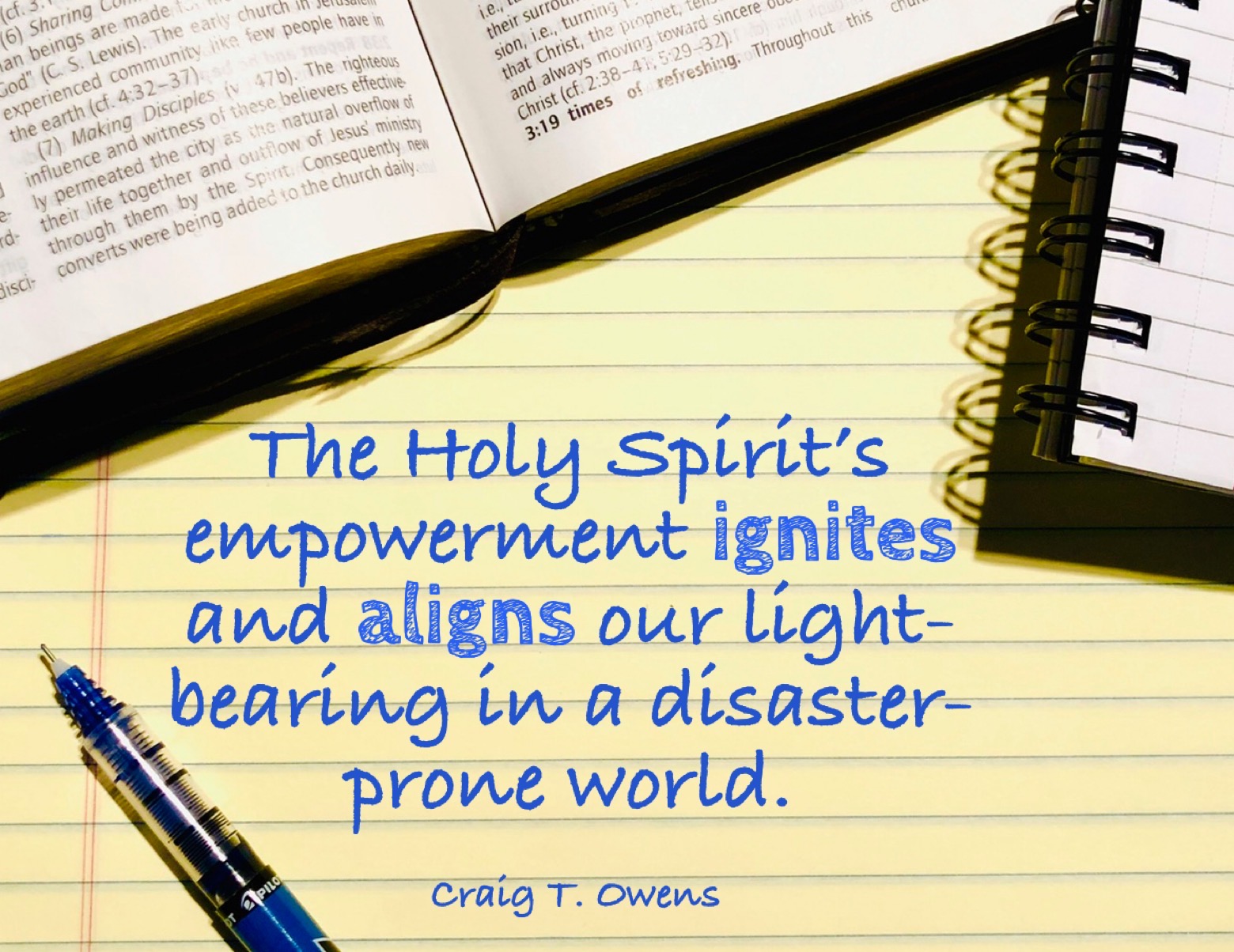
The Holy Spirit’s empowerment ignites and then aligns our light-bearing to a disaster-prone world.
When Joel saw disaster coming, he called for a fast. This fast led to the outpouring of God’s empowerment on godly people, so they could take the Light to those lost in deep darkness. I think the same response is needed from Christians today.
When it appears this world is plunging deeper into darkness—when we hear of disasters (remember that disastros means people are without Light)—we need to pray and fast so that the Holy Spirit can be reignited in us, so that we can then be realigned to best shine the light of Jesus brightly.
Our lives can and should be the epiphany of Christ’s love for the world to see! Let’s all pray: “Holy Spirit, make us Your epiphany to a dark world!”
If you’d like to check out the other messages in our series We Are: Pentecostal, please click here.



 On this episode of “The Craig And Greg Show” we talk about:










 Craig T. Owens