This is a weekly series with things I’m reading and pondering from Charles Spurgeon. You can read the original seed thought here, or type “Thursdays With Spurgeon” in the search box to read more entries.
The Wonder Of Christ
Works of art require some education in the beholder before they can be thoroughly appreciated. … Because of failures in our character and faults in our life, we are not capable of understanding all the separate beauties and the united perfection of the character of Christ, or of God, His Father. …
You cannot fail to notice that men, through the alienation of their natures, are continually misrepresenting God because they cannot appreciate His perfection.… Men will misunderstand Him because they are imperfect themselves and are not capable of admiring the character of God. …
Did you ever notice, when you read the history of Jesus Christ, that you could never say He was noble for any one virtue at all? …
It is because of the complete perfection of Jesus Christ that we are not accustomed to say of Him that He was eminent for His zeal, or for His love, or for His courage. We say of Him that He was a perfect character, but we are not able very easily to perceive where the shadows and the lights blended, where are the meekness of Christ blended into His courage and where His loveliness blended into His boldness in denouncing sin.
We are not able to detect the points where they meet. And I believe the more thoroughly we are sanctified, the more it will be a subject of wonder to us how it could be that virtues that seem so diverse were in so majestic a manner united into one character. It is just the same of God.
From Mercy, Omnipotence, And Justice
As we grow in our understanding of processes and techniques, our appreciation of a work of art or a symphony grows as well. We may go from “Oh, I like that” to “That is amazing” to “This is an exquisite masterpiece!”
Christians should experience the same wonder and awe of the character of God seen in Jesus and revealed to us by the Holy Spirit.
I believe the reason the angels around God’s throne are constantly calling out, “Holy, Holy, Holy!” is because at every moment they are perceiving a new facet of His sheer awesomeness. They are calling out to one another, “Did you see that?! Holy!” And another responds back, “Yes, and look at that! Holy!”
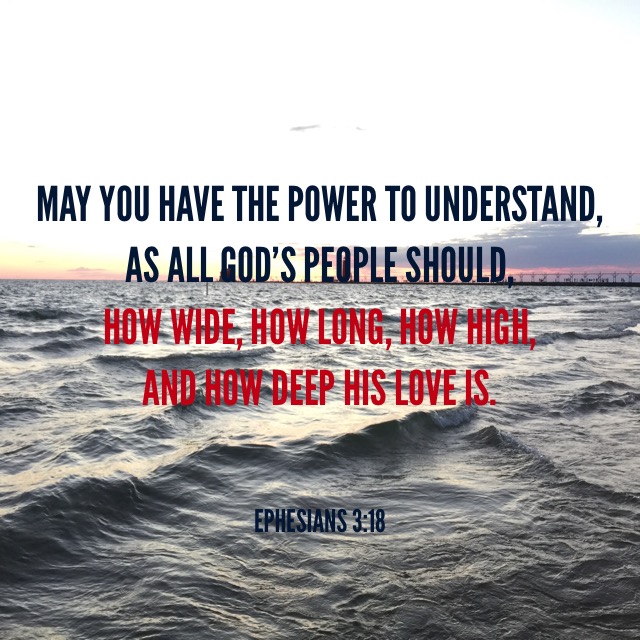
We are invited to join in that chorus. The apostle Paul prayed that our eyes would be opened and our vision expanded to see new depths, and heights, and widths, and lengths of the awesomeness of our God (see Ephesians 3:16-19).
This is a weekly series with things I’m reading and pondering from Charles Spurgeon. You can read the original seed thought here, or type “Thursdays With Spurgeon” in the search box to read more entries.
Holding Two Extreme Truths
This is a deep, unsearchable mystery. Man walks without a leash yet treads in the very steps that God ordained him to tread in as certainly as though manacles had bound him to the spot! Man chooses his own seat, selects his own position; guided by his will, he chooses sin, or guided by divine grace, he chooses right. And yet in His choice God sits as sovereign on the throne, not disturbing but still overruling and proving Himself to be as able to deal with free creatures as with creatures without freedom. As able to effect His purpose when He has endowed men with thought and reason and judgment, as when He had only to deal with the solid rocks and with the imbedded sea.
O Christians! You will never be able to fathom this, but you may wonder at it. I know there is an easy way of getting out of this great deep either by denying predestination altogether or by denying free agency altogether. But you can hold the two: You can say, “Yes, my consciousness teaches me that man does as he wills, but my faith teaches me that God does as He wills, and these two are not contrary the one to the other. And yet I cannot tell how it is. I cannot tell how God effects His end. I can only wonder, and say, ‘Oh, the depth of the riches both of the wisdom and knowledge of God! How unsearchable are His judgments and His ways past finding out!’” (Romans 11:33). Every creature is free and doing as it wills, yet God is freer still and doing as He wills not only in heaven, but also among the inhabitants of this lower earth.
From The Infallibility Of God’s Purpose
The debate has raged for years: predestination vs. freewill.
People will sometimes ask me, “Are you a Calvinist (predestination) or an Arminian (freewill)?” And I always give the same answer, “Yes, I am a solid Cal-minian!” As with most things that are difficult for our finite, human minds to grasp about God’s nature, the answer is not either-or but it’s both-and.
C.S. Lewis captured the same sentiments as Spurgeon. Lewis always said the best course between two immovable ideas was right between them. He added, “Heaven will solve our problems, but not, I think, by showing us subtle reconciliations between all our apparently contradictory notions. The notions will all be knocked from under our feet. We shall see that there never was any problem” (emphasis mine).
Spurgeon would agree—there never was any problem, at least not with God. Any problems of understanding are in ourselves, not in Him. So far better than choosing one over the other, choose the both-and, and then stand in awe and wonder and worship that our infinite God is sovereign over all. Even over our puny, limited theologies and doctrines.
With “LONG LIVE THE KING!” still reverberating in our ears from Psalm 47, the sons of Korah ask us to zoom out a little farther to see how things begin to change now that the King has assumed His rightful place on the throne.
So Psalm 48 opens with the same praise with which Psalm 47 closed—Great is the Lord and most worthy of praise! The Hebrew word for great means massiveness! God is great beyond comprehension. He is larger than any problem. He is unique. He is uncontainable, unlimited, utterly beyond description. His glory is so bright that no sun is needed (see Revelation 21:23).
His glorious light reveals God’s beauty all around us. As C.S. Lewis noted, “I believe in God as I believe the sun has risen. Not because I can see it, but because by way of it I can see everything else.” Indeed, the psalmist reminds us that the city of our God has become “beautiful in its loftiness”(v. 2).
Look at how majestic our King is, and how majestic He makes His city, with phrases like the city of our God, the city of the Great King, and the city of the Lord Almighty.
God makes His city secure forever.
Selah—pause and consider that.
About 1200 years after this psalm was written, Augustine would write his book called The City of God in which he contrasted the City of God with the City of Man. He noted how the Romans had gods they trusted in, but the Romans had to “rescue” their gods from the invading barbarians. Rome ultimately fell to those invading barbarians, but, Augustine said, the City of God can never fall because it isn’t a tangible place. The City of God resides inside God’s people.
So notice that after the Selah the word “city” doesn’t appear anymore. Instead, we read about:
Here’s the question for all of us to ask—Is my heart a City of God or a City of Man?
When people look at the “city” of my life, can they tell God is on the throne? The telling characteristics of a City of God are a city where…
I’ll ask it again—Can people clearly see that God is the unrivaled King of your heart?
Join me next Sunday as we continue our look at the Selahs in the Psalms.
Last I week I told you how Hebrew poetry often puts the climax in the middle. In Psalm 47 that middle climax is in verse 5—God has ascended. This is one of seven “psalms of enthronement” in the Psalter. Since all of the Scripture points to Jesus, let’s look at the definition of this word ascend and see how it fits with Jesus:
When a king is coronated—when he is heading toward his throne—we can expect the people to be happy. So the psalmist tells us that in God’s case the people are clapping and shouting (v. 1), telling God how awesome He is (v. 2), thanking Him for subduing their enemies (v. 3), and expressing their gratitude that He has established them as His people (v. 4).
Then comes the Selah / Pause—what is happening during this pause? The King is being crowned. He has ascended to His rightful throne. So this is selah/pause is really a deep breath that’s about to explode in a crescendo of praise!
Now there are shouts of joy (v. 5a). In our earthly understanding, it would be something like: “LONG LIVE THE KING!!” There is also a sounding of trumpets (v. 5b) which literally means a thundering of trumpets. And then there’s the singing—lots and lots of singing. In fact, the word sing appears five times in the next two verses.
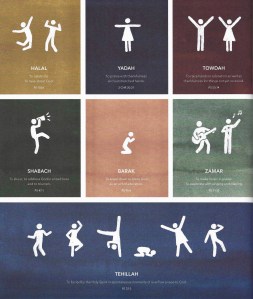
From The Infographic Bible (click the image for more)There are so many ways to say LONG LIVE THE KING—singing, dancing, raising our hands, falling down on our knees. shouting.
Our God is praise-worthy. He is clap-worthy! He is sing-worthy! He is dance-worthy! He is shout-worthy! He is bowing-worthy!
Why does it seem that we are prone to worship so quietly? Perhaps we need to take it up a notch or two (or three or four). Perhaps we haven’t gazed into His awesome beauty enough to realize just how incredible He is!
Do you think shouting praises to the King of kings is too undignified? Did you know that when the King of kings returns, He is going to shout and there is also going to be a thundering trumpet? For the Lord Himself shall descend from heaven with a shout, with the voice of an archangel, and with the trumpet of God (1 Thessalonians 4:16)!
Here are 4 important lessons from this Psalm of Enthronement—
I hope you can join me this next Sunday as we continue our series looking at the Selahs in the Psalms.
Sarah Young does a masterful job in helping us hear Jesus speak to us in the first-person, as she weaves Scripture together so beautifully. Check out my full book review by clicking here.
“Taste and see that I am good. The more intimately you experience Me, the more convinced you become of My goodness.”
“Follow Me one step at a time. … Keep your mind on the present journey, enjoying My Presence. Walk by faith, not by sight, trusting Me to open up the way before you. … I set the pace in keeping with your needs and My purposes.”
“Walking in the light of My presence blesses you in many ways. Good things are better and bad things are more bearable when you share them with Me. As you bask in My Love-Light, you are better able to love others and enjoy fellowship with them. You are less likely to stumble or fall because sins are garishly obvious in My holy Light. As you walk in this Light with Me, I encourage you to exult in My righteousness.”
“Although your new self is being conformed to My image, this process does not erase the essence of who you are. On the contrary, the more you become like Me, the more you develop into the unique person I designed you to be.”
“Holiness is letting Me live through you. Since I dwell in you, you are fully equipped to be holy. Pause before responding to people or situations, giving My Spirit space to act through you. Hasty words and actions leave no room for Me; this is atheistic living. I want to inhabit all your moments—gracing your thoughts, words, and behavior.”
“Talk with Me about every aspect of your day, including your feelings. Remember that your ultimate goal is not to control or fix everything around you; it is to keep communing with Me. A successful day is one in which you have stayed in touch with Me, even if many things remain undone at the end of the day.”
“Do not let your to-do list (written or mental) become an idol directing your life. Instead, ask My Spirit to guide you moment by moment.”
“Exceeding Joy is for both you and Me. I delight in you now, but this Joy will be astronomically magnified when you join Me in Glory. The Joy you will experience in heaven is so far beyond anything you have known on earth that it is indescribable. Nothing can rob you of this glorious inheritance which is imperishable and will not fade away.”
“Thankfulness is not some sort of magic formula; it is the language of Love, which enables you to communicate intimately with Me.”