The Father’s Business

Listen to the podcast of this post by clicking on the player below, and you can also subscribe on AppleSpotify, or Audible. 

The Holy Spirit’s involvement in our lives isn’t reserved for just the “big” things, but He wants us to be aware of and tuned in to His voice and His thoughts all the time. There shouldn’t be a secular-sacred divide in our activities, but we should make every place holy ground and every moment a divine opportunity for God to be glorified. Or said another way, we shouldn’t have times of work and times of worship, but our worship should be seen in every single thing we do. 

I think everyone of us has experienced at one time or another a poor employer or manager. Maybe it’s an employer that demands results but doesn’t give you the training or the tools to do the job. Or maybe you have the training and tools but you don’t know exactly how much you are able to use these things without crossing a line. 

Maybe you have known a boss that is barely present, but when they do stop by the worksite, they aren’t happy with the work that has been done. On the opposite side, maybe it’s a boss who does everything and then gets mad that you aren’t keeping up or working as hard as them. It’s drudgery working for someone like this! 

But, somewhat surprisingly, Jesus used more work examples to talk about the Kingdom of God than He did worship examples. He talked about farmers, bakers, builders, employers, managers, and employees way more than about worshiping, singing, or preaching. 

One of the few glimpses we have of the early life of Jesus shows Him talking about His mission while on earth. Consider the story of Jesus in the temple in Jerusalem when He was 12 years old (Luke 2:41-49). The phrase in the NIV where Jesus says that He must be “in My Father’s house” can be translated…

  • about My Father’s business (NKJV) 
  • dealing with the things of My Father (MSG) 
  • occupied about My Father’s business (AMPC) 

(Check out all of the Scriptures in this post by clicking here.)

Jesus was consistent about this idea of working while He was on earth (John 5:17, 36; 9:4; 17:4). For Jesus, His work was a delight because it was directed by the Holy Spirit (Luke 3:21-22; 4:1, 18-19; Acts 10:38). 

Remember that I mentioned the unreasonable employer that gives us no training, no tools, no goals for which to aim, but expects us to work for his benefit alone. This was not the case with Jesus! He trained us, provided us with the Holy Spirit to guide us, told us the goal for which we were to aim, and said that both His Father would be glorified and we would be rewarded by our Kingdom work done on earth. 

Jesus wants us to work as He did, and He promised that the Holy Spirit would help us in this (John 14:10-12, 24:49; Mark 16:19-20). 

We saw that Luke 2:49 in the AMPC has Jesus saying, “occupied about My Father’s business.” In Luke 19:13 Jesus tells us to “occupy till I come” (KJV). This word is also translated into phrases like: 

  • put this money to work (NIV) 
  • do business (NKJV) 
  • invest this (NLT) 

Jesus is talking about the “talents” given to His stewards (Luke 19:11-13, 16-23). Every servant received the same thing: one mina. We all have been given one life to live; we all have been given 24 hours in a day; we all have been given opportunities to be occupied about our Father’s business. 

The Holy Spirit as our Counselor is there at every moment, every conversation, every decision to help us hear His voice, think His thoughts, and sanctify every experience. Jesus says that He will reward our occupying until He returns. Just doing things like feeding the hungry, giving water to the thirsty, taking care of those in need. This sounds a lot like the work of Jesus in Luke 4:18-19 and Acts 10:38. This Spirit-empowered work earns the commendation from our Master, “Well done, good and faithful servant! Enter into your Master’s happiness!” 

Be baptized in the Holy Spirit and let Him help you be about your Father’s business until Jesus returns. 

If you’ve missed any of the messages in our We Are: Pentecostal series, you can check them all out here. 

►► Would you please prayerfully consider supporting this ministry? My Patreon supporters get behind-the-scenes access to exclusive materials. ◀︎◀︎

Praying While You Work

Listen to the podcast of this post by clicking on the player below, and you can also subscribe on AppleSpotify, or Audible. 

Waiting for God to answer doesn’t mean sitting still and doing nothing. Sometimes we have to work, and plan, and strategize while we are praying. Check out this example from Nehemiah. 

Check out more thoughts about using the Bible as our prayer guide in our series Our Prayer Book. 

I use Nehemiah and another godly leader as prayer examples in my post Persistent and Insistent Prayer. And you can read a little more about Nehemiah’s prayerful planning in my godly leadership series in the post Godly Leaders Prayerfully Plan. 

►► Would you please prayerfully consider supporting this ministry? My Patreon supporters get behind-the-scenes access to exclusive materials. ◀︎◀︎
Links & Quotes

Questions engage people more than statements do. Check out the full conversation Greg and I had on The Craig And Greg Show. I have lots of new content every week, which you can check out on my YouTube channel.

How should Christians engage with artificial intelligence (AI)? This is a very thoughtful and biblically-centric post.

The Bible records the fall of Jerusalem to the Babylonians in 586 BC and to the Romans in AD 70. For the first time, archeologists have discovered evidence of both armies in close proximity to each other. Yet again, archeology confirms the historicity of the Bible. 

“In America, we have a tendency to worship our work, work at our play, and play at our worship.” —Lenny Esposito

“Young people are told, ‘You’ve got plenty of time, live a little, first,’ as if life ends after the wedding. The truth about marriage, however, is that it is, statistically, the single best predictor of long-term happiness. Making this even more important to understand is that for at least the last 20 years now, Americans have been steadily getting less happy.” Here’s how John Stonestreet shares this report from the University of Chicago.

T.M. Moore shared an interesting component of early-colonial American lawmaking: “Peruse the civil codes of the American colonies and you will discover a curious phenomenon. Frequently, colonial legislators drafted their civil codes by looking to the Old Testament Law of God.”

Dr. Tim Clarey said, “The global Flood also answers why dinosaurs were still alive and flourishing until the end of the Cretaceous. At that moment in the Flood, they were likely trying to stay on the highest ground available as waters encroached closer, week by week. As the dry land rapidly disappeared, many species herded together. This explains why varied types of dinosaurs were buried together at the end of the Cretaceous. The Flood’s tsunami-like waves eventually crashed over the remaining dinosaurs and entombed them in what’s called Upper Cretaceous strata.” Check out more evidence for the Flood that is recorded in the Book of Genesis. 

Thursdays With Spurgeon—We Are All Laborers

This is a weekly series with things I’m reading and pondering from Charles Spurgeon. You can read the original seed thought here, or type “Thursdays With Spurgeon” in the search box to read more entries.

Listen to the podcast of this post by clicking on the player below, and you can also subscribe on iTunes or Spotify.

We Are All Laborers

I planted, Apollos watered, but God gave the increase. So then neither he who plants is anything, nor he who waters, but God who gives the increase. Now he who plants and he who waters are one, and each one will receive his own reward according to his own labor. For we are God’s fellow workers; you are God’s field, you are God’s building. (1 Corinthians 3:6-9) 

     Remember that the ablest ministers, the most powerful evangelists, the most profound teachers are, after all, nothing but laborers together with God. Let your mind be set upon the Master and not upon the servants! Do not say, ‘We are for this man because he plants,’ or ‘We are for the other because he waters,’ or ‘We are a third party for nobody at all.’ But let us join in ascribing all honor and praise to God, Who works all our works in us, since every good gift and every perfect gift is from above and comes down from the Father of lights, to Whom be glory world without end! … 

     The church is God’s farm.… In the margin of the Revised Version, we read, ‘You are God’s tilled ground….’ 

    We begin by considering that the church is God’s farm. The Lord has made the church of His sovereign choice to be His own by purchase, having paid an immense price for it. ‘For the Lord’s portion is His people; Jacob is the lot of His inheritance’ (Deuteronomy 32:9). Because the Lord’s portion was under mortgage, therefore the only begotten Son laid down His life as the purchase price and redeemed His people to be the Lord’s portion forever and ever. Henceforth it is said to all believers, ‘You are not your own. For you were bought at a price’ (1 Corinthians 6:19-20). Every acre of God’s farm cost the Savior bloody sweat, yes, the blood of His heart! He loved us and gave Himself for us; that is the price He paid! … 

     The Master’s commission is not ‘sit still and see the Spirit of God convert the nations,’ but ‘Go into all the world and preach the gospel to every creature’ (Mark 16:15). 

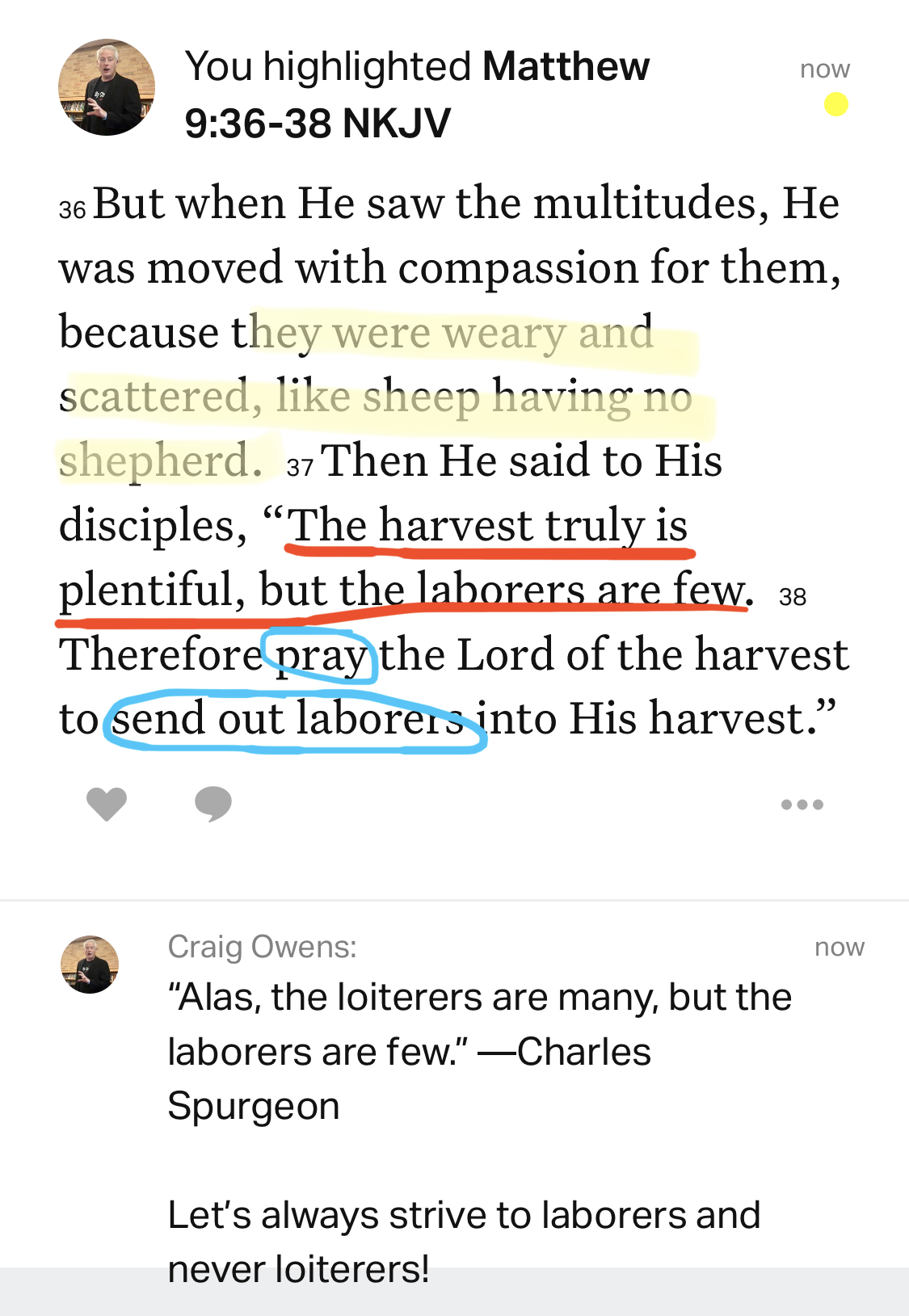
     Alas, the loiterers are many, but the laborers are few.

From Farm Laborers

It’s sad how much time Christians spend on non-essential things. We church shop to find the pastor or the music that suits our tastes; we claim ownership over ministries and only allow others to work under us, but never alongside us; or we attend church and give our tithes and offerings and expect the pastor to do all of the ministry. 

All of this is not only unbiblical but none of this is focused on eternity. And as C.S. Lewis said, “All that is not eternal is eternally useless.” 

Jesus paid too high a price for us to keep the good news to ourselves, or claim that our ministry is superior to someone else’s, or to simply loiter and watch others do the work. All Christians are laborers in God’s field. God made an invaluable investment in the work Jesus did on the Cross, so He wants to see a return on His investment that will last for all eternity. 

It’s time for us to stop squabbling, stop protecting our turf, and stop loitering. We must get to the work because the time is short and the Master is looking for eternal results.

►► Would you please prayerfully consider supporting this ministry? ◀︎◀︎

Work Can Be Worship

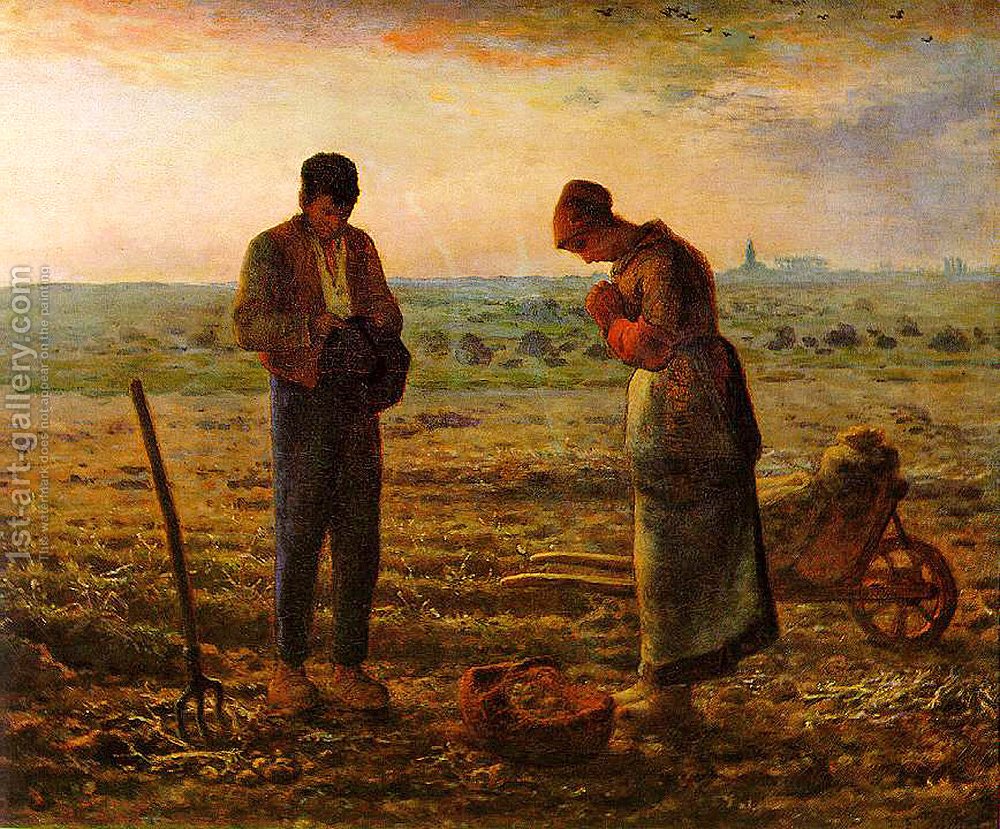
“Have you seen the painting The Angelus by Jean-Francois Millet? It portrays two peasants praying in their field. A church steeple sits on the horizon, and a light falls from heaven. The rays do not fall on the church, however. They don’t fall on the bow heads of the man and woman. The rays of the sun fall on the wheelbarrow and the pitchfork at the couple’s feet. 

“God’s eyes fall on the work of our hands. Our Wednesdays matter to Him as much as our Sundays. He blurs the secular and sacred. One stay-at-home mom keeps this sign over her kitchen sink: Divine tasks performed here daily. An executive hung this plaque in her office: My desk is my altar. Both are correct. With God, our work matters as much as our worship. Indeed, work can be worship.” —Max Lucado, in You!

(To read some other quotes from You!click here, please .)

Prayer Is The Battle

When I was growing up and struggling with a problem, my Mom would always challenge me with one simple question—“Have you prayed about it?”

This is a great question because it helps us keep the main thing the main thing.

Typically we have three substitutes for prayer—

(1) Ignoring the problem. We’re like the board of directors that was facing falling sales and falling profits, but their solution was to just wait for something magical to happen.

(2) Talking about the problem. Christians often call this “a prayer request.” We take 10 minutes to give our friends all the gory, depressing details of our situation and oftentimes say “please pray for me” as we walk away. Solomon said, “Talk is cheap, like daydreams and other useless activities” (Ecclesiastes 5:7).

(3) Working to solve the problem. This isn’t in the Bible, but many times we act as if it is: God helps those who help themselves. Instead, God wants us to call on Him so He can reveal things to us (see Jeremiah 33:3).

Something that is in the Bible is this: “Ask whatever you wish, and it will be done for you.” But there is a condition for this, and it’s the part of the sentence that comes before the asking that makes all the difference—

If you remain in Me and My words remain in you, ask whatever you wish, and it will be done for you (John 15:7).

Oswald Chambers said, “We are apt to think of prayer as a common-sense exercise of our higher powers in order to prepare us for work; whereas in the teaching of Jesus, prayer is not to fit us for the ‘greater works,’ prayer is the work. Prayer is…the means whereby we assimilate more and more of His mind, and the means whereby He unveils His purposes to us.”

Prayer IS the work!

We don’t ignore the problem, and we don’t just talk about the problem. But neither do we pray and then work on the problem. Prayer is the work!

It can’t be stated enough: Prayer doesn’t prepare us to work, prayer IS the work.

Even the Apostle Paul identified this in his teaching on spiritual warfare. In language similar to what Jesus said in John 15:7, Paul says, “Be strong IN the Lord and IN His mighty power. Put on the full armor of God SO THAT you can take your stand against the devil’s schemes” (Ephesians 6:10-11).

Paul doesn’t tell us to ignore the devil’s schemes, nor does he tell us to talk about them. But neither does he tell us to put on God’s armor to fight against the devil’s schemes. He tells us to put on the armor of God so that we can pray (see Ephesians 6:18-20).

The armor of God is NOT to fight in, but to shield us while we pray!

PRAYER IS THE BATTLE … PRAYER IS THE WORK

When you are facing a difficulty, don’t ignore it, don’t just talk about it, and don’t go to work fighting it. Listen to the Holy Spirit asking you, “Have you prayed about it,” and then drop to your knees and PRAY!

This principle is illustrated so wonderfully in the life of David. We’ll be looking at David’s prayers over the next few weeks, and I hope you will join me in learning that prayer is the battle!

Thursdays With Oswald—Prayer Is The Work

Oswald ChambersThis is a weekly series with things I’m reading and pondering from Oswald Chambers. You can read the original seed thought here, or type “Thursdays With Oswald” in the search box to read more entries.

Prayer Is The Work 

     The key to the missionary problem is in the hand of God, not of man, and according to Our Lord, the key is prayer, not work, as that word is popularly understood, because work may mean evading spiritual concentration. Our Lord says—“Pray therefore…” [Matthew 9:38]. … 

     We are apt to think of prayer as a common-sense exercise of our higher powers in order to prepare us for work; whereas in the teaching of Jesus, prayer is not to fit us for the “greater works,” prayer is the work. Prayer is the outcome of our apprehension of the nature of God, the means whereby we assimilate more and more of His mind, and the means whereby He unveils His purposes to us. …  

     God is not impressed by our earnestness, He nowhere promises to answer prayer because of our agony in intercession, but only on the ground of Redemption. We have “boldness to enter into the holiest by the blood of Jesus,” and in no other way. … 

     The armor is for the battle of prayer [see Ephesians 6:11-20]. “Take up the whole armor of God … stand therefore …” and then pray. The armor is not to fight in, but to shield us while we pray. Prayer is the battle. … 

     We have to live depending on Jesus Christ’s wisdom, not on our own. He is the Master, and the problem is His, not ours. We have to use the key He gives us, the key of prayer. Our Lord puts the key into our hands, and we have to learn to pray under His direction. That is the simplicity which He says His Father will bless.

From So Send I You

In light of these thoughts from Oswald Chambers, how does this change your view of prayer?

Dads: Godly Influencers

Godly Influencer - fathers dayIt’s hard work being a Dad!

  • We have to be tough enough to kill spiders, yet tender enough to attend a princess tea party.
  • We have to bring home the bacon, yet not eat too much bacon so our cholesterol doesn’t get out of control.
  • We have to know the strategy of football, and the scoring for competitive cheerleading.
  • We have to be strong and gentle, smart and compassionate.
  • We have to climb the ladder at work, and build a solid foundation at home.
  • We have to knock down our competitors, and build up our children.

The Bible has a lot to say to encourage Dads to do all of these things, and to become the godly influencer God wants us to be in all aspect of our lives.

Please join me this Sunday as we learn from a man in the Bible who had everything to lose at work by doing things God’s way. Yet he chose God’s way and reaped some amazing results. Hope to see all the Dads this Sunday at 10:30am.

Improve Performance At Work, Home & School

How To Get Along With OthersA huge component of poor performance is poor communication. You might think you are communicating your expectations well, but if you are only speaking in your primary communication style, you are probably only fully connecting with 1-out-of-3 people in your life.

I previously shared some thoughts for Christians to share their faith in Jesus in a communication style that will connect with all other communication styles. Here are some thoughts for improving communication effectiveness at work, home and school, which will lead to improved performance as well.

HOW TO TALK THEIR TALK AT WORK

Doer

  • Communicate in bullet points
  • Training: give them the quick-start guide
  • Strength: implementation
  • Position: service calls on products
  • Focus: bottom line

Planner

  • Communicate with detailed instructions
  • Training: give them the full training manual
  • Strength: logistics
  • Position: back office work (accounting, billing, HR records)
  • Focus: milestones with due dates

People

  • Encourage teamwork
  • Training: take them to a seminar
  • Strength: people resources
  • Position: sales / customer service
  • Focus: milestones with due dates

Vision

  • Show them the big picture
  • Training: verbally explain to the procedures
  • Strength: brainstorming
  • Position: customer service / R&D
  • Focus: boundaries

HOW TO TALK THEIR TALK AT HOME

Doer

  • Chores: assign small chunks with a deadline
  • Tell them the bottom line

Planner

  • Chores: work with an organized schedule
  • Let them come up with the plan

People

  • Chores: Work together
  • Show them what to do, don’t tell them what to do

Vision

  • Chores: start with the end in mind
  • Give them boundaries

I shared some other ways to connect with people of different communication styles in an earlier post. You can read that here.

Links & Quotes

link quote

“With such prayer [‘Praying in the Holy Sprit’ (Jude 20)] it is an absolute certainty that I must succeed with God in prayer. If my prayer were my own prayer, I might not be so sure of it, but if the prayer which I utter be God’s own prayer written on my soul, God is always one with Himself, and what He writes on the heart is only written there because it is written in His purposes.” —Charles Spurgeon

“In the passage where the New Testament says that every one must work [Acts 20:34-35], it gives as a reason ‘in order that he may have something to give to those in need.’ Charity—giving to the poor—is an essential part of Christian morality.” —C.S. Lewis

“Security comes as we put God’s precepts into practice. We’re only as strong as our obedience.” —Max Lucado

Dan Reiland shares 6 things God says to church leaders.

“Mountain lions detect vulnerabilities in their prey and attack the weakest—the young, the sick, the injured. Studies have confirmed this instinctive cruelty. It’s how the mountain lion lives, following the scent of suffering and feasting on whatever he finds. The enemy of your hope and happiness hunts with that same instinct, with a cold-hearted and ruthless hunger for the weak or hurting. satan prowls like a roaring lion.” Read how to overcome the prowlings of the devil.

For anyone struggling with pornography, here is a great source of help: MyPilgrimage.com. Watch the introductory video, and then subscribe!

Here is some good advice for students who are addicted to pornography—