Links & Quotes

As a Christian, when you are sharing your testimony and someone wants to argue with you, remember that you are not fighting against people but you are fighting FOR people. Remind yourself of this over and over so that you respond in love.

I have a lot of new video content on my YouTube channel every week. Please check it out and subscribe so you don’t miss anything.

“Now in history there is no Revolution that is not a Restoration. Among the many things that leave me doubtful about the modern habit of fixing eyes on the future, none is stronger than this: that all the men in history who have really done anything with the future have had their eyes fixed upon the past. I need not mention the Renaissance, the very word proves my case. The originality of Michael Angelo and Shakespeare began with the digging up of old vases and manuscripts.” —G.K Chesterton 

Dr. Stephen Nichols tells of a national day of thanksgiving in 16th century England that began from a very unlikely source.

“Most of the important things in the world have been accomplished by people who have kept on trying when there seemed to be no hope at all.” —Dale Carnegie 

I Press On

Not that I have already obtained all this, or have already arrived at my goal, but I press on to take hold of that for which Christ Jesus took hold of me. … I press on toward the goal to win the prize for which God has called me heavenward in Christ Jesus. (Philippians 3:12, 14)

There is no neutral, but always going forward.

There is no complacency, but always striving.

There are no shortcuts, but always straining.

There is no baggage, but always something new.

There is no regression, but always progression.

There is no relaxing, but always gripping tightly.

There is a reward—an eternal reward—which I eagerly long to receive.

Links & Quotes

If I want to present my best ideas, I need to be open to the helpful, sharpening critique that people close to me have to offer. My first idea sounds great, until others come along to make it better.

I have a lot of new video content on my YouTube channel every week. Please check it out and subscribe so you don’t miss anything.

“In so far as I am Man I am the chief of creatures. In so far as I am a man I am the chief of sinners.” —G.K. Chesterton 

Cold case detective J. Warner Wallace applies the same scrutiny to examining the evidence of the New Testament as he does with a suspect. “There are four critical questions that must drive our examination of any eyewitness, ancient or modern: Were they actually present to see what they claim? Can their account be corroborated in some fashion, even indirectly? Have the key elements of their story shifted over time? And finally, do they possess ulterior motives or bias that would tempt them to lie or embellish? This is not a uniquely religious or anti-religious method; it is simply good investigative practice.”

“Few men, if any, step into responsible positions without preparation. Sometimes in our shortsightedness we seem to get the idea in regard to Bible characters that they come on the scene ready-made, fully prepared; here they are, God’s gift to the world! They take up the work, and that’s all there is to it. But if you will read more carefully, you will find that usually—I think we could even say always—there is a period of preparation behind them. God lays His plans well in advance.” —William Sanford LaSor 

Leaders Are The First To Step Into The Unknown

Listen to the podcast of this post by clicking on the player below, and you can also subscribe on AppleSpotify, or Audible. 

The Jordan River was a powerful border guard. For years it had served the Canaanites well, protecting their eastern border from large-scale attacks from their enemies. Now the Jordan was all that stood between the Israelites on the east side of the river and their promised land on the west side. 

Joshua gave some unusual instructions to the priests that carried the ark of the covenant of the Lord. He told them to carry the ark while they walked into the middle of the flood-level river. He said they should trust that God would stop the flow of the river while they stood there (see Joshua 3:1—4:11). 

I can imagine the two priests carrying the ark at the front stepping into the water, feeling the current rush around their ankles, and holding their breath as they took their next steps deeper into the river. 

Step after step the two priests in front waded into the Jordan. Until finally they walked far enough that the priests carrying the ark from the back stepped into the Jordan. 

And all of a sudden, the water levels begin to go down! Lower and lower until the priests were standing on a damp riverbed that had been completely covered by water just a few minutes earlier. To their left, as they looked downstream, no water was to be seen. To their right, as they looked upstream, they might have glimpsed the wall of water piled up as the invisible Hand of God held it back. 

Only then did the Israelites began crossing the previously uncrossable river. Family after family, tribe after tribe began to march at long last into their promised land. 

   And while all Israel passed over on dry ground, the priests who bore the ark of the covenant of the Lord stood firm on dry ground in the midst of the Jordan, until all the nation finished passing over the Jordan. … For the priests who bore the ark stood in the midst of the Jordan until everything was finished that the Lord commanded Joshua to tell the people…. (Joshua 3:17, 4:10)

It was only after every Israelite had crossed the Jordan, and memorial stones had been gathered from the riverbed and carried to the shore, that the priests carrying the ark of the covenant of the Lord came across themselves. It was immediately after this that the mighty Jordan River began flowing again at full strength. 

There are two important lessons here. First, godly leaders go first. They don’t want to be first, but they want to go first in obeying God so that the way is opened for everyone else to enjoy God’s blessings. 

Second, godly leaders stand their ground until all the people enter into God’s blessing. Remember that God is patient, “not wanting anyone to perish, but everyone to come to repentance” (2 Peter 3:9). 

So leaders, let me encourage you—

Keep going first in obeying God, keep standing firm in His promises, keep showing others the path they need to follow to step into God’s blessings, and keep encouraging people to walk into that blessing. 

Don’t be slow in obeying. Don’t fear going first into the unknown. And don’t become weary or frustrated or nervous and walk away too soon. 

►► Would you please prayerfully consider supporting this ministry? My Patreon supporters get behind-the-scenes access to exclusive materials. ◀︎◀︎

Links & Quotes

High-capacity leaders may need to tap the brakes a bit for the sake of their teammates. Otherwise, their teams may get discouraged and then completely disengage. Check out the full conversation on The Craig and Greg Show.

I have a lot of new video content on my YouTube channel every week. Please check it out and subscribe so you don’t miss anything.

“The important thing is not to stop questioning. Curiosity has its own reason for existing. One cannot help but be in awe when he contemplates the mysteries of eternity, of life, of the marvelous structure of reality. It is enough if one tries merely to comprehend a little of this mystery every day. Never lose a holy curiosity.” —Albert Einstein 

“A steady and balanced diet of God’s Word provides the spiritual energy disciples need for the work of the Lord. … Preachers and teachers must always bear this in mind. Disciples don’t grow into Christlikeness in leaps and bounds, but incrementally, here a little and there a little. We must teach the glory and majesty and scope of the whole counsel of God, but we must teach the disciples how to discern what that requires for every next step in their lives.” —T.M. Moore 

Some skeptics of Christianity try to push their claim that Easter is really a pagan holiday co-opted by Christians. But reading the historical records shows that this is clearly not the case. Check out this helpful article from Michael A.G. Haykin. 

Caiaphas was a key high priest during the New Testament era. The Bible Archeology Report has a really cool archeological biography of this man.

“One step at a time is all it takes to get you there.” —Emily Dickinson 

Links & Quotes

Whether you call it grit or stick-to-it-iveness, those who don’t give up easily are the ones who will become leaders by their example. Check out the conversation we had on The Craig and Greg Show.

I have a lot of new video content on my YouTube channel every week. Please check it out and subscribe so you don’t miss anything.

I was thrilled to be asked to write an article for Influence Magazine about the biting sheep that every pastor has experienced. I am praying that this article will help pastors recover and thrive in their shepherding ministry.

“Knowing our lowliness and Christ’s worthiness, we neither grovel nor saunter into the presence of God. And we do not go home flippant or weeping. In Christ, we will receive what we ask or what we should have asked.” —David Mathis

In 1 Thessalonians 5:19, the apostle Paul warns us not to quench the Holy Spirit. T.M. Moore asks, “How do we quench the Spirit?” and then gives Christians seven warning signs to avoid this quenching. Check out his post Joy In His Spirit.

I really enjoy these archeological biographies of biblical people and places. The Bible Archeology Report writes, “The Neo-Babylonian king, Amēl-Marduk (biblical Evil-Merodach) is only mentioned twice in Scripture (in 2 Kings 25:27–30 and the parallel passage, Jeremiah 52:31–34), both times in connection with the restoration of Jehoiachin, king of Judah.” In a separate post, John Stonestreet shares an archeological discovery in a Roman cemetery in Frankfurt of an amulet that shows that “the Gospel spread farther and faster than historians thought.”

Kenneth Blanchard shares his novel way of setting personal and business goals for the year in a post ‘Look forward to looking back at your goal success in 2025.’

Links & Quotes

This is amazing—Jesus wants to say, “Amen!” to your prayers!

I have a lot of new video content on my YouTube channel every week. Please check it out and subscribe so you don’t miss anything.

“If we try to display the excellence of God without joy in it, we will display a shell of hypocrisy and create scorn or legalism. But if we claim to enjoy His excellence and do not display it for others to see and admire, we deceive ourselves, because the mark of God-enthralled joy is to overflow and expand by extending itself into the hearts of others. … God calls us to pray and think and dream and plan and work not to be made much of, but to make much of Him in every part of our lives.” —John Piper

I have blogged quite a bit about the importance of getting enough quality sleep. A new study finds that the link between poor sleep and mental health problems could be related to deficits in brain regions that keep unwanted thoughts out of mind. Check out the full report.

“You may have to fight the battle more than once to win it.” —Margaret Thatcher 

Believe it or not, New Year’s Day hasn’t always been observed on January 1. Dr. Steve Nichols has the strange and sometimes comical history about this date.

“Heroes always have their scars. Some you can see, some you read about later on.” —George Foreman 

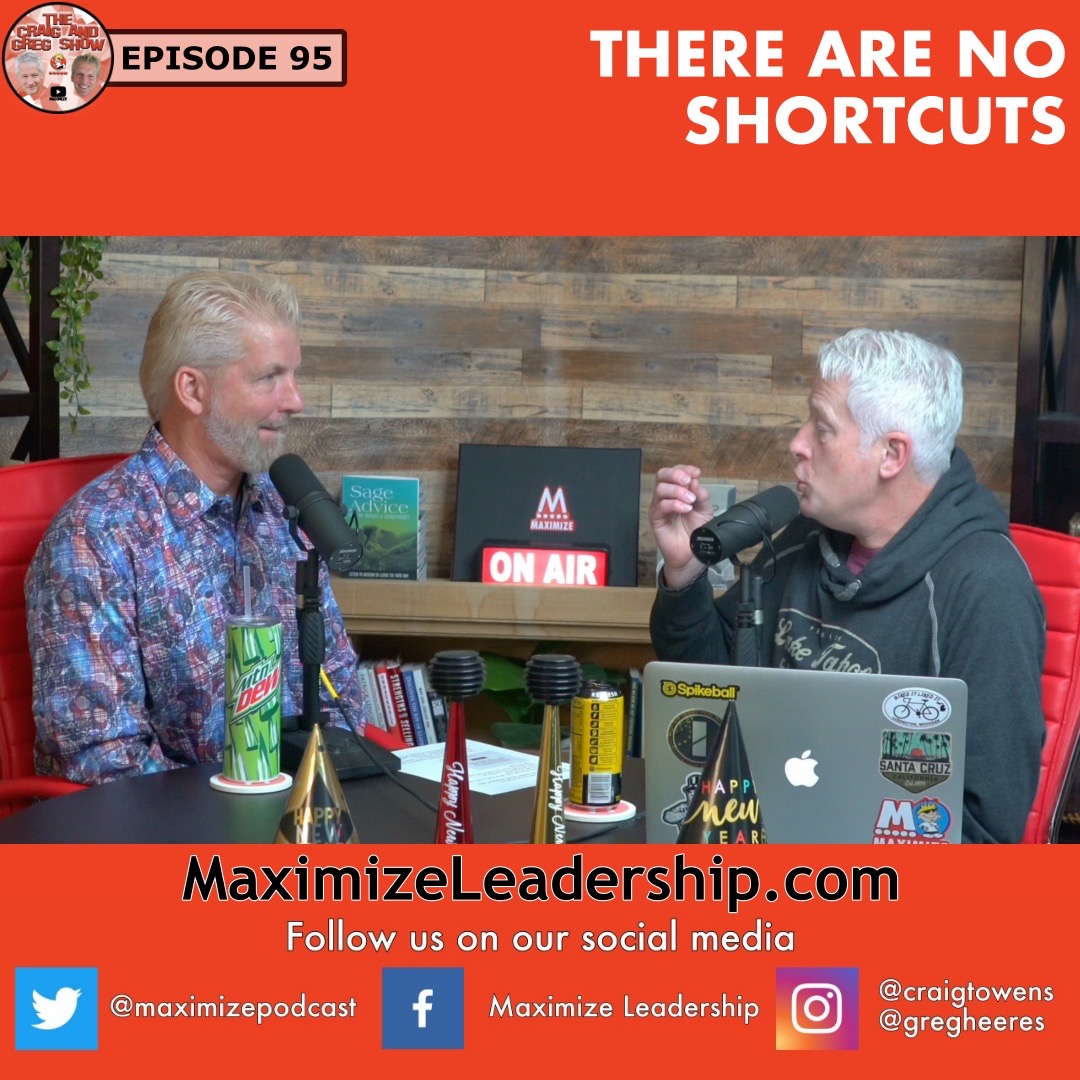
The Craig And Greg Show: There Are No Shortcuts

Listen to the audio-only version of this podcast by clicking on the player below, or scroll down to watch the video.

When you’re trying to accomplish a task it’s natural to want to search for the quickest way to get it done. But what if that’s not the best way? In this episode Greg and I discuss why rejecting shortcuts and persevering through struggles will make you a better leader, and also allow you to help your team get better as well. Join us for some powerful motivation to kick off the new year!

  • [0:23] The shortest distance between two points is ____?
  • [1:04] Why do we want things done so quickly?
  • [2:36] When difficulty makes us slow down, our natural inclination is to bail.
  • [3:40] Sometimes slowing down enriches our lives.
  • [5:22] Leaders have to prepare their team for upcoming hardships, and be willing to fight through them with the team.
  • [7:12] Greg discusses how going the extra mile separates you from the crowd.
  • [8:29] Failure informs your success.
  • [9:27] Greg and I discuss our personal experiences with “shortcut culture” in today’s society.
  • [13:11] We discuss why we love grit and stick-to-it-ivness.
  • [16:02] Greg shares a story from his time coaching football that illustrates how a leader can push the team farther.
  • [18:43] We share action points for leaders to implement this new year.
  • [22:35] A leadership coach will help you improve and be better equipped to lead your team.

Check out this episode and subscribe on YouTube so you can watch all of the upcoming episodes. You can also listen to our podcast on Spotify and Apple.

Links & Quotes

You are more likely to act yourself into good feelings than you are to feel yourself into action. Leaders need to get moving and keep moving! Check out this full conversation from The Craig and Greg Show.

I have lots of new content every week, which you can check out on my YouTube channel.

In news that’s not surprising at all, many recent paleontological discoveries confirm to exactly what would be expected if we take the biblical account of Creation and a global Flood literally.

John Piper was asked to weigh-in on the value of repetitive phrases in worship songs. He said, “The issue’s not repetition per se but whether there is enough substance, enough rich content of truth about God woven into the repetitions to justify them, to warrant them. That’s the issue. There’s a difference between repetitions that are called forth by the repeated crescendo of new, glorious truth, and repetitions that serve as a kind of mantra without sufficient truth that is simply used to sustain or intensify a mood. Moods in worship should be awakened and sustained primarily by truth, assisted by music—not primarily by music with a little truth thrown in to justify the singing.”

Pastor John Piper used Psalm 136 as an example in the post above. T.M. Moore also shared this thought about Psalm 136: “The term most frequently used to describe this everywhere-present-and-always-at-work love of God is translated as ‘lovingkindness’ or, in some versions, ‘steadfast love.’ Especially Psalm 136, with its antiphonal arrangement of verses, insists that the cosmos is upheld, sustained, and pervaded by the lovingkindness of God. … It would improve our learning to pray without ceasing if we simply took some time out during the day to thank the Lord for the many ways His steadfast love surrounds, sustains, and swarms us at every moment!”

“When people refer to a man as a man of the Book, meaning the Bible, he’s generally found to be a man of multitudinous books, which simply isolates the one Book to its proper grandeur. The man who reads only the Bible does not as a rule know it or human life.” —Oswald Chambers

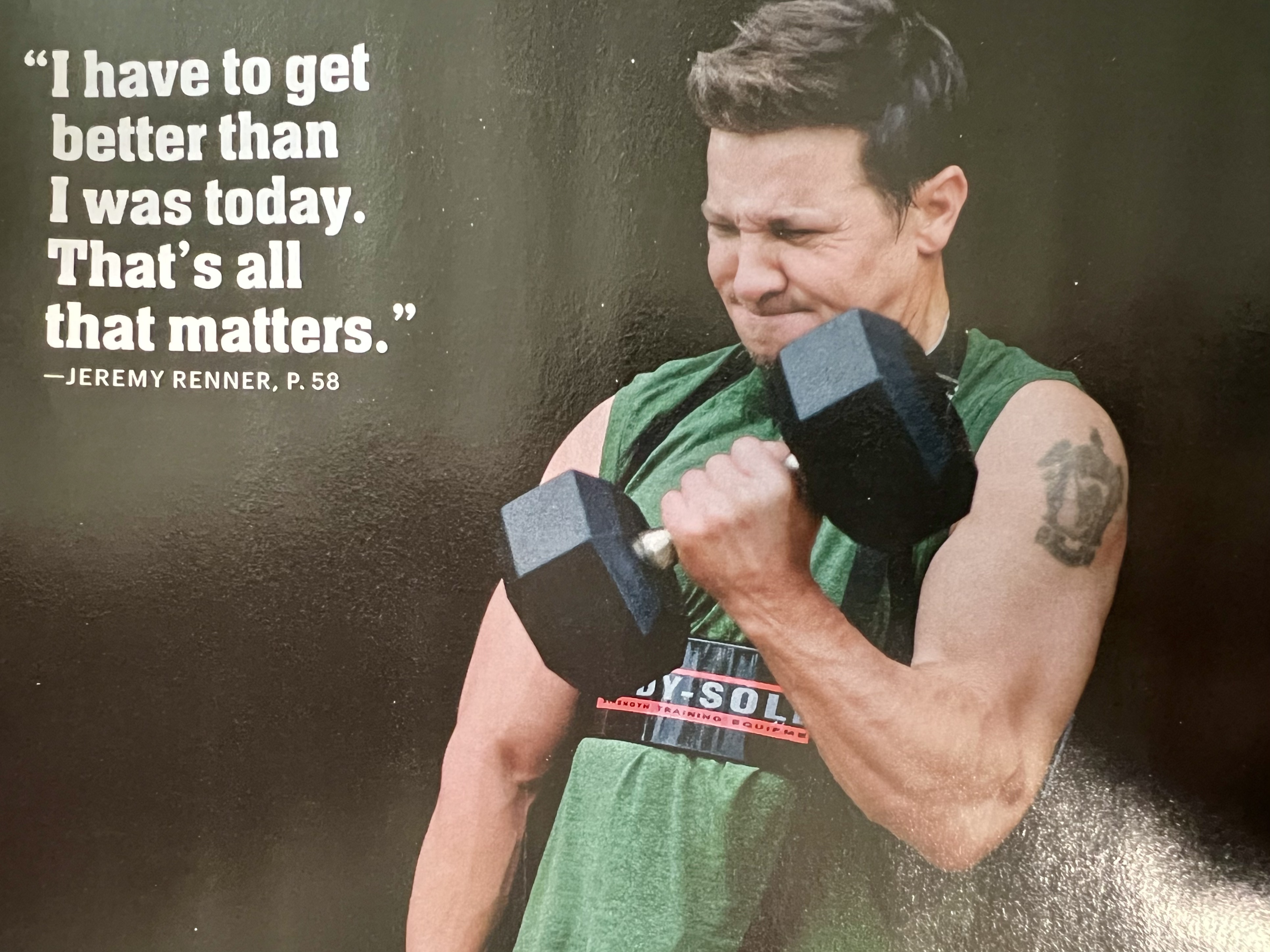
Men’s Health magazine shared an interview with Jeremy Renner, who was nearly killed in a tragic accident. I love his attitude about making today better than yesterday. His words remind me of a poem my grandma used to use to motivate me to keep “besting” what I had already done.

Christopher Ash writes about reading the Psalms through the lens of Jesus. He concludes this way: “I remember seeing on the wall of a church the words of Psalm 20:4: ‘May [the Lord] grant you your heart’s desire and fulfill all your plans!’ How wonderful, you might think. The Bible promises me all that my heart desires. Until you read the psalm and realize that Psalm 20 is a prayer for the king in David’s line. Ultimately, it is a prayer that Jesus will have His heart’s desire granted and that His plans will be fulfilled. And they will! The Psalms are not all about me. If I think they are, I will end up disillusioned. But when I grasp that they are all about Christ, my heart lifts in joy that He is the blessed Man and I belong to Him.”

Still Maturing

Listen to the podcast of this post by clicking on the player below, and you can also subscribe on AppleSpotify, or Audible. 

Have you ever said to yourself… 

  • …I should have known better?  
  • …why I am going through this again?  
  • …I thought I was over this hurdle? 
  • …you would think I would have matured enough by now to not have to deal with this?  

Maybe the author of Psalm 129 felt this way: “Here I am on the 10th step and I’m still having to deal with this! When will I finally arrive at the top and be done with these issues?” (compare Psalm 129:1-2 with 124:1-5). 

(Check out all of the Scriptures I use in this post by clicking here.) 

I think those statements—“I should have known better” or “I thought I was over this”—pre-suppose that we will reach a point in our life where we “arrive.” If nothing else, this psalm is a reminder that we are still on the journey, that we are still a work-in-progress, that the saint-ification process is still ongoing. It’s clear from Scripture that we never “arrive” until we arrive in Heaven and hear our Master say, “Well done, good and faithful servant.” 

While we are ascending up toward our heavenly home, these great oppressions and plowings remind us that there is still work to be done in us and through us to bring glory to God (Romans 5:3-4; James 1:2-4, 12). 

Of his Soviet prison, Alexander Solzhenitsyn said, “I bless you, prison—I bless you for being in my life—for there lying on rotting prison straw, I learned the object of life is not prospering as I had grown up believing, but the maturing of the soul.” 

The reality is God is using all of those things for my good and for His glory (Romans 8:28). 

What happens as I am oppressed and plowed? 

(1) I am refined—Psalm 66:8-12, 16-20. God is removing the impurities from my life. 

(2) My prayers are matured. Psalm 129:5-8 is an imprecatory prayer, a prayer that says, “Get ‘em, God!” These have their place, but for us they are to be our emergency release valve (which I discuss in more depth in my book When Sheep Bite). But Jesus calls for our prayers to mature from imprecatory to intercessory (Matthew 5:43-45). In my book I write, “This is the highest level of Christian maturity: To pray like Jesus did for those who insulted Him, slandered Him, and crucified Him, ‘Father, forgive them for they don’t understand what they are doing’ (Luke 23:34)” 

(3) I develop more intimate God-dependence—2 Corinthians 1:8-10. 

(4) I am better equipped to help others—2 Corinthians 1:3-6.  

(5) Others feel more inclined to pray for me—2 Corinthians 1:7, 11.  

“God uses broken things. It takes broken soil to produce a crop, broken clouds to give rain, broken grain to give bread, broken bread to give strength.” —Vance Havner 

Oppressed? Yes! Defeated? No! 

Plowed? Yes! Enslaved by the plow’s cords? No! 

God uses this to bring us closer and closer to Him until He can eventually say to us face-to-face, “Well done, good and faithful servant!” That’s when we truly arrive! Until then, we keep on ascending. 

If you’ve missed any of the other messages in our series looking at these songs of ascent, you can check them all out here. 

►► Would you please prayerfully consider supporting this ministry? My Patreon supporters get behind-the-scenes access to exclusive materials. ◀︎◀︎