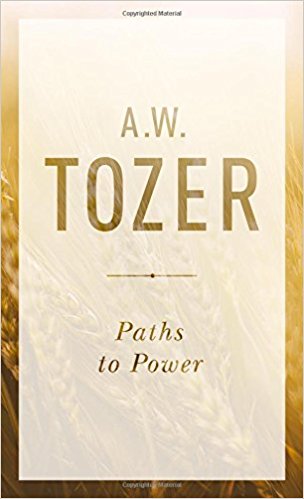
As I read A.W. Tozer’s words I find myself saying two things: (1) “Ouch!” and (2) “Amen!” Tozer’s Paths To Power is a continuation in those responses as he outlines what robs the Church and individual Christians of the power God wants them to have.
Right at the outset, Tozer identifies a key element robbing the Church of power: a lack of obedience in the things God has commanded us. “A knowledge of the truth is not enough,” he writes. “The truth must be followed if we would realize in actual experience the blessedness which is here described.”
Another power-blocker is an unwillingness to let God confront us and help us change. We get stuck in a this-is-how-it’s-always-been rut and then shut our eyes to the times of refreshing God wants to send to us. Other blockers include poor doctrine, putting the Holy Spirit in a box, justifying our sin, and not unleashing our faith, to name just a few.
Thankfully, Tozer also points us to the straightforward cures for all of the blockages to power. If we are willing to open our eyes, ears, and hearts to God’s voice, His unlimited blessings could flow uninterrupted into our lives and churches.
Paths To Power contains only seven short chapters, but the digestion, contemplation, and implementation of Tozer’s cures will be something that will involve a lifetime commitment for those ready for God’s fresh power to be poured into their lives.
When Nehemiah heard about the devastation in Jerusalem, the first thing he did was a very good thing: “I sat down and wept, and mourned for many days; I was fasting and praying before the God of heaven” (Nehemiah 1:4).
An important mark of a godly leader is one who exchanges “you” and “me” for “we.”
Godly leaders identify themselves with their people; they don’t think of themselves more highly nor look down on others.
Nehemiah said in his prayer, “BOTH my father’s house and I have sinned. WE have acted corruptly against You” (vv. 6, 7). Given the fact that this is 70 years after Judah went into captivity, it is doubtful that Nehemiah was captured in Jerusalem, but he was probably born in exile. Yet he said WE sinned against God.
He also asks God to “be attentive to the prayer of Your servant, AND to the prayer of Your servantS” (v. 11). Once again Nehemiah identifies himself with all the people by not claiming that his prayer carries any more weight than anyone else’s prayer. Every prayer, in Nehemiah’s mind, was equally as pleasant to God’s ears.
My prayer—Help me to be a “we” leader.
This is Part 23 in my series on godly leadership. To read my other posts, please click here.
In our American history, we have many valuable lessons. Some of these lessons come from sad chapters that now we have the benefit of hindsight to see the error of our ways. But with this hindsight, there should come insight into the issues which currently face us.
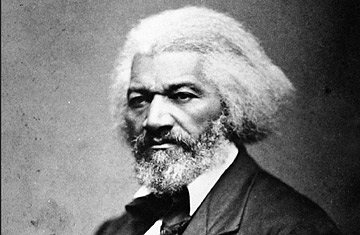
Slavery was an abhorrent evil that plagued our country. Thankfully there were strong men who forcefully and persuasively spoke out against the horrors of slavery; men like Frederick Douglass. His address “What To The Slave Is The Fourth Of July?” is a masterpiece of statesmanship!
Those under the oppression of slavery had no choice. They weren’t allowed speak for themselves, so they depended upon free men and women to speak for them.
Much the same today, babies who are aborted in the womb have no choice, no voice. They cannot speak for themselves, so it is up to us to speak out for them against this abhorrent evil that plagues our country.
I would ask you to consider some of the words of Frederick Douglass where the terms for slavery are replaced with the terms for abortion.
“Standing with God and the crushed and bleeding [aborted baby] on this occasion, I will, in the name of humanity which is outraged, in the name of liberty which is fettered, in the name of the Constitution and the Bible, which are disregarded and trampled upon, dare to call in question and to denounce, with all the emphasis I can command, everything that serves to perpetuate [abortion]—the great sin and shame of America! …
“The feeling of the nation must be quickened; the conscience of the nation must be roused; the propriety of the nation must be startled; the hypocrisy of the nation must be exposed; and its crimes against God and man must be proclaimed and denounced. …
“Let it be thundered around the world, that, in tyrant-killing, king-hating, people-loving, democratic, Christian America, the seats of justice are filled with judges, who hold their offices under an open and palpable bribe, and are bound, in deciding in the case of [an unborn baby’s] liberty, hear only [the abortionist]! …
“A religion which favors [‘choice’] against the [unborn baby]; which exalts the proud above the humble; which divides mankind into two classes, [pro-choice] and [pro-life]; which says to the [baby in the womb, you don’t matter]; and to the [abortionist, continue on]; it is a religion which may be professed and enjoyed by all the robbers and [killers] of mankind; it makes God a respecter of persons, denies His fatherhood of [all human life], and tramples in the dust the great truth of the brotherhood of man. …
“The American church is guilty, when viewed in connection with what it is doing to uphold [abortion]; but it is superlatively guilty when viewed in connection with its ability to abolish [abortion]. The sin of which it is guilty is one of omission as well as of commission. … Let the religious press, the pulpit, the Sunday school, the conference meeting, the great ecclesiastical, missionary, Bible and tract associations of the land array their immense powers against [abortion]; and the whole system of crime and blood would be scattered to the winds….
“O! had I the ability, and could I reach the nation’s ear, I would, to-day, pour out a fiery stream of biting ridicule, blasting reproach, withering sarcasm, and stern rebuke. For it is not light that is needed, but fire; it is not the gentle shower, but thunder. We need the storm, the whirlwind, and the earthquake. The feeling of the nation must be quickened; the conscience of the nation must be roused; the propriety of the nation must be startled; the hypocrisy of the nation must be exposed; and its crimes against God and man must be proclaimed and denounced.”
This is a weekly series with things I’m reading and pondering from Oswald Chambers. You can read the original seed thought here, or type “Thursdays With Oswald” in the search box to read more entries.
Whose Temple Is My Body?
If you have been laid hold of by the Spirit of God don’t think it strange concerning the spring-cleaning God is giving you, and don’t clamor for anything because it will have to go. … My body is designed to be a “temple of the Holy Ghost,” and it is up to me to stand up for the honor of Jesus Christ in my bodily practices. …
The Spirit of God will not allow me to use my body for my own convenience; the whole limit must be God’s. I am not to serve my own ends with my body, I am to serve the ends of Jesus Christ and be a devoted disciple of His. …
The historic Temple was twice cleansed by our Lord; and when He came again to Jerusalem He no longer spoke of it as “My Father’s house,” but “Behold, your house is left onto you desolate” [Matthew 23:37-38]. A terrible pronouncement, and a terrible possibility in our own lives. It is appallingly true that we may get to the place where Jesus can no longer say of us, “My Father’s house”; where He can no longer give us the benefit of scourging and cleansing, but can only retire, a weeping Christ, over our willfulness. “How often would I … and ye would not!” …
I am responsible before God for conducting my body as the temple of the Holy Ghost. Am I doing it, or is my body dictating to God, telling Him what it must do? … “Let not sin therefore reign in your mortal body, that ye should obey it in the lusts thereof” [Romans 6:12].
From The Soul Of A Christian
This is the key question: Is my body my house or is it my Father’s house?
In other words, after becoming a Christian am I saying, “I can do whatever I want with my body” or am I saying, “My body is Yours, God, to do with as You see fit”?
This is a weekly series with things I’m reading and pondering from Oswald Chambers. You can read the original seed thought here, or type “Thursdays With Oswald” in the search box to read more entries.
The Enormous Need To Be A Christian
All we can deal with in psychology is consciousness, but God does not limit our salvation by our consciousness. The need to be a Christian is not simply that Jesus Christ’s salvation may work on our conscious life, but that the unconscious realm of our personality may be protected from supernatural powers of which we know nothing. …
We are much more than we are conscious of, and if Jesus Christ only came to alter our conscious life, then the Redemption is “much ado about nothing.” But when we come to examine the New Testament we find that Redemption does infinitely more than alter our conscious life; it safeguards the unconscious realm which we cannot touch. …
Part of our personal life is conscious, but the greater part is unconscious, and every now and again the unconscious part emerges into the conscious and upsets us because we do not know where it comes from or where it leads to, and we get afraid of ourselves. …
There is only one Being Who understands us, and that is our Creator. …
Have we ever awakened to the fact that there are forces of evil around us greater than we can control? Jesus Christ by His Redemption not only saves us completely, but keeps us oblivious of the awful dangers there are outside. …
Unless we hand over the keeping of our personality to God to garrison, there are a hundred and one influences which can come into us which we never can control but which will soon control us. …
It is impossible to guard our spirit, the only One who can guard its entrances is God. If we hand ourselves over to His keeping we shall be kept not only from what we understand as dangers, but from dangers we have never even imagined. …
These aspects revealed the need to be a Christian as an enormous need. Thank God for the amazing security of His salvation! It keeps us not only in conscious life but from dangerous of which we know nothing, unseen and hidden dangers, subtle and desperate.
From The Soul Of A Christian
Thank God for the amazing security of His salvation! Do you know this security? If not, don’t wait another day to invite Jesus Christ into your life.
This is a weekly series with things I’m reading and pondering from Oswald Chambers. You can read the original seed thought here, or type “Thursdays With Oswald” in the search box to read more entries.
A Dangerous (But Vital) Prayer
No one but a fool or a sincere soul would ever pray this prayer—‘Search me, O God’ [Psalm 139:23-24] … Any soul who prays that prayer will be answered. …
If you want to know what the scrutiny of God is like, listen to Jesus Christ: “For from within, out of the heart of man, evil thoughts proceed…” [Matthew 15:19], and then follows a rugged catalog of things few of us know anything about in conscious life, consequently we are apt to be indignant and resent Jesus Christ’s diagnosis—“I have never felt like a murderer, or an adulterer, therefore those things cannot be in me.” To talk in that way is proof that we are grossly ignorant of ourselves. If we prefer to trust our ignorant innocence we pass a verdict on the only Master of the human heart there is, we tell Him He does not know what He is talking about. The one right thing to do is to listen to Jesus Christ and then hand our hearts over to God to be searched and guarded, and filled with the Holy Spirit. …
Jesus Christ has undertaken through His Redemption to put into us a heart so pure that God Almighty can see nothing to censure in it, and the Holy Spirit searches us not only to make us know the possibilities of iniquity in our heart, but to make us “unblameable in holiness” in His sight.
From The Soul Of A Christian
Are you willing to really pray this prayer, listen to what the Holy Spirit says, and then allow Christ’s work of redemption to make you unblameable in holiness?
Or, Chambers asks, “Are we willing to let God scrutinize us, or are we doing the worst of all things, trying to justify ourselves?”
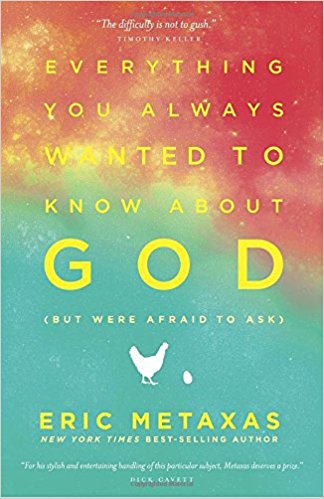
This book from Eric Metaxas is a great way to stimulate a conversation about spiritual questions, or a wonderful resource for you to read together with a friend who is on a spiritual journey of discovery. Check out my review of this book by clicking here, and then enjoy a few of the quotes I especially appreciated.
“We aren’t responsible for having answers to every question about God or the Bible posed to us, but we are responsible for how we answer, even if we don’t have a full answer.”
“Our culture is so obsessed with the physical and the material that we have lost the ability to think logically about anything outside that realm.”
“The bottom line is that those who follow God have to have genuine love and compassion for others, and if we recognize how profoundly messed up we ourselves are, we will have compassion for other people. So if people don’t have serious humility about their own state of affairs, they should probably keep their mouth shut. God doesn’t want His followers to add to the pain of the people He loves. He wants His children to treat others as people He desperately loves.”
“The idea of a moral structure that cuts God out of the picture is very attractive to humans because that puts us in control. But God wants us to understand that without a relationship with Him, moral behavior isn’t worth anything. Mere moral rectitude doesn’t fool God.”
“Religion in the negative sense of simply being a bunch of rules and rituals is pretty much the same as superstition. Without a relationship with God at its core, all religion devolves to superstition.”
“One of the most harmful things in human history is when people have confused fear-based superstition with faith in God.”
“Either Jesus was God and died on the Cross and then rose bodily from the dead, thereby destroying sin and death and making it possible for us to be with Him in paradise forever, or having faith in him is bogus. Period. Without the central events of Jesus’ crucifixion and resurrection, you simply don’t have Christianity. You can call it Christianity, but it’s not. All religions are not alike, so ultimately you have to choose.”
“That’s always the case with sin. It never presents itself as sin. It’s always presented as a doorway to a higher consciousness, as a path to enlightenment meant, as the path to divinity—to becoming a god, or like God.”
“To try to earn God’s love is to miss the point entirely. He loves us already. We can’t be more loved by Him. So to try is like adding numbers to infinity. You can’t get higher than infinity, and His love for us is infinite.”
“Faith does not necessarily make us perfect, but perhaps it does have a way of making us more aware of our feelings.”
Listen to the podcast of this post by clicking on the player below, and you can also subscribe on Apple, Spotify, or Audible.
Mankind was created good and upright in God’s image and given dominion over everything God had created (see Genesis 1:26-28; Psalm 8:3-8). But man was not given dominion over himself (Genesis 2:15-17).
As Oswald Chambers said, “The temptation came to him on this line—‘Disobey, and you will become as God.’ Man took dominion over himself and thereby lost his lordship over everything else. According to the Bible, the disposition of sin is my claim to my right to myself” (see Genesis 3:1-7).
“And sure enough, they then had knowledge of good and evil, but it was from the standpoint of becoming evil and remembering how good they once were” (Nancy Guthrie). Their disobedience created an unbridgeable gulf between God and man.
There were other consequences of their sin too:
Consequence #1—They realized they were naked, making them ashamed of themselves and ashamed to be in God’s presence.
Consequence #2—They feared God and tried to hide from Him.
Consequence #3—They couldn’t accept responsibility for what they did because that acceptance would mean they would also be responsible for bridging the gulf, something they were utterly unable to do.
Consequence #4—They were completely separated from God. Now there was nothing that they could do except work, have children, raise a family, and try to make the best of things.
Even in the midst of this despair, God foreshadowed the hope that would be their salvation. First, God promised that their offspring would one day crush satan’s head. Then God sacrificed an innocent animal and used those skins to make more permanent clothes for Adam and Eve, foreshadowing what Jesus would do.
Adam must have glimpsed this ray of hope because he then named his wife Eve, which means life!
But who could bridge this chasm? Who could be a mediator between God and man? The only possible candidate would have to be Someone who was both fully God and fully Man—that is Jesus Christ!
Only Jesus can fully and eternally cover our nakedness, remove our fear and shame, and present us without sin before His Father (see Jude 24 and Romans 5:6-11).
If, as Oswald Chambers says, sin is my claim to my right to myself, then salvation is God’s right to myself because I have surrendered to the reconciling work of Jesus.
“Believers in Christ are seen by God exactly as Christ is seen by God,” wrote Ann Voskamp, because those who believe in Jesus are clothed in His righteousness!
If you haven’t surrendered yourself to God’s right to you, what’s holding you back from doing that today? If you have surrendered yourself to God, don’t ever let satan lie to you about your nakedness, shame, or unworthiness—you are “Christ’s friend, God’s child, Spirit’s home!” (Ann Voskamp).
“A false peace is sweeping through many churches today, a peace that will fail in the troubled days ahead. Moses called stubborn Israel ‘self-blessed,’ meaning self-deceived. He warned Israel that a curse would come upon all wicked, disobedient children of God who walked in idolatry. They would plaster over their sinful ways with a false sense of peace: ‘When he hears the words of this curse, that he bless himself in his heart, saying, I shall have peace, though I walk in the imagination of mine heart’ (Deuteronomy 29:19).
“Moses is describing the child of God who decides to satisfy his lust for evil by finding a cozy doctrine that tells him he’s still saved, heaven bound—while still sinning. He says to himself, ‘I will do as I please and still not lose the peace in my heart.’ False peace!” —David Wilkerson (emphasis added)



 As I read A.W. Tozer’s words I find myself saying two things: (1) “Ouch!” and (2) “Amen!” Tozer’s Paths To Power is a continuation in those responses as he outlines what robs the Church and individual Christians of the power God wants them to have.



 Craig T. Owens