Links & Quotes

Having too many items listed as “priorities” on your To Do list can actually paralyze you. You have keep your list manageable to keep your leadership effective. Check out the full conversation Greg and I had on setting goals and making changes. This is also an important aspect of maintaining good mental health.

I have lots of new content every week, which you can check out on my YouTube channel.

According to Leslie T. Lyall, the secret of Hudson Taylor’s life and ministry could be summed up in four simple propositions: “There is a living God. He has spoken in His Word. He means what he says. And He is willing and able to perform what He has promised.”

“Hard times create strong men. Strong men create good times. Good times create weak men. And, weak men create hard times.” —G. Michael Hopf

In lamenting the rise of worldliness in our churches, John Piper said, “About forty years ago, David Wells wrote a book called No Place for Truth, which made the case that in the American church, God rests far too lightly on the people of God. He doesn’t have weight. It was the same heart cry from Dr. Wells as from J.B. Phillips. God is marginal. God has little weight in our worship services and little weight in our lives. He’s taken lightly. He’s simply one among many factors rather than the all-consuming factor, and I have thought that if I were to write a book today with a similar burden, it might have this title: Your Christ Is Too Cheap, Your Heaven Is Too Distant, Your Earth Is Too Big.”
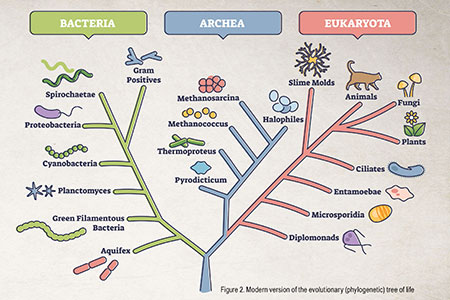
The Institute for Creation Research reported, “In July of 2024, Science magazine confidently reported, ‘The last ancestor shared by all living organisms was a microbe that lived 4.2 billion years ago, had a fairly large genome encoding some 2600 proteins, enjoyed a diet of hydrogen gas and carbon dioxide, and harbored a rudimentary immune system for fighting off viral invaders.’ That’s quite a statement that details an unknown creature living somewhere on this planet 4.2 billion years ago.” Of course, this is an unobservable, unprovable claim, but that’s part and parcel of the evolutionists’ claims. 

Fight The New Drug explains what sextortion is and how to protect yourself and your family from this insidious online threat.

“What we do on some great occasion will probably depend on what we already are; and what we are will be the result of previous years of self-discipline.” —H.P. Liddon, nineteenth-century theologian 
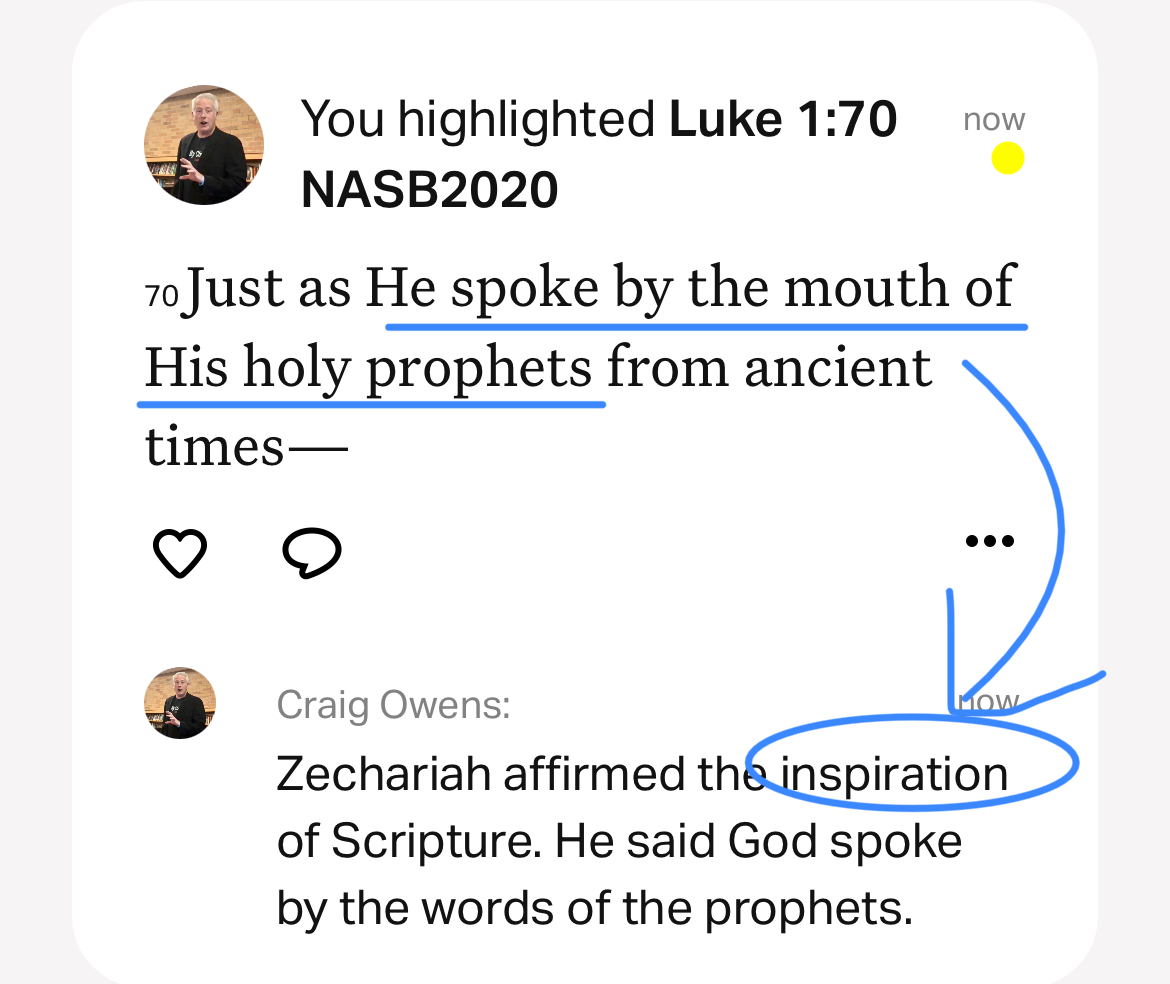
Lenny Esposito has a great podcast for Christian apologists called the Come Let Us Reason podcast. On a recent episode, Lenny used a passage in the Book of Jeremiah to talk about the inspiration of Scripture.

“God will work when He pleases, how He pleases, and by what means He pleases. He is not bound to keep our time, but He will perform His word, honor our faith, and reward them that diligently seek Him.” —Matthew Henry 

As the first Christian church dealt with a serious complaint that could have split the church internally, there are a number of leadership gifts that are in play to provide a wise solution. Most of these leadership gifts get overlooked by the casual observer, but they are all absolutely indispensable. This is new exclusive content I regularly share with my Patreon supporters. Would you prayerfully consider supporting this ministry?

The Craig And Greg Show: Leaders At Every Level

Listen to the audio-only version of this podcast by clicking on the player below, or scroll down to watch the video.

You might be checking out this episode with the hope of one day being a leader. Well, Greg and I have good news for you—you already are! Leaders are not just the person at the top, but if you have a leadership mindset you can be a leader in whatever position you currently occupy. Join us as we chat about how important it is to start being a leader before you have the “leader” title.

  • [0:24] What if you’re not the point leader in your organization? 
  • [1:22] Regardless of your title or position, you are still a leader.
  • [3:13] Leaders—whether at the top or in the middle—need to try to raise up other leaders.
  • [5:29] One trait that will increase your value to the organization is cross-training.
  • [8:20] Another trait is curiosity that keeps you a lifelong learner.
  • [11:07] An example from Tom Brady about how important passion is for those who aren’t starters yet.
  • [13:47] Two other important traits for emerging leaders is patience and self-discipline.
  • [14:37] How do point leader keep their bench players engaged until there is a new leadership position available for them?
  • [17:07] Mentoring and coaching aren’t the same things. How do we know which one to use in our organizations?
  • [21:22] Maximize Leadership can help coach you on how to mentor your emerging leaders. Check it out at https://www.maximizeleadership.com/coaching
  • [23:21] What you can do if you don’t have any mentors within your organization?

Check out this episode and subscribe on YouTube so you can watch all of the upcoming episodes. You can also listen to our podcast on Spotify and Apple.

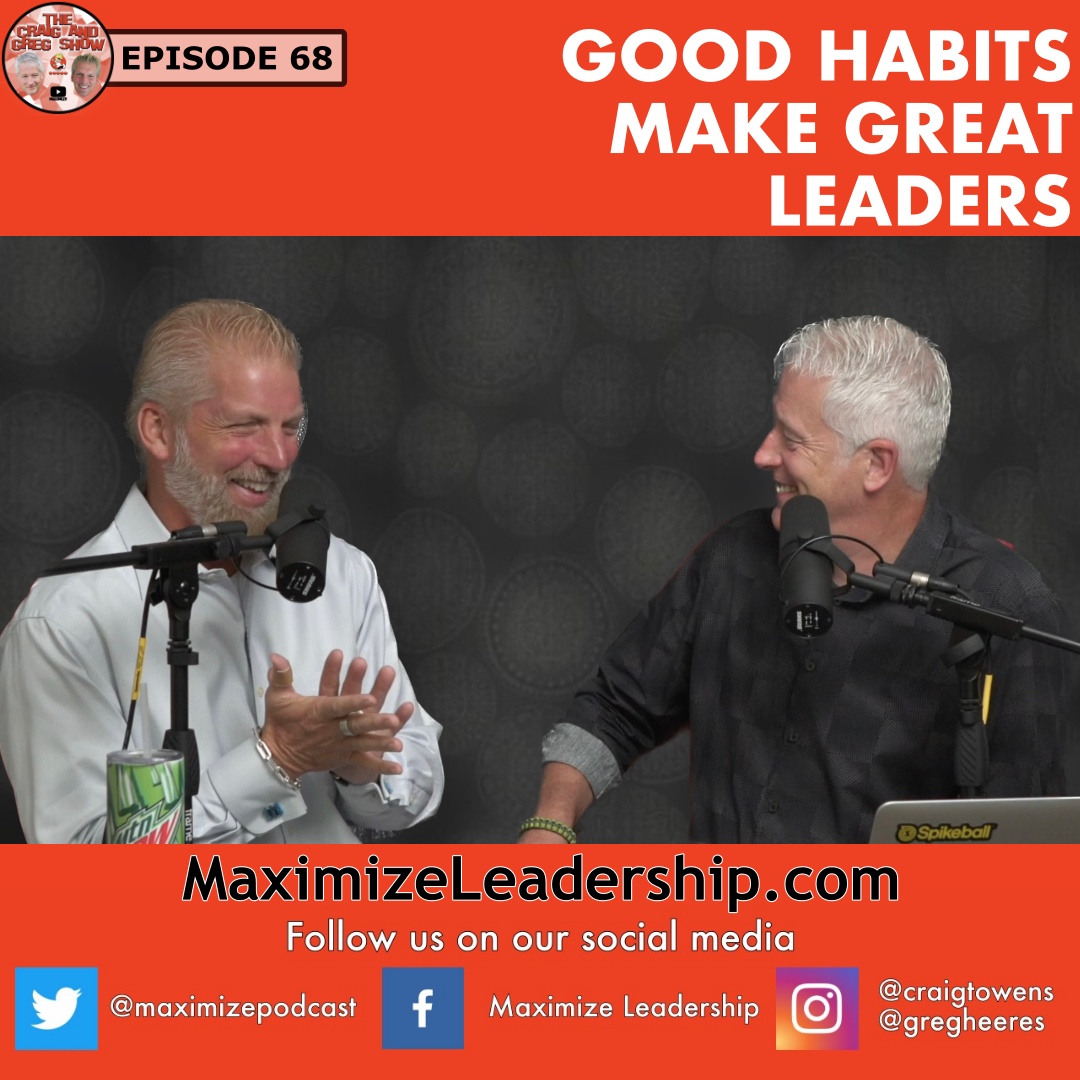
The Craig And Greg Show: Good Habits Make Great Leaders

Listen to the audio-only version of this podcast by clicking on the player below, or scroll down to watch the video.

Automatic habits are an integral part of our everyday lives. From driving a car to the way we tie our shoes, these habits help us all the time with very little thought. Of course, habits aren’t limited to these mundane tasks, we also form them in other areas, like our leadership. As a leader, it’s important to be self-reflective of our habits and make sure they are taking us in the direction we want to go. In this episode, Greg and I discuss how cultivating the right habits will help you flourish as a leader.

  • [0:19] Aristotle said excellence is a matter of our habits. 
  • [1:27] Our habits are mostly automatic—both the good and the bad habits.
  • [3:10] How do we keep our habits healthy during chaotic times?
  • [5:54] What about coping habits—should a leader use them or avoid them?
  • [7:15] My most beneficial leadership habit.
  • [9:13] Time-wasters are habits too.
  • [10:37] When we make changes in our habits, they should be incremental changes.
  • [12:17] We need to know why we want to make the change in a habit. The “why” determines the “what” and the “how.”
  • [15:24] How do leaders sustain their healthy habits?
  • [16:33] How can leaders regain their list momentum of good habits?
  • [19:27] Leaders need to be aware of the pull of their unintentional habits.
  • [22:23] How do we get our habits to serve us?
  • [23:30] I share two vital habits all high-performing leaders need.
  • [24:56] Leaders need to develop “muscle memory” to keep their healthy habits serving them.
  • [26:27] Greg shares some important quotes about a leader’s habits.

Check out this episode and subscribe on YouTube so you can watch all of the upcoming episodes. You can also listen to our podcast on Spotify and Apple.

It Takes All Of Us

Listen to the podcast of this post by clicking on the player below, and you can also subscribe on AppleSpotify, or Audible. 

In my book Shepherd Leadership I talk about some strong, godly men who gave into temptation at a moment of weakness—David who behaved so poorly toward Bathsheba and Uriah, Elijah who got depressed and suicidal, and Peter who denied knowing Jesus. 

One common factor for all of these guys is that their moment of giving in came when they were alone. They were isolated from others who may have been able to help them overcome the temptations that tripped them up. 

The principle is clear: Christians are stronger when they are with other Christians.  

Have you ever heard of the law of the weakest link? 

If I have a chain with links that can handle 400, 300, 250, 175, and 500 pounds, how much weight can the chain hold? You don’t really need a calculator for this one because the answer is the capacity of the weakest link: 175 pounds. This is why it’s to my advantage to not only strengthen myself, but to help others grow their strength as well. 

In Galatians 6:2-5, the apostle Paul talks about the strength we need for ourselves and our fellow Christian brothers and sisters. First, he says that each of us should test our own actions. I can only know my breaking point if I’m tested, and the Holy Spirit knows how to do this perfectly. After this testing, Paul says then I can take pride in myself without saying, “Well, at least I’m better than him!” 

Quite simply, Paul tells each of us that we must be able to carry our own loads. Why? Because only a strong Christian can help someone else with their load. We each have to get stronger individually so that we have strength for others! 

This is just like what we’ve been learning in our look at the Songs of Ascent: the goal is for all of the pilgrims to get to Zion together!

In this series, we are going to learn about six spiritual disciplines. Much like a physical workout, the Holy Spirit will start with us where we are. Not everyone will be at the same level nor will everyone progress at the same rate. But all of us will need these four things.

(1) Discipline. This is saying no to the easy thing or the thing that brings only fleeting happiness so that I can say yes to the things that bring eternal joy. 

(2) Stick-to-it-iveness. I have to be committed to this process for a lifetime. 

(3) Grace for yourself. There are going to be moments of struggles, plateaus, and even stumbles. Those are all a part of the journey, so we must extend grace to ourselves to learn, repent, and move forward. 

(4) Patience for others. As I just mentioned, we are all on our own journey and we all progress at different rates. Let’s be patient with each other. 

All of these spiritual disciplines are to strengthen us individually so that we have something to share with other saints (2 Corinthians 1:3-6). 

These spiritual disciplines shouldn’t become legalistic. Don’t make the way you do it the way everyone has to do it. After all, a 175-pound link will be different than a 250-pound link. 

What I am calling spiritual disciplines, C.S. Lewis called religious practices. In a letter to a friend, he wrote about the safety and beauty that result from these pursuits—

“I think about the practices what a wise old priest said to me about a ‘rule of life’ in general—‘It is not a stair but a bannister’…i.e. it is, not the thing you ascend by but it is a protective against falling off and a help-up. I think thus we ascend. The stair is God’s grace. One’s climb from step to step is obedience. Many different kinds of bannisters exist, all legitimate. It is possible to get up without any bannisters, if need be: but no one would willingly build a staircase without them because it would be less safe, more laborious, and a little lacking in beauty.” (C.S. Lewis)

The New Testament always has the words “saints” in the plural, so these disciplines will help us grow from strong individual saints to a healthy and effective collection of saints. 

Each of us needs all of us, and all of us need each of us! It does, indeed, take all of us.  

If you would like to follow along as we learn about these six spiritual disciplines, you can find all of the messages by clicking here. 

►► Would you please prayerfully consider supporting this ministry? My Patreon supporters get behind-the-scenes access to exclusive materials. ◀︎◀︎

Thursdays With Spurgeon—Froth Or Substance?

This is a weekly series with things I’m reading and pondering from Charles Spurgeon. You can read the original seed thought here, or type “Thursdays With Spurgeon” in the search box to read more entries.

Listen to the podcast of this post by clicking on the player below, and you can also subscribe on AppleSpotify, or Audible. 

Froth Or Substance?

     Many of you will read a novel from beginning to end, and what have you got? A mouthful of froth when you have done. But you cannot read the Bible—that solid, lasting, substantial, and satisfying food goes uneaten, locked up in the cupboard of neglect, while anything that man writes, as a catch of the day is greedily devoured. ‘I have written for him the great things of My law, but they were considered a strange thing’ [Hosea 8:12].

From The Bible

The Bible is the most important book anyone can read, contemplate, and apply to their lives. Yet far too many people say, “I just don’t have enough time to sit down to read the Bible.” Sadly, these same people take a lot of time on much less meaningful activities. 

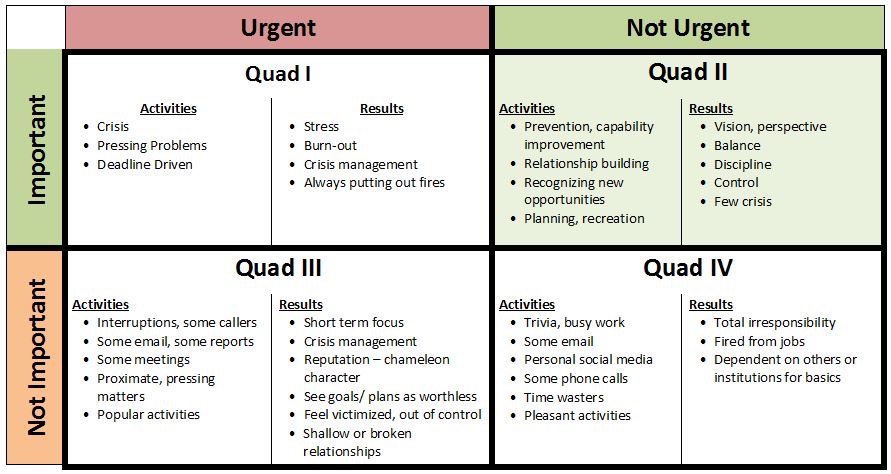
One thing that has been immensely helpful to me is the Urgent/Important grid Stephen Covey talks about in his book The Seven Habits Of Highly Effective People. Your Bible reading is never urgent—that is, an alarm will not go off to tell you it is time to read. However, your Bible reading is hugely important. 

Covey discusses how we can put all of our activities into one of the four quadrants in this chart:

Your Bible reading time is definitely a Quadrant II activity, and the best place to find time for this activity is by eliminating things in Quadrant IV—the activities Spurgeon would call froth. In my book Shepherd Leadership: The Metrics That Really Matter, I discuss how leaders can use this grid to increase their leadership effectiveness. 

The bottom line: We all must make sure we are eliminating the froth so that we have time for the great Substance that can only be found in God’s Word. 

You can download Covey’s Urgent/Important grid here → Urgent Important [Covey quadrants]

And then check out chapter 10 in Shepherd Leadership—“Can’t, Won’t or Don’t”—to learn how to use this grid to help you make the time for those important Quadrant II activities.

►► Would you please prayerfully consider supporting this ministry? My Patreon supporters get behind-the-scenes access to exclusive materials. ◀︎◀︎

The Fire Of Greatness

“It is not wrong to aspire to greatness. The warning here is to be careful to never confuse fame with greatness. Otherwise, you may be aspiring to what is not really greatness at all. Fame is what you do for yourself; greatness is what you do for others. Jesus has unveiled to us how greatness is achieved in His kingdom. To be great, you must serve. So don’t give up on your ambition to be great; instead, change your definition of what it means to be great and how greatness is achieved. … 

“The words samurai and deacon have the same core meaning. They both mean ‘servant.’ … Too often we have confused humility with powerlessness. Humility cannot be achieved from a posture of powerlessness. As long as we see ourselves as victims, humility does not come from a position of strength. True humility can be experienced only when we have come to know our power and use it for the good of others and not for ourselves. … 

“Greatness is never found; it is gained. Greatness never comes easy; it’s always the outcome of great discipline and hard work. If you’re comfortable with where you are, if you’re complacent, you will never discover the greatness that lies within. Complacency is like pouring water on coals. It is so important not to misunderstand the words of Jesus. Remember, He never said, ‘Don’t be great.’ In fact, His invitation was for only those who aspire to greatness: ‘Whoever wants to become great among you must be your servant.’ You will never know the power of servanthood until you know the fire of greatness.

“Whatever God has placed within you that could ever be described as great was never meant for you, anyway. It’s a stewardship that has been given to you. Greatness never belongs to the one who carries it; it belongs to the world that needs it.” —Erwin McManus, The Way Of The Warrior (emphasis mine)

You can read other quotes from The Way Of The Warrior here and here.

Thursdays With Oswald—Difficult Times Reveal Our Habits

Oswald ChambersThis is a weekly series with things I’m reading and pondering from Oswald Chambers. You can read the original seed thought here, or type “Thursdays With Oswald” in the search box to read more entries.

Difficult Times Reveal Our Habits 

     Practice means continually doing that which no one sees or knows but ourselves. Habit is the result of practice, by continually doing a thing it becomes second nature. The difference between men is not a difference of personal power, but that some men are disciplined and others are not. The difference is not the degree of mental power but the degree of mental discipline. If we have taught ourselves how to think, we will have mental power plus the discipline of having it under control. Beware of impulse. Impulsiveness is the characteristic of a child, but it ought not to be the characteristic of a man, it means he has not disciplined himself. Undeterred impulse is undisciplined power.

     Every habit is purely mechanical, and whenever we form a habit it makes a material difference in the brain. The material of the brain alters very slowly, but it does alter, and by repeatedly doing a thing a groove is formed in the material of the brain so that it becomes easier to do it again, until at last we become unconscious of doing it. When we are regenerated we can reform by the power and presence of God every habit that is not in accordance with His life. … We have to learn to form habits according to the dictates of the Spirit of God. The power and the practice must go together. … If we keep practicing, what we practice becomes our second nature, and in a crisis we will find that not only does God’s grace stand by us, but our own nature also. The practicing is ours not God’s and the crisis reveals whether or not we have been practicing. [See Matthew 5:31-37.]

From Studies In The Sermon On The Mount

All of us have blind spots. These are typically habits that we have left in place, unchallenged and unchanged. That “groove” in our brain is operating on auto-pilot, but those blind-spot habits aren’t serving us well. 

The role of the Holy Spirit in the life of a Christian is to help us notice these habits in which we are unconsciously incompetent. But once the Spirit of God points these out, then we must practice, and practice, and practice until the new healthy habit has overwritten the old groove of the unhealthy habit. 

Then we will find, as Chambers points out, that in a time of crisis “not only does God’s grace stand by us, but our own nature also.” 

Times of difficulty will reveal habits—both the unhealthy and the healthy. The question then becomes: what are you going to do about the unhealthy habits? 

The Scriptures And Our Temperament

“We naturally tend to interpret Scripture in the light (or shadow) of our own temperament and let our peculiar mental cast decide the degree of importance we attach to various religious doctrines and practices. …

“The minister above all others should look deep into his own heart to discover the reason for his more pronounced views. It is not enough to draw himself up and declare with dignity that he preaches the Bible and nothing but the Bible. That claim is made by every man who stands in sincerity to declare the truth; but truth has many facets and the man of God is in grave danger of revealing only a limited few to his people, and those the ones he by disposition favors most. …

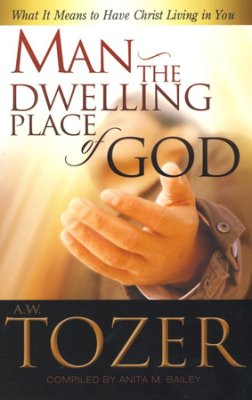
“The Scriptures, critical self-discipline, honesty of heart and increased trust in the inward operations of the Holy Spirit will save us from being too greatly influenced by temperament.” —A.W. Tozer, in Man—The Dwelling Place Of God

Religious Boredom

“Those Christians who belong to the evangelical wing of the church (which I firmly believe is the only one that even approximates New Testament Christianity) have over the last half-century shown an increasing impatience with things invisible and eternal and have demanded and got a host of things visible and temporal to satisfy their fleshly appetites. Without Biblical authority, or any other right under the sun, carnal religious leaders have introduced a host of attractions that serve no purpose except to provide entertainment for the retarded saints.

“It is now common practice in most evangelical churches to offer the people, especially the young people, a maximum of entertainment and a minimum of serious instruction. It is scarcely possible in most places to get anyone to attend a meeting where the only attraction is God. One can only conclude that God’s professed children are bored with Him, for they must be wooed to meeting with a stick of striped candy in the form of religious movies, games and refreshments. …

“Any objection to the carryings on of our present golden-calf Christianity is met with the triumphant reply, ‘But we are winning them!’ And winning them to what? To true discipleship? To cross-carrying? To self-denial? To separation from the world? To crucifixion of the flesh? To holy living? To nobility of character? To a despising of the world’s treasures? To hard self-discipline? To love for God? To total committal to Christ? Of course the answer to all these questions is no.

“We are paying a frightful price for our religious boredom. And that at the moment of the world’s mortal peril.”

—A.W. Tozer, in Man—The Dwelling Place Of God

Stop Yawning!

A challenging quote from Oswald Chambers—

“We have to treat the body as the servant of Jesus Christ: when the body says ‘Sit,’ and He says ‘Go,’ go! When the body says ‘Eat,’ and He says ‘Fast,’ fast! When the body says ‘Yawn,’ and He says ‘Pray,’ pray!”

I do not run like a man running aimlessly; I do not fight like a man beating the air. No, I beat my body and make it my slave so that after I have preached to others, I myself will not be disqualified for the prize. (1 Corinthians 9:26-27)

Wow! Time for me to redouble my efforts to Go, Fast, and Pray.