Links & Quotes

When there is a misunderstanding between the leader and a team member, insecure leaders want the other person to change. Secure leaders, however, take ownership and ask, “What do I need to do differently?” Check out more from The Craig and Greg Show.

I have a lot of new video content on my YouTube channel every week. Please check it out and subscribe so you don’t miss anything.

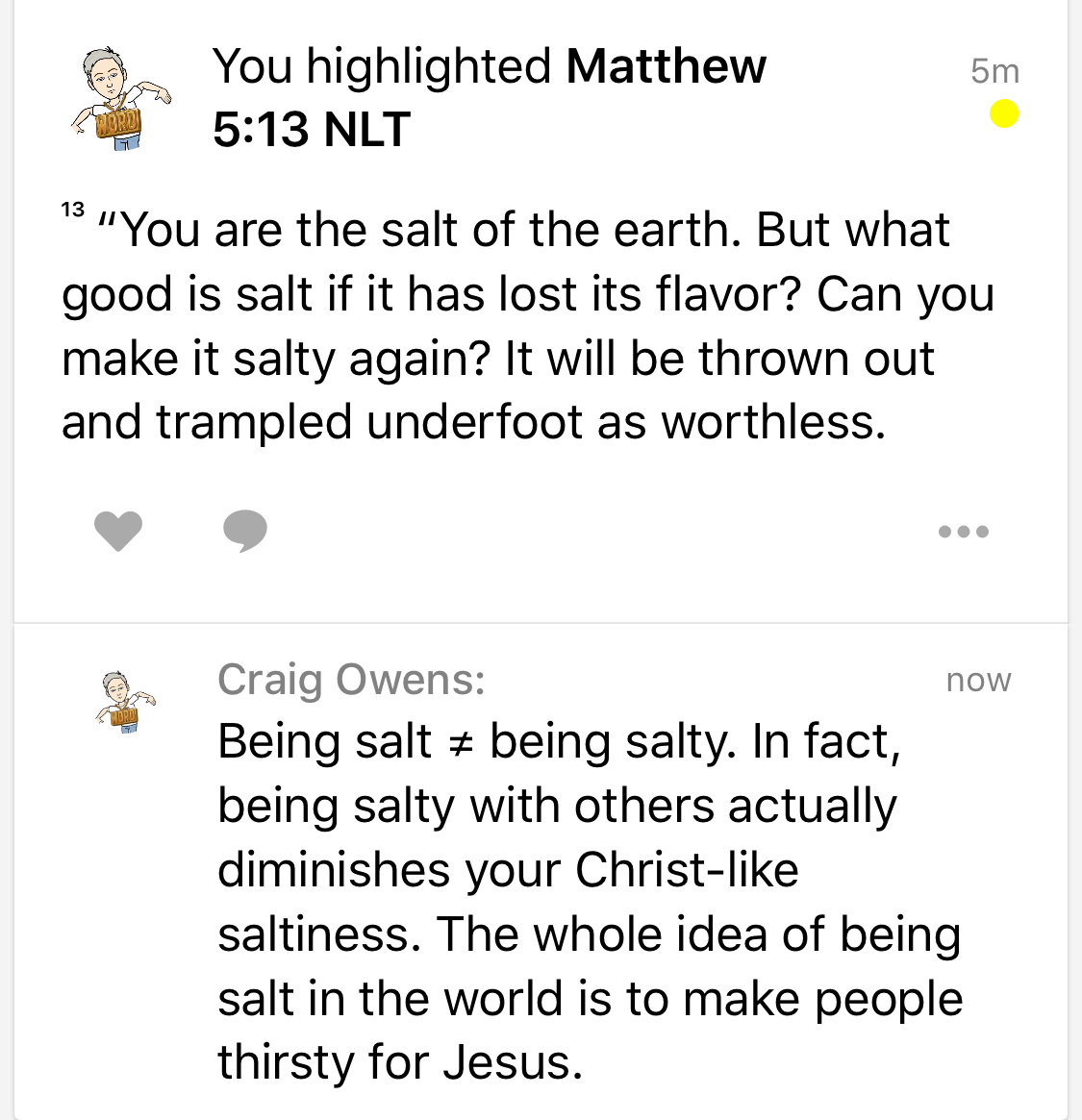
In elaborating on the words of Jesus in Matthew 5:13 about Christians being the salt of the earth, T.M. Moore wrote, “In Jesus’ day, salt had three primary functions. Most people would have understood two of these, but only those raised in an Old Testament framework would have known about the third.” Read more about what churches should be considering about how they season the community around them.
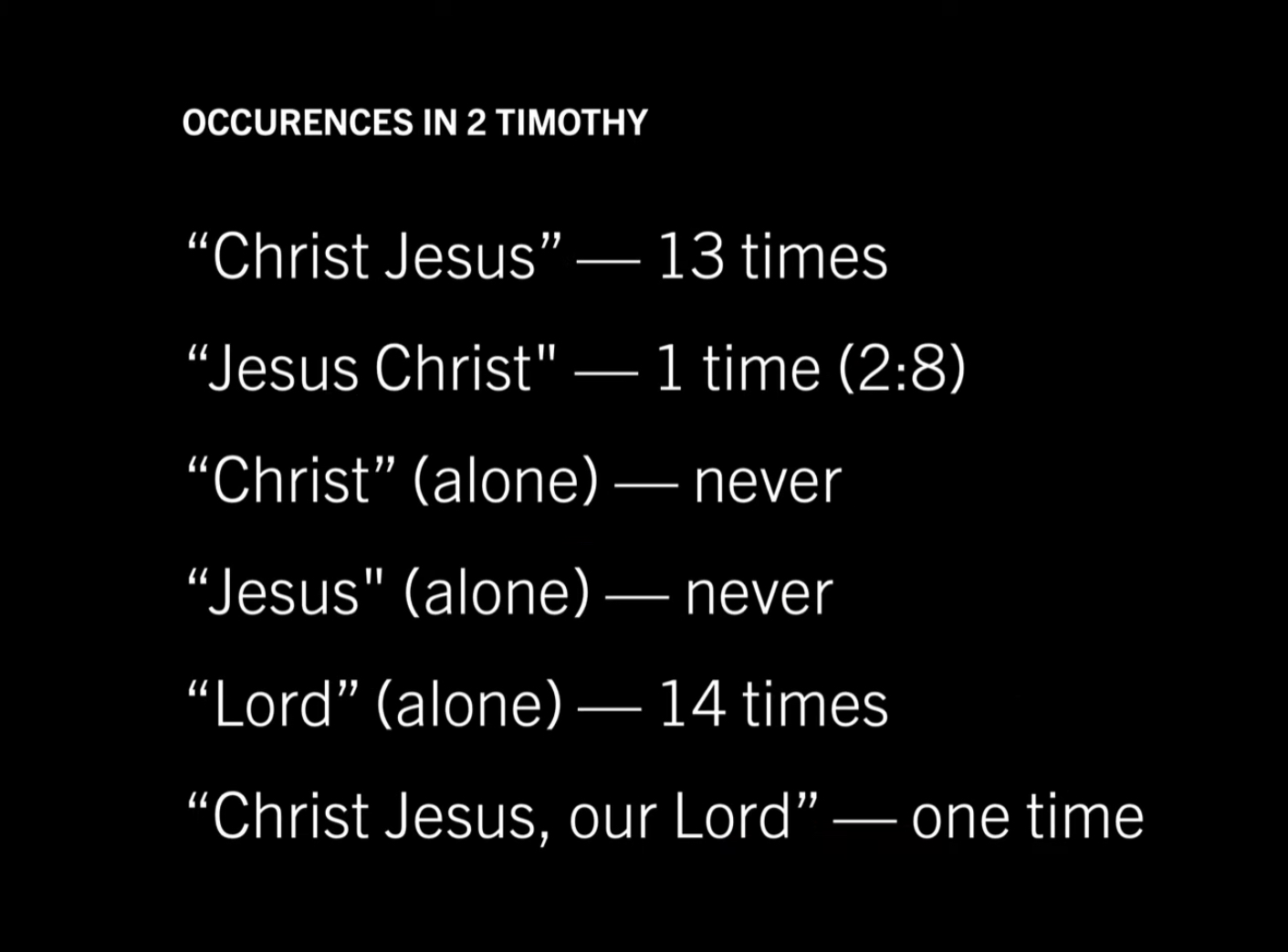
In his “Look at the Book” series, John Piper expounds on the many ways Paul refers to Jesus in his second letter to Timothy. There are several ways, but Paul’s preferred way is “Christ Jesus.” Pastor John unpacks the Hebrew and Greek origins of these words and titles, and why he thinks Paul especially gravitated toward this title.

Aerosols from penguin excrement may help trigger cloud formation, reducing solar heating and helping stabilize local areas of the Antarctic climate, study finds.” Hmmm, it’s almost like God designed His creation to take care of itself—because He did!

And an article in Science says, “According to secular models of Solar System formation, Earth, as an inner Solar System planet, should have little to no water.” And yet more than 70% of Earth is covered with water!

Aelred of Rievaulx wrote, “In friendship there is nothing more outstanding than faithfulness, which seems to be both the nurse and guardian of friendship. In all of life’s turns, in adversity and prosperity, in joy and sadness, in delightful and bitter circumstances, it reveals itself to be comparable to friendship, holding in the same regard both the humble and the exalted, the poor and the rich, the strong and the weak, the well and the infirm.”

Commenting on Aelred’s words, T.M. Moore observed, “Don’t we all want friends like that, who not only will provoke and prod us to grow in the Lord, but will stand by us in good times and bad, when we’re up and when we’re down? But if we would have such friends, we must be good stewards of their trust. This, again, is why spiritual friendships must be grounded in the Lord and focused on Jesus if they are going to bear the fruit of His indwelling Spirit.”

Evolutionary scientists claim to have made some steps forward in their understanding of the origins of life by using “the last universal common ancestor (LUCA).” But creationists like those at ICR observe that, “This mysterious LUCA is an unknown entity that existed from an unknown time ago at an unknown place by an unknown chain of unknown processes.” Clearly, the hypothesis that is the most straightforward and explainable is that God created the life in our universe just as the Bible states.

Along the same lines, Glenn Schrivener asks, “What do you think was there ‘in the beginning’—before peoples, planets, and protons? If you could hit rewind on the history of the universe and go back as far as possible, what would you find?” Then he gives us four possible things we may consider.
Sowing In Expectation

Listen to the podcast of this post by clicking on the player below, and you can also subscribe on AppleSpotify, or Audible. 

I’ve noticed how quick some people are to give up when things don’t get them the results they thought they should get, or the results don’t come as soon as they expected. 

Anytime we try something new, there is always the potential for failure. Even later on, those who appear to be an expert at something rarely do it perfectly. But in either case, there are three things we need to do if we don’t get the results we expected: (1) reflect, (2) evaluate possible improvements, (3) re-engage. 

Even before Jesus commissioned us to take His message of Good News to every street everywhere, He told us not to expect perfect results. In one of His best-known parables, Jesus talked about the farmer sowing seed (see Luke 8:5-8). 

(You can see all of the Scriptures I mention in this post by clicking here.)

Jesus didn’t say, “All of your efforts at sharing the Gospel will be successful.” In fact, He said some efforts would totally fail (falling on the hard path), and some would have only temporary success (falling on the weedy and stony ground). But we keep on sowing the seed because some will fall on good soil and yield a harvest a hundred times more than was sown! 

So, as John Wesley said, “Do all the good you can, by all the means you can, in all the ways you can, in all the places you can, at all the times you can, to all the people you can, as long as ever you can.” 

The baptism of the Holy Spirit brings dynamic, life-changing power (Acts 1:8). The life that is changed first is our own. Everything about us begins to change. 

When people heard Jesus speak, they said, “How did this Man get such learning without having been taught?” (John 7:15). The same Holy Spirit who empowered Jesus to speak is the same Holy Spirit who will empower our words. 

When our words are Spirit-empowered words, people can feel it. When our words are matched by our lifestyle, people can’t ignore it (John 7:46; Acts 2:37, 4:13, 6:10)! 

Just like salt that influences effortlessly, silently, and irreversibly, we never know what part the salt of our lives is playing in someone else’s life, even if it appears that nothing substantial is happening at all. But God said His word always accomplishes its purpose (Isaiah 55:10-11), which is why we keep on living and speaking as Spirit-empowered witnesses. 

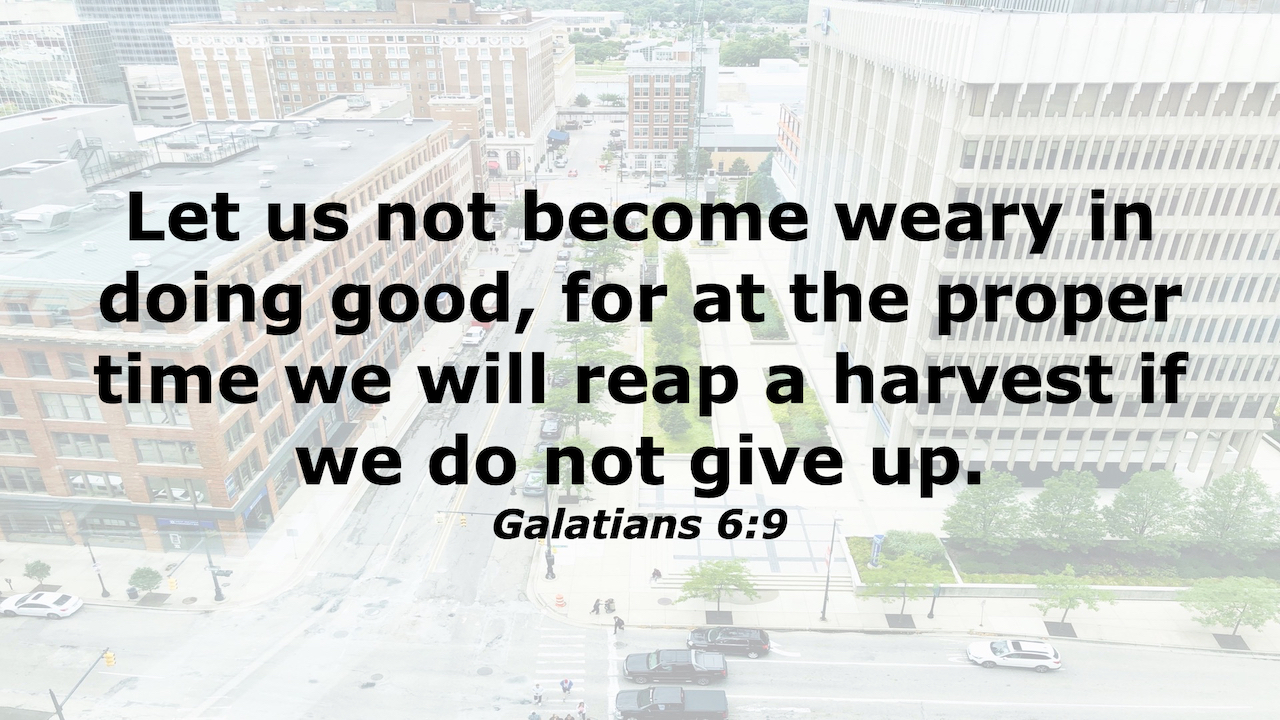
And we live expecting that something is happening—Let us not become weary in doing good, for at the proper time we will reap a harvest if we do not give up (Galatians 6:9). 

How do we take this message of Jesus to every street? 

  1. Stay yielded to the influence of the Holy Spirit 
  2. Regularly and consistently read and apply God’s Word to your own life 
  3. Keep sowing in expectation 
  4. If your efforts appear to fail: reflect, evaluate, re-engage in expectation 

We can be salt without being salty; we can be light without being annoying. 

We have been empowered to take the Good News to every street, so let us not become weary in doing this. 

If you’ve missed any of the message in our series Takin’ Him to the Streets, you can find them all by clicking here. 

►► Would you please prayerfully consider supporting this ministry? My Patreon supporters get behind-the-scenes access to exclusive materials. ◀︎◀︎

Gratitude Is A Shield

Listen to the podcast of this post by clicking on the player below, and you can also subscribe on AppleSpotify, or Audible. 

Gratitude is a great attitude. It sets you apart from the crowd of complainers, and it causes people to ask, “What do you know that we don’t know?”      

Wouldn’t you just love to silence the complainers in your life? Maybe you can relate to this poem by Shel Silverstein called Complainin’ Jack

This morning my old jack-in-the-box
Popped out—and wouldn’t get back-in-the-box.
He cried, “Hey, there’s a tack-in-the-box,
And it’s cutting me through and through.
“There also is a crack-in-the-box,
And I never find a snack-in-the-box,
And sometimes I hear a quack-in-the-box,
‘Cause a duck lives in here too.”
Complain, complain is all he did—
I finally had to close the lid.

Since, as Christians, we can’t really “close the lid” on the complaining people around us, maybe there’s something else we can do. I can think of three possibilities. 

  1. We could entirely avoid complaining people. But to do this wouldn’t allow us to live our lives as the salt and light Jesus called us to (Matthew 5:13-16). After all, in order for salt to season or light to drive away darkness, the salt and light have to be in close proximity to those they are helping. 
  1. We could simply ignore the negativity. Be around it, but do nothing about it. But both Paul and Jesus call us to engage with people in a way that points them to the Good News of the Gospel (Philippians 2:14-16; Matthew 28:19). 
  1. If we cannot avoid complainers nor remain apathetic about them, we must find a way to engage them but protect our hearts in the process. 

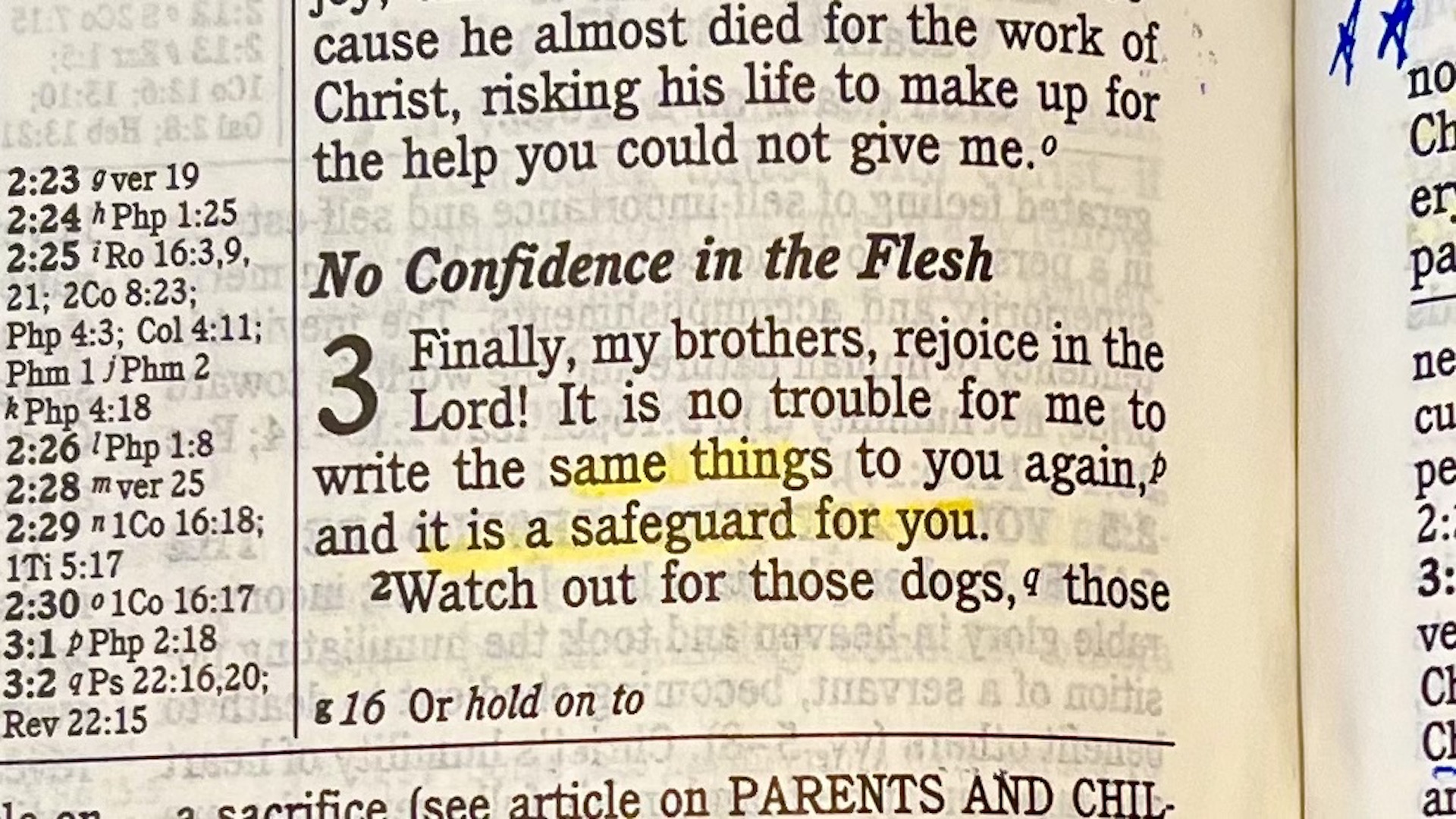
We learn from the apostle Paul’s letter to Philippi that gratitude is our shield against anything that would seek to steal our joy! “Further, my brothers and sisters, rejoice in the Lord! It is no trouble for me to write the same things to you again, and it is a safeguard for you” (Philippians 3:1). 

In the Greek, the root word for “safeguard” means “fail.” But when we add the prefix it becomes cannot fail! So rejoicing makes us secure, firm, reliable.

Quite simply that means that gratitude is our attitude protector because gratitude is our shield against anything that would seek to steal our joy!

Jesus used the same word for rejoicing even when we are facing insults, exclusion, and persecution—

Blessed are you when people hate you, when they exclude you and insult you and reject your name as evil, because of the Son of Man. Rejoice in that day and leap for joy, because great is your reward in heaven. For that is how their ancestors treated the prophets. (Luke 6:22-23) 

Both Jesus in this passage and Paul in Philippians 3:1 remind us that our rejoicing is IN the Lord. We are not expected to rejoice in our circumstances, but in who God is for us. Matthew Henry noted, “The more we rejoice in Christ the more willing we shall be to do and to suffer for Him, and the less danger we shall be in of being drawn away from Him.” 

I also like both the proactive and reactive use of rejoicing that John Henry Jowett identifies when he says, “Gratitude is a vaccine, an antitoxin, and an antiseptic.” Rejoicing is never supposed to be a one-and-done action, but it is an ongoing lifestyle. As Paul wrote to the Christians in Philippi just a few verses later, “Rejoice in the Lord always. I will say it again: Rejoice!” (Philippians 4:4). 

Gratitude is a shield—a vaccine, an antitoxin, and an antiseptic—but it doesn’t protect us unless we use it!

In order to use this shield whenever it’s needed, we have to be constantly reminded to be grateful. This is where we can leverage the power of our brain’s reticular activating system. I shared a short video about how to do this on The Podcast last week—check it out here. 

Gratitude is a great attitude, and grateful people are a winsome testimony of God’s love and provision to those “complainin’ Jacks” we all encounter. Try it and see what a difference it will make with those you are around this week. 

To check out all of the sermons in this series, please click here. 

►► Would you please prayerfully consider supporting this ministry? My Patreon supporters get behind-the-scenes access to exclusive materials, like this exclusive video in which I take my supporters behind the scenes of my thought process in designing my confrontation flowchart. ◀︎◀︎

A Preservative To Moral Decay

Listen to the podcast of this post by clicking on the player below, and you can also subscribe on AppleSpotify, or Audible. 

Have you ever wondered why the Roman soldiers treated Jesus so cruelly? After all, these are professional soldiers so why are they acting in such an unsoldierly way (see Mark 15:16-20)? 

Perhaps they thought that Jesus was just another criminal that was in cahoots with Barabbas—a murderer and insurrectionist. But where would they get that idea? It must have come from the lies and slander that the Sanhedrin were spewing. 

Perhaps the soldiers had a low value of all human life. Where would this come from? First from their leadership: particularly the way history tells us that Pontius Pilate treated the Jews. But we can go a little broader because we also know from history the disregard the Romans had for the weak, the young, the sick, and the aged. 

The bottom line is this: Anytime there is a departure in even the slightest degree from the Great Commandment—love God, love yourself, and love your neighbor—the resulting society is dark and ugly, with people mistreating others in the most inhumane of ways. 

This is where Christians are called to be salt and light. 

We stand as a check against the decay in societal values. Our high view of God’s power and love, our proper understanding of each person’s worth in God’s sight, and the way we express genuine love for others—especially the weak and marginalized—is a preservative to the moral decay. 

It’s so easy to get caught up with the loud voices around us. Pontius Pilate did, the Roman soldiers did, the Sanhedrin did, and the crowds that listened to these leaders did too. 

If you are concerned about the moral decay you see in your neighborhood, the movies and music that are released, or the behavior of our elected officials, we must adhere all the more closely to the Great Commandment: Love God with all your being, maintain a healthy self-image in light of God’s love for you, and then love your neighbor—all of your neighbors—in the same way God loves you. 

This is the only way His Spirit can equip and empower us to be effective salt and light in these last days! 

►► Would you please prayerfully consider supporting this ministry? My Patreon supporters get behind-the-scenes access to exclusive materials. ◀︎◀︎

Shine In The Darkness

Listen to the podcast of this post by clicking on the player below, and you can also subscribe on AppleSpotify, or Audible. 

I’ve noticed that when people want to sound super-spiritual that they like to use King James Version phrases. Sometimes I hear people speaking in normal, everyday English until they begin praying and then I hear, “Thy servant … Thou O Most High … we beseech Thee … Thou knowest Thine children….” 

Statement #6 in our series “Is that in the Bible” also sounds more powerful when people quote it in King James English—Shun the very appearance of evil or sometimes Wherefore come out from among them, and be ye separate, saith the Lord. Are those in the Bible? Yes, they are! 

We don’t use the word “shun” very often today, but in what was probably the first written book of the Bible we read that not only did Job shun evil, but God commended him for shunning evil too. And wise King Solomon advocated for his readers to shun evil (Job 1:1, 8; 2:3; Proverbs 3:7, 14:16). 

Yes, those phrases that I quoted earlier come right from the King James Version of the Bible in 1 Thessalonians 5:22 and 2 Corinthians 6:17, but does this mean that we are to stay away from anything that is “unChristian”? Does it mean that we are to shun sinners? 

There is a story that is told in the synoptic Gospels, but I especially like it in Matthew’s Gospel for one specific reason (which I’ll share with you in a moment). Jesus has just called Matthew to be His disciple, and several of Matthew’s coworkers appear to be having a going-away dinner for him which Jesus attended. 

Then comes the “911” call from the Pharisees (this statement is in Matthew 9:11): “Gasp! Jesus is eating with sinners! He’s not shunning them! Call in the sin police!” The New Living Translation is even more harsh, with the Pharisees asking, “Why does your Teacher eat with such scum?” (v. 13 NLT). 

In Luke’s Gospel we read another story where Jesus eating with “such scum” turned another tax collector’s life around. In Luke 19:1-10, we read of Zaccheus experiencing a complete life change because of His encounter with Jesus. 

Listen to Christ’s words in both Matthew and Luke: “It is not the healthy who need a doctor, but the sick. … I have not come to call the righteous, but sinners. … The Son of Man came to seek and to save what was lost” (Matthew 9:12-13; Luke 19:10). 

This doesn’t sound like Jesus shunned sinners.

Likewise, Jesus called us to be His salt and light in the world (Matthew 5:13-14). No matter how beneficial the salt of my life is, it doesn’t help anyone if it stays in the saltshaker, shunning the food. No matter how bright the lantern of my life is, it doesn’t help anyone in a closed closet, shunning the darkness. 

Notice what Jesus didn’t do. He didn’t go to Matthew’s house or Zaccheus’ house for a good time, or for a good meal, or for a time of entertainment. He was on mission. So too for Christians: We go into dark places not for our pleasure or entertainment, but because we’re on a rescue mission! 

In both the Old Testament Hebrew and the New Testament Greek, the words for “shun” point at our own hearts. The words mean: You walk away from things that will pull you down, or you hold yourself back from the places and things that will lead you to sin. 

So look at the phrase “Shun the very appearance of evil” in its context: “Do not quench the Spirit. Do not treat prophecies with contempt but test them all; hold on to what is good, reject [or shun] every kind of evil” (1 Thessalonians 5:19-22). 

Paul is calling us to shun the things that drown out the voice of the Holy Spirit. Listen to two of those verses in another translation: “But test and prove all things until you can recognize what is good; to that hold fast. Abstain from evil” (vv. 21-22 AMP). 

In 2 Corinthians 6 the phrase “Be ye separate” is in the context about being “unequally yoked” with unbelievers. This is what happened to King Solomon when he married women who were idolaters, and they pulled his heart away from God. 

Shun” means to keep away from those things that would pull you down. How do I know if a certain environment or activity or person is pulling me down? I need to check my thoughts, attitudes, and actions. If I find they are becoming un-Christlike, then that is an indication of a place or person that I need to limit my exposure. 

As long as my thoughts, attitudes, and actions remain Christlike, I should keep on seasoning and shining in dark places so that I can draw others to Jesus. “Do everything without complaining and arguing, so that no one can criticize you. Live clean, innocent lives as children of God, shining like bright lights in a world full of crooked and perverse people” (Philippians 2:14-15 NLT). 

Don’t shun people that Jesus dearly loves, but don’t put yourself in a position where your devotion to God is compromised either. Listen to the voice of the Holy Spirit giving you the wisdom you need to be both on-mission for Jesus and shining a bright, innocent light! 

If you’ve missed any of the other lessons in this series, you can find the full list by clicking here. 

►► Would you please prayerfully consider supporting this ministry? My Patreon supporters get behind-the-scenes access to exclusive materials. ◀︎◀︎

Reversing Entropy

Listen to the podcast of this post by clicking on the player below, and you can also subscribe on Apple or Spotify.

Don’t you wish that you could clean things up and they would stay clean? After you get everything set the way you like it, why can’t it just stay that way? Quite simply, things can’t stay clean and pristine because of the Law of Entropy. Entropy is the measure of disorder in a system, and the Law of Entropy says that unless sufficient energy is applied, an ordered system will always move toward disorder. This is as true spiritually as it is in physics. 

God created a perfectly ordered system both physically and spiritually, but man’s sin brought in disorder, disease, and decay. It gets so bad that just three chapters after man’s first sin we read, “The Lord saw how great the wickedness of the human race had become on the earth, and that every inclination of the thoughts of the human heart was only evil all the time” (Genesis 6:5).  

Throughout history, there have been revivals, reformations, and awakenings where people see the disorder and decay that sin has brought to their lives and they want to return to God. The pain of entropy causes people to repent, and the Spirit of God moves in with sufficient energy to restore. Sadly, unless the Holy Spirit’s energy is continually applied, entropy will again begin to run its downward course. 

Jesus not only came to reverse the entropy of sin (see Isaiah 9:2, 49:9; John 1:5, 8:12), but He sent us out into a sinful world to do the same thing. Jesus told us that we are salt that reverses entropy’s decay and we are light that reverses entropy’s darkness (Matthew 5:13-14). Jesus also told us that there’s no way we can maintain this entropy-reversing energy on our own—we need the Holy Spirit’s empowerment (Luke 24:49; Acts 1:8). [Check out all of these verses by clicking here.] 

Paul talked about this same idea in 2 Corinthians 3. He contrasts the ministry of the Old Testament with its fading glory, and the ministry of the New Testament with terms like more glorious, surpassing glory, and ever-increasing glory. 

Do you realize that Spirit-filled Christians never have to long for “the good ol’ days”? Being baptized in the Holy Spirit means, as Paul reminds us, that we are perpetually being transformed into the image of Jesus and we are therefore reflecting more and more of His glory. Every day can be more glorious than the day before. We don’t have to experience any entropy in our spiritual walk. 

This isn’t because of our actions. Paul says, “not that we are competent in ourselves…but our competence comes from God. … [We] are being transformed into His likeness with ever-increasing glory, which comes from the Lord, who is the Spirit.” 

Spirit-filled Christians are the agents of change in the world IF we are being transformed by the Holy Spirit. In other words, we will tend toward entropy (and uselessness) unless we have the Spirit’s energy continually applied to our lives. 

Being transformed is an ongoing, continual process. We have to have the energy of the Holy Spirit continually at work on us personally to keep us from entropy. And then we’ll be able to reflect that entropy-defeating light to a dark world. 

I’ve said this before, but I’m going to keep on saying it: Don’t stop at salvation—be baptized in the Holy Spirit. Don’t let entropy decay your salt or dim your light. Let the Holy Spirit help you reflect the light Jesus so that you can reverse the entropy of a dark, sinful world. 

If you’ve missed any of the other posts in our series called We Are: Pentecostal, you can access the full list by clicking here.

►► Would you please prayerfully consider supporting this ministry? ◀︎◀︎

Thursdays With Oswald—No Undercover Christians

Oswald ChambersThis is a weekly series with things I’m reading and pondering from Oswald Chambers. You can read the original seed thought here, or type “Thursdays With Oswald” in the search box to read more entries.

No Undercover Christians

     The illustrations our Lord uses are all conspicuous—salt, light, and a city set on the hill. There is no possibility of mistaking them. …  

     “You are the salt of the earth.” Some modern teachers seem to think our Lord said, “You are the sugar of the earth,” meaning that gentleness and winsomeness without curativeness is the ideal of the Christian. Our Lord’s illustration of a Christian is salt, and salt is the most concentrated thing known. Salt preserves wholesomeness and prevents decay. It is a disadvantage to be salt. Think of the action of salt on a wounded, and you will realize this. If you get salt into a wound, it hurts, and when God’s children are amongst those who are “raw” their presence hurts. The man who is wrong with God is like an open wound, and when “salt” gets in it causes annoyance and distress and he is spiteful and bitter. … How are we to maintain the healthy, salty tang of saintliness? By remaining rightly related to God through Jesus Christ. …  

     “You are the light of the world.” Light cannot be soiled; you may try to grasp a beam of light with the sootiest hand, but you leave no mark on the light. A sunbeam may shine into the filthiest hovel in the slums of the city, but it cannot be soiled. … Thank God for the men and women who are spending their lives in the slums of the earth, not as social reformers to lift their brother men to cleaner sties, but as the light of God, revealing a way back to God. 

From Studies In The Sermon On The Mount

God wants you to be His salt and light in the world. Are you willing to do that? 

Salt preserves, but it also stings as it does so. Some people will lash out at you for being salt in their presence, but keep on loving them with the love of Jesus. 

Light guides, but it also reveals unpleasant things. Some people will lash out at you for revealing sinful things, but keep on loving them with the love of Jesus. 

Don’t let the hostile reaction of people send you “underground.” Keep being conspicuously, unmistakably God’s salt and light in a world that is in desperate need of cleansing and illumination! 

Links & Quotes

link quote

10 facts on the great commissionJeffrey Kranz from The Overview Bible Project has a nice post called 10 Things I Wish Everyone Knew About The Great Commission.

“The purpose of the salt in the steak is to do its work so quietly that it changes the nature of what it invades without calling attention to itself. … Salt must get into something in order to have effect, where it indelibly stamps its own character upon what it invades.” —George O. Wood

Good counsel for my fellow pastors: “One great and general rule is, ask advice of Heaven by prayer about every part of your preparatory studies; seek the direction and assistance of the Spirit of God, for inclining your thoughts to proper subjects, for guiding you to proper Scriptures, and framing your whole sermon both as to the matter and manner, that it may attain the divine and sacred ends proposed.” —Isaac Watts

Culture’s Big Lie About Marriage addresses head-on the way culture wants to bend and redefine marriage.

February 27 is the day to shine a light on slavery and sex trafficking around the world. Check out the END IT movement and mark your red “X.”

“I hope the doctrine that Christians ought to be gloomy will soon be driven out of the universe. There are no people in the world who have such a right to be happy, nor have such cause to be joyful as the saints of the living God.” —Charles Spurgeon

Earth Day And The Christian

Earth Day 2013Some Christians I know shy away from being involved with anything that’s even remotely related to Earth Day. They tell me that Earth Day seems too “earthy” or even “worldly” for them. I disagree. For the Christian, I believe there are a couple of principles that converge and therefore compel us to be involved.

The first principle is mankind’s original mandate. When God created Adam and Eve and placed them in His garden, He gave them the responsibility and privilege of caring for His creation. They were to care for both the plants and animals, making sure a healthy environment was maintained for them to be fruitful (see Genesis 1:26-28 and 2:15).

The second principle is Christ’s directive. Jesus told Christians to shine like lights and season like salt, “that they may see your good deeds and praise your Father in heaven” (Matthew 5:14-16). Even Jesus Himself “went around doing good” (Acts 10:38).

So when there’s an opportunity to care for our environment by doing “good deeds,” I’m going to take advantage of that every single time!

Saturday, April 26, beginning at 10am, is the annual Earth Day and Cedar Creek cleanup in Cedar Springs. I will be there along with a number of other folks from Calvary Assembly of God. I encourage others in Cedar Springs to join us. If you live in a different community, find an activity in which you can get involved and let your light shine brightly and lovingly in your city.

Thursdays With Oswald—Consecration Isn’t Just For Ministers

This is a weekly series with things I’m reading and pondering from Oswald Chambers. You can read the original seed thought here, or type “Thursdays With Oswald” in the search box to read more entries.

Oswald Chambers

Consecration Isn’t Just For Pastors 

     Consecration is not the giving over of the calling in life to God, but the separation from all other callings and the giving over of ourselves to God, letting His providence place us where He will—in business, or law, or science; in workshop, in politics…. We are to be there working according to the laws and principles of the Kingdom of God…. 

     “Business is business” is not true for the Christian. Business is a sphere of labor in the world where a man exhibits the laws and principles of the Kingdom, otherwise he is a coward, a deserter, and a traitor to that Kingdom. 

From Christian Disciplines 

Jesus calls all Christians to be salt and light; to season and shine wherever God has placed us. We are consecrated for service to God is we are working by biblical principles, no matter what job we happen to be doing.