(Extra)Ordinary People

Listen to the podcast of this post by clicking on the player below, and you can also subscribe on AppleSpotify, or Audible. 

Paul addresses his letter to the church at Philippi like this, “all God’s holy people … the overseers and deacons” (Philippians 1:1). Notice that Paul addresses all of the saints, whether they are in a position of leadership or not. 

In verse 5, Paul says he is grateful for their “partnership in the Gospel.” Some translations use the word “fellowship” instead of partnership. This is the Greek word koinonia. By the use of this word Paul is recognizing the close relationship the church members have with their leaders, with each other, with Paul, and even with other Christians in other cities. 

The root word is koinos. The Levitical Jews used this word to designate anything that their religious rules deemed unclean, common, or ordinary. One of the things these Jewish leaders would have called unclean are Gentile people. Which means they would have referred to the saints who made up the bulk of this assembly at Philippi as unclean and unworthy of God’s love! 

But here is Paul using this ordinary word in an extraordinary way. That is, he is calling ordinary people something extraordinary: saints! Remember in the opening verse he addressed his letter to “God’s holy people.” The word holy here means the exact opposite of common or unclean—it means people set apart for God’s special use. 

The “extra” that elevated common, ordinary, unclean people to the extraordinary position of being called a saint is their personal relationship with Jesus as their Savior and Lord. 

Jesus makes the ordinary extraordinary!

Still today, our koinonia is something extraordinary. When common, ordinary, blood-cleansed people remain in relationship with Jesus and other fellow saints, God can do extraordinary things through them. Our common bond with our Savior and with other saints is itself a testimony to the life-changing power anyone can have in Jesus! 

When you are in fellowship with God and in fellowship with God’s holy people, there is nothing ordinary about you. You are an extraordinary testimony of God’s loving, transforming, and keeping power! 

►► Would you please prayerfully consider supporting this ministry? My Patreon supporters get behind-the-scenes access to exclusive materials. ◀︎◀︎

7 Images Of The Church

Husbands, love your wives, just as Christ loved the church and gave Himself up for her to make her holy, cleansing her by the washing with water through the Word. (Ephesians 5:25-26)

Dr. Henry Halley points to seven images the Bible portrays of how Jesus interacts with His saints.

“1. The Shepherd and the sheep emphasizes both the warm leadership and protection of Christ and the helplessness and dependency of believers (John 10:1-18). 

2. The vine and the branches points out the necessity for Christians to depend on Christ’s sustaining strength for growth (John 15:1-8).

3. Christ as high priest and the church as a kingdom of priests stress the joyful worship, fellowship, and service which the church can render to God through Christ (Hebrews 5:1-10; 7:1; 8:6; 1 Peter 2:5-9). 

4. The cornerstone and building stones (Matthew 21:42) accents the foundational value of Christ to everything the church is and does, as well as Christ’s value to the unity of believers. Love is to be the mortar which solidly holds the living stones together (1 Corinthians 3:9; 13:1-13; Ephesians 2:19-22; 1 Peter 2:5). 

5. The head and many-membered body, the church, is a vibrant organism, not merely an organization; it draws its vitality and direction from Christ, the Head, and each believer has a unique and necessary place in its growth (1 Corinthians 12:12-13, 27; Ephesians 4:4). 

6. The last Adam and new creation presents Christ as the initiator of a new creation of believers as Adam was of the old creation (1 Corinthians 15:22, 45; 2 Corinthians 5:17). 

7. The bridegroom and bride beautifully emphasizes the intimate fellowship and co-ownership existing between Christ and the church (Ephesians 5:25-33; Revelation 19:7-8; 21:9).

You can read all of the Bible verses listed in this post by clicking here. 

No Contention, No Compromise

Listen to the podcast of this post by clicking on the player below, and you can also subscribe on AppleSpotify, or Audible. 

As we continue our look at the Book of Jude, let me remind you that Jude calls Christians to contend for the faith with a servant’s attitude and with an all-in attitude that will not give in even when the going gets tough. 

What exactly are we contending for? Jude calls it the faith once for all entrusted to the saints” (Jude 3). 

(Check out all of the Scriptures in this post by clicking here.) 

It might be helpful to look at this phrase in the AMPC: “…to contend for the faith which was once for all handed down to the saints—the faith which is that sum of Christian belief which was delivered verbally to the holy people of God.” 

During the Reformation there was a phrase that became prominent: “Sola Scriptura” which means the Bible is our authoritative guide for everything in our lives. Jesus addressed the religious leaders who added to the Scripture (Mark 7:8-9, 13), and here Jude is now addressing those who took away from Scripture (Jude 4).   

We have to be so careful here. Contending doesn’t meet fighting for our traditions, nor does it mean compromising with the whims of culture. Jesus told us to preach the Gospel, not to argue nor give in to avoid problems. Jude says this Gospel message have been entrusted to us. 

Ronald Reagan was talking about the freedoms in the United States of America, but his warning sounds like it originated with Jude: “Freedom is never more than one generation away from extinction. We didn’t pass it to our children in the bloodstream. It must be fought for, protected, and handed on for them to do the same, or one day we will spend our sunset years telling our children and our children’s children what it was once like in the United States where men were free.” 

We don’t want to spend our sunset years telling our children and grandchildren how it used to be when we contended for the faith that was entrusted to us, but we want to tell them how we are still winsomely and consistently contending for this faith still to this day! 

So how do we contend for this faith the right way?  

(1) Study God’s Word and then study it some more. I like what Charles Spurgeon said of John Bunyan,  “Why, this man is a living Bible! Prick him anywhere—his blood is Bibline, the very essence of the Bible flows from him. He cannot speak without quoting a text, for his very soul is full of the Word of God. I commend his example to you, beloved.” May that be said of us! 

James encourages Christians to receive God’s Word in their hearts. The Amplified Bible says it this way: “the Word which [is] implanted and rooted in your hearts.” But I really love the KJV rendering that calls it “the engrafted word.” We study God’s Word to us so that it can become a living, breathing part of who we are—the very fabric of our thoughts and attitudes. 

(2) Wrestle with the whole counsel of Scripture. This is hard work, but it is the most rewarding work of all! Don’t stick with only passages of the Bible that are enjoyable to read, but consider the whole counsel of God’s Word. Ask yourself things like: What did it mean then? What does it mean now? What does it mean for me? Where can I cross-reference this with another place in Scripture? 

(3) Make your “No” merciful, peaceful, and loving. This is how Jude calls us to live in v. 2, and the apostle Peter said something very similar in 1 Peter 4:1-5. 

(4) Make your “Yes” compelling and attractive. Remember that we want to be known more for what we’re for, not for what we’re against. Again, Peter sounds this same note in 1 Peter 3:13-16. 

As saints entrusted with the faith, we have to learn to contend for this faith without becoming contentious and without compromising the truth. 

If you’ve missed any of the other messages in this series Earnestly Contend, you can find them all here. 

►► Would you please prayerfully consider supporting this ministry? My Patreon supporters get behind-the-scenes access to exclusive materials. ◀︎◀︎

Serving The Body

Listen to the podcast of this post by clicking on the player below, and you can also subscribe on AppleSpotify, or Audible. 

Last week we were reminded that sanctification (or as I call it “saint-ification”) is an ongoing process that usually involves the help of other saints. There is something else we need to do with other saints: serve them. 

We are all a part of the same Body so it is beneficial for the whole Body if we care for every part of the Body (1 Corinthians 12:25 AMPC; Ephesians 5:30). 

(Check out all of the Scriptures in this post by clicking here.) 

In order to serve others, we are going to have to check our attitude. We have been called to have the attitude that Jesus had about the Church (Ephesians 5:29; Philippians 2:3-7; John 13:3-5, 14-17). 

We must all know: 

  • I have a gift—notice the phrase each of you in 1 Peter 4:10 
  • I must use my gift to serve the Body of Christ (Luke 17:10)

In the early Church, we see so much togetherness that they rewrote the definition of the Greek word koinonia (see Acts 2:42). Here’s what koinonia looks like in the Church:

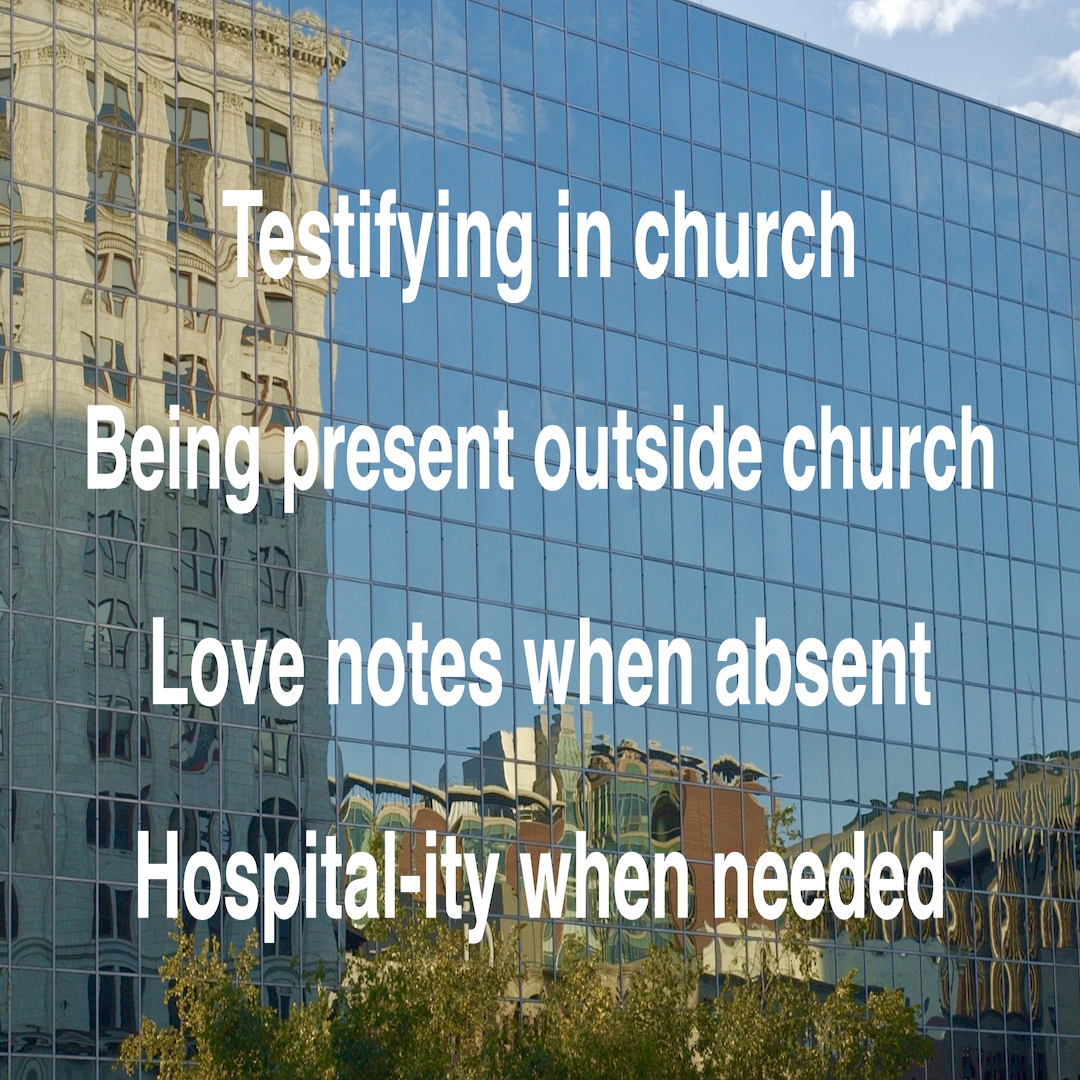
(1) Testifying in church (Psalm 40:9-10 NLT) 

(2) Being present with saints outside of church. From Acts 20-28, the pronouns “we” and “us” are used over 80 times! Paul was blessed simply by Luke being with him, just as saints are blessed when you are truly with them. 

(3) Love notes when a saint is absent. The apostle John was brilliant at this. Look at his three epistles: 

  • dear children 9x in 1 John  
  • chosen / dear lady 2x in 2 John  
  • dear friend 4x in 3 John  

(4) Hospital-ity whenever it’s needed. Be a place of healing and refreshment for the saints God has placed in your life, just as Philemon did (Philemon 2-7, 22). 

What a testimony it is when we live this way (Romans 12:10, 13)! 

Remember the saint-ification process brings fruitfulness, joy-fullness, and an enhanced testimony. I love this quote from Richard Stearns, “The beautiful simplicity of our faith is that it distills down to the exact same bottom line for both the brilliant theologian and the five-year-old child: love God and love each other—period. Everything else derives from that.” 

If you’ve missed the “B” or “A” in our series B.A.S.I.C. Christianity, you can check those out here. 

►► Would you please prayerfully consider supporting this ministry? My Patreon supporters get behind-the-scenes access to exclusive materials. ◀︎◀︎
God-ability

Listen to the podcast of this post by clicking on the player below, and you can also subscribe on AppleSpotify, or Audible. 

The last time we were together, Pastor Caleb mentioned that I was the only one he knew that put hot sauce on my eggs. But then several of you let him know that you do that too. After the service, someone told me that they like Tabasco sauce on their pizza, which isn’t something I enjoy. 

We all have different tastes. Our tastebuds are just one of the things that makes us unique creations. Unique means one-of-kind, no one else like me. We don’t need to add something like “very unique” because just by itself the word means that God made a once-in-eternity masterpiece when He made you and me. 

It’s a good thing that we are unique. I see what you don’t see, and you see what I don’t see. There are some things I know how to do well, but perhaps you struggle doing them. That’s okay because there are things you can do that I won’t have the opportunity to do. Combined together we saints make an amazing team! 

The apostle Paul understood the value of unique individuals. 

(Check out all of the Scriptures in this post by clicking here.) 

Titus was probably the one who carried Paul’s letter to the Corinthians and then had the responsibility to teach those saints how to carry out what was in the letter (2 Corinthians 2:12-13; 7:6-7, 13-15; 8:6, 16-17). Titus was the pastor that Paul sent to Crete. Paul quoted a poet who said, “Cretans are always liars, evil brutes, lazy gluttons” (Titus 1:12). Titus was confident and bold to stand his ground for what he believed (Galatians 2:1-3). 

Timothy was more soft-spoken and tenderhearted, so Paul had to encourage him more (1 Timothy 4:7, 12), but he was the one who could soothe troubled spots. Timothy stepped in to help behind the scenes (Acts 18:1-5) and he was the one Paul reached out to with his last letter form prison, asking Timothy to come to him (2 Timothy 4:12). 

What a great thing it is to have unique saints in our lives! 

One person—not matter how gifted—cannot do it all. Look at Moses in Exodus 18:13-18. Even an anointed team like the 12 apostles cannot to it all. Look at Acts 6:1-2. 

These leaders recognized the need to other uniquely gifted people to come alongside them. Moses was advised to choose capable men. In other words, those with the ability to judge disputes wisely (Exodus 18:19-25). The apostles chose those who were full of the Holy Spirit and wisdom (Acts 6:3-6). The Greek word for wisdom (sophia) means someone with heaven-sent wisdom that also has the ability to apply that wisdom effectively. 

Israel in the Old Testament and the Church in the New Testament would have been constricted if those other people hadn’t agreed to let their God-given abilities be used. 

God’s talent + My ability = God-ability

In 2 Corinthians 8-9, Paul is specifically talking about the ability of people to give their offerings to help the growing church, but there is a phrase that I think is appropriate for any application of our gifts: They gave themselves first of all to the Lord (2 Corinthians 8:5). 

When what we do is a cheerful “get to” and not an obligatory “got to” it is noticed by everyone. Those two chapters in 2 Corinthians are filled with words like cheerful, eagerness, and enthusiasm. 

In our Hand2Hand food ministry, some people have…

  • Give-ability to give financially 
  • Shop-ability to find deals
  • Organize-ability to make all the parts work
  • Strength-ability to lift and move 
  • Deliver-ability to get the needed items to those who need them

But none of these work without availability. This is the attitude that makes our God-ability a blessing and not a chore. 

There is a place in ministry for every Christian. When you are available, God will allow the talent that He has given you to be a blessing to the Church. You benefit, the other saints benefit, and the watching world sees a living witness that will draw them to Jesus. 

►► Would you please prayerfully consider supporting this ministry? My Patreon supporters get behind-the-scenes access to exclusive materials. ◀︎◀︎
Good Grief From A Friend

Listen to the podcast of this post by clicking on the player below, and you can also subscribe on AppleSpotify, or Audible. 

After God created Adam, He said, “It’s not good for you to be alone.” That’s just as true today: God didn’t intend for us to journey on our own, but He gives us companions along the way. 

Last week we saw that God has to sometimes cause us grief to get our attention when we are straying from His path. He sometimes puts people in our lives to do the same thing. 

There’s a reason God puts the people in our lives that He does. We are called to speak the truth in love (Ephesians 4:15). But that sometimes means people will get upset with us (Galatians 4:16). “Real friends hurt each other. … Truth is the primary way faithful friends should wound each other—it is the help that hurts.” —Dick Brogden 

(Check out all of the verses in this post by clicking here.) 

The Corinthians thought they were super-spiritual, but Paul had to call them out on their foolishness (1 Corinthians 3:3; 5:1-2). Before Pauls’ letter, the Corinthians seemed happy. His letter caused them grief, but it was good grief that led to repentance and true joy (2 Corinthians 7:8-10). 

To keep silent when a brother or sister is straying is not God-honoring. We are not to be the sin police, but we are to address sinful issues (James 5:19-20). 

As King David flirted with the idea of how he could get something that he thought would make him happy, an anonymous attendant tried to get his attention. David ignored this and then tried to sweep it under the rug. In fact, he thought he got away with his sin (2 Samuel 11:1–12:7). 

But God sent Nathan to speak a hard word to David. We don’t know when Psalm 141 was written, but we know that David did write it. Perhaps it was penned at the time of Nathan’s loving confrontation. He said, “Let a righteous man strike me—that is a kindness; let him rebuke me—that is oil on my head” (Psalm 141:5). 

We do know that David wrote Psalm 51 after Nathan’s loving hard word, and in this prayer we see David’s confession, repentance, and a request for God’s joy to replace David’s grief. 

So how do New Testament-era Christians use good grief to help fellow saints? 

  1. Examine yourself first (Matthew 7:1-5). Make sure you aren’t plagued by the same sin you have noticed in a brother or sister. 
  2. Cry before you confront, just as the prophet Samuel did before he had to deliver a hard word to King Saul (1 Samuel 15:10-11). 
  3. Confront in love with the goal of restoration, but make sure you are confronting someone who know you love them and who will receive your loving word  (Proverbs 27:5; 9:8). 
  4. Pray that their grief will be turned to joy (Luke 22:31-32; Galatians 6:1; Psalm 51:12). 

Friendships with fellow saints are precious and they are vital. We need iron to sharpen iron (Proverbs 27:17) so that we will all stand before the throne together for eternity. 

This is the final message in our series Grief Into Joy. If you missed any of the messages, you can check them all out by clicking here. 

►► Would you please prayerfully consider supporting this ministry? My Patreon supporters get behind-the-scenes access to exclusive materials. ◀︎◀︎
Praying For Our Fellow Saints

Listen to the podcast of this post by clicking on the player below, and you can also subscribe on AppleSpotify, or Audible. 

We tend to be pretty self-centered creatures, filtering everything through our lens. This becomes especially true when we are going though a difficult time. 

When I walked through a dark valley, I battled both physical and spiritual forces. People attacked me, but so did my own thoughts. “Why me?” and “I didn’t do anything to deserve this!” led to prayers like, “God, why didn’t You protect me from this? Why won’t you get me out of this?” 

Do you hear a common theme? I didn’t while I was in the midst of the battle, but perhaps you hear it—“Why me? I didn’t do anything to deserve this! God, why didn’t You protect me from this? Why won’t You get me out of this?” 

In his book Winning With People, John Maxwell shared ‘The Big Picture Principle’: “The entire population of the world, with one minor exception, is composed of others.” 

On the other side of my dark valley I learned something about my time in the dark valley—I had grown:

  • I could help others diagnose depression 
  • I could empathize with others
  • I could share helpful strategies to those who were struggling 
  • I could intercede for them in prayer 

My definition for intercede is to pray for people in a meaningful way because they are too beat up to pray for themselves. 

In order to pray for them, I have to know what and how to pray. I can’t know what and how to pray unless I have firsthand experience. So perhaps my dark valley wasn’t for me, but for someone else (see Romans 8:28; 2 Corinthians 1:3-11). 

(Check out all of the Scriptures in this post by clicking here.)

As Christians, we’re in this life together. 

I have talked and blogged so many times about the phrases “one another” and “each other” throughout Scripture. That means that Christian faith is best seen when we are with each other, supporting one another. 

Jesus taught us to pray, “Our Father” (Matthew 6:9). The “our” signifies we are praying…

  • …with Jesus—John 14:13-14 
  • …with other saints—Matthew 18:18-20 

Even more than praying with us, Jesus intercedes for us (Hebrews 4:15-16). And Jesus gives us the Holy Spirit (John 14:26) who also intercedes for us and with us (Romans 8:26-27). 

We join with our High Priest, helped by our Advocate, as we pray to our Heavenly Father on behalf of our brothers and sisters.  

Listen to the interceding and expectation of a joyful answer that David writes in Psalm 20, and also notice how the saints are together—

    May the LORD answer you when you are in distress; may the name of the God of Jacob protect you. May He send you help from the sanctuary and grant you support from Zion. May He remember all your sacrifices and accept your burnt offerings. May He give you the desire of your heart and make all your plans succeed. May we shout for joy over your victory and lift up our banners in the name of our God. May the LORD grant all your requests. Now this I know: The LORD gives victory to His anointed. He answers him from His heavenly sanctuary with the victorious power of His right hand.  Some trust in chariots and some in horses, but we trust in the name of the LORD our God. They are brought to their knees and fall, but we rise up and stand firm. LORD, give victory to the king! Answer us when we call!

My cousin Dick Brogden wrote, “Jesus never intended us to suffer alone. We may not physically be able to cross oceans or deserts and sit in lonely cells with colleagues—but we are intended to traverse that distance spiritually and to bear the burdens of our brothers in prayer. Followers of Jesus under duress are empowered to bear unimaginable suffering when they know that they do not agonize alone.” 

In your prayer time, I encourage you to ask the Spirit to show you lessons you have learned in your dark valleys, and then begin to intercede for your fellow brothers and sisters with the help you have already received. 

If you’ve missed any of the messages in this prayer series, you can find them all here. 

►► Would you please prayerfully consider supporting this ministry? My Patreon supporters get behind-the-scenes access to exclusive materials. ◀︎◀︎

First, Make It Right

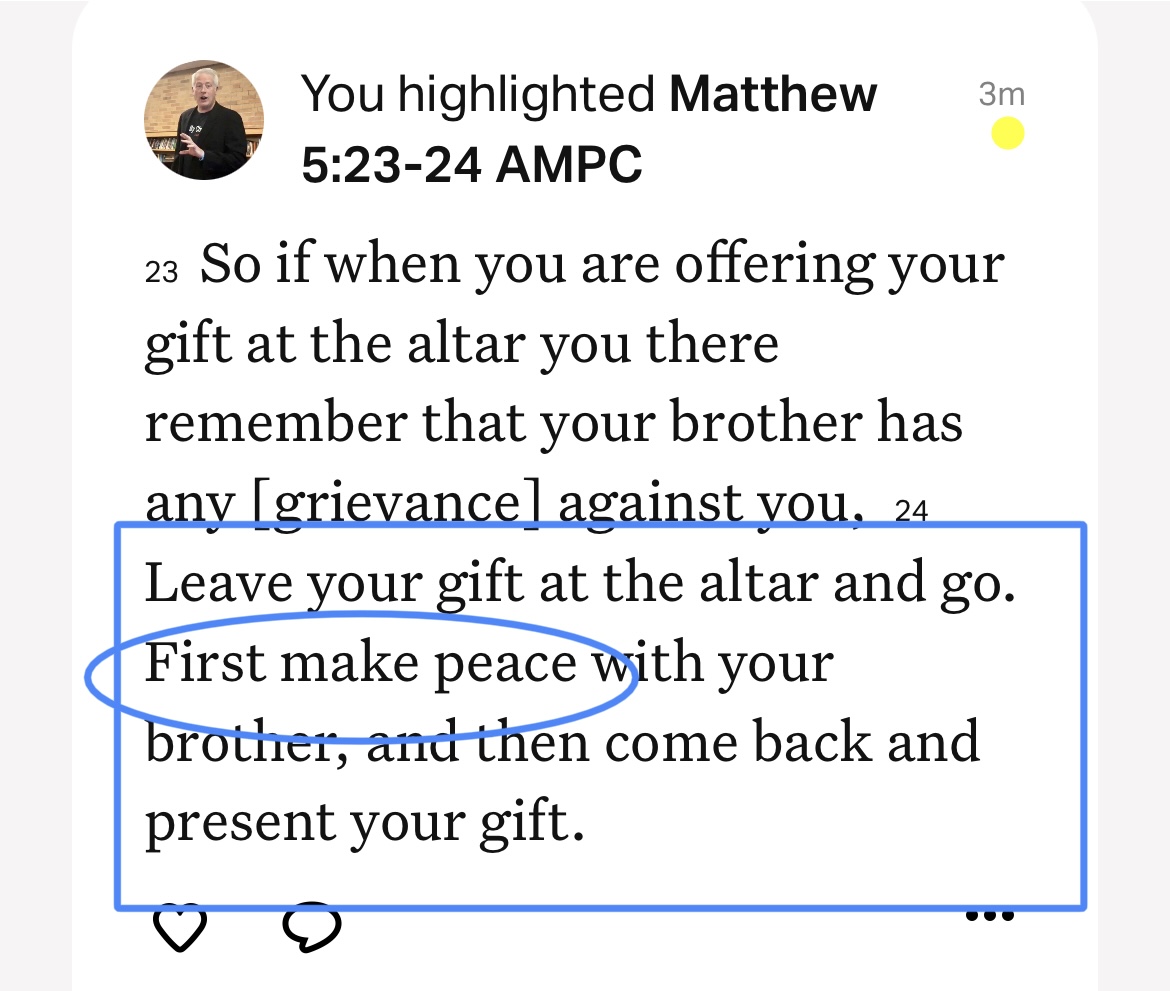
So if when you are offering your gift at the altar you there remember that your brother has any [grievance] against you, leave your gift at the altar and go. First make peace with your brother, and then come back and present your gift. (Matthew 5:23-24 AMPC) 

If someone has something against you, you must take the initiative to make it right. We cannot brush it off with, “I didn’t do anything wrong” or “That’s their problem,” but we must be proactive peacemakers. 

It could be that our restorative action will allow the other person to enter into worship in a way they were unable to before you reached out to them. 

I talk about this more in:

Links & Quotes

The apostle Paul lists three indispensable qualities of a godly leader. Remove even one of those qualities, and you no longer have a godly leader. I dive deep on these qualities (and more) in my book Shepherd Leadership.

I have lots of new content every week, which you can check out on my YouTube channel.

T.M. Moore wrote, “We are God’s poems, as Paul says in Ephesians 2:10, where the Greek word for ‘workmanship’ is ποίημα, poiema—poem. Perhaps this is why we find it pleasurable when others take an interest in us and want to get to know us better. They’re asking us to ‘read’ our ‘poem’ to them. What fun! And God wants us to know, love, enjoy, and serve Him by all the things He has freely given to us and which He seeks to ‘read’ to us day by day.”

“Saints” is always plural in the Bible. That means we always need to be looking out for our brothers and sisters in Christ. I love the words James uses to close his letter to the saints.
✅ Gather frequently to encourage others
✅ Reach out to those who are absent
✅ Speak the truth in love
✅ Exhort and encourage
✅ Forgive and ask for forgiveness
✅ Restore quickly and gently

Anthony Kidd warns about something I address in my book When Sheep Bite. “Inherent to our calling as shepherds is the task of looking out for the flock of God and protecting it from savage wolves and false shepherds. However, Paul emphasizes here that one of the greatest threats to the church can emerge from within its own leadership ranks, making self-awareness a critical aspect of pastoral leadership.” Read this full article about the earning signs of diseased leadership.

More amazing findings that show the incredible beauty and wisdom of our Creator! The ICR reports, “Insects, such as the winged insects in the order Lepidoptera, continue to reveal incredible abilities with some facets that zoologists thought were reserved only for vertebrates.”

Delighted To Go To Church

And from there the brothers and sisters, when they heard about us, came as far as the Market of Appius and the Three Inns to meet us; and when Paul saw them, he thanked God and took courage. (Acts 28:15) 

We have to be careful of thinking of Paul as some sort of super-evangelist. Yes, he was sustained by his faith in God, but look what happens to him when he is in the assembly of fellow saints—it prompted him to thank God and brought courage to his heart. 

Do you have to go to church to be a Christian? Of course not. But you will be encouraged and you will be the source of encouragement to others when you gather together regularly. 

As the writer of Hebrews tells us—

Let’s hold firmly to the confession of our hope without wavering, for He who promised is faithful; and let’s consider how to encourage one another in love and good deeds, not abandoning our own meeting together, as is the habit of some people, but encouraging one another; and all the more as you see the day drawing near. (Hebrews 10:23-25) 

You may also be interested in these related posts: