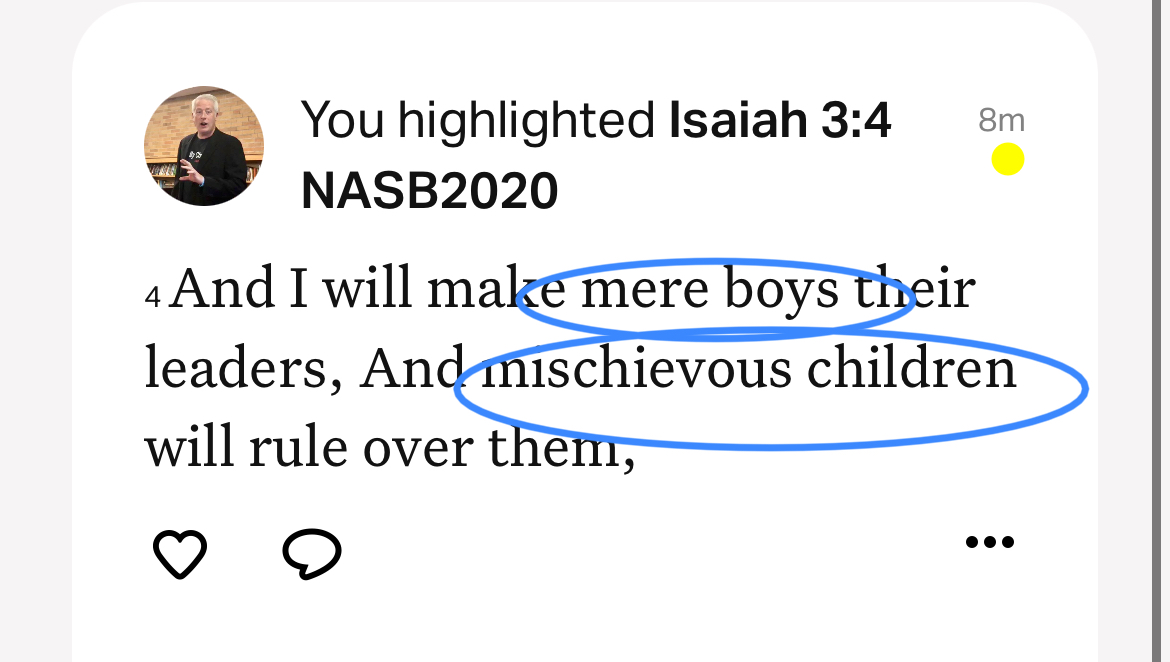
“And I will make mere boys their leaders, and mischievous children will rule over them, and the people will be oppressed, each one by another, and each one by his neighbor; the youth will assault the elder, and the contemptible person will assault the one honored.” (Isaiah 3:4-5)
God gives nations the “leaders” they deserve. They are leaders in that they occupy an office, but they don’t lead people nor care for the citizens—they don’t have wisdom to lead nor do they care about anyone but themselves. This is the inevitable result for a nation that turns its back on God!
In Hebrew, “mere boys” and “mischievous children” are defined as arbitrary, unprepared, unskilled, immature people. The AMPC translation says, “And I will make boys their princes, and with childishness shall they rule over them with outrage instead of justice” (Isaiah 3:4).
If we think our political and civic leaders are self-focused, unskilled, and childish, we should look in the mirror. We must be the leaders in confession and repentance if we want to see a change “downstream” in our governmental leaders. It’s not “them,” it’s us. We have to change—turning wholeheartedly to God—and only then God can change our leadership.
And one [angel] called out to another and said, “Holy, Holy, Holy, is the Lord of armies. The whole earth is full of His glory.” And the foundations of the thresholds trembled at the voice of him who called out, while the temple was filling with smoke. Then I said, “Woe to me, for I am ruined! Because I am a man of unclean lips, and I live among a people of unclean lips; for my eyes have seen the King, the Lord of armies.” (Isaiah 6:3-5)
The literal translation of the phrase “the whole part is full of His glory” is, “The fullness of the whole earth IS His glory.”
Paul says it this way, “All things have been created through Him [Jesus] and for Him. He is before all things, and in Him all things hold together” (Colossians 1:16-17). God spoke all things into existence—we literally live today in His breath, we breathe His breath, we eat His breath. All that exists is the fullness of His glory.
Isaiah got a small glimpse of this glory, and the weightiness of God’s awesome glory brought him to his knees (Isaiah 6:4-5).
How many trivial things would fall to the side when we realize how unimportant they are in comparison to the eternal importance of God’s glory!
How differently we would live each day if we were aware of God’s presence in and around us!
How fearful we would be to even contemplate sinning in His presence!
How quick we would be to repent of sin when we are aware of just how present He is!
How unafraid we would be to boldly stand for God and proclaim His love and power if we were aware of His ever-present Spirit equipping and supporting us!
Oh, that “the Father of glory may give you a spirit of wisdom and revelation in the knowledge of Him” (Ephesians 1:17)!
“God, do not remain quiet; do not be silent and, God, do not be still. For behold, Your enemies make an uproar, and those who hate You have exalted themselves. They make shrewd plans against Your people, and conspire together against Your treasured ones. They have said, “Come, and let’s wipe them out as a nation, so that the name of Israel will no longer be remembered.” … Fill their faces with dishonor, so that they will seek Your name, Lord. May they be ashamed and dismayed forever, and may they be humiliated and perish, so that they will know that You alone, whose name is the Lord, are the Most High over all the earth.” (Psalm 83:1-4, 16-18 NASB2020)
Even God’s punishment on the enemies of His people has a redemptive purpose: “So that they will seek Your name … So that they will know that You alone, whose name is the Lord, are the Most High over all the earth.”
Yes, we should pray as this psalmist’s Holy Spirit-inspired words direct us. Pray for protection for God’s people, pray for punishment for God’s enemies, but also pray that all of this brings about the “so thats” that will lead these enemies of God to accept His forgiveness that Jesus paid for on the Cross.
We need to be careful of overlooking details we think might be insignificant because we can easily think that our small lives are somehow insignificant. They are not! As Tom Kaastra reminded us last week, we are here on purpose and for a purpose; our lives are eternally significant.
Immediately after His resurrection, the followers of Jesus struggled to wrap their minds around what they had just experienced. Just before His ascension, Jesus explained to them both what had happened already, and what was about to happen (Luke 24:44-49).
Jesus said He had already fulfilled the promised about His crucifixion and resurrection. Luke writes that Jesus “opened their minds so they could understand” (v. 45).
Notice two important things:
The Spirit of Jesus—the Holy Spirit—opens minds
He opens minds to grasp the truth in Scripture
Jesus also says that we are still fulfilling the “what is written” (v. 46) in the the proclamation of the death and resurrection of Jesus. We are fulfilling the prophecy that says the message of Jesus will be preached everywhere to all peoples, so that they also can receive the forgiveness Jesus paid for and repent of their Godless ways.
Who opens minds? The Holy Spirit.
What does the Spirit use as a catalyst to open minds? Our witness.
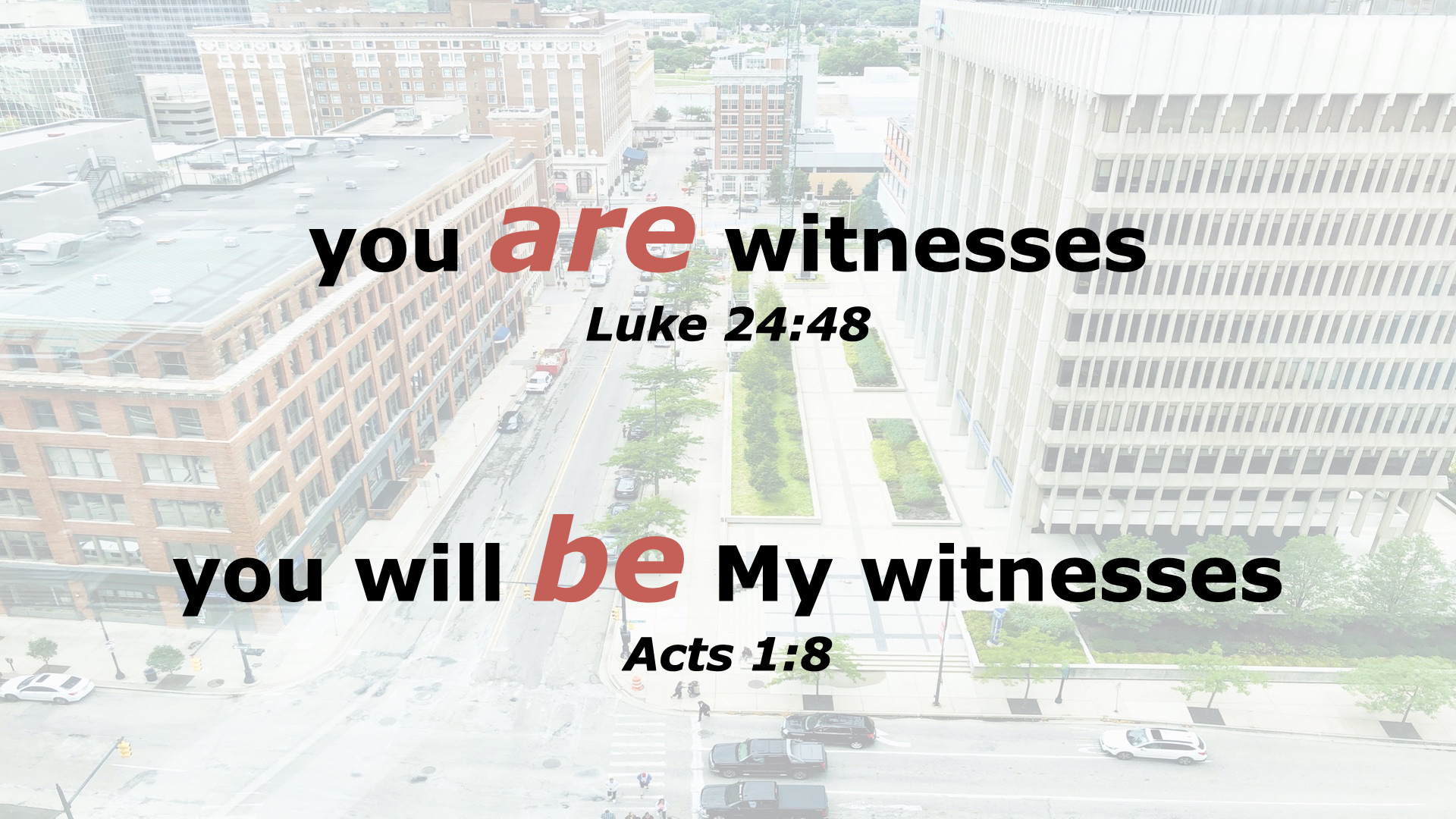
A witness is a truth-teller, who tells their firsthand story and who amplifies their verbal testimony by their Christ-honoring lifestyle. Jesus used two phrases to remind us that witnessing is not something we do, but it is who we are:
you ARE witnesses (Luke 24:48)
you will BE My witnesses (Acts 1:8)
Holy Spirit-baptized Christians are empowered to take Jesus to every street. God has strategically and purposefully placed us on our “streets” to proclaim our witness. From Easy Street to Skid Row, and everywhere in between, we are to fulfill the prophecy of proclaiming this good news to all nations (see 1 Corinthians 9:20-22).
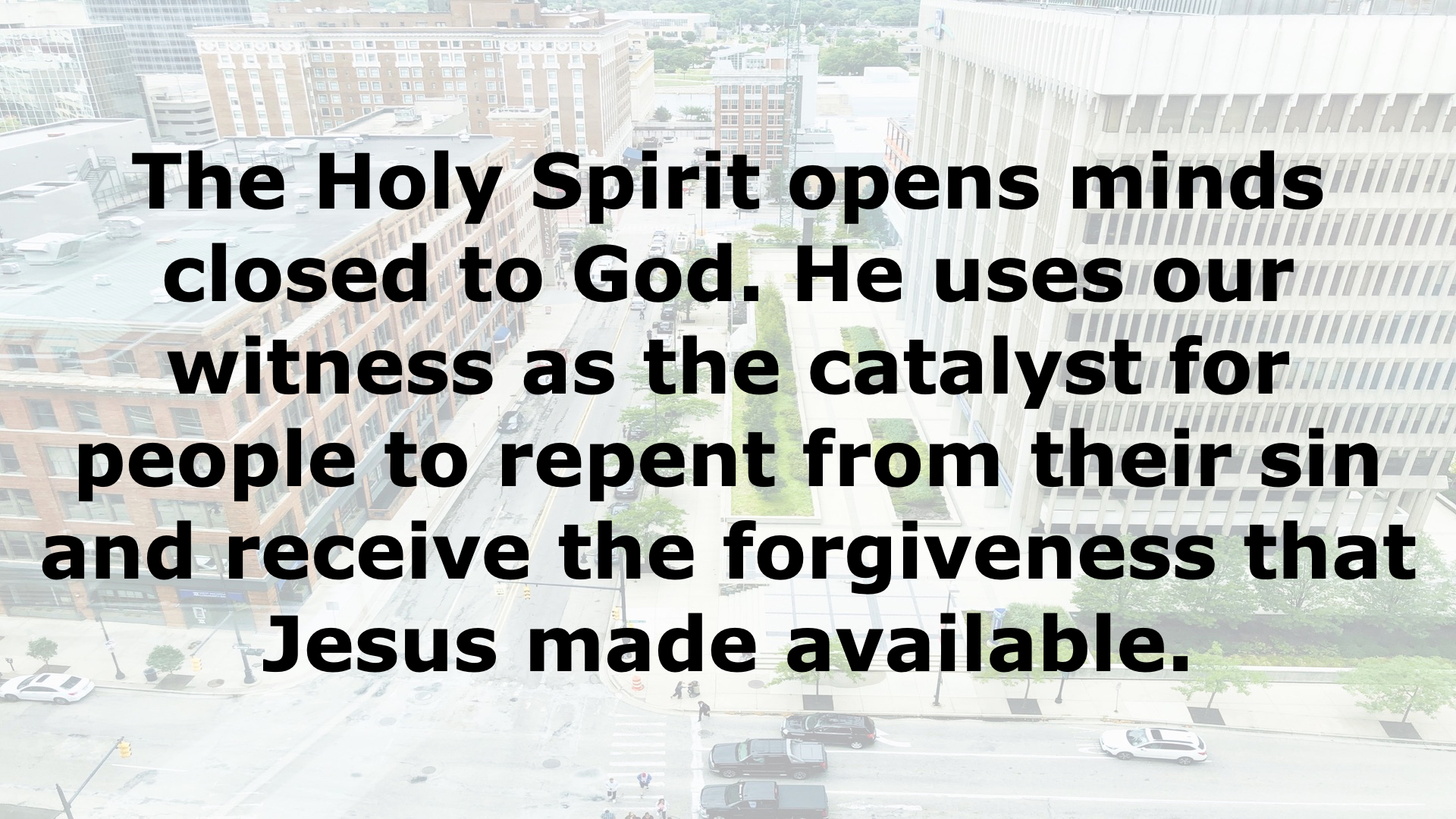
The Holy Spirit opens minds closed to God. He uses our witness as the catalyst for people to repent from their sin and receive the forgiveness that Jesus made available.
He turned to God and the people put away their idols <or>
He turned from God and the people turned to their idols
It’s true: As goes the leader, so go the people.
In my life, I’ve experienced that the good things that I do over-the-top are only moderately emulated by those around me. But the unhealthy things that I even slightly indulge in are adopted quickly by everyone else.
Godly leaders must be so aware of how their example impacts everyone around them, and they must fight to maintain biblical standards. When we miss the mark, we must be quick to admit our shortcoming, repent, and get back on track.
In Hosea 4:9, God warns that the people will follow the ungodly example of their leaders, which is why God’s punishment is often more severe for those leaders.
On the positive side, in Leviticus 9, Moses and Aaron demonstrate the leadership example of spending time in God’s presence and fully obeying everything God had revealed to them there. Then verse 23 it says that after they came out of His presence, God’s glory appeared to all the people. The positive example of the leaders led to huge blessings for all the people!
A mark of a godly leader is one who increasingly aware of the power of his example.
Leaders, let’s be first to go first in…
…being in God’s presence
…obeying God’s commands
…repenting when we fall short
…asking forgiveness of those who have seen our poor example
…asking God to bless His people because of our good example
This is part 77 in my series on godly leadership. You can check out all of my posts in this series by clicking here.
Listen to the podcast of this post by clicking on the player below, and you can also subscribe on Apple, Spotify, or Audible.
This is what the Lord Almighty says: “Cut down the trees and build siege ramps against Jerusalem. This city must be punished…” (Jeremiah 6:6).
When I read these 2500-year-old words it makes me shudder. Why? Because if we changed “Jerusalem” to “Washington, D.C.” and “Judah” to “America,” the sins of the people sound eerily the same:
arrogantly closed ears refusing to listen to God’s Word
people calling the loving message of the Bible “offensive”
the predominance of greed
deceptive “prosperity” preachers who are only in it for their own personal gain
shameless, detestable lifestyles
open rebellion against God’s laws
constant slandering of God and of people created in God’s image (vv. 10-28)
God says, “This city must be punished.”
But still, a hope remains. God also says, “Take warning, Jerusalem [or America], or I will turn away from you” (v. 8).
There is still time for repentance! There is still time to take heed of this loving warning and turn away from sin. That’s what repentance truly means—seeing our sins as disgusting in God’s sight, asking for forgiveness, and turning away from those sins.
Repentance means an about-face, so that instead of the catalog of sins that I just listed, we instead see:
a humility that hears and obeys God’s Word
living in contentment with God’s blessings and not lusting for anything more
listening to preachers who faithfully, lovingly, and boldly speak exactly what God has spoken to their hearts
being ashamed of our former sinful lifestyle, and gratefully receiving the forgiveness that Jesus purchased for us
and having a passion to help everyone live in this God-glorifying way
Repent, America! There is still time before God’s judgment falls on us. The historical record is there for all to read: Unrepented sin received God’s righteous judgment. But in His mercy, God is still giving us time to repent today. Don’t miss this golden opportunity!
This is a weekly series with things I’m reading and pondering from Charles Spurgeon. You can read the original seed thought here, or type “Thursdays With Spurgeon” in the search box to read more entries.
Listen to the podcast of this post by clicking on the player below, and you can also subscribe on Apple, Spotify, or Audible.
Understanding Repentance
Repentance is an old-fashioned word, not much used by modern revivalists.
“Oh!” said a minister to me one day, “it only means a change of mind.” This was thought to be a profound observation. “Only a change of mind”; but what a change! A change of mind with regard to everything!
Instead of saying, “It is only a change of mind,” it seems to me more truthful to say it is a great and deep change—even a change of the mind itself. But whatever the literal Greek word may mean, repentance is no trifle. You will not find a better definition of it than the one given in the children’s hymn:
Repentance is to leave
The sins we loved before
And show that we in earnest grieve,
By doing so no more.
From The Soul Winner
The Greek word Spurgeon references that is rendered as repentance is metanoia. Many have translated this as a “new mind.” But a more literal translation is “with new understanding.” When my carnal mind has been replaced by a spiritual mind, I now see everything differently—I understand everything differently.
The Amplified Bible elaborates it like this: Bring forth fruit that is consistent with repentance—let your lives prove your change of heart (Matthew 3:11).
More than just an about-face away from my old sinful habits, repentance is a more profound understanding of just how grievous my sinful lifestyle was to God. It repulses me to even consider indulging in those sins again because now that I understand how joy-filled my relationship with Jesus is when I walk in righteousness, I never want to even dabble in that slime again!
Listen to the podcast of this post by clicking on the player below, and you can also subscribe on Apple, Spotify, or Audible.
At that time I will search Jerusalem with lamps and punish those who are complacent… (Zephaniah 1:12).
When I taught a series on the minor prophets, I noted that Zephaniah wanted to share some really, really good news, but first, he had to make his audience confront the really bad news. The really bad news is that we all have sinned and fall short of God’s righteous standard. The really, really good news is that God has provided forgiveness for our sins through Jesus.
Sadly, one of the things that keeps us from addressing the sin in our heart is complacency. The King James Version of Zephaniah 1:12 says that the people were “settled in their complacency.” If you look up the definition of the Hebrew word here, it literally means settled on their lees.
Look at the full verse in the NIV: “At that time I will search Jerusalem with lamps and punish those who are complacent, who arelike wine left on its dregs, who think, ‘The Lord will do nothing, either good or bad.’”
This phrase—“who are like wine left on its dregs”—puts the people at a tipping point. The lees or dregs of a barrel is where the wine is at its finest color and flavor. But wine that has “settled” is right at the point of curdling.
God is addressing people who have become self-satisfied. They have reached the place that they have called their “good life.” They want nothing to disturb them; especially not any teaching or preaching that may bring the conviction of the Holy Spirit.
So they have deluded themselves. They have said, “If everything seems to be going well for me, then I must be doing everything right. Don’t tell me anything that might make me uncomfortable.” Outward appearances and circumstances can be deceiving. We have to listen for the voice of the Holy Spirit. We must never become complacent in our relationship with Jesus.
A very similar warning is sounded for the church in Laodicea. Jesus called them complacent when He said that they were neither hot nor cold, but lukewarm. They, too, had also stopped listening to the Holy Spirit because they had complacently said to themselves, “I am rich; I have acquired wealth and do not need a thing.”
Laodicea was at the point where they should have been at their finest, but instead their complacency had brought them to a place of curdling—a place where Jesus threatened to spit them out of His mouth!
Complacency is deadly!
The solution: listen to the rebuke and discipline that the Holy Spirit brings, and repent of complacency. If we do, we will discover the inestimable, eternal riches that only a vibrant relationship with Jesus can give us (Revelation 3:14-22).
Let us never become settled on our lees, but let us be ready to be poured out for our Master’s enjoyment and glory. May I suggest that we all regularly pray the prayer of David: “Search me, O God. Point out any sin that I have complacently allowed to remain in my heart” (Psalm 139:23-24). And when that sin is revealed, don’t wait to repent because your wine is just about to curdle! But the restoration that repentance will bring to your heart will allow the richness and vibrancy of your life to be pleasing to your Savior!
There is a psychological term called “projection” where we see in others what is really in ourselves. This is something Christians MUST guard against doing. Instead of going to the other person first, let’s go to our knees in prayer first. This is a short clip from a full-length teaching video I provided exclusively for my Patreon supporters.
“Blessed are those who can give without remembering and can take without forgetting.” —Elizabeth Bibesco
Listen to the podcast of this post by clicking on the player below, and you can also subscribe on Apple, Spotify, or Audible.
I have probably heard this verse quoted more by non-Christians than any other verse: “Do not judge, or you too will be judged” (Matthew 7:1).
Does Jesus mean that we can never point out to anyone else an area of concern? No, because Jesus Himself did this as well as nearly every epistle writer of the New Testament. What it does mean is that confrontation needs to be truly corrective and never condemning.
Correcting means that I am never serving as the judge and jury. But it does mean that I can lovingly help someone before they have to stand before God on Judgment Day. Jesus said that if I am a mean, self-serving judge of others, I can expect to receive that same treatment (v. 2).
Instead, I need to first recognize that what I may see in another person may only be apparent to me because I am afflicted with the same thing. So my first response when I see “a speck” in someone else’s eye is to ask the Holy Spirit to show me a possible “plank” in my own eye. Only after I have dealt with this through repentance and making appropriate changes, will I have the necessary empathy and gentleness to help my brother or sister deal with their own eye speck (vv. 3-4).
Jesus said that trying to get someone else to repent of something that still exists in my own life is being a hypocrite. It’s playing a role that isn’t me. So Jesus says “first” deal with my own sin, “then” I may help a brother or sister (v. 5).
Notice that I have been very careful to use the phrase “brother and sister.” I believe that Christians should deal with fellow Christians, but we shouldn’t try to bring correction to those who don’t come from the same biblical paradigm that we have. In legal terms, I may say that we have no standing, or that non-Christians are out of my jurisdiction.
One final thought. I think I need to treat a concern that another person brings to me in a very similar fashion as I would treat an eye speck in someone else. Perhaps God sent them to me, so I need to ask the Holy Spirit to show me any “plank” that may be in my eye, even if it has been brought to my attention through a judgmental person. It is very God-honoring for me to give that person the benefit of the doubt by saying that they cared enough for my well-being that they would be willing to point something out to me.
Correction is an important aspect of Christian maturity. But we need to make sure we do it in a Christlike way.



 This is God speaking—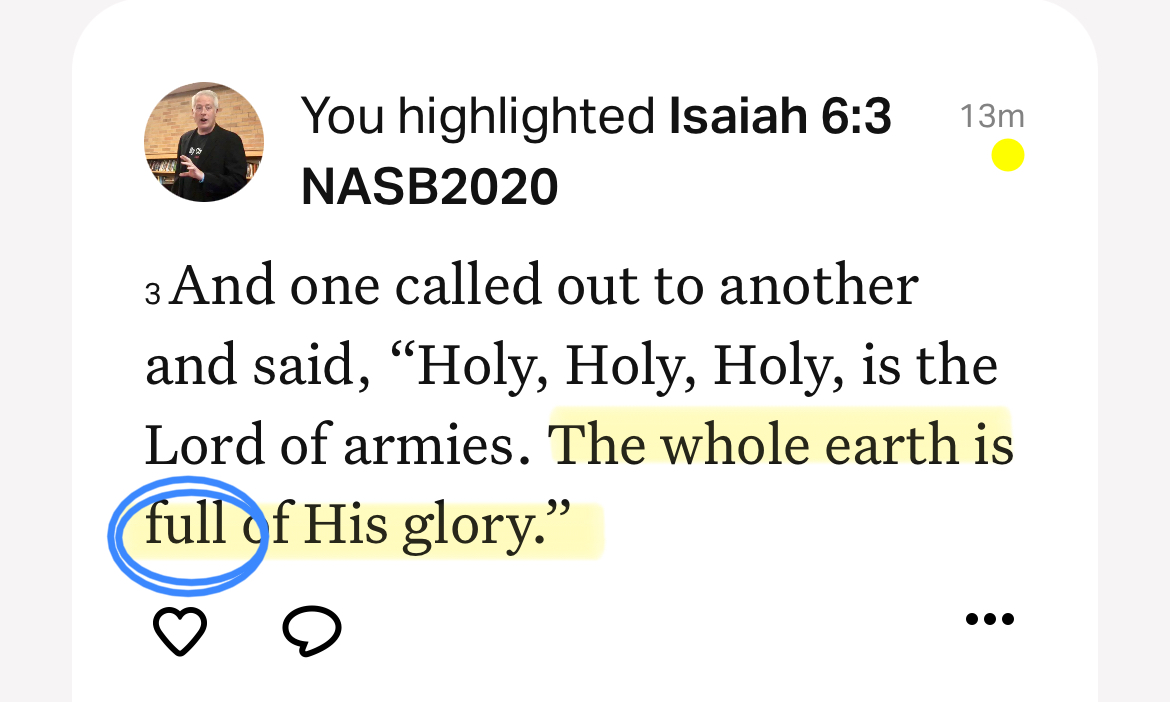










 Craig T. Owens