T.M. Moore wrote, “I’m persuaded that one reason the work of personal evangelism has fallen on hard times in our day is that the people of God are simply fearful of the task. We find no joy in bearing witness to Jesus. Instead, we’re afraid that others won’t receive us kindly, that they’ll lash out or, worse, talk about us to others. We fear we might mess up the Gospel presentation and permanently offend someone. We fear the questions and challenges others might pose, that we might not be able to answer them. We’re afraid of being laughed at, yelled at, or dismissed as foolish or deceived or mad.”
“Do not be satisfied, dear brethren and sisters in Christ, with the grace that you already have. Be thankful for it, but ask for the divine multiplication of it; regard the grace which you have already received as being like the boy’s loaves and fishes, and expect that Christ will continue to multiply it for you and for thousands of others round about you: ‘Grace unto you, and peace, be multiplied.’” —Charles Spurgeon, commenting on 1 Peter 1:2
“Come to Me with a teachable spirit, eager to be changed. A close walk with Me is a life of continual newness. Do not cling to old ways as you step into a new year. Instead, seek My face with an open mind, knowing that your journey with me involves being transformed by the renewing of your mind.… Give yourself fully to this adventure of increasing attentiveness to My presence.” —Sarah Young, in Jesus Calling [she formed this quote from Romans 12:2; Jeremiah 29:11]
“Until you value yourself, you won’t value your time. Until you value your time, you will not do anything with it.” —M. Scott Peck
Clinton Manley gives us two bad excuses that people give for either not reading their Bible or not applying what they did read. He says, “God woos us to His word with unblushing promises of reward; take hold of them.”
“The simple step of a courageous individual is not to take part in the lie. One word of truth outweighs the world.” —Alexander Solzhenitsyn
Geneticists have found a single-cell pond ciliate that uses its RNA to send unexpected signals to the cell. “Surface-level study may make cells seem like simple chemistry, but deeper study reveals coded instructions, used by molecular tools and monitored by timing controls. Those tools operate as part of a larger biological network. This detailed process reflects sound engineering principles.” Even this tiny creature shows the flawless design of our Creator.
Listen to the podcast of this post by clicking on the player below, and you can also subscribe on Apple, Spotify, or Audible. Check out the video content in this post by clicking here.
Even Charles Spurgeon—a man called “the prince of preachers”—recognized the heavy responsibility of God’s call on someone to serve as a pastor.
Here are the two Spurgeon quotes I shared in the video—
“Oh, what a solemn thing it is to be a preacher of the everlasting gospel! It is an office so high that an angel might covet it, but one that is so responsible that even an angel might tremble to undertake it.”
“Pray for us who preach, not merely to a few, but to many of our fellow-creatures, that we may be the means, in the hand of God, of blessing to our hearers.”
The best resource a pastor can tap into is prayer, and I would suggest that the first person a pastor should pray for is himself. This is where my book Amen Indeed can be a huge blessing. This is a book that helps pastors turn the Scriptures into prayer.
Listen to the podcast of this post by clicking on the player below, and you can also subscribe on Apple, Spotify, or Audible.
At 176 verses, Psalm 119 is the longest chapter in the Bible. It is a chapter that extols the immeasurable and eternal value found in God’s Word. With the exception of four verses, every other verse specifically names God’s Word—using words like statutes, commands, precepts, and laws.
Andrew Murray wrote in The Inner Life, “Anyone who really wants to know how to study his Bible according to God’s will should make a careful study of this psalm.” To that end, he gives the following six suggestions, to which I am adding my own thoughts.
(1) Take note of all the different names which refer to God’s Word. For example, “the law of the Lord” (v. 1), “His statutes” (v. 2), and “His ways” (v. 3).
(2) Take note of all the different verbs expressing how we should feel and what we should do in regard to the Word. Like: “that I may see wonderful things in Your law” (v. 18), “my soul is consumed with longing” (v. 20), and “remove from me their scorn and contempt” (v. 22).
(3) Count how many times verb tenses appear in the past, present, and future. “You have laid down” (past tense in v. 4), “obeying Your decrees” (present tense in v. 5), and “would not be put to shame” (future tense in v. 6). “Put all these together and see how more than a hundred times he presents himself before God as one who honors and keeps His law.”
(4) Study the prayers themselves and note the different requests he makes with regard to the Word—“cause me to understand” (v. 27) and “strengthen me according to Your word” (v. 28).
(5) Count the verses in which there is any reference to affection from his own sinful condition, from his enemies, from the sins of the wicked, or God delaying to help him. Phrases like, “my soul is weary with sorrow” (v. 28) and “take away the disgrace I dread” (v. 39).
(6) Notice how often the little pronouns You, His/Him, and Your occur. “Then you will see how the whole psalm is a prayer spoken to God.”
The Hebrew alphabet has 22 letters, and this psalm is divided into twenty-two 8-verse sections. The verses in each section all begin with the Hebrew letter of that section, and they form a mini-theme within themselves.
“Let us seek, by the grace of the Holy Spirit, to have the kind of devotional life which this psalm reveals,” wrote Andrew Murray. And to that sentiment I add, “Amen!”
Henry and Richard Blackaby had some amazing thoughts to share in their book Spiritual Leadership (check out my review here), but they also pull together insights from so many other noted leaders.
“The American church is dying due to a lack of strong leadership. In this time of unprecedented opportunity and plentiful resources, the church is actually losing influence. The primary reason is the lack of leadership. Nothing is more important than leadership.” —George Barna
“Human communities have always had a need for people with very strong drives to do tough jobs like leadership.” —Malcome Davies
“Leadership is one of the most observed and least understood phenomena on earth.” —James MacGregor Burns
“Popularity is not leadership. Results are.” —Peter Drucker
“Continual success probably means our bar is too low or our tape too short.” —Max De Pree
“Good times blind us. Bad times reveal truth to us.” —Peter Koestenbaum
“If you’re not uncomfortable in your work as a leader, it’s almost certain you’re not reaching your potential as a leader.” —Seth Godin
“There is an almost universal quest for easy answers and half-baked solutions. Nothing pains some people more than having to think.” —Martin Luther King Jr.
You can check out the other quotes I shared from Spiritual Leadershipby clicking here.
The biblical historian Luke mentions the Roman Caesar Tiberius. “Tiberius is only named directly once in the Bible (Luke 3:1), where the fifteenth year of his reign is a chronological marker, signalling the beginning of the ministries of John the Baptist and Jesus.” Although only named once, Tiberius’ influence is seen throughout the historical events recorded in the New Testament. Check out the archeological biography of this interesting Roman leader.
“Oh! what prophets and kings longed for, do not let us despise, and we shall despise these mercies if we do not make the most of them by entering into the fullness of the joy which they are meant to bring to us.” —Charles Spurgeon, commenting on 1 Peter 1:11
Conventional scientists, looking for a way to explain the origin of life, have proposed nanozymes which served as catalysts to speed up chemical processes. But as ICR notes, “What can be done in a laboratory is not always what happens outside of it. Laboratory tests depend on selected chemicals, planned procedures, and controlled conditions. Such experiments show what skilled researchers can make chemicals do, but they don’t indicate that an unguided environment built the first living cell. … Life displays ordered parts, stored instructions, and linked systems. These observable traits are consistent with the workmanship of a wise creator. As Scripture says, ‘O LORD, how manifold are Your works! In wisdom You have made them all’ (Psalm 104:24).”
“Spiritual warfare against lust is enlistment for a lifetime career. … But do not be afraid because your enemies are mighty and many; your victory will be so much greater. And do not worry, either, when you see Caesars stripped of their insignias and forced to die in chains of lust. Remember, it is only the unbelieving world—without spiritual arms and abandoned by God—that is left to become the prey of satan.” —William Gurnall, The Christian In Complete Armor
“It is manly to be tender toward your wife. … A Christian husband should be intimately aware of his wife’s needs, her strengths and weaknesses, and her goals and desires. He should know as much about her as possible, in order to respond in the best way to her.” —Dr. Henry Halley
Listen to the podcast of this post by clicking on the player below, and you can also subscribe on Apple, Spotify, or Audible. Check out the video content in this post by clicking here.
Although no one can truly verify the accuracy of this story, it seems to fit the character of what we do know about Alexander the Great. This powerful leader was walk-in among the camp during the night and came upon a soldier who was supposed to be on guard duty. Except Alexander found him dozing off.
“Soldier, what is your name?” he demanded, bringing the sleeping soldier quickly awake.
“Alexander,” he stammered weakly.
Alexander stepped closer to the young man and repeated, “What is your name?”
“My name is Alexander, sir,” the soldier said a little more clearly this time.
Now, almost nose to nose, Alexander asked again, “What is your name?”
This time the soldier quietly said, “My name, sir, is Alexander.”
Alexander the Great then looked intently at the young soldier, “Either change your name or change your conduct.”
That story may or may not be true, but Brennan Manning’s words are most assuredly true: “The greatest single cause of atheism in the world today is Christians: who acknowledge Jesus with their lips, walk out the door, and deny Him by their lifestyle. That is what an unbelieving world simply finds unbelievable.” We must take an honest assessment of our lifestyle and then either change our name or change our conduct.
Our next Royal Psalm is Psalm 96. This psalm begins by echoing the words of praise the King David sang on the day the ark of the covenant of the Lord was brought to Jerusalem (see 1 Chronicles 16:23-29). This day may have been the pinnacle of this great king’s reign. Immediately after celebrating the return of the ark of the covenant of the Lord, God makes the promise to King David that his family will continue to reign until the coming of King Jesus (1 Chronicles 17).
Although this is a celebratory day for Israel—God’s chosen people—David’s psalm of thanks reverberates into all the world. It is David’s desire that not just the Jewish people, but all people know King Jesus as their Lord.
In our last Royal Psalm, we saw an invitation give to us three times to come into the presence of the King of kings (Psalm 95:1, 2, 6). But we are not to stay in the tabernacle with Him—Luke 9:28-33; 10:1. David uses words like: all the earth, the nations, all peoples, families of nations, the world (vv. 1, 2, 7, 9, 10, 13).
In the middle of Psalm 96 is our proclamation to the world. We have the word ascribe (vv. 7-8) three times and an invitation in the word come. Ascribe means, “Come! Come on! Come see His glory and strength!” Then just as we have seen His glory and strength for ourselves, we invite the world to bring an offering and come into His courts.
T.M. Moore wrote, “People in the unbelieving world have witnessed a good bit of hypocrisy, shallowness, disingenuousness, dishonesty, and corruption among the members of the Church. Many of them have installed a spam filter on their brains which automatically blocks anyone calling himself a Christian as having anything meaningful or significant to say.”
So these action words in Psalm 96 are our words backed up or supported by our lifestyle.
Sing (3x) in vv. 1-2. Songs naturally come from our lips because of what is in our minds and hearts. Make sure you are singing to the LORD a new song of His moment by moment goodness to you.
Praise His name (v. 2) is better translated as bless (see NKJV, AMPC, Strong’s). Bless means to not only celebrate our King, but then to bless other people in the name of the Lord. In the New Testament Greek, bless means to say good words—say good words to people about your good King.
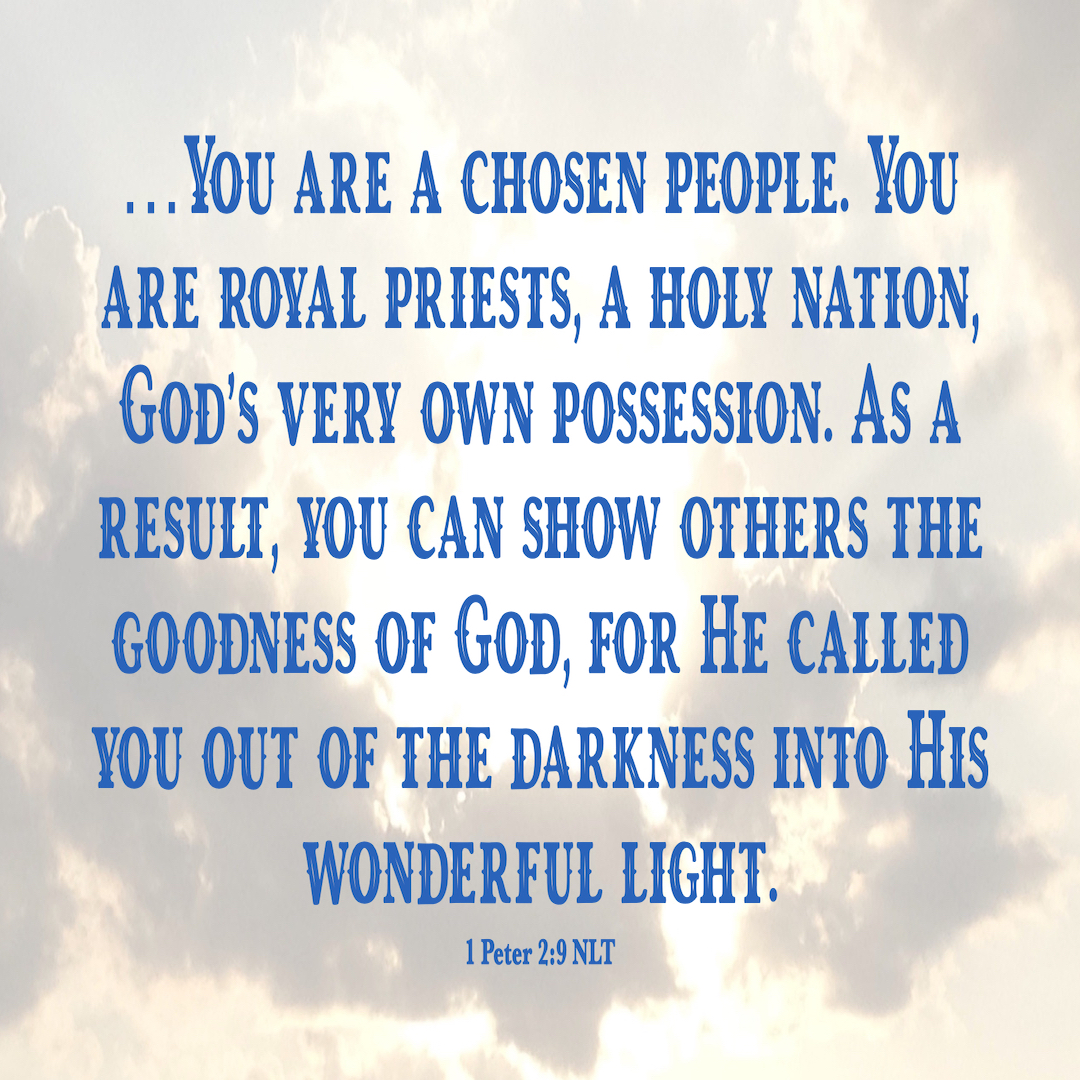
Proclaim His salvation (v. 2). …You are a chosen people. You are royal priests, a holy nation, God’s very own possession. As a result, you can show others the goodness of God, for He called you out of the darkness into His wonderful light. (1 Peter 2:9 NLT)
Declare His glory…His marvelous deeds (vv. 3-6). Recount God’s miracles to you again and again.
Worship the LORD (v. 9). The Old English spelling was worth-ship—find ways to tell people how invaluable our King’s blessings are.
Say… “The LORD reigns” (v. 10). Do your words and attitude express that God is on His throne?
C.S. Lewis wrote, “Fine feelings, new insights, greater interest in ‘religion’ mean nothing unless they make our actual behavior better; just as in an illness ‘feeling better’ is not much good if the thermometer shows that your temperature is still going up. In that sense the outer world is quite right to judge Christianity by its results. Christ told us to judge by results. A tree is known by its fruit; or, as we say, the proof of the pudding is in the eating. When we Christians behave badly, or fail to behave well, we are making Christianity unbelievable to the outside world. … Our careless lives set the outer world talking; and we give them grounds for talking in a way that throws doubt on the truth of Christianity itself.”
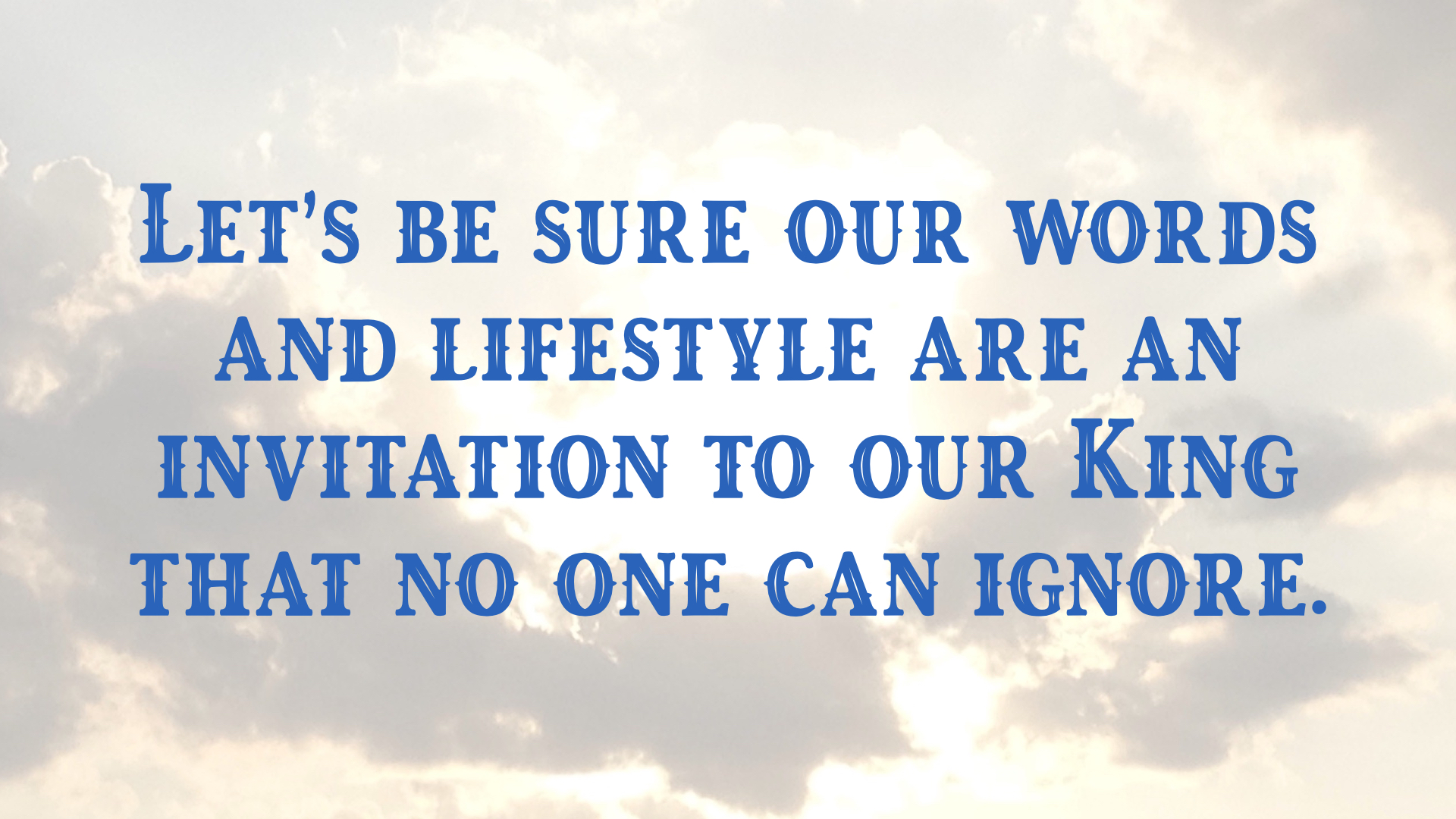
Jesus called us to this (Matthew 5:16). Let’s be sure our words and lifestyle are an invitation to our King that no one can ignore.
“Oh! to be solid gold through and through. If so, you need not mind the trials of today, since they will only prepare you for the glories eternal at the appearing of Jesus Christ.” —Charles Spurgeon, commenting on 1 Peter 1:6-7
“The clearer and more compelling our vision, the more earnest, specific and devoted we will be in taking up the disciplines necessary to realize our vision.” —T.M. Moore
Dan Reiland writes that leaders under sustained pressure may “eventually face a breaking point where caving in no longer looks like a weakness and starts looking like the only option to survive.” He then shares some solid leadership practices to help us stand firm during these pressure-packed situations.
“The sign that the Holy Spirit is in us is that we realize, not that we are full, but that we are empty. There is a sense of absolute need. We come across people who try us, circumstances that are difficult, conditions that are perplexing, and all these things awaken a dumb sense of need, which is a sign that the Holy Spirit is there. If we are ever free from the sense of need, it is not because the Holy Spirit has satisfied us, but because we have been satisfied with as much as we have.” —Oswald Chambers, in If You Will Ask
How cool is this: “Another fascinating clue has been found pointing to Neanderthals belonging to the human population. In a Russian cave, researchers discovered what they believe to be a 60,000-year-old Neanderthal molar tooth with a hole in it. A LiveScience article has dubbed the discovery ‘the oldest evidence of intentional dentistry to date.’” Of course, this human isn’t 60,000 years old, but more like 4000 years old, and shows the intelligence that the Creator endowed in all humans.
Greg and I both have confessions to make about areas we fell short in our earlier careers. But we have learned that those stumbling points can be launching points for greater growth.
“Without God, there could be no American form of Government, nor an American way of life. Recognition of the Supreme Being is the first—the most basic—expression of Americanism.” —Dwight D. Eisenhower
Greg Morse calls out the way pornography addictions are hamstringing the church. “My intention is simply to kindle the abhorrence that every saint should have for this sin. I hate pornography. I hate what it does to young men; I hate what it does to marriages; I hate what it does to older men and even older ministers who trip while crossing the finish line. I hate its accessibility; I hate its covertness; I hate how it is designed by satan to disable the men and women who were made for so much more.”
“But the question is not what we intended ourselves to be, but what [God] intended us to be when He made us. He is the inventor, we are only the machine. He is the painter, we are only the picture. How should we know what He means us to be like? … We may be content to remain what we call ‘ordinary people’: but He is determined to carry out a quite different plan. To shrink back from that plan is not humility: it is laziness and cowardice. To submit to it is not conceit or megalomania; it is obedience.” —C.S. Lewis, in Mere Christianity
“Leadership development is synonymous with personal development. As leaders grow personally, they increase their ability to lead. As they increase their capability to lead, they enlarge the capacity of their organization to grow. Therefore, the most crucial objective for any leader is personal growth. … The most important thing spiritual leaders do is cultivate their relationship with God (John 15:5; Jeremiah 7:13).” —Richard and Henry Blackaby, in Spiritual Leadership
Here’s a quote from John Piper that got me thinking: “God loves His people. He loves for them to get good food, rich food. He knows how to put His shepherds in the vice of affliction and squeeze out of us authentic, prayer-soaked, desperation-flavored insight—the unsearchable riches of Christ for the joy of His people.” Pastor, God wants to use you to shepherd the flock He’s placed under your care. So trust Him to give you what you need. And check out my book When Sheep Bite to help you along through this journey.
“Do more than go to church; be the church. Find a place to serve in the promises of your pastor and fight for that vision like it was your own. Do more than give what’s left; give what’s right. Do more than show up as a consumer; show up as a partner, knowing the day will come when you will need partnership to see your dream come to pass. If your promise is concerning business, then be the best employee of the people for whom you work. If your promise will need generous people involved to make it happen, then be generous in the promises of others. If your promise is about your family, be a blessing to the families of those who are around you. Make their dreams come to pass and you will plant the seeds that will, in time, become the fruit of your God-given why.” —Jim Wiegand, in Why is Greater Than What
“You have noticed, I expect, that Christ Himself sometimes describes the Christian way as very hard, sometimes as very easy. He says, ‘Take up your Cross’—in other words, it is like going to be beaten to death in a concentration camp. Next minute he says, ‘My yoke is easy and my burden light.’ He means both.” —C.S. Lewis, in Mere Christianity
T.M. Moore is beginning a new series of posts on the importance of the spiritual life for the Christian. He writes, “We may thus define the spiritual life in terms of Christ exalted as our focus, Christ indwelling as our sustaining power, Christ at work in and through us as the outcome of our discipleship, and Christ returning as the hope which sustains us through the tests we encounter every day. True spiritual life, in other words, is all about Jesus Christ.”
“The truths of eternity have an infinite power. They are often powerless because we do not give them time to reveal themselves. Taking time to be alone with God is the only remedy. … The Word that we get from the mouth of God brings the power to know it and to do it. Let us learn this lesson: personal fellowship with God alone in secret can make the Word alive and powerful.” —Andrew Murray
Dr. Thaddeus Williams unpacks what Charles Darwin meant when he wrote to a friend, “The horrid doubt always arises whether the convictions of man’s mind, which has been developed from the mind of the lower animals, are of any value or at all trustworthy.” Check out Dr. Williams’ post, which he opens with, “If our minds came from a capital “M” Mind—God—gifted to us as truth-knowing mechanisms, we have a reason to reason. But if our minds came from a non-mind, a literally dumb process of random mutations and natural selection, then our minds are not fundamentally truth-knowing mechanisms, but mere survival mechanisms.”
“Our first birth brought us into sin and sorrow, but our second birth brings us into purity and joy. We were born to die; now are we born never to die, ‘begotten again’ unto a life that shall remain in us for evermore, a life which shall even penetrate these mortal bodies, and make them immortal, ‘by the resurrection of Jesus Christ from the dead.’” —Charles Spurgeon, commenting on 1 Peter 1:3-4
Patience is a leadership builder, just as surely as impatience is a leadership killer. When leaders repeatedly make poor choices because of their impatience, there is only one way to fix this leadership killer—lengthen the fuse.
“It’s not what you look at that matters, it’s what you see.” —Henry David Thoreau
“Christian sorrow leads to repentance; repentance leads to forgiveness; and forgiveness leads to true joy over one’s reconciliation with God.” —Henry Halley, commenting on James 4:9-10; c.f. Psalm 32:1
“People who were not Christians themselves helped me to Christianity. But usually it is those who know Him that bring Him to others. That is why the Church, the whole body of Christians showing Him to one another, is so important. You might say that when two Christians are following Christ together there is not twice as much Christianity as when they are apart, but sixteen times as much.” —C.S. Lewis, in Mere Christianity
“And so I labored hard to be a man of full integrity in all my dealings, being careful not to fall into temptation, lest the pagan should some pretext have to denigrate my good episcopate and to disparage me.” —Patrick of Ireland
With all the activity inside even the tiniest of cells, how do the cells keep their proper shape? Scientists have discovered a process called CorMR. “Researchers found that CorM, a protein inside the system, forms thin strands just under the inner cell membrane. CorR, another bacterial protein, helps place those strands in the right area. An additional system, MinC, helps keep them away from the cell ends and the division site.” This is just another example of the precise details our Creator superintends in all He has made!
Thomas S. Kidd writes, “Given the mixed personal record of the American Founders, what accounts for our nation’s impressive history of Christian devotion? The most important factor was the Lord’s providence working through thousands of churches to spread the gospel. A second essential factor in America’s robust religious history was the unusual freedom that churches and Christians enjoyed due to religious liberty.” Check out this thoughtful post about the story of Christianity in America.



 Greg and I both have a confession to make. But these confessions also show that all of us should be continually evaluating and growing. Don’t stop short!



Links & Quotes
August 1, 2026 — Craig T. OwensI have a lot of new video content on my YouTube channel every week. Please check it out and subscribe so you don’t miss anything.
The biblical historian Luke mentions the Roman Caesar Tiberius. “Tiberius is only named directly once in the Bible (Luke 3:1), where the fifteenth year of his reign is a chronological marker, signalling the beginning of the ministries of John the Baptist and Jesus.” Although only named once, Tiberius’ influence is seen throughout the historical events recorded in the New Testament. Check out the archeological biography of this interesting Roman leader.
“Oh! what prophets and kings longed for, do not let us despise, and we shall despise these mercies if we do not make the most of them by entering into the fullness of the joy which they are meant to bring to us.” —Charles Spurgeon, commenting on 1 Peter 1:11
Conventional scientists, looking for a way to explain the origin of life, have proposed nanozymes which served as catalysts to speed up chemical processes. But as ICR notes, “What can be done in a laboratory is not always what happens outside of it. Laboratory tests depend on selected chemicals, planned procedures, and controlled conditions. Such experiments show what skilled researchers can make chemicals do, but they don’t indicate that an unguided environment built the first living cell. … Life displays ordered parts, stored instructions, and linked systems. These observable traits are consistent with the workmanship of a wise creator. As Scripture says, ‘O LORD, how manifold are Your works! In wisdom You have made them all’ (Psalm 104:24).”
“Spiritual warfare against lust is enlistment for a lifetime career. … But do not be afraid because your enemies are mighty and many; your victory will be so much greater. And do not worry, either, when you see Caesars stripped of their insignias and forced to die in chains of lust. Remember, it is only the unbelieving world—without spiritual arms and abandoned by God—that is left to become the prey of satan.” —William Gurnall, The Christian In Complete Armor
“It is manly to be tender toward your wife. … A Christian husband should be intimately aware of his wife’s needs, her strengths and weaknesses, and her goals and desires. He should know as much about her as possible, in order to respond in the best way to her.” —Dr. Henry Halley
Share this: