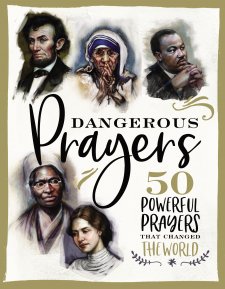
Dangerous Prayers give a brief biography of 50 culture-shifting people, and the world-changing prayers they prayed. Check out my full book review by clicking here, and then enjoy just a few of the prayers from this excellent book.
“Listen to my supplication, Master, so that my soul doesn’t stagger under Your instruction, so that I don’t stumble in testifying to Your mercies, by which You tore me away from all my ruinous pathways. Thus You’ll grow sweet to me beyond all that led me wrong, in my willingness to follow it. Thus I’ll love You most mightily, and grasp Your hand with all the strength of my inmost being. Thus You’ll tear me away from every trial, clear to the end.” —Augustine
“Restore me to liberty, and enable me so to live now that I may answer before Thee and before the world. Lord, whatever this day may bring, may Thy name be praised. Amen.” —Dietrich Bonhoeffer, while awaiting execution in a Nazi concentration camp
“Give us grace, O God, to dare to do the deed which we well know cries to be done. Let us not hesitate because of ease, or the words of men’s mouths, or our own lives. Mighty causes are calling us—the freeing of women, the training of children, the putting down of hate and murder and poverty—all these and more. But they call with voices that mean work and sacrifice and death. Mercifully grant us, O God, the spirit of Esther, that we may say: ‘I will go unto the king and if I perish, I perish.’” —W.E.B. DuBois
“Because we have need continually to crave many things at Your hands, we humbly beg You, O heavenly Father, to grant us Your Holy Spirit to direct our petitions, that they may proceed from such a fervent mind as may be agreeable to Your holy will.” —John Knox
“O keep us, we beseech Thee, Lord, for without Thy keeping we cannot keep ourselves.” —Charles Spurgeon
“Oh Jesus, You who suffer, grant that today and every day I may be able to see You in the person of Your sick ones and that, by offering them my care, I may serve You. Grant that, even if You are hidden under the unattractive disguise of anger, of crime, or of madness, I may recognize You and say, ‘Jesus, You who suffer, how sweet it is to serve You.’” —Mother Teresa
“I now make it my earnest prayer, that God would have you, and the State over which you preside, in His holy protection, that He would incline the hearts of the Citizens to cultivate a spirit of subordination and obedience to Government, to entertain a brotherly affection and love for one another, for their fellow Citizens of the United States at large, and particularly for their brethren who have served in the Field, and finally, that He would most graciously be pleased to dispose us all, to do Justice, to love mercy, and to demean ourselves with that charity, humility, and pacific temper of mind, which were the Characteristics of the Divine Author of our blessed Religion, and without an humble invitation of whose example in these things, we can never hope to be a happy Nation.” —George Washington
“God give me a deep humility, a well-guided zeal, a burning love, and a single eye, and then let men or devils do their worst.” —George Whitefield
Prayer changes things. That makes prayer dangerous and the pray-ers themselves a danger to anything that opposes the kingdom of God. Dangerous Prayers is a collection of powerful prayers and a brief biography of those who prayed them.
Growing up, a constant refrain rang in my ears from my parents whenever I faced a problem: “Have you prayed about it?” I’m not sure why we make prayer our last resort instead of our first response, but it often seems that some of the most heartfelt, passionate prayers are offered up in the darkest of times.
Dangerous Prayers offers a short biography of some world-changing people who changed the world in large part because of their desperate dependence on God’s help, as seen in the frequent and bold prayers they prayed. Many of these prayers were prayed in dark places—prisons, before the executioner, in the midst of war, in unimaginable poverty, or staring down the evils of slavery. These men and women repeatedly turned to God, and God repeatedly strengthened them to accomplish amazing things. Some of the answers to prayer came in their lifetimes, and some prayers were only answered long after they had died.
Dangerous Prayers is an excellent coffee table book. By that, I mean it’s a great book to leave out in the open as a conversation-starter. Parents could read these short biographies and prayers with their children, and friends could use them as a bridge from past history to current events. But more than anything, keep Dangerous Prayers close at hand will—I sincerely hope—cause you to turn to prayer frequently and boldly.
Allow me to introduce myself in the Aramaic fashion—I am Craig bar Raymond. I am proud of my father and want my name to always be associated with his, so I remember my heritage by telling people I am Craig son of Raymond.
If I wanted to be a little more formal I might introduce myself as Craig Bar Raymond Bar Colson, or even Craig Bar Raymond Bar Colson Bar Walker, to honor my forefathers back four generations.
People took great pride in their family heritage. They wanted to keep their connection to their family and their tribe intact and known to those around them. It’s how they kept their standing in their community.
That’s why it’s odd that Luke—the premier historian that he is—introduces us to a man he simply calls “a blind man” in the city of Jericho. Luke was always so precise in mentioning names throughout both his Gospel and the Book of Acts, and it appears that this man does have a name. In the Gospel of Mark he is called Bartimaeus, and presumably Luke used Mark as one of his source documents. So why would Luke omit this guy’s name?
Keep in mind that “bar” simply means “son of,” so although Mark calls him Bartimaeus, his name is really something like “_________ son of Timaeus.” Is that because he was born blind and his parents didn’t even name him? Or was he thought so little of that people couldn’t remember his first name? Maybe it’s because Timaeus means unclean, defiled, polluted. So this blind beggar is really just the Anonymous son of Filth!
This beggar is looking for alms in Jericho when he hears a commotion. He asks what is happening and is told, that Jesus of Nazareth is passing by.
This man knows the reputation of Jesus, recalling that He has even opened blind eyes. Immediately he shouts, “Jesus, son of David have mercy on me!” Son of David is a title only used twice in the New Testament (also see Matthew 15:22), and both times by desperate people who wouldn’t take “no” for an answer.
Actually, his phrase is in the form of a command, so he really says, “Jesus, son of David, have mercy on me NOW!”
“Who do you think you are, you nameless beggar,” the townspeople rebuke him. “How dare you demand anything of anyone! Shut your mouth, you worthless piece of filth!”
Undeterred, this man now raises his voice to a shriek and repeats, “JESUS, SON OF DAVID, HAVE MERCY ON ME NOW!”
This shriek gets Christ’s attention and He stops dead in His tracks. He commands that this man be brought to him.
Check out the confidence this blind man shows—he throws his cloak aside to get to Jesus. Why is that significant? Because he’s blind! If he can’t see, how is he going to find his cloak again? Who would ever want to help him?
Jesus asks him, “What do you want me to do for you?” He was testing him: did he want a hand-out? did he want revenge on the cruel people in Jericho? did he want to get back at his parents?
He specifically prays, “I want to see.” Jesus is moved by compassion (Matthew 20:34) and says, “Your faith has made you whole.” The blind man immediately is healed!
What was his faith that healed him? It was a loud, insistent, persistent, won’t-take-no-for-an answer, audacious request. The crowd said he was asking too much, but Jesus was moved to compassion by his insistence and boldness and answered his prayer.
That community may have forgotten that man’s name. Maybe the blind man had even forgotten his own name. But God hadn’t!
Jesus is moved by faith-filled, won’t-be-silenced cries for mercy. He wants to answer your specific requests. You aren’t an anonymous son or daughter of filth. You aren’t marginalized, worthless, or overlooked by your Heavenly Father.
God knows your name. He knows your need. He is passing by. Cry out to Him again and again and again! When He answers your prayer, you are made whole and our Heavenly Father is glorified.
Have you ever been in the right place at the right time to experience something wonderful? Maybe you got to meet someone important, or you got the job, or you got the money, or you got to ride in that fancy car.
Some will call you “lucky” or say you “caught a break,” but both of those statements imply that something unexpected happened to you.
Is it still “lucky” to be in the right place at the right time if you knew ahead of time that it was coming? For praying Christians, to be in the right place at the right time when we are expecting God to provide is called “an answer to prayer.”
David prayed, “In the morning, Lord, You hear my voice; in the morning I lay my requests before You and wait expectantly” (Psalm 5:3). The Aramaic word for prayer means “to set a trap.” If we pray, and we live in expectation, then it isn’t luck when we’re in the right place at the right time, but it’s a “trap” that caught the answer to our prayer.
Our daily walking can be our daily praying, as long as we’re walking in faith in the direction God pointed us.
One man who—literally!—walked this principle out was Elisha.
Before we look at Elisha’s expectant, prayerful walking, let’s look at his prayer request—
When they reached the other side, Elijah said to Elisha, “What can I do for you before I’m taken from you? Ask anything.” Elisha said, “Your life repeated in my life. I want to be a holy man just like you” (2 Kings 2:9 MSG).
Elisha was essentially asking to be like Elijah’s firstborn son, to be his spiritual heir. This was the original promise God gave when He told Elijah to anoint Elisha as his successor (1 Kings 19:16). From that point onward, Elisha steadily walked in expectation of God answering this prayer.
Elisha wouldn’t stay in a place of military victory, or in a significantly spiritual place, or even in a place surrounded by godly leaders. Elisha wouldn’t be held back by a lucrative family business, or the warning words of friends or his spiritual mentor, or even the seemingly uncrossable Jordan River. He kept on walking (see 2 Kings 2:1-15).
He kept on walking.
He kept on walking until “suddenly” God showed up and answered his prayer.
But was it really “suddenly”? Elisha knew it was coming. He believed what God had promised. He clung to it even when Elijah told him he had asked “a difficult thing.” Elisha kept on walking until he was in the right place at the right time to receive all that God had planned.
If you have prayed in faith, start walking. Settling anywhere else is robbing yourself of a blessing and robbing God of glory.
Just keep walking! And let your walking be your praying.Don’t get discouraged. Don’t settle. Don’t stop eagerly expecting that the next step you took could be the “suddenly” you’ve been waiting for. Just keep walking!
Join me this Sunday as we learn a valuable lesson from another bold pray-er from the Bible.
So He Himself often withdrew into the wilderness and prayed (Luke 5:16).
“So”—in light of what just happened. What happened? Jesus was preaching everywhere, He healed a leper, and great multitudes came to hear Him speak and to be healed. So Jesus had to withdraw frequently to pray and be replenished.
All of us have only a finite amount of energy. When we are sensing that energy level is low, we also need a retreat. Otherwise, our low energy levels can sabotage us and diminish what God wants to do through us.
Then check out the results after Christ’s time of replenishing:
God’s power was “present to heal” (v. 17)
People were saved (v. 20)
Jesus had holy perception (v. 22)
Miracles confirmed the word that Jesus preached (v. 24)
God was glorified (v. 26)
People followed Jesus (vv. 27, 28)
Jesus had enough grace and patience to handle criticism (v. 30)
Jesus had enough wisdom and patience to handle tricky theological questions (vv. 33-39)
J.C. Ryle noted, “The most successful workmen in the Lord’s vineyard are those who are, like their Master, often and much upon their knees.”
Healthy leaders are keenly aware of their own energy levels.
So… A mark of a godly leader is one who frequently retreats.
This is part 32 in my series on godly leadership. You can check out all of my posts in this series by clicking here.
This past Christmas I was quite surprised to receive a package in the mail. It was something I ordered as a Christmas gift for my wife.
Sort of.
It was actually half of what I thought I ordered. I went back online and discovered some “fine print” that I hadn’t really noticed earlier.
You’ve probably experienced that too—asterisks … fine print … footnotes … hidden fees … “limits and exclusions may apply” are all so frustrating!
Unfortunately, we get so used to these things that we begin to—consciously or subconsciously—plug them into places where they don’t actually belong. So even when Jesus Himself says something that sounds wonderful like, “I tell you the truth, if you have faith as small as a mustard seed, you can say to this mountain, ‘Move from here to there’ and it will move. Nothing will be impossible for you” (Matthew 17:20), we want to insert an asterisk.
Or when He says, “And I will do whatever you ask in My name so that the Son may bring glory to the Father. You may ask Me for anything in My name, and I will do it” (John 14:13-14), we think we’re supposed to ask, “What’s the catch?”
Christians are inserting asterisks where they don’t belong and, as a result, are praying timid prayers.
Why do we pray this way? Perhaps we are…
…fearful of being too bold. But in telling us how to pray, Jesus says God rewards our bold “shameless persistence” in prayer.
I tell you, although he will not get up and supply him anything because he is his friend, yet because of his shameless persistence and insistence he will get up and give him as much as he needs. So I say to you, ask and keep on asking and it shall be given you; seek and keep on seeking and you shall find; knock and keep on knocking and the door shall be opened to you. (Luke 11:8-9 AMP)
…unsure that God hears us, cares for us, or even wants to answer us. But the Bible is quite clear that all of these things are true: He hears us, cares for us, and does want to give us what He has promised (1 John 5:14-15; Romans 8:32; Romans 4:20-21).
…ignorant of what/how to pray. T.M. Moore reminds us, “God has given us three great helps to assist us in our prayers. His Spirit groans for us; His Word guides us; and His Son governs and intercedes for us.”
…not looking for God’s answer. David said that after praying, he expectantly watched for God’s answer (Psalm 5:3). Indeed, the Aramaic word for prayer means “to set a trap.”
“He is the God of limitless resources—the only limit comes from us. Our requests, our thoughts, and our prayers are too small, and our expectations are too low. God is trying to raise our vision to a higher level, call us to have greater expectations, and thereby bring us to greater appropriation. Shall we continue living in a way that mocks His will and denies His Word?” —A.B. Simpson
Why are you hesitating to ask God for even a tiny amount when such vast resources are available? What would happen if you started to pray more boldly? What if you began to make mountain-moving requests? I dare you to try!
Stop looking for the asterisks and start taking God at His word!
Join me next week as we continue our series on Boldly Praying, looking at some bold pray-ers in the Bible.
This is a weekly series with things I’m reading and pondering from Oswald Chambers. You can read the original seed thought here, or type “Thursdays With Oswald” in the search box to read more entries.
Philanthropy, Prayer, And Penance
In chapter Matthew 5, our Lord demands that our disposition be right with Him in our ordinary natural life lived to men; in chapter 6, He deals with the domain of our life lived to God before men. The main idea in the region of religion is: Your eyes on God, not on men. …
Briefly summed up these verses [6:1-4] mean: Have no other motive in giving than to please God. In modern philanthropy we are ‘egged on’ with other motives—It will do them good; they need the help; they deserve it. Jesus Christ never brings out that aspect in His teaching; He allows no other motive in the giving than to please God. … It is a very penetrating thing to ask ourselves this question—“What was my motive in doing that kind act?” …
“But when you give it to the needy, do not let your left hand know what your right hand is doing.” That means do good until it is an unconscious habit of the life and you do not know you are doing it….
Have no other motive in prayer than to know Him [6:5-15]. … Call a halt one moment and ask yourself—“Why do I pray? What is my motive? Is it because I have a personal secret relationship to God known to no one but myself?” …
It is impossible to live the life of a disciple without definite times of secret prayer. You will find that the place to enter in is in your business, as you walk along the streets, in the ordinary ways of life, when no one dreams you are praying, and the reward comes openly, a revival here, a blessing there. …
In verse 8 Jesus goes to the root of all prayer—“Your Father knows what you need before you ask Him.” Common sense says, “Then why ask Him?” Prayer is not getting things from God, that is a most initial stage; prayer is getting into perfect communion with God; I tell him what I know He knows in order that I may get to know it as He does. …
Penance [6:16-18] means putting ourselves into a straitjacket for the sake of disciplining our spiritual character. Physical sloth will upset spiritual devotion quicker than anything else. If the devil cannot get at us by enticing to sin, he will get at us by sleeping-sickness spiritually…. Penance means doing a hardship to the body for the sake of developing the spiritual life. … Jeremy Taylor said that men hang out the sign of the devil; to prove there is an angel within; that is, they wear sad countenances and look tremendously severe in order to prove they are holy.
From Studies In The Sermon On The Mount
Good questions from Oswald Chambers:
Philanthropy—What was my motive in doing that kind act?
Prayer—Why do I pray? What is my motive? Is it because I have a personal secret relationship to God known to no one but myself?
Penance—Am I “hanging out a sign” just to let other people know that I’m discipling myself?