The next chapter gives specific boundaries for Israel’s borders, listing 21 specific places.
After that, we read a list of 12 specific names of leaders who are to assign portions of land to all the Israelite tribes.
Our God is a specific God. No detail escapes His notice. Nothing happens by chance, nor is God ever scrambling to fix something I’ve messed up or to address something that I think is “unexpected.” God knows the end from before the beginning (Isaiah 46:10), including my specific role in His plan.
Let me say it again—Our God is a specific God.
Heavenly Father, you have a specific plan for my life. You have given me specific talents to use at specific “stages” along the journey of my life. Holy Spirit, help me not to lean to my own understanding, for it is far too finite and skewed. In all my ways—in all the stages of my life—I want to use my specific talents specifically to glorify Jesus.
When it comes to the Holy Spirit’s involvement in a Christian’s life: In > On.
Sometimes, instead of referring to the two major divisions of the Bible as Old Testament and New Testament, I prefer to use First Testament and Second Testament. This helps me remember that “Old” doesn’t mean outdated, and “New” doesn’t mean forgetting what came before it.
B.B. Warfield had a great analogy. He imagined the First Testament to be a perfectly-constructed mansion. Only the finest materials had been used, and the mansion had been constructed by the best craftsmen being overseen by the world’s premier Architect. The only problem was this mansion had no lights. With the appearing of Jesus in the Second Testament, finally the lights are turned on. Jesus reveals the beauty that was already there!
In the First Testament, we frequently read that the Holy Spirit comes ON people, usually for leadership functions. We see this phrase with Moses and his co-leaders, several of the judges, Israel’s first two kings, and many of the prophets (see Numbers 11:25; Judges 3:10, 6:34, 11:29, 15:14; 1 Samuel 11:6, 16:13; 2 Kings 2:15).
However, there is one leader in the First Testament about which we notice the Spirit came IN him. Twice Ezekiel says this (2:2, 3:24). This was hinting at a to-be-fulfilled promise in the Second Testament (36:25-27).
The Holy Spirit being IN God’s people—which makes them God’s leaders—is described by Jesus in Acts 1:5. Many translations render this verse, “You will be baptized with the Holy Spirit.” But the NIV footnote and The Message both say “in the Holy Spirit.” Indeed, the Greek word means “by, with, or in.” But in context to being baptized (which means immersed, submerged, cleansed, overwhelmed), I think the best word is: baptized IN the Holy Spirit.
Let me say it again: When it comes to the Holy Spirit’s involvement in a Christian’s life: In > On.
“You hardly need to pray to have the Spirit poured out, for that has been done. What you need is a baptism of the Holy Spirit; to go down personally into that glorious flood that has been poured forth. Oh, to be immersed in the Holy Spirit and into fire—covered with His holy influence—plunged into the Godhead’s deepest sea and lost in His immensity! Here is our life and power.” —Charles Spurgeon
Jesus wants all of His followers to be baptized IN the Holy Spirit. So He told us to keep on asking, keep on seeking, keep on knocking, keep on waiting for God’s promised infilling (Luke 11:9-13; Acts 1:4-8).
Don’t stop at salvation—with just the Holy Spirit deposited in you—press on to be submerged deep into the Holy Spirit.
You stood up for someone, but when you needed someone to stand up for you they disappeared Or you did what was right, but no one recognized you for it? Or you were the encourager, but when you needed encouragement no one was around for you? Or maybe even you obeyed God down to the very last detail, and yet it seemed God abandoned you when you needed Him most?
Jesus knows what every single one of these scenarios feel like! He stood up for the downtrodden, but they screamed, “Crucify Him!” He poured His life into teaching and encouraging His friends, but they all ran when the heat was on, leaving Jesus all by Himself. He obeyed God down to the very last detail, and yet it seemed like God abandoned Him when He needed Him most.
Have you ever felt abandoned by God?
Jesus did.
Hanging from the Cross He cried out, “My God, My God, why have You forsaken Me?!”
I cannot help but notice two things about the state of mind Jesus was in heading to the horrific treatment He would face (see Matthew 26:31-44; 27:27-46).
Jesus knew all of this was going to happen to Him. Notice the phrases “for it is written” and “so that the Scriptures would be fulfilled” and “so that the writings of the prophets might be fulfilled.” Even His cry from the Cross was a literal quotation of Old Testament Scripture (Psalm 22:1).
God was silent. Even though Jesus called out to His Father three times in prayer, “My Father!” there was no heavenly response.
Why would God remain silent during this trial? God didn’t need to speak to His Son during the trial because He had already spoken to Him before the trial!
It’s the same in our trials—
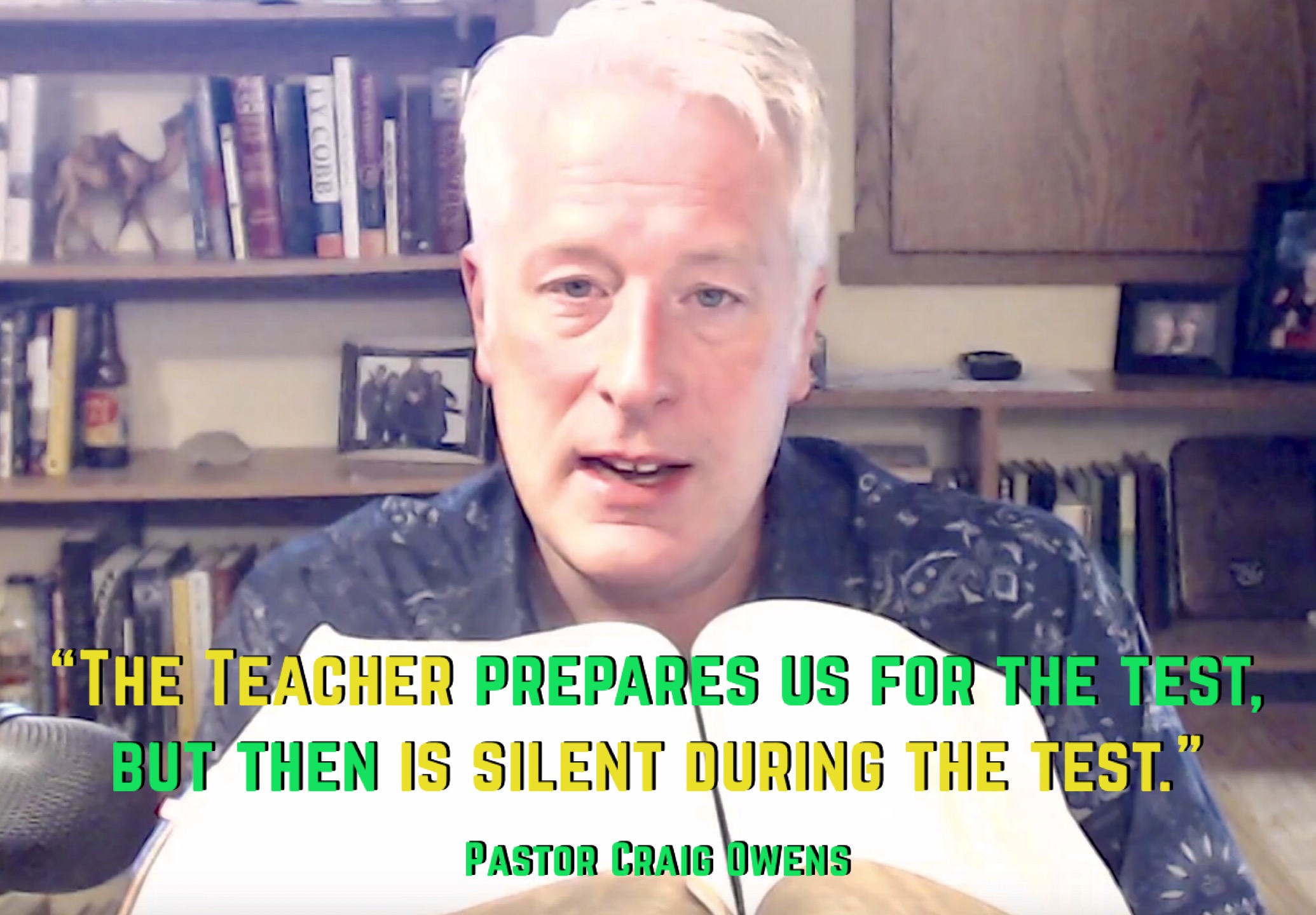
The Teacher prepares us for the test, but then is silent during the test.
God’s silence is not His rejection or abandonment. Just as God provided for Jesus in His moment of trial, God has provided for us in our trials too—For no temptation (no trial regarded as enticing to sin), [no matter how it comes or where it leads] has overtaken you and laid hold on you that is not common to man [that is, no temptation or trial has come to you that is beyond human resistance and that is not adjusted and adapted and belonging to human experience, and such as man can bear]. But God is faithful [to His Word and to His compassionate nature], and He [can be trusted] not to let you be tempted and tried and assayed beyond your ability and strength of resistance and power to endure, but with the temptation He will [always] also provide the wayout (the means of escape to a landing place), that you may be capable and strong and powerful to bear up under it patiently. (1 Corinthians 10:13 AMP)
So let’s learn three invaluable lessons we can learn from Christ’s time of supreme suffering.
1. Be honest in God’s presence
Jesus didn’t hide His feelings, nor did He try to couch His vocabulary in “churchy” sounding words. God already knows what’s in your heart, so pour it out raw and honestly! Go to the Psalms and see raw emotions on full display in prayer.
2. Lean all your weight on Jesus
Jesus prayed, “My Father!” and He cried out from the Cross, “My God!” His death on the Cross took away the barriers that kept up from coming into God’s presence (see 2 Corinthians 5:21). After His resurrection, Jesus sent this message to His friends: “Go instead to my brothers and tell them, ‘I am ascending to MYFather and YOURFather, to MYGod and YOURGod’” (John 20:17).
3. Go to the Word of God
This is what Jesus did. In His moment of abandonment, He quoted Psalm 22 from the Cross. Jesus fulfilled ALL of the Scriptures, so now we can pray with greater assurance—For no matter how many promises God has made, they are “Yes” in Christ. And so through Him the “Amen” is spoken by us to the glory of God (2 Corinthians 1:20).
God’s silence is NOT God’s abandonment. God’s silence is His invitation for us to be honest, to lean on Jesus, and to trust every promise in His Word. Every single promise that is Yes! and Amen!
If you’ve missed any of the other messages in our Where’s God? series, please check out:
How do “Bible” and “artisan” belong in the same title? They’re more connected than you may have previously thought, and The Artisan Collection Bible is the perfect place to explore this connection.
If you were to ask someone what occupation Jesus had while He was on earth, it would be a safe bet that most people would say He was a carpenter. Indeed, the Greek word tekton is translated as “carpenter” for both Joseph and Jesus (see Matthew 13:54-56 and Mark 6:2-3). However, the consensus among Greek scholars today is that the word tekton is more likely to mean an artisan than just merely a wood-working carpenter.
That makes sense, doesn’t it? After all, you would expect boundless creativity from the Creator. The One who fashioned our beautiful universe would certainly still be interested in expressing Himself in creative and beautiful ways.
For myself, reading the Bible sparks in me a desire to be creative with words, and images, and colors, and designs. This is exactly what The Artisan Collection Bible gives you the space to do. And I literally mean “space.”
One of the most attractive features to me about this Bible is the extra-wide margins along every single page. As you read God’s Word and the beauty of the Creator is illuminated in your heart and mind, you have readily available space to express your own creativity as worship to the Creator. Try crafting a poem, or turning the passage into a personal prayer, or drawing a picture that captures the vibrancy of God’s love letter written to you. The design of this Bible helps you to do more than just read the Word of God, it invites you to interact with the God of the Word.
The Artisan Collection Bible would make an excellent gift for your creative friend or loved one.
I am a Zondervan book reviewer and a member of the Bible Gateway Blogger Grid. As a book reviewer I received a free copy of this book from the book publisher. I am not compensated for my review. Although I may have received the book free of charge, I am under no obligation to write a favorable review. I am free to express my honest opinion about the book’s content. If I say it’s a good book, it’s because I think it’s a good book!
This is a weekly series with things I’m reading and pondering from Charles Spurgeon. You can read the original seed thought here, or type “Thursdays With Spurgeon” in the search box to read more entries.
Turn The Scriptures Into Your Cries
‘My God, My God, why have You forsaken Me?’ … This cry is taken from ‘the Book.’ Does it not show our Lord’s love of the sacred Volume, that when He felt His sharpest grief, He turned to the Scripture to find a fit utterance for it? Here we have the opening sentence of the twenty-second Psalm. Oh, that we may so love the inspired Word that we may not only sing to its score but even weep to its music! …
When you are delirious with pain, think of your Bible. When your mind wonders, let it roam toward the mercy seat. And when your heart and your flesh fail, still live by faith and still cry, ‘My God, my God.’ …
Grief has small regard for the laws of the grammarian. Even the holiest, when in extreme agony, though they cannot speak otherwise than according to purity and truth, yet use a language of their own that only the ear of sympathy can fully receive.
From My God, My God Why Have You Forsaken Me?
Grief is a time to get real. As Spurgeon said, “Grief has small regard for the laws of the grammarian.” Grief is not a time to carefully choose our words.
Get real with God in your prayer closet. Tell Him everything that frustrates you. I promise you, God is not going to fall off His throne and say, “What?! I had no idea you felt that way!” He already knows what’s in your heart, but it will do you much good to get it out. Much like someone with food poisoning needs to vomit out the poison, God will not be offended when you vomit out your “My God, my God, why have You forsaken me?” in His presence.
Many scholars believe that Jesus probably sang the entirety of the 22nd Psalm from the Cross. Whether He did or not, listen to the assurances that Jesus had from just this psalm alone, even in the midst of His heart-wrenching cry—
My God, my God, why have You forsaken me? Why are You so far from saving me,so far from my cries of anguish?My God, I cry out by day, but You do not answer, by night, but I find no rest. Yet You are enthroned as the Holy One; You are the one Israel praises. In You our ancestors put their trust; they trusted and You delivered them. To You they cried out and were saved; in You they trusted and were not put to shame. … But You, Lord, do not be far from me. You are my strength; come quickly to help me. … I will declare Your name to my people; in the assembly I will praise You. … From You comes the theme of my praise in the great assembly; before those who fear You I will fulfill my vows. The poor will eat and be satisfied; those who seek the Lord will praise Him. (vv. 1-5, 19, 22, 25-26)
Jesus turned to the Scriptures to find the words He cried out to His Father in His darkest moment, and He invites you to follow His example. Make the psalms your own—turn them into your own prayers. God is close to you when you cry out, “My God!” to Him.
So the people grumbled against Moses … The people gathered in opposition to Moses and Aaron (Exodus 15:24; Numbers 20:2).
People with limited vision have limited faith too. As a result, they frequently grumble when things don’t go their way. Ironically, their grumbling is almost always directed at the leader who does have far-reaching vision and God-honoring faith!
For most of his tenure as leader, Moses handled the grumbling of the people well. Sometimes, though, the complaints seemed more personal:
…in opposition to Moses and Aaron
…they quarreled with Moses
…“Why did you…?”
These complaints may seem like a personal attack, but in the end, we find out that these attacks weren’t really against Moses at all—“the Israelites quarreled with the Lord” (Numbers 20:13).
God tried to help Moses and Aaron see that this was not a personal attack on them. He instructed them to “speak to that rock” so that water would be provided for the grumbling people. But sadly, Moses and Aaron missed this point. They said to the Israelites, “must we bring you water out of this rock?” And then in total frustration with the quarrelsome Israelites, Moses “struck the rock” instead of speaking to it.
Moses made himself the focal point, not God. God responded: “you did not trust in Me enough to honor Me as holy in the sight of the Israelites” (v. 12).
A mark of a godly leader is one who doesn’t take personal attacks personally.
Previously, Moses responded to the grumblers better—
He “cried out to the Lord” and received directions
He obeyed God’s directions to the letter
He reminded the people that their grumbling was really “against the Lord” (Exodus 16:6-8)
He humbled himself before the people and pleaded with them not to rebel against God
He humbled himself before God and interceded for the people
If God has called you to lead, people will bring their quarrels and complaints to you. It will feel like a personal attack, but it’s not. When attacked or when people grumble, you need to humble yourself before the Holy Spirit and ask, “Did I do something wrong?” and then listen attentively for His answer.
If the answer is yes: repent, ask forgiveness, make things right.
If the answer is no: don’t take it personally, stay humble before God and the people, and obey the specific directions God will give you. Don’t get frustrated and cut short your tenure as a leader.
This is part 44 in my series on godly leadership. You can check out all of my posts in this series by clicking here.
Listen to the podcast of this post by clicking on the player below, and you can also subscribe on Apple, Spotify, or Audible.
…to the church of the Thessalonians (2 Thessalonians 1:1).
This short letter from the apostle Paul to the church in Thessalonica is a masterpiece on how to correctly correct fellow Christian brothers and sisters.
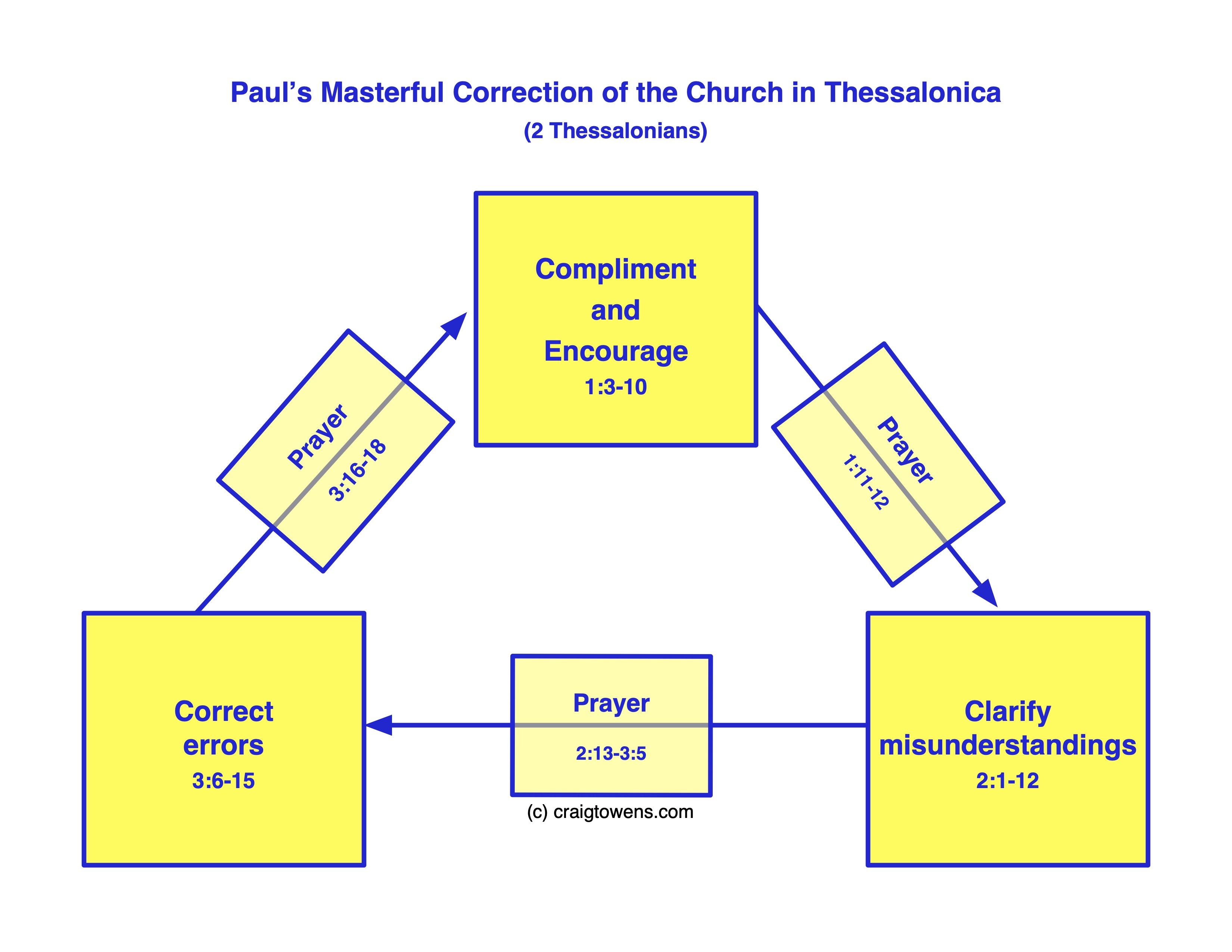
The entire letter follows this pattern: 3 Cs surrounded by prayer—
(1) Compliment and encouragement—“We are bound to thank God always for you…because your faith grows exceedingly” (1:3). Paul complimented their love for each other, their patience and endurance in persecution, and their future glorification. He encouraged them that Jesus IS coming, and He will deal with their persecutors and take the righteous into glory with Him (1:3-10).
(2) Prayer—And then he prays for them to be equipped to endure to the end and finish well (1:11-12).
(3) Clarify misunderstandings—“Let no one deceive you by any means” (2:3). Paul reminds them of what he taught them about the end times and the Second Coming of Christ, clarifying that watchful Christians will by no means miss out on the signs (2:1-12).
(4) Prayer—Paul again praises their acceptance of the gospel and launches into another prayer for them to finish well (2:13-3:5).
(5) Correct errors of understanding—“But we command you” (3:6). There were those who were departing from the faith, growing slack in their work ethic, being disorderly, and meddling as busybodies. Paul said, “We command and exhort through our Lord Jesus Christ” that you knock it off! He even told the church to “not keep company” with such people (3:6-15).
(6) Prayer—Finally, Paul closes with a prayer for God’s peace to be with his brothers and sisters (3:16-18).
This is such a masterful pattern for all of us in church ministry to follow!
If you are in a leadership role, I hope your ongoing prayer would be the same as mine: “Holy Spirit, in all my interactions with my fellow saints, remind me of this godly, practical plan for confrontation, and help me to live it out for God’s glory. In Jesus’ name, amen.”
P.S. You can also learn a lesson from the way the prophet Samuel handled correction in this post.
This is why we need to make prayer an ongoing discipline. If we do, we will be much more likely to turn to prayer when we feel the intense moments, and our faith in those intense moments will be strengthened and ready to respond.
Every day we are either preparing or repairing. Prayer is either helping us prepare for the challenges we will be facing, or it’s helping us recover from the battle we just fought. Believe me: it’s much better to be preparing than it is to be repairing!
One time the disciples of Jesus got stymied in a spiritual battle. A father brought his demon-possessed son to them, asking that they cast out the demon. But this distraught father then had to report to Jesus, “They couldn’t do it” (see Matthew 17:14-21).
Why couldn’t they? These men had been taught how to pray by Jesus Himself, and they already had experienced ministry success (Matthew 6:9-13; Mark 6:13). So were they stumped now?
Jesus told them, “It’s because you have so little faith.” He went on to tell them that these intense spiritual battles require an ongoing lifestyle of prayer. Jesus wasn’t suggesting that they should have said to that father, “Come back in a few days after we have prayed and fasted.”
But what Jesus was really saying was that all of us need to stay connected to the Source of our spiritual power at every single moment (John 15:5, 7). Sometimes this requires taking our eyes off ourselves and our own appetites.
In a word: we need to fast.
The wordfasting means “to cover the mouth” or “to close the mouth.”
often fasting is in response to calamity or as a sign of mourning
sometimes it’s alongside an intense prayer
ideally it should be a regular discipline in our lives. In Matthew 6:16-18, notice the phrase “when you fast.” Not “if you fast,” but when. Jesus assumed that we would do this, and since this teaching appears right after Jesus teaches us how to pray, it makes sense that prayer and fasting go well together.
Fasting intensifies our focus on God in the quiet times so that we can keep our eyes on Him in the crashing storms.
Fasting helps us tune in to the unmistakable Voice of the Holy Spirit in the peaceful moments so that we can still recognize His Voice in the tumult of battle.
Is there a comfort food you tend to run to? Is there a coping activity that you typically use to de-stress? Is there someone or something other than God that is your go-to in times of trouble? Perhaps we should start there and fast from those things for a short period of time.
Fasting in the quiet times will strengthen us for the intense battle times.
Let’s prepare daily for victory, instead of having to repair after a failure.



 Numbers 33:3-49 goes on to list 43 specific places.








 Craig T. Owens