Listen to the podcast of this post by clicking on the player below, and you can also subscribe on Apple, Spotify, or Audible.
Pastors are called to be shepherd leaders. Karl Vaters points out that some pastors get caught up in “the green room syndrome” that disconnects them from their sheep.
Here is another clip from The Church Lobby Podcast where Karl and I talk about this.
The biblical passage I reference in this interview is John 10:1-16.
Check out other parts of my interview on The Church Lobby podcast here. Or check out the full conversation Karl and I had on The Church Lobby podcast here.
Get more information on Shepherd Leadershiphere. And pre-order my newest book When Sheep Bitehere.
“When the Lord chose His twelve disciples, it was ‘that they might be with Him and that He might send them out to preach’ (Mark 3:14). A life in fellowship with Him prepared them for the work of preaching. …
“The law of their first calling remained unchanged: their unbroken fellowship with Him was the secret of their power to preach and to testify of Him. …
“The same principle stands for all His servants, for all time: without the experience of His presence with us, our preaching has no power. The secret of our strength is the living testimony that Jesus Christ is every moment with us, inspiring, directing and strengthening us. …
“But remember that this power is never meant to be experienced as if it were our own. It is only as Jesus Christ as a living Person dwells and works with His divine energy in our own hearts and lives that there can be power in our preaching as a personal testimony. …
“For it’s only when His servants show in their lives that they obey Him in all His commands can they expect the fullness of His power and His presence to be with them. Only when they themselves are living witnesses to the reality of His power to save and to keep from sin can they expect to experience His abiding presence, and the power to train others to the life of obedience that He asks.
“The living experience of the presence of Jesus is an essential element in preaching the gospel. If this becomes clouded, work becomes a human effort, without the freshness and power of the heavenly life. Nothing can bring back the power and blessing but a return to the Master’s feet so that He may breathe into the heart, in divine power, His blessed word, ‘I am with you always!’” —Andrew Murray
This is just one example of the power of a leader’s storytelling. Check the full conversation Greg and I had on The Craig And Greg Show. I have lots of new content every week, which you can check out on my YouTube channel.
“We are all born ignorant, but one must work hard to remain stupid.” —Benjamin Franklin
George Jeffreys was born with a limiting speech impediment, but with the empowering of the Holy Spirit, George and his brother Stephen led incredible Pentecostal revivals in England and Wales. They were said to be the greatest evangelists since George Whitefield and John Wesley. Someone asked Jeffreys how long a revival should last, and he responded, “Thank God, a revival started in my heart 30 years ago, and it has never stopped; it will never end.” He continued by saying, “As long as Jesus is kept in the front, and made the center of fellowship and blessing and unity, the revival will never end.” Check out this mini biography about his life.
John Stonestreet uses the example of C.S. Lewis’ Aslan to talk about how God can speak to us through our pain. John writes, “Pain is never the point of God’s plans, any more than it is the purpose of physical exercise. Never pushing ourselves to the point that it hurts means never improving our health. On the other hand, seeking pain is more likely to do harm than to aid our wellbeing. In and of itself, pain is not good, but it is meaningful. Pain indicates that something is wrong and needs to be addressed.”
“The best way to make a dream come true is to wake up.” —Dame Anna Wintour
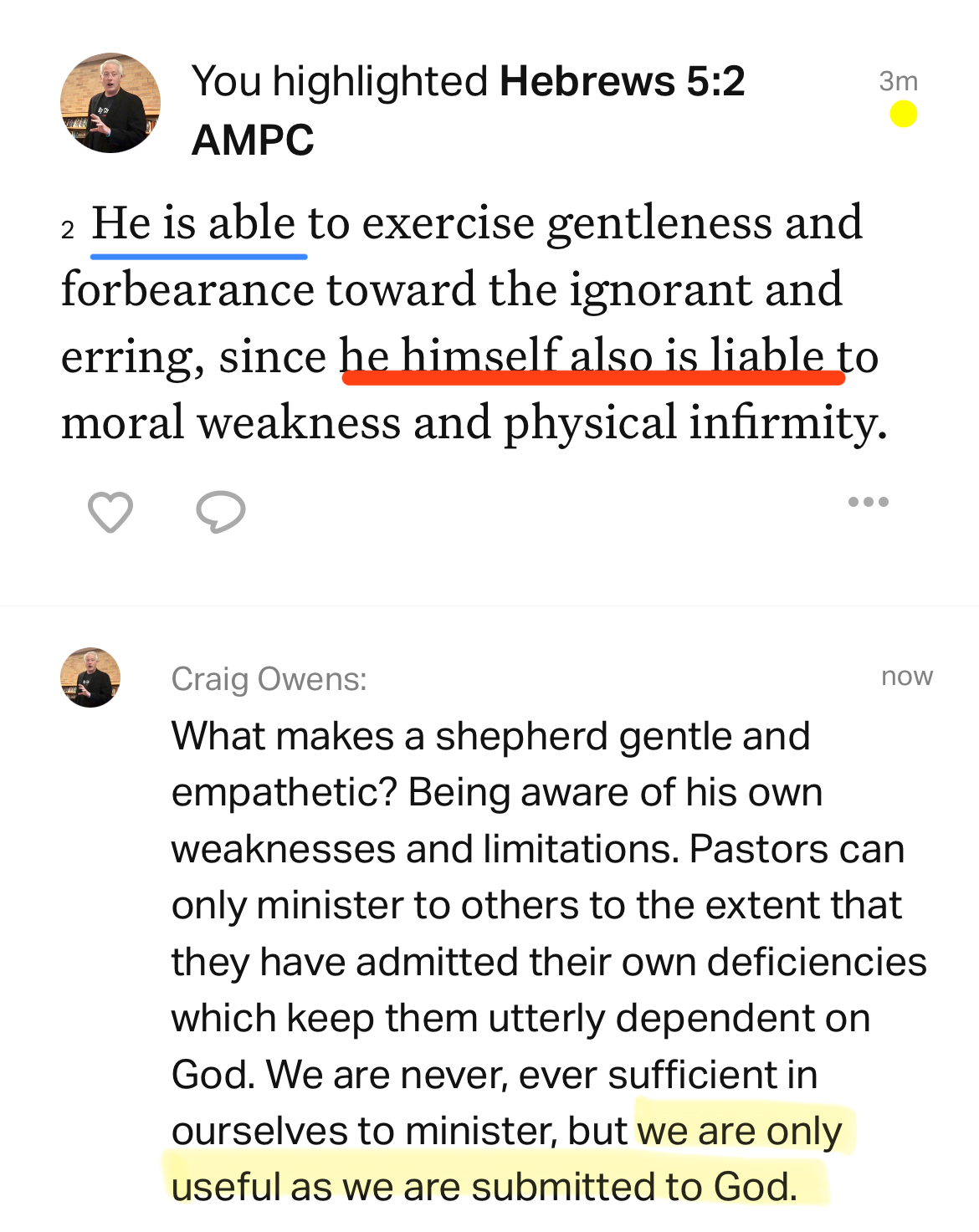
Because of the extensive prayer, research, and work I put into my book Shepherd Leadership, I am frequently drawn to passages of Scripture that reinforce the idea of pastors as shepherds. I was meditating on Hebrews 5:2 the other day, and I shared some of my thoughts with some of my pastor friends.
Don’t give in to F.E.A.R. When the devil’s lies make us afraid, remember that F.E.A.R. stands for false evidence appearing real. The Holy Spirit can help you find the true evidence in God’s Word that will confront and dismantle the false evidence.Check out this full message here. I have lots of new content every week, which you can check out on my YouTube channel.
“Meanwhile it is also necessary for the ruler [pastor] to keep wary watch, lest the lust of pleasing men assail him; lest, when he studiously penetrates the things that are within, and providently supplies the things that are without, he seek to be beloved of those that are under him more than truth…” (Gregory the Great). Check out how T.M. Moore unpacks this quote.
The Culture Translator” newsletter from Axis has this sobering reminder of the dangers of pornography.
What it is: An eye-opening essay in The Free Press describes the impact of pornography on a teen’s developing brain.
What it tells us: The author of this piece, Isabel Hogben, is a homeschooled high schooler living in Redford City, California. In one of several devastating lines, Hogben details how she stumbled upon PornHub when she was only ten years old, even as her very present mother was “making sure I was eating nine differently colored fruits and vegetables on the daily.” Hogben goes on to explain that today’s pornography depicts a synthetically augmented and physically brutal type of sex that makes Playboy magazine look “like an American Girl Doll catalog.” She notes that teens who have never had a physical sexual encounter can’t know the difference between what fake sex and real sex is supposed to be like, skewing their expectations, and that her peers think selling nudes online is normal. As she examines the way porn causes scientifically-measurable changes in the brain, Hogden concludes that porn is not “content” as much as it is a dangerously addictive substance not unlike street drugs.
“Do nothing that you would not like God to see. Say nothing you would not like God to hear. Go no place where you would not like God to find you. Never spend your time in such a way that you would not like God to say, ‘What are you doing?’” —J.C. Ryle
“Learning to say no is not just about courage, but also learning how to prioritize your life and become more productive.” —John Maxwell
Listen to the podcast of this post by clicking on the player below, and you can also subscribe on Apple, Spotify, or Audible.
T.M. Moore is an esteemed theologian and a good friend. I was excited to discover someone who shared my passion for viewing pastoring as “pasturing”—seeing ourselves as under-shepherds following The Chief Shepherd Jesus.
Shalom—the peace that comes from God—could be defined simply as “nothing missing.” But couldn’t it also be defined as “no one missing”? It sure could! What peace there is when no one is missing from Heaven! Check out more of this message here. And be sure to check out all of my videos on my YouTube channel.
“Despite the moon’s apparently simple shape, uniformitarian scientists have long had great difficulty explaining how it could form by natural processes apart from a supernatural Creator. One Harvard astrophysicist once quipped that the best explanation for the moon’s existence was observational error—the moon doesn’t really exist!” This is a very interesting post from the Institute for Creation Research.
“Do we not miss very much of the sweetness and efficacy of prayer by a want of careful meditation before it, and hopeful expectation after it? … We too often rush into the presence of God without forethought or humility. We are like people who present themselves before a king without a petition, and what wonder is it that we often miss the end of prayer? We should be careful to keep the stream of meditation always running, for this is the water to drive the mill of prayer. … Prayer without fervency is like hunting with a dead dog, and prayer without preparation is hawking with a blind falcon. Prayer is the work of the Holy Spirit, but He works by means. God made man, but He used the dust of the earth as a material. The Holy Ghost is the Author of prayer, but He employs the thoughts of a fervent soul as the gold with which to fashion the vessel. Let our prayers and praises be not the flashes of a hot and hasty brain but the steady burning of a well-kindled fire.” —Charles Spurgeon, in Spurgeon and the Psalms
What a powerful word to pastors from T.M. Moore’s post First Things First. “Pastors sometimes complain that their people don’t seem very hungry or thirsty for the things of the Lord. Sated on the junk food of getting-and-spending, generously ladled over with pop culture, God’s people have little appetite for Christ or His Word. But what about us? Does our hunger and thirst for Christ make them long for the same? Do they see in us that earnest desire to be with the Lord that tells them they’re missing something of great importance? Loving Christ and delighting to be with Him is infectious. If the people we serve see it in us, they’ll want it for themselves, more than anything this world might offer.”
We don’t read about Jesus getting angry that often, but what usually got Him upset was when people in need were being kept from the God who could meet their needs. Sadly, it was usually man-made rules and practices that kept people away. I don’t want to make Jesus angry, so I need to evaluate anything in my life that may be standing in the way of connecting needy people with a need-satisfying God.
“So in our broader culture, people no longer sin; they make mistakes. What about our Christian environment? In our case, sin is not denied. Instead it is often redefined to refer to the more flagrant sins of society. We tend to ignore our own sins of pride, selfishness, gossip, and the like. So, effectively, no one sins anymore. The reason is that we have lost sight of the biblical meaning of sin. Typically, if we are not actually murderers, felons, or adulterers, we tend to think of our common sins as no more serious than a parking violation. We are so used to living with pride, selfishness, envy, gossip, and a whole host of other ‘respectable sins’ that we don’t even think of them as sin. But the fact is that, as serial sinners, we are all as guilty before God as that murderer. You and I sin every day in thought, word, deed, and motive. And whether those sins appear great or small in our own sight, in reality every sin we commit is an act of rebellion against God, a rejection and attempted negation of His sovereignty and rulership over us.” —Jerry Bridges
Listen to the podcast of this post by clicking on the player below, and you can also subscribe on Apple, Spotify, or Audible.
CEO stands for “chief executive officer” and usually designates the person who is at the top of the organization’s flowchart. Those who occupy that office frequently exhibit a top-down mindset, where everyone below them is only in that position to serve the CEO.
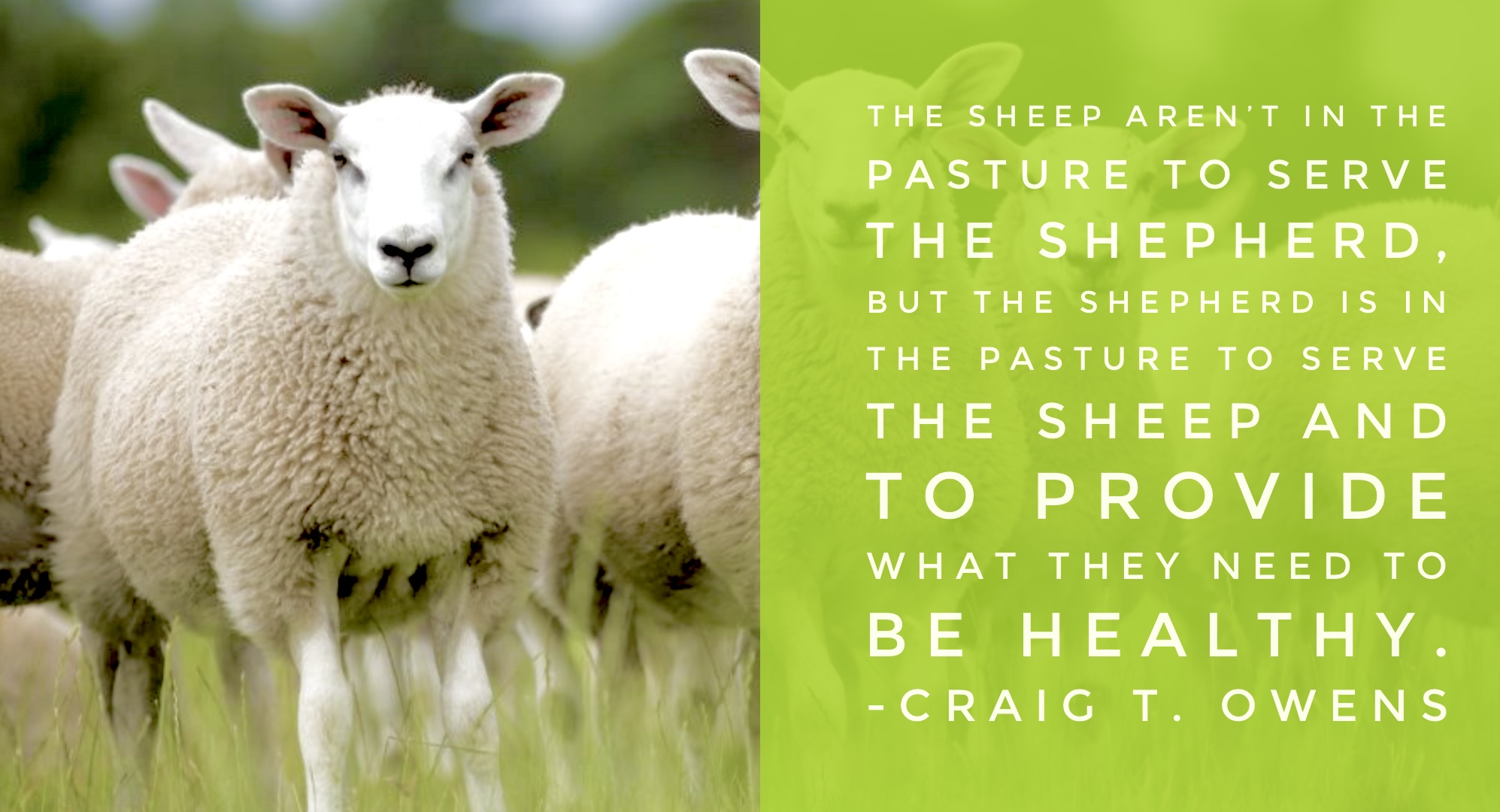
This may work well in the corporate world, but this is not at all the heart Jesus demonstrates toward us. Therefore, it shouldn’t be the mindset or practice of Christ’s under-shepherds—those whom He has called to pastor His sheep. The sheep aren’t in the pasture to serve the shepherd, but the shepherd is in the pasture to serve the sheep and to provide what they need to be healthy.
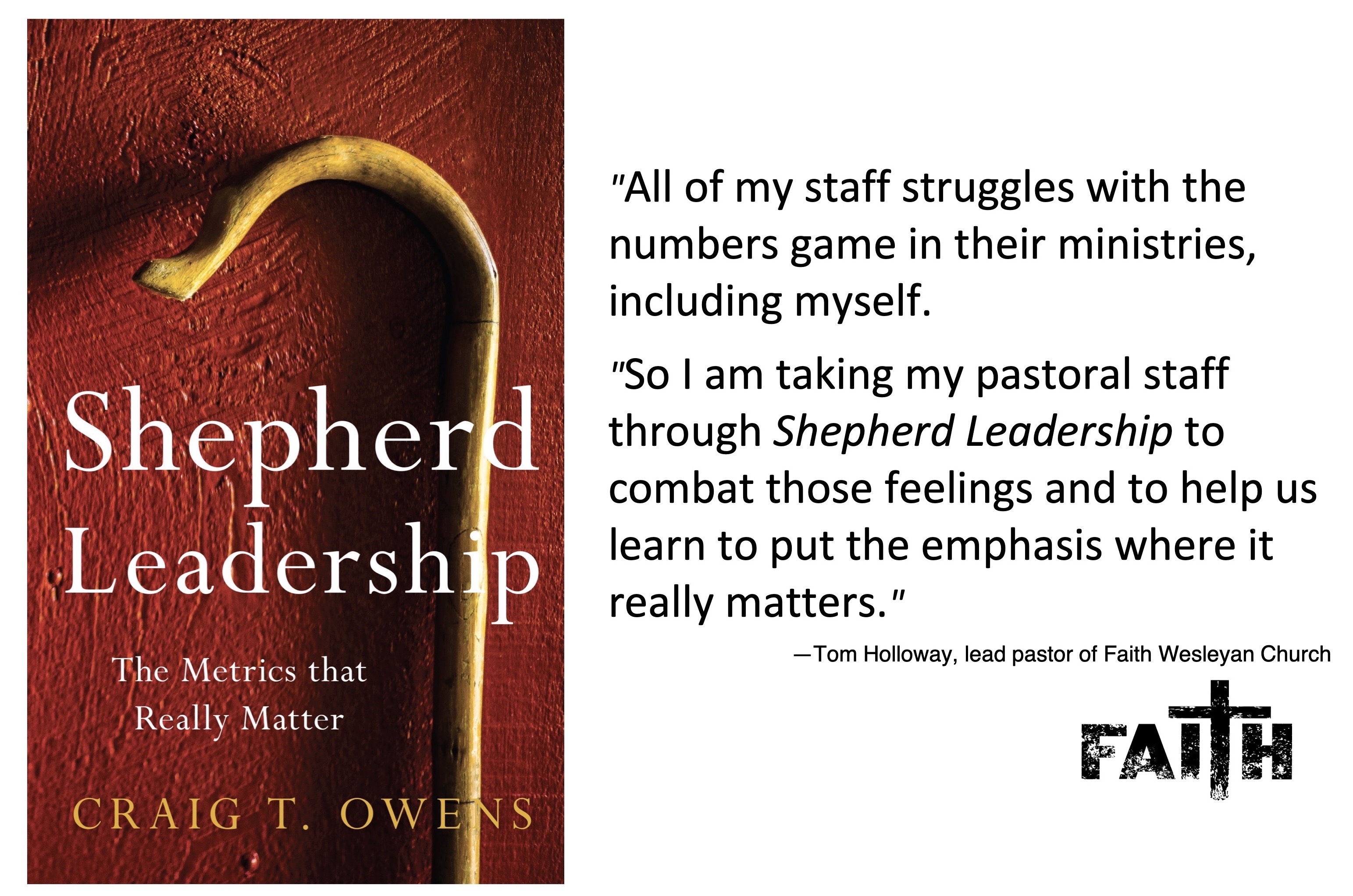
Check out this conversation I had when I joined a pastoral staff that is using my book Shepherd Leadership as a study guide.
Jesus was confident in who He was and what His Father’s plan was: “Jesus knew that the Father had given Him authority over everything and that He had come from God and would return to God” (John 13:3 NLT).
Yet Jesus also said, “For even the Son of Man came not to be served but to serve others and to give His life as a ransom for many” (Mark 10:45 NLT).
If you are a pastor, you have been charged with caring for the sheep under your care, and not the other way around—
Tend (nurture, guard, guide, and fold) the flock of God that is your responsibility, not by coercion or constraint, but willingly; not dishonorably motivated by the advantages and profits belonging to the office, but eagerly and cheerfully; not domineering—as arrogant, dictatorial, and overbearing persons—over those in your charge, but being examples (patterns and models of Christian living) to the flock (the congregation). (1 Peter 5:2-3 AMP)
Listen to the podcast of this post by clicking on the player below, and you can also subscribe on Apple, Spotify, or Audible.
Are you a pastor who is feeling discouraged? Or do you know a pastor who has become frustrated by what isn’t happening in their church? If so, please read on because I have something special for you.
When I was interviewed on the 200churches podcast with Jeff Keady, I tried to speak an encouraging word to my fellow pastors, especially those who were discouraged to the point of wanting to throw in the towel. If that’s you, I hope that you will take two minutes to listen to this short clip (click the audio link above).
I’ve never seen the actual research, but I’ve heard the story enough to believe that it’s probably true that more pastors write their letters of resignation on Monday morning than on any other day.
That’s understandable.
All week, pastors prepare to deliver a message on Sunday, and then they pour out their hearts as they minister to those who have come to church. But when they look around for those who didn’t come to church, or when they see only apathy in those who did come to church, or (perhaps worst of all) when all they hear are complaints, it’s understandable how frustration and discouragement can creep in and even overwhelm.
So back in their office on Monday morning, facing the prospect of another week that seems to be shaping up to feel unsuccessful again, many pastors choose to resign.
My heart goes out to these pastors. In fact, I had these very pastors in mind as I wrote my book Shepherd Leadership.
As we are at the start of a new year, I would like to make a special offer for pastors. For just $12 I will send you an autographed copy of my book and a download link to get the audiobook of Shepherd Leadership free of charge.
All you need to do is complete this form and I’ll have the materials right out to you. I’m praying for you, my friend, that you will allow God to use the message in this book to encourage you to persevere and thrive despite the challenges you are facing.
Jim pastors a very large church, I pastor a small church, and John coaches pastors who pastor every size church in between. We are all in agreement that when it comes to the vitality of both the church and the pastor, the size of the church or its budget is not the best metric to monitor. Take a listen…
None of us are anti-growth when it comes to the church, but we are pro-health. Jim said it well: We will get what we focus on. If we just want numbers, the numbers may explode, but people may explode (or implode) in the process. But if we focus health, we will get healthy—both the pastor and the congregation.
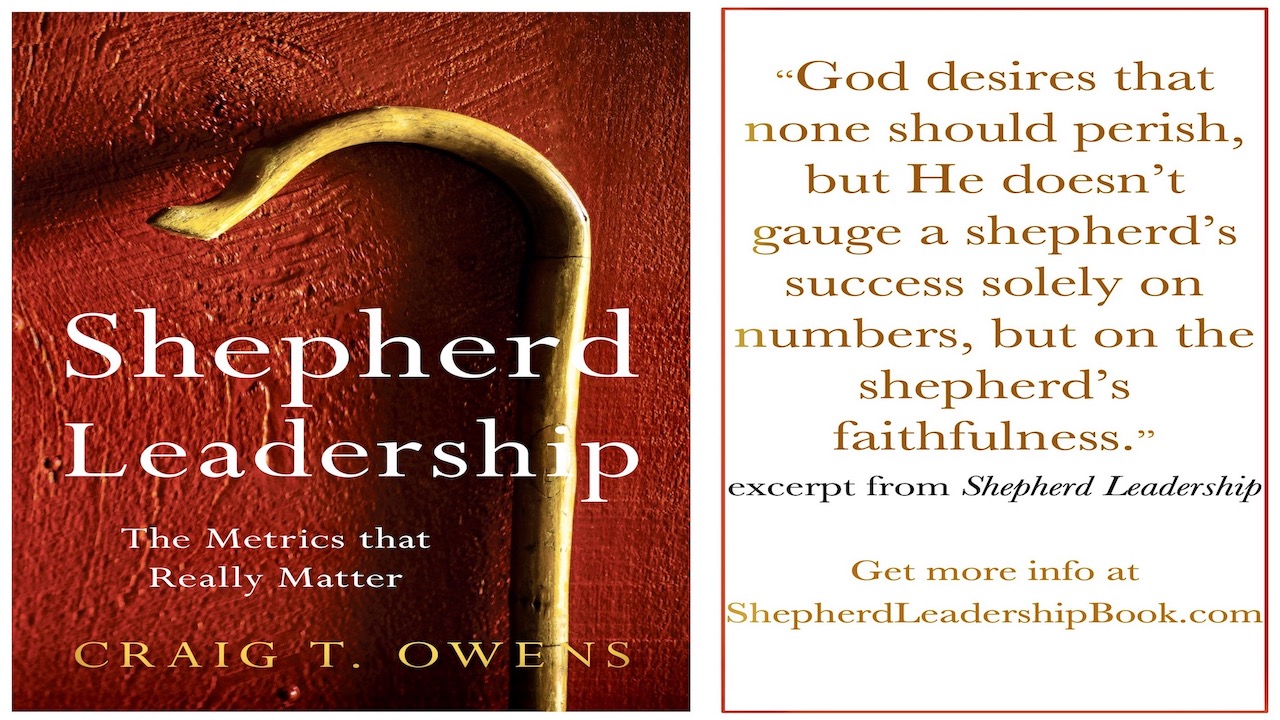
This idea is the reason behind my book Shepherd Leadership, especially the subtitle “The metrics that really matter.” I am so grateful to hear that my book is helping pastors and church boards realign their thinking along biblical practices, and that Shepherd Leadership is even being used as a textbook in a pastoral training school. I believe my book can be of assistance to you too.
I’ll be sharing more clips from this Leading From Alignment interview soon, so please stay tuned. Shepherd Leadership: The Metrics That Really Matter is available in print or ebook, and in audiobook through either Audible or Apple.









 Craig T. Owens