Listen to the podcast of this post by clicking on the player below, and you can also subscribe on Apple, Spotify, or Audible.
Christians need to be known more for what is good than for what is bad. Jesus hasn’t called us to point out what’s bad, but to point out how good Jesus is.
Listen to the podcast of this post by clicking on the player below, and you can also subscribe on Apple, Spotify, or Audible.
The letters we’ve looked at so far—B, A, S, and I—are bringing about greater fruitfulness and joy-fullness in our lives, which is then enhancing our personal testimony. So the B, A, S, and I all lead up to the C—community involvement.
One of the first things we need to consider about our community is our role—both what the Bible says is and isn’t our area of concern. Jesus helps us with a parable about wheat and weed and its explanation a few verses later (Matthew 13:24-30, 36-43).
From Jesus we learn that the world was created good—that’s what God said at each day of Creation. Since the fall of man, satan has sown his evil seeds alongside Christ’s good seeds.
Our responsibility isn’t about pointing out what’s wrong in the world
It isn’t about rooting out the evil in the world
It isn’t about judging the evil or even the evildoers in the world
Our responsibility is to proclaim how good our God is
Our responsibility is to bear as much God-honoring fruit as we can
Our responsibility is to embody biblical principles and proclaim the benefits of God’s Kingdom to others
The apostle Paul helps us see our role in our community with his payer in Ephesians 1:17-20. Paul desires that we know…
The hope to which God has called us. A rock-solid, irrevocable, eternal hope!
The riches of His inheritance in His saints. The treasure is in us. We get to be God’s blessing to those around us.
God’s incomparably great power for us. We’re never lacking anything because His power is for us—God Himself is for us!
When our eyes are opened to this, we can see better how to live in our communities. God has placed us and equipped us to proclaim His glorious Gospel in our Personal Mission Field. The PMF includes places like our:
Family—John 1:35-42
Friend group—John 1:43-46
Neighborhood—Colossians 1:3-8
Workplace—Ephesians 6:5-9
How do we do this?
We talk about the daily interactions you have with Jesus—make it clear that He is a real Person with Whom you have a relationship.
We live out our biblical worldview.
We stay in fellowship with out saints so that we are sharpened and prepared to give an answer for the reason for the hope we have.
We continually monitor our conversation and attitude to make sure they are Christ-like.
Let us saints be known for what we’re for more than for what we’re against!
Instead of railing on the evil, proclaim the favor of God, proclaim the soul-satisfying joy of a relationship with Jesus, and proclaim the advantages of the Holy Spirit’s continual counsel.
If you’ve missed any of the previous messages in our series B.A.S.I.C. Christianity, you can find them all here.
Listen to the podcast of this post by clicking on the player below, and you can also subscribe on Apple, Spotify, or Audible.
I want to give you some thoughts to take your Bible studies even deeper. Here are three strategies to make your Bible study time stickier—sticking in your heart and your mind.
Listen to the podcast of this post by clicking on the player below, and you can also subscribe on Apple, Spotify, or Audible.
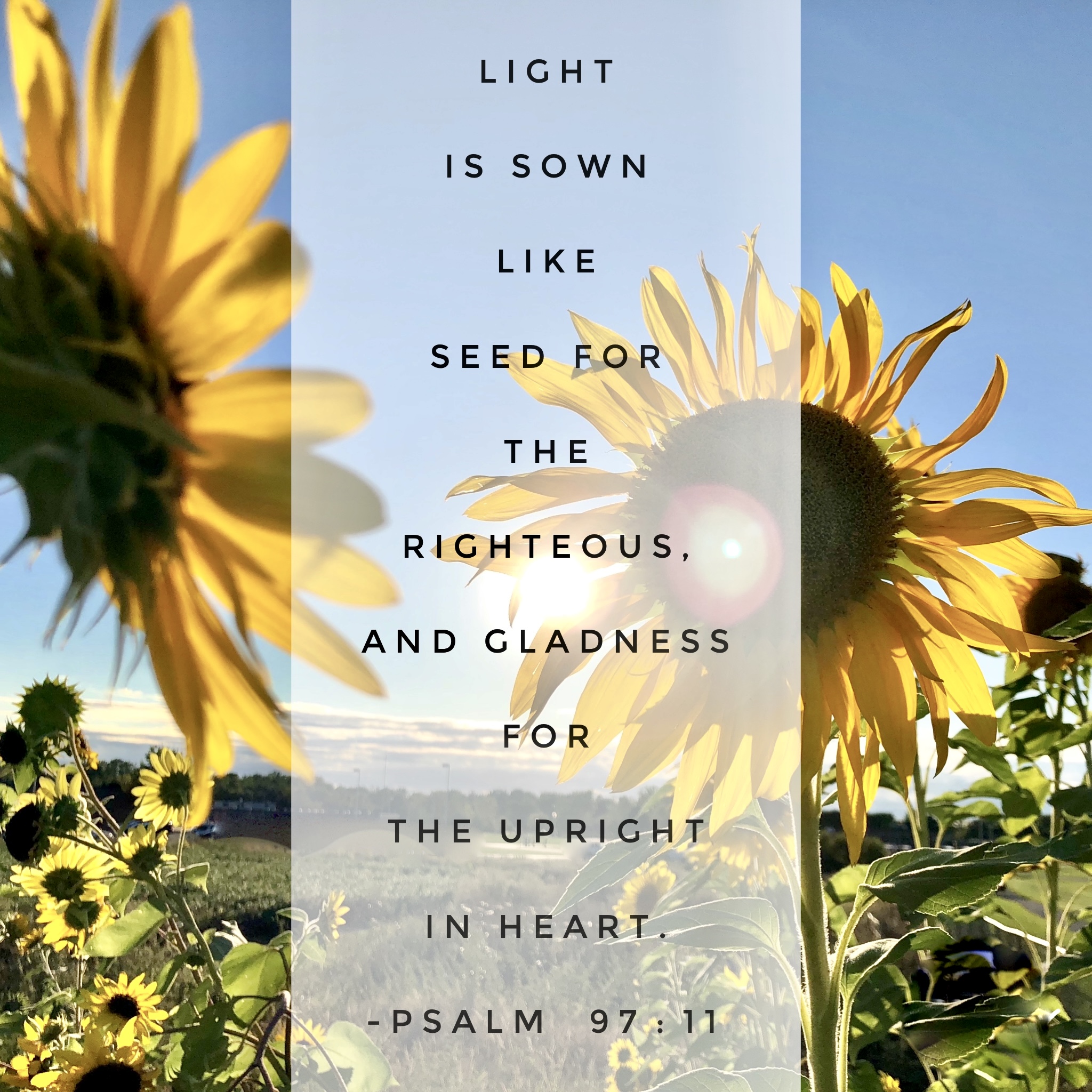
Light is sown like seed for the righteous, and gladness for the upright in heart. (Psalm 97:11)
Jesus used the parable of a farmer sowing seed as a picture of the seed God wants to sow in our hearts. The psalmist says that God’s seeds are light—driving out the shadows of darkness, and producing an abundant harvest of gladness in our hearts.
I like how the Amplified Bible renders this verse in Psalm 97—Light is sown for the uncompromisingly righteous and strewn along their pathway, and joy for the upright in heart—the irrepressible joy which comes from consciousness of His favor and protection.
Let’s live in a such a God-honoring way that His seeds of light bring forth an abundant harvest that gives Him all the glory and points others to Jesus the Savior.
In what may be the best-known parable that Jesus told, what’s the difference between the hard path where the seeds failed to produce anything and the fertile soil where the seeds produced an abundant harvest? The fertile soil had a plow applied to it. In the same way, God wants to “plow” the hard places in our life so that there can be an abundant harvest! Check out this full sermon here.
I have lots of new content every week, which you can check out on my YouTube channel.
“The greatest reason for a loss of reality is that while we say we believe one thing, we allow the spirit of the naturalism of the age to creep into our thinking, unrecognized.” —Francis Schaeffer, in True Spirituality
“The glory of God is a silver thread, which must run through all our actions.” —Thomas Watson
“Christianity is not the removal of weakness, nor is it merely the manifestation of divine power. Rather, it is the manifestation of divine power through human weakness.” —Dr. Donald Stamps, Life In The Spirit Study Bible,commenting on 2 Corinthians 4:7-9, 12:9-10
“In our media-rich, secular age, we must be especially vigilant against unbelief finding its way into our hearts [Hebrews 3:12]. The heavenly calling of God is really real, and we can really partake of it. But we’ll need to be continuously on guard against ideas and messages that can undermine our confidence, stifle our boasting, rob us of the reality of our experience of Christ, set us adrift from the Lord, and end up proving us to be someone other than we thought.” —T.M. Moore
“If you don’t want responsibility, don’t sit in the big chair. To be successful, you must accept full responsibility.” —Pat Summitt
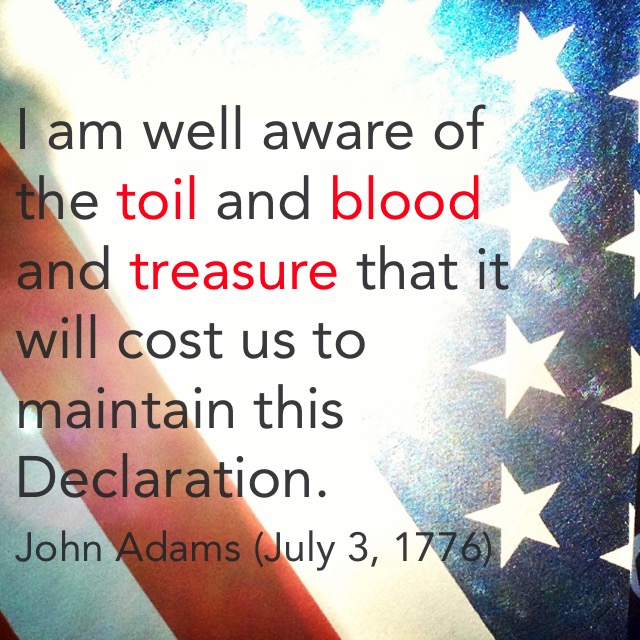
From the 1440 Daily Digest: Congratulations, America—July 4, 2024, marks the 248th commemoration of the day the Declaration of Independence was adopted by the Second Continental Congress. Through the centuries, the US has grown from 13 colonies with about 2.5 million people to 50 states and 14 territories with a population of more than 330 million. The economy has swelled to over $27T. Advances in public health have cut the child mortality rate from over 45% to under 1%, while our citizens live over 35 years longer on average. Scientific achievements in the US have delivered everything from the light bulb, modern flight, and the internet to air conditioning, movies, and the polio vaccine. More than 2.7 million miles of power lines electrify the country across over 4 million miles of paved roads, with over 90% of households accessing broadband internet. The US has also been responsible for more than 800 human visits to space—the most of any country.
Listen to the podcast of this post by clicking on the player below, and you can also subscribe on Apple, Spotify, or Audible.
The disciples of Jesus heard His story and asked Him to explain to them what the parable meant. He said, “Don’t you understand this parable? How then will you understand any parable?” (Luke 8:9; Mark 4:13).
The parable in question was the one we refer to as the parable of the sower. According to Christ’s own words, this is the most basic and understandable of all of His parables. If this was a college class, this would be Parables 101.
The kingdom of heaven is so otherworldly, infinite, and utterly beyond a succinct description that even Jesus asked out loud, “What shall we say the kingdom of God is like, or what parable shall we use to describe it?” (Mark 4:30). Then time and time again, Jesus continued to reveal His kingdom with the phrase, “The kingdom of God is like….”
Before we move on to Parables 201 or Parables 301, let’s make sure we know this most basic parable intimately. According to Jesus, this parable is the key to unlocking the meaning of all of His other parables. Approach this one again as you ask the Holy Spirit to reveal something new to your heart.
For instance, as I read through this parable again this week I was captivated by those whom Jesus said had shallow roots. It reminded me that I need to temper my teaching with gentleness. If I’m too aggressive or too theologically deep, I may do damage these tender plants. On the other hand, if I’m too timid, I may leave these plants vulnerable to the ravages of disease or the scorching of the sun. Here again, I must rely on the Holy Spirit’s help. The message may be the same, but perhaps my delivery needs to be more appropriate to my audience.
Let me leave you with this challenge: When was the last time you saw something for the first time in this simplest of parables? If it’s been a while, it may be time for a quick refresher in Parables 101, then you will have the key to go deeper into the other parables. Try it and let me know how it works for you.
This is a weekly series with things I’m reading and pondering from Charles Spurgeon. You can read the original seed thought here, or type “Thursdays With Spurgeon” in the search box to read more entries.
Listen to the podcast of this post by clicking on the player below, and you can also subscribe on Apple, Spotify, or Audible.
The Death Of The Christian
You shall come to the grave at full age, as a sheaf of grain ripens in its season. (Job 5:26)
Let me tell you a parable. Behold, two men sat together in the same house when Death came to each of them. He said to one, ‘You will die.’
That man looked at him. Tears suffused his eyes, and tremblingly he said, ‘O Death, I cannot! I will not die.’ He sought out a physician and said to him, ‘I am sick, for death has looked upon me. His eyes have paled my cheeks, and I fear I must depart. Physician, there is my wealth. Give me health and let me live.’ The physician took his wealth but gave him not his health with all his skill. The man changed his physician, tried another, and thought that perhaps he might spin out the thread of life a little longer.
But alas! Death came and said, ‘I have given you time to try your varied excuses. Come with me. You will die.’ And he bound him hand and foot and made him go to that dark land of Hades. As the man went, he clutched at every side post by the way, but Death, with iron hands, still pulled him on. … He did not come to his grave, but death fetched him to it; the grave came to him.
But death said to the other man, ‘I am come for you.’
He smilingly replied, ‘Ah, Death! I know you; I have seen you many a time. I have held communion with you. You are my Master’s servant. You have come to fetch me home. Go and tell my Master I am ready, whenever He pleases. Death, I am ready to go with you.’ And together they went along the road and held sweet company.
Death said to him, ‘I have worn these skeleton bones to frighten wicked men. But I am not frightful. I will let you see myself. The hand that wrote upon Belshazzar’s wall was terrible because no man saw anything but the hand. But,’ said Death, ‘I will show you my whole body. Men have only seen my bony hand and have been terrified.’
And as they went along, Death ungirded himself to let the Christian see his body, and he smiled, for it was the body of an angel. He had wings of cherubs and a body glorious as Gabriel. The Christian said to him, ‘You are not what I thought you were. I will cheerfully go with you.’ At last Death touched the believer with his hand. … So did Death put his finger on the man’s pulse and stopped it for a moment, and the Christian found himself by Death’s kind finger changed into a spirit. Yes, found himself brother to the angels. His body had been etherealized, his soul purified, and he himself was in heaven.
From The Death Of The Christian
I love God’s timing. In my ongoing series looking at the sermons of Charles Spurgeon, I simply turned the page to the next sermon for this week, and this parable was especially timed for me because my Mom just passed away on December 26.
What a godly woman she was!
What a thrill it is to know that Death did not take her to her grave, but that she came to her grave at full age, fully ripened in God’s timing. Our family is at peace because we know that my Mom is now at Home with her Savior Jesus—the home she has been longing for!
Our family loves the promise in 1 Thessalonians: And now, dear brothers and sisters, we want you to know what will happen to the believers who have diedso you will not grieve like people who have no hope (1 Thessalonians 4:13). We grieve because we will miss her, but we have such an unshakable hope of her eternal home! Paul goes on to tell us that we should “encourage each other with these words” (v. 18).
So let me encourage you, my friend, with this question: Will Death have to take you to the grave, or will you come willingly with him? If you have your sins forgiven because you have placed your faith in the sin-forgiving work Jesus Christ did upon His Cross, then Death will have no fear for you. If you are uncertain or fearful, don’t lose another moment! Pray to God: admit you are a sinner who is helplessly trapped in your sin, believe that Jesus paid the full penalty for your sin, and then ask God to forgive your sins because of your faith in Jesus. The moment you do that, you will be completely forgiven and the fear of Death will be removed.
Listen to the podcast of this post by clicking on the player below, and you can also subscribe on Apple or Spotify.
Perelandra by C.S. Lewis is the second book in Lewis’ space trilogy. Of all the books in this series, this is the only book that I would recommend reading the first book—Out Of The Silent Planet—first, so that you can fully appreciate the story.
Out Of The Silent Planet took place on Malacandra (or Mars) where our protagonist Dr. Elwin Ransom learns the Old Solar language and clashes with the antagonist Dr. Edward Weston. Perelandra (or Venus) is the setting of this second book, which essentially picks up right from the conclusion of book one.
Although C.S. Lewis had much stricter definitions for terms like “allegory” or “parable,” his fantasy stories in both this space trilogy and his Narnian books clearly are telling a much grander and more real Story than merely the fictional accounts in these books. This concept is on full display in Perelandra.
In the biblical account of the temptation of Eve, the whole affair is covered rather quickly. The devil says, “Eat the fruit,” to which Eve replies, “We’re not supposed to.” And then the devil says, “Nothing bad will happen to you if you do eat it,” and she does it. In Perelandra, C.S. Lewis takes us back to that scene and imagines the debate that might have happened, with Ransom counseling the Lady of Perelandra to obey, and Weston (or at least Weston’s body) trying to convince her to bravely disobey. The interplay between these three characters is quite fascinating.
This story is a very enjoyable read on its own, but I found that the backstory of Out Of The Silent Planet increased my enjoyment in reading this book again. Whenever you choose to read this book, you are in for—with all due apologies to C.S. Lewis—a lovely allegory!
Listen to the podcast of this post by clicking on the player below, and you can also subscribe on Apple or Spotify.
To some who were confident of their own righteousness and looked down on everybody else, Jesus told this parable: “Two men went up to the temple to pray, one a Pharisee and the other a tax collector. The Pharisee stood up and prayed about himself: ‘God, I thank You that I am not like other men—robbers, evildoers, adulterers—or even like this tax collector. I fast twice a week and give a tenth of all I get.’
“But the tax collector stood at a distance. He would not even look up to heaven, but beat his breast and said, ‘God, have mercy on me, a sinner.’
“I tell you that this man, rather than the other, went home justified before God. For everyone who exalts himself will be humbled, and he who humbles himself will be exalted.” (Luke 18:9-14)
I think the NIV footnote on verse 11 is the most accurate rendering of “the Pharisee stood up and prayed about himself.” The footnote says, “He prayed TO himself.” He made himself God, which, if you will recall, is exactly how satan tempted Adam and Eve—you will be like God (Genesis 3:5).
In a portion of William Cowper’s poem Truth, he addresses the pride of the Pharisee, and warns us that this could be our pride too if we aren’t carefully guarding our hearts.
Who judged the Pharisee? What odious cause
Exposed him to the vengeance of the laws?
Had he seduced a virgin, wrong’d a friend,
Or stabb’d a man to serve some private end?
Was blasphemy his sin? Or did he stray
From the strict duties of the sacred day?
Sit long and late at the carousing board?
(Such were the sins with which he charged his Lord.)
No—the man’s morals were exact. What then?
‘Twas his ambition to be seen of men;
His virtues were his pride; and that one vice
Made all his virtues gewgaws [gyoo-gaws] of no price;
He wore them as fine trappings for a show,
A praying, synagogue-frequenting beau.
The self-applauding bird, the peacock, see—
Mark what a sumptuous Pharisee is he!
Meridian sunbeams tempt him to unfold
His radiant glories, azure, green, and gold:
He treads as if, some solemn music near,
His measured step were govern’d by his ear;
And seems to say—“Ye meaner fowl give place;
I am all splendour, dignity, and grace!”
Not so the pheasant on his charms presumes,
Though he, too, has a glory in his plumes.
He, Christian-like, retreats with modest mien
To the close copse or far sequester’d green,
And shines without desiring to be seen.
The plea of works, as arrogant and vain,
Heaven turns from with abhorrence and disdain;
Not more affronted by avow’d neglect,
Than by the mere dissembler’s feign’d respect.
What is all righteousness that men devise?
What—but a sordid bargain for the skies!
But Christ as soon would abdicate His own,
As stoop from heaven to sell the proud a throne.
When the writer of Hebrews says that we can approach the throne of grace boldly, it is clear that it is not because of our righteous deeds, even if they are as exacting and as perfect as a Pharisee. We can only come boldly into God’s presence because we come in the name and the righteousness of Jesus. “I tell you that this man, rather than the other, went home justified before God.”
Adding “in Jesus name” to the end of our prayers isn’t a password that opens the storeroom of Heaven, but it is a reminder that we have nothing in ourselves to commend us to God. We come boldly only in Jesus.
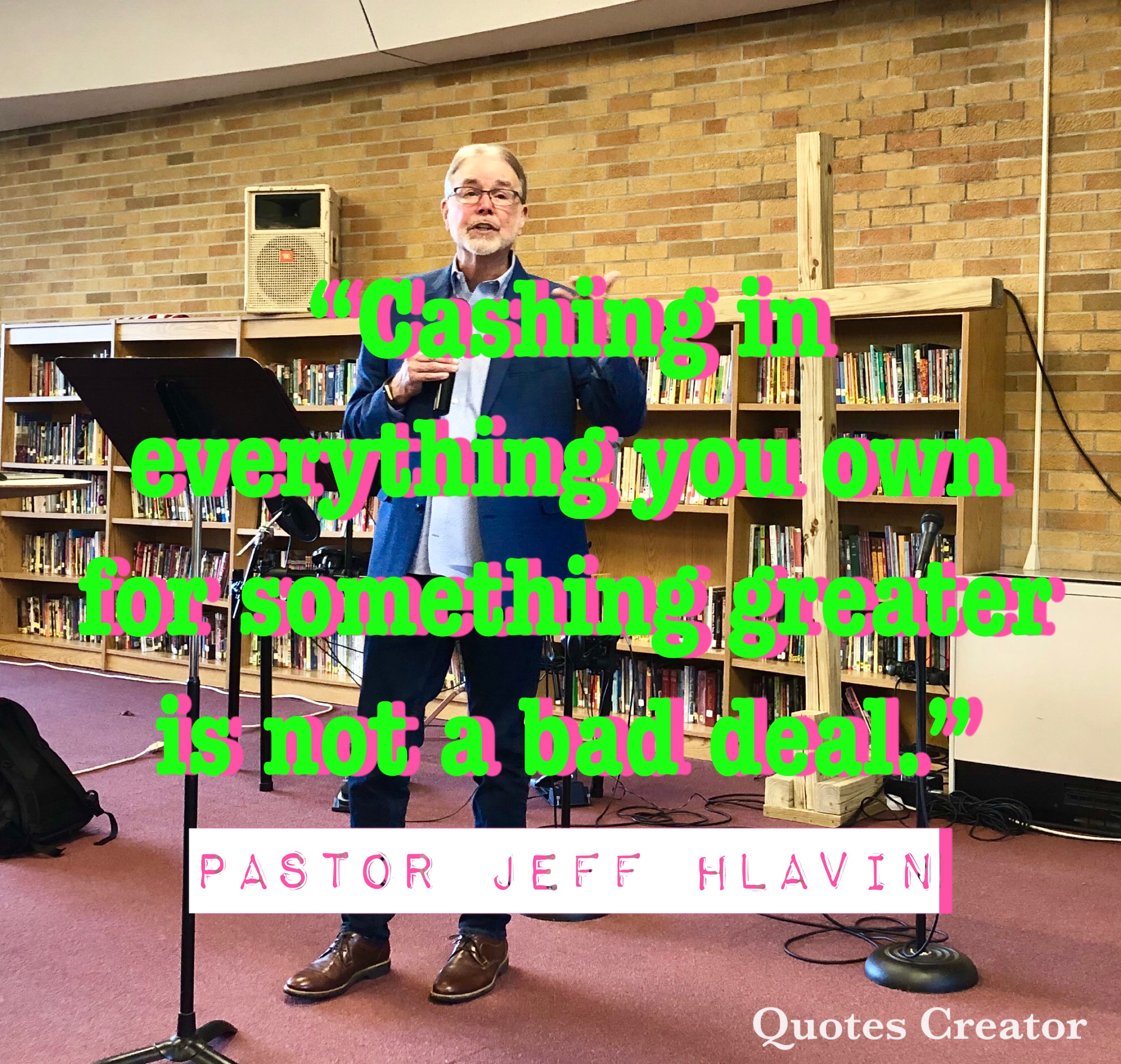
I am always blessed to sit under the ministry of Jeff Hlavin! These are some of my notes from his message Calvary Assembly of God on Sunday, but you really should watch the whole message.
The kingdom of heaven is like a treasure hidden in the field, which a man found and hid; and from joy over it he goes and sells all that he has, and buys that field.Again, the kingdom of heaven is like a merchant seeking fine pearls, and upon finding one pearl of great value, he went and sold all that he had, and bought it. (Matthew 13:44-46)
There are at least two possible perspectives about the meaning and the application of these two parables:
First Perspective: Jesus is the One who finds and seeks.
The field is the world, and Jesus paid the price for the whole field/world to be His.
Second Perspective: We are the ones doing the discovering.
Jesus provides Himself as the Treasure of treasures. So taking up our cross to follow Him is not a morbid thing. There is overwhelming joy because of the extravagant treasure that is ours when we do so!
1. It’s about our response to discovering His Kingdom.
2. It’s about our appropriate response to His Kingdom.
3. It’s about the whole-hearted appropriate response which the Kingdom of God requires.
4. It’s about the value of His Kingdom.
5. It’s about the primacy of His Kingdom.
Three Observations:
Both individuals are alike in that…
Both of them know there is more to life than what they have. Neither one of them considers what they’re doing as a sacrifice because of what they’re gaining!
Both of them recognize what is missing when they find it.
Both of them recognize that what they have found is of far more inestimable value than everything else they have.












 Craig T. Owens