Links & Quotes

link quote

“People most affected by fear are those who hang around negative people. If you’re going to control the negative thoughts in your life, you’ve got to get away from negative people as much as you can.” —Rick Warren

“Liberty cannot be established without morality, nor morality without faith.” —Horace Greeley

“It’s natural enough in our species, as in others, that the young birds should show off their plumage—in the mating season. But the trouble in the modern world is that there’s a tendency to rush all the birds on to that age as soon as possible and then keep them there as late as possible, thus losing all the real value of the other parts of life in a senseless, pitiful attempt to prolong what, after all, is neither its wisest, its happiest, or most innocent period. I suspect merely commercial motives are behind it all: for it is at the showing-off age that birds of both sexes have least sales resistance!” —C.S. Lewis

“Don’t make a decision, large or small, without sitting before God with an open Bible, an open heart, and open ears. Philippians 2:13 says, ‘God is working in you to help you want to do and be able to do what pleases Him.’” —Max Lucado

“Strange as it may seem, one of the primary purposes of being shaken by suffering is to make our faith more unshakable. Faith is like muscle tissue: if you stress it to the limit, it gets stronger, not weaker. That’s what James means here [James 1:2-3]. When your faith is threatened and tested and stretched to the breaking point, the result is greater capacity to endure. … If you think your suffering is pointless, or that God is not in control, or that He is whimsical or cruel, then your suffering will drive you from God, instead of driving you from everything but God—as it should. So it is crucial that faith in God’s grace includes the faith that He gives grace through suffering.” —John Piper

“The promise, made when I am in love and because I am in love, to be true to the beloved as long as I live, commits me to being true even if I cease to be in love. A promise must be about things that I can do, about actions: no one can promise to go on feeling in a certain way. He might as well promise never to have a headache or always to feel hungry.” —C.S. Lewis

“It’s the lives of the saints, not the arguments of the theologians and philosophers, that covert people.” — Pope Benedict XVI

Links & Quotes

link quote

“Reading the Bible is a good preparative for prayer, as prayer is an excellent means to render reading effectual.” —George Whitefield

“God would have remained hidden afar off if Christ’s splendor had not beamed upon us.” —John Calvin

“In selecting men for office, let principle be your guide. Regard not the particular sect [party] of the candidate—look to his character. … It is alleged by men of loose principles or defective views of the subject that religion and morality are not necessary or important qualifications for political stations. But the Scriptures teach a different doctrine. They direct that rulers should be men ‘who rule in the fear of God, able men, such as fear God, men of truth, hating covetousness.’” —Noah Webster

“During the gold rush, the people who made the most money were the ones selling the shovels.” —Russell Brunson

Husbands, here are 8 things your wife should expect from you.

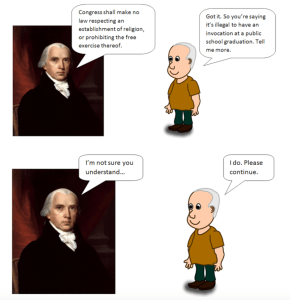
James Madison & the Bill of RightsMurray Vassar has another great cartoon. Click the picture or here to see the rest…

Seth Godin always makes me think. Like this post called Opposition

The opposite of creativity is fear.
And fear’s enemy is creativity.
The opposite of yes is maybe.
Because maybe is non-definitive, and both yes and no give us closure and the chance to move ahead.
Perfect is the enemy of good.
Us is not the enemy of them. Us is the opposite of alone.
They can become us as soon as we permit it.
Everything is the opposite of okay. Everything can never be okay. Except when we permit it.
The right is not the opposite of the left. Each side has the chance to go up, which is precisely the opposite of down.
Dreams are not the opposite of reality. Dreams inform reality.

[VIDEO] John Maxwell makes me think, too. Here he does it with a bit of humor—

https://youtu.be/n4VwCtnGbHw

Links & Quotes

link quote

“People who suffer the loss of a loved one will tell you that your presence is comforting, not your answers. In his first sermon after losing his son to suicide, Pastor Rick Warren advised his congregants that if they were unsure about what to say in a tragedy, say nothing. Just be there. Job’s friends initially did that. It was only after they began to speak that they made matters worse. If you’re hurting right now, I risk making matters worse by giving intellectual answers to emotional pain.” —Frank Turek

“Men may as well build their houses upon the sand and expect to see them stand, when the rains fall, and the winds blow, and the floods come, as to found free institutions upon any other basis than that of morality and virtue, of which the Word of God is the only authoritative rule, and the only adequate sanction. All societies of men must be governed in some way or other. The less they have of stringent state government, the more they must have of individual self-government. The less they rely on public law or physical force, the more they must rely on private moral restraint. Men, in a word, must necessarily be controlled either by a power within them or a power without them; either by the Word of God or by the strong arm of man; either by the Bible or by the bayonet. It may do for other countries and other governments to talk about the state supporting religion. Here, under our own free institutions, it is religion which must support the state.” —Robert Winthrop, speaker of the US House of Representatives (1847–1849)

Some wonderful quotes from Maya Angelou.

“Anything which you have in this world, which you do not consecrate to Christ’s cause, you do rob the Lord of.” —Charles Spurgeon

“If we don’t kill every hint of immorality, we’ll be captured by our tendency as males to draw sexual gratification and chemical highs through our eyes. But we can’t deal with our maleness until we first reject our right to mix standards. As we ask ‘How holy can I be?’ we must pray and commit to a new relationship with God, fully aligned with His call to obedience.” —Steve Arterburn

[VIDEO] So are Christian scientists biased in their research? Yes! Any scientist is, but that is why there are controls—

Links & Quotes

link quote

“…It will not be possible to compound for my own sins by denouncing those of others. That is a very cheap sort of virtue; bullying other people’s vices. The easiest thing in all the world is to be constantly denouncing popular faults; but to wring the neck of one of my own bosom sins is a harder work by far, and a much better sign of conversion. To be earnest against the sin of others may be praiseworthy, but it is no sign of grace in the heart; for natural men have been some of the greatest leaders in this matter. To loathe my own sin, to humble myself on account of my own personal faults, and to endeavor in the sight of God to renounce every false way, is a work of something more than human nature. … Unless you hate especially the besetting sin which is most congenial to your own nature, you need to be converted.” —Charles Spurgeon

“I find that when I think I am asking God to forgive me I am often in reality (unless I watch myself very carefully) asking Him to do something quite different. I am asking Him not to forgive me but to excuse me. But there is all the difference in the world between forgiving and excusing.” —C.S. Lewis

The valuable role of godly women: It’s Time For Women To Go To War.

Married couples need to remember this: Kids Aren’t The Priority. Marriage Is.

Parents, here are the 5 best gifts you can give your children.

For you science buffs, and for those interested in facts to use when debating Creation versus evolution, check out Myths Dressed As Science.

And here’s another great piece: Why Evolutionary Ethics Fails To Account For Objective Morality.

“We do not really believe in God unless we believe He is the God of the impossible!” —David Wilkerson

What Are You Looking At?

Blue eyeI read a fascinating article on some recent research on how eye movement can effect moral decision-making.

The researchers found that, “people asked to choose between two written moral statements tend to glance more often towards the option they favour.” And also that a decision can be influenced by asking for an answer immediately after the person looks at what you want them to choose.

The Bible has much to say about where our eyes are fixed, and how that impacts our life decisions―

I have a message from God in my heart concerning the sinfulness of the wicked: There is no fear of God before their eyes. (Psalm 36:1)

So we fix our eyes not on what is seen, but on what is unseen, since what is seen is temporary, but what is unseen is eternal. (2 Corinthians 4:18)

With eyes full of adultery, they never stop sinning…. (2 Peter 2:14)

Your eye is the lamp of your body; when your eye (your conscience) is sound and fulfilling its office, your whole body is full of light; but when it is not sound and is not fulfilling its office, your body is full of darkness. (Luke 11:34, Amplified)

I made a covenant with my eyes not to look lustfully at a young woman. (Job 31:1)

Keep your eyes straight ahead; ignore all sideshow distractions. (Proverbs 4:25, Message)

So … what are you looking at?

Links & Quotes

link quote

“The Cross was the place of your spiritual birth; it must ever be the spot for renewing your health, for it is the sanatorium of every sin-sick soul. The blood is the true balm of Gilead; it is the only catholicon [remedy] which heals every spiritual disease.” —Charles Spurgeon

“One way to be humble is to cast all your anxieties on God [1 Peter 5:6-7]. Which means that one hindrance to casting your anxieties on God is pride. Which means that undue worry is a form of pride.” —John Piper

“Where there is no Christian Sabbath, there is no Christian morality, and without these our free institutions cannot long be sustained.” —John MacLean, associate justice of the United States Supreme Court

Albert Einstein probably wasn’t a Christian, but he certainly did believe in God. Here are 10 Einstein Quotes Linked To Biblical Principles.

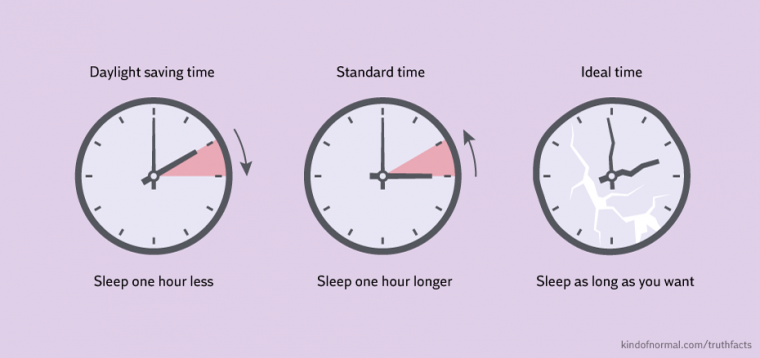
Are you struggling with losing an hour of sleep after daylight savings time kicked in? Perhaps you can relate to this from Truth Facts

09[VIDEO] John Maxwell addresses one of my pet peeves: laziness―

https://www.youtube.com/watch?v=zGsCrpDakWc


Links & Quotes

link quote

“When the body is about to be led into a sinful action by some fear or craving, we are to take the sword of the Spirit and kill that fear and that craving. In my experience, that means mainly severing the root of sin’s promise by the power of a superior promise. … Having promises at hand that suit the temptation of the hour is one key to successful warfare against sin…. Be constantly adding to your arsenal of promises. But never lose sight of the chosen few that God has blessed in your life. Do both. Be ever-ready with the old. And every morning look for a new one to take with you through the day.” —John Piper

“At the heart of the Hebrew concept of marriage is the notion of covenant—a legally binding agreement with spiritual and emotional ramification (Proverbs 2:17). God serves as a witness to the marriage covenant, blessing its faithfulness but hating its betrayal (Malachi 2:14-16). The Lord’s intimate involvement renders this legal commitment a spiritual union, ‘so they are no longer two, but one’ (Matthew 19:6). The purpose of marriage as articulated in the Bible is to find true companionship (Genesis 2:18; Proverbs 18: 22), produce godly offspring (Malachi 2:15; 1 Corinthians 7:14) and fulfill God’s calling upon an individual’s life (Genesis 1:28). … Marriage binds husband and wife together into an entity greater than either partner as an individual, and it does so in order to assure continuity of the family lineage.” —Archeological Study Bible

“To educate a man in mind and not in morals is to educate a menace to society.” —Theodore Roosevelt

Eric Metaxas, in his commentary A Murderous Mother, tells how the environmentalists have gotten off track, and how Christians are really the only one who can help us.

“In our esteem, the joys of earth are little better than husks for swine compared with Jesus the Heavenly Manna. I would rather have one mouthful of Christ’s love, and a sip of His fellowship, than a whole world full of carnal delights. What is the chaff to the wheat? What is the sparkling paste to the true diamond? What is a dream to the glorious reality?” —Charles Spurgeon

I really like this post—Is There A Spiritual Side To Sex?

Abortion, Inc. documents the $500 million Planned Parenthood gets in your tax dollars to keep killing innocent children.

Links & Quotes

link quote

Some good reading and watching from today…

“I set you down as nearer akin to a devil than to a saint, if you can go your way and look into the face of your friend or child, and know him to be on the downward road, and yet never pray for him nor use any means for his conversion.” —Charles Spurgeon

Truth: 5 reasons why church is good for your marriage.

“Surely you know that if a man can’t be cured of churchgoing, the next best thing is to send him all over the neighborhood looking for the church that ‘suits’ him until he becomes a taster or connoisseur of churches.” —C.S. Lewis, in The Screwtape Letters

When doctors given expectant parents about a health issue for their baby, that information may be misleading.

…but there is no mistaking this abortionist’s vile confession: “we let babies born alive ‘expire.’

“A person morally incapable of doing evil would be, by the same token, morally incapable of doing good. A free human will is necessary to the concept of morality.” —A.W. Tozer

Yet again climatologists’ “models” of so-called global warming are destroyed.

I love Pastor Chilly’s list: 66 Expressions Of Love.

[VIDEO] John Piper on what it means to be Gospel-centered…

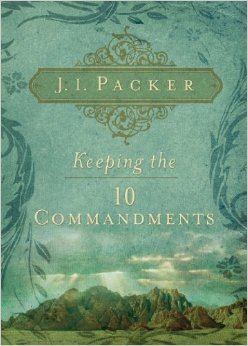
12 Quotes From “Keeping The Ten Commandments”

Keeping The Ten CommandmentsJ.I. Packer wrote a very readable, but scholarly, book examining how 21st-century people should live out the biblical Ten Commandments. You can read my full book review by clicking here, but I’m sharing some of my favorite quotes below.

“God’s love gave us the law just as His love gave us the gospel, and as there is no spiritual life for us save through the gospel, which points us to Jesus Christ the Savior, so there is no spiritual health for us save as we seek in Christ’s strength to keep the law and practice the love of God and neighbor for which it calls.”

“Where the law’s moral absolutes are not respected, people cease to respect either themselves or each other; humanity is deformed, and society slides into the killing decadence of mutual exploitation and self-indulgence.”

“The negative form of the Commandments has positive implications. ‘Where a sin is forbidden, the contrary duty is commanded’ (Westminster Larger Catechism, Question 99). The negative form was needed at Sinai (as in the West today) to curb current lawlessness that threatened both godliness and national life.” 

“Moral permissiveness, supposedly so liberating and fulfilling, is actually wounding and destructive: not only of society (which God’s law protects), but also of the lawless individual, who gets coarsened and reduced as a person every time.”

“Law-keeping is that life for which we were fitted by nature, unfitted by sin, and refitted by grace, the life God loves to see and reward; and for that life liberty is the proper name.”

“The Bible, however, takes promises very seriously; God demands full faithfulness of our vows. Why? Partly because trustworthiness is part of His image, which He wants to see in us; partly because without it society falls apart.”

“We honor God by respecting His image in each other, which means consistently preserving life and furthering each other’s welfare in all possible ways.”

“We have in us capacities for fury, fear, envy, greed, conceit, callousness, and hate that, given the right provocation, could make killers out of us all. … When the fathomless wells of rage and hatred in the normal human heart are tapped, the results are fearful.”

“When you lie to put someone down, it is malice; when you lie to impress, move, and use him, and to keep him from seeing you in a bad light, it is pride.”

“Reformed theologians said that God’s law has three uses or functions: first, to maintain order in society; second, to convince us of sin and drive us to Christ for life; third, to spur us on in obedience, by means of its standards and its sanctions, all of which express God’s own nature.”

“What is God’s ideal? A God-fearing community, marked by common worship (commandments 1, 2, 3) and an accepted rhythm of work and rest (commandment 4), plus an unqualified respect for marriage and the family (commandments 5, 7), for property and owner’s rights (commandments 8, 10), for human life and each man’s claim on our protection (commandment 6), and for truth and honesty in all relationships (commandment 9).”

“When God’s values are ignored, and the only community ideal is permissiveness, where will moral capital come from once the Christian legacy is spent? How can national policy ever rise above material self-interest, pragmatic and unprincipled? How can internal collapse be avoided as sectional interests, unrestrained by any sense of national responsibility, cut each other down? How can an overall reduction, indeed destruction, of happiness be avoided when the revealed way of happiness, the ‘God first, others next, self last’ of the Commandments, is rejected? The prospects are ominous. May God bring us back to Himself and to the social wisdom of His Commandments before it is too late.”

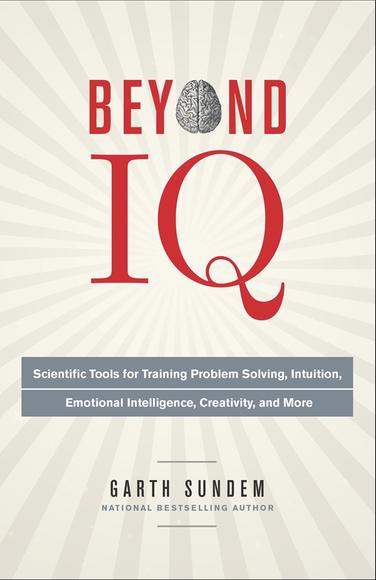
14 Quotes From “Beyond IQ”

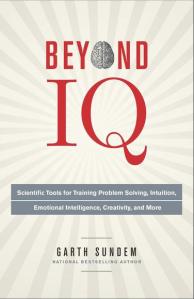
Beyond IQI found Beyond IQ by Garth Sundem to be engaging because of both the research he presents, and the engaging exercises he incorporates to make the research applicable to us. You can read my full book review by clicking here. Here are some of the quotes I especially appreciated.

“First, here’s why insight can be difficult: it requires a paradoxical mix of experience with openness. Usually, experience leads to set-in-stone ways of doing things. Typically, openness is only present when you’re forced by inexperience to remain available in your search for solutions. Experience mixed with openness is a rare cocktail. … Rather than opening your mind to insight, [John] Kounios and [Mark] Jung-Beeman show that if you want insight, the best thing you can do is to close it. A closed mind shows up on an fMRI as activation of the anterior cingulate cortex, your brain’s home of inhibiting distraction. It’s as if your ACC is a pair of noise-canceling headphones, and with these headphones in place you’re more able to hear your brain’s quiet, insightful whispers.” 

“Science has known that during sleep the brain’s hippocampus—the structure responsible for encoding new memories—replays the day’s experiences from short-term storage and filters them into the neocortex, where experiences are integrated into… ‘pre-existing knowledge representations.’ Insight is the novel connection of knowledge, and sleep knocks knowledge into new configurations.”

“[Robert] Sternberg and his frequent collaborator, Richard Wagner, showed that situational judgment tests…designed to measure practical intelligence are a much better predictor then IQ of job performance in business managers, bank managers, and graduate students. IQ doesn’t lead to success. Practical intelligence does.” 

“The language of problem-solving is: initial state, constraints, operations, and goal state. … [Richard] Mayer says that the most striking feature of people who successfully solve real-world problems is the time they spend studying the initial state and the constraints—the extra time they spend clarifying the problem.”

“University of California-San Bernardino researcher James Kaufman knows the recipe for creativity. It’s equal parts intrinsic motivation, experience, and something he calls low personal inhibition. Intrinsic motivation is pretty self-explanatory, but beware of the danger of ‘replacing intrinsic motivation and a natural curiosity with external rewards,’ says Kaufman. If a parent wants a child to become a creative pianist, the parent should encourage interest in the piano but not incentivize this interest with ice cream. Creativity blooms in fields you’re drawn to, not in fields into which you’re pushed. … Kaufman’s research has shown that creative people are hard workers with background knowledge and expertise in their creative domains. ‘It’s the “learn the rules so you can break them” approach,’ he says.” 

“Dean Keith Simonton of UC Davis found that the nineteenth-century scientists who wrote the most-cited papers also wrote the least-cited papers. … The more scientific papers or sonatas or sonnets a person writes, the greater chance that one or more will be especially creative.”

“In any kind of cognitive activity you have two kinds of things going on. You have intelligence, but there’s also learning and skill and knowledge based on practice. The more the second develops, the less important the first becomes. … Even more importantly, we’ve shown that with enough practice and hard work, you can actually change the neurophysiology of the brain. For example, practice can encourage the brain to grow greater myelin coating on neurons. Thus our behaviors become literally hard-wired. Developing expertise literally makes certain thought patterns more efficient than others.” —Paul Feltovich 

“Florida State researcher K. Anders Ericcson shows that it’s not only experience that creates expertise but a step-by-step method of sculpting experience that he calls deliberate practice. To Ericsson, famous for his theory that 10,000 hours of practice creates expertise in any field, the four-step path to expertise includes performing your skill, monitoring your performance, evaluating your success, and figuring out how to do it better next time. Completing only the first step—performing the skill itself—leads to automated, low-level, rote performance in which you perform the skill the same way every time. Monitoring, evaluating, and adjusting your skill allows you to modify it after every pass, helping skill evolved toward expertise.”

“The more you use your brain, the longer you’ll be able to use it. … People with ‘cognitively protected’ brains were those who challenge themselves through a lifestyle that included reading, writing, attending lectures, and doing word puzzles—in other words, they followed a self-imposed regimen of cognitive involvement. … Cognitive involvement is only one tine of a three-pronged approach to brain health in later life. The second tine is a healthy body. … In fact, your cardiovascular health in middle age is even more important for your later brain health than the same risk factors in old age itself. … The third tine: social interaction. … Nothing forces the brain to work like interacting with other brains.” 

“Moral reasoning and wisdom are linked. Specifically (and this is kind of cool albeit technical), for those who possess strong moral reasoning, wisdom increases with age. If you have lower moral reasoning, you gain no wisdom as you get older. So if you want wisdom later, train your moral reasoning now.”

“Wisdom requires thought and action without yourself in mind, and sociologist Monika Ardelt of the University of Florida shows that selflessness is also the best predictor of successful aging. In fact, the wisdom born of selflessness beats out physical health, income, socioeconomic status, physical environment, and even social relationships in predicting life satisfaction in old age.”

“Pressure…sits like a lead weight in your working memory, claiming space that could otherwise hold useful information. And because working memory is a mainline to general intelligence, space claimed by pressure makes you measurably dumber. … Pressure flips a mental switch from implicit to explicit thought, making you apply a layer of analysis to things that should be automatic. … Chronic pressure can make you chronically prioritize the quick rewards of drugs and alcohol while discounting their long-term risk. … So beware. Stress plugs your working memory, analysis paralysis forces you to try to use it anyway, and your dopamine circuits cry for a quick, risky solution.”

“Students with high emotional intelligence (EI) have lower rates of drug use and teachers with high EI get more support from their principals. Employees with high EI have higher job performance, especially when their IQ is low (implying that emotional intelligence can help compensate for low general intelligence—and also that these skills are distinct). EI is even implicated in resilience—the more EI you have, the higher your chances of bouncing back after trauma or negative life events.” 

“If IQ is the strength of the bulb in your lighthouse, willpower is the lens that focuses it into a beam.”