Listen to the podcast of this post by clicking on the player below, and you can also subscribe on Apple, Spotify, or Audible.
The word amazement shows up numerous times throughout the Gospels. As you might expect, it’s almost always associated with something Jesus said or did. He would heal someone, calm a storm, silence His detractors, or teach persuasively, and the people stood amazed!
But there are two instances where Jesus Himself is amazed.
The first time is when a Roman centurion sends a message to Jesus by way of a servant. This centurion asks Jesus to speak a word of healing over another one of his servants. He says that just a word from Jesus will be sufficient, and he doesn’t need Jesus to personally come to his house.
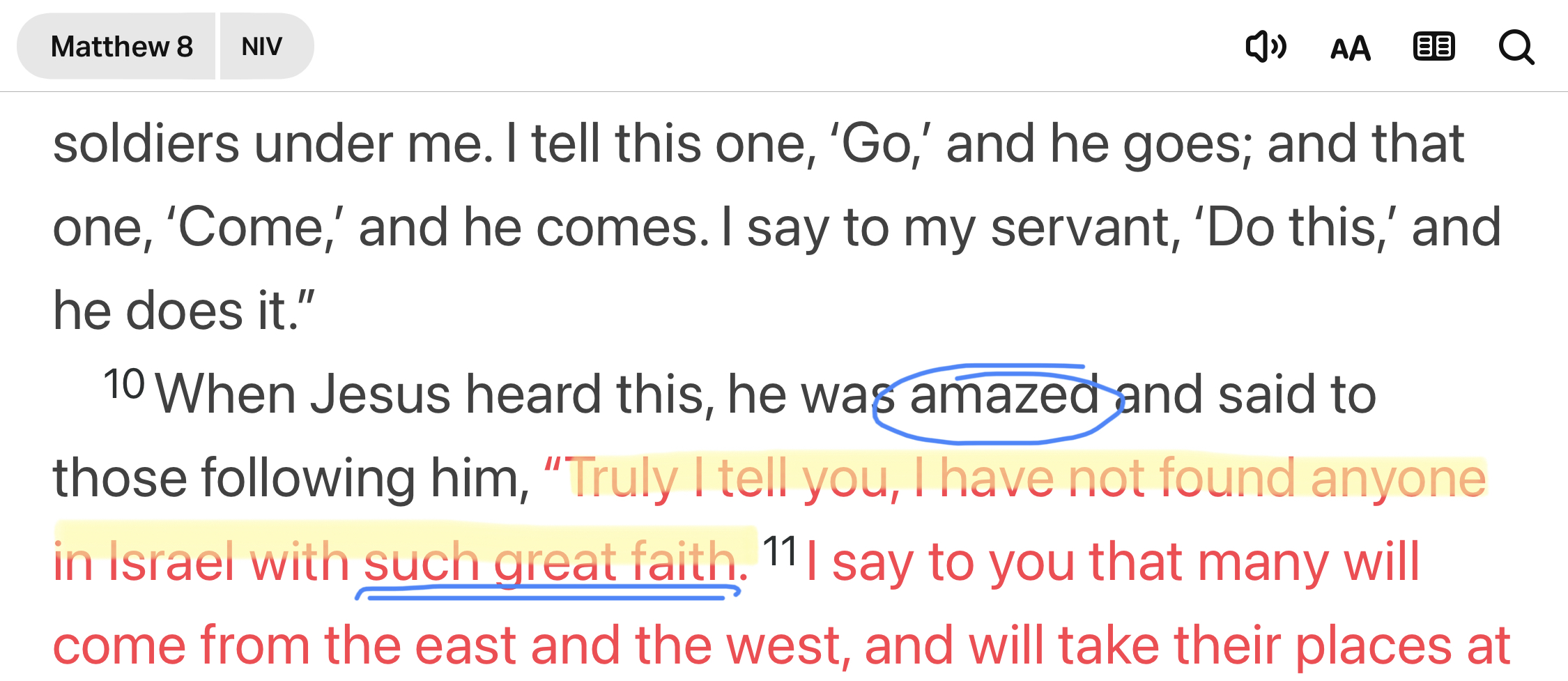
When Jesus heard this, He was amazed. “Turning to those who were following Him, He said, ‘I tell you the truth, I haven’t seen faith like this in all Israel!’” (Matthew 8:10; Luke 7:9).
Because of this centurion’s faith, his servant was immediately healed!
The second time Jesus was amazed was when He was visiting His hometown. There He discovered people with whom He had grown up that refused to believe that He was who He claimed to be. As a result, Jesus “was amazed at their unbelief” (Mark 6:6).
So either Jesus is amazed at our faith in Him, or He is amazed at our unbelief in Him. When I have faith in Jesus—when I believe He is who He says He is, and that He is willing to do what He says He will do—He is amazed at my faith and can do miracles on my behalf. But when I doubt, when I allow my unbelief to seize my heart, I exclude myself from the miracles He wants to do.
Jesus will be amazed at you. Will He be amazed at your faith in Him? Or will He be amazed at your unbelief in His power that is waiting to be released on your behalf? I pray that Jesus will always be amazed at our faith in Him.
Listen to the podcast of this post by clicking on the player below, and you can also subscribe on Apple, Spotify, or Audible.
The word “amazed” shows up numerous times throughout the Gospels, almost always associated with something Jesus said or did. He would heal someone, calm a storm, silence His detractors, or teach persuasively. And the people marveled!
But there are two instances where Jesus Himself is amazed, where the Bible says He marveled at what someone said.
The first is when a centurion asked Jesus for help, but said he didn’t need Jesus to be personally present. He told Jesus that just a word from Him would be more than enough to heal a sick servant. Jesus was amazed at this man’s faith, and as a result, the servant was healed (Matthew 8:10; Luke 7:9)!
The second time that Jesus was amazed was when He was visiting His hometown and the people with whom He grew up didn’t believe He was who He claimed to be. As a result, Jesus was amazed and the Bible says He was unable to do many miracles there (Mark 6:6). How sad!
It’s still true today. Either Jesus will be amazed at our faith or He will be amazed at our unbelief. When we have faith in Him—when we stand amazed and in awe and in expectation of His power—He is amazed and can perform miracles. But when we push Jesus away and say, “We can take care of this ourselves,” Jesus is also amazed. But this type of amazement results in Jesus being unable to unleash His miraculous power on our behalf.
Let’s learn this amazing lesson, and always stand amazed at who Jesus is and what Jesus can do. When we are amazed, and our faith grows stronger, Jesus will be amazed at our faith and will move on our behalf in amazing ways!
We have a new kitten in our home and the places she shows up cracks me up!
In the Wall Street Journal, Andy Kessler said that without the discoveries and influence of Michael Faraday, “there would be no modern economy.” John Stonestreet built on this by explaining that “Faraday is an example of how Christians can balance the constructive purposes of science with an accurate understanding of scientific authority.” Indeed, Faraday’s Christian faith made his scientific findings even more powerful.
“For many years, evidence has been found showing that humans were surprisingly intelligent in times that were only supposed to reveal simple, ‘primitive’ man in his brute, evolving condition.” Now a new discovery has shown a surgical amputation that took place about 7000 years ago.
There’s a cool story in three of the Gospels where some creative, persistent friends took their paralyzed friend to Jesus. The Bible notes that “when Jesus saw *their* faith” He healed their friend. Wow! Which of your friends or family are too weak to pray for themselves? Who do you know that feels paralyzed and cannot get to Jesus? Be that friend who has faith for someone else. And be sure to check out more of my Monday Motivation videos too.
We have seen it in countless science fiction movies, but is it possible for artificially intelligent machines to take over the world? This is a great video from Science Uprising—
If you have known someone who has battled cancer, you know that their liver is quite vulnerable to metastatic cancer since everything in our body is filtered through the liver at some point. Researchers have discovered the mechanism by which this metastasis happens, opening the door for defensive measures that can be employed. Let’s pray for divine insight for these researchers!
Is Christianity rational? Cold-case detective J. Warner Wallace explains how Christianity stands up to intense scrutiny—
There is a psychological term called “projection” where we see in others what is really in ourselves. This is something Christians MUST guard against doing. Instead of going to the other person first, let’s go to our knees in prayer first. This is a short clip from a full-length teaching video I provided exclusively for my Patreon supporters.
“Blessed are those who can give without remembering and can take without forgetting.” —Elizabeth Bibesco
According to 1 Corinthians 12-14, the Holy Spirit operates in nine different gifts to both evangelize the sinner and edify the saints. The apostle Paul says that these gifts are available to all Christians who will allow the Holy Spirit to operate through them.
Listen to the podcast of this post by clicking on the player below, and you can also subscribe on Apple, Spotify, or Audible.
Last week we saw the in-ness of the Holy Spirit guiding us, teaching us, and empowering us to overcome evil. For what purpose? Why does the Holy Spirit lead us this way? Because the Spirit desires to draw everyone into this in-ness. His work in and through our lives is always unmistakable and irrefutable.
A good word to describe the unmistakable and irrefutable work of the Spirit is: Miracles.
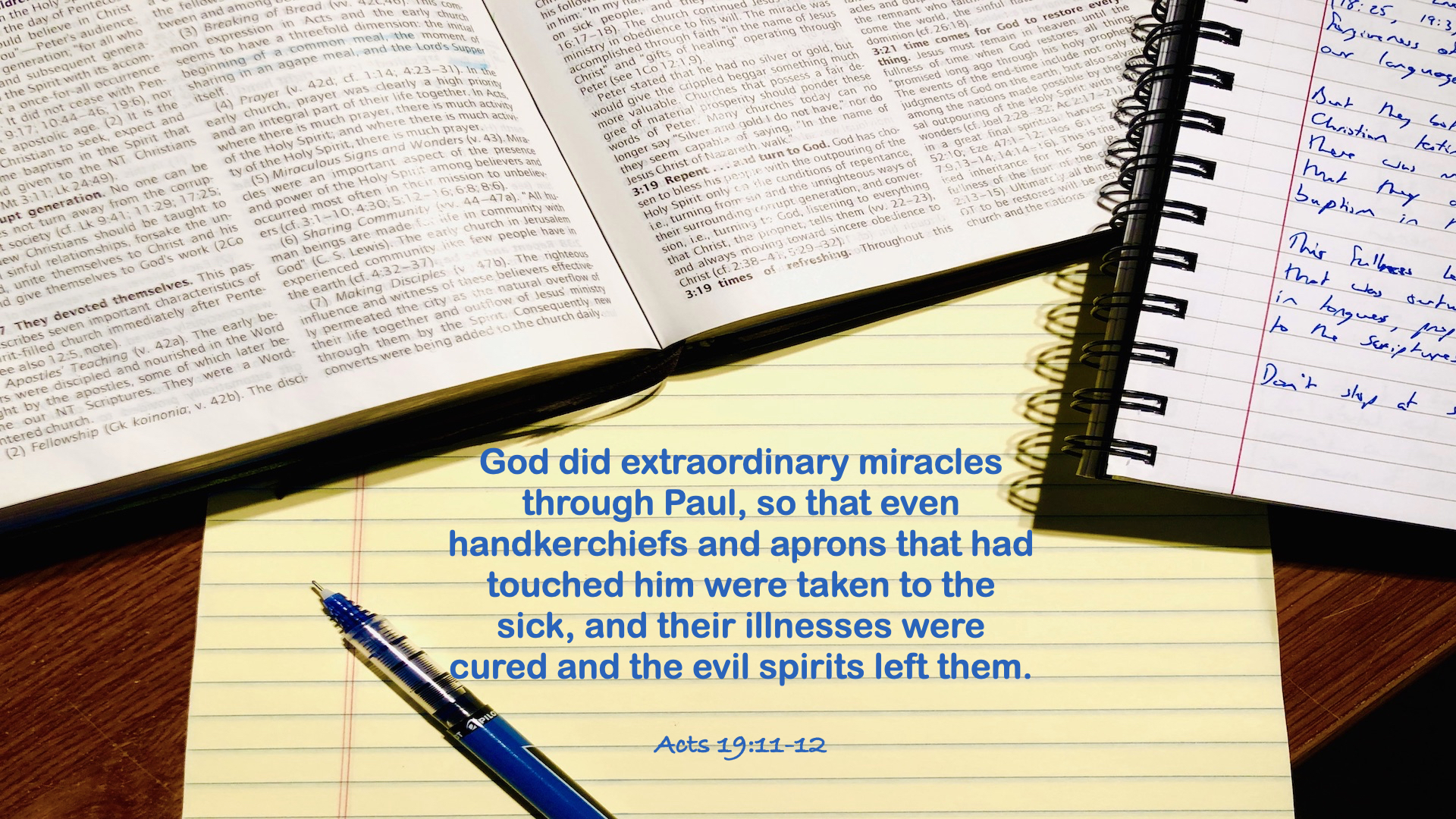
Miraculous signs characterized the earthly ministry of Jesus, and they also should to the hallmark of Spirit-baptized Christians today who are sharing the Gospel with others (Acts 10:38; 2:43; Mark 16:20).
Some may ask, “Why don’t we see as many miracles today?” And some skeptics even point to a decrease in miracles as proof of their cessationist paradigm. But consider this: Has God’s power been diminished? Have all needs been met? Are there no more sickness or unsolvable problems of human suffering? Is everyone free of the power of the devil?
No, of course not!
So that would mean if there is any diminishment in miracles, the diminishment would seem to be in us! Particularly I think it is that we no longer expect miracles to happen.
Not only should we expect miracles, but we should also expect to be the vessel through which the Holy Spirit demonstrates the miracle.
Here are 8 miracles that we should be expecting:
Minds opened that were blinded to the Gospel message—2 Corinthians 4:4-6
Listen to the podcast of this post by clicking on the player below, and you can also subscribe on Apple, Spotify, or Audible.
Have you ever heard this truism: The person with an experience is never at the mercy of the person with an argument?
There are, sadly, many who deny the reality of God’s divine healing for today. They may say God healed in the past, but that age has passed, or they may simply deny all supernatural activity. I have the best reply to these skeptics or deniers—and you may have this same reply: God does heal today; I know this is true because He has healed me!
Our truth statement about this says: “Divine healing is an integral part of the gospel. Deliverance from sickness is provided for in the atonement, and is the privilege of all believers.” Let me break this down into three parts.
(1) “Divine healing is an integral part of the gospel.” After that word “integral” I’d like to insert the word “indisputable.” When God does the miraculous, it is an undeniable proof of His love and power. A great story to prove this point is when Jesus healed a paralytic after He forgave him of his sins (Luke 5:17-26).
Notice how the people responded: Everyone was amazed and gave praise to God. This glory to God has always been the reason God performs miracles (see Mark 6:7-13; Acts 2:43; Acts 3:9-12).
(2) “Deliverance from sickness is provided for in the atonement.” I like to remember that the word atonement means “at-onement” and stands opposed to disease which I like to say as “dis-ease.” Sin is our ultimate dis-ease—the ultimate separator—so Jesus took care of both our spiritual dis-ease and our physical dis-ease when He died on the Cross for us, just as Isaiah prophesied. That’s why the New Testament also shows us salvation and healing frequently being linked together (Acts 10:38; 8:4-8).
(3) “And is the privilege of all believers.”ALL believers, not just a select few and not just those who lived at the time of the first apostles.
Divine healing has been—and always will be—an integral and indisputable part of the gospel precisely because it exalts God as THE Healer.
Many people today still believe what the disciples of Jesus believed: Disease is a consequence of personal sin. In addressing this misunderstanding, Jesus said that disease was “so that the work of God might be displayed” in the life of the one about to be healed. He said something similar while at the graveside of Lazarus, before he raised that dead man back to life (John 9:1-38; 11:4-45).
Sometimes God heals us now, but ALWAYS He heals us in our glorified bodies (2 Corinthians 12:9-10; 5:1-9; Revelation 21:4). Our patience and hope in our future, ultimate healing glorifies God in the present.
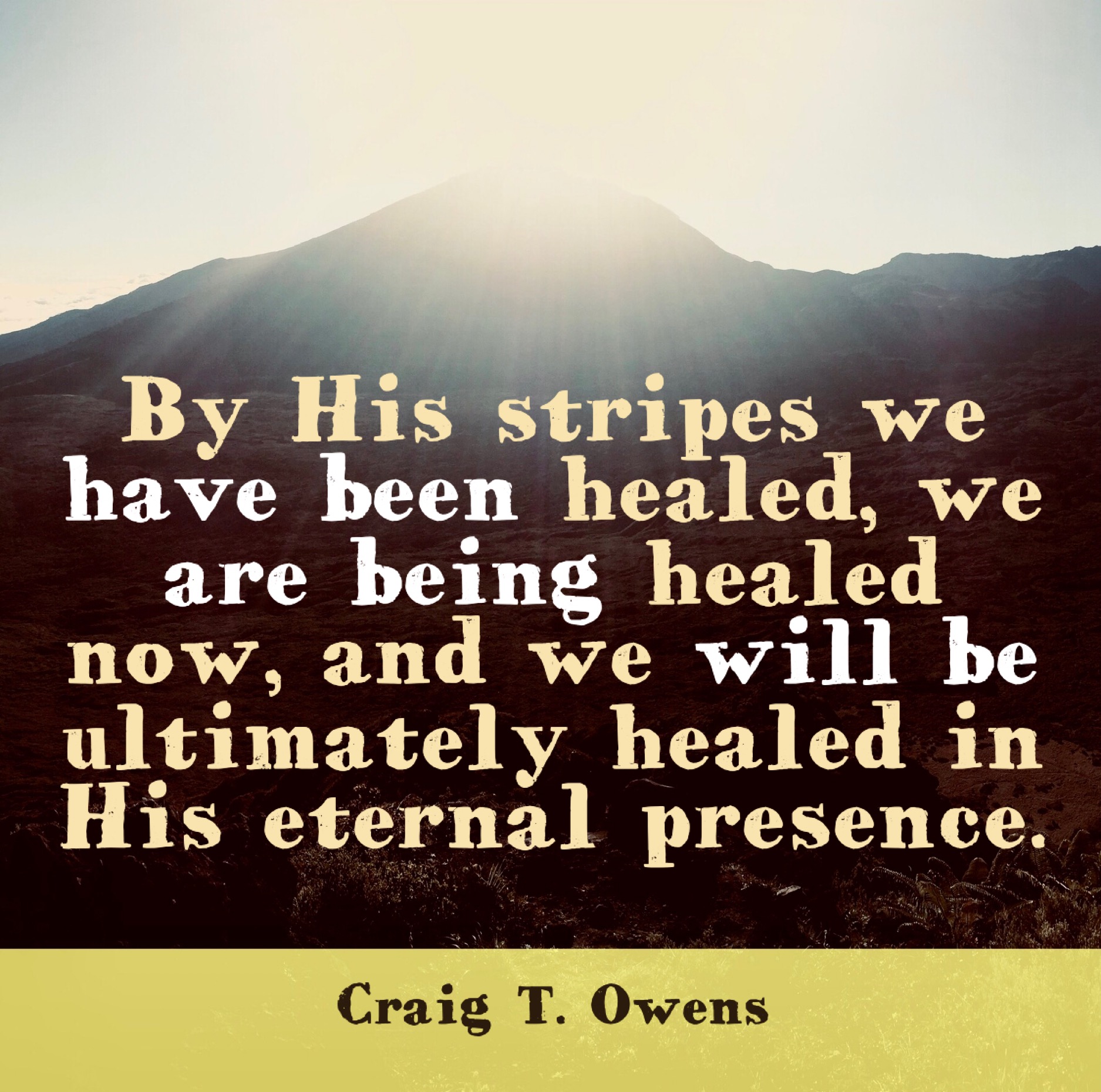
By faith in Jesus we can claim that “by His stripes we have been healed” (1 Peter 2:24). The verb tense Peter uses means we have been healed, we are being healed now, and we will be ultimately healed in Christ’s eternal presence. Whether we are healed here or not, we can live knowing that His healing power always brings Him glory and always draws people to Him, so don’t hesitate to keep on asking Him for His healing touch on your body and soul.
A person filled with the Holy Spirit cannot help but make a difference wherever they go! Look at how Peter summed up the earthly ministry of Jesus:
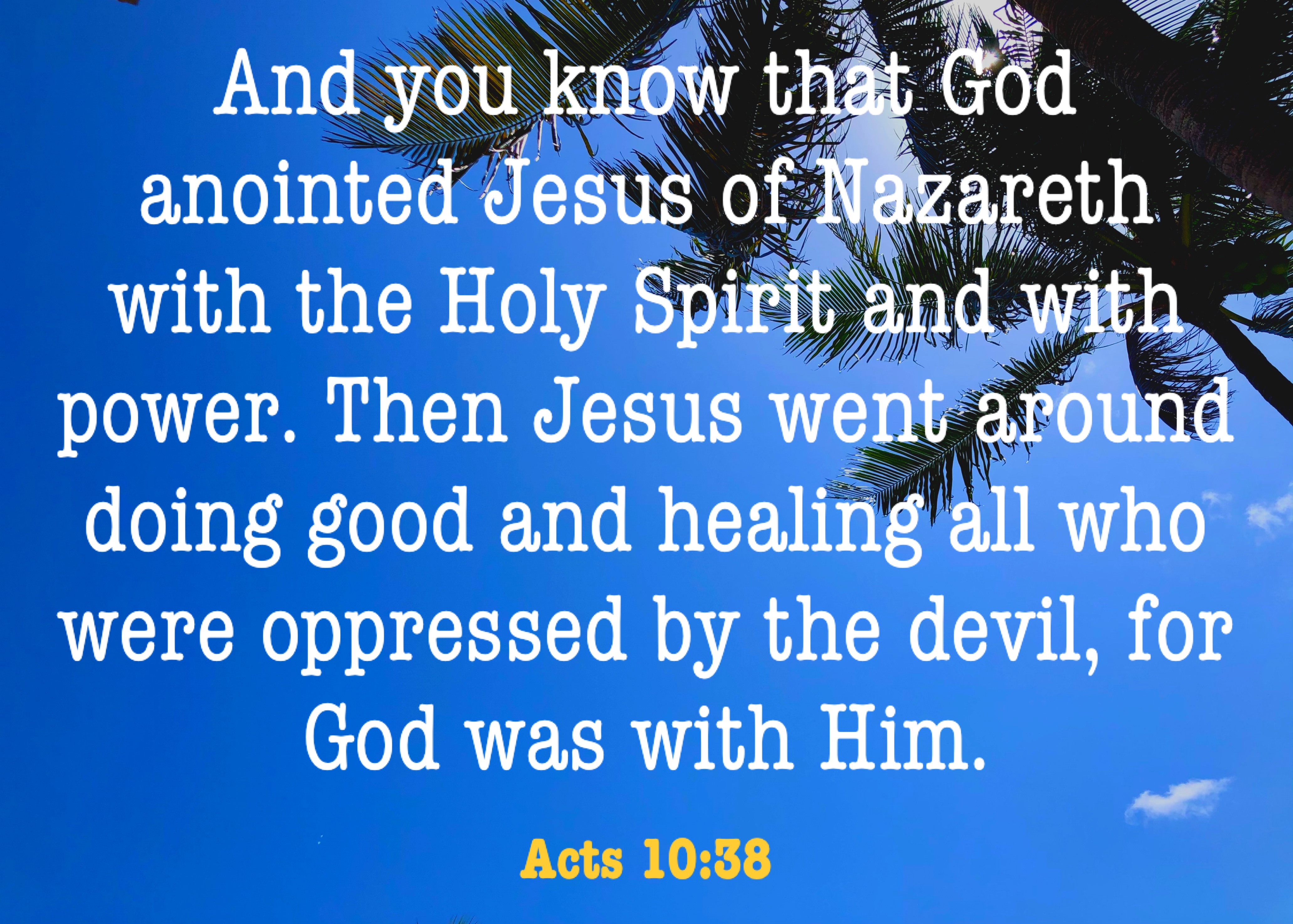
And you know that God anointed Jesus of Nazareth with the Holy Spirit and with power. Then Jesus went around doing good and healing all who were oppressed by the devil, for God was with Him. (Acts 10:38 NLT)
The continuous action of Jesus was doing good and healing those who were diseased in body and soul. This is supposed to be the continuous action of the followers of Jesus too. The baptism of the Holy Spirit is an empowerment for the continuous, unmistakable, irrefutable action of those anointed by Him.
Andrew Murray commented on the miraculous healings that were recorded in the Book of Acts, “This was the continuous experience of the early church. … The abundant outpouring of the Spirit produced abundant healings.” Indeed it did! Check out the continuous miraculous action that Luke records in Acts.
Listen to the podcast of this post by clicking on the player below, and you can also subscribe on Apple or Spotify.
The baptism in the Holy Spirit is what Pentecostal Christians frequently refer to as our distinctive doctrine. Notice I said distinctive, not better. Can someone go to heaven without being baptized in the Spirit? Yes! But I’ve found that living in this distinctive empowerment makes the journey to heaven so much more productive and joyful.
After the resurrection of Jesus, everything took on a whole new meaning, because the “light” had been turned on in the Old Testament palace. All of the practices that Jews had been observing for thousands of years suddenly had a new illumination in the New Testament.
Pentecost had always been a celebration 50 days following the Passover. In the Old Testament, the law was given from Sinai on the fiftieth day after the deliverance from Egypt, so in a sense, the appearance of God on Sinai was the birthday of the Jewish nation. In the New Testament, the first outpouring of the Holy Spirit on the first Pentecost after Jesus ascended to heaven was the birthday of the Christian nation for all people.
One of our foundational truths says: “All believers are entitled to and should ardently expect and earnestly seek the promise of the Father, the baptism in the Holy Spirit and fire, according to the command of our Lord Jesus Christ. This was the normal experience of all in the early Christian Church.”
And another foundational truth is a corollary: “The baptism of believers in the Holy Spirit is witnessed by the initial physical sign of speaking with other tongues as the Spirit of God gives them utterance.”
God has always confirmed His presence with signs and wonders. From the signs in Egypt to convince Pharaoh that Jehovah was greater than the Egyptian gods to the ministry of Jesus. In fact, Peter said that the signs and wonders done by Jesus were God’s authentication of His ministry (see Luke 5:17-26; Acts 2:22; Acts 10:38).
R.A. Torrey noted, “The baptism of the Holy Spirit always imparts power for service…. The baptism of the Holy Spirit is the Spirit of God falling upon the believer, taking possession of his faculties, imparting to him gifts not naturally his own, but which qualify him for the service to which God has called him.”
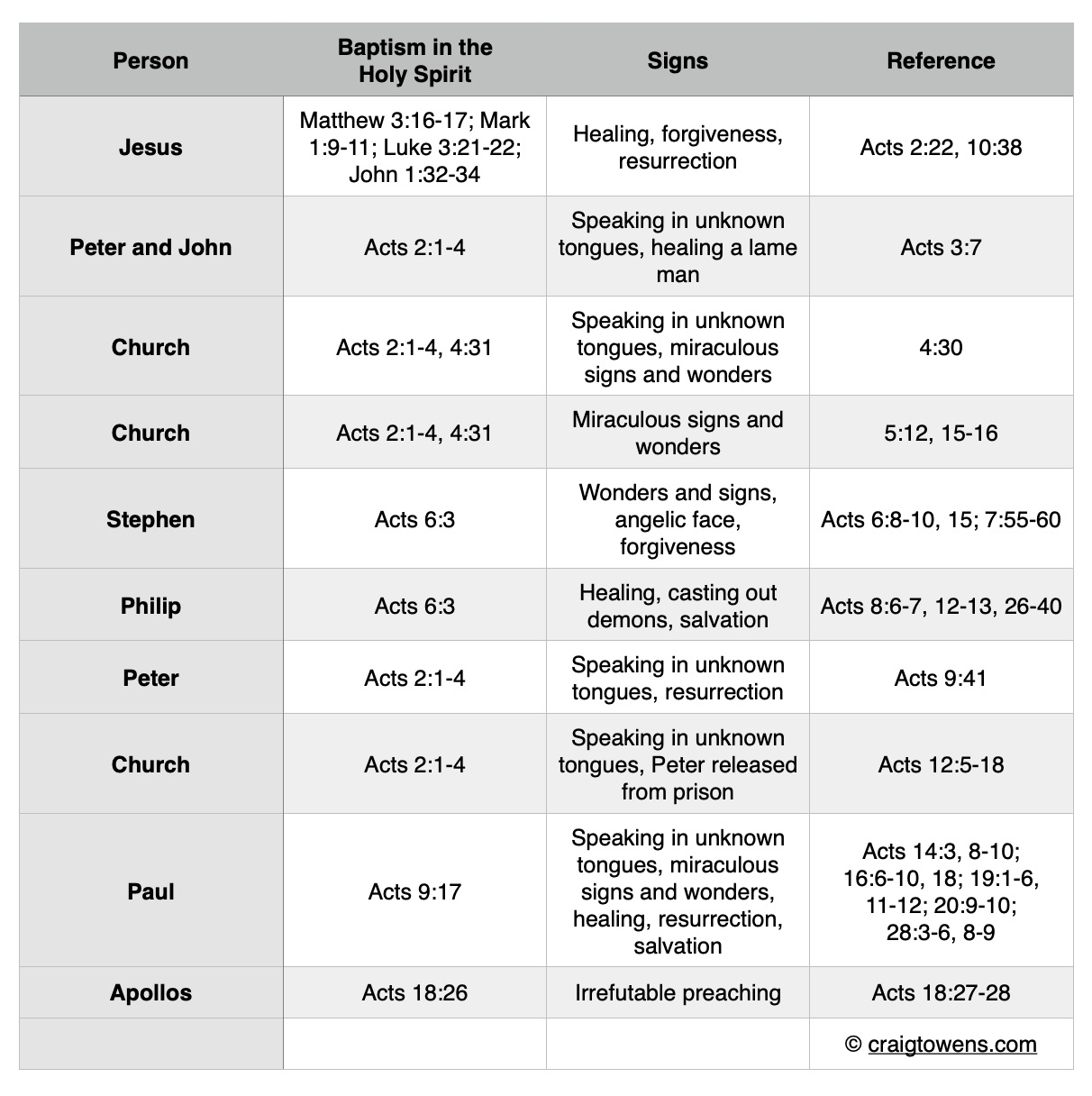
Check out this chart that walks us through the book of Acts to see how God authenticated the ministry of those who were baptized in the Holy Spirit by performing signs and wonders through them:
When a Christian is baptized in the Holy Spirit there are two types of evidence:
Initial evidence—typically speaking in a language that hasn’t been studied but has been supernaturally given by God.
Ongoing evidence—I would sum this up in the word sanctification (or as I like to remember it by saying “saint-ification”). This is the lifestyle change, the empowered living, and even the miraculous that cannot be counterfeited by man’s efforts alone.
Let’s not try to put God in a box—telling Him when, where, how, and through whom He can work. Instead, let’s yield ourselves entirely to Him by letting the Holy Spirit empower us to be effective, unmistakable witnesses for Jesus Christ.
I will be relaunching our series called We Are: Pentecostal in two weeks. Please follow along with all of the messages in this series by clicking here for the details.









 Craig T. Owens