Keep Your Love Up-To-Date

Busyness Can Kill LoveIt’s possible to be so busy doing good things that we forget why we are doing those good things. Worse than that: our busyness can actually kill what’s most important.

When Jesus addressed the church at Ephesus (Revelation 2:1-7), He addressed a problem we in the West face today as well. Jesus said, “You are hard workers. You keep pressing on despite the obstacles. You are ministering to others, you’re making sure no wolves in sheep’s clothing infiltrate the church, and you even stand strong under persecution for your faith.”

But then Jesus drops a hard word on them: “Yet I have this against you: You have forsaken your first love.

The Ephesians were fighting the good fight. Yet this intense work and ministry detracted from what is most important: Love for God. The New Living Translation says verse four this way: You don’t love Me or each other as you did at first.

  • Busyness can kill love.
  • Fighting evil can kill love.
  • Standing for truth can kill love.
  • Ministering to others can kill love.

Ministering to others is not love. It can only come from the overflow of love. But if the love is not kept full, there’s nothing there to overflow, and we’re only “doing our duty.”

So Jesus challenges the Ephesians (and us) with these two steps: Remember and Repent.

The verb tense for remember is the present tense. That means it’s something we need to do now. I cannot tell my wife “I love you” nine times on Monday morning and expect that I’m covered for the next 10 days. In the same way, we cannot tell Jesus we love Him on Sunday morning, and then go off to do our own thing for the rest of the week. That choice will not allow us to overflow with love; in fact, it will be just the opposite: we’ll be running on empty, just doing our duty.

We must keep our love up-to-date. Remember often how much God loves you, and express your love to Him. And if you find something in your life that is more of a focus that Christ, repent. Turn from that and turn back to your first love.

13 Quotes From “The Bare Facts”

The Bare FactsJosh McDowell knows the mindset of today’s youth well, and he very ably lays out an honest discussion about sex in his book The Bare Facts: 39 Questions Questions Your Parents Hope You Never Ask About Sex. You can read my full book review by clicking here. Below are some of the quotes and statistics that especially stood out to me.

“Research by the National Center for Health Statistics and the University of Maryland found that women who save sex for marriage face a considerably lower risk of divorce than those who are sexually active prior to marriage. … Studies indicate that women who engage in early sexual activity and those who have had multiple partners are less satisfied with their sex lives than women who entered marriage with little or no sexual experience.”

“If you cannot define love, how do you know if you are in love? If you cannot define love, how can you know if you are being loved? If you cannot define love, how do you know if you have a loving, intimate relationship? … Love cannot be a feeling because you cannot command an emotion. … Love is more than a feeling. It is a series of choices. When we choose to love, our emotions can be transformed, but love is expressed by acts of the will.”

“When you have sex outside of marriage, the lines between love and lust are blurred. It is easy to misinterpret the chemical reactions in your brain for feelings of love. You can’t trust your feelings to verify if sex is right or wrong, and feelings of love aren’t proof that your relationship is mature or beneficial.”

“Since God designed sex to bind us to each other, when we choose to engage in sex outside of marriage it turns relationships upside down and confuses emotions to the point where a person can misinterpret sex for love. When we follow God’s plan, the love between a man and woman is already established before sex enters the equation.”

“Clearly, God doesn’t ask us to wait for sex in order to spoil our fun or restrict us unnecessarily. His commandments regarding sex are evidence of His love for us as He seeks to protect and provide for our good.”

“Female brains receive especially high doses of oxytocin whenever there is touching and hugging. Vasopressin is a hormone that does the same thing in the male brain. … When we continually change partners, oxytocin levels decrease and the brain’s oxytocin release function doesn’t work as it’s supposed to. Promiscuous sexual activity wears down vasopressin production in the male brain, causing men to become desensitized to the risk of short-term relationships.”

“Today, doctors recognize twenty-five major STDs, nineteen of which have no cure. In the 1960s one out of every sixty sexually active teens got an STD. By the 1970s that number jumped to one out of every forty-seven. Today one in four sexually active teenagers is infected.”

“While condoms offer only partial protection against HIV, gonorrhea, and chlamydia, they offer zero protection from many other STDs. In fact, for the most part, condoms do not reduce STDs, because most STDs are viruses. They are passed by areas of the body not covered by a condom. … With an average woman, between twenty and twenty-four years of age, when condoms were used 100 percent of the time, there was a 31 percent failure rate. … The FDA refuses to certify condoms. Why? Because the failure rate is off the charts. Another government agency, the CDC, says that abstinence is the only surefire way to prevent STDs.”

“Girls, imagine making the choice to become sexually active your sophomore year of high school. You never show any symptoms of an STD and you never get tested. Several years later you meet the man of your dreams. You marry and try to start a family, but you can’t get pregnant. When you go to the doctor to discuss your infertility, your doctor tells you that you have PID. You have had no symptoms but at one time you were infected with chlamydia. You now have to drive home and tell your husband that he will never have children of his own. Guys, imagine a similar scenario. You lose your virginity to a girl you thought you loved at age fifteen. Ten years later you learn what true love is when you meet and marry your wife. She is a virgin on your wedding day. Several years into your marriage your wife begins to experience abnormal bleeding. She goes to the doctor and discovers she has cervical cancer, likely caused by HPV that you unknowingly gave to her. Even though she chose to wait, she is forced to pay a huge price because you didn’t.”

“Sexually active teenage girls are 300 percent more likely to attempt suicide than their virgin peers. Sexually active teenage boys are more than twice as likely as sexually active girls to be suicidal. In fact, sexually active teenage boys are 700 percent more likely to attempt suicide than peers who are waiting.”

“Dr. Freda McKissic Bush of the Medical Institute for Sexual Health noted, ‘One of the greatest risk factors for depression, loss of self-esteem, and a lot of emotional consequences has to do with the number of people you have [sexual] relations with.’ She went on to say, ‘The more people you have [sexual] relations with, the more likely you are to have difficulty forming healthy relationships in the future when you are ready to be with one person.’”

“When it comes to sex, the mechanics almost always work. Bad sex isn’t the result of too little experience or sexual incompatibility. The problem is relationships. The problem is a lack of a character, trust, respect, and commitment. On your wedding night, experience is the last thing you need.”

“An article titled ‘Aha! Call It the Revenge of the Church Ladies,’ published in USA Today concluded that Christian woman (and the men who sleep with them) are among the most sexually satisfied people on the planet. … Men and women who test the waters of sexual compatibility before marriage are the least likely to be sexually fulfilled.”

30 Quotes From “Raising Your Child To Love God”

Raising Your ChildIt’s a book I called a “must read for all parents” (you can read my full book review by clicking here). After typing up my notes of all the quotes I highlighted in this book, I ended up with 18 pages of notes, so these quotes from Andrew Murray’s book are, in my opinion, the cream of the crop. Tomorrow I will share some of the prayers Murray offered in his book.

“Example is better than precept. … Love that draws is more important than law that demands. … Let parents be what they want their children to be.”

“How terrible is the curse and power of sin! Through the father the child becomes a partaker of the sinful nature, and the father so often feels himself too sinful to be a blessing to his child; thus the home becomes a path to destruction rather than to eternal life. But—blessed by God!—what sin destroyed, grace restores. … Let God’s Father-heart and His Father-love be your confidence. As you know and trust Him the assurance will grow that He is fitting you for making your home, in ever-increasing measure, the bright reflection of His own.”

“God seeks a people on earth to do His will. The family is the great institution for this object; a believing and God-devoted father is one of the mightiest means of grace.” 

“What God says of Abraham gives us further insight into the true character of this grace: ‘For I have chosen him, so that he will direct his children and his household after him to keep the way of the Lord.’ The spirit of modern so-called liberty has penetrated even into our family life; and there are parents, who some from a mistaken view of responsibility, some from lack of thought as their sacred calling, somer from love of ease, have no place for such a word as ‘command.’ They have not seen the heavenly harmony between authority and love, between obedience and liberty. Parents are more than friends and advisers; God has clothed them with a holy authority to be exercised in leading their children in the way of the Lord.”

“Oh that Christian parents would realize, just as Judah did, what it means to stand in that place for their child! How often—when our children are in danger because of the prince of this world, when the temptations of the flesh or the world threatened to make them prisoners and slaves, holding them back from ever reaching the Father’s home—are we found careless or unwilling to sacrifice our ease and comfort in order to rescue them!” 

“Oh, that the eyes of God’s people might be opened to the danger that threatens the church! It is not infidelity or superstition, it is the spirit of worldliness in the homes of Christian families, sacrificing the children to the ambitions of society, to the riches or the friendship of the world—that is the greatest danger of Christ’s church. If every home once won for Christ were a training school for His service, we would find in this a secret of spiritual strength no less than all that ordinary preaching can accomplish.”

“With a parent’s love comes a parent’s influence. … The character of a child is formed and molded by impressions; continual communion with the parent can render these impressions deep and permanent. The child’s love for a parent rises to meet the parent’s love.” 

“The first four commandments have reference to God, the last five to our neighbor. In between stands the fifth. It is linked to the first four because to the young child the parent represents God; from him the child must learn to trust and obey God. And this command is the transition to the last five because the family is the foundation of society, and there the first experience comes of all the greater duties and difficulties with humankind at large.”

“The child can only honor what he sees to be ‘worthy of honor.’ And this is the parent’s high calling: always so to speak and act, so to live in the child’s presence, that honor may be spontaneously and unconsciously rendered. … Above all, let parents remember that honor comes from God. Let them honor Him in the eyes of their children, and He will honor them there too.”

“There is nothing that drive home the word of instruction as powerfully as a consistent and holy life. … The entrance of divine truth into the mind and heart, the formation of habits and the training of character—these are not attained by sudden and isolated efforts, but by regular and unceasing repetition.”

“Love knows no sacrifice, counts nothing a burden; love does not rest until it has triumphed.”

“We don’t want to be just another family with whom God dwells and is pleased. Ours must be wholly consecrated to God. And do not be afraid that strength will not be given to keep the vow. It is with the Father in heaven, calling and helping and tenderly working both to will and to do in us, that we are working.”

“We need renewed wisdom directly from above for the individual needs of each child. Daily prayer is the secret of training our children for God. … Those who have already communicated with God and received divine teaching about their children will be those who desire still more and pray earnestly for it.”

“Nothing open the fountains of divine love and renewed love for each other more than the prayerful desire to know how to raise our children to love God.”

“Not to restrain a child is to dishonor God and the child.”

“My duty is never measured by what I feel is within my power to do but by what God’s grace enables me to do.”

“Every thoughtful parent knows that there are times and places when the temptations of sin will be more apt to surprise even the most well-behaved child. Such are the times, both before and after the child goes into a situation or circumstance where he may be tempted, that a praying father and mother should do what Job did, bring the children before God in repentance and faith and where possible to confront them with questions concerning their behavior.”

“Let us ask God to make us very watchful and very wise in availing ourselves of opportunities to admonish our children and to pray audibly with them.”

“In our family’s life, the first thing of importance must not be our earthly happiness, or even the supply of our daily needs, nor seeing to the child’s education for a life of prosperity and usefulness, but rather the yielding of ourselves to God in order to be conveyors of His grace and blessing to our children. Let us live for God’s purpose: deliverance from sin. Thus our family life will forever be brightened with God’s presence and with the joy of our heavenly home to come, of which our earthly one is by the nursery and the image.”

“‘The children of Your servants will live in Your presence; their descendants will be established before You’ (Psalm 102:25-28). Death may separate one generation from another, but God’s mercy connects them as it passes on from one to another; His righteousness, which is everlasting, reveals itself as salvation from generation to generation. … It is God’s will that His salvation should be known from generation to generation in your family too, that your children should hear from you and pass on to their children the praises of the Lord.”

“God’s purpose is that the Holy Spirit should take possession of our sons and daughters for His service; that they should be filled with the Holy Spirit, consecrated for service. They belong to Him and He to them.” 

“Jesus desires that we rise above the experiences of fatherhood on earth to know more deeply the Father in heaven.”

“The earthly father must not only make the Father in heaven his model and guide, but he must so reflect Him that his child will naturally desire to emulate the One whom he so aptly represents. … In a Christian father a child ought to have a better picture than the best of sermons can give of the love and care of the heavenly Father and all the blessing and joy He wants to bestow.”

“If we are to watch over the heavenly quality of our children, we must ourselves be childlike and heavenly-minded. … Children lose their childlikeness all too soon because parents have so little of it.”

“Fathers, you have sons whom you would fain bring to Jesus to be saved, come and hear the lessons the Lord would teach you. Let these children first send you to Jesus in confession, prayer, and trust; your faith can bring them in.”

“Your motherhood is in God’s sight holier and more blessed than you realize.”

“The effect of the good advice parents give is more than neutralized by their own behavior.” 

“A child should never be allowed to feel that his immaturity is not taken into account, that his young reasoning is not regarded, that he has not received empathy, or help, or justice that he expects. This will take a kind of love and thoughtfulness that parents are all too short of.”

“If you feel that you do not know how to teach the Word to them, to make it interesting or exciting for them, take heart—God will make it come alive to them if you are faithful to read it and live it.”

“I am the giver of their physical life, the framer of their character, the keeper of their souls, the trustee of their eternal destiny. I was first blessed that I may bless them, first taught how my Jesus loved me and gave Himself for me that I may know how to love and how to give myself for them. … And the more tenderly my love to them is stirred up, the more I feel the need to be wholly and only the Lord’s, entirely given up to the love that loves and makes itself one with me. This will fill me with a love from which selfishness shall be banished, giving itself in a divine strength to live for the children that God has given me.”

Painful Love

Sometimes pastors don’t want to say “No” to someone in their congregation because they don’t want to hurt them. Sometimes pastors don’t confront someone in their sinful choices because it seems “mean spirited” to do so.

David Wilkerson

David Wilkerson

Love must be tough. Love sometimes inflicts pain.

“Love inflicts pain, even as it does no harm (Romans 13:10). True love repeatedly disappoints, hurts, confronts, refuses, and disciplines. This is certainly how God has loved us, and we should not expect to love others without hurting them. Love hurts but does not harm. God’s minister bears the sword, but not in vain (v. 4) and with the hope that long-term health will come from short-term faithful wounds.” —Dick Brogden

“Elijah’s hatred for the sins of Israel sprang out of his very strong love for God’s people. He was not a people hater, only a sin hater. He was not a man of revenge, but rather a man whose heart yearned for Israel’s return to the Lord.” —David Wilkerson 

Run To The Pain

Listen to the podcast of this post by clicking on the player below, and you can also subscribe on AppleSpotify, or Audible.

We have become a numbed culture: we try to soften every blow, water down each negative report, ask only surface questions in the hopes that no one will really tell us how much they’re hurting, and then medicate away every symptom. But these symptoms are screaming to be noticed!

Dr. Paul Brand the renown hand surgeon and missionary to leprosy patients in India, wrote:

     “Pain contributes daily to a normal person’s quality of life…. Every normal person limps occasionally. Sadly, leprosy patients do not limp. Their injured legs never get the rest needed for healing…. This inability to ‘hear’ pain can cause permanent damage because the body’s careful responses to danger will break down. … A body only possesses unity to the degree that it possesses pain…. We must develop a lower threshold of pain by listening, truly listening, to those who suffer. … The body protects poorly what it does not feel.” —Dr. Paul Brand & Philip Yancey, In His Image

The Gospels often talk of the compassion of Jesus. His compassion led Him to teach the confused, feed the hungry, and heal the sick. The phrase usually used in the NKJV is descriptive: Jesus was moved with compassion. In other words His feelings moved Him to action.

The Old English way of describing compassion was to say someone was “moved in his bowels.” This is because when someone else is suffering it should be like a kick in my gut too.

Jesus gravitated toward the hurting, but in one story He told, Jesus related something different about His Father’s compassion. It’s the story we now call the story of the prodigal son. In this story Jesus said His Father watched the horizons every day to see if His wayward child would return. When He saw this child coming into view, God saw his slumped shoulders, He could detect his heavy heart and worn-out body. Then Jesus says something amazing, “The Father was moved with compassion and He RAN TO HIS SON!

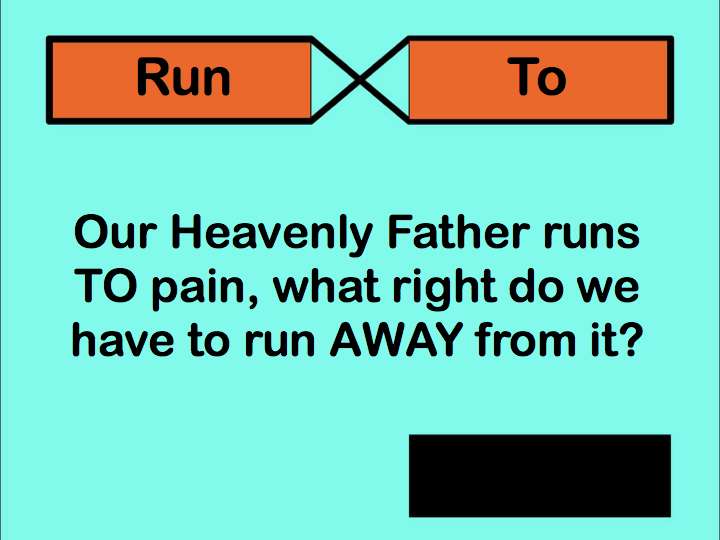
If our Heavenly Father runs TO another’s pain, what right do we have to ever run AWAY from it? 

If we are to be God-honoring in our interaction with others, we need to—as Dr. Brand says—lower our threshold of pain. We need to feel what others feel, to feel it like a kick in our own gut, and then move toward the pain with help and healing and restoration.

Christians—if we are truly Christ-like—should be known as the most compassionate people of anyone.

So we need to always be asking: What am I doing to let this compassion be seen in my life?

Check out all of the other messages in our series Live Together by clicking here.

►► Would you please prayerfully consider supporting this ministry? My Patreon supporters get behind-the-scenes access to exclusive materials. ◀︎◀︎

“Love Thyself Last”

As I was studying for our series Life Together, I remembered this poem from Ella Wheeler Wilcox, and I think it’s a perfect picture for remembering our joyful duty to one another

Ella Wheeler WilcoxLove thyself last. Look near, behold thy duty

To those who walk beside thee down life’s road.

Make glad their days by little acts of beauty

And help them bear the burden of earth’s load.

a

Love thyself last. Look far and find the stranger

Who staggers ‘neath his sin and his despair;

Go, lend a hand, and lead him out of danger,

To heights where he may see the world is fair.

a

Love thyself last. The vastness above thee

Are filled with Spirit-Forces; strong and pure

And fervently there faithful friends shall love thee

Keep thou thy watch o’er others and endure.

a

Love thyself last, and oh! such joy shall thrill thee

As never yet to selfish souls was given;

Whate’er thy lot, a perfect peace will fill thee,

And earth shall seem the ante-room of Heaven.

a

Love thyself last, and thou shalt grow in spirit

To see, to hear, to know, and understand.

The message of the stars, lo, thou shalt hear it,

And all God’s joys shall be at thy command.

Ella Wheeler Wilcox

Growing Pains

Listen to the podcast of this post by clicking on the player below, and you can also subscribe on AppleSpotify, or Audible. 

I remember when I was a teenager having such an ache in my legs at night. I’d be laying on my bed trying to sleep, but I couldn’t get comfortable because of that dull, unrelenting ache in my legs. I’d go ask my Mom what was going on, and her reply was simple: “Those are growing pains.”

In order to grow in any area of our lives—physically, emotionally, mentally, relationally—we have to go through a certain amount of pain.

No pain, no gain.

The process is not always a lot of fun, but that’s why we have to keep our eyes on the goal. The process may not be something we like, but the end results will make the pain worth it.

For instance, you may not like dieting but you like the weight loss or lower cholesterol numbers, so you stick with it. You may not like saying, “I’m sorry, I was wrong, please forgive me” but you like the healed relationship, so you say it.

Throughout the New Testament the phrase one another is frequently used to address how members of the Body of Christ should relate to each other. God desires that all of us operate interdependently with one another. In order to get there, we must get ready for some growing pains!

In Ephesians 4:2, Paul tells us what is required to get to a place of unity and maturity in the Church:

  • Be completely humble (the King James Version says lowliness). This Greek word means not letting our thoughts rise far from the ground. In other words, we are thinking of ourselves as God thinks of us, not independently as a self-made man or woman, but viewing all of my success as God-appointed. This process toward interdependence starts in our thoughts—in our attitudes about ourselves and about others.
  • Gentle means strength under control. Gentleness says, “I could do this, but for your sake I won’t.”
  • Patient interaction (KJV: longsuffering) with others is allowing them the freedom to grow just as others allowed me the freedom to grow.
  • Bearing with one another in love. Think of a load-bearing wall in a building that is holding up the weight of the roof and walls. When we bear with one another we are helping to share the burdens.

Being humble with ourselves and gentle and patient with others is the way we go through the growing pains of bearing with one another in love. The process may not be a lot of fun, but the end result is something that glorifies God, that’s why we must stick with one another through all our growing pains.

Check out all of the other messages in our series Live Together by clicking here.

►► Would you please prayerfully consider supporting this ministry? My Patreon supporters get behind-the-scenes access to exclusive materials. ◀︎◀︎

Love The Sinner

Love the sinnerIf anyone sees his brother commit a sin…he should pray…. (1 John 5:16)

The King James Version says this a little more poetically, “If any man see his brother sin a sin.” The Greek does not have the indefinite “a” in front of sin, and the verb tense makes this an ongoing process, so it’s probably more accurate to say it like this: “If anyone sees his brother sinning sins.”

The apostle John is head-over-heels in love with Jesus. So time and time again his counsel is for us also to fall more in love with God, and to demonstrate this by loving others. There is no more loving thing we can do for someone sinning sins than to pray for them (see also Galatians 6:1 and James 5:19-20).

John doesn’t ask us to catalogue their sins; otherwise he would have said “a sin” or even “their sinS.” We are not to be the sin police trying to document each and every infraction! Instead, when we see a brother or sister with a lifestyle that is separated from the love of God, we need to pray for them.

I think John might ask us to pray that they would see the love of God so clearly that the love of sin would become cold and pale and unattractive.

Catch ‘Em Doing Right

Listen to the podcast of this post by clicking on the player below, and you can also subscribe on AppleSpotify, or Audible. 

Ken Blanchard is right: we spend way too much time trying to catch someone doing something wrong (or worry that they’re going to do something wrong), and not enough time trying to catch them doing something right.

…if anything is excellent or praiseworthy, think about these things…. (Philippians 4:8)

…love rejoices in the truth…. (1 Corinthians 13:6)

I should be praying for and looking for praiseworthy things. Why? Because people generally live up to someone’s expectations (they live down to their expectations too)—especially someone who has demonstrated they care about them.

Listen to the apostle John’s right-catching statement:

It gave me great joy to have some brothers come and tell about your faithfulness to the truth and how you continue to walk in the truth. I have no greater joy than to hear that my children are walking in the truth. (3 John 3-4)

“The truth” is sometimes taught in a Christian home or in a church, or maybe it’s caught there. The child or the churchgoer has heard the truth, but then do we honestly believe the truth—along with the Holy Spirit reminding them of that truth—somehow becomes ineffectual?

We often act like that.

We seem to be more willing to believe the negative reports than the positive reports. Perhaps, like John, I need to be more ready to catch others doing right. Perhaps I need to be more ready to rejoice in the success stories. Perhaps I need to pray for greater discernment to see the positive changes the truth is making in those I love.

If we make this a matter of prayer, I believe the Holy Spirit will help us catch others doing right.

►► Would you please prayerfully consider supporting this ministry? My Patreon supporters get behind-the-scenes access to exclusive materials. ◀︎◀︎

Love Is… (part 3)

Love Is… worsheet 3True love—or the Greek word agape—is a hard-working verb. It’s not mushy. It’s not puppy love. It’s not even romantic. It’s a love that is determined to love another no matter what! It’s the kind of love God extended toward us when we weren’t doing anything worthy of His love, and it’s the kind of love Jesus told we as us His disciples would be known for.

We just wrapped up a series called Loving The Unloveable where we explored what the Bible says about how we are to live out this agape love, especially to those who seem “unloveable.” We went through a list of 15 facets of this love spelled out in 1 Corinthians 13.

You can read about the first five facets by clicking here.

You can read about the second set of attributes by clicking here.

Here are the final five—

Love is protecting

  • The King James Version says love bears all things. So we need to ask, “What does love bear?”
  • The Greek word means: “protecting by covering with silence.”
  • In other words, we bear with the insults of an unloveable/unloving person by refusing to talk about them in a negative way.
  • Agape doesn’t talk about people (unless it’s a conversation with God); agape only talks lovingly to people. Agape protects their reputation.

Love is trusting

  • Love has a high confidence in success. Not my success, but God’s success. So we keep believing for a breakthrough; keep trusting God to accomplish something; keep doing our part in pointing out the best (or the best that is yet to be) in others.

Love is hopeful 

  • The Amplified Bible says: love’s hopes are fadeless under all circumstances.
  • So we work now, but we are always looking forward to the future with joy and full confidence.
  • Think about a farmer: After he plants the seed, he doesn’t see it any more. But his outlook remains hopeful. So he waters a seed he cannot see. He fertilizes a seed he cannot see. He works the ground for a seed he cannot see.
  • Our acts of love may be planting a seed, or fertilizing, or watering. Every part is vital; no part can be skipped. And we remain hopeful of a harvest.
  • Let us not become weary in doing good, for at the proper time we will reap a harvest if we do not give up. (Galatians 6:9)

Love is persevering

  • I love the Greek definition: “enduring through every circumstance without ever weakening.”
  • Never let your love waver. Keep on being patient, and kind, and forgiving, and all of the other characteristics of agape listed in 1 Corinthians 13. All of them are irreplaceable and effective! 

Love is maturing

  • Love continues to grow up.
  • Agape is creative, never stagnant or stuck in a rut. Agape finds new ways to express itself.

Here’s where the real test comes in: How will you apply these attributes of love to someone in your life? More specifically: to someone you think is “unloveable”?

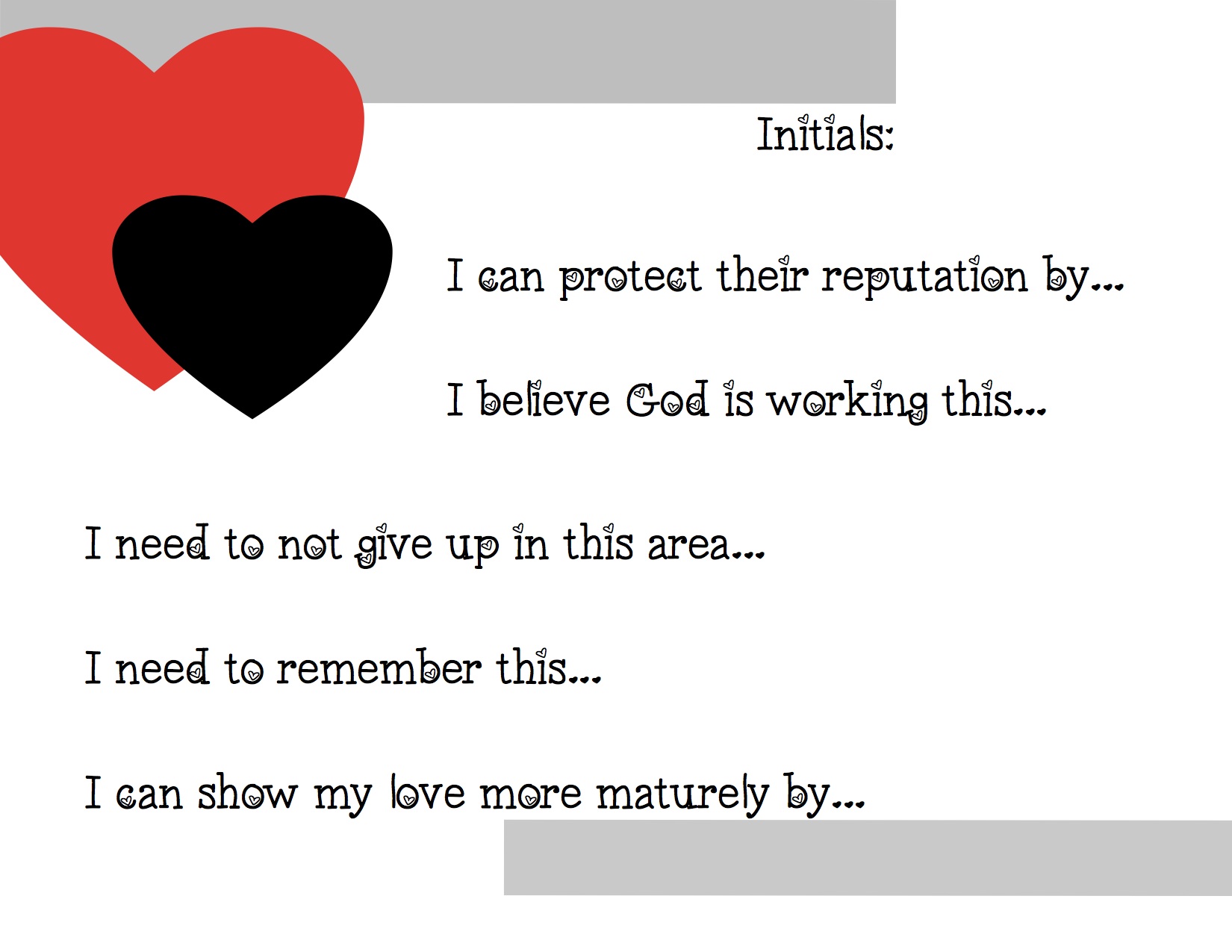
I know you have someone in your life that you think is unloveable. With that person’s face clearly in mind, how will you fill in the blanks:

  1. I can protect their reputation by…
  2. I believe God is working in this…
  3. I need to not give up in this area…
  4. I must remember this…
  5. I can how my love more maturely by…

If you would like a downloadable PDF of this worksheet, click here -–> Love Is… worsheet 3

If you would like to download the other worksheets, or if you missed any of the messages in our Loving the Unlovable series, you can check them all our here.