Saturday In The Proverbs—Sowing & Reaping (Proverbs 17)

[Each chapter in the Book of Proverbs contains thoughts that fit into a theme; they are not just random thoughts gathered together. In this “Saturday In The Proverbs” series, I will share a theme that I see in each chapter. But the cool thing about God’s Word is that you may see an entirely different theme. That’s great! If you do, I would love for you to share it in the comments below.]

A wise servant will rule over a son who causes shame… (Proverbs 17:2).

There are inevitable outcomes for our attitudes and (in)actions. Or said another way: We always reap what we sow.

Not dealing with confrontation correctly → → Strife (v. 1)

Wise work ethic → → Leadership rewards (v. 2)

Allowing God to refine you → → A pure heart (v. 3)

Listening to lies and slander → → Punished by God (v. 4)

Mocking the less fortunate → → Punished by God (v. 5)

Living well → → Leaving a legacy for my children (v. 6)

Truthful, uplifting speech → → Being treated like a prince (v. 7)

Lies and loose lips → → Being treated like a fool (v. 7)

Giving gifts to others → → Favor with others (v. 8)

Forgiving and forgetting an offense → → Cementing a friendship (v. 9)

Telling others about an offense → → Losing a friendship (v. 9)

Rebuking a wise man → → Gaining wisdom (v. 10)

Rebuking a fool → → Getting rebuked myself (v. 10)

Rebellion → → Repaid with cruelty (v. 11)

Trade folly with a fool → → Get mauled (v. 12)

Repay good with evil → → Get stuck with evil (v. 13)

Keep picking a fight → → Open a world of hurt (v. 14)

Justify the wicked or condemn the just → → Displace God (vv. 15, 26)

Give wisdom to a fool → → Get burned (v. 16)

Love your friends → → Have help in difficult times (v. 17)

Make a bad deal → → Get stuck with it for a long time (v. 18)

Love sin and promoting yourself → → Watch it all crash down (v. 19)

Look for deceit → → Fall into evil (v. 20)

Don’t discipline your children → → No joy (vv. 21, 25)

Be happy → → Make others happy (v. 22)

Be sad → → Cause rotten feelings in others (v. 22)

Accept a bribe → → Pervert justice (v. 23) and displease God (v. 15)

Keep focused on the here-and-now → → Get wisdom for there-and-then (v. 24)

Use words sparingly → → Bring calm (v. 27)

Stay silent when you have nothing good to say → → Be thought of as wise (v. 28)

If you don’t like what you’re reaping in your life, check what you’re sowing. 

No Pity Parties, Please

And do you seek great things for yourself? Do not seek them… (Jeremiah 45:5). 

Baruch faithfully obeyed God and faithfully stood by Jeremiah, but now that the heat was on he was having a bit of a pity party—“Woe is me now! For the Lord has added grief to my sorrows. I fainted in my sighing and find no rest.”

In essence, Baruch was saying, “Things are not working out as I had planned.” God reminds Baruch that His plans are much bigger, and He graciously assures him that He will protect his life where ever He sends Baruch. 

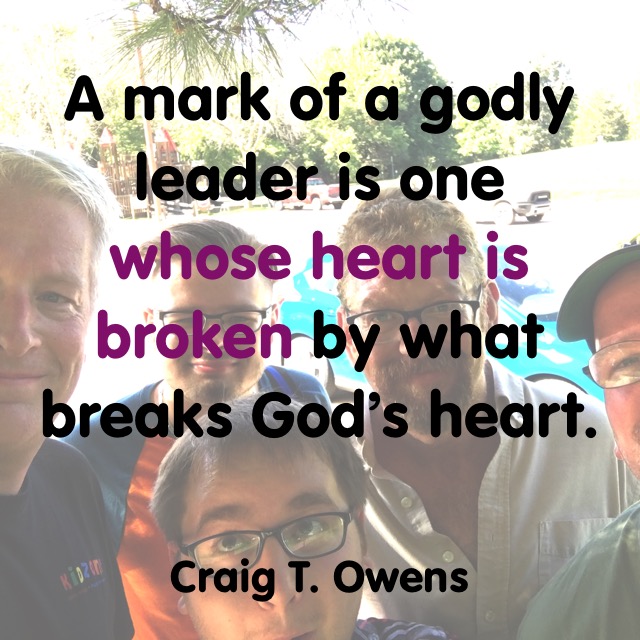
A mark of a godly leader is one who quickly leaves his pity parties.

Instead, my posture should always be: I will obey God and then say, “I am an unworthy servant who is simply doing my Master’s duty” (see Luke 17:7-10). 

This is part 24 in my series on godly leadership. You can check out all of my posts in this series by clicking here.

UPDATE: In my book Shepherd Leadership: The Metrics That Really Matter, I tell a story about a pity party I briefly hosted on my leadership journey in a chapter called “Stick-to-it-iveness.” I think you will really like it!

9 More Quotes From “Brothers, We Are Not Professionals”

Those in pastoral ministry are ministers; they are not professional, career-minded, corporate ladder-climbers. John Piper has written a book that I believe every pastor should read: Brothers, We Are Not Professionals. Here are a few more quotes from this excellent book. 

“Is not our most painful failure in the pastorate the inability to weep over the unbelievers in our neighborhoods and the carnal members of our churches? …  

“I must feel the truth of hell—that it exists and is terrible and horrible beyond imaginings forever and ever. ‘These will go away into eternal punishment’ (Matthew 25:46). Even if I try to make the ‘lake of fire’ (Revelation 20:15) or the ‘fiery furnace’ (Matthew 13:42) a symbol, I am confronted with the terrifying thought that symbols are not overstatements but understatements of reality. …

“I say to you, on the authority of Scripture, remember, remember, remember the horrid condition of being separated from Christ, without hope and without God, on the brink of hell. ‘Remember that you were at that time separated from Christ, alienated from the commonwealth of Israel and strangers to the covenants of promise, having no hope and without God in the world’ (Ephesians 2:12). … 

“When the heart no longer feels the truth of hell, the gospel passes from good news to simply news.” 

“Warning has value in stirring us up to take the glories of holiness and heaven seriously so that we come to see them for what they are and delight in them. But it is the delight in them that causes the true grief when we fall short.” 

“Pastors, you will know your people’s souls best by knowing your own. So try to be ruthlessly honest with yourself.” 

“If the heart is without passion, it will produce lifeless, jargon-laden spontaneity. And if the heart is aflame, no form will quench it.” 

“We ought to experience the deepest emotions about the deepest things. And we ought to speak often, and publicly, about what means most to us, in a way that shows its value.” 

“Eating, exercising, and sleeping are more spiritually relevant in the ministry than we may think. … The point is that we be intentional about how our eating affects the ability of our body to be a helpful partner in seeing the glory of God.” 

“When we say that what we do on Sunday morning is to ‘go hard after God,’ what we mean is that we are going hard after satisfaction in God, and going hard after God as our prize, and going hard after God as our treasure, our soul-food, our heart-delight, our spirit’s pleasure. Or to put Christ in His rightful place—it means that we are going hard after all that God is for us in Jesus Christ, crucified and risen.” 

“It will transform your pastoral leadership in worship if you teach your people that the basic attitude of worship on Sunday morning is not to come with your hands full to give to God but with your hands empty to receive from God.” 

“Brothers, we are leaders, and the burden of change lies most heavily on us.” 

You can read my full book review of Brothers, We Are Not Professionals by clicking here, and you can check out some other quotes from this book here. 

A Warrior For God’s Favor

I love this guy! 

Caleb is a dog. I’m not kidding: his name literally means dog. To be more specific his name actually means a rabid dog. What?! Yeah, but it totally fits his life. 

Caleb first shows up on the scene when the Israelites are getting ready to explore Canaan for the first time. They have just been delivered from Egypt and in about two months have arrived at the border of their promised land. Moses wants to send a representative from each tribe to scout out the land. 

So the first thing we learn about Caleb is that he is a leader of the largest, most powerful tribe in Israel (Numbers 13:1-3, 6). 

After scouting the land for 40 days, these men come back with a report for everyone. Halfway through their report, Caleb interrupts everyone—“We should go take the land right now, for we can certainly do it!” (13:30). Caleb was outspoken for God’s favor. He firmly believed that God was for them. 

Unfortunately, nearly all the other scouts (except Joshua) disagreed with Caleb. They warned that there were giants in the land that would eat them for lunch. In essence, the same people who had seen God deliver them from the Egyptians and part the Red Sea for them now thought that God wasn’t able to defeat giants. This vocal majority turned the entire nation against Moses and wanted to return to Egypt! 

So God promised that none of the adults would enter the promised land, with only two exceptions: Joshua and Caleb. God pointed out that Caleb “has a different spirit and follows Me wholeheartedly” (Numbers 14:24). This is where we first learn that Caleb is rabid. The term rabid means zealous, intense, fanatical, inspired. Caleb is a man who is focused—intensely, wholeheartedly focused—on God. In fact, this word wholehearted is used about Caleb three more times (see Joshua 14: 8, 9, 14). 

Along with the rest of the Israelite community, Caleb wandered in the wilderness for 40 years. He never thought God had forgotten him; he never lost his intense wholeheartedness; he stayed rabid the whole time. He had a trust in God that never diminished. His motto might have been: “God said it; I believe it.” 

After 40 years in the wilderness, and then five more years fighting to claim their promised land, Caleb was still raring to go. He told Joshua, “I am still just as strong as I was 45 years ago. I’m 85 years old and still ready to take on giants. Let me at ‘em!” And he did it! Caleb drove out three giants in order to claim his territory (Judges 1:20).

But Caleb wasn’t done yet. He then used God’s favor to be a blessing to others. The Apostle Paul tell something that Caleb lived out: God will generously provide all you need. Then you will always have everything you need AND plenty left over to share with others (2 Corinthians 9:8). Without a word of complaint, Caleb gladly accepted not only the responsibility of letting the Levities live in the town he had conquered, but he also took on the added duties of making that city of Hebron a “city of refuge.” In this city, Caleb would keep anyone safe from those seeking their lives until a proper trial could be held. 

Caleb was successful for nearly 90 years because he was convinced that God was for him.

Nothing could distract him from wholeheartedly clinging to God’s favor! 

Caleb was a warrior for God’s favor, and he was a successful warrior because of God’s favor. The same can be said of you IF you will decide to cling to God’s favor wholeheartedly.

The Integrity Of A Godly Leader

I will instruct you and teach you in the way you should go; I will guide you with My eye. (Psalm 32:8)

“God does not expect leaders to be perfect, but to be whole. To have integrity means to be whole, as in a whole number (an ‘integer’). Despite their human frailties, leaders can effectively guide those who follow.

“This Scripture reminds us that leaders must closely observe the flock for its needs and problems. God expects spiritual leaders to serve as guides. A guide takes a person or group safely to a planned destination. The Hebrew words for ‘guide’ gives us several clues as to what God expects from those He uses as leaders:

  • A guide is a spiritual head who unites and directs people in their walk with God.
  • A guide takes people on the straight path that leads to fellowship with God.
  • A guide gives accurate and godly counsel to those who need it.
  • A guide leads with gentleness and trustworthiness, making others feel safe.
  • A guide bases his or her direction on the Spirit and the Word of God.” —John Maxwell, in The Maxwell Leadership Bible

Having Conversations With Yourself

Why are you cast down, O my soul…? (Psalm 42:5, 11). 

There can be no healing if there isn’t first an admission of need. 

This psalmist recognizes: 

  • the dryness of his soul
  • his depression
  • the taunts of his enemies
  • the ‘good ol’ days’ 

He not only questions his soul, but he admits to himself and to God, “My soul is cast down within me.” But each time he has this conversation with himself, he reminds himself of the same conclusion—“God is worthy of praise and I can put my hope in Him!” 

We have to stop listening to crippling self-pity and begin talking to ourselves about our well-placed confidence in God. He is worthy of our praise! He will satisfy me like nothing else can. He is the only One in whom I can put my hope. 

As Augustine reminded himself, “Thou hast formed us for Thyself, and our hearts are restless till they find rest in Thee.”

A mark of a godly leader is one who has honest conversations with himself. 

Don’t listen to your downcast thoughts; talk back to your downcast thoughts and tell yourself the only place where real hope can be found. 

This is part 23 in my series on godly leadership. You can check out all of my posts on this topic by clicking here.

How NOT To Make A Decision

Adonijah thought he was the obvious heir to the throne so he stated what he believed, “I will be king” (1 Kings 1:5). 

On what evidence did Adonijah base his claim? 

  1. All of his friends said he would make a great king
  2. His father (the king) had always given him everything he wanted
  3. He was handsome and popular
  4. A couple members of the king’s court supported him
  5. No one had ever told him “no” 

While all of this sounded good, Adonijah overlooked some vital points. Like…

  1. …more men backed his brother Solomon to be king than backed him
  2. …his father had the decisive and definitive say in who would be king, and he chose Solomon
  3. …God had chosen Solomon to be king

It’s tempting for us to read the popular sentiment of the moment, or to listen to the cheering voices around us, or even to think that our plans are wise and well thought-out. But this is NOT the right way to make a decision.

Instead, we need to humbly consider three things that are external:

  1. The unbiased, wise counsel of others
  2. The buy-in of key stakeholders
  3. God’s clear “yes”

If these three things are in alignment, you cannot go wrong!

8 Quotes From “How To Listen So People Will Talk”

In How To Listen So People Will Talk you will learn some invaluable skills for taking your relationships and your leadership deeper. Becky Harling has given us an amazing resource! Check out my full book review by clicking here. 

“Honestly, it’s impossible to be a good listener without developing a humble spirit. Think about it. When you’re listening and fully engaged, you allow the other person to have all the attention. Listening forces you to lay aside your agenda. It challenges you to let go of your need to share your opinions, theories, and assumptions in favor of listening to another’s feelings, thoughts, and sentiments. That decision can only come from a heart of humility.” 

“Resist the urge to dive in with your own story. … Whenever you dive in with your own story, you are stealing the microphone from the person who is telling their story. … The best advice is to remember to let someone be the star of their own show. Keep the focus on the person talking.” 

“How is it that we who have problems ourselves are so quick to try to fix someone else’s problem? James was spot on when he wrote, ‘Everyone should be quick to listen, slow to speak’ (James 1:19). I’d like to suggest that a great paraphrase for this verse is, ‘Let everyone be quick to listen and slow to give advice!’” 

“Don’t tell people what to do; ask them questions. … You gain greater insight, they gain greater self-awareness, and the two of you grow closer. … When we dare to ask someone what they want, we give them the opportunity to verbalize their need. … The best questions allow people to explore what’s in their hearts.” 

“When you validate another person’s feelings, you’re basically saying, ‘Your feelings make sense.’ You compassionately acknowledge that the person’s feelings are important and that those feelings are understandable. You don’t correct feelings or instruct a person on how to feel. You simply offer understanding. … Validating someone’s feelings doesn’t necessarily mean you agree with the actions of the other person. … Feelings are neither right nor wrong. They’re just feelings. It’s what we do with those feelings that determines whether or not we sin. … Validate feelings, but only validate actions that line up with Scripture.” 

“In your relationships, what does it look like for you to mimic Jesus and show others how valuable they are? How does your face send the signal, ‘I want to hear what you have to say’? Your nonverbal signals act as a green light, inviting others to share their feelings.” 

“Conflict can be transformational. In the chaos of an argument, if you will listen to understand and focus on meeting the others need, you’ll be more able to work as a team, coming up with a solution that satisfies both. In the end, your relationship will emerge stronger and more resilient.” 

“People are dying to feel heard, and unless we’ve purpose in our hearts to offer our full presence to others, we’ll drift through life distracted and dishonor those who matter to us in the process.” 

How To Listen So People Will Talk (book review)

If this title was the switched, I’ll bet a lot of people would snap it up. Why? Because all of us want to be heard. In fact, some people are dying to be heard! Which is exactly why Becky Harling hits the nail on the head for ultimate, intimate, life-changing conversations in her book (very aptly titled) How To Listen So People Will Talk.

If Christians are going to follow the teachings of Jesus, there are two relationship principles that must be followed: (1) Love others and (2) serve others. There is no better way to love and serve those around us than by letting them know how deeply we are listening to them. 

Becky introduces us to at least eight major principles to raise our listening game. She uses her own life experiences, lessons that Jesus taught, the wisdom from Scripture, and even some insights from those in the psychological fields. Becky says, “People feel more loved and valued if we are actively and attentively listening to them.” And these principles will help you do just that. 

In addition to Becky’s insightful teachings, she concludes each chapter with some follow-up lessons and exercises to help us begin to apply the lessons to our conversations. 

How To Listen So People Will Talk is a game-changing book! I encourage all leaders—pastors, parents, teachers, coaches—as well those who want to enrich the relationships they have in their lives to get a copy of this book. 

I am a Bethany House book reviewer. 

A Leader’s Priority

But now your kingdom must end…because you have not kept the Lord’s command (1 Samuel 13:14). 

How tragic! 

Saul, as the first king ever of Israel, could have set the standard. He could have raised the bar high. He could have been the measuring stick by which every other king in Israel’s history was judged. But he missed out on all that.

It was not only tragic but short-sighted too. The prophet Samuel told Saul, “How foolish! You have not kept the command the Lord your God gave you. Had you kept it, the Lord would have established your kingdom over Israel forever. 

Saul’s priority was about appearances. Saul’s priority was about betting on a sure winner. Saul’s priority was about working his agenda.

A mark of a godly leader is one who has made obedience to God’s Word his first priority. 

The psalmist tells us some of the benefits—

  • God’s Word keeps us pure
  • God’s Word keeps us from sin
  • God’s Word is the key to God’s blessings
  • God’s Word strengthens us
  • God’s Word preserves us
  • God’s Word does us good
  • God’s Word keeps us from going astray
  • God’s Word lights our path

Make God’s Word your first—and highest—priority! 

This is part 22 in my series on godly leadership. You can check out all of my posts on this topic by clicking here.