I have not stopped thanking God for you. I pray for you constantly. (Ephesians 1:16)
Paul didn’t pray just a one-and-done prayer, but every time he thought of his friends he was grateful and prayerful.
The mark of a godly leader is one who is grateful and prayerful of those around him.
What a prayer Paul prayed! He didn’t want his friends just barely eking out an existence, but he desired for their lives to experience explosive growth and joy!
He prayed for them to experience…
… the full weight of God’s glory
… the vast knowledge of God’s revelation wisdom
… an ever-increasing understanding of just who God is
… an enlightened mind to grasp God’s nature
… an unshakable hope in God
… the immeasurable richness of an intimate relationship with God through Jesus Christ
… God’s power working both in them and through them
… the rock-solid security they have in Jesus
… their inestimable value they were to God
… their indispensable place in the Body of Christ
I like the way Eugene Peterson captures this prayer in The Message:
That’s why, when I heard of the solid trust you have in the Master Jesus and your outpouring of love to all the followers of Jesus, I couldn’t stop thanking God for you—every time I prayed, I’d think of you and give thanks. But I do more than thank. I ask—ask the God of our Master, Jesus Christ, the God of glory—to make you intelligent and discerning in knowing Him personally, your eyes focused and clear, so that you can see exactly what it is He is calling you to do, grasp the immensity of this glorious way of life He has for His followers, oh, the utter extravagance of His work in us who trust Him—endless energy, boundless strength!
Spiritual leaders should be working for and praying for the ever-growing maturity of those under their care. When they see that growth, they should burst out into grateful prayer. And if they don’t see the growth they anticipated, they should pray in faith believing that maturity will soon be visible.
Let me say it again: The mark of a godly leader is one who is grateful and prayerful of those around him.
This is part 40 in my series on godly leadership. You can check out all of my posts in this series by clicking here.
“Amid the confusion of Christians mistreating people with gender dysphoria to prop up their sense of self-righteousness, and progressives mistreating them to advance their agenda of autonomy, those with real identity struggles are forgotten. Christ alone understands who we are through and through. And because of that each one of us in our fractured states needs to come to Him. …
“The need of the hour is for biblically faithful compassion. The church needs to open its doors and Christians need to open their hearts so that those struggling to find resolution to their dysphoria—and those who are struggling to find clarity amidst other confusions—can find community and, ultimately, their true identity in Christ. In Christ, they can be understood. …
“God’s original intent is for harmony between one’s soul and one’s body. This is why Christians, of all people, should be compassionately concerned with helping people find mind-body congruence. For the Christian, the mind and the body are both important and were meant to work harmoniously. … This biblical perspective defends our integrity as whole human beings in contradistinction to the secular effort to reduce us to our chemistry and jettison any idea that we have an immaterial mind or soul. …
“That is why the invitation of Christ has come in this order: recognition, repentance, redemption, regeneration. When we recognize our need for the Savior (because of our sins in general, not because of our dysphoria), repentance happens and then we are redeemed. But that redemption works itself out in our lives over time. It is the Holy Spirit who lives and works in us to conform us to Jesus’ likeness. It is not an overnight process, which means the church must do a better job of helping that process along. The church needs to foster community.” —Abdu Murray
Paul and Timothy, bondservants of Jesus Christ, to all the saints in Christ Jesus who are in Philippi, with the bishops and deacons (Philippians 1:1).
In just his opening line, Paul lists three types of servant-leaders: bondservants, bishops, deacons.
The servant-leaders are all called to put the needs of the saints ahead of their own needs. They all serve so the saints can shine! And as the saints shine, they attract others to Jesus Christ.
Jesus is our example of the Ultimate Servant (Philippians 2:5-8), and we are called to follow His example (John 13:12-17).
One thing that clearly kept Paul, Timothy, and the other servant-leaders in Philippi in this servant’s posture was prayer. Even the physical posture of kneeling in prayer is a posture of a servant who is actively serving.
Paul prayed for the Philippians frequently—In all my prayers for all of you, I always pray with joy (1:4).
He prayed for them to grow in love and knowledge—I pray that your love will overflow more and more, and that you will keep on growing in knowledge and understanding (1:9).
Paul was grateful for the prayers of the saints—I know that as you pray for me and the Spirit of Jesus Christ helps me, this will lead to my deliverance (1:19).
And he closed his letter with a call for them to continue to pray about everything—Don’t worry about anything; instead, pray about everything. Tell God what you need, and thank Him for all he has done (4:6).
Here are four powerful lessons for all Christians to live out…
(1) Leaders need to pray for the saints, and leaders need the saints to pray for them.
(2) Leaders need to be prayerful to keep their posture right as servants.
(3) Saints need to be prayerful for their leaders so that their leaders can continue to serve them in God-honoring ways.
(4) We all serve best when we are diligent to keep our prayer life vibrant and healthy.
Paul had a desire to visit certain cities to share the Gospel, so he made his plans. But he was careful to add, “if the Lord permits.” He knew from personal experience that God knows best the where and the when.
In fact, the first time Paul came to Macedonia, it was only after he had been blocked from his original plans—
They tried to go to certain regions of Asia, but they were prevented by the Holy Spirit (Acts 16:6).
They headed toward Bythinia, but again the Spirit of Jesus did not allow them to go there (Acts 16:7).
While at Troas, Paul had a vision of a man from Macedonia, so they concluded that God was calling themto preach there (Acts 16:9-10).
We must know that we know that God has green-lighted an opportunity for us. Where God opens opportunities, satan is sure to attack (1 Corinthians 16:9). We don’t want to then assume that the attack means that we are in the wrong place at the wrong time, or even in the right place at the wrong time.
When God said, “Go!” Paul could endure any opposition because he was assured that God had called. And when God said, “No” Paul could rest peacefully because he was assured that God knew the best place at the best time.
The same principle is true for godly leaders today—
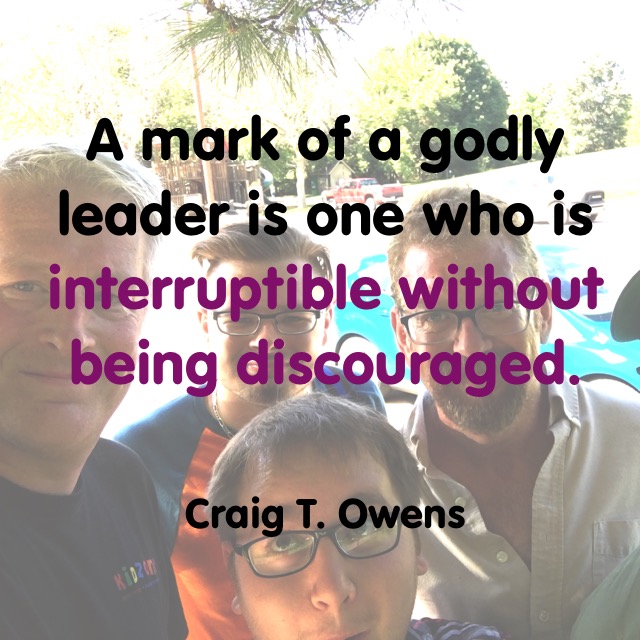
A mark of a godly leader is one who is interruptible without becoming discouraged.
This is part 39 in my series on godly leadership. You can check out all of my posts in this series by clicking here.
Jesus never rushed. He was never late. He was never early. Nor did He ever remain silent when He should have spoken. Nor did He ever misspeak.
His timing and His wording were always spot on.
This wasn’t just a “Jesus thing,” as He told His followers that we could flow in God’s timing just as He was doing.
We don’t have to try to figure out our timing or our wording by external standards (v. 24). But when we are so immersed in the same Holy Spirit that directed Jesus, we simply flow in His living water to where we need to be, when we need to be there. Whether it’s time to speak or time for silence, the Holy Spirit can again flow our thoughts and words perfectly.
Others won’t understand.
They have their own agenda, and they will want me to be a part of their plans (vv. 3-5, 18, 32-36, 42, 52). I must listen to the unmistakable voice of the Spirit and squelch the voices of the crowd.
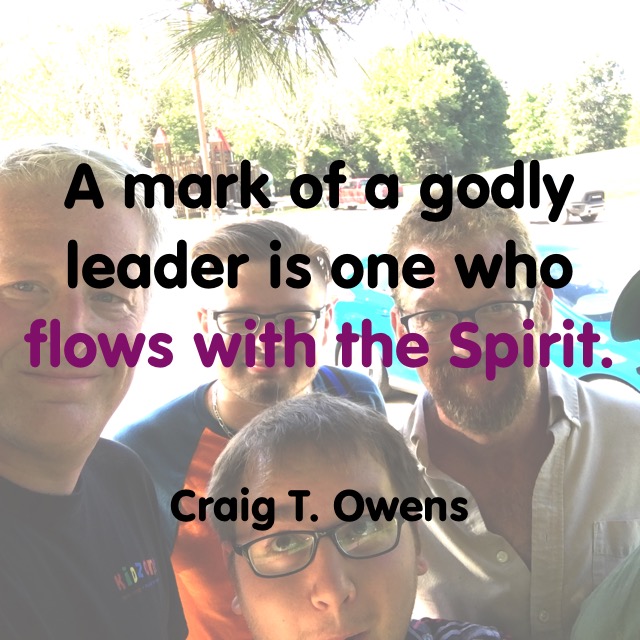
A mark of a godly leader is one who flows with the Spirit of God.
Don’t go with the flow of culture or others’ agendas. Don’t try to figure out where you need to be or what you need to say. Simply flow in the Spirit. Then your timing and your wording will be just as spot-on as Jesus showed us.
This is part 38 in my series on godly leadership. You can check out all of my posts in this series by clicking here.
Paul didn’t bring letters of reference to Corinth, nor did he ask the Corinthians to write any testimonials on his behalf.
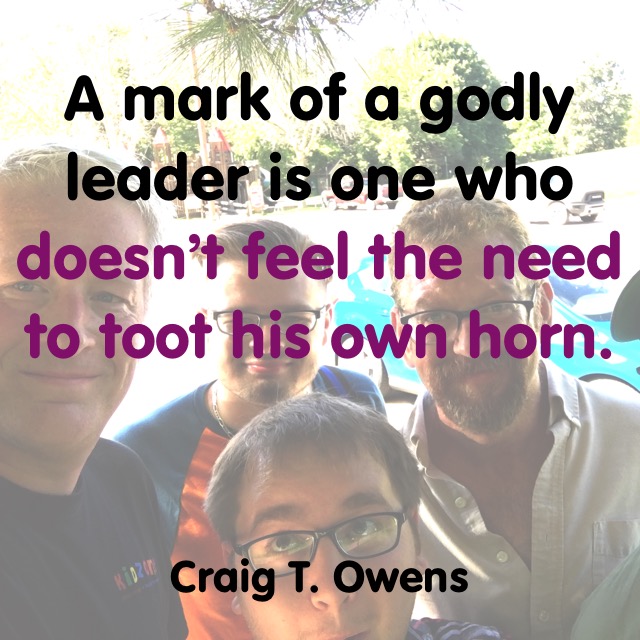
A mark of a godly leader is one who doesn’t feel the need to toot his own horn.
Paul’s focus was not on what he could get now, but on what would be his in eternity—
any “letters of recommendation” would be written on peoples hearts (v. 3)
any skills he had came through Jesus (vv. 4-6)
he had hope that God was keeping accurate records (vv. 7-11)
he had the freedom to speak boldly in love because he wasn’t trying to win man’s approval (vv. 12-13, 18)
he saw transformed lives as his real trophy (v. 18)
his ministry was through God’s mercy so he remained humbled and encouraged (4:1)
he didn’t feel the need to concoct a “marketing plan” nor leverage his pulpit for personal gain (v. 2)
he focused on glorifying God alone (vv. 3, 4, 6)
his sermons weren’t me-focused, but always others-focused as he became a bondservant to those to whom he ministered (v. 5)
he worked only for eternal rewards (vv. 7-12, 16-18)
he spoke only what he had already appropriated and faithfully applied to his own life (vv. 13-15)
Our prayer could be very similar to what Paul taught and probably prayed for himself—“May I lead by serving. May I not look for human praise—nor even be tempted to toot my own horn—but lead and minister only to hear applause from the nail-scarred hands of Jesus.”
As R.T. Kendall reminds us—
“Every day we breathe in and out—in and out—thousands of times a day. There is a day fixed, that unless Jesus comes first, you and I will only breathe out. No amount of money, power, or prestige can alter the date that we each have with death. And at that moment the only thing that will matter is whether we have known Christ and served Him well—that our lives have made a difference. In short: that we are popular in heaven—and famous in hell.”
This is part 37 in my series on godly leadership. You can check out all of my posts in this series by clicking here.
T.M. Moore has given pastors a phenomenal training resource in Shepherding God’s Flock. Please be sure to check out my full book review by clicking here.
“The work of church leaders today—and especially of that class of leaders called elders, with which this study is concerned—has been shaped and conditioned more by the temper of our times than by the teaching of God’s Word.”
“According to Paul, any church that does not have in place elders—and other leaders working with them—who are functioning as shepherds is a church that is not in order.… A church without a strong ministry of shepherding is a flock without genuine pastoral care, oversight, and equipping. It may be very active, even happy, and may be ‘growing’ in what some consider impressive ways. But without shepherding as the framework and integrating dynamic, such a church will always be something less than what God intends.”
“Where the work of shepherding is being faithfully pursued, the gospel goes forth with power, lost sheep are located, and the flocks of God grow as He adds new souls to the fold.”
“Where faithful shepherds are at work, the Lord’s sheep will be well fed. Both milk and the meat of the Word will be their daily diet, according to the needs and callings of each. Well-fed sheep are healthy, strong, and fruitful in their own contributions.”
“The work of shepherding begins in relationships of mutual love and trust, spiritual friendships where sheep and shepherd know, love, and care about one another.”
“Only when the people feel known and loved, and only when they know and love those who are called to lead them—only then will they be willing to follow where the shepherds of the church are seeking to take them.”
“In the Christian life, people tend to live up to or achieve, not the level of their abilities, for their abilities are virtually limitless, given the presence of the indwelling Spirit of God. Rather, they tend to live up to the level of their vision—of what they see for their lives in Christ. Unless we are leading them into God’s vision for their lives, the people of God will settle for something less than the prize of the upward call of God in Christ Jesus.”
“When temptation arises we can follow one of two courses. Either we will fall through temptation into sin, or we will grow through temptation into a higher stage of sanctification. … The shepherd’s task is twofold: first, he must help the Lord’s sheep to recognize temptation, by grounding them firmly in the law and Word of God; second, he must equip and encourage them in finding the way of escape from temptation, so that they may grow as the Lord intends.”
“Jesus’ approach to bearing witness was thus energetic, proactive, continuous, compassionate, and pioneering. Should we expect anything less from the shepherds He has left to bring other lost sheep into His fold?”
T.M. Moore founded the Fellowship of Ailbe, a ministry patterned after the example of the Irish Christians who kept the spread of the Gospel alive during history’s dark times. A key component of the Fellowship’s ministry is the equipping of pastors for their tasks, and Shepherding God’s Flock masterfully lays out the role of pastors like few other resources.
Throughout the Scriptures, God uses the picture of a shepherd caring for his sheep as a consistent image of how God cares for His people, and how He desires for pastors/elders to care for those under their care as well. God has stern warnings for shepherd-leaders who misuse or abuse their positions, but He also showers His blessings on those shepherd-leaders whose hearts beat with God’s heart. David talked lovingly of the Lord being our Shepherd, Jesus called Himself the Good Shepherd, and the Apostle Peter called for elders in the church to shepherd the flock under their care.
Shepherding God’s Flock helps pastors work through the practicalities of their shepherding role. And I do mean work through these concepts. This book is as much a workbook as it is a textbook. T.M. Moore gives valuable insights for pastors, but he intersperses penetrating discussion questions throughout his teaching. You will also need to keep your Bible handy while reading Shepherding because Moore will send you to passage after passage to undergird the principles he is teaching.
I can’t recommend this book highly enough to both current pastors and those preparing to enter into pastoral ministry. It would probably be a good idea for lead pastors to read this book alongside their elder/deacon boards.
As Moore notes in his closing words, “Shepherding is the work God has chosen for the care and nurture of His flocks. We’ve neglected this ministry for too long. Let us resolve to bring the work of shepherding to bear on the task of building Christ’s Church.”
“Criticism is something you can avoid easily—by saying nothing, doing nothing and being nothing.” —Aristotle
“The Lord uses critics to show us our own hearts, even if what they say is not fully true, informed, or even fair. There is almost always a germ of truth in what our critics (in their own pain and disappointment) shout at us. The wise leader will humble himself and look for the truth embedded in every oppositional interaction.” —Dick Brogden [see 2 Samuel 16:5-12]
“Feedback is the breakfast of champions.” —Ken Blanchard
“Criticism can be received as a gift from God. It is an opportunity to pray, search Scripture, evaluate your own heart, and offer grace to others. The right response to criticism should not be retaliation or pride (which just perpetuates hurt), but rather humility.” —Jeremy Carr
“There is a growing trend to attack, criticize, and resent anyone who has talent or achievements that sets them apart from others. This tendency extends to those who resent the efforts of leaders who challenge the status quo. Opponents of change initiatives often attempt to marginalize leaders by attacking their character and questioning their motives. If the messenger is flawed, then the message and vision they offer cannot be trusted. As disappointing as it is, these challenges come with the territory of leadership.” —Dr. J. Lee Whittington
“If I were to attempt to answer all the criticisms and complaints I receive, I would have no time for any other business. From day to day I do the best I can and will continue to do so till the end. If in the end I come out all right, then the complaints and criticisms and what is said against me will make no difference. But, if the end brings me out wrong, then ten angels coming down from heaven to swear I was right would still make no difference.” —Abraham Lincoln
“If a ministry is God-anointed, it doesn’t matter who criticizes it. If it’s not anointed, it doesn’t matter who praises it.” —Rick Warren
“Your critics have information that your friends are withholding.” —John Maxwell
“God never gives us discernment so that we may criticize, but that we may intercede.” —Oswald Chambers
“No leader is exempt from criticism and his humility will nowhere be seen more clearly than in the manner in which he accepts and reacts to it.” —J. Oswald Sanders
“Criticism may not be agreeable, but it is necessary. It fulfills the same function as pain in the human body: It calls attention to an unhealthy state of things.” —Winston Churchill
“Every man needs a blind eye and a deaf ear, so when people applaud, you’ll only hear half of it, and when people salute, you’ll only see part of it. Believe only half the praise and half the criticism.” —C.H. Spurgeon
“Any fool can criticize, condemn and complain—and most fools do. But it takes character and self-control to be understanding and forgiving.” —Dale Carnegie
“A mark of a godly leader is one so focused on God’s plan that he pays no attention to his critics or enemies.” —Craig T. Owens
“Never be afraid of honest criticism. If the critic is wrong, you can help him; and if you’re wrong, he can help you. Either way, somebody’s helped.” —A.W. Tozer
“It’s so much easier to teach correct principles than it is to know and love a person. It’s so much easier to give brilliant advice than to empathize and be open. It’s so much easier to live independently than to live interdependently. It’s so much easier to be a judge than to be a light. It’s so much easier to be a critic than to be a model.” —Stephen Covey
“When is it inappropriate to praise a critical person? One: When you are being criticized for outright sin, and the criticism is accurate. If what is said is true, the tension you feel will be relieved only one way: confession. Two: when you are falsely accused of sin. Sin is a serious charge, obviously more serious than those ‘against you’ realize or they would have done their homework.” —Blaine Allen
“Don’t let an arrow of criticism pierce your heart unless it first passes through the filter of Scripture.” —Mark Batterson
“There is no better antidote for unjust criticism than a clear conscience before God.” —James Hernando
“It is not the critic who counts; nor the many who point out how the strong man stumbles, or where the doer of deeds could have done them better. The credit belongs to the man in the arena, whose face is marred by dust and sweat and blood, who strives valiantly… who knows the great enthusiasms, the great devotions, who spends himself in a worthy cause, who at the best knows in the end the triumph of high achievement, and who at the worst, if he fails, at least fails while daring greatly, so that his place shall never be with those cold and timid souls who have never known neither victory nor defeat.” —Teddy Roosevelt
In the same way, let your good deeds shine out for all to see, so that everyone will praise your heavenly Father. (Matthew 5:16)
Jesus wants Christians to be leaders, to be pacesetting examples. That means that Christian leaders must be comfortable with others carefully watching their lives.
A mark of a godly leader is one who is comfortable with public scrutiny.
“It is bad enough to be blind ourselves. It is a thousand times worse to be a blind guide.” —J.C. Ryle
“Live an exemplary life among the natives so that your actions will refute their prejudices. Then they’ll be won over to God’s side and be there to join in the celebration when he arrives.” —1 Peter 2:12 MSG
“Sermons must be practiced as well as preached…. If a man teach uprightly and walk crookedly, more will fall down in the night of his life than he built in the day of his doctrine.” —John Owen
“Be a walking, talking, living example of what you preach, in every silent moment of your life, known and unknown; bear the scrutiny of God, until you can prove that you are indeed an example of what He can do.” —Oswald Chambers
“Behave yourselves wisely—living prudently and with discretion—in your relations with those of the outside world (the non-Christians)…” —Colossians 4:5 AMP
“We hear that some people in your group refuse to work [or are behaving irresponsibly; are living/walking in idleness/disorder]. They do nothing but busy themselves [meddle; interfere] in other people’s lives. We command those [such] people and beg [urge; encourage; exhort] them in the Lord Jesus Christ to work quietly [or settle down] and earn [eat] their own food.” —2 Thessalonians 3:11-12 EXB)
“We should make less excuses for the weaknesses of a Christian than for any other man. A Christian has God’s honor at stake. When a man is regenerated and bears the Name of Christ the Spirit of God will see to it that he is scrutinized by the world, and the more we are able to meet that scrutiny the healthier will we be as Christians.” —Oswald Chambers
This is part 37 in my series on godly leadership. You can check out all of my posts in this series by clicking here.



 Paul didn’t pray just a one-and-done prayer, but every time he thought of his friends he was grateful and prayerful.