Jesus Is Everlasting Father

Listen to the podcast of this post by clicking on the player below, and you can also subscribe on AppleSpotify, or Audible. 

Last week we talked about how the title “God” can mean different things to different people. When we are talking about the One True God as He is revealed to us in the Person of Jesus, there is no doubt of Whom we are speaking. The opponents of Christianity knew this too, which is why they tried to get the early saints to not use the name Jesus.  

Isaiah 9:6 says that a Child is born and a Son is given, but this Son is given the unusual title of Everlasting Father. Jesus acknowledged this unusualness in this exchange with the Pharisees in Matthew 22:41-45. 

(Check out all of the Scriptures in this post by clicking here.) 

Everlasting” means continuous existence; existing in perpetuity; the Chief by which all other things are ordered and aligned. We see this in Genesis 1:1, where “In the beginning” signifies God started Time but He existed before that moment. 

In John 1:1, similar words are used,  but here “in the beginning” means if you stand at the moment Time began and were able to look back into the immeasurable eternity that existed before that, God was there. More specifically, the Word of God (Jesus) was there as God. Jesus Himself affirmed this in Revelation 1:8 and 3:14. 

Then in 1 John 1:1, the phrase “from the beginning” means that after Time ends, you can look into the infinite eternity that still exists and God is there. Again, Jesus Himself affirms this in Revelation 22:13. 

Father” this is the first word in our biblical Hebrew dictionary. It means father, the head or founder of a family, the protector of the family. Paul says that Jesus fulfills all of these definitions (Colossians 2:9-10, 1:15-22), and the writer of Hebrew opens his epistle with the same thought (Hebrews 1:1-3). 

No one on earth has seen God the Father. This makes it difficult to follow Him. Which is why Jesus made His appearing among us (John 1:1, 14, 18). 

Paul wanted people to know the mystery of God, namely, Christ” (Colossians 2:2), and he said that Jesus is the Key that unlocks the treasure-trove of God’s rich love for us. Notice Paul’s progression: teaching the Word (1:25-27) so that we mature (1:28), so that we have the full riches of complete understanding, in order that we may know the mystery of God, namely, Christ (2:2-4). 

When Jesus was born, Simeon gave us the same assurance when he saw Jesus and announced that Jesus was the Christ that had been prophesied (Luke 2:25-32), and Jesus Himself told His disciples the exact same thing (John 14:8-9). 

Let people see God’s love through your life, all year-round but especially at Christmas. As we said last week, when we talk about Jesus and live for Jesus, we invite others to God, through Jesus, by the Spirit’s illumination. 

If you have missed any of the other messages in our series Jesus Is…, you can find them all here.

►► Would you please prayerfully consider supporting this ministry? My Patreon supporters get behind-the-scenes access to exclusive materials. ◀︎◀︎
Jesus Is Mighty God

Listen to the podcast of this post by clicking on the player below, and you can also subscribe on AppleSpotify, or Audible. 

Have you ever heard the phrase “in name only”? For instance, someone might say, “He’s the boss around here in name only, but the one who really calls the shots is someone else.” We might give the title “boss” to someone just for convenience because “The guy who thinks he’s in charge” is probably too awkward to keep saying! We know the true boss by what he or she says or does, and how people respond to him or her. 

I think this is true when someone says, “God,” you might wonder just what they mean by that. Sennacherib’s field commander appeared to be confused by this, as he uses both “God” and “god” interchangeably in 2 Kings 18:19-22, 32-35. But the foretelling of the Advent of the Christ makes it perfectly clear to Whom the prophets were pointing (Isaiah 9:6-7). 

(Check out all of the Scriptures in this post by clicking here.) 

Let’s consider the title Mighty God. The word God is the Hebrew word el. It is translated many ways, but let’s find out which definition is correct in this foretelling of Jesus. 

  1. A god-like person  
  2. A mighty hero  
  3. An angel  
  4. A manmade god  
  5. The One True God 

We can eliminate “a god-like person” from Exodus 15:11.
We can eliminate “a mighty hero” from Psalm 82:1.
We can eliminate “an angel” from Psalm 29:1 and Isaiah 6:1-3.
We can eliminate “a manmade god” from Isaiah 14:12-15.

So it must mean He is The One True God! One of Isaiah’s favorite phrases is “the Lord Almighty” which he uses 61 times (e.g. Isaiah 47:4)! 

Isaiah 40 is one of the most descriptive chapters of the Lord Almighty. In here we see that…

  • He forgives sin (vv. 1-2) 
  • He is beyond description (v. 12)—holding the world’s 326 quintillion gallons of water in the hollow of His hand, fitting the 10 septillion stars of the cosmos across the breadth of His hand, and carrying the weight of the Earth (1.3 octillion pounds) easily in His basket! 
  • He is distinguished from manmade gods (vv. 18-20, 25) 
  • His strength is absolutely unrivaled (vv. 26, 28) 

How do we know these descriptive words in Isaiah point to Jesus? Look at these First Testament Scriptures compared to Christ’s First Advent: 

  • Isaiah 40:3-5 foretells the messenger who would herald Christ’s arrival. Zechariah is inspired by the Holy Spirit to make this connection to his son John (Luke 1:76-77), and then John lives this out (Mark 1:1-3).  
  • Remember that 40:1-2 says that The One True God forgives sins, which is what John the Baptizer sees in Jesus (John 1:29).  
  • In 41:10, 13-14 we read of God shining His light into darkness to set people free, which is another thing that Zechariah connects to Jesus (Luke 1:67-75). 

Jesus wasn’t God in name only, but His words and action—and the response of those who saw and heard Him—affirmed that He is the Mighty God that was foretold (John 8:48-59; Mark 14:60-64). 

Notice also how the early New Testament saints proclaimed Christ’s unique deity, stating clearly that He is the fulfillment of all of the prophetic words that point to Him as The One True God (Acts 4:8-10, 12, 18; 5:27-32). 

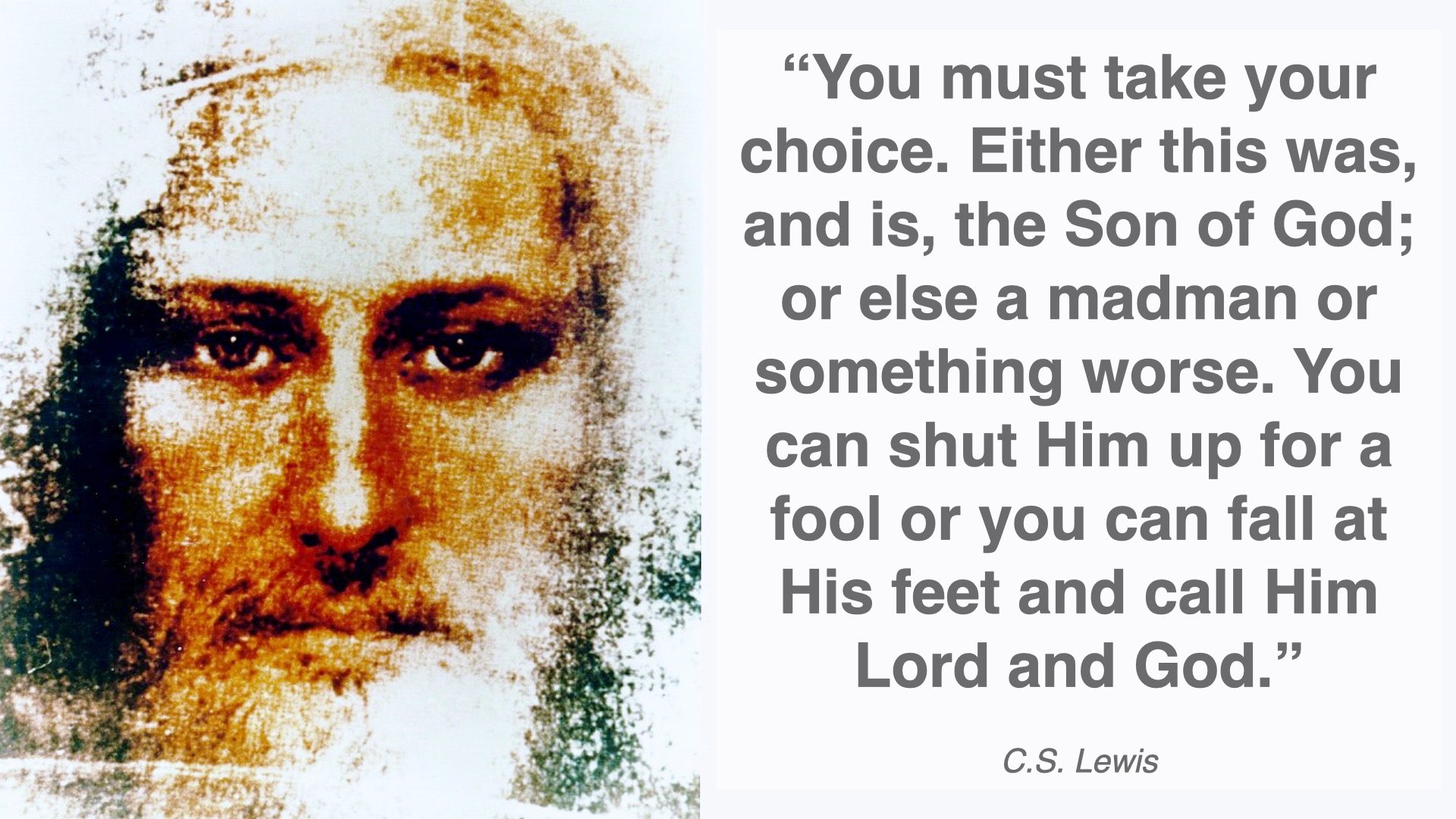
Peter and John said, “We are witnesses of this.” We too are witnesses of this if we have accepted Jesus as our Lord and Savior. We get to proclaim His Lordship by our verbal testimony and our lifestyle. As C.S. Lewis said, “A man who was merely a man and said the sort of things Jesus said would not be a great man or a moral teacher. He would either be a lunatic—on the level with the man who says he is a poached egg—or else he would be the devil of hell. You must take your choice. Either this was, and is, the Son of God; or else a madman or something worse. You can shut Him up for a fool…or you can fall at His feet and call Him Lord and God.” 

In Philippians 2:9-11, Paul points out that Jesus has the name above every name and that every knee must bow to Him and every tongue confess that He is Mighty God! Today, let us bow our knee to Him and lift our voices proclaiming that He is Lord and God until our One True God takes us home or returns at His Second Advent. 

If you’ve missed any of the other message in our Advent series called Jesus Is…, you can find them all here. 

►► Would you please prayerfully consider supporting this ministry? My Patreon supporters get behind-the-scenes access to exclusive materials. ◀︎◀︎
Jesus Is Wonderful Counselor

Listen to the podcast of this post by clicking on the player below, and you can also subscribe on AppleSpotify, or Audible. 

Jesus made His first appearance as a fully human Man in a stable in Bethlehem. But His Advent—or appearing—had been anticipated for a long time before that. 

In fact, one of the darkest chapters in human history takes place shortly after human history began. Mankind sinned and was separated from God because of that sin. The initial separation foretold an eternal separation (Genesis 3:22), but God shines His light of hope in this darkest hour, foretelling the Advent of our rescue (3:15). 

(Check out all of the Scriptures in this post by clicking here.)

Seven hundred years before Christ’s birth in Bethlehem, the setting is still dark and getting darker. Sin is running rampant, God’s people are groping in darkness, and enemies are pressing in from every side. 

Out of the darkness, God speaks (Isaiah 8:5-10), giving us a glimpse of the Messiah’s glory. Notice the hope-filled words Immanuel (v. 8) and God with us (v. 10). This darkness is the inevitable result of not gazing on God’s glory (vv. 21-22), and yet there appears another glorious promise in a single word: Nevertheless (9:1-7). 

We get a glimpse of Immanuel’s glory in the titles that will describe our Messiah. Let’s look first at Wonderful Counselor. 

Wonder can have two definitions: 

  1. Something so extraordinary that it is hard for our finite human minds to comprehend—Exodus 15:11; Isaiah 25:1 NLT. 
  2. God’s awesome deeds: His works that leave us in absolute awe of His greatness—Jeremiah 32:17 AMPC. 

Counselor is someone who gives counsel; not just any counsel, but perfect counsel because He is omniscient (knows it all) and omnipotent (can do it all)—Isaiah 14:26-27; Psalm 139:1-6; Psalm 32:8. 

Job got a glimpse of this Awesome Counselor too in Job 42:1-6. 

Our First Testament friends only got a glimpse of the Messiah’s glory, but we have the glory revealed to us—Hebrews 1:1-3a; Matthew 1:22-23; John 1:5, 14, 18. 

We have His wonderful counsel revealed to us too—Luke 5:20-26; John 7:37-46. 

And we look forward to seeing His glory undimmed at His Second Advent—John 1:47-51; Mark 14:61-62. 

As we live now between the Advents, we have the joyful privilege and responsibility to proclaim this glory to those still living in darkness—Matthew 28:18; Acts 4:30.  

See how the saints proclaimed Christ’s glory, relying on His wonderful counsel in Acts 4:13, 20, 31; 5:12; 6:8, 10; 8:6-8. This is how we are to live too (2 Thessalonians 2:16-17). 

As you live between the Advents, I pray that the glory of our Wonderful Counselor will become more real to you and that it will shine out of every word you speak and everything you do! 

Check out the other posts in this series Jesus Is… here.

►► Would you please prayerfully consider supporting this ministry? My Patreon supporters get behind-the-scenes access to exclusive materials. ◀︎◀︎

Jesus Is…

Over 700 years before He was born in Bethlehem, God spoke through the prophet Isaiah to describe the Messiah that was coming. Peter said that until the advent of Jesus, the prophets continued to scour the evidence of who this Messiah was going to be. 

When Jesus finally came to earth as a Man, young and old alike were thrilled to proclaim that the One they had been longing for had made His long-expected appearing! As Jesus lived on earth, died on Calvary, and was resurrected back to life, He continued to fulfill all that had been prophesied about Him. 

Isaiah said of Jesus: “He will be called Wonderful Counselor, Mighty God, Everlasting Father, Prince of Peace.” This Advent season we will take some time to unpack what each of these majestic titles mean. We will explore how Jesus demonstrates that He is truly worthy of each of these titles, and we will see how that knowledge should thrill our hearts as we celebrate His first Advent and eagerly long for His Second Advent. 

Join me at Calvary Assembly of God for this encouraging Advent series as we learn that Jesus is…

Review Your History

Listen to the podcast of this post by clicking on the player below, and you can also subscribe on AppleSpotify, or Audible.  

We saw in part one of this two-part series that we quickly go into crisis mode when we forget that God is in control, so we need to remain full of thanks all the time (Ephesians 5:20 AMPC). We called gratitude our inoculation against the pull from contentment to crisis, but inoculation doesn’t mean that we never experience some pangs of anxiety when a moment of darkness hits. Maturing Christians are learning how to spot the beginning of anxiety and move back into the contentment zone earlier and earlier (Romans 5:3-5; James 1:2, 12). 

(Check out all of the Scriptures in this post by clicking here.)

James says we “will receive the crown of life” from Jesus. There’s no doubt about that! In a trial, it’s important to be reassured that the trial can never cause us to lose out with our Heavenly Father (Romans 8:38-39). 

Psalm 107 starts out with this same assurance—“those He redeemed” (v. 2) is in the perfect tense. It’s complete and irrevocable! We walk out our redemption in circumstance after circumstance in a way that bring glory to God and draws others to Him as well. “Let the redeemed of the Lord say” is in the imperfect tense, which means giving thanks is an ongoing practice (v. 1). 

Redeemed once, but giving thanks always! 

Romans 8 gives a little snapshot of some of the situations that could have sent us spiraling into crisis mode, but remember the conclusion: None of those things can separate from God’s love. 

Last week we saw how the psalmist linked prayer and gratitude in a repeated theme. This practice is backward looking (vv. 7-8, 14-15, 20-22, 29-32). When we look back to see how God has moved and then we contemplate Who He is (Hebrews 13:8; Isaiah 59:1). 

Look at the closing verse (v. 43): 

  • heed = guard, watch over attentively; this is an imperfect verb—which means we keep on doing it 
  • consider = discern: to take apart the evidence and harvest the lessons 
  • great love = God’s limitless lovingkindness 

I love this verse in the New Living Translation: Those who are wise will take all this to heart; they will see in our history the faithful love of the Lord.

That means we… 

  1. Review the history of God’s faithfulness 
  2. Rejoice over it 
  3. Apply it to your current circumstance 

We can pray, “God, You have been faithful—You have rescued me. Now help me to see that You are still Sovereign over this current situation—You are doing something in the midst of this crisis.” 

In Romans 8:28, Paul tells us that God is working together all of our circumstances for His glory and our our good. Oswald Chambers noted, “In the Christian life we have no aim of our own, and God’s aim looks like missing the mark because we are too shortsighted to see what He is aiming at.” Reviewing our history and then giving thanks helps assure our anxious heart that God is going to hit the mark (Philippians 1:6). 

Praise the Lord! I will thank the Lord with all my heart as I meet with His godly people. How amazing are the deeds of the Lord! All who delight in Him should ponder them. Everything He does reveals His glory and majesty. His righteousness never fails. He causes us to remember His wonderful works. How gracious and merciful is our Lord! (Psalm 111:1-4 NLT) 

►► Would you please prayerfully consider supporting this ministry? My Patreon supporters get behind-the-scenes access to exclusive materials. ◀︎◀︎
Remember Who’s In Control

Listen to the podcast of this post by clicking on the player below, and you can also subscribe on AppleSpotify, or Audible. 

I love the Fibber McGee and Molly radio broadcasts! One of the running gags on this show was Fibber’s closet: People who mistakenly opened the closet door got buried under a pile of stuff that Fibber had stashed away. 

In one episode, Molly is determined to grow through all of the items that were strewn across the floor before they got shoved back into the closet. One by one Molly asked Fibber about all of the odd knick-knacks and he had a good explanation for every single one justifying why he couldn’t possibly part with it. One of my favorites was this—“What’s this bamboo pole,” Molly asked, and Fibber said, “Why, that pole is very important. If I was ever offered to be Joe Louis’ sparing partner, that’s the ten-foot pole I wouldn’t touch it with!” 

I’m afraid that many of us have closets like this in our minds. We’ve accumulated a lot of just-in-case stuff for each and every scenario that may come upon us at some point in our lives. 

All of our contingency plans implies that something is going to go wrong and that only the prepared and well-stocked will make it through. 

(Check out all of the Scriptures in this post by clicking here.) 

Psalm 107 is the first psalm in Book 5 of the Psalter—the book that focuses mostly on praise. This author is recounting the history of Israel through the times of crisis: 

  • lost and homeless (v. 4) 
  • hungry and thirsty (vv. 5, 9) 
  • trouble and distress (vv. 6, 13, 19, 28) 
  • darkness and deepest gloom (vv. 10, 14) 
  • prisoners in chains (v. 10) 
  • knocking on death’s door (v. 18) 
  • terrorized (v. 26) 
  • at their wits’ end (v. 27) 

We quickly go into crisis mode when we forget that God is in control! 

In God’s Kingdom there is no emergency, no crisis, no Plan B. God is sovereignly in control—Isaiah 46:10. 

  • God is in control of the macro—Genesis 1:1; Job 38:4-11 
  • God is in control of the micro—Psalm 139:16; Jeremiah 29:11 
  • God will use what we call a crisis to display His glory—Exodus 14:4 NLT 

When you feel yourself spiraling into crisis mode—when you feel you’re at your wits’ end—you can get back into contentment mode. 

“When a man is at his wits’ end it is not a cowardly thing to pray, it is the only way he can get in touch with Reality.” —Oswald Chambers 

That’s what Job finally did—Job 42:1-2. 

And that’s also what the psalmist did—Psalm 107:6-8, 13-15, 19-21, 28-31.  

Prayer is a great rescue in trouble, and ongoing thankfulness is a great inoculation against going into crisis mentality. Notice that those four repeated phrases have both cried out to the Lord AND Let them give thanks to the Lord for His unfailing love. 

Let’s strive to remain aware of His unfailing love by cultivating consistent gratitude. I like v. 2 from the NLT: “Has the Lord redeemed you? Then speak out! Tell others He has redeemed you from your enemies”. When you are preoccupied with telling others and yourself how good God is, there isn’t room in your heart for the worry that leads toward crisis mode. 

Remember: We can quickly go from contentment mode to crisis mode when we forget that God is in control, so remain full of thanks. “At all times and for everything giving thanks in the name of our Lord Jesus Christ to God the Father” (Ephesians 5:20 AMPC). 

►► Would you please prayerfully consider supporting this ministry? My Patreon supporters get behind-the-scenes access to exclusive materials. ◀︎◀︎

Links & Quotes

As I was studying the Book of Jude, I came across this phrase, “Though you already know all this, I want to remind you.” This prompted these three quick thoughts that I want to share with my fellow pastors.

I have a lot of new video content on my YouTube channel every week. Please check it out and subscribe so you don’t miss anything.

Using the words from Isaiah 40:10-11, Sarah Young has Jesus speaking these words to us: “Adverse circumstances become growth opportunities when you affirm your trust in Me no matter what.”

Ken Blanchard has long used a challenge for leaders to catch their teammates doing something right. That phrase has now become the title of a biography about Ken. He says, “Great leaders who want to encourage and motivate their people set up a positive cycle:

  1. A great leader catches someone doing something right and praises them. 
  2. The leader’s praise helps the person feel good about themselves. 
  3. People who feel good about themselves produce good results. 
  4. A great leader notices when people produce good results. 
  5. See #1.”

This is a very encouraging read for men! Scott Hubbard writes, “You may not have ability for preaching and teaching, as Timothy did. But the Holy Spirit does not leave any Christian giftless. … You may have a small vision for your life; God does not.”

An amazing series from T.M. Moore on the law in a Kingdom economy. T.M. writes, “Christians don’t keep the Law to be saved; we keep it because we are saved, because it is the path that Jesus walked (1 John 2:1-6); and we recognize its value for helping us realize more of the life of holy, righteous, and good works for which we have been redeemed (Romans 7:12; Ephesians 2:8-10).” 

Geologists have discovered what Creationists already proposed about plate tectonics related to the Flood described in the Bible. “Flood geologists have predicted that plate motion slowed at the end of the Flood year, and now conventional scientists are finding it to be true.”

The Assemblies of God has always responded to popular religious trends with solid biblical exegesis. The “latter day rain” movement in the 1940s is a good example.

“Mature leaders swallow their egos and recognize God as their power source. They walk confidently in His authority, but never assume credit for it. Faith enables them to stretch, while humility enables them to stoop.” —John Maxwell

Training For The Fight

Listen to the podcast of this post by clicking on the player below, and you can also subscribe on AppleSpotify, or Audible. 

Last week I challenged all of us to ask the Holy Spirit to check our attitude to ensure we indeed have the attitude of a secure servant. This is especially true when we remember that we are in the midst of a spiritual battle and that Jude writes this letter to us to encourage us to “contend for the faith.” 

When Jesus told His parable about the sower, here’s what He said about the seed that fell on the hard path (Mark 4:15 AMPC). Jesus said the forces of evil want to try to bring down the Kingdom of God (Matthew 11:12).

(All the Scriptures I use in this post may be viewed here.)  

Are we willing to engage in this intense battle? Will we strive with the forces of darkness for the sake of seeing lost people saved? God told Isaiah that it was so easy to give in—to throw our hands up (Isaiah 64:5-7). Paul extolled a Christian brother named Epaphras for his willingness to wrestle in prayer for the saints (Colossians 4:12). 

Indeed wrestling for the saints is what Jude had in mind. 

I like the phrase “contend for the faith” in the Message paraphrase: “Fight with everything you have in you.” 

The Greek word Jude uses here is the only time it’s used in the New Testament. It means:

  1. To enter a contest—1 Corinthians 9:24-26 
  2. Contend with adversaries—Colossians 4:12; Ephesians 6:12 
  3. Struggle through difficulties—Colossians 1:28-29 
  4. Endeavor with strenuous zeal to obtain victory—1 Timothy 6:12; 2 Timothy 4:7 

The root word is agonizimai which sounds a lot like our English word “agonize.” This is an all-in mentality. Sitting on the sidelines, casually interacting, dabbling in it every once in a while won’t lead to victory. 

The stakes are too high, our enemy is cunning and desperate, so nothing less than agonizing training that will not quit no-matter-what will do! 

What exactly are we training to do? 

Too many view salvation as just saved from Hell. That’s part of it, but not all of it. We’re also saved to display the glory of God. The first part is accepting Jesus as Savior; the second part is accepting Jesus as Lord. The salvation we share is not either-or, but it is both-and: Jesus is both our Savior and Lord. 

We need to strive to obtain the fullness of Christ’s nature in us. People should be able to see and feel a difference in our lives without us even opening our mouths. Francis of Assisi said, “Preach always; if necessary, use words.” To that end, he offered this prayer—

“Lord, make me a channel of Thy peace, that
where there is hatred, I may bring love;
where there is wrong, I may bring the spirit of forgiveness;
where there is discord, I may bring harmony;
where there is error, I may bring truth;
where there is doubt, I may bring faith;
where there is despair, I may bring hope;
where there are shadows, I may bring light;
where there is sadness, I may bring joy.”

Will you be all-in?
Will you wrestle in prayer?
Will you let go of earthly things so you can cling to Jesus?
Will you display His light through your life?
Will you be ready to use words, if necessary?

Let’s make sure we are ready to contend for the faith the right way! 

P.S. Speaking of prayer, my new book Amen Indeed is a prayer guide for pastors. Please consider giving a copy of this book to your pastor! 

If you’ve missed any of the other messages in our series Earnestly Contend, you can find them all here. 

►► Would you please prayerfully consider supporting this ministry? My Patreon supporters get behind-the-scenes access to exclusive materials. ◀︎◀︎
Eyes On The Eternal

Listen to the podcast of this post by clicking on the player below, and you can also subscribe on AppleSpotify, or Audible. 

Most of our Royal Psalms have taken us from King David to King Jesus. Psalm 72 is a bit different because King David is speaking some of his last words as a blessing and a reminder to King Solomon. Jesus, Peter, and those in a church prayer meeting all affirmed that David’s words were inspired by the Holy Spirit (Matthew 22:43; Acts 1:16, 4:25), so these words in Psalm 72 are just as inspired. 

(Check out all of the Scriptures in this post by clicking here.)

The introduction to this psalm in the NIV says “Of Solomon.” But because the Hebrew word for “of” can also be “for” and since v. 20 says these are the final words of David, I think we can say that this psalm is of David and for Solomon. 

David has received God’s promise of an heir always on the throne of his kingdom. Here is the first transfer of power, and David is foreseeing the blessing that Solomon will be to the Israelite nation because of the endowment of God’s righteousness. Those blessings for his subjects include: 

  • fair judgments (v. 2; 1 Kings 10:1-3) 
  • prosperity (v. 3; 1 Kings 10:7, 27) 
  • safety from enemies (v. 4; 1 Kings 10:26) 
  • longevity (v. 5; 1 Kings 10:8) 
  • favor (vv. 6-7; 1 Kings 10:9) 

Historically, we know of the fulfillment of these things. We can especially see it in the visit of Queen Sheba in 1 Kings 10. 

In this next paragraph, as we have seen with other royal psalms, there is a modulation back-and-forth between King Solomon and King of kings Jesus (vv. 8-11). Verse 8 is the ends of the earth rule of Jesus; vv. 9-10 are the local rule under Solomon; v. 11 then speaks of all kings…all nations bowing to Jesus as the King of kings. 

This modulation reminds us that no earthly king can ever stand-in for the Eternal King. After the static of switching back-and-forth, from our perspective at this point in history a flashback event becomes crystal clear. 

  • David gives instructions and a warning to Solomon (1 Kings 2:1-4) 
  • Solomon wields his power in Israel (2 Chronicles 1:1) 
  • Solomon falters under his power by becoming intoxicated by it (1 Kings 3:3; 11:1-4)
  • Solomon’s kingdom is diminished (1 Kings 11:10-13) 

This is not the case for our King of kings! His kingdom has no end because His rule has no end (Isaiah 9:6-7; Luke 1:32-33). 

The devil tried to limit Jesus by offering Him a shortcut, but Jesus stood firm. So the remainder of this Royal Psalm can only be fulfilled by Jesus:

  • vv. 12-14 foreshadow the prophecy of Jesus Isaiah 61:1-2 and its fulfillment in Luke 4:21 
  • vv. 15-17 foretell all nations being blessed forever under the lordship of King Jesus 

Don’t get caught up in looking at what’s before your eyes right now. Don’t get discouraged by the voice that’s in your ears right now. Don’t get mesmerized by the glittery things of earth. Keep your focus on the Eternal King. David’s conclusion to this Royal Psalm is that we worship our King above all else (Psalm 72:18-19). 

And David’s final words should echo from our lips as well: Amen and Amen! 

If you’ve missed any of the other messages on these Royal Psalms, you can find them all here. 

►► Would you please prayerfully consider supporting this ministry? My Patreon supporters get behind-the-scenes access to exclusive materials. ◀︎◀︎

Staggering Seduction

Listen to the podcast of this post by clicking on the player below, and you can also subscribe on AppleSpotify, or Audible. 

The northern tribes of Israel had been defeat by the Assyrians and gone into exile because of their persistent and unrelenting sins against God. You would think that this would be a vivid enough warning to get the attention of the people of Judah, but sadly it wasn’t. 

King Manasseh sinned and then doubled-down on his sinning. The prophets thundered their warnings, and Manasseh not only kept his sins going but he kept pulling more and more people down into sin with him. 

Isaiah pointed to the example of Israel’s sin—

     Woe to Samaria the crown of pride of the drunkards of Ephraim [the ten tribes], and to the fading flower of its glorious beauty, which is on the head of the rich valley of those overcome and smitten down with wine! … But even these reel from wine and stagger from strong drink: the priest and the prophet reel from strong drink; they are confused from wine, they stagger and are gone astray through strong drink; they err in vision, they stumble when pronouncing judgment. (Isaiah 28:1, 7 AMPC) 

Notice the words like reel and stagger, as though intoxicated by alcohol. 

A mark of an ungodly leader is one who is so intoxicated by his own power that he makes others drunk too. 

Look at this description of Manasseh: “But the people [of Judah] would not listen; and Manasseh seduced them to do more evil than the nations did whom the Lord destroyed before the Israelites!” (2 Kings 21:9). 

The Hebrew word translated “seduced” is the same Hebrew word that Isaiah used for the staggering and going astray of a drunkard. 

This is the power that leaders have for both good and evil. A sober-minded, godly leader can encourage people toward righteousness, but an ungodly leader who is intoxicated by his power seduces people to join him in his unrighteousness. Manasseh was described as “making Judah sin, by doing evil in the sight of the Lord” (v. 16).

Certainly there are people who choose a sinful lifestyle during the tenure of a godly leader, and there are people who steadfastly choose righteousness during the tenure of an ungodly leader. But the Bible issues strong warnings to those leaders who misuse their God-appointed positions of leadership to lead people astray (see Ezekiel 3:17-21, 33:1-9). 

Leaders, be on guard that a position of leadership doesn’t seduce you to stray from righteousness. Don’t forget that God chose you for this role, so to Him you will have to stand to give an accounting of your leadership. I pray you can say that you soberly and sincerely pursued righteousness and led your people in that pursuit as well. I want you to hear, “Well done, good and faithful servant” and not, “Depart from Me.” 

This is part 86 in my series on godly leadership. You can check out all of my posts in this series by clicking here.

►► Would you please prayerfully consider supporting this ministry? My Patreon supporters get behind-the-scenes access to exclusive materials. ◀︎◀︎