Remaining

In John 15, Jesus uses a Greek word that gets translated in the English as remain fifteen times. If anyone uses a single word that many times, you know it must be important. The same Greek word is also translated in and last in this same passage. The word means:

  1. continually present (in reference to time), and
  2. not leaving a certain orientation (in reference to state or condition).

The big idea Jesus is trying to convey here is connectedness. So I’m asking myself, Is my life so connected and reliant on Christ’s life, that it is nearly impossible to perceive two? Do we look and operate like one? Is my life completely sustained by His life? When people look at me, can they tell I am remaining in Jesus?

This same Greek word is translated living in (John 14:10) when Jesus says, “It is the Father living in Me, Who is doing His work.” When we see Jesus, we see the oneness—the remaining—between Father, Son, and Spirit.

This same remaining oneness is possible for me because of the promise of a Helper. Jesus said the Counselor (the Holy Spirit) would be with you (John 14:16). This is the exact same Greek word. The word is used again in the following verse: He lives with you and will be in you.

The Holy Spirit helps me look more and more like Jesus. He helps me remain. He develops the oneness.

Oh, marvel of marvels! To be one with Jesus! To remain—to last! To have Him in me, and I in Him!

I want to remain more deeply, more “one-ly,” that God may be glorified in the lasting fruit that my remaining will allow Him to produce.


Torn Veil

Our Where’s God? Easter drama reached its climax when the veil in the temple was torn by Christ’s death on the Cross. All three of the synoptic gospels record this—

At that moment the curtain in the sanctuary of the Temple was torn in two, from top to bottom. (Matthew 27:51; also see Mark 15:38 and Luke 23:45)

This was so significant in answering the question “Where’s God?” The veil prevented anyone from going into God’s presence (except the high priest on the Day of Atonement). This made God’s presence something of a mystery: Does God see me? Does He care about me? How do I get to God? Can I even approach Him? Would He receive me or would He reject me?

The best way to remember the definition for atonement is like this: at-onement.

In one moment, when Jesus said, “It is finished,” all that separated us from God was removed! And we can now live forgiven! We can now be at onement with God!

The veil not only literally and physically hung in the temple, but it figuratively and spiritually hangs in our hearts. This is what the Apostle Paul writes—

But their minds were made dull, for to this day the same veil remains when the old covenant is read. It has not been removed, because only in Christ is it taken away. Even to this day when Moses is read, a veil covers their hearts. But whenever anyone turns to the Lord, the veil is taken away. Now the Lord is the Spirit, and where the Spirit of the Lord is, there is freedom. And we, who with unveiled faces all reflect the Lord’s glory, are being transformed into His likeness with ever-increasing glory, which comes from the Lord, Who is the Spirit. (2 Corinthians 3:14-18)

Jesus Christ’s death on the Cross allowed the Heavenly Father to tear apart the physical veil in the temple. Have you allowed the Holy Spirit to tear apart the spiritual veil in the temple of your heart? Here’s how you can know that the veil has been torn apart—you can notice that you are being transformed more and more into Christ’s likeness.

That’s the significance of the torn veil! That’s the power of Christ’s atonement!

If you missed any of the message in our Where’s God? series, you can find them all here.

Thursdays With Oswald—The New Thinking Of Pentecost

This is a weekly series with things I’m reading and pondering from Oswald Chambers. You can read the original seed thought here, or type “Thursdays With Oswald” in the search box to read more entries.

The New Thinking Of Pentecost

     Everywhere the charge is made against Christian people, not only the generality of Christians, but really spiritual people, that they think in a very slovenly manner. Very few of us in this present dispensation live up to the privilege of thinking spiritually as we ought. This present dispensation is the dispensation of the Holy Spirit. The majority of us do not think according to the tremendous meaning of that; we think ante-Pentecostal thoughts, the Holy Spirit is not a living factor in our thinking; we have only a vague impression that He is here. Many Christian workers would question the statement that we should ask for the Holy Spirit (Luke 11:13). The note struck in the New Testament is not ‘Believe in the Holy Spirit,’ but ‘Receive the Holy Spirit.’ That does not mean the Holy Spirit is not here; it means He is here in all His power, for one purpose, that men who believe in Him might receive Him. So the first thing we have to face is the reception of the Holy Spirit in a practical conscious manner. …

     So as Christians we have to ask ourselves, does our faith stand ‘in demonstration of the Spirit and of power’? Have we linked ourselves up with the power of the Holy Spirit, and are we letting Him have His way in our thinking?

From Biblical Ethics

There are two dangerous extremes: (1) We can become so intellectual, that we never ask for the Holy Spirit’s help, or (2) We can become so “spiritual” that we ignore the development of our intellect.

I believe the proper balance is a both-and approach.

  • In the Old Testament, David asked for the Holy Spirit to search his heart and thoughts (Psalm 139:23-24).
  • Jesus said that the Holy Spirit would guide us into all truth (John 16:13), and that He would help us to recall the things we have heard from Christ (John 14:26).
  • The apostle Paul talked about the Holy Spirit searching our mind and revealing God’s mind to us (1 Corinthians 2:10-16).

(check out all of the above Scriptures by clicking here.)

All of these speak of a partnership. We have to do our part AND we have to listen to the Holy Spirit’s voice. And from personal experience, I’ve found that I think much more clearly and thoroughly when I listen to the Holy Spirit!

Temptation

Have you ever thought, “Well, of course Jesus could say ‘no’ to temptation! After all, He is God.”

Yes, Jesus is fully God. But He is also fully Man. And it was as a Man that He defeated temptation.

“As a Man, without using any of His divine powers, Jesus defeated temptation in the same areas where Eve failed and where we fail. … By this He condemned sin in sinful man, that is, He showed we sin, not because we have to sin, but because we choose to sin and because we ignore the help available through the Word and the Spirit.” —Stanley Horton

We don’t have to sin, but we choose to sin.

Ouch!

“In His temptation, Jesus did not use His divine power to defeat the devil. Still identifying Himself with us as Spirit-filled human, He defeated satan by the same means that are available to us — the Word, anointed by the Spirit. Eve, tempted in exactly the same areas—the lust of the flesh (appetite), the lust of the eyes (desire), and the pride of life—failed (Genesis 3:6; 1 John 2:16). In these areas, which John says together comprise the things of the world or worldliness (1 John 2:15). Jesus won a complete victory for us. He has truly overcome the world (John 16:33). We can do the same by our faith (1 John 5:4).” —Stanley Horton

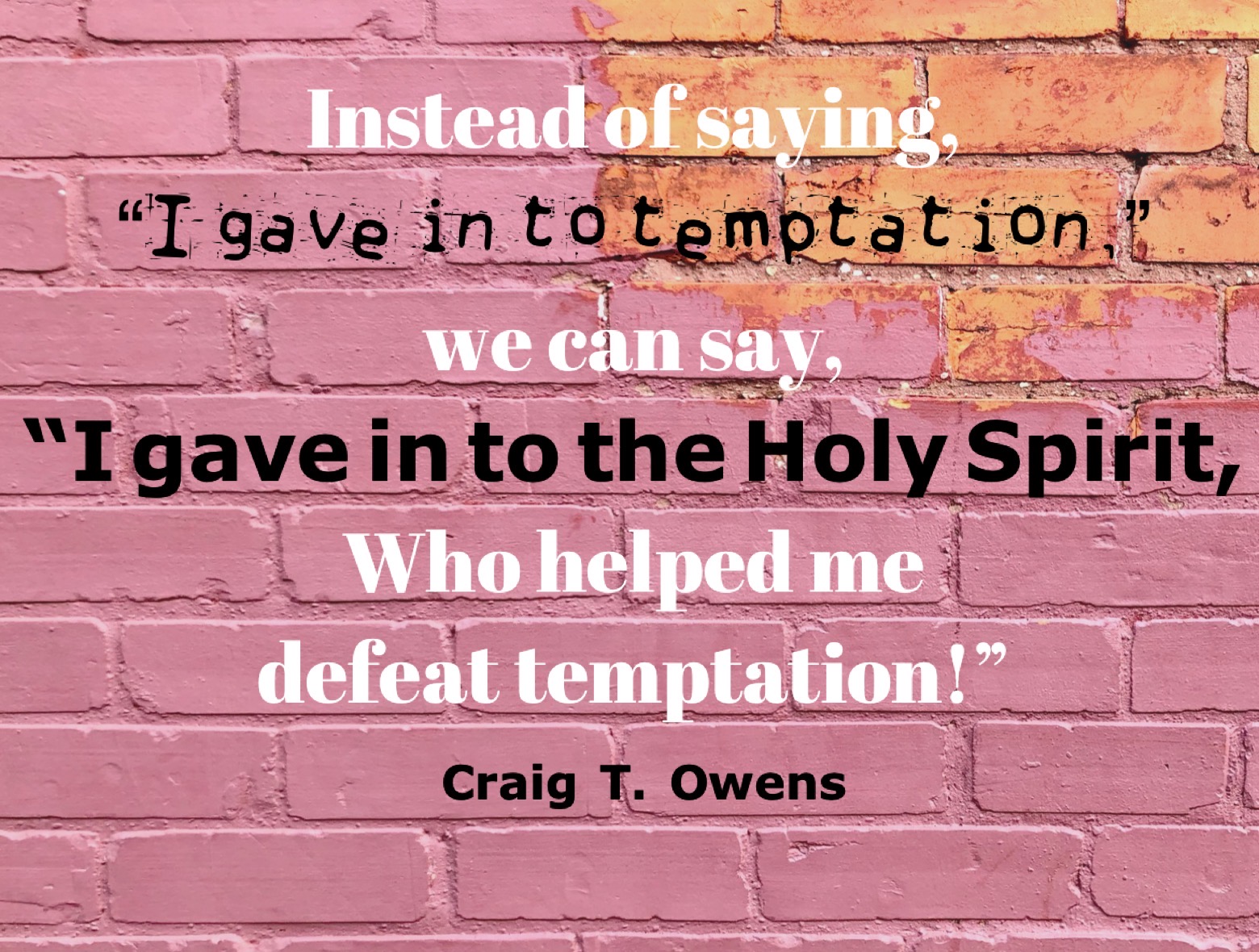
We can do the same thing. Instead of saying, “I gave in to temptation,” we can say, “I gave in to the Holy Spirit, Who helped me defeat temptation!”

Cry Before You Confront

Listen to the podcast of this post by clicking on the player below, and you can also subscribe on AppleSpotify, or Audible.

As a pastor, one of your responsibilities is to point out what may be harmful in someone’s life. We have a word for that: confrontation.

Handled correctly, confrontation can lead to restoration and newfound maturity. Handled incorrectly, and, well, let’s just say it can get very ugly!

I just heard the story of a pastor who felt like he needed to confront one of his board members. I don’t really know this pastor, nor do I know the board member; I don’t know what was said in their meeting, but I have heard about the outcome, and it got ugly.

Samuel was going to be sent by God to confront King Saul about the sin he had committed. Look at this passage:

Then the word of the Lord came to Samuel: “I am grieved that I have made Saul king, because he has turned away from Me and has not carried out My instructions.” Samuel was troubled, and he cried out to the Lord all that night. (1 Samuel 15:10-11)

Did you catch how Samuel responded? He cried out to the Lord all that night.

Perhaps if we, as pastors, cried before we confronted the results might be more healthy.

“Tears shed for self are tears of weakness, but tears shed for others are a sign of strength.” —Billy Graham

Nehemiah was another pastoral/prophetic figure that was going to confront the inhabitants of Jerusalem about their sin.

When I heard these things, I sat down and wept. For some days I mourned and fasted and prayed before the God of heaven. Then I said: …I confess the sins we Israelites, including myself and my father’s house, have committed against You. (Nehemiah 1:4-6)

Before Nehemiah confronted the sins of the people, he tearfully took a hard look at himself, and then asked for forgiveness. Jesus shared this same concept with these words:

Why do you look at the speck of sawdust in your brother’s eye and pay no attention to the plank in your own eye? How can you say to your brother, “Let me take the speck out of your eye,” when all the time there is a plank in your own eye? You hypocrite, first take the plank out of your own eye, and then you will see clearly to remove the speck from your brother’s eye. (Matthew 7:3-5)

So before you confront your brother or sister, let the Holy Spirit confront you. Then, if it’s needed, confess your sin and ask God’s forgiveness. Let the Holy Spirit remove things in your life so that you can see clearly how to lovingly confront your brother.

Cry before you confront. Cry over your sin. Cry over the sinful state of your brother or sister. Plead with the Lord for this time of confrontation to lead to restoration and maturity.

►► Would you please prayerfully consider supporting this ministry? My Patreon supporters get behind-the-scenes access to exclusive materials. ◀︎◀︎

Who Are You?

This is another post especially for pastors (but I think others will find this helpful too).

John the Baptizer had no credentials, and yet people flocked to hear him speak.

He had no formal training, and yet people hung on his every word.

He had no authority from a sanctioning body, and yet he spoke with such power.

This perplexed the religious leadership. After all, they had credentials, training, and authority. So they came to John asking, “Who are you? What do you have to say about yourself?” (John 1:21-22).

If God has called you to the pastorate, He will equip you.

There’s nothing wrong with credentials, training, or sanctioning, per se. But when you think your call to preach has authority because of your title, your training, or your denominational appointment, you have missed the point! John had none of these, and yet Jesus said, “There’s never been a greater prophetic voice!”

So, pastor, who are you?

Are you the one who is credentialed, or trained, or sanctioned?

Or are you the one who has been called and equipped by God?

There’s a huge difference!

Who are you? I hope you can answer, “I am only a servant of the Most High, equipped by the Holy Spirit to make Jesus known in my city.”

UPDATE: I use John the Baptist as a prominent example in my book Shepherd Leadership: The Metrics That Really Matter.

Preparing The Preacher

A friend of mine was preparing to preach his first sermon at a new church, and he was (as anyone might understand) nervous. He had all sorts of concerns: Is this the right word for this congregation? Will my thoughts make sense to them? Have I prepared enough for this message?

It was that last question that jogged my memory of a quote I had read from Oswald Chambers in his book Approved Unto God. The title of that book comes from a passage a Scripture in which preachers are told to correctly handle the Word of God as a worker that is approved unto God (2 Timothy 2:15).

Check out this pearl of wisdom:

“Keep yourself full to the brim in reading; but remember that the first great Resource is the Holy Spirit Who lays at your disposal the Word of God. The thing to prepare is not the sermon, but the preacher.” —Oswald Chambers (my emphasis)

God doesn’t need His Word prepared—it’s already perfect. But He does need to prepare me to deliver the message. He needs to remove my opinions, my preconceived ideas, my hang-ups with that particular passage, my hesitation to share it.

The Holy Spirit of God needs to prepare me. And I need to let Him do it.

It’s a heavy, awesome responsibility to be “the one” sharing God’s Word to a group of precious people. I dare not even attempt it unless I have let the Spirit prepare me first.

God Wants Deeper Growth

“After a soul has been converted by God, that soul is nurtured and caressed by the Spirit. Like a loving mother, God cares for and comforts the infant soul by feeding it spiritual milk. Such souls will find great delight in this stage. They will begin praying with great urgency and perseverance; they will engage in all kinds of religious activities because of the joy they experience in them. But there will come a time when God will bid them to grow deeper. He will remove the previous consolation from the soul in order to teach it virtue and prevent it from developing vice.” —John of the Cross

I-Have-To-Have-It Attitude

In our Live Dead series, we have been talking about different areas we need to allow to die, so that we might truly live for Christ as His disciples.

One of the things that often gets in the way of our pursuit of Christ is our cravings. This word—which the dictionary defines as a longing or an eager desire—has an interesting origin. The root word in both Latin and Old English means to lay claim to or to demand by right.

In other words, a craving is when something that was originally a want has now become a need in my mind. So I lay claim to it, saying that it’s something that is owed to me.

The Apostle Paul talks about cravings that we all had before we came to know Christ as Savior when he wrote, “All of us also lived among them at one time, gratifying the cravings of our sinful nature and following its desires and thoughts” (Ephesians 2:3).

This same Greek word shows up in Christ’s parable of the sower when He talks about the seed that falls among the weeds. These people, He explains, allow the worries of this life, the deceitfulness of wealth and the desires for other things come in and choke the Word (Mark 4:19).

Gratifying my cravings = Choking out the life of Christ in me

The problem is that this craving or desire for things other than Christ is often an unconscious habit. We have allowed them to become cravings—laying our claim to them as needs—without even realizing it.

The antidote: fasting. When we give up something, the Holy Spirit can show us if that thing has created an I-Have-To-Have-It attitude in our hearts. This spiritual discipline is hard because our bodies will rebel against having to give up “a right.” But when we press through with this discipline of fasting, God describes the results:

Then your light will break forth like the dawn, and your healing will quickly appear; then your righteousness will go before you, and the glory of the LORD will be your rear guard. Then you will call, and the LORD will answer; you will cry for help, and He will say: Here am I. (Isaiah 58:8-9)

That’s how I want to live! So I must live dead to my cravings. I can only do this when I allow a time of fasting to open my heart to hear the Holy Spirit point out all my I-Have-To-Have-It attitudes.

To check out all of the messages in our Live Dead series, please click here.

Thursdays With Oswald—Desperate For The Holy Spirit

This is a weekly series with things I’m reading and pondering from Oswald Chambers. You can read the original seed thought here, or type “Thursdays With Oswald” in the search box to read more entries.

Desperate For The Holy Spirit

     We have to learn to rely on the Holy Spirit because He alone give the Word of God life. All our efforts to pump up faith in the Word of God is without quickening, without illumination. …

     If you are without the control of the Spirit of God, devotional emotion and religious excitement always end in sensuality. …

    ‘Be filled with the Spirit’; it is as impossible to be filled with the Spirit and be free from emotion as it is for a man to be filled with wine and not show it. … Be ‘being filled with the Spirit,’ and as we walk in the light the life of God is worked out moment by moment—a life of glorious discipline and steady obedience.

From Biblical Ethics

Oh, how I need the Holy Spirit moment by moment!

Without His counsel, the Word of God doesn’t make any sense.

Without His anointing, I only speak meaningless words.

Without His discipline, my emotions are all over the place.

Without His instruction, my life is purposeless.

May I keep on being filled with You, Spirit of God!