It’s Not Me; It’s You

Listen to the podcast of this post by clicking on the player below, and you can also subscribe on AppleSpotify, or Audible. 

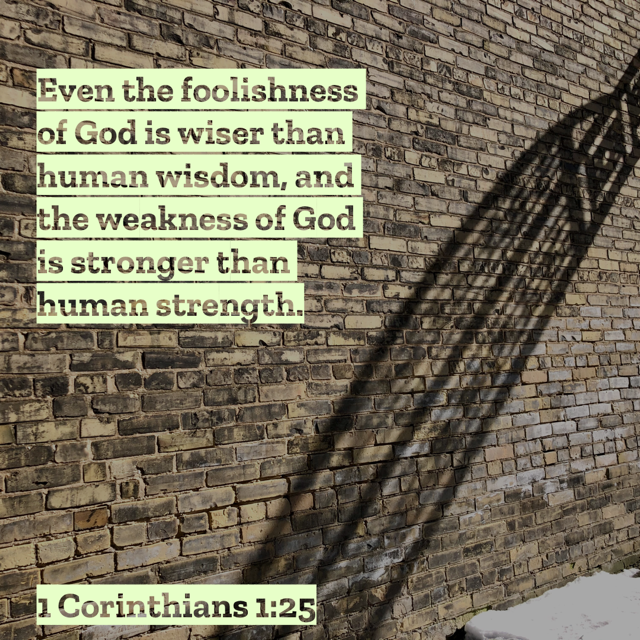
When I first came to you, dear brothers and sisters, I didn’t use lofty words and impressive wisdom to tell you God’s secret plan. For I decided that while I was with you I would forget everything except Jesus Christ, the One Who was crucified. I came to you in weakness—timid and trembling. And my message and my preaching were very plain. Rather than using clever and persuasive speeches, I relied only on the power of the Holy Spirit. I did this so you would trust not in human wisdom but in the power of God. (1 Corinthians 2:1-5)

I only want Jesus lifted up; not me.

As Your Spirit gives me words to share, may people turn to You; not me.

May anyone who hears me desire more of You; not me.

May my messages create a hunger and thirst for You; not me.

I want people to find encouragement in You; not me.

May I find my strength to minister in You; not in me.

May people only follow You; not me.

May everyone who hears me be impressed with You; not me.

It’s all about You, Jesus; not me.

►► Would you please prayerfully consider supporting this ministry? My Patreon supporters get behind-the-scenes access to exclusive materials. ◀︎◀︎

Getting Out Of The Hole

Yesterday in part two of our Immersed series, we looked at how helpless we are in trying to break free from sin’s pull on our lives. That is, we are helpless to help ourselves.

But with the Holy Spirit’s help, we go from helpless to hopeful!

In Romans 8, there are all of these contrasting statements about the sinful life versus the Spirit-led life. Our hope to move into the Spirit-led life turns on this phrase in verse 15: but by the Spirit. It is only by God’s Spirit that we can break free. To help illustrate this point, I read a rather long passage from C.S. Lewis’ Mere Christianity. Several people have asked to see this, so here it is—

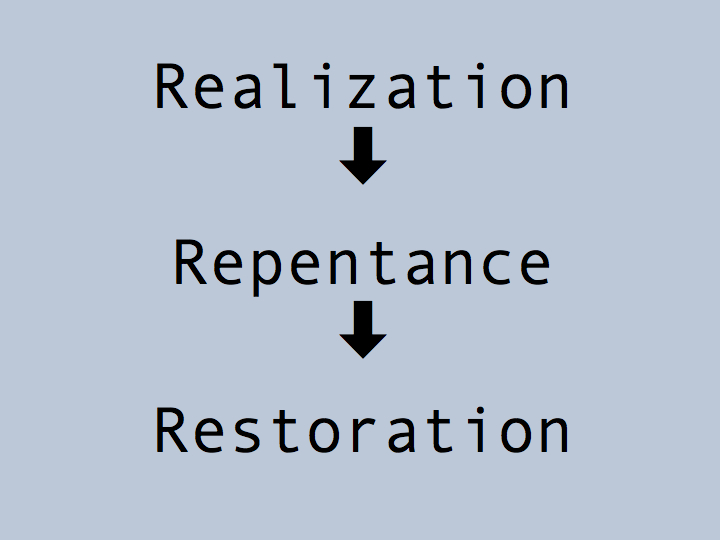
“Now what was the sort of ‘hole’ man had got himself into? He had tried to set up on his own, to behave as if he belonged to himself. In other words, fallen man is not simply an imperfect creature who need improvement: he is a rebel who must lay down his arms. Laying down your arms, surrendering, saying you are sorry, realizing that you have been on the wrong track and getting ready to start life over again from the ground floor—that is the only way out of a ‘hole.’ This process of surrender—this movement full speed astern—is what Christians call repentance. Now repentance is no fun at all. It is something much harder than merely eating humble pie. It mean unlearning all the self-conceit and self-will that we have been training ourselves into for thousands of years. It means killing a part of yourself, undergoing a kind of death. In fact, it needs a good man to repent. And here comes the catch. Only a bad needs to repent: only a good man can repent perfectly. The worse you are the more you need it and the less you can do it. The only person who could do it perfectly would be a perfect person—and he would not need it.

“Remember, this repentance, this willing submission to humiliation and a kind of death, is not something God demands of you before He will take you back and which He could let you off is He chose: it is simply a description of what going back to Him is like. If you ask God to take you back without it, you are really asking Him to let you go back without going back. It cannot happen. Very well, then, we must go through with it. But the same badness which makes us need it, makes us unable to do it. Can we do it if God helps us? Yes, but what do we mean when we talk of God helping us? We mean God putting into us a bit of Himself.

When we invite Christ into our lives, He places “a bit of Himself” in us: the Holy Spirit. That enables us to be perfectly forgiven.

But then when we allow the Holy Spirit to immerse us in Himself, it’s not just “a bit of Himself” we get, but all of Him. This opens the door to deeper intimacy, greater closeness, and a more God-glorifying life!

I want to live immersed!

If you’ve missed any of the messages in the Immersed series, you can find them all here.

Thursdays With Oswald—My Spiritual Personality

This is a weekly series with things I’m reading and pondering from Oswald Chambers. You can read the original seed thought here, or type “Thursdays With Oswald” in the search box to read more entries.

Spiritual Personality

     When we receive the Holy Spirit, He so energizes our spirit that we are able to detect things that are wrong, and we are able to rectify them if we ‘mind’ the Holy Spirit. This is the Scotch use of the term ‘mind,’ and it means ‘remember to obey.’ It carries with it the meaning of another Scotch word, ‘lippen,’ that is, ‘trust.’ Mind the Holy Spirit, mind His light, mind His convictions, mind His guidance, and slowly and surely the sensual personality will be turned into a spiritual personality. 

From Biblical Psychology

It’s not too often that I think of personality in a spiritual light. But God created me as a unique person, complete with my own personality. He gave me the personality He did on purpose: to glorify Him.

Left to myself, my personality is highly self-serving. But when I “mind” the Holy Spirit, He helps me live out my God-given personality in a way that is more and more God-serving and God-glorifying.

I love Chambers’ list:

  • Mind the Holy Spirit
  • Mind His light [illumination]
  • Mind His convictions
  • Mind His guidance

I’m working on “minding” better. How about you?

If I Only Would Have Thought That Through…

These words are usually said after we have messed up something. We look back and say, “What was I thinking?!”

The truth is: you were thinking, it was just wrong thinking.

The Apostle Paul writes this:

Clothe yourselves with the Lord Jesus Christ, and do not think about how to gratify the desires of the sinful nature. (Romans 13:14)

The King James Version, instead of do not think, says, “make no provision for the flesh.” In other words, the idea here is forethought.

We have a filter at the base of our brains called the reticular activating system (or R.A.S.). This is what lets in the important things, and keeps out the unimportant things. But here is the vital issue—

YOU CAN PROGRAM YOUR R.A.S.!

You tell your RAS what’s important and what’s unimportant. Paul says that if we use our forethought to consciously decide to clothe ourselves with Christ, we are programming our RAS to spot the things that glorify Him and ignore the things that gratify our fleshly desires.

A phrase that I use often (hat tip to Dr. Richard Dobbins) is: I need to think about what I’m thinking about.

By doing this, I’m able to see how I’ve programmed my RAS. It’s either programmed to look for God-honoring things or flesh-gratifying things.

Try it for yourself. Make the conscious decision to read the Bible every day. Then in your prayer time, ask the Holy Spirit to help you think about God-honoring things. If you will do this, you will notice that you are noticing more things that please God, and that you are ignoring more things that please your sinful nature.

The Hard Word

As a pastor, you are going to have to deliver the hard word from time to time. You will have to address touchy subjects, both corporately and privately. It is very instructive to see how the apostle Paul approached the hard word.

In Romans 9, Paul is getting ready to address one of the most sensitive subjects of his day. The Jews felt they were “in” with God just because they were Jews, and the Gentiles were “out” with God just because they weren’t Jews. Paul is going to have to deliver the word that both Jews and Gentiles can be accepted by God because of what Jesus did on the Cross.

So notice how he begins:

I speak the truth in Christ—I am not lying, my conscience confirms it in the Holy Spirit—I have great sorrow and unceasing anguish in my heart.

1. I speak the truth in Christ. It wasn’t his opinion, but the word from God. I must settle this matter before delivering the hard word. Far too often we can put our preferences on par with God’s Word. I cannot do this!

2. My conscience confirms it in the Holy Spirit. Before I speak a hard word that people may not like to hear, I need to make sure my conscience is right before the Holy Spirit. He alone confirms His Word. The reaction of the audience, however, may or may not confirm what God says.

3. I have great sorrow and unceasing anguish in my heart. It should be a major red flag if I looked forward to delivering a painful/challenging/correcting word. I need to put myself in their place, not try to put someone else in their place!

My job as a pastor is not to condemn, nor even to convict; the Holy Spirit will do that. My job is to (a) hear God’s truth, (b) get my conscience right with the Spirit, and (c) empathize with people as I lovingly speak the truth to them.

Immersed

What happens when we truly let the Holy Spirit have His way in our lives?

Could we experience today the things that are recorded in the Book of Acts?

Is it possible that God wants to do so much more through our lives than we are allowing Him to do now?

That last question, I believe is the most important one. One of the apostle Paul’s prayers went like this:

And I pray that you, being rooted and established in love, may have power, together with all the saints, to grasp how wide and long and high and deep is the love of Christ, and to know this love that surpasses knowledge — that you may be filled to the measure of all the fullness of God. Now to Him who is able to do immeasurably more than all we ask or imagine, according to His power that is at work within us, to Him be glory in the church and in Christ Jesus throughout all generations, for ever and ever! Amen. (Ephesians 3:17-21)

This is an expansive prayer … a mind-blowing prayer … a prayer that is asking God to go beyond our ability to contain all that He has for us.

The only way we can get to this place (and I want all of us to get to this place) is if we let go. In other words, if we will let the Holy Spirit totally immerse us in His presence, if we will not try to box Him up, or shut Him out of any area of our lives.

We’ll be learning more about Immersed this Sunday at Calvary Assembly of God. If you’ve missed any of the messages in this series, you can check them out here:

A Warning To Shepherds

If you are a pastor, God sees you as a shepherd (see John 21:15-17; 1 Peter 5:1-4).

If you are a shepherd, there is a heavy responsibility on you to lovingly, attentively care for God’s precious sheep. We cannot shirk this responsibility for even a moment.

God loves His sheep so much that He gave His sheep YOU!

God loves His sheep so much that He will remove you, if He has to.

Consider this:

“What sorrow awaits the leaders of My people—the shepherds of My sheep—for they have destroyed and scattered the very ones they were expected to care for,” says the Lord. Therefore, this is what the Lord, the God of Israel, says to these shepherds: “Instead of caring for My flock and leading them to safety, you have deserted them and driven them to destruction. Now I will pour out judgment on you for the evil you have done to them. …Then I will appoint responsible shepherds who will care for them, and they will never be afraid again. Not a single one will be lost or missing. I, the Lord have spoken!” (Jeremiah 23:1, 2, 4)

This is a HEAVY word, and should not be taken lightly.

Pastor, never assume you are leading God’s sheep in the right paths. Ask the Holy Spirit to tell you if you are leading God’s sheep in the right paths!

UPDATE: This post was one of the seed thoughts that went into fashioning my book Shepherd Leadership: The Metrics That Really Matter.

Thursdays With Oswald—Me, Me, Me

This is a weekly series with things I’m reading and pondering from Oswald Chambers. You can read the original seed thought here, or type “Thursdays With Oswald” in the search box to read more entries.

Me, Me, Me

     The greatest peril is the peril within, which men never think of as a peril. My right to myself, self-pity, self-conceit, consideration for my progress, my ways of looking at things, those things are the satanic perils which will keep us in perfect sympathy with satan…. 

     In all probability satan is as much upset as the Holy Spirit is when men fall in external sin, but for a different reason. When men go into external sin and upset their lives, satan knows perfectly well that they will want another Ruler, a Savior and Deliverer; as long as satan can keep men in peace and unity and harmony apart from God, he will do so (see Luke 11:21-22). Remember, then, satan’s sin is dethroning God. 

From Biblical Psychology

My natural bent is to internalize. In other words, I want to ponder my circumstances, think about solutions myself, and reach my own conclusion. This, Oswald Chambers says, is dangerous.

When I’m thinking subjectively, everything runs through the filter of me, me, me. But when I verbalize—when I get my thoughts out in the open—the Holy Spirit can use God’s Word to help me think objectively.

I need an objective, external standard to keep me on the right path. If I keep it all inside, my natural subjective bent (that all of us humans have) will lead me down the path of quietly dethroning God and enthroning myself.

God Is For You!

I cross paths with far too many people who think God is unapproachable, distant, or—perhaps worst of all—angry with them.

But listen to this good news: God is for you! 

God created you to be in relationship with Him.

When Paul writes in Romans 8:31, “If God is for us, who can be against us,” it’s not a wondering, uncertain “if” (as in, “I wonder if this is true?”). No! What Paul is saying is, “If you already know that God is for you, why are you wondering about who or what is against you?”

Here are the facts (all from Romans 8):

  • The Holy Spirit is interceding for you (vv. 26, 27)
  • God is working out all things for your good (v. 28)
  • God justifies you (vv. 30, 33)
  • God will give you everything He gave Jesus (v. 32)
  • Jesus is interceding for you (v. 34)
  • Nothing and no one can ever separate you from God’s love (vv. 35-39)

Let me state it again—

God is for you!

Nothing can stand between you and God!

Forgotten God (book review)

I grew up in a Pentecostal family (in fact, I’m a third-generation Pentecostal), so talk about the Holy Spirit was almost second nature to me. But even with my background, sometimes it’s easier to have discussions about God the Father or God the Son, than it is God the Spirit. The Holy Spirit has, in many circles, become the “forgotten God.” That’s why Forgotten God: Reversing Our Tragic Neglect of the Holy Spirit by Francis Chan is such a timely book.

“If I were satan and my ultimate goal was to thwart God’s kingdom and purposes, one of my main strategies would be to get churchgoers to ignore the Holy Spirit.” (Francis Chan)

I think part of our forgetfulness is that it’s hard to know where to put the Holy Spirit cognitively. We can understand the concepts of the Father and the Son, but it’s hard to have a mental “place” for the Spirit. And since we can find places for the Father and the Son, we can keep them in their places. But the Holy Spirit doesn’t have a “box,” and so we cannot contain Him.

Nor should we try. But, sadly, far too many people do. Again, Francis Chan writes:

“The reality is that the early church knew less about the Holy Spirit than most of us in the church today, at least in the intellectual sense. But they came to know the Spirit intimately and powerfully as He worked in and through their lives. All throughout the New Testament, we read of the apostles whose lives were led by the Spirit and lived out by His power.”

When I read what happened in the Book of Acts, my cry is always, “Do it again! Do it today!” I believe the Holy Spirit is also desirous of operating in us and through us, just as He did in the First Century Church. The question is: Will we let Him?

Forgotten God is a great introduction course for those curious about Who the Holy Spirit is, or what His role is in our lives today. This book is also a great reminder course for those of us who have grown up with the theology, but perhaps are lacking the full operational force of the Spirit in our lives. In either case, Forgotten God is an eye-opening book.