Thursdays With Spurgeon—An Assured Eternity

This is a weekly series with things I’m reading and pondering from Charles Spurgeon. You can read the original seed thought here, or type “Thursdays With Spurgeon” in the search box to read more entries.

Listen to the podcast of this post by clicking on the player below, and you can also subscribe on iTunes or Spotify.

An Assured Eternity 

     The life of God in the soul is not transient but abiding. Not temporary but eternal. Some think that the life of God in the believer’s soul may die out. But how then could it be eternal? If it dies, it is not eternal life. If it is eternal life, it cannot die. … We are said to have been made ‘partakers of the divine nature’ (2 Peter 1:4). Surely this means, among other things, that we receive an undying life. …  

     If our life is Christ’s life, we will not die until Christ dies. … 

     This is John’s desire for you: that you would believe with all your heart and soul and strength. He would have you believe more constantly, so that you may say, ‘My heart is steadfast, O God, my heart is steadfast; I will sing and give praise’ (Psalm 57:7). It is not always so with us. We are at times chicken-hearted. We play the man today and the mouse tomorrow. Lord, have mercy upon us. We are an inconsistent people, fickle as the wind. The Lord would have us abide always in Him with strong and mighty confidence, being rooted and built up in Him. He would have us trust courageously.

From The Blessing Of Full Assurance 

John the Beloved wrapped up his Gospel with this statement: “But these are written that you may believe that Jesus is the Messiah, the Son of God, and that by believing you may have life in His name” (John 20:31). The word John uses for “life” is the Greek word zoe. This is how zoe is defined—

Life real and genuine, a life active and vigorous, devoted to God, blessed, in the portion even in this world of those who put their trust in Christ, but after the resurrection to be consummated by new accessions…and to last for ever. (Strong’s Greek dictionary) 

Do you believe Jesus died and rose again? Based on that faith, have you asked the Father to forgive you of your sins? If so, then listen for the voice of the Holy Spirit in your heart that is giving you full assurance of promises like these: 

  • Everyone who believes may have eternal life in [Jesus] (John 3:15) 
  • Whoever believes in [Jesus] shall not perish but have eternal life (John 3:16) 
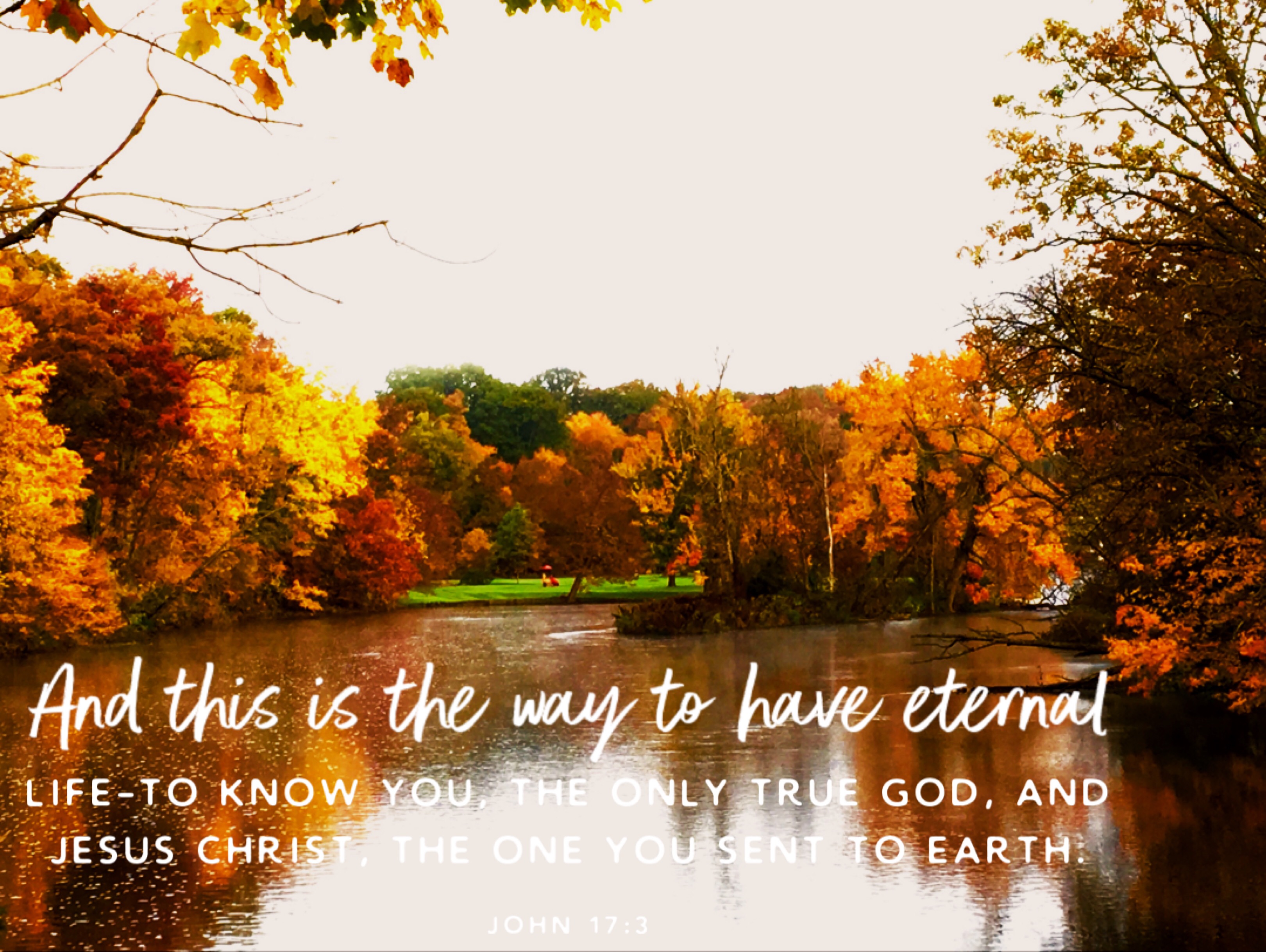
  • Now this is eternal life: that they know You, the only true God, and Jesus Christ, whom You have sent (John 17:3) 
  • Whoever believes in the Son has eternal life (John 3:36) 
  • Whoever drinks the water I give them will never thirst. Indeed, the water I give them will become in them a spring of water welling up to eternal life (John 4:14) 
  • Because I live, you also will live (John 14:9) 
  • Whoever hears My word and believes Him who sent Me has eternal life and will not be judged but has crossed over from death to life (John 5:24) 
  • My Father’s will is that everyone who looks to the Son and believes in Him shall have eternal life, and I will raise them up at the last day (John 6:40) 
  • When Christ, who is your life, appears, then you also will appear with Him in glory (Colossians 3:4) 
  • Resting in the hope of eternal life, life which the ever truthful God Who cannot deceive promised before the world or the ages of time began (Titus 1:2) 
  • I write these things to you who believe in the name of the Son of God so that you may know that you have eternal life (1 John 5:13) 

[Check out all of these verses by clicking here.]

Friend, this is why it’s so important for us to regularly read the Bible. We need to have our faith bolstered by hearing these rock-solid, unchanging, eternal words of God so that we can live each day in full assurance of our salvation and eternal life.

►► Would you please prayerfully consider supporting this ministry? ◀︎◀︎
Reversing Entropy

Listen to the podcast of this post by clicking on the player below, and you can also subscribe on Apple or Spotify.

Don’t you wish that you could clean things up and they would stay clean? After you get everything set the way you like it, why can’t it just stay that way? Quite simply, things can’t stay clean and pristine because of the Law of Entropy. Entropy is the measure of disorder in a system, and the Law of Entropy says that unless sufficient energy is applied, an ordered system will always move toward disorder. This is as true spiritually as it is in physics. 

God created a perfectly ordered system both physically and spiritually, but man’s sin brought in disorder, disease, and decay. It gets so bad that just three chapters after man’s first sin we read, “The Lord saw how great the wickedness of the human race had become on the earth, and that every inclination of the thoughts of the human heart was only evil all the time” (Genesis 6:5).  

Throughout history, there have been revivals, reformations, and awakenings where people see the disorder and decay that sin has brought to their lives and they want to return to God. The pain of entropy causes people to repent, and the Spirit of God moves in with sufficient energy to restore. Sadly, unless the Holy Spirit’s energy is continually applied, entropy will again begin to run its downward course. 

Jesus not only came to reverse the entropy of sin (see Isaiah 9:2, 49:9; John 1:5, 8:12), but He sent us out into a sinful world to do the same thing. Jesus told us that we are salt that reverses entropy’s decay and we are light that reverses entropy’s darkness (Matthew 5:13-14). Jesus also told us that there’s no way we can maintain this entropy-reversing energy on our own—we need the Holy Spirit’s empowerment (Luke 24:49; Acts 1:8). [Check out all of these verses by clicking here.] 

Paul talked about this same idea in 2 Corinthians 3. He contrasts the ministry of the Old Testament with its fading glory, and the ministry of the New Testament with terms like more glorious, surpassing glory, and ever-increasing glory. 

Do you realize that Spirit-filled Christians never have to long for “the good ol’ days”? Being baptized in the Holy Spirit means, as Paul reminds us, that we are perpetually being transformed into the image of Jesus and we are therefore reflecting more and more of His glory. Every day can be more glorious than the day before. We don’t have to experience any entropy in our spiritual walk. 

This isn’t because of our actions. Paul says, “not that we are competent in ourselves…but our competence comes from God. … [We] are being transformed into His likeness with ever-increasing glory, which comes from the Lord, who is the Spirit.” 

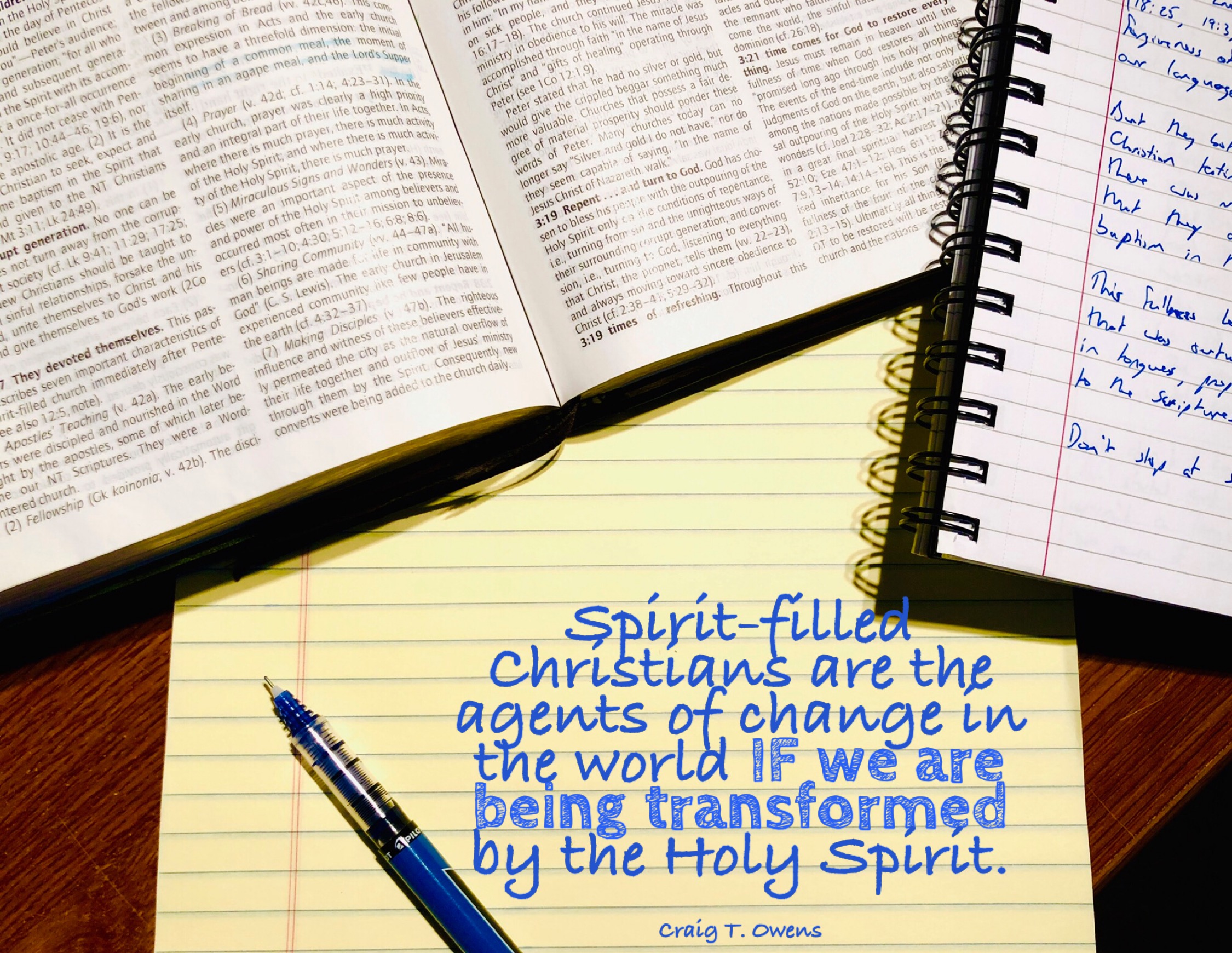
Spirit-filled Christians are the agents of change in the world IF we are being transformed by the Holy Spirit. In other words, we will tend toward entropy (and uselessness) unless we have the Spirit’s energy continually applied to our lives. 

Being transformed is an ongoing, continual process. We have to have the energy of the Holy Spirit continually at work on us personally to keep us from entropy. And then we’ll be able to reflect that entropy-defeating light to a dark world. 

I’ve said this before, but I’m going to keep on saying it: Don’t stop at salvation—be baptized in the Holy Spirit. Don’t let entropy decay your salt or dim your light. Let the Holy Spirit help you reflect the light Jesus so that you can reverse the entropy of a dark, sinful world. 

If you’ve missed any of the other posts in our series called We Are: Pentecostal, you can access the full list by clicking here.

►► Would you please prayerfully consider supporting this ministry? ◀︎◀︎
Thursdays With Spurgeon—Three Pieces Of Evidence

This is a weekly series with things I’m reading and pondering from Charles Spurgeon. You can read the original seed thought here, or type “Thursdays With Spurgeon” in the search box to read more entries.

Listen to the podcast of this post by clicking on the player below, and you can also subscribe on iTunes or Spotify.

Three Pieces Of Evidence

     Many who believe in the name of Jesus are not sure that they have eternal life. They only hope so. … I speak affectionately to the weaker ones who cannot yet say that they know they have believed. I speak not to your condemnation but your consolation. Full assurance is not essential to salvation, but it is essential to satisfaction. May you get it at once. At any rate may you never be satisfied to live without it. You may have full assurance. …  

     Do you love God? Do you love His only begotten Son? You can answer those two questions surely. … If I love Him, I know it is because He first loved me [1 John 4:19]. Love to God in us is always the work of God’s love toward us. … Love to Jesus is an effect that proves the existence of its cause. …

     John goes on to give another evidence: ‘By this we know that we love the children of God, when we love God and keep His commandments’ (1 John 5:2). … The Holy Spirit tells us that if we love the brethren, we have passed from death to life. You can tell whether you love the brethren, as such, for their Master’s sake and for the truth’s sake that is in them. And if you can truly say that you thus love them, then you may know that you have eternal life [1 John 3:14]. … 

     Our apostle gives us this further evidence: ‘This is the love of God, that we keep His commandments. And His commandments are not burdensome’ (1 John 5:3). Obedience is the grand test of love. … Do you feel that you love the ways of God, that you desire holiness and follow after it joyfully? Then, dear friends, you have eternal life and these are the sure evidences of it. Obedience, holiness, delight in God, never came into a human heart except from a Heavenly Hand. …

     To me the fact that the mouth of God has spoken it stands in the place of all argument, either for or against. If Jehovah says so, so it is. … If your faith stands in the wisdom of men and is based upon the cleverness of a preacher, it will fail you. But if it stands on the sure Word of the Lord, it will stand forever.

From The Blessing Of Full Assurance 

These pieces of evidence are why I stressed last week that you make reading the Bible a regular practice: God tells us that faith comes through hearing the Word of God (Romans 10:17). One of the favorite tactics of the devil is to try to get people to doubt or misapply God’s Word—he asked Adam and Eve, “Did God really say…” and then he quoted the Psalms out of context to Jesus to try to get Him to doubt (Genesis 3:1; Luke 4:10-11). 

So when doubts about your secure standing in God’s sight creep in, you can return to the Scripture to say, “I have these three pieces of evidence that make me confident of God’s favor: I love Him because He first loved me, I love others because His love is in me, and I delight to obey all that my Father has told me.” 

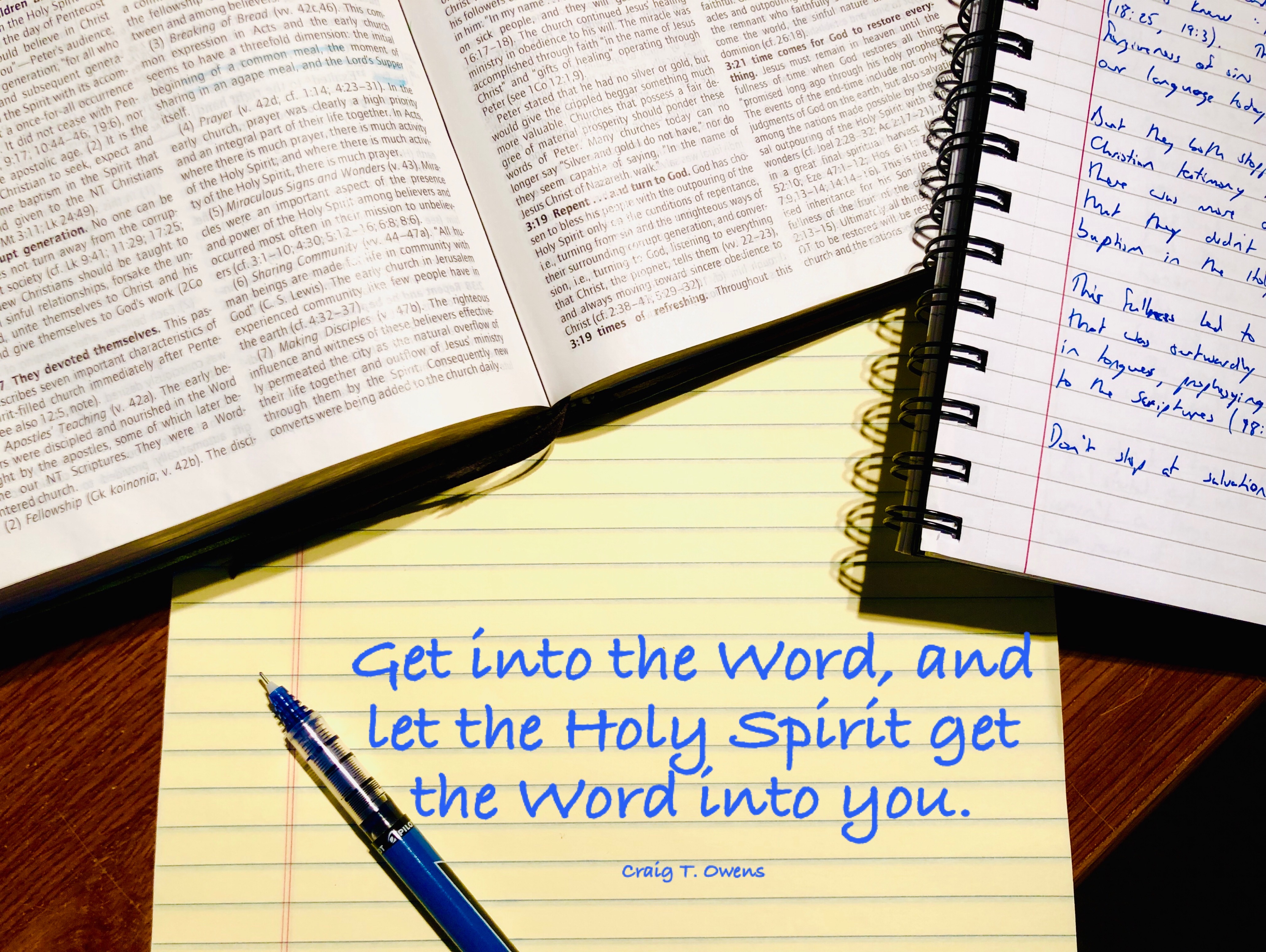
Don’t passively listen to your doubts and the devil’s lies, but actively talk back to them! Get into God’s Word and let God’s Word get into you so that you can speak the truth to every doubt.

►► Would you please prayerfully consider supporting this ministry? ◀︎◀︎
Continuous Action

A person filled with the Holy Spirit cannot help but make a difference wherever they go! Look at how Peter summed up the earthly ministry of Jesus: 

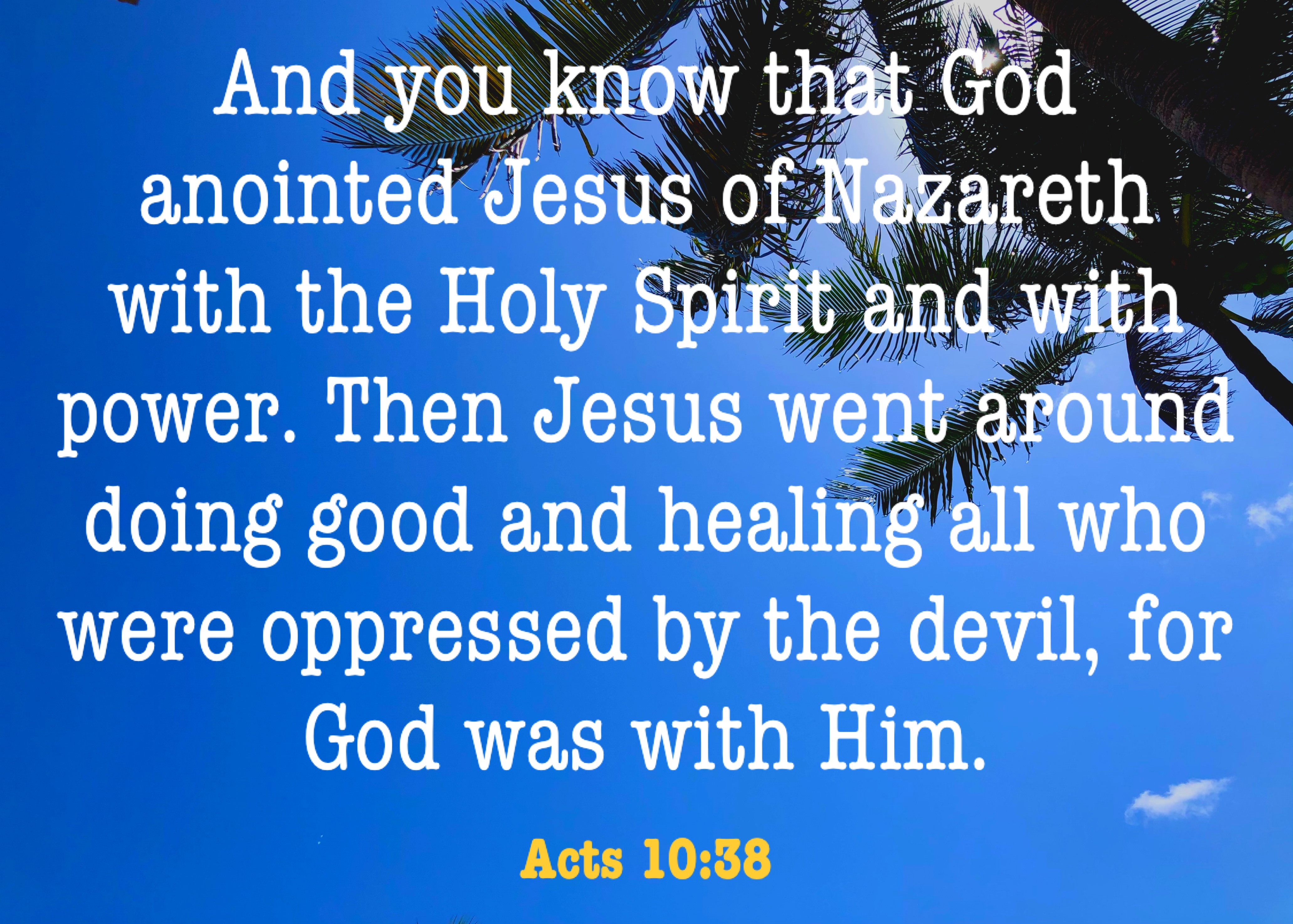
And you know that God anointed Jesus of Nazareth with the Holy Spirit and with power. Then Jesus went around doing good and healing all who were oppressed by the devil, for God was with Him. (Acts 10:38 NLT) 

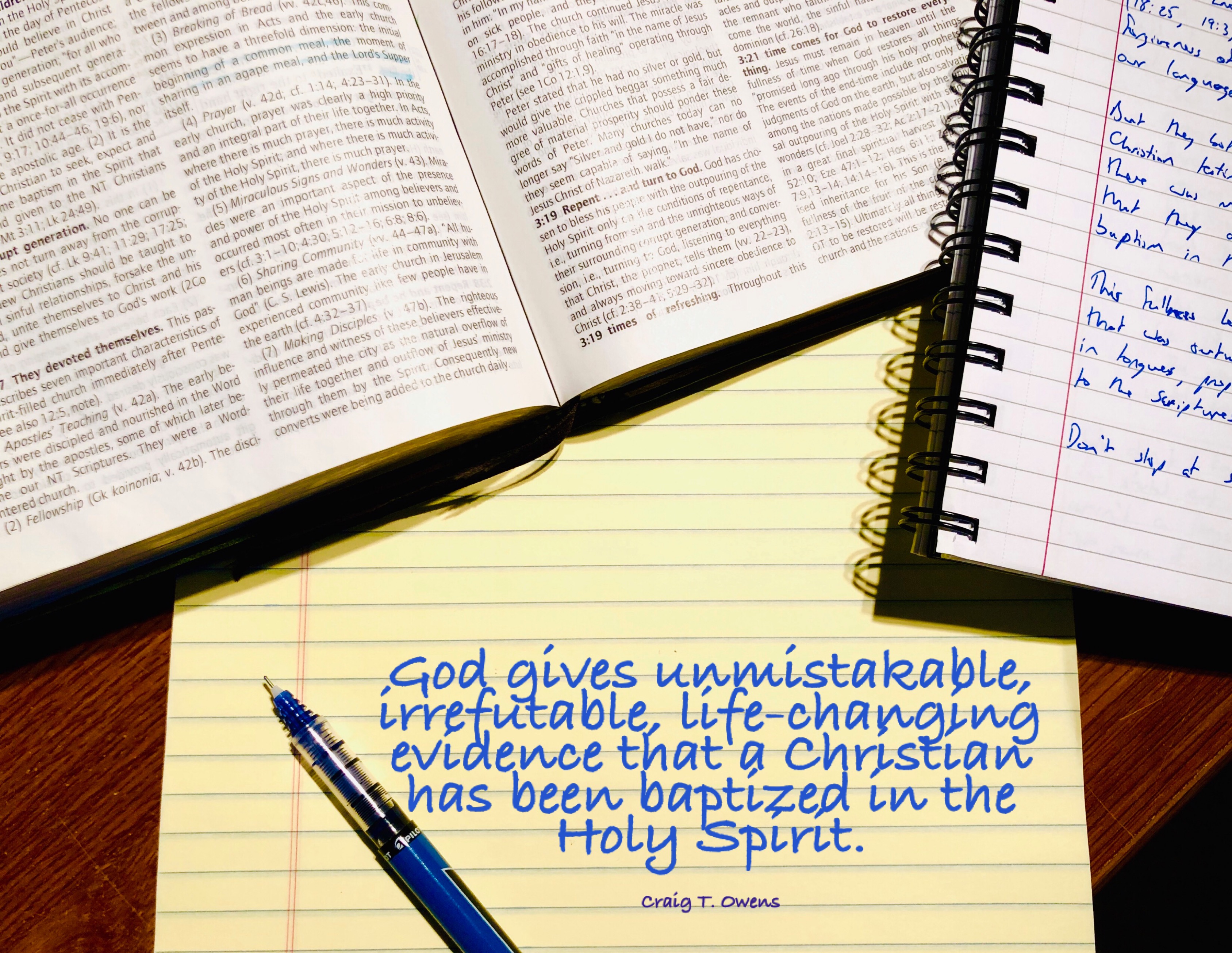
The continuous action of Jesus was doing good and healing those who were diseased in body and soul. This is supposed to be the continuous action of the followers of Jesus too. The baptism of the Holy Spirit is an empowerment for the continuous, unmistakable, irrefutable action of those anointed by Him.

Andrew Murray commented on the miraculous healings that were recorded in the Book of Acts, “This was the continuous experience of the early church. … The abundant outpouring of the Spirit produced abundant healings.” Indeed it did! Check out the continuous miraculous action that Luke records in Acts. 

The evidence of God’s Spirit in a Christian should produce continuous action that is unmistakable, undeniable, and God-glorifying.

An Unmistakable Response

Listen to the podcast of this post by clicking on the player below, and you can also subscribe on Apple or Spotify.

When something goes wrong, the response from most people is pretty predictable, isn’t it? Some try to ignore the problem, some complain about it, many get quite angry, and most people try to find someone or something to blame. 

These responses don’t sound very Christian-like, do they? What many people think the Christian response should be is something closer to the opening words of Rudyard Kipling’s poem—“If you can keep your head when all about you are losing theirs and blaming it on you….” 

And yet, though this sounds Christian-like, it still misses the mark for Spirit-baptized Christians. Remember that a couple of weeks ago I described the baptism in the Holy Spirit as a “distinctive doctrine.” There is nothing distinct about a Christian responding predictably like everyone else does. 

A Spirit-baptized Christian is distinguished by the miraculous ways God confirms His presence in that person’s life. What really honors God is not a predictable response or even a learned response, but an unpredictable, miraculous response: A Spirit-baptized Christian’s response to bad news should be peace and joy. 

I believe the Holy Spirit can so transform our hearts that our response becomes an unmistakable testimony of the power of God. We may experience the initial pang of regret and pain but our next response turns all the focus off of us and on to God.  

The Holy Spirit uses trials to transform our hearts and minds into Christlike thinking and action. 

Our Heavenly Father’s desire is for everyone to come into a close, personal relationship with Him. Before Jesus came this was first pictured for us in the operations of the temple and its sacrifices. Yet man’s attempts to control this hijacked what God intended. This is why we see Jesus acting in righteous anger to clear out the temple of merchants and money-changers (John 2:12-17; Luke 19:45-48). 

Oswald Chambers noted the similarities between what Jesus did in the physical temple and what the Holy Spirit does in our hearts: 

“Immediately the Spirit of God comes in we begin to realize what it means—everything that is not of God has to be cleaned out. People are surprised and say, ‘I asked for the Holy Spirit and expected that He would bring me joy and peace, but I have had a terrible time ever since.’ That is the sign He has come, He is turning out the ‘money-changers,’ that is, the things that make the temple into a trafficking place for self-realization.” 

The Holy Spirit has to disturb our man-made peace so that His peace can take its place. Or as Jesus said, “Do not think that I came to bring peace on earth. I did not come to bring peace but a sword” (Matthew 10:34). 

Jesus told us that the indwelling Holy Spirit would bring about this heart and mind transformation in His followers. The Holy Spirit doesn’t teach us how to respond in a learned, predictable way, but He transforms us to respond in an unmistakably unpredictable way (John 16:12-15, 20-22; 14:26-27). 

The transformed response of the Spirit-baptized Christian is joy in place of anger, and peace in place of frustration (James 1:2-4; Romans 5:3-5). I like how the Amplified Bible defines “blessed” in the Beatitudes Jesus lists in Matthew 5: “happy, to be envied, and spiritually prosperous—with life-joy and satisfaction in God’s favor and salvation, regardless of [the] outward conditions.” 

This transformation brings God glory and is exactly what Jesus prays for us (John 17:13-18), which is why I keep on saying: Don’t stop at salvation—press on to be baptized in the Holy Spirit! 

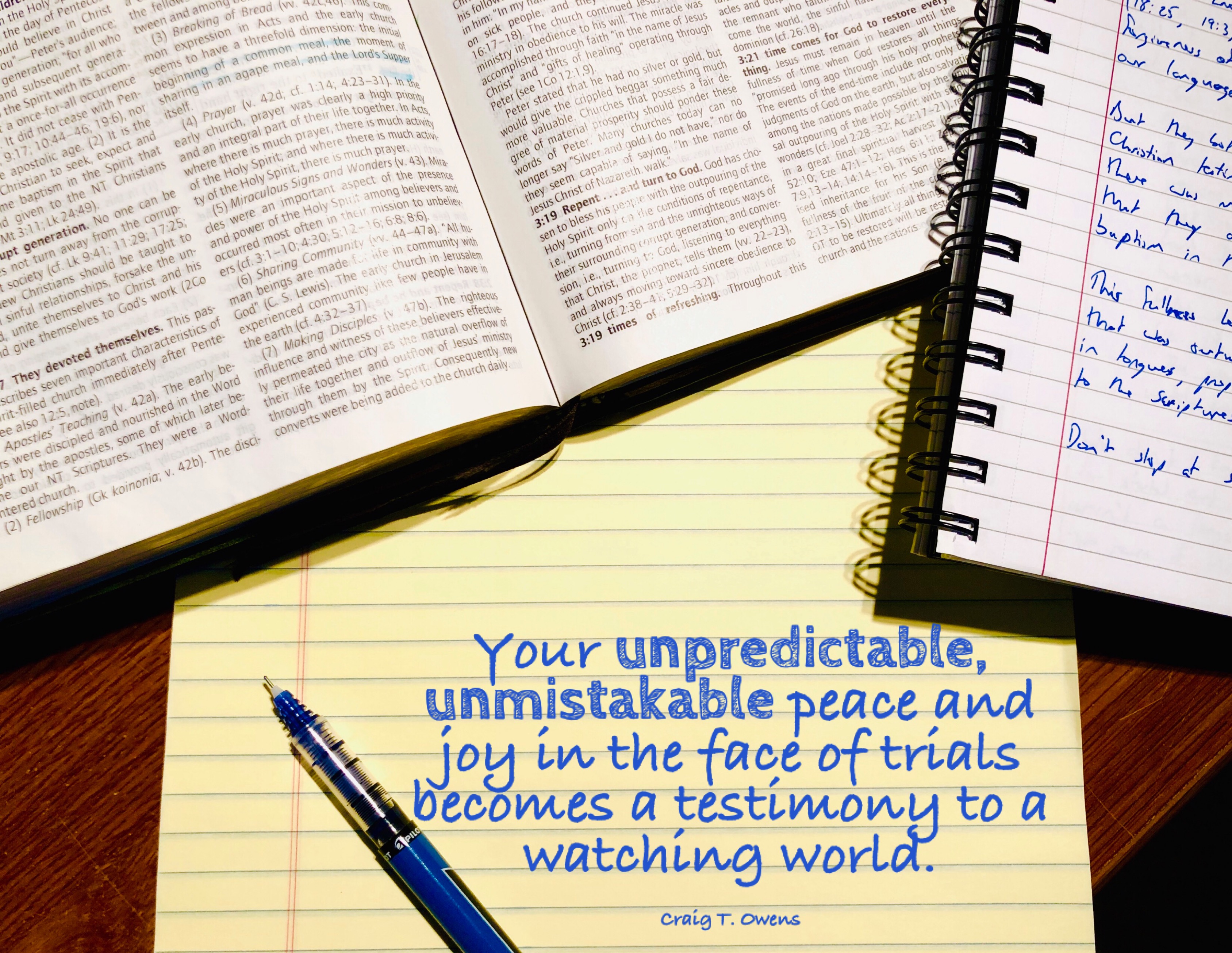
Your unpredictable, unmistakable peace and joy in the face of trials becomes a testimony to a watching world. 

If you’ve missed any of the posts in our series on the empowerment that comes from being baptized in the Holy Spirit, you can find the full list by clicking here.

►► Would you please prayerfully consider supporting this ministry? ◀︎◀︎
Thursdays With Spurgeon—Value The Scriptures

This is a weekly series with things I’m reading and pondering from Charles Spurgeon. You can read the original seed thought here, or type “Thursdays With Spurgeon” in the search box to read more entries.

Listen to the podcast of this post by clicking on the player below, and you can also subscribe on iTunes or Spotify.

Value The Scriptures

     John wrote to believers, ‘These things I have written to you who believe in the name of the Son of God’ (1 John 5:13). It is worthy of note that all the Epistles are so written. … 

     We do not wonder that certain men do not receive the Epistles, for they were not written to them. … Here is a will and you begin to read it. But you do not find it interesting. It is full of words and terms that you do not take the trouble to understand because they have no relation to yourself. But should you, in reading that will, come upon a clause in which an estate is left to you, I guarantee you that the nature of the whole document will seem changed to you.

You will be anxious now to understand the terms and to make sure of the clauses, and you will even wish to remember every word of the clause that refers to yourself. O dear friends, you may read the testament of our Lord Jesus Christ as a testament of love to yourselves, and then you will prize it beyond all the writings of the sages. … 

     But as these things are written to believers, believers ought especially to make themselves acquainted with them and to search into their meaning and intent. … Do not, I beseech you, neglect to read what the Holy Spirit has taken care to write to you. …  

     Value the Scriptures. … The saint can say, ‘Oh, how I love Your law!’ (Psalm 119:97). If we cannot say so, something is wrong with us. If we have lost our relish for Holy Scripture, we are out of condition and need to pray for spiritual health.

From The Blessing Of Full Assurance 

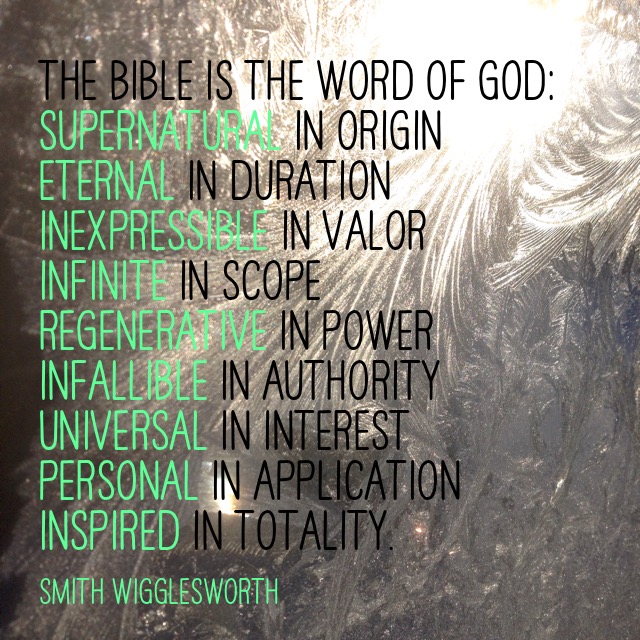
The Bible is God’s love letter to you. I love what Smith Wigglesworth said about the Word of God: 

“Never compare this Book with other books. Comparisons are dangerous. Never think or say that this Book contains the Word of God. It is the Word of God. It is supernatural in origin, eternal in duration, inexpressible in value, infinite in scope, regenerative in power, infallible in authority, universal in interest, personal in application, inspired in totality. Read it through. Write it down. Pray it in. Work it out. And then pass it on.”

I spent a whole week blogging about my favorite Book. You can check out those posts by clicking here. In the meantime, let me encourage you in the strongest possible terms: Make the time to read your Bible every single day. Doing so will totally transform your life!

►► Would you please prayerfully consider supporting this ministry? ◀︎◀︎
We Are: Pentecostal

Pentecost for over 1500 years was a celebration in Jerusalem that brought in Jews from all over the world. But on the Day of Pentecost that came just ten days after Jesus ascended back into heaven, the meaning of Pentecost was forever changed! 

Followers of Jesus—now empowered by an infilling of the Holy Spirit—began to take the good news of Jesus all over the world. These Spirit-filled Christians preached the Gospel and won converts to Christ even among hostile crowds, performed miracles and wonders, stood up to pagan priests and persecuting governmental leaders, and established a whole new way of living as Christ-followers. 

We, too, can be Pentecostal followers of Jesus Christ today. We can experience an anointing and an empowering in our lives that turns ordinary Christianity into extraordinary Christianity! 

Please join me this Sunday as we rejoin this series. You can check out what I taught in this series in 2019 by clicking here, and the topics I covered in 2020 are on this list.

Check out the messages in the 2021 series:

Confirmation Of The Baptism In The Holy Spirit

Listen to the podcast of this post by clicking on the player below, and you can also subscribe on Apple or Spotify.

The baptism in the Holy Spirit is what Pentecostal Christians frequently refer to as our distinctive doctrine. Notice I said distinctive, not better. Can someone go to heaven without being baptized in the Spirit? Yes! But I’ve found that living in this distinctive empowerment makes the journey to heaven so much more productive and joyful.   

After the resurrection of Jesus, everything took on a whole new meaning, because the “light” had been turned on in the Old Testament palace. All of the practices that Jews had been observing for thousands of years suddenly had a new illumination in the New Testament.  

Pentecost had always been a celebration 50 days following the Passover. In the Old Testament, the law was given from Sinai on the fiftieth day after the deliverance from Egypt, so in a sense, the appearance of God on Sinai was the birthday of the Jewish nation. In the New Testament, the first outpouring of the Holy Spirit on the first Pentecost after Jesus ascended to heaven was the birthday of the Christian nation for all people. 

One of our foundational truths says: “All believers are entitled to and should ardently expect and earnestly seek the promise of the Father, the baptism in the Holy Spirit and fire, according to the command of our Lord Jesus Christ. This was the normal experience of all in the early Christian Church.” 

And another foundational truth is a corollary: “The baptism of believers in the Holy Spirit is witnessed by the initial physical sign of speaking with other tongues as the Spirit of God gives them utterance.” 

God has always confirmed His presence with signs and wonders. From the signs in Egypt to convince Pharaoh that Jehovah was greater than the Egyptian gods to the ministry of Jesus. In fact, Peter said that the signs and wonders done by Jesus were God’s authentication of His ministry (see Luke 5:17-26; Acts 2:22; Acts 10:38). 

Jesus said this should characterize our ministry too (see Mark 16:15-20; Acts 1:5, 8).  

R.A. Torrey noted, “The baptism of the Holy Spirit always imparts power for service…. The baptism of the Holy Spirit is the Spirit of God falling upon the believer, taking possession of his faculties, imparting to him gifts not naturally his own, but which qualify him for the service to which God has called him.” 

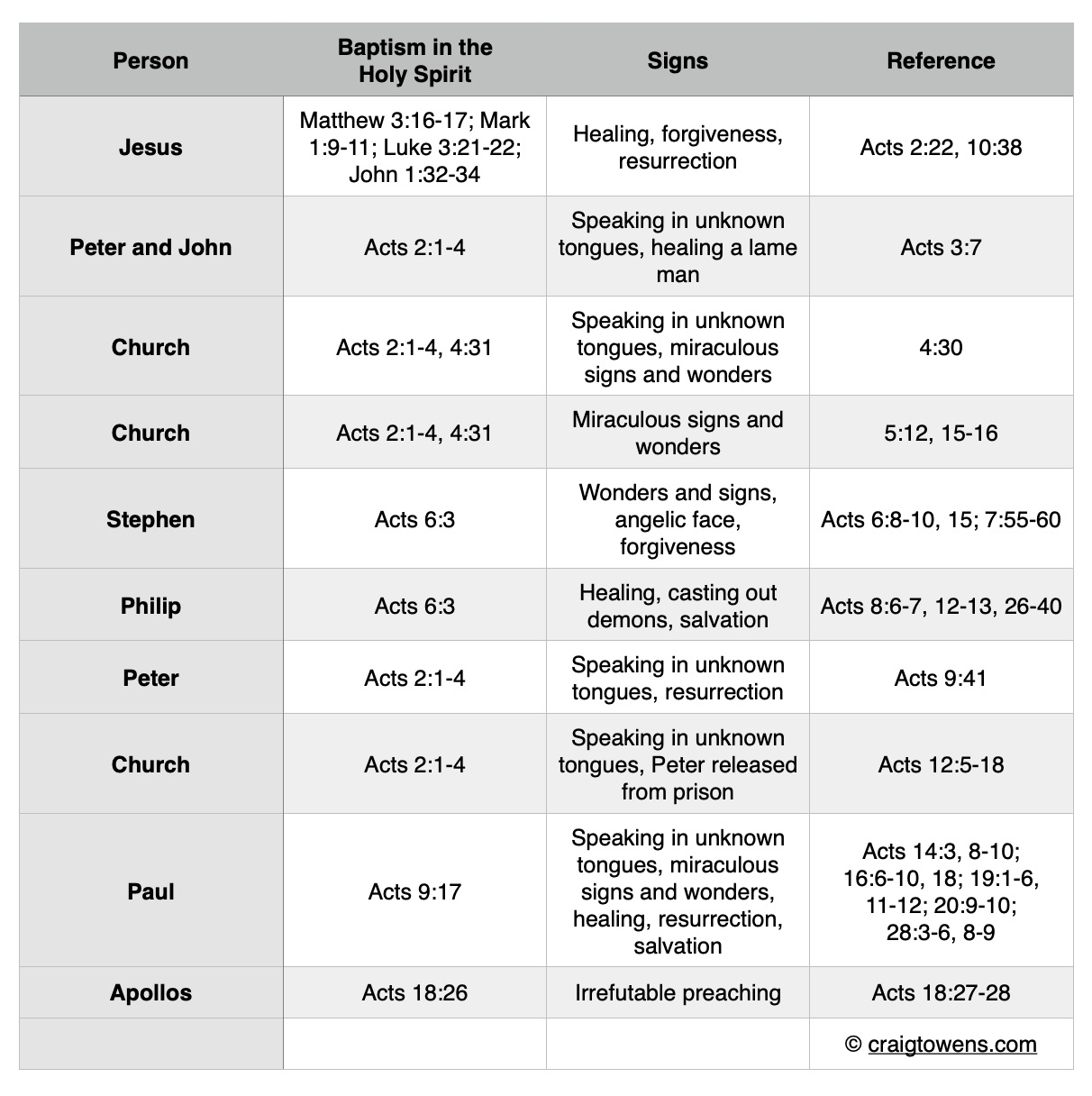
Check out this chart that walks us through the book of Acts to see how God authenticated the ministry of those who were baptized in the Holy Spirit by performing signs and wonders through them:

You may download this chart in a PDF format by clicking here Chart of signs in Acts ←

When a Christian is baptized in the Holy Spirit there are two types of evidence:

  1. Initial evidence—typically speaking in a language that hasn’t been studied but has been supernaturally given by God. 
  2. Ongoing evidence—I would sum this up in the word sanctification (or as I like to remember it by saying “saint-ification”). This is the lifestyle change, the empowered living, and even the miraculous that cannot be counterfeited by man’s efforts alone. 

Let’s not try to put God in a box—telling Him when, where, how, and through whom He can work. Instead, let’s yield ourselves entirely to Him by letting the Holy Spirit empower us to be effective, unmistakable witnesses for Jesus Christ. 

►► Would you please prayerfully consider supporting this ministry? ◀︎◀︎
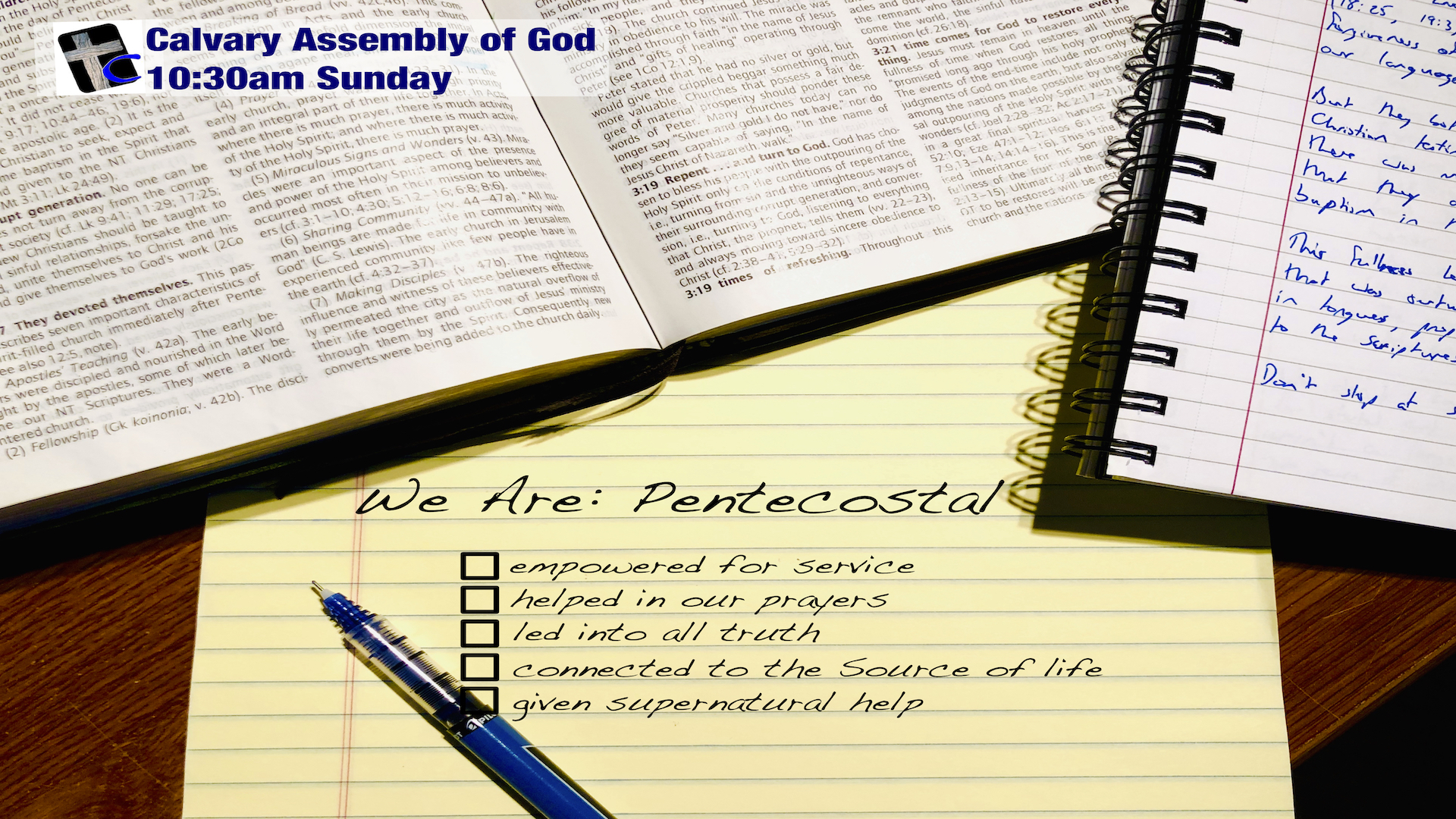
I will be relaunching our series called We Are: Pentecostal in two weeks. Please follow along with all of the messages in this series by clicking here for the details.

And if you would like to check out the other messages in our series looking at our foundational belief statements, you can find the full list by clicking here.

5 Truisms From Psalm 62

Listen to the podcast of this post by clicking on the player below, and you can also subscribe on Apple or Spotify.

When I see words like truly (3 times), surely (2 times), and yes (1 time) occurring so frequently in a rather short psalm, it catches my attention. Combined with the call for a Selah pause another two times in this twelve-verse psalm, and this is clearly a chapter that we should read slowly and deliberately. 

Because of these words truly and surely, I find five truisms that David makes clear to us, and I also find that they are linked together in a beautiful circular chain. 

Truism #1—God keeps me secure. He alone is my source of security (vv. 1-2). 

Truism #2—Evil people are envious of a righteous person’s secure position and will try to pull them down (vv. 3-4). When this happens I need to take a Selah pause to remember Who holds me secure. 

Truism #3—These attacks by evil people do not put my security in jeopardy, but instead it gives me a been-there-done-that testimony to share with others (vv. 5-8). Again, I need to Selah to remember that my challenges are often for the benefit of others as much as they are for my strengthening. 

Truism #4—Poor people are not excluded from God’s help, and rich people are not above God’s help (vv. 9-10). God sees every human being as infinitely valuable. 

Truism #5—God is both All-Loving and All-Powerful. He gets the final word on both judgment and reward (vv. 11-12). This fifth truism should refuel my understanding of the first truism—that God holds me securely—which continues my confident journey through this chain of beautiful truisms all over again. 

Friends, I urge you to go slowly through your personal Bible reading time. Pray for the Holy Spirit’s illumination before you begin reading, and then watch to see how He will point out to you patterns, repeated words, and other insights that will allow you to apply God’s Word to your daily life.

►► Would you please prayerfully consider supporting this ministry? ◀︎◀︎
Poetry Saturday—Eternal Spirit

Listen to the podcast of this post by clicking on the player below, and you can also subscribe on Apple or Spotify.

Eternal Spirit, we confess
And sing the wonders of Your grace!
Your power conveys our blessings down
From God the Father and the Son.
Enlightened by Your heavenly ray,
Our shades and darkness turn to day.
Your inward teachings make us know
Our danger and our refuge, too.
Your power and glory work within,
And break the chains of reigning sin,
Does our imperious lusts subdue,
And forms our wretched hearts anew.
The troubled conscience knows Your voice,
Your cheering words awake our joys;
Your words allay the stormy wind,
And calm the surges of the mind.

*Spurgeon used this poem as a conclusion to his sermon entitled Human Depravity and Divine Mercy. I was unable to find this poem attributed to anyone else, so I am assuming it was written by Spurgeon himself. 

►► Would you please prayerfully consider supporting this ministry? ◀︎◀︎