A Graphical Look At Ephesians 2

Ephesians 2:11-21

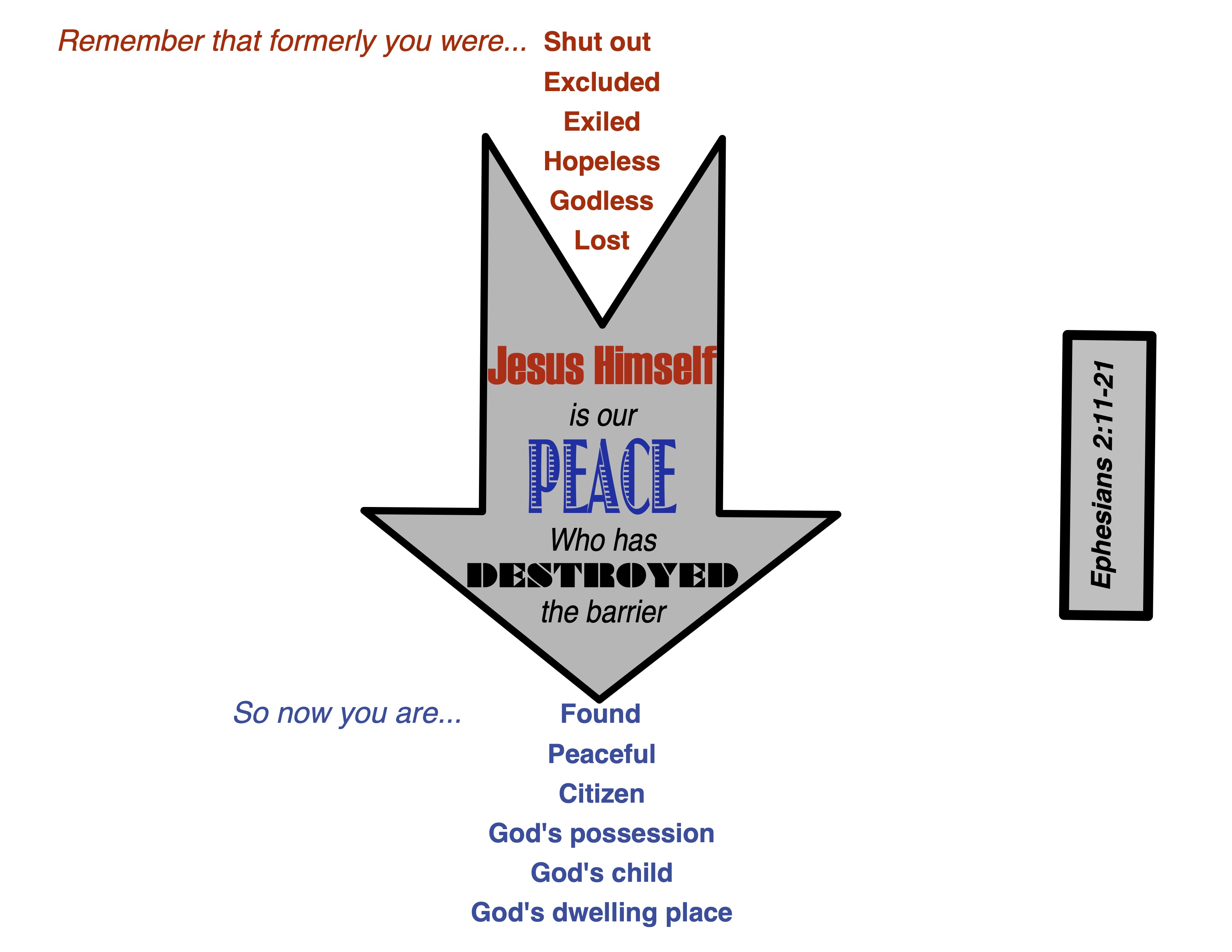
11 Therefore, remember that formerly you who are Gentiles by birth and called “uncircumcised” by those who call themselves “the circumcision” (which is done in the body by human hands)—12 remember that at that time you were separate from Christ, excluded from citizenship in Israel and foreigners to the covenants of the promise, without hope and without God in the world. 13 But now in Christ Jesus you who once were far away have been brought near by the blood of Christ.

14 For He Himself is our peace, who has made the two groups one and has destroyed the barrier, the dividing wall of hostility, 15 by setting aside in His flesh the law with its commands and regulations. His purpose was to create in Himself one new humanity out of the two, thus making peace, 16 and in one body to reconcile both of them to God through the Cross, by which He put to death their hostility. 17 He came and preached peace to you who were far away and peace to those who were near. 18 For through Him we both have access to the Father by one Spirit.

19 Consequently, you are no longer foreigners and strangers, but fellow citizens with God’s people and also members of His household, 20 built on the foundation of the apostles and prophets, with Christ Jesus Himself as the chief cornerstone.21 In Him the whole building is joined together and rises to become a holy temple in the Lord.


In > On

When it comes to the Holy Spirit’s involvement in a Christian’s life: In > On.

Sometimes, instead of referring to the two major divisions of the Bible as Old Testament and New Testament, I prefer to use First Testament and Second Testament. This helps me remember that “Old” doesn’t mean outdated, and “New” doesn’t mean forgetting what came before it.

B.B. Warfield had a great analogy. He imagined the First Testament to be a perfectly-constructed mansion. Only the finest materials had been used, and the mansion had been constructed by the best craftsmen being overseen by the world’s premier Architect. The only problem was this mansion had no lights. With the appearing of Jesus in the Second Testament, finally the lights are turned on. Jesus reveals the beauty that was already there! 

In the First Testament, we frequently read that the Holy Spirit comes ON people, usually for leadership functions. We see this phrase with Moses and his co-leaders, several of the judges, Israel’s first two kings, and many of the prophets (see Numbers 11:25; Judges 3:10, 6:34, 11:29, 15:14; 1 Samuel 11:6, 16:13; 2 Kings 2:15). 

However, there is one leader in the First Testament about which we notice the Spirit came IN him. Twice Ezekiel says this (2:2, 3:24). This was hinting at a to-be-fulfilled promise in the Second Testament (36:25-27). 

The Holy Spirit being IN God’s people—which makes them God’s leaders—is described by Jesus in Acts 1:5. Many translations render this verse, “You will be baptized with the Holy Spirit.” But the NIV footnote and The Message both say “in the Holy Spirit.” Indeed, the Greek word means “by, with, or in.” But in context to being baptized (which means immersed, submerged, cleansed, overwhelmed), I think the best word is: baptized IN the Holy Spirit.  

Let me say it again: When it comes to the Holy Spirit’s involvement in a Christian’s life: In > On. 

“You hardly need to pray to have the Spirit poured out, for that has been done. What you need is a baptism of the Holy Spirit; to go down personally into that glorious flood that has been poured forth. Oh, to be immersed in the Holy Spirit and into fire—covered with His holy influence—plunged into the Godhead’s deepest sea and lost in His immensity! Here is our life and power.” —Charles Spurgeon 

Jesus wants all of His followers to be baptized IN the Holy Spirit. So He told us to keep on asking, keep on seeking, keep on knocking, keep on waiting for God’s promised infilling (Luke 11:9-13; Acts 1:4-8). 

Don’t stop at salvation—with just the Holy Spirit deposited in you—press on to be submerged deep into the Holy Spirit. 

If you missed the first couple of posts in this series, check out Where’s God Today? and The Holy Spirit Keeps Christians “Oscar Mike.” 

Where’s God Today?

Transitions are always hard things. We are leaving the known for the unknown. Even if the known is unhealthy or painful, it’s still hard to go to the unknown. 

Why are these transitions so difficult? Perhaps it’s because I’ve learned how to cope with the known, or I’ve gotten used to this “normal” life, or even I’ve simply learned to navigate any dysfunctional areas.

But is that really living? Am I managing my life or is God? When I’m against transitions, aren’t I really saying that I’ve put God’s plan for my life in my box?

Those questions trigger even more questions in my mind: Where’s God in all of this? Why can’t He just make my known better? Why is He leading me (or maybe even pushing me) into this unknown? 

Jesus didn’t endure the unimaginable horrors of the Cross just so you could cope with life. Jesus came to bring us abundant life—not a barely-getting-by life or just a coping life!

How does He bring us into this abundant life? By leading us through transitions. And where is He in all our transitions? Closer than you think! 

Moses sang a song to conclude his sermon in Deuteronomy. In that song, he mentions God taking care of His people the way an eagle cares for its eaglets.

Adults eagles build their extremely large nests in the highest point they can find. Their nests are made of massive branches. In fact, they build some of the largest nests of all birds, and build them in the most inaccessible of places. Before their eggs are laid, the adult eagles will soften their nest with feathers pulled from their own body. From the time the eggs are laid until the eaglets leave the nest, they are never without a parent present—while one parent hunts, the other watches. 

Eaglets first test their stumpy wings by jumping around in the nest, mimicking their parents. Eventually they will start “branching”—jumping to nearby branches—and then “fledging”—taking their first short flights from the nest. All under the watchful eye of the parents. Finally, the adult eagles will “stir up” their nest by blowing away all of the comforts of their plucked feathers, encouraging the eaglets to soar. 

Moses said that this is how God cares for His children. First by shielding and guarding us, and then by stirring up our nest and encouraging us to soar! 

Much like when Jesus ascended back to Heaven. He was going to physically leave His disciples, but He knew He had adequately trained his “eaglets” to soar without Him with them in bodily form. 

But Jesus never leaves us spiritually. He said that His ascension back to heaven would allow for the Holy Spirit to be resident in each of His followers (see John 16:7-15). It is the Holy Spirit that continues to guide us, teach us, empower us, correct us, and lead us to SOAR into abundant, God-honoring, Christlike living. 

There are many, many times of transition as we soar, but He never leaves us. The Holy Spirit is our constant Counselor. God shows His love for us by caring for us. God also shows His love for us by making us uncomfortable with the status quo. 

May the times of transition cause us to rely even more on the very present help of the Holy Spirit.

Continue to follow along with me in a new series of posts looking at how the Holy Spirit helps us to soar!

Child Of God

You are the children of the Lord your God… (Deuteronomy 14:1). 

I am a child of the King of kings.
He is the King of Endless Supply.
He has no lack, no deficiencies, no quotas. 
He IS Abundance! 

So why would I live like a pauper—scraping by and scrambling to provide for myself? Why would I live like an orphan—with a scarcity mindset? 

My Heavenly Father knows what I have need of before I even ask, and He has already promised to supply for all of my needs (Matthew 6:8; Philippians 4:19).

As a child of God, I should have a joy-filled, peace-filled, abundance mentality. With this mindset I can…

I’m not trying to build a bankroll here. My inheritance is secure in Heaven. As a child of the King of kings, I can expect Him to provide all I need. 

I was young and now I am old, yet I have never seen the righteous forsaken or their children begging bread. (Psalm 37:25) 

With the same measure I use to bless others, I will be blessed. A good measure, pressed down, shaken together and running over, will be poured into your lap. (Luke 6:38) 

I need to live as a child of the Abundant King, not as a helpless orphan with no one on whom to call for help! 

Thursdays With Spurgeon—Why Bethlehem?

This is a weekly series with things I’m reading and pondering from Charles Spurgeon. You can read the original seed thought here, or type “Thursdays With Spurgeon” in the search box to read more entries.

Why Bethlehem?

     There [in Bethlehem] cleaved to [Naomi] Ruth the Moabitess, whose Gentile blood should unite with the pure untainted stream of the Jew and should thus bring forth the Lord our Savior, the great King both of Jews and Gentiles. … And in the streets of Bethlehem did Boaz and Ruth receive a blessing that made them fruitful, so that Boaz became the father of Obed and Obed the father of Jesse—and Jesse the father of David. … 

     There is something in the name of the place. Bethlehem Ephrathah. The word Bethlehem has a double meeting. It signifies ‘the house of bread’ and ‘the house of war.’ …

     Bethlehem, you house of bread, rightly were you called, for there the Bread of life was first handed down for man to eat.

     And it is called ‘the house of war,’ because Christ is to a man either ‘the house of bread’ or else ‘the house of war.’ While He is food to the righteous, He causes war to the wicked, according to His own words: ‘Do not think that I came to bring peace on earth. I did not come to bring peace but a sword…’ (Matthew 10:34–36).

     Sinner, if you do not know Bethlehem as ‘the house of bread,’ it will be to you a ‘house of war.’ If from the lips of Jesus you never drink sweet honey—if you were not like the bee, which sips sweet luscious liquor from the Rose of Sharon, then out of the selfsame mouth there will go forth against you a two-edged sword! And that mouth from which the righteous draw their bread will be to you the mouth of destruction and the cause of your ill. … 

     Ephrathah … the meaning of it is ‘fruitfulness’ or ‘abundance.’ … 

     If we are like trees planted by the rivers of water, bringing forth our fruit in our season, it is not because we were naturally fruitful, but because of the rivers of water by which we were planted. It is Jesus who makes us fruitful. ‘If you abide in Me, and My words abide in you, you will ask what you desire, and it shall be done for you’ (John 15:7). Glorious Bethlehem Ephrathah! Rightly named! Fruitful house of bread—the house of abundant provision for the people of God! 

From The Incarnation And Birth Of Christ

Bethlehem wasn’t just a random place for Jesus Christ to be born. God doesn’t do anything randomly. Everything He does has a plan and a purpose. We may have difficulty seeing what the purpose is. As Martin Tupper noted in one of his poems—

We look through a glass darkly, we catch but glimpses of truth;
But, doubtless, the sailing of a cloud hath Providence to its pilot…
Man doeth one thing at once, nor can he think two thoughts together;
But God compasseth all things, mantling the globe like air…

Not only was the birthplace of Jesus purposely chosen by God, so was your birthplace. And your birth parents. And, indeed, everything about you. You are not an accident or some chance encounter. You have been created by God on purpose and for a purpose. 

Let the birthplace of Jesus—all the rich meaning of Bethlehem Ephrathah—be an encouragement to you that God knows and loves you dearly. Your life has meaning and purpose, which you can discover through a personal relationship with your Heavenly Father through Jesus Christ. 

Thursdays With Spurgeon—All The Trinity In Salvation

This is a weekly series with things I’m reading and pondering from Charles Spurgeon. You can read the original seed thought here, or type “Thursdays With Spurgeon” in the search box to read more entries.

All The Trinity In Salvation

     We are, alas, too apt to forget that while there are distinctions as to the persons in the Trinity, there are no distinctions of honor—and we do frequently ascribe the honor of our salvation, or at least the depths of its mercy and the extremity of its benevolence, more to Jesus Christ than we do to the Father. This is a very great mistake.

     What if Jesus came? Did not His Father send Him? If He were made a Child, did not the Holy Spirit beget Him? If He spoke wondrously, did not His Father pour grace into His lips that He might be an able minister of the new covenant? If His Father did forsake Him when He drank the bigger cup of gall, did He not love Him still? And did He not, by and by, after three days, raise Him from the dead and at last receive Him up on high, leading captivity captive?

     Ah, beloved, he who knows the Father, the Son, and the Holy Spirit as he should know them never sets one before another. He is not more thankful to one than the other; he sees them at Bethlehem, at Gethsemane, and on Calvary all equally engaged in the work of salvation.

From The Incarnation And Birth Of Christ

All of the Godhead is involved in our salvation. God doesn’t separate Himself—He is One. 

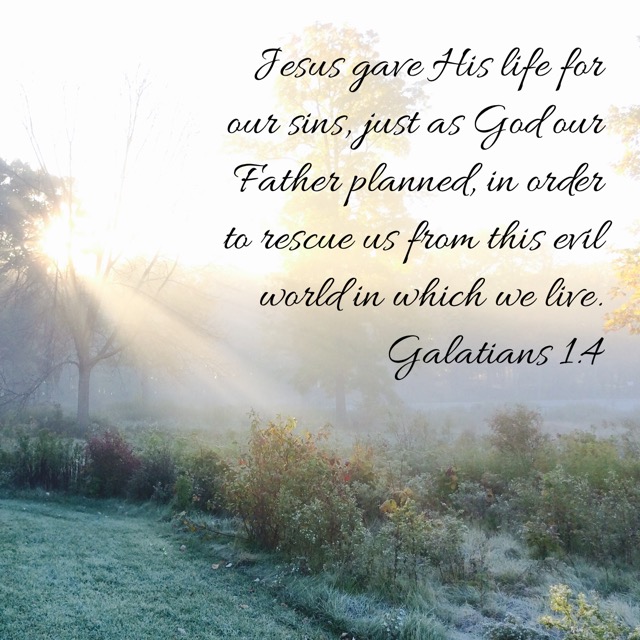
God the Father planned our salvation and sent His Son (Micah 5:2; Matthew 10:40; Ephesians 1:4-5).

God the Son proclaimed the Father’s good news and purchased our salvation (Mark 10:45; John 3:17; Ephesians 1:9-10). 

God the Holy Spirit seals and confirms our salvation (Galatians 4:4-6; Ephesians 1:13-14). 

We come to the Father, through the Son, by the drawing of the Spirit. We need the full Trinity to bring us fully into His presence forever and ever! 

A Praying Family

Not one word in Scripture is wasted: not one word is redundant or replaceable. When Jesus taught us to pray to a Heavenly Father, He taught us to say, “OUR Father.” That means we are all His children, with His Holy Spirit helping us to grasp this—The Spirit Himself testifies with our spirit that WE are God’s children. Now if WE are children, then WE are heirs—heirs of God and co-heirs with Christ… (Romans 8:16-17). 

Did you know that the word saints never appears in the singular in Scripture? No one person is singled out for his or her saintliness. Because we are saintS, praying together to OUR Father, this means accountability. For some people, accountability is a bad word. It seems to them to feel like someone is looking over their shoulder or checking up on them. But Christians should never feel this way! I like how Ken Blanchard defines this: “Accountability means: We owe each other for something we’ve agreed upon.” 

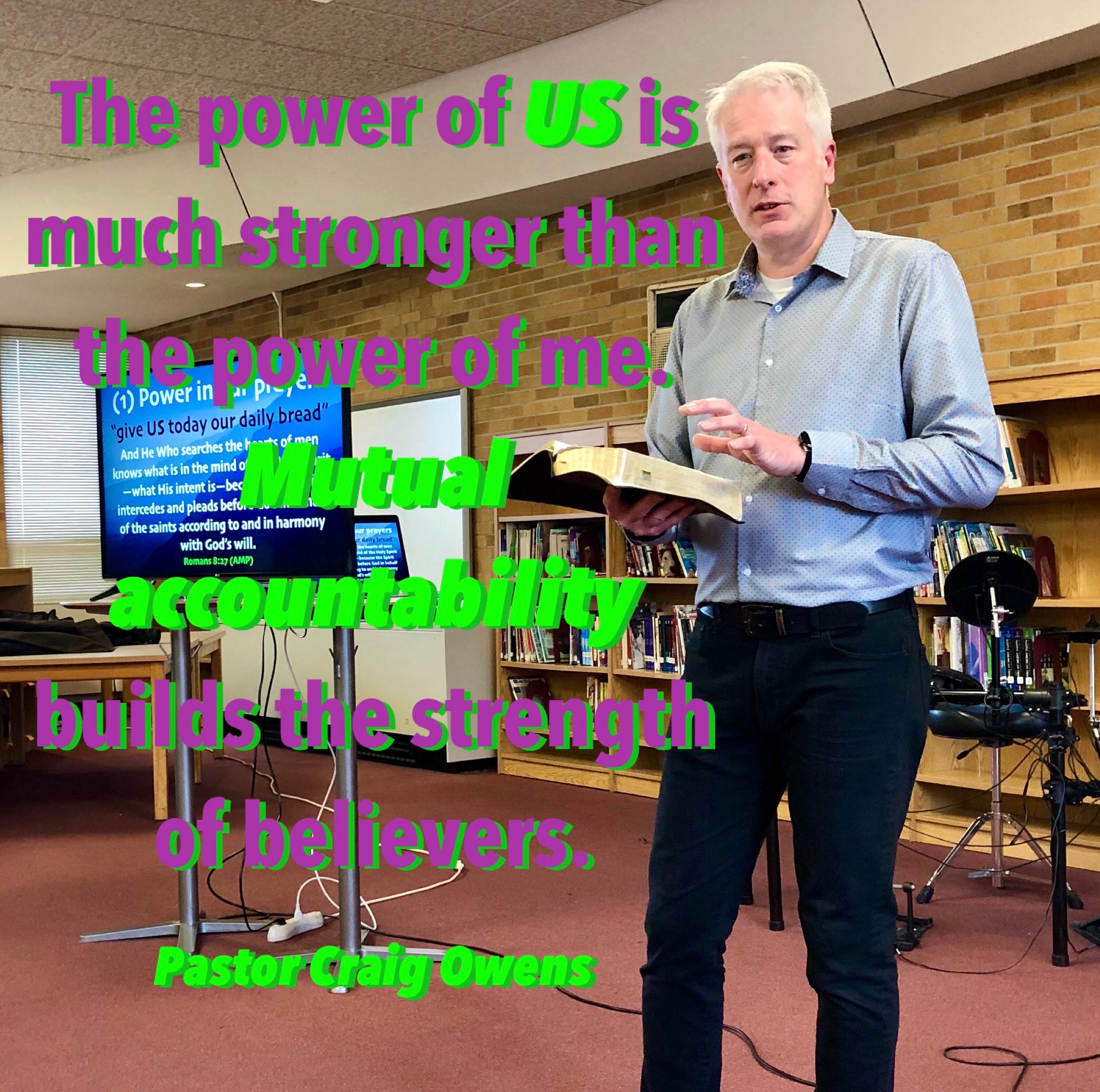
What have the saints of God agreed upon? That God is our Father, that Jesus is His Son and our Brother, and that the Holy Spirit is our Helper. We’ve agreed that if we are brothers and sisters in God’s family, we are mutually accountable to one another. 

In the context of the prayer Jesus taught us to pray, being mutually accountable means: 

  1. Power in our prayersgive US today our daily bread. Jesus talks about the power in agreement, and the apostle Paul emphasizes how the Holy Spirit helps believers harmonize in prayer with each other and with God’s will (Matthew 18:19-20; Romans 8:27). 
  1. Strengthening of our characterforgive US our debts, as WE also have forgiven our debtors. Jack Hayford points out that, “The believer’s best defense against self-deception is through mutual accountability to one another.” In order for our character to be strengthened, we have to allow others to speak into our lives—even the lovingly painful words (Proverbs 27:17, 6). 
  1. Protection from falling to temptationlead US not into temptation, but deliver US from the evil one. Samson became entangled with a prostitute when he was all by himself; Elijah became depressed when he sent his servant away; David fell into sin when he was alone; Peter denied Christ when all of the other disciples had run away. That’s why the writer of Hebrews counsels us to stick close to our Christian family members (Hebrews 10:21-25). 

In an earlier post, I noted that how we view God is going to determine what we pray and what we expect after we pray. Coming together and praying together will help us see God better. Just as the angels around the throne are always crying out to each other “Holy! Holy! Holy!”, when we come together we can show our fellow saints what we’ve learned about our holy Father’s love and power. This is both an encouragement to others and allows others to be an encouragement to us too. Then together we can pray more boldly and expect great things in response to our prayer. 

Being mutually accountable to the saints in prayer…

  • hallows God as our Father

  • glorifies Jesus as our Brother

  • honors the Spirit as our Helper

God never intended that you would have to walk through life alone. He wants us to share the journey with fellow saints—His family made up of our brothers and sisters. This praying family truly honors God’s name! 

Join me on Sunday as we continue to learn more about prayer. 

Poetry Saturday—What Is Prayer?

Prayer is the soul’s sincere desire,
Unuttered or expressed;
The motion of a hidden fire,
That trembles in the breast.

Prayer is the burden of a sigh,
The falling of a tear;
The upward glancing of an eye,
When none but God is near.

Prayer is the simplest form of speech
That infant lips can try;
Prayer, the sublimest strains that reach 
The Majesty on high.

Prayer is the Christian’s vital breath,
The Christian’s native air;
His watchword at the gates of death—
He enters heaven with prayer.

Prayer is the contrite sinner’s voice,
Returning from his ways;
While angels in their songs rejoice
And cry, ‘Behold, he prays!’ 

The saints in prayer appear as one,
In word, in deed, and mind;
While with the Father and the Son,
Sweet fellowship they find.

No prayer is made by man alone
The Holy Spirit pleads;
And Jesus, on th’ eternal throne
For sinners intercedes.

O Thou! by Whom we come to God,
The Life, the Truth, the Way;
The path of prayer Thyself hast trod:
Lord, teach us how to pray. —James Montgomery

Thursdays With Spurgeon—Our Father In Heaven

This is a weekly series with things I’m reading and pondering from Charles Spurgeon. You can read the original seed thought here, or type “Thursdays With Spurgeon” in the search box to read more entries.

Our Father In Heaven

     I believe that this prayer [“Our Father in heaven, hallowed be Your name”] was never intended for universal use. Jesus Christ taught it not to all men, but to His disciples, and it is a prayer adopted only to those who are the possessors of grace and are truly converted. In the lips of an ungodly man, it is entirely out of place. Does not one say, “You are of your father the devil, and the desires of your father you want to do” (John 8:44)? Why then should you mock God by saying, “Our Father in heaven”? 

     Let none despise this prayer. It is matchless, and if we must have forms of prayer, let us have this first, foremost, and chief. But let none think that Christ would tie His disciples to the constant and only use of this. Let us rather draw near to the throne of heavenly grace with boldness, as children coming to a father, and let us tell forth our wants and our sorrows in the language that the Holy Spirit teaches us. …

     If we say, “Our Father in heaven,” we must remember that our being sons involves the duty of obedience to God. When I say “my Father,” it is not for me to rise up and go in rebellion against His wishes. If He is my Father, let me note His commands and let me reverentially obey. If He has said, “Do this,” let me do it, not because I dread Him, but because I love Him. And if He forbids me to do anything, let me avoid it. …

     We are one in the family of God and no one is ahead of the other. One may have more grace than another, but God does not love one more than another. One may be an older child than another, but he is not more a child. One may do mightier works and may bring more glory to his Father, but he whose name is the least in the kingdom of heaven is as much the child of God as he who stands among the king’s mighty men. Let this cheer and comfort us when we draw near to God and say, “Our Father in heaven.” … 

     And after you have prayed that, rise up and act it. Say not “our Father” and then look upon your brethren with a sneer or frown. I beseech you, love like a brother and act like a brother. Help the needy. Cheer these sick. Comfort the fainthearted. Go about doing good; minister to the suffering people of God wherever you find them. Let the world take notice of you—that you are when you are on your feet what you are upon your knees—that you are a brother to all the brotherhood of Christ, a brother born for adversity, like your Master Himself.

From The Fatherhood of God

This kind of prayer speaks of…

  • access
  • responsibility
  • power
  • love
  • provision
  • assurance
  • protection
  • acceptance
  • joy
  • and more blessings than we can ever enumerate! 

What a blessing to pray to a Heavenly Father who is also Holy God.

Remain