The Best Way To De-Stress

Listen to the podcast of this post by clicking on the player below, and you can also subscribe on Apple, Spotify, or Audible. 

Of all the things that rob a Christian of peace and robust mental health, stress has to be near the top of the list. There are so many stressors in our lives that to not find a way to actively de-stress is to choose to remain stressed. This is sort of like fertilizing the weeds, as we learned in our second mental health strategy. 

A certain amount of stress is good for us—doctors call this eustress. Our bodies have been designed by God with a hormone called cortisol that helps us respond to stressful situations, and He also designed that the unused cortisol be flushed from our bodies as we sleep and exercise. However, when we become stressed, many times sleep and exercise are squeezed out of our lives. 

Men’s Health magazine reported, “You personally may dictate when you’ll die. After studying 1633 men for 30 years, Purdue scientists found that worrying takes 16 years off your life. Negative thinking triggers the release of cortisol, a stress hormone that can be dangerous when elevated for long periods of time.” 

The eustress can degrade into distress if we’re not attentive to this downward slide. The excess cortisol that is allowed to remain in our bodies leads to unhealthy responses—like sleeplessness, starvation or binge eating, and little to no exercise. These unhealthy factors are further exacerbated by our diminished coping skills that come from the damage done to the hippocampus in our brain. Lingering cortisol kills the neurons in this memory center of our brains, which makes it harder for us to recall past lessons that could help us resolve stress. 

Sadly, distress can become its own downward cycle as the unhealthy responses and diminished coping skills negatively impact our lives, creating even more stressors. 

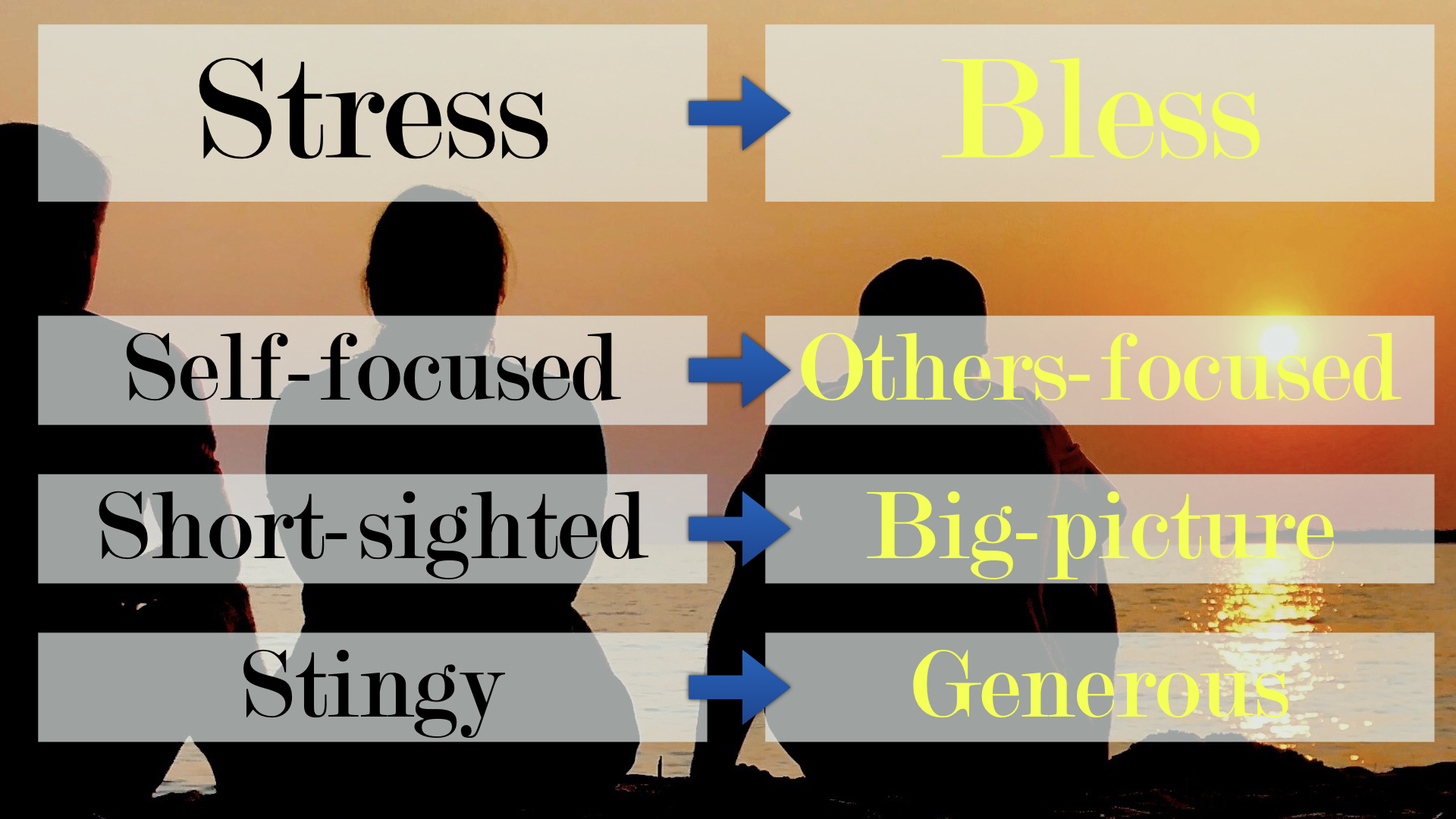
Stress makes us:

  1. Self-focused 
  2. Short-sighted 
  3. Stingy with our time, possessions, and even God’s promises 

But there is a word of hope for us. William James noted, “The greatest weapon against stress is our ability to choose one thought over another.” 

I want to give you one thought—one word, one action—to combat stress: Bless. 

Blessing others takes the focus off myself. Blessing God puts the focus on Him. 

In the Gospels, we see people who had suffered the ravages of stress, encounter Jesus, find freedom, and then begin to bless others as a preventative to returning to their stress-filled lives. We can see a few examples in healed women, a man delivered from demons, and a woman who had lived a less-than-virtuous life (Luke 8:1-3, 26-39; 7:36-50). 

Frequently, the Old Testament psalmists shared how blessing God and others brought them out of their stressful situations. A great example comes from David when he chose to bless God in a stressful place, and ended up being a blessing to other afflicted people around him (Psalm 34:1-6). 

When you feel stress mounting, you need to get active. Feelings follow actions. We usually won’t feel ourselves into action, but we can act ourselves into feelings. 

The best way to de-stress is to bless! 

As we bless, look at the shifts that take place: 

  1. Instead of remaining self-focused we become others-focused 
  2. Instead of being short-sighted we get a big-picture orientation 
  3. Instead of being stingy with our possessions and God’s promises we become generous

Remember that in the distress cycle I mentioned earlier the brain cells in the hippocampus were being damaged? The excess cortisol literally kills those neurons. The good news is that the hippocampus is one of the few places in the brain that experiences neurogenesis after cortisol is flushed. When you replace stressing with blessing, and the cortisol is regularly flushed from your body, brain cells are regenerated in your hippocampus. In essence, you are developing both a new brain and a new mind. 

The apostle Paul wrote, “Put off, concerning your former conduct, the old man which grows corrupt according to the deceitful lusts, and be renewed in the spirit of your mind, and that you put on the new man which was created according to God, in true righteousness and holiness” (Ephesians 4:22-24 NKJV). 

Don’t let stress steal life from your years and years from your life. De-stress by blessing God and blessing those around you. 

If you’ve missed any of the previous eight mental health strategies that I have shared in this series, you can find them all by clicking here. 

►► Would you please prayerfully consider supporting this ministry? My Patreon supporters get behind-the-scenes access to exclusive materials, like this exclusive video in which I take my supporters behind the scenes of my thought process in designing my confrontation flowchart. ◀︎◀︎

The Lens For Difficult Biblical Passages

Listen to the podcast of this post by clicking on the player below, and you can also subscribe on Apple, Spotify, or Audible. 

If you’ve ever found sections of the Bible difficult to understand, I’ve got a few thoughts to help you out.

Check out this episode of The Podcast.

Resources mentioned in this video:

►► Would you please prayerfully consider supporting this ministry? My Patreon supporters get behind-the-scenes access to exclusive materials, like this recent video where I explain how God reveals previously-unknown truths to us. Become a supporter today and get instant access to everything I have already shared with my supporters. ◀︎◀︎

Appointment Vs. Opportunity

Listen to the podcast of this post by clicking on the player below, and you can also subscribe on Apple, Spotify, or Audible. 

If we’re not careful, we can get so focused on our own appointments that we will miss out on the amazing opportunities God sends our way to show His love to others.

Check out this episode of The Podcast.

Resources mentioned in this video:

►► Would you please prayerfully consider supporting this ministry? My Patreon supporters get behind-the-scenes access to exclusive materials, like this recent video where I explain how God reveals previously-unknown truths to us. ◀︎◀︎

Because You Say So

Listen to the podcast of this post by clicking on the player below, and you can also subscribe on Apple, Spotify, or Audible. 

It had been a long, fruitless night of fishing for Peter, Andrew, and their fishing partners. They came back to shore and began to wash their nets which had caught nothing all night long. 

As they washed their nets, no doubt contemplating how they were going to make ends meet without any fish to sell in the marketplace, they listened to an itinerant Preacher. This Man was fascinating to listen to as He talked about Scripture in a way none had ever heard. 

The crowds listening to Him swelled in size—almost spellbound by His kindness and wisdom—until the Preacher had no place left to stand on the shore. Turning to Peter, the Preacher said, “Peter, my name is Jesus. Would you allow Me to stand in your boat so I can continue to speak to all of these good people?” 

Peter welcomed Him onto his ship and pushed out a little ways from shore. There he sat and continued to listen with growing amazement at the way this Man taught. It was unlike anything Peter had heard from any other rabbi. 

When Jesus concluded His sermon and dismissed the crowds, He turned to Peter and said, “Thank you for helping Me. I know it’s been a tough night for you. If you will sail back out to deeper waters, you will be able to let down your nets for a huge catch.” 

Peter smiled and said, “Master, we’ve worked hard all night and haven’t caught a thing. I doubt we will be able to catch anything now.” For a brief moment, Peter contemplated rowing Jesus back to shore, but those words he had heard Jesus speaking were still resonating in his heart, bringing to life a faith he hadn’t known. 

Almost before he realized he was speaking the words, Peter said, “But because You say so, I will obey.” 

No sooner had Peter and Andrew let their nets down into the deep water, than they caught so many fish that their nets almost began to break. They shouted to their partners for help. Even with their combined efforts, the amount of fish they caught nearly sunk their boats! (See Luke 5:1-11.)

What an example Peter has given me! 

It may seem illogical, unconventional, counter-cultural, scary, or embarrassing. But because You say so, I will obey. 

I may lose friends, lose “face,” lose position, lose money, or lose possessions. But because You say so, I will obey. 

I may feel afraid, uncertain, unclear, confused, or skeptical. But because You say so, I will obey.

It’s only in my obedience that I can see Your power, Your lordship, Your wisdom, Your blessing, and Your glory.  So because You say so, I will obey. 

Jesus, You said, “Anyone who loves Me will obey Me” (John 14:23). I do love You, Jesus. No matter what it is, because You say so, I will obey. 

►► Would you please prayerfully consider supporting this ministry? My Patreon supporters get behind-the-scenes access to exclusive materials, like this recent video where I explain how God reveals previously-unknown truths to us. ◀︎◀︎

Loving Fighters

Listen to the podcast of this post by clicking on the player below, and you can also subscribe on Apple, Spotify, or Audible. 

I’ve always loved this stanza from a William Cowper poem:

Restraining prayer, we cease to fight
Prayer makes the Christian’s armor bright
And satan trembles when he sees
The weakest saint upon his knees.

Prayer is indispensable in spiritual warfare! Prayer is where we fight best for those we love. 

Have you ever heard the question, “Are you a lover or a fighter?” I don’t believe this is an either-or answer, both both-and. I’m a fighter because I’m a lover. I love Jesus and I am loved by Jesus.  This fuels my passion to fight for His glory to be seen. This drives me to fight against the powers that keep others from knowing this love for themselves. 

T.M. Moore wrote, “If we want God to bring revival and save the world from its many and increasing troubles, we must give ourselves to extraordinary efforts in prayer before we enter the conflict.” Prayer isn’t preparation for the fight; prayer is the fight that has been lovingly empowered. This is why our fifth spiritual discipline of prayer is so vital. 

As we have seen with giving and fasting, Jesus also has some don’ts and dos for us about praying (Matthew 6:5-8):

  • don’t pray publicly for earthly recognition or human applause (v. 5) 
  • do pray privately (v. 6) 
  • don’t pray robotically—And when you pray, do not heap up phrases—multiply words, repeating the same ones over and over—as the Gentiles do, for they think they will be heard for their much speaking (v. 7 AMP) 
  • do pray intimately (v. 8) 

Jesus practiced what He preached about praying in secret: Jesus was praying in private (Luke 9:18). He must have prayed so differently than anyone else the disciples had ever heard because they asked Him, “Lord, teach us to pray” (Luke 11:1). 

Remember that prayer is the battle—things are happening while I’m praying. 

There is a way I speak to my wife in private that I don’t typically say in public. If I didn’t speak intimately to her in private, others would notice a difference in public. When I do have intimate, private, regular conversations with her, it also shows publicly. 

So too with prayer. The New Testament doesn’t record very many of the prayers of Jesus for us. In fact, many of things we might think of as prayers sound more like commands from Jesus—“Lazarus, come forth,” “Little girl, get up,” “Be clean,” and similar phrases. We see the public display of power because Jesus had been empowered in private by His Father. 

Private prayer is noticed publicly in the lives of the followers of Jesus too (see Acts 4:13; 6:15). 

I don’t pray privately so that I can show off publicly. I pray in intimate privacy so that I can publicly show off Jesus! 

All of our spiritual disciplines are for us individually so that we have something to give corporately. For instance—

As we are built up in private prayer, there is a greater unity in corporate prayer, and Jesus is lifted up for the world to see. We love Jesus and we love others, so we fight for the glory of God and the strengthening of our brothers and sisters. We are loving fighters! 

So let me encourage you to make private, intimate conversation with Jesus a priority in your life. 

If you’ve missed any of the previous spiritual disciplines we’ve covered in this series, you can check them all out here. 

►► Would you please prayerfully consider supporting this ministry? My Patreon supporters get behind-the-scenes access to exclusive materials, like this recent video where I explain how God reveals previously-unknown truths to us. ◀︎◀︎

God’s Word Always Prevails

Listen to the podcast of this post by clicking on the player below, and you can also subscribe on Apple, Spotify, or Audible. 

I love the simple but utterly profound statement the angel Gabriel leaves with Mary. Listen to it from different biblical translations:

  • For no word from God will ever fail (Luke 1:37 NIV) 
  • For nothing will be impossible with God (NASB)
  • For the word of God will never fail (NLT) 
  • For with God nothing is ever impossible and no word from God shall be without power or impossible of fulfillment (AMPC)

“No word”—not the single dot of an “i” or the cross of a “t” will be missing. 

The God who never slumbers—the Omnipotent One, the Omniscient One—superintends every single word He has spoken. 

It is His word: “No word from God will ever fail.” It is not the way I desire it to be, or the way culture wants it to be, but it is the way the All-Loving, All-Powerful One has already determined it is going to be. 

The plans God has for me are for His glory. He is working all things out to bring to completion what He has declared. 

God’s words never fail, but they always prevail. It doesn’t matter how dark, hopeless, or even impossible it may seem, His plan always triumphs! 

When I have God’s word on it, I can confidently say, “Worry, be gone! Striving, cease! Doubt, you are a liar! I belong to the One who has spoken His word. I will rest assured in Him until His word prevails. I say as Mary replied to Gabriel, ‘May it be to me as you have said’” (Luke 1:38). 

►► Would you please prayerfully consider supporting this ministry? My Patreon supporters get behind-the-scenes access to exclusive materials, like a map and an app I just shared to help with your personal Bible study time. ◀︎◀︎

Impossible Or Opportunity?

Listen to the podcast of this post by clicking on the player below, and you can also subscribe on Apple, Spotify, or Audible. 

The dad knew it was impossible. His son knew it was impossible since he had lived with it nearly all of his life. All of their family and friends knew it was impossible because they had seen the devastation. The disciples of Jesus even proved it was impossible. 

The son was plagued by a demon. In a last-ditch effort, the beleaguered dad brought his boy to the disciples of Jesus. But the disciples were stymied. The dad said to Jesus, “I begged Your disciples to drive it out, but they could not” (see Luke 9:37-43; Mark 9:14-27).

Jesus loves “impossible” situations. 

What seems impossible to humans is merely an opportunity for the greatness of God to be seen.

Don’t run from your difficulties.

Don’t quake at the impossibilities.

Don’t try to solve the seemingly unsolvable on your own.

Bring the “impossible” to Jesus. 

Jesus said to the dad, “Bring your son here.” Jesus rebuked the impure spirit, healed the boy, and gave him back to his father. 

This is why Jesus loves it when we bring the impossible to Him: God’s glory is made abundantly clear. Luke records, “And they were all amazed at the greatness of God.” 

The greater the difficulty, the greater the glory of God is seen in the deliverance. 

Don’t throw in the towel on your situation. Don’t throw up your hands in despair. Instead, bring your impossibility to the One who is never stymied, never at a loss, never too weak or too busy to meet your need. Bring it to Jesus and let Him do what only He can do. 

►► Would you please prayerfully consider supporting this ministry? My Patreon supporters get behind-the-scenes access to exclusive materials, like a 10-minute video I just shared on study tips for the poetic books of the Bible. ◀︎◀︎

Shift Your Faith

Listen to the podcast of this post by clicking on the player below, and you can also subscribe on Apple, Spotify, or Audible. 

When Luke says first that “Jesus grew in wisdom,” that is our indication that a healthy mind is at the foundation for every other aspect of health (Luke 2:52). We don’t see Jesus anxious or worried, we don’t see Him confused in His thinking, or even indecisive of what to say or do. So by studying the life of Jesus—and the Scriptures on which He relied—we, too, can improve our mental health. 

This may sound unbelievable when you first read this, but I believe that at their foundation, anxiety and assurance are remarkably similar. The similarity is that they both have faith. 

The dictionary defines faith as a strong or unshakeable belief in something. The biblical definition of faith is remarkably similar: “Faith is confidence in what we hope for and assurance about what we do not see” (Hebrews 11:1). 

Using those definitions of faith, let me point out the similarity and the difference between the anxious mind and the assured mind:

  • Anxiety is faith or expectation that something bad is going to happen. 
  • Assurance is faith or expectation that something good is going to happen. 

But the biggest difference of all is seen in the mental health of the one worried and anxious about the bad things that are coming versus the one who is confidently assured of the good things that are coming. 

If we are going to be mentally healthy people, we need to shift our faith from anxiety to assurance every single time we feel the worry building in our hearts. This isn’t just changing our mindset but knowing what we believe and why we believe it. 

Assurance and anxiety both believe in the unseen. The assured person believes in God’s promises to provide all that we need, while the anxious person doubts their own abilities and resources will be able to sustain them. 

As a result, the assured person has an abundance mindset, while the anxious person has a scarcity mindset. 

These feelings can be traced back to our faith about the origins of the universe. The assured person believes that God transcends this universe—that He existed before time began and spoke all created things into existence (Hebrews 11:3). But the anxious person is still trying to find answers in constantly-changing theories about the universe’s beginning. 

Since the anxious person thinks the universe’s beginning was an accident, they can easily wonder if their own life is an accident. But the assured person believes they have been uniquely and purposefully created by God to have eternal purpose (Psalm 139:13, 16; Jeremiah 1:5). 

Finally, the person who sees the universe and their own life as accidental becomes quite anxious and uneasy when they think about death, and what may or may not come on the other side. But the one who trusts God as their Creator is confident that God is their eternal reward (Hebrews 11:6). 

Hebrews 11 is filled with the accounts of assured people who shifted their faith away from anxiety—believing something bad was going to happen—to the assurance that God was bringing about something incredibly good! Hebrews 12 then invites Christians today to remember that cloud of witnesses and keep our eyes on Jesus, who is described as the Author and Perfecter of our faith, so that we don’t lose hope (Hebrews 12:1-3). 

I’ve previously shared seven strategies for a Christian to maintain a strong mental health. Our eighth strategy is a constant shifting of our faith away from anxiety to assurance. Every single time an anxious thought tempts us to believe something bad is coming, we need to make a shift toward the assurance of God’s goodness. 

Really quickly, here is how we can use the first seven strategies to help us make that shift: 

  1. Pray for the Holy Spirit to help you make a new path. 
  2. Notice your fearful or anxious words and pull them out by the root.  
  3. Confront the thought patterns that are causing fear or anxiety. 
  4. Talk back to those fearful thoughts with the truth from God’s Word. 
  5. Check the inputs that may be causing fear (poor diet, not taking time for solitude, anxious friends, etc.). 
  6. Focus on today—I like the words of the song “strength for today and bright hope for tomorrow!” 
  7. Don’t look to escape, but take time to de-escalate. 

If you’ve missed any of the messages in this series on mental health, you can find all of them by clicking here. 

►► Would you please prayerfully consider supporting this ministry? My Patreon supporters get behind-the-scenes access to exclusive materials, like a 10-minute video I just shared on study tips for the poetic books of the Bible. ◀︎◀︎

Spotting The Attitude That Derails

Listen to the podcast of this post by clicking on the player below, and you can also subscribe on Apple, Spotify, or Audible. 

There is an attitude that can derail almost everything. I’d like to help you spot it ahead of time.

Check out this episode of The Podcast.

Resources mentioned in this video:

►► Would you please prayerfully consider supporting this ministry? My Patreon supporters get behind-the-scenes access to exclusive materials. ◀︎◀︎

A Proactive Pause

Listen to the podcast of this post by clicking on the player below, and you can also subscribe on Apple, Spotify, or Audible. 

Let’s keep in mind why we are learning and working on these spiritual disciplines. The key phrase is “so that”—I get stronger so that we can get stronger.

Today we are looking at spiritual discipline #2—Solitude. We will need discipline to abide with Jesus in our time of solitude—removing all distractions—so that we can respond better to our circumstances, and help other saints respond better too. 

Part of the dictionary definition of solitude is “a place absent of human activity.” Note that important word human activity. Solitude is a time for stepping back from all our human striving to get a heavenly perspective. Solitude is a proactive pause in difficult times so that we can respond with a God-honoring reaction. 

Let me give you five ideal situations to discipline ourselves to find solitude. 

(1) After ministry exertion. I’m sure there have been times when an interaction with another person or a group of people has exhausted you. It’s at these times we should find a place of solitude to be refreshed, just as Jesus did (Luke 5:16). 

(2) In stormy times. When everything around us seems to be unstable, proactively pausing in a time of solitude is saying with the psalmist, “God is our refuge and strength, an ever-present help in trouble,” and then hearing God say to our anxious hearts, “Be still, and know that I am God” (Psalm 46:1, 10). These are the same words Jesus said to both the stormy seas and the disquieted hearts of His disciples (see Mark 4:35-39). 

(3) When we’re between a rock and a hard place. This is when we feel like neither option before us is a pleasant one. Like when the Israelites were caught between the onrushing Egyptian army and the uncrossable Red Sea. Listen to how similar the words of Moses sound, “The Lord will fight for you; you need only to be still” (see Exodus 14:1-14). 

(4) When we have a big decision ahead. We may gather all of the information and do our our research and still feel inadequate to make a good decision. Jesus had hundreds of disciples, but He needed to choose just twelve to serve as His apostles. Before making this decision, Jesus spent the night in solitude with His Father (Luke 6:12-13). 

(5) When we get angry. There are other strong emotions that sometimes seem to overwhelm us, but I’ve noticed that anger causes more people to fly off the handle than most of the other emotions. When Jesus saw the shameful way the temple was being used, He got so angry that His disciples recalled the Psalm that said zeal was burning Him up (Psalm 69:9; John 2:17). Instead of reacting in the heat of the moment, Jesus spent all night in solitude with His Father (Mark 11:11, 19).  

Our solitude time could include Bible reading, but it’s probably more of a time for quieting ourselves—taking a break from human activity—so we can hear the Holy Spirit reminding us of what we’ve already studied (John 14:26).  

Then keep in mind that solitude is not retreating and staying away from others, but solitude is so that I can effectively respond to pressing situations. Christian solitude is not me-time, it’s us-time (where the “us” is me + Jesus) so that I’m ready for we-time (where the “we” is me + others). 

This is such an important discipline for Christians so that we don’t respond inappropriately in an intense situation, but we respond in a Christ-like way that brings glory to God. Pay attention to your strong emotions, listen to the Holy Spirit, and proactively find a place of solitude. 

If you have missed any of the other messages in this series called Saints Together, you can find them all by clicking here.

►► Would you please prayerfully consider supporting this ministry? My Patreon supporters get behind-the-scenes access to exclusive materials, like a 10-minute video I just shared on study tips for the poetic books of the Bible. ◀︎◀︎