Using The Bible To Pray

Listen to the podcast of this post by clicking on the player below, and you can also subscribe on AppleSpotify, or Audible.

During the first year of [Darius’] reign, I, Daniel, learned from reading the Word of the Lord, as revealed to Jeremiah the prophet, that Jerusalem must lie desolate for seventy years. So I turned to the Lord God and pleaded with Him in prayer and fasting. I also wore rough burlap and sprinkled myself with ashes. (Daniel 9:2-3 NLT) 

Reading the Word of God prompted Daniel to pray to the God that is revealed in the Word, and the prayer he offered to God was grounded in biblical promises—in God’s own promises (vv. 4-19). 

It’s like when children are speaking to their earthly fathers and say, “Dad, you promised,” it gets the attention of that father’s heart because he wants to keep his word. 

God hasn’t forgotten His promises; in fact, He is always at work to fulfill what He has said. But when we pray, “Father, according to Your promise to me,” we are praying words that resonate with His heart. He delights for His children to see Him at work. And He is glorified when we praise Him for fulfilling what He has promised. 

When we end our prayer with “in the name of Jesus, Amen,” that is not just some magical phrase that we tag on, but it is a reminder that we can come boldly before God’s throne with our petition. And prayers that are aligned with the heart of God—prayers that are grounded in the Word of God—have the “Amen” of Jesus added to them (Hebrews 10:19-22; 2 Corinthians 1:20). 

We never need to be at a loss for words when we go to our Heavenly Father in prayer. Read His Word, see the Holy Spirit illuminate and apply the Word to your circumstances, and then pray confidently in the name of Jesus.

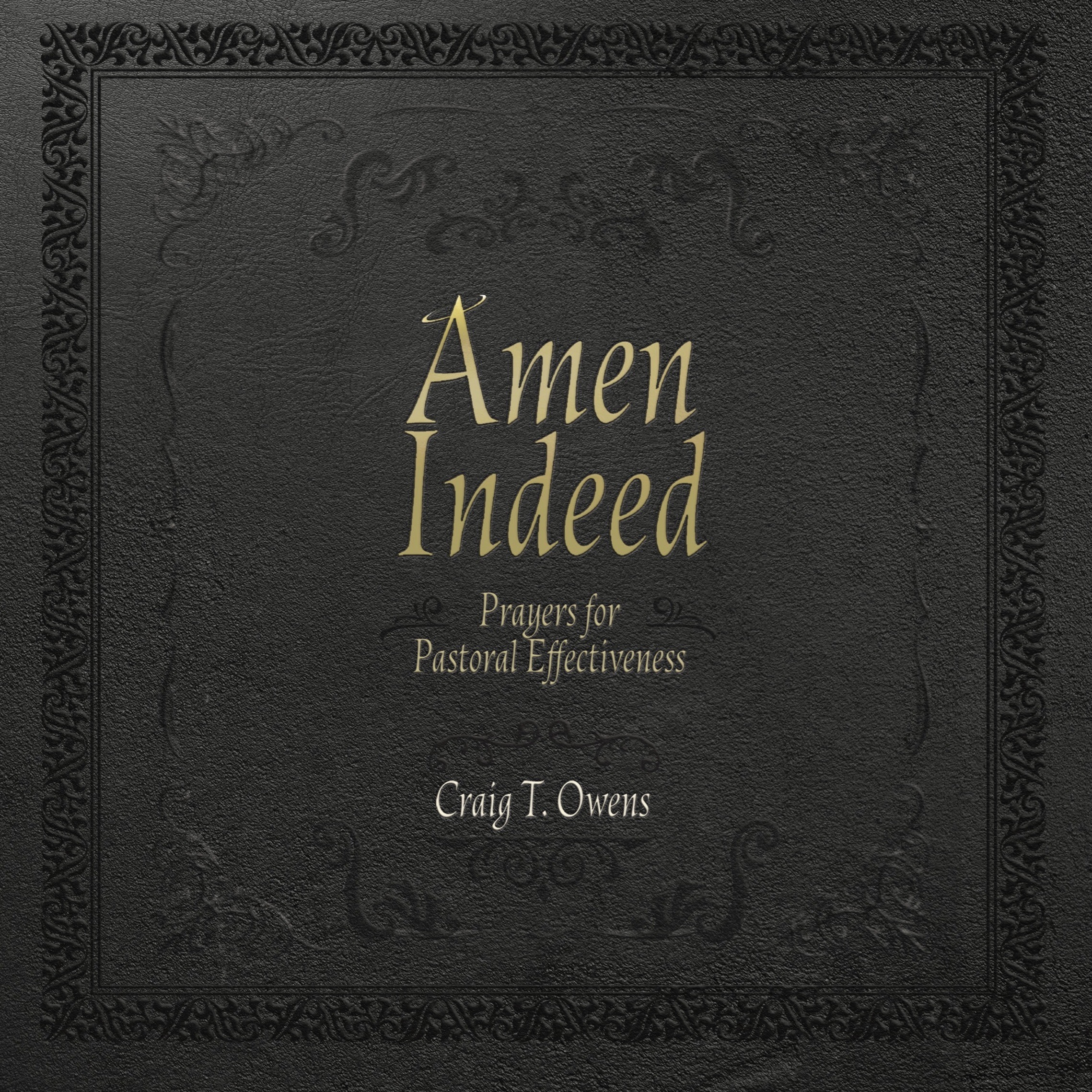
For pastors and shepherd leaders, my book Amen Indeed contains over 100 biblically-based prayers for many of the situations we face in our ministries. My prayer for you is that this book will help you learn how to use the Bible as your Prayer Book.

►► Would you please prayerfully consider supporting this ministry? My Patreon supporters get behind-the-scenes access to exclusive materials. ◀︎◀︎

Kept From Self-Deception

Keep me from lying to myself; give me the privilege of knowing your instructions. (Psalm 119:29 NLT) 

We all have a tendency to judge others by what they said or did, but we usually judge ourselves by what we intended to say or do. This is the essence of self-deception: lying to ourselves. 

In verse 18, the psalmist asks for his eyes to be open to the truth in God’s Word; in verse 29 the prayer is for him to see if he is truly applying that truth. We could personalize this prayer: “Give me the privilege of knowing that I am really applying Your instructions to my life.” 

Give me understanding and I will obey Your instructions; I will put them into practice with all my heart (v. 34). May the Holy Spirit prompt me to do this today. Amen!

The Healing Word

Listen to the podcast of this post by clicking on the player below, and you can also subscribe on AppleSpotify, or Audible. 

If you go to the doctor because you sense that something is wrong, you want your doctor to tell you the truth. A doctor who avoids telling you the truth because it might hurt your feelings doesn’t put you on the road to recovery. 

If this is true for medical doctors, isn’t it more important for soul doctors? After all, even the best doctors cannot keep your physical body alive forever, but your soul will live eternally. 

If God has given you His Word to share, He says, “I will make My words fire in your mouth” (Jeremiah 5:14). Deliver that painful—but absolutely vital—diagnosis to help people recover from the ravages of their sin. 

To soften the words, to water-down the medicine for the sake of people’s feeling or for the desire to be liked by people, is to become a quack, a false prophet. God says of these charlatans, “They dress the wound of My people as though it were not serious. ‘Peace, peace,’ they say, when there is no peace” (Jeremiah 6:14, 8:11). 

Then God says,

The prophets prophesy falsely, and the priests exercise rule at their own hands and by means of the prophets. And My people love to have it so! But what will you do when the end comes? (Jeremiah 5:31) 

The healing word is often a hard word. It might even be considered by those plagued by the ravages of sin to be a harsh and painful word. But the only path to healing is the medicine found in God’s Word—the healing balm that comes from exposing my sin, repenting of my sin, and finally enjoying the healing of God’s forgiveness. 

We must always speak the truthful healing word in love because eternity is at stake! 

►► Would you please prayerfully consider supporting this ministry? My Patreon supporters get behind-the-scenes access to exclusive materials. ◀︎◀︎

Study To Apply

Listen to the podcast of this post by clicking on the player below, and you can also subscribe on AppleSpotify, or Audible. 

Jude calls Christians to contend for the faith without contention and without compromising the truth. Last week we learned that one of the first disciplines to help us do this is: Study God’s Word and then study it some more. 

What do we mean by using the word “study”? 

Paul counsels his friend and protege to study God’s Word (see 2 Timothy 2:15 in the KJV). But the word study (Greek: spoude) simply means diligence aimed at a goal. So what’s the goal? To contending for the truth (2 Timothy 2:14-18, 22-26). Jude is addressing a similar issue ( see Jude 4).

(Check out all of the Scriptures in this post by clicking here.)

Just as Paul told Timothy to stick with “the Word of truth,” Jude says we need to be reminded of God’s Word (Jude 5). 

Jude is writing to people who probably have first hand—maybe even eyewitness experience—knowledge. They have either heard it from someone who was right there, or perhaps from a friend who heard it from someone who was there. And yet, certain godless men have already slipped in among you and are teaching lies. 

Jude goes back to Scripture (vv. 5-7): 

  • Israelites delivered from Egypt rebelled against God and died in the wilderness 
  • angels who were in God’s presence were expelled from heaven and await an eternity in hell 
  • the residents of Sodom and Gomorrah experienced deliverance from Abraham but chose to debase themselves 

Jude says, “In the very same way, these dreamers pollute their own bodies” (v. 8) by changing “the grace of our God into a license for immorality” (v. 4). 

So we study the Scripture to apply it first to our own lives (James 1:22-25).  

Jude uses four examples of people who knew the Word of God intimately, but in their pride wouldn’t apply it to themselves: Lucifer, Cain, Balaam, and Korah (vv. 9-11).

  1. The devil—pride is what turned Lucifer into satan. 
  2. The way of Cain—God warned him about sin crouching at his door, but he ignored it.
  3. Balaam’s error—he tried to calculate how close to disobeying he could get without actually disobeying because he wanted earthly rewards. 
  4. Korah’s rebellion—the Greek word for “rebellion” is antilogia: literally anti + Logos, or contradicting the Word of God. 

Jesus warned the most learned men of His day against this (John 5:39-40) and we need to humbly receive God’s Word in order apply to our lives. 

If I don’t diligently study the Scripture, I cannot apply it to my life and I am doomed to repeat the same fatal errors. I must study God’s Word diligently so that it can change me. Only then may I teach others (1 Timothy 1:3-7). 

If you’ve missed any of the other messages in this series from the Book of Jude, you can find them all here. 

►► Would you please prayerfully consider supporting this ministry? My Patreon supporters get behind-the-scenes access to exclusive materials. ◀︎◀︎

Teaching Good Counsel

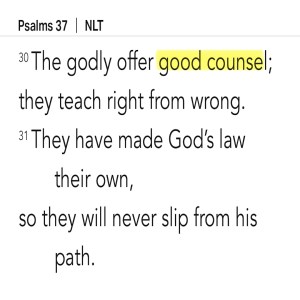
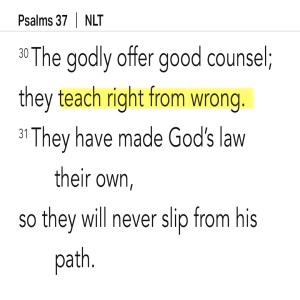
The godly offer good counsel; they teach right from wrong.. (Psalm 37:30) 

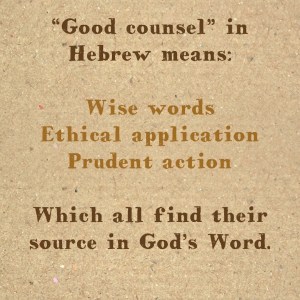
“Good counsel” in Hebrew means:

  • Wise words 
  • Ethical application 
  • Prudent action 

      …which all find their source in God’s Word. 

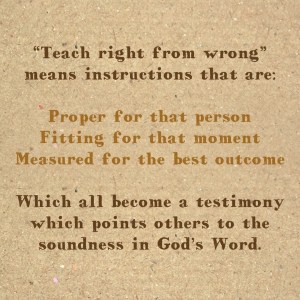
“Teach right from wrong” means instructions that are:

  • Proper for that person 
  • Fitting for that moment 
  • Measured for the best outcome 

     …which all become a testimony which points others to the soundness in God’s Word. 

Again And Again And Again

Listen to the podcast of this post by clicking on the player below, and you can also subscribe on AppleSpotify, or Audible. 

I don’t know if this ever happens to you, but I’ve lost count of the number of times that this happens to me. I open up my Bible and begin reading right where I left off the day before, and as I’m reading, my attention is riveted by words that seem to pop off the page! 

I look at them again and see that this passage contains highlights or underlining or notations from when I read here before. Yet I’m left scratching my head saying, “How did I miss this when I read this passage earlier?!” 

I know this is because I’m a different person now than I was the last time I was reading this passage. I’ve learned some things and hopefully I have grown in the process. Quite simply, the Holy Spirit knew I wasn’t ready earlier for the new concept that jumped off the page at me. 

The other day I was reading in the Book of Romans and I noticed something that Paul wrote—

     And, moreover, that the Gentiles might glorify God for His mercy. As it is written: “Therefore I will praise You among the Gentiles; I will sing the praises of Your name.” Again, it says, “Rejoice, you Gentiles, with His people.” And again, “Praise the Lord, all you Gentiles; let all the peoples extol Him.” And again, Isaiah says, “The Root of Jesse will spring up, One who will arise to rule over the nations; in Him the Gentiles will hope.” (Romans 15:9-12) 

Look at that wording: “As it is written … again it says … and again … and again….” Paul is telling us that God tells us the same thing in different ways, at different times, and through different voices. It’s the same message, but it resonates a little differently in each place. As God’s Word speaks to us again and again and again, we see the richness and fullness of the message. 

In v. 9, Paul quotes David in 2 Samuel 22:50 and Psalm 18:49. 

In v. 10, the quotation is from Moses in Deuteronomy 32:43.

In v. 11, an anonymous psalmist in Psalm 117:1 is quoted. 

And in v. 12, Paul quotes the prophet Isaiah in Isaiah 11:10. 

(Check out all of these Scriptures for yourself by clicking here.)

The Jews considered the Holy Scripture to be divided into three sections: The Law, the Prophets, and the Writings. Look again what Paul did: 

  • He quotes Moses from the Law 
  • He quotes Isaiah from the Prophets
  • He quotes David and the anonymous psalmist from the Writings

Jesus said, “Do not think that I came to destroy the Law or the Prophets. I did not come to destroy but to fulfill” (Matthew 5:17). And after His resurrection, as He walked and talked with a couple of disciples, He reminded them, “This is what I told you while I was still with you: Everything must be fulfilled that is written about me in the Law of Moses, the Prophets and the Psalms” (Luke 24:44). 

One of the reasons that the consistent message of the Scripture is repeated again and again and again is so that everyone will have a chance to hear it and believe it. 

There is such a beauty in this! I encourage you to take the time to look up the cross-references that many Study Bibles have put together. As you read the “it is written” statements in the Bible, I hope you will be encouraged as you see it throughout all the Bible again and again and again! 

Check out the book reviews I’ve shared on these study Bibles: 

I would also recommend 3 Bible studies for you to try and 2 more Bible studies for you to try. 

►► Would you please prayerfully consider supporting this ministry? My Patreon supporters get behind-the-scenes access to exclusive materials. ◀︎◀︎

The Best Sermons

Listen to the podcast of this post by clicking on the player below, and you can also subscribe on AppleSpotify, or Audible. 

This one is for my fellow pastors. I want to give you THE question to ask to help you in crafting the most applicable and memorable sermons. 

It’s a question that Paul asks in Romans 4: “What does the Scripture say?” (v. 3). Preachers must make sure they get their ideas from the text of the Bible, not just from their own good ideas. Look at this amazing example from Paul in just this one chapter of his letter to the saints at Rome. 

He starts off with a question: “What then shall we say?” (v. 1). 

Then he answers his question with another question: “What does the Scripture say?” and he proceeds to give his answer by quoting from the Book of Genesis. 

From this, Paul makes a conclusion in vv. 4-5 that is signaled by the word “Now…”. 

In order to support his conclusion, Paul then quotes from Psalm 32: “David says the same thing” (vv. 6-8).

Next Paul alternates between questions and answers in vv. 9-12, bringing this Q&A to a logical conclusion in vv. 13-16. 

He supports his conclusion with even more Scripture: “As it is written” (v. 17), and “Just as it had been said” (v. 18). 

Finally, Paul wraps up this part of his sermon by both quoting more Scripture (vv. 22-23) and then reminding his audience, “The words ‘it was credited to him’ were written not for him alone, but also for us” (vv. 23-24). This shows that God’s words weren’t just for Abraham, nor just for Paul’s audience, but for anyone reading the Scripture today.

This is a short, masterful, and powerful sermon! Why? Simply because it is totally banked on God’s timeless words. 

The way that preachers can design THE perfect sermon—that is both applicable and memorable—is to start with the same question Paul did: “What does the Scripture say?” 

►► Would you please prayerfully consider supporting this ministry? My Patreon supporters get behind-the-scenes access to exclusive materials. ◀︎◀︎

Links & Quotes

Christian parents often experience both a weight and a wait as they pray for their children. Biblical waiting is always active, calling us to continue to pray for our kids—not matter how old they are!

I have a lot of new video content on my YouTube channel every week. Please check it out and subscribe so you don’t miss anything.

The Institute for Creation Research reported: “Perhaps one of the top evidences for creation are the subcellular and incredibly efficient molecular protein machines that clearly function by known engineering principles. They are hardly simple. Determining just a part of their function requires the best science has in twenty-first-century technology: ‘While belonging to the nanoscale, protein machines are so complex that tracing even a small fraction of their cycle requires weeks of calculations on supercomputers.’”

Dr. Thaddeus Williams said, “What do you think is the most repeated phrase in the entire Bible? It’s, ‘Thus says the Lord…’ which clocks in at over 400 occurrences. The God of the Bible is not the stone-cold silent god of the ancient Greeks. Nor is He the stone-cold silent god of the ancient Stoics or Epicureans, too busy enjoying the amenities of divine bliss to bother with humanity. No. The God who exists is a God who speaks.” What does this mean for us? Dr. Williams talks about what happens to people who make time to regularly hear what God has to say to them through His Word.

“Work is the outcome of effort; fruit, of life. A bad man may do good work, but a bad tree cannot bear good fruit.” —Hudson Taylor 

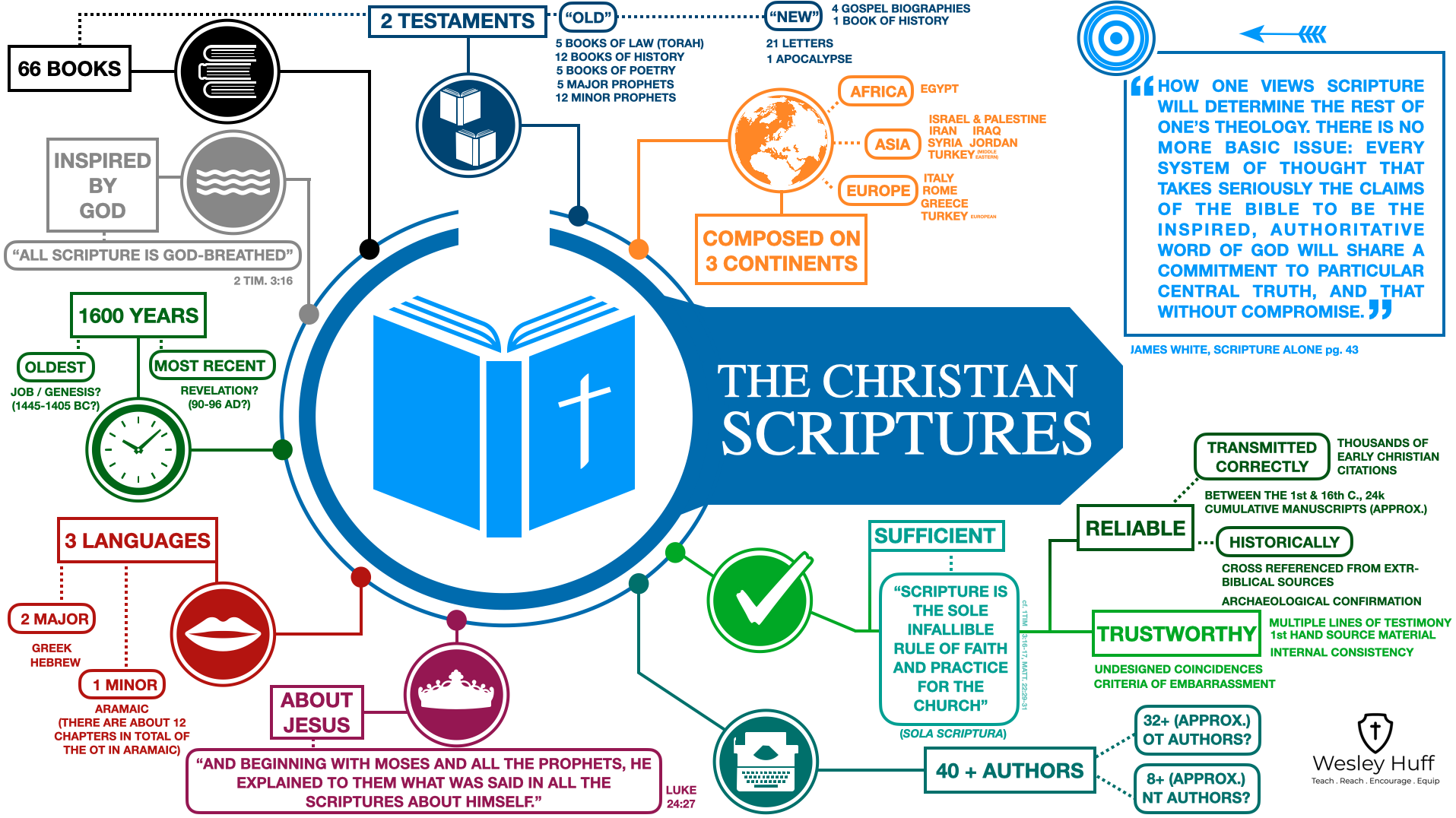
I love studying my Bible, and I also enjoy passing along things that encourage others to begin studying their own Bibles. This is a really cool infographic from Wesley Huff, giving a great overview of the Bible.

Dr. Steve Nichols has an interesting mini-biography of King Louis IX, whom some have called “the greatest king of the Middle Ages.”

J. Warner Wallace leads us all along “the fuse” that led up to the arrival of Jesus as the Messiah, the One to whom the Old Testament prophets predicted.

God’s Two Books

Happy (blessed, fortunate, enviable) is the man who finds skillful and godly Wisdom, and the man who gets understanding [drawing it forth from God’s Word and life’s experiences]. (Proverbs 3:13 AMPC)

Sir Francis Bacon wrote, “God has, in fact, written two books, not just one. Of course, we are all familiar with the first Book He wrote, namely Scripture. But He has written a second book called creation.” 

God’s Word tells us about our life’s experiences, and it tells us about our observations of His creation and our experiences. These observations and experiences should take us back to God’s Book to fully appreciate and apply them in a manner which glories God.

Wolf Deterrent

Listen to the podcast of this post by clicking on the player below, and you can also subscribe on AppleSpotify, or Audible. 

As Paul is on his way to Jerusalem, he makes time to meet with the leaders of the Church in Ephesus. An important reminder Paul gives them comes from the example he lived out while he was in Ephesus: “For I have not hesitated to proclaim to you the whole will of God” (Acts 20:27). 

Some translations say “the whole counsel of God,” but I like the simple, straightforward wording in the KJV: “all the counsel of God.” In other words, Paul’s textbook was everything in the Scriptures. 

One of Paul’s traveling companions was Luke, who made frequent use of the Greek word boulē, which is translated “counsel.” He is the only Gospel writer to use this word, and then he uses it seven more times in the Book of Acts. Putting together Luke’s usage of boulē with the three other appearances in the New Testament, we can come up with a good overview of what Paul meant by “the whole will of God.” 

Boulē tells us that…

  • God’s purpose always prevails (Acts 2:23, 4:28, 5:38, 13:36; 1 Corinthians 4:5; Ephesians 1:11) 
  • Man’s counsel can be flawed (Luke 23:51; Acts 27:12, 42) 
  • God’s counsel if immutable (Hebrews 6:17) 
  • Men who mutate God’s counsel are the wolves that seek to destroy the flock (Luke 7:29-30; Acts 20:27-31)

(Check out all of these Scriptures by clicking here.)

Paul warned these Ephesians leaders: 

Keep watch over yourselves and all the flock of which the Holy Spirit has made you overseers. Be shepherds of the church of God, which He bought with His own blood. I know that after I leave, savage wolves will come in among you and will not spare the flock. Even from your own number men will arise and distort the truth in order to draw away disciples after them. So be on your guard!… (Acts 20:28-31, emphasis added) 

In my book When Sheep Bite I have a chapter called’ Driving Away the Wolves.’ In that chapter I point out—

  There is a phrase that is often associated with the behavior of wolves: a lone wolf. Normally, wolves travel and live in packs. The phrase “lone wolf” is associated with those who leave in order to find a mate, carve out their own territory, and then form their own pack. 

   Jesus said that His sheep hear His voice and follow Him. Lone wolves hear the shepherd’s voice but ignore it to follow their own pursuit of forming their own pack. Remember that these lone wolves don’t want to stay alone: they want to build their own following.

Jesus said we could spot imposters—wolves in sheep’s clothing—by their fruits (Matthew 7:15-20). Two evident fruits are: 

  1. Mutating the immutable counsel of God’s Word to suit their own needs 
  2. Ignoring or criticizing the whole counsel of God’s Word that godly shepherd leaders faithfully teach and preach

For shepherd leaders and their flocks, the whole counsel of God’s Word is the best wolf deterrent you can find! Another passage from my book says—

   David’s beautiful description of the Good Shepherd in Psalm 23 has a phrase that sounds unusual to my ears. He writes, “Your rod and Your staff, they comfort me.” How can such wooden instruments bring comfort to sheep? When the sheep know their shepherd has the rod of God’s Word in his hand and is skilled at using it, the sheep are far more relaxed around the shepherd. This is because a shepherd’s rod is not used against the sheep, but only against the enemies of the sheep. 

   Throughout the Old Testament, the rods in the hands of leaders were the symbol of their God-appointed authority (think of the staffs of Moses and Aaron). Those rods were symbolic of the words God had spoken to these shepherds to empower them to lead His sheep. In the New Testament setting, the Bible is described in similar terms. Shepherds are directed to correctly handle the rod of God’s Word, knowing that His Word is the only thing that can reliably care for the sheep by teaching, rebuking, correcting, and training (2 Timothy 2:15, 3:16). The sheep will welcome this; the wolves will fight against this. 

Pastors, immerse yourself in the whole counsel of God’s Word. Not just the parts that are comfortable for you or pleasant to preach about, but all of God’s Word! This will strengthen the rod of leadership God has given you, it will bring health and comfort to the sheep in your flock, and it will be a strong deterrent against the wolves that would seek to infiltrate your pasture. 

I would also humbly recommend that you pick up a copy of my book When Sheep Bite to help resource you to heal from old or ongoing injuries, and to fortify you to remain faithful to the call God has on your ministry. 

►► Would you please prayerfully consider supporting this ministry? My Patreon supporters get behind-the-scenes access to exclusive materials. ◀︎◀︎