A Christlike Response To Skeptics

Listen to the podcast of this post by clicking on the player below, and you can also subscribe on AppleSpotify, or Audible. 

God is precise in His promise making and promise keeping. He doesn’t just fulfill promises in a vague way or in “the spirit of the law,” but He attends to the jots and tittles of every single detail.  

Last week we saw the example of Jesus going into a dark place to bring the light of hope. It’s the same for us: God uses circumstances to direct our steps into dark places because people need to see the light. 

But people living in darkness sometimes don’t like the light. 

When we feel like our message of hope is being ignored or rejected (or we’re even being persecuted for sharing the truth) we have a natural emotional response that begins to bubble up. That emotion is anger. How do I know this? Because Jesus experienced this too. 

We can do two things with our anger: 

  1. We can blast skeptics with righteous judgment <or> 
  2. We can follow the example of Jesus  

In The Pilgrim’s Progress, Faithful told how a man came and beat him because he had broken the law. Even when Faithful begged for mercy the man said, “I don’t know how to show mercy to anyone.” This man was Moses the Lawgiver. Faithful explained what finally gave him relief: “He would have finished me off, but then One came by, and told Him to stop. I did not know Him at first, but as He went by, I saw the holes in His hands and in His side and I concluded that He was Jesus.” 

Moses had every right to be angry, and he expressed it a way that tried to finish off Faithful. 

Jesus also got angry, but let’s see what He did with it. 

(Check out all of the Scriptures I list below by clicking here.)

In Matthew 12:9-10 we see the motive of the skeptics: catch Jesus doing something wrong. This opposition came from the religionists—they weren’t interested in the truth, they were interested in proving themselves right and righteous. 

As they are asking their entrapping question, Luke tells us that “Jesus knew what they were thinking” (Luke 6:8). And Mark tells us that Jesus then asked a question of His own (Mark 3:4-5). These religionists refused to answer His question, and their stubborn hearts made Jesus deeply angry! 

So Jesus answered His own question, concluding that the Sabbath was the day that god intended for healing and helping. To prove this point, Jesus then healed the shriveled hand of the man who stood before Him (Matthew 12:11-14). In response to this, the Pharisees plotted with the Herodians on how to kill Jesus (Mark 3:6). 

Matthew then writes, “Aware of this, Jesus withdrew from that place (Matthew 12:15). He didn’t withdraw in fear, but in complete awareness of His Father’s plan. Part of that plan was not for Jesus to win argument, but for Him to win souls. 

Perhaps in His anger in the moment, Jesus would have spoken words that were too harsh. There is a time to speak, but it’s usually not in the heat of the moment. In fact, Laurence J. Peter rightly said, “Speak when you are angry, and you will make the best speech you’ll ever regret.” 

So in fulfillment of another prophetic word given in Isaiah 42, Jesus withdrew to continue His teaching and healing ministry (Matthew 12:17-21). 

What does this mean for us today? I think we can see five important responses in these prophetic words: 

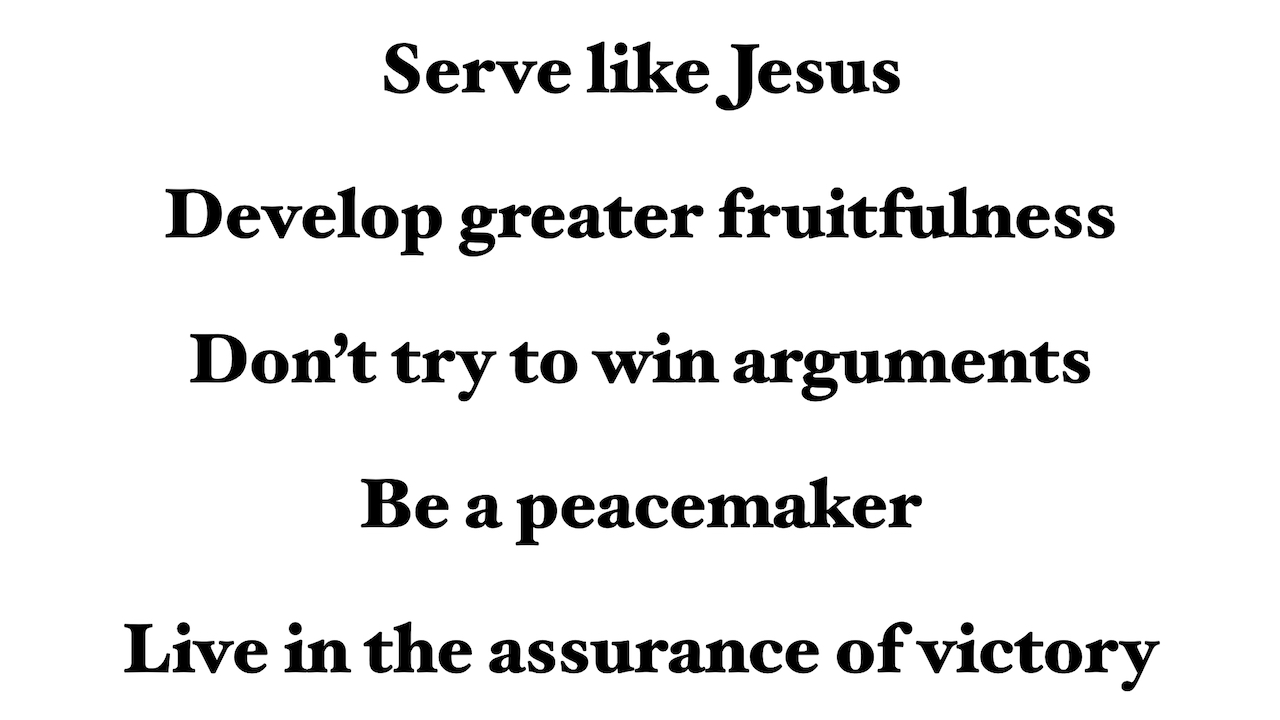
  1. I am to serve others as Jesus did—even those who want to silence me.  
  2. I can let the Holy Spirit use this opposition to bring greater fruitfulness out of my life (Galatians 5:19-26).  
  3. I don’t need to win an argument with skeptics. 
  4. I can be a peacemaker that points people to the Prince of Peace (1 Peter 2:8-12). 
  5. I should live in the assurance of ultimate victory, just as Jesus did (1 Peter 2:23).  

God gets the final word, the decisive word, and the best word, so I don’t have to try to win arguments with skeptics. Like Jesus, I can love and serve in a way that leaves them an unmistakable testimony. 

To check out the other messages in this series called Jots and Tittles: Why it matters that God is in the smallest of details, please click here. 

►► Would you please prayerfully consider supporting this ministry? My Patreon supporters get behind-the-scenes access to exclusive materials. ◀︎◀︎

Walking Boldly In Dark Places

Listen to the podcast of this post by clicking on the player below, and you can also subscribe on AppleSpotify, or Audible. 

I was reading the results of a survey which said one of the top traits for exemplary leaders was: They keep their word. 

But don’t we really mean, “They keep their word most of the time”? After all, we do allow those who have a track record of integrity an “out” for unusual or unexpected circumstances. And we would still say that leader had honesty and integrity. 

God always keeps His word. He never needs an “out” because nothing is ever unexpected for Him! He is always the Promise Maker and the Promise Fulfiller (Isaiah 42:9, 46:10, 55:10-11; Jeremiah 1:12). 

I like the way Jesus sums up these statement from His Father: For assuredly, I say to you, till heaven and earth pass away, one jot or one tittle will by no means pass from the law till all is fulfilled (Matthew 5:18 NKJV). 

A  jot is the smallest Hebrew letter (yodh). In Greek the word is iota. This tells us that God is concerned about the smallest of details. 

A tittle is the precise difference between Hebrew letters like cheth and he, between daleth and resh, and between beth and kaph.  

All of these are fulfilled—brought to their perfect completion (Luke 1:37, 22:37)! 

When we see any of God’s promises made and kept, we need to ask ourselves three questions:

  1. What did it mean then? 
  2. What does it mean now? 
  3. What does it mean for me today? 

For example, look at the promise that was made about people living in a very dark place seeing the Light of God. The prophecy is first made in Isaiah 8:19-9:7 that the people of Zebulun and Naphtali would get to see and experience the light of the Messiah. 

Matthew 4:11-17 tells us that after Jesus endured the temptation of the devil for 40 days, He went to Capernaum—the region of Zebulun and Naphtali. But before He arrived there, He was first rejected by the folks in His hometown of Nazareth (see Luke 4:14-31). 

Our God who knows the end from the beginning never makes a mistake; nothing is ever random or inconsequential. We should develop the habit of praying, “Now that this is happened, what would You have me do?” As Jesus was rejected by the people who should have been so excited to see His ministry flourish, He wasn’t dismayed or discouraged, but He directed His steps toward Capernaum. 

In my heart, I may plan a course for my life, but I must trust God to direct my steps. My life has a purpose. Just as the Holy Spirit directed the movements of Jesus, He is directing my steps. 

Even when God seems to have directed my steps into a dark place, He has sent me there as His light. I am sent on purpose. I walk a path Jesus has already walked, and a path that He is still walking with me—He guides me in paths of righteousness for His name’s sake. Even though I walk through the valley of the shadow of death, I will fear no evil, for You are with me (Psalm 23:3-4). 

I don’t walk into the darkness in my own strength or as a way to fulfill my own plans but instead I trust that “the zeal of the Lord Almighty will accomplish this” (Isaiah 9:7)! 

Because Jesus is fulfilling every jot and every tittle, I can live confidently in Him! 

If you would like to follow along with all of the messages in this series called Jots and Tittles, you can find them all here. 

►► Would you please prayerfully consider supporting this ministry? My Patreon supporters get behind-the-scenes access to exclusive materials. ◀︎◀︎
Jots And Tittles

As we get closer to the death and resurrection of Jesus, there are an increasing number of prophecies that are fulfilled in these events. Jesus appears to have been very attentive to making sure that each and every one of these prophecies were fulfilled to the smallest detail. 

Near the beginning of His public ministry, Jesus noted that not one iota—or “one jot or tittle” in the Old English vocabulary—of any of God’s promises would be left unfulfilled (Matthew 5:18). It’s amazing that Jesus so carefully attended to all of these, but it’s also important to ask ourselves what these fulfilled prophecies mean to us today. 

This is what we are going to be unpacking in our series Jots and Tittles. I hope you can join us, but if you have missed any of the messages in this series, you will be able to find them all right here—

“God Said”

Listen to the podcast of this post by clicking on the player below, and you can also subscribe on AppleSpotify, or Audible.

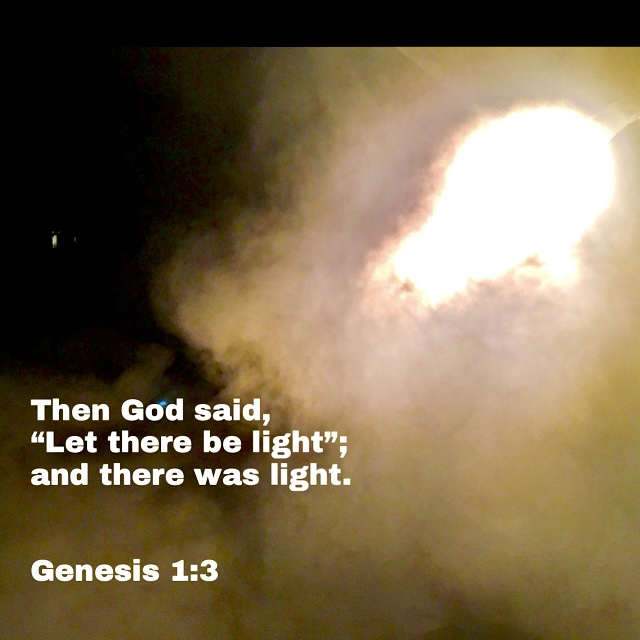
And God said, “Let there be light,” and there was light (Genesis 1:3).

“God said.” His words literally became substance! 

Those who deny a Creator claim that this whole universe came into being by chance. But they still cannot get away from the fact that there was “something” there—some basic elements—that interacted to start the process. The Bible tells us that the “something” was actually Someone—Jehovah God! 

The New Defender’s Study Bible notes: 

“No other cosmogony, whether in ancient paganism or modern naturalism, even mentions the absolute origin of the universe. All begin with the space/time/matter universe, already existing in a primeval state of chaos, then attempt to speculate how it might have ‘evolved’ into its present form. Modern evolutionism begins with elementary particles of matter evolving out of nothing in a ‘big bang’ and then developing through natural forces into complex systems.” 

Which requires more faith? To believe that all of the order and perfection in our universe—from the astronomical to the sub-atomic—came to be by mere chance? Or that the perfect design we see came into being by a Perfect Designer? It seems to me that it takes tremendously more faith to be an atheist. 

Check out this recent post from the Institute for Creation Research:

“It is appropriate for Christians to begin the New Year by referring back to the beginning of the very first year. The first verse of God’s Word is also its most important verse, since it is the foundation on which everything else is built. Even God’s great work of salvation is irrelevant and futile without His prior work of creation, for only the Creator of all things could ever become the Savior of all things. If a person really believes Genesis 1:1, he or she should have no difficulty believing anything else in the Bible.” 

I trust the God revealed to us in His Word and in His Creation. He has proven Himself faithful over and over again, never giving me a reason to doubt that He is who He says He is. 

“God said” is the encouraging, faith-building promise I cling to!

►► Would you please prayerfully consider supporting this ministry? My Patreon supporters get behind-the-scenes access to exclusive materials. Like a first look at the cover of my brand new book. ◀︎◀︎

Helping Skeptics See The King

Listen to the podcast of this post by clicking on the player below, and you can also subscribe on AppleSpotify, or Audible. 

I once worked with a guy that was the epitome of “all talk and no action.” After a while people just stopped listening to him or believing anything he said. But something worse is someone who says he will do something but doesn’t have the power to finish what he started. In that case, you may have believed him and not taken any steps of your own, so when he finally admits defeat, you are totally unprepared to step in to help finish the task. 

I think that comes close to the two attitudes people had prior to the First Advent of Jesus in Bethlehem. Some people thought all of God’s promises had just become “all talk and no action.” 

But after Jesus began His public ministry, His skeptics may have originally thought He was also “all talk and no action,” but when they saw how the people responded to Him, they realized He at least had the power to sway a crowd. But they certainty didn’t think He could finish what He started. 

The religious elite—the Sanhedrin—had their own plans in the works, and it appeared to them that Jesus was just going to get in the way. So they hatched a plan to have Pontius Pilate, the Roman governor, have Jesus crucified. As Jesus is hanging on the Cross, you can hear the skepticism and derision in the voices of these religious elite—

In the same way the chief priests, the teachers of the law and the elders mocked Him. “He saved others,” they said, “but He can’t save Himself! He’s the King of Israel! Let Him come down now from the Cross, and we will believe in Him. He trusts in God. Let God rescue Him now if He wants Him, for He said, ‘I am the Son of God.’” (Matthew 27:41-43)

After all, they had experienced “messiahs” before (Acts 5:35-37) so they thought this Jesus from Nazareth was just the next in a long line of pretenders. “King of Israel, indeed! Ha!” 

But when someone tells you what they are going to do, and then they actually do it, skeptics are turned into believers. We see this happen in people like Nathaniel, a whole village of Samaritans, and one of the thieves that was crucified alongside Jesus (John 1:43-51; John 4:9-42; Luke 23:39-42)

Even though Jesus told His disciples exactly what was going to happen to Him in Jerusalem—and then it did!—they were still skeptical of the claims of His resurrection until they saw it for themselves (Matthew 20:18-19; John 20:3-8). 

Just like the prophets told us how Jesus would come from a virgin and be born in Bethlehem—and then it happened!—so Jesus foretold His death and resurrection. 

There is a common theme here that turned all these skeptics into believers:

  • Philip said to Nathaniel, Come and see Jesus” 
  • The Samaritan woman said to her fellow townsfolk, “Come and see Jesus”  
  • The criminal saw and heard Jesus’ loving words when He forgave His crucifers 
  • And the doubting disciples ran to the tomb and “saw and believed” 

(See John 1:46; John 4:29; Luke 23:34; John 20:8) 

Skeptics need to see and hear for themselves that Jesus has the power to do what He says He will do. We are the ones that preach this Good News to them by the way we live. 

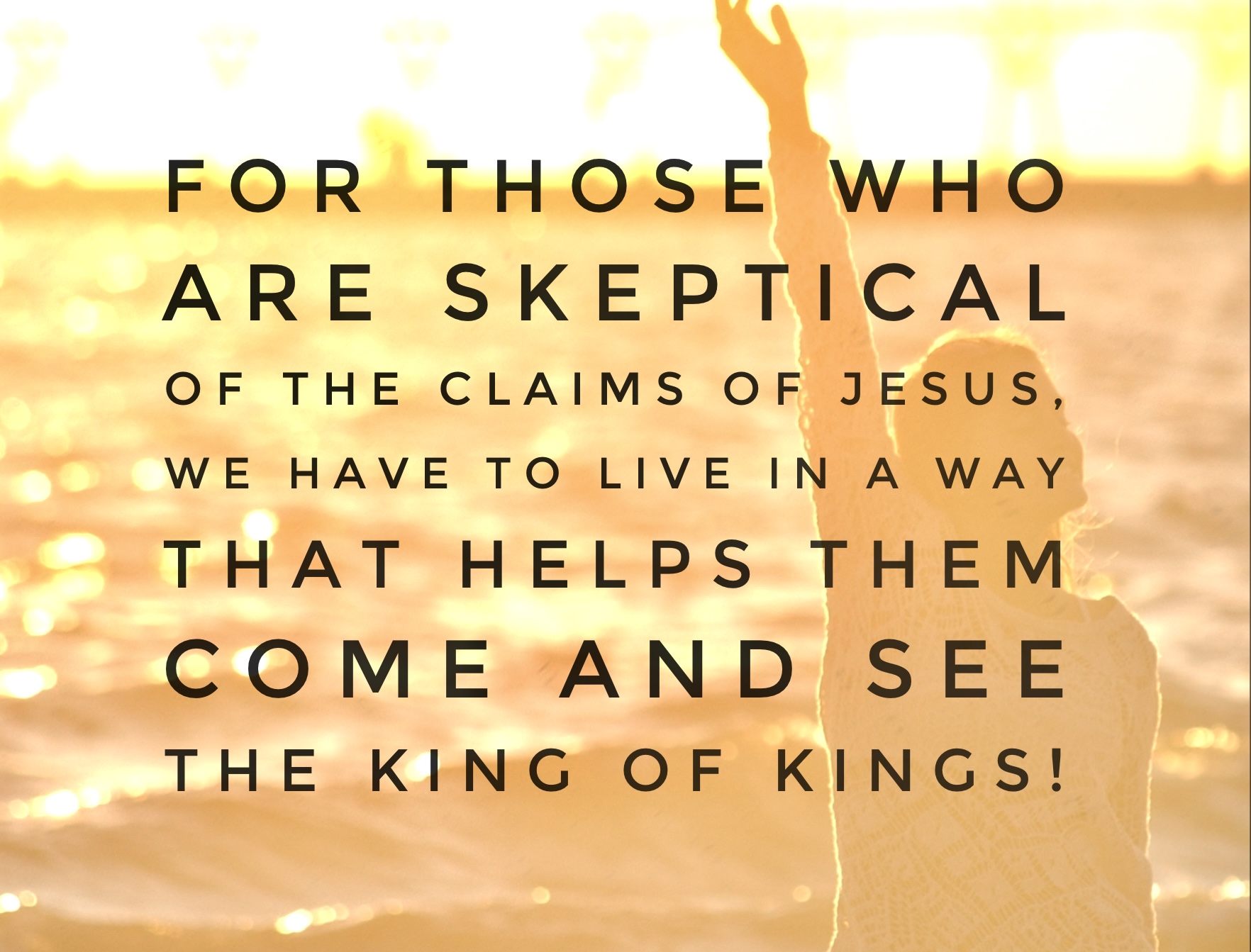
We have to live as good citizens of the King of kings so that people will “come and see” what a good and loving King He is. For those who are skeptical of the claims of Jesus the King, we have to live in a way that makes it real. We have to help them see the King of kings! 

Advent isn’t just a long-ago event that we fondly remember. The First Advent is proof that God has the power to keep His word. And just as we have seen the First Advent, so we will see the Second Advent. 

If you’ve missed any of the messages in this Advent series, you can check them all out here. 

►► Would you please prayerfully consider supporting this ministry? My Patreon supporters get behind-the-scenes access to exclusive materials. Like this video where I explain what the Bible means when we “examine” our lives. ◀︎◀︎

Faith Fueled By The Promise

Listen to the podcast of this post by clicking on the player below, and you can also subscribe on AppleSpotify, or Audible. 

Last week we looked at the amazing genealogy in Matthew 1 that connects Jesus to King David! 

After this genealogy, we read that an angel says to Joseph, “Joseph son of David, do not be afraid to take Mary home as your wife, because what is conceived in her is from the Holy Spirit” (Matthew 1:20). And then notice this commentary from Matthew—

All this took place to fulfill what the Lord had said through the prophet: “The virgin will conceive and give birth to a Son, and they will call Him Immanuel” (which means “God with us”). (Matthew 1:22-23)

Matthew says, “all this took place to fulfill what the Lord had said.” All what? Everything that came before that statement: the genealogy with all its exceptional items, the 70-year exile of the Jewish people, the Immaculate Conception, the fulfillment of a 700-year-old prophecy. 

I find this absolutely astounding! And so, apparently, did Joseph!  

But remember that Jesus is not only “the son of David” but He is also called a “son of Abraham.” This means that Jesus came to be more than just the King of the Jews. 

We have a cliché that says something like, “Don’t miss the forest for the trees.” By this, we mean that sometimes in the moment we only see one large tree or obstacle in front of us and we miss seeing the majesty of the whole forest. Or maybe we only see the obstacle and not the path that would take us where we need to go. 

We are living between the Advents now so you would think that we have a good “forest” perspective, but even we sometimes get bogged down in the moment, wondering what God is doing. The story of Abraham should help us to see the whole forest of God’s plan a little better. 

In Genesis 12:1-3 we read God’s promise to Abraham that all people on earth would be blessed by his obedience to God’s call. Listen to the opening words of Stephen’s sermon as he looked back on this—

The God of glory appeared to our father Abraham while he was still in Mesopotamia, before he lived in Harran. “Leave your country and your people,” God said, “and go to the land I will show you.” So he left the land of the Chaldeans and settled in Harran. After the death of his father, God sent him to this land where you are now living. (Acts 7:2-4) 

Stephen reminds us that God spoke to Abraham while he was still living in Mesopotamia. Abraham must have shared this promise with his father because in Genesis 11:31 we read that Terah takes Abraham, Sarah, and Lot with him to make this journey, but they only traveled as far as Harran. 

Why did they stop here? We’re not sure. Perhaps Terah was still grieving the death of his youngest son who had died before they left. Maybe Terah was concerned about his middle son Nahor who chose not to travel with them. Or maybe Terah was paralyzed by the magnitude of the journey still ahead of them. Whatever the reason, Terah allowed a “tree” to obscure his view of the whole “forest” of God’s plan. 

Stephen then says that Abraham continued the journey to Canaan “after the death of his father.” But if we do the math, it appears that Terah was still biologically alive when Abraham left (see Genesis 11:26, 32; 16:3, 16). 

Abraham had to trust God more than he respected his father, even to the point of considering his father as dead. 

Later on, God gave Abraham a similar test with his own son. Abraham passed this test and God repeated His promise about blessing all people through Abraham (see Genesis 22:1-18). 

In Romans 4, Paul explains that Abraham’s faith in God’s promise was rewarded, and that through our faith in Jesus we are connected to this same promise. 

Just as there was an “all this took place to fulfill what the Lord had said” about Jesus—including the faith-filled obedience of Abraham and David—God has an “all this” for your life too. 

God saw you before you were born. He had a plan for your life. He gave you gifts and talents to be used for His glory. There is not a single part—not a single experience—of your life that is accidental (Psalm 139:16; Ephesians 2:10; Romans 8:28). 

Just as He used all this for Jesus, He is using all this for your life too. Will you trust Him? 

Through David, God fulfilled the promise that Jesus would be King of the Jews. Through Abraham, God fulfilled the promise that Jesus would be King of all nations. Through Jesus, God fulfilled the promise that Jesus would be our Righteousness. 

Abraham died without seeing the promise fulfilled. But we have seen the promise fulfilled, and that should fuel our faith to trust God to fulfill the promise He has for each of us. I pray that this assurance will be renewed in your heart as you celebrate Advent this year. 

If you’ve missed any of the messages in our series called Long Live the King of Kings, you can check them all out here. 

►► Would you please prayerfully consider supporting this ministry? My Patreon supporters get behind-the-scenes access to exclusive materials. Like this video where I talk about the logic in Psalm 119. ◀︎◀︎

Keep Walking

Listen to the podcast of this post by clicking on the player below, and you can also subscribe on AppleSpotify, or Audible. 

What do you do when it appears that your dream has died? I’ve got two words for you: Keep walking. 

Check out this episode of The Podcast.

Some resources to go along with this video:

►► Would you please prayerfully consider supporting this ministry? My Patreon supporters get behind-the-scenes access to exclusive materials. ◀︎◀︎

Links & Quotes

Leaders, you need to determine the coachability factor before you start trying to coach a teammate. Check out our full conversation on The Craig and Greg Show. I have lots of new content every week, which you can check out on my YouTube channel.

Sextortion is when someone demands money or other favors in exchange for not sharing an explicit photo or video of the targeted victim. The sextortion of minor children runs into the thousands every month. Axis reported, “Most targets of sextortion are teen boys, who seem to be more likely than girls to send an explicit selfie to someone they aren’t having a romantic relationship with. Anonymous scammers will reach out to their target over social media, engaging in a flirtation and eventually asking for nudes.” Axis also shared these helpful resources, “Families can prepare by telling their teens about resources like TakeItDown, a free service which will remove nudes from the internet within two days, and the 24/7 Crisis Text Line, which connects teens with professional counselors via text at any time.”

“First, government is not God; instead, government is God’s servant for the good of those served. And second, the people are not God, and therefore must not be allowed the last word on what defines the terms of ‘good’ public policy. Only God can define what is good for people, for He alone is good (Mark 10:18; Psalm 119:68).” —T.M. Moore

“Since the Roe v. Wade U.S. Supreme Court decision more than 50 years ago, almost 40% of all abortions in America have been in the Black community, resulting in erasing the lives and destinies of an estimated 23 million Black babies.” The National Black Fellowship is aggressively working to change this.

Can New Testament Christians claim Old Testament promises? Yes! John Piper shares 8 “filters” to help us with this application.

“You gain strength, courage and confidence by every experience in which you really stop to look fear in the face. You are able to say to yourself, ‘I have lived through this horror. I can take the next thing that comes along.’ You must do the thing you think you cannot do.” —Eleanor Roosevelt

J. Warner Wallace uses forensic evidence to demonstrate why we should believe the New Testament was written much closer to the time of the actual event than most skeptics believe. Check out this video.

Shift Your Faith

Listen to the podcast of this post by clicking on the player below, and you can also subscribe on AppleSpotify, or Audible. 

When Luke says first that “Jesus grew in wisdom,” that is our indication that a healthy mind is at the foundation for every other aspect of health (Luke 2:52). We don’t see Jesus anxious or worried, we don’t see Him confused in His thinking, or even indecisive of what to say or do. So by studying the life of Jesus—and the Scriptures on which He relied—we, too, can improve our mental health. 

This may sound unbelievable when you first read this, but I believe that at their foundation, anxiety and assurance are remarkably similar. The similarity is that they both have faith. 

The dictionary defines faith as a strong or unshakeable belief in something. The biblical definition of faith is remarkably similar: “Faith is confidence in what we hope for and assurance about what we do not see” (Hebrews 11:1). 

Using those definitions of faith, let me point out the similarity and the difference between the anxious mind and the assured mind:

  • Anxiety is faith or expectation that something bad is going to happen. 
  • Assurance is faith or expectation that something good is going to happen. 

But the biggest difference of all is seen in the mental health of the one worried and anxious about the bad things that are coming versus the one who is confidently assured of the good things that are coming. 

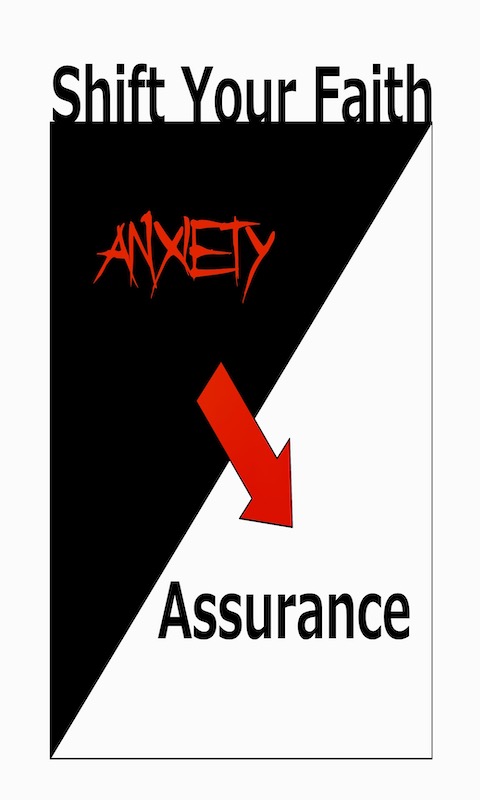
If we are going to be mentally healthy people, we need to shift our faith from anxiety to assurance every single time we feel the worry building in our hearts. This isn’t just changing our mindset but knowing what we believe and why we believe it. 

Assurance and anxiety both believe in the unseen. The assured person believes in God’s promises to provide all that we need, while the anxious person doubts their own abilities and resources will be able to sustain them. 

As a result, the assured person has an abundance mindset, while the anxious person has a scarcity mindset. 

These feelings can be traced back to our faith about the origins of the universe. The assured person believes that God transcends this universe—that He existed before time began and spoke all created things into existence (Hebrews 11:3). But the anxious person is still trying to find answers in constantly-changing theories about the universe’s beginning. 

Since the anxious person thinks the universe’s beginning was an accident, they can easily wonder if their own life is an accident. But the assured person believes they have been uniquely and purposefully created by God to have eternal purpose (Psalm 139:13, 16; Jeremiah 1:5). 

Finally, the person who sees the universe and their own life as accidental becomes quite anxious and uneasy when they think about death, and what may or may not come on the other side. But the one who trusts God as their Creator is confident that God is their eternal reward (Hebrews 11:6). 

Hebrews 11 is filled with the accounts of assured people who shifted their faith away from anxiety—believing something bad was going to happen—to the assurance that God was bringing about something incredibly good! Hebrews 12 then invites Christians today to remember that cloud of witnesses and keep our eyes on Jesus, who is described as the Author and Perfecter of our faith, so that we don’t lose hope (Hebrews 12:1-3). 

I’ve previously shared seven strategies for a Christian to maintain a strong mental health. Our eighth strategy is a constant shifting of our faith away from anxiety to assurance. Every single time an anxious thought tempts us to believe something bad is coming, we need to make a shift toward the assurance of God’s goodness. 

Really quickly, here is how we can use the first seven strategies to help us make that shift: 

  1. Pray for the Holy Spirit to help you make a new path. 
  2. Notice your fearful or anxious words and pull them out by the root.  
  3. Confront the thought patterns that are causing fear or anxiety. 
  4. Talk back to those fearful thoughts with the truth from God’s Word. 
  5. Check the inputs that may be causing fear (poor diet, not taking time for solitude, anxious friends, etc.). 
  6. Focus on today—I like the words of the song “strength for today and bright hope for tomorrow! 
  7. Don’t look to escape, but take time to de-escalate. 

If you’ve missed any of the messages in this series on mental health, you can find all of them by clicking here. 

►► Would you please prayerfully consider supporting this ministry? My Patreon supporters get behind-the-scenes access to exclusive materials, like a 10-minute video I just shared on study tips for the poetic books of the Bible. ◀︎◀︎

Kept To Keep

Listen to the podcast of this post by clicking on the player below, and you can also subscribe on AppleSpotify, or Audible. 

Last week I reminded you that the main point in Hebrew literature is usually found in the middle. In Psalm 121 that would be the first phrase of verse 5: The Lord watches over you. 

But I notice something that seems contradictory in the New Testament. Whereas the message here is, “God watches over you,” the message in some New Testament verses seems to be, “You watch over yourself” (see for example Matthew 26:41; 1 Thessalonians 5:6; 1 Timothy 4:16). Paul even said to the Christians at Corinth, “I worked harder than all of them” (1 Corinthians 15:10). 

So which is it: Is God watching over us or are we to watch over ourselves? It’s actually both, but something important has to come first. We cannot watch over ourselves unless we are assured that the Lord is watching over us to sustain us. 

Okay, I was being a bit sarcastic when I said those verses seemed contradictory, as I clearly quoted them out of their context. For instance, in that statement from Paul in 1 Corinthians, check out the full verse, “But by the grace of God I am what I am, and His grace to me was not without effect. No, I worked harder than all of them—yet not I, but the grace of God that was with me.” Paul is clearly saying that he could only work hard because he was empowered by God’s grace. Notice that it is decidedly not the other way around: Paul doesn’t say, “I worked hard to earn the grace of God.” 

Remember that these psalms of ascent remind us of our upward look and our upward journey. We need to keep our eyes on the prize, which is God Himself (Psalm 121:1-2). Using the apostle Paul’s life as an example again, he said something very similar—

Not that I have already obtained all this, or have already arrived at my goal, but I press on to take hold of that for which Christ Jesus took hold of me. Brothers and sisters, I do not consider myself yet to have taken hold of it. But one thing I do: Forgetting what is behind and straining toward what is ahead, I press on toward the goal to win the prize for which God has called me heavenward in Christ Jesus. (Philippians 3:12-14) 

The middle verse of Psalm 121 foretells what appears six times in just eight verses: the Hebrew word samar. Depending on the translation of the Bible, this word is either “watch over” or “kept.” In either case, the meaning is a concentrated focus, not turning aside to the left or the right, not distracted, eyes on the ultimate prize. And all six of these instances are God’s unwavering, loving focus on us. In this song, we are told: 

  • God never slumbers or is even momentarily distracted (vv. 3-4) as opposed to other deities that were thought to sometimes be unavailable to their worshippers (see 1 Kings 18:27). Instead, our God watches us so closely that He notices if even a single hair falls from our head (Matthew 10:30-31). 
  • God stands beside us to protect our places of vulnerability (vv. 5-6). The Amplified Bible says, “The Lord is your shade on your right hand—the side not carrying a shield.”
  • God keeps us from the entrapment of evil (v. 7). Jesus told us that He was praying this way for us so we can have confidence to pray this for ourselves (Luke 22:32; Matthew 6:13).  
  • God protects us as His most precious treasure. David uses this same word samar in Psalm 17:8, “Keep me as the apple of Your eye; hide me in the shadow of Your wings.” 
  • God is our eternal Protector. The last phrase of this psalm says He watches over us “both now and forevermore” (v. 8).  

The other places the word samar is used in the Bible is a call for us to keep God’s commands. But just as we saw with Paul that he was committed to running his race well because he was assured of the prize Jesus had secured for him, so for us, we can only keep God’s commands because we are kept secure by God. 

Because we are kept by God we can keep His commands. In Deuteronomy 4, Moses applies the word samar to God’s people. We are to..

  • keep the commands of the Lord (v. 4) 
  • watch ourselves closely so we don’t forget what God has done for us (v. 9) 
  • be careful not to forget the covenant God paid for us (v. 23)
  • keep God’s decrees and commands as way a way to pass on God’s blessing to future generations (v. 40)

If God is not the One keeping and preserving me, it will be impossible for me to keep His commands on my own. The promise of His watchful keeping and preserving should fuel our prayer to watch over ourselves with all diligence. Read His promises, pray His promises, be assured of His ever-present help so that you can use His help to look out for yourself. 

If you’ve missed any of the others messages in our look at the Psalms of Ascent, you can find them all here.

►► Would you please prayerfully consider supporting this ministry? My Patreon supporters get behind-the-scenes access to exclusive materials. ◀︎◀︎