This is a weekly series with things I’m reading and pondering from Oswald Chambers. You can read the original seed thought here, or type “Thursdays With Oswald” in the search box to read more entries.
Jeremiah 14
[These are notes from Oswald Chambers’ lecture on Jeremiah 14.]
While one desire remains unsatisfied, God is not Lord over all. That means we must quit some desires or else quit God. Most of us bring our desires to God and He has to wither them. When we delight in God He gives us our desires because they are in accordance with His will (see Psalm 37:4).
From Notes On Jeremiah
Wow, there’s a lot to contemplate in that short statement.
Oswald Chambers references this verse: Take delight in the Lord, and He will give you the desires of your heart (Psalm 37:4).
And then there’s this—You will show me the path of life; in Your presence is fullness of joy, at Your right hand there are pleasures forevermore (Psalm 16:11).
Some things I’m contemplating:
Listen to the podcast of this post by clicking on the player below, and you can also subscribe on Apple, Spotify, or Audible.
Only Luke uses the Greek word for manger in all of the New Testament, with three of those instances being closely linked with the story of Christ’s birth in Bethlehem (Luke 2:4-16).
Luke is a prolific writer, but also a very specific writer. Luke uses more unique Greek words in his two books of the Bible than any other New Testament author. Because Luke is so precise, we need to pause to ask: what message was Luke trying to highlight in the fact that Jesus was born in a manger.
Here are three manger lessons…
The birthplace of Jesus was predicted 700 years before He was born (Micah 5:2). God moved the heart of the most powerful man in the world (Caesar Augustus) to issue a decree that would bring a nearly unknown Joseph and Mary to Bethlehem, and cause them to cross paths with a bunch of unnamed shepherds.
Jesus was not born to a handsome family (Isaiah 53:2), nor was He born to an influential family (Philippians 2:7). If He had been born to the high and mighty class, He would not only be unmoved by the desperate conditions of the least and the lost, but He would also be inaccessible to them.
Think about this—Who would you be more likely to have access to: a King or a peasant? Jesus came not to be served but to serve (Matthew 20:25-28).
God is pleased to deliver His good news to the disempowered, the downcast, the over-burdened, the desperate (Luke 2:14; Matthew 11:25-26). And what is this good news? The good news is that Jesus came to make it possible for us to be linked with Him forever! (see Matthew 11:28-30).
Jesus was born in a manger to show us that (1) God’s plans always prevail; (2) His priority is to rescue those who are unable to rescue themselves; and (3) He has immense pleasure to yoking us to Him forever and ever!
May this good news of Christ in manger bring you joy this Christmas season!
►► Would you please prayerfully consider supporting this ministry? My Patreon supporters get behind-the-scenes access to exclusive materials. ◀︎◀︎
If you’ve missed any of the other Christmas carols we have already looked at, you can check them out by clicking here.
“Why did Saul obey the people instead of God? Because he feared the people instead of God. He feared the human consequences of obedience more than he feared the divine consequences of sin. He feared the displeasure of the people more than the displeasure of God. And that is a great insult to God. … To turn from Him out of fear of what man can do is to discount all that God promises to be for those who fear Him It is a great insult. And in such an insult God can take no pleasure. On the other hand when we hear the promises and trust Him with courage, fearing the reproach brought upon God by our unbelief, then He is greatly honored. And in that He has pleasure.” —John Piper
“In the absence of any other proof, the thumb alone would convince me of God’s existence.” —Sir Isaac Newton
“No man knows how bad he is till he has tried very hard to be good. … We never find out the strength of the evil impulse inside us until we try to fight it: and Christ, because He was the only man who never yielded to temptation, is also the only man who knows to the full what temptation means—the only complete realist.” —C.S. Lewis
“What, sirs, is your wisdom? Your wisdom dwells in denying what your eyes can see—a God; in denying what your consciences tell you—that you are guilty; in denying what should be your best hope, what your spirit really craves after—redemption in Christ Jesus. Your folly lies in following a perverted nature, instead of obeying the dictates of One Who points you to the right path. You are wise and you drink poison; we are fools and we take the antidote. You are wise and you hunt the shadow; we are fools and we grasp the substance. You are wise, and you labor and put your money into a bag which is full of holes, and spend it for that which is not bread, and which never gives you satisfaction; and we are fools enough to be satisfied, to be happy, to be perfectly content with heaven and God.” —Charles Spurgeon
Seth Godin says, “Those critical choices you made then, they were based on what you knew about the world as it was.” Now check out his post New Times Call For New Decisions.
J. Warner Wallace, a cold-case detective, wrote, “I’ve worked more cases involving witnesses than I can even count. A career in law enforcement will put you in direct contact with eyewitnesses on a daily basis, starting with your very first night on the job. After interviewing literally thousands of witnesses over the course of twenty five years, I think I’ve learned something about reliable eyewitness testimony.” Check out more in his post Why We Should Expect Witnesses To Disagree.
Such a sweet video from a boy with Down Syndrome to his Dad on Fathers Day. I love the ending tag line: “Love doesn’t count chromosomes”—
We have been working through our series on the Book of Ephesians, and I am so excited to share the speaking responsibilities with Tom Kaastra. Tom pastored a church in the Detroit area for nearly 40 years, and he is bringing such a richness of knowledge to this series!
“If you had one son in whom you found unspeakable delight, would it not be normal as a father to want many more? It is exactly so with the Eternal Father, Who by nature and choice, has desired and purposed to have a vast family of human-divine sons who are just like His Only Begotten Son.” —DeVern Fromke
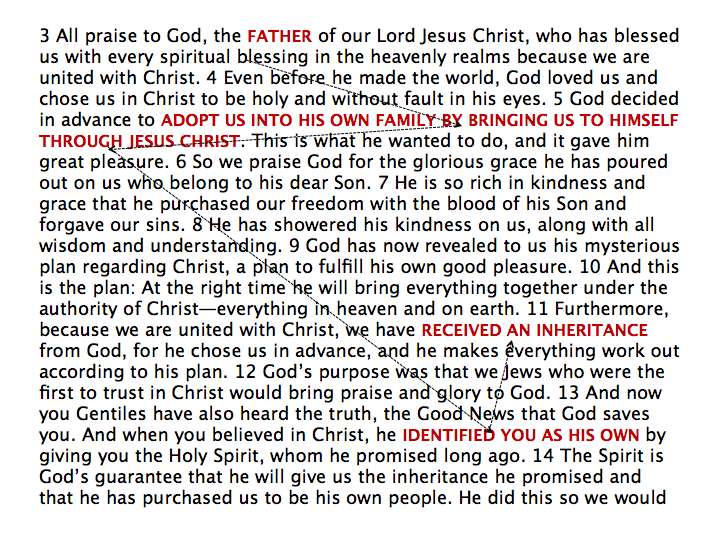
The opening section of Ephesians 1 is just loaded with words of God’s delight:
Not only is God’s delight so ample in this section, but so is be the praise toward God which should be bursting out from us:
What is this thing in which God is so delighted, and for which we should be so filled with praise?
It is quite simply this: God has revealed Himself to us as a loving Father, His Son has made it possible for us to come into God’s family, and the Holy Spirit has given us the assurance that we have been adopted by our Heavenly Father.
That’s right … God’s plan was to adopt you into His family. When did He come up with this idea?
God loves YOU so much that He had a plan from before the beginning of time to adopt YOU into His family. That’s what Jesus made possible through His death on the Cross, and what the Holy Spirit is constantly trying to reveal to YOU!! WOW!!
Please join us next Sunday as we continue our study on this amazing book in the Bible.
Listen to the podcast of this post by clicking on the player below, and you can also subscribe on Apple, Spotify, or Audible.
There’s a popular cliché that many motivators use to challenge people to go beyond where they are. They will cheer them on by saying, “C’mon, let’s raise the bar!” The only problem is, once someone clears the bar’s next height, they usually celebrate and then stop trying to go any higher.
Christians should be especially on guard against this mindset. It’s not a one-time thing. I don’t simply invite Jesus into my life and then set Him on a shelf. If I’m going to live a life that pleases God, I must learn how to do so more and more.
…We instructed you how to live in order to please God, as in fact you are living. Now we ask you and urge you in the Lord Jesus to do this more and more (1 Thessalonians 4:1).
The KJV says, “abound more and more.” This means that there is no set level I’m trying to reach, but that the level is always higher—there’s always more, my capacity is always increasing.
More and more is a single word in the Greek language. It means:
When the Holy Spirit speaks to me, do I respond and obey more willingly? more readily? sooner? If I do, then I am truly abounding more and more.
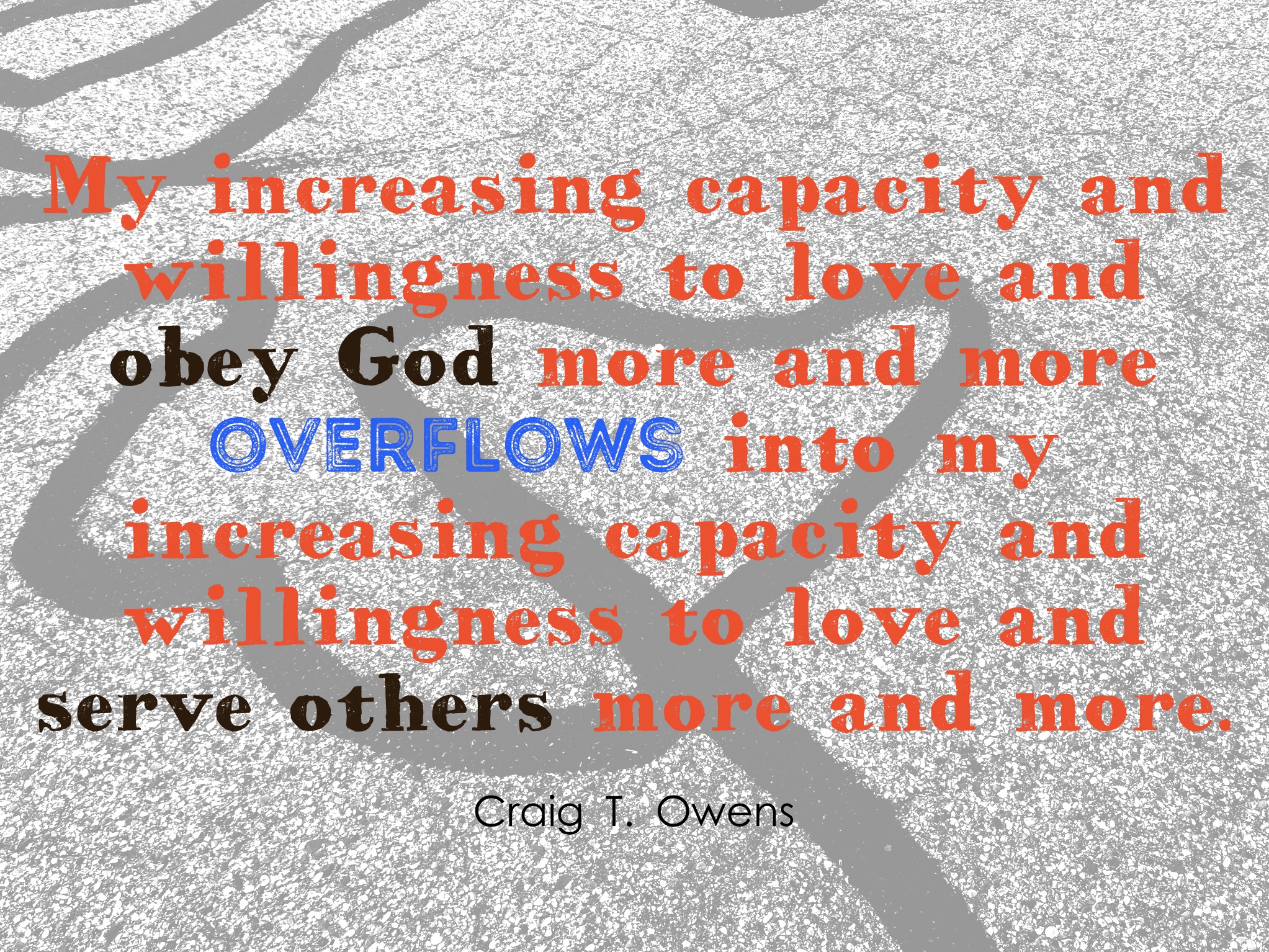
This relentless focus on pleasing God more and more then overflows in the way I cheer on and encourage my brothers and sisters. Paul uses the exact same Greek word for more and more when he says a few verses later: “We urge you, brothers, to [express brotherly love] more and more” (vv. 9-10).
My prayer for you and for me: Holy Spirit, help us to hear Your voice, to abound more and more in our obedience to Your direction, and to express our love more and more to others.
►► Would you please prayerfully consider supporting this ministry? My Patreon supporters get behind-the-scenes access to exclusive materials. ◀︎◀︎