Read The Red Letters

Read the red lettersLet’s see if you can guess what famous person said the following (the answers are below … but no cheating!):

  1. “The phonograph is of no commercial value.”
  2. “I think there is a world market for about five computers.”
  3. “I tell you Wellington is a bad general, the English are bad soldiers; we will settle the matter by lunch time.”
  4. “There will never be a bigger plane built.”
  5. “The world potential market for copying machines is 5000 at most.”

People get it wrong lots of times. Even really smart, successful people. King Solomon, who was called the wisest of all, wrote a book called Ecclesiastes in which he shared some bad advice he tried to follow. In the closing verses he gave this warning, “My son, be warned. Of making many books there is no end so do not believe everything you read, and much study is the weariness of the flesh” (Ecclesiastes 12:12).

In the Hebrew world there were three departments of knowledge:

  • Law―words from God to man
  • Prophesy―judgment from God on how man is doing in observing God’s law
  • Wisdom―man’s attempt to live out God’s law based on observation, experience, and reflection (for a great example of all three departments at work, see Luke 10:25-37)

What we need is someone who (1) knows God’s way, (2) lives God’s way, and (3) can teach us how to live out God’s way for ourselves. Someone who is perfect, flawless in every phase. We need the One Who said, “Heaven and earth will pass away, but My words will never pass away” (Matthew 24:35). That One is Jesus.

Can I make a suggestion that will bring you amazing results? Spend some time reading the red letters. That is, go to the Gospels of Matthew, Mark, Luke and John and focus on the words of Jesus (which many Bible translations print in a red font). There I am certain you will discover the greatest words ever spoken!

If you can, please join me over the next few Sundays as we will be attempting to discover the greatest words ever spoken on a variety of subjects. Folks have turned in the questions that they would like answered, and we are going to look to the red letters to see what Jesus has to say.

Answers to the quiz:

  1. Thomas Edison, remarking on his own invention 
  2. Thomas Watson, Sr., chairman of IBM
  3. Napoleon Bonaparte, at a breakfast with his generals preceding the Battle of Waterloo
  4. A Boeing engineer, after the first flight of the 247, a twin engine plane that held ten people 
  5. IBM board of directors, to the eventual founders of Xerox
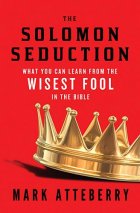
13 Quotes From “The Solomon Seduction”

Solomon SeductionThe Solomon Seduction is a biography on King Solomon, a Bible study, a book for men to overcome temptation, a leadership book, and a great discussion starter for a men’s group. In other words, there are lots of reasons for guys to read this book! You can read my full book review by clicking here, and below are some of the quotes I highlighted from this book.

“Moderation can be a great thing. But the idea that anything is okay as long as it’s done in moderation has given rise to some of the wackiest notions known to man. … One of the big problems with using moderation as a justification for whatever you want to do is that it’s almost impossible to take just a bite when you’re really hungry.” 

“Are you just a guy who goes to church, or are you serious about growing spiritually and acquiring discernment? satan’s chances of seducing you will rise or fall on your answers to these questions.”

“Solomon is the perfect example of the fact that you can have your cranium crammed full of discernment and still end up embarrassing yourself. Keep in mind, he not only knew the book of Proverbs, he wrote the vast majority of it! And then ended up doing many of the very things he himself said were foolish!” 

“All of satan’s various attempts at seducing believers must include an attempt to undermine Scripture.”

“What we have here is a case not of ignorance or confusion or misinterpretation, but of satan subtly and artfully manipulating Solomon’s thinking to the point where he felt the commands of God seemed out of touch with his real-world experience.”

“satan doesn’t try to get you to forsake your good priorities. He just encourages you to mix in a few lesser priorities that will compete with those good priorities.”

“Mark it down. When the word I starts replacing the word we in your speech, something ugly is happening in your heart. Your ego is swelling.” 

“Big-ego people almost never back up and take another look at their actions. Why should they? They’re convinced that everything they do is right. It never occurs to them that they might be on the wrong track. They’re so infatuated with themselves that they can see nothing but that beautiful image in the mirror.”

‘What’s the big deal?’ If ever a question spoke to the attitude of our generation towards sin, that one does. We shrug off sin as though it’s just a little harmless fun. You know, boys will be boys. Everybody sows some wild oats, right? Or, if we don’t play the what’s-the-big-deal card, we claim that the sin we are indulging in is actually necessary.” 

“Instead of repenting, instead of exterminating, illuminating, or correcting their bad behavior, [sin managers] try to manage it. They believe that if they can keep the behavior from getting out of hand, keep people from being hurt or offended, keep the status quo from being upset, keep the ugliness under wraps and out of sight, they can hang on to their sin and everything will be fine. … This is typical of sin managers. Instead of seeing sin as the problem, they see the awkwardness the sin creates as the problem and believe, therefore, that if they can find an answer for the awkwardness, they will have solved the problem.”

“In the category of cold, hard truths, this is a doozy: God doesn’t share the throne of your heart with anybody or anything. You either give it to Him wholly and completely, or He vacates it. You can tell yourself that God comes first and that the sin you’re harboring is just a little something you need to work on, but if you choose a lifestyle of sin management over repentance, you’ve pledged your allegiance to your sin, not to God.”

“Repentance is not what saves us; grace is. But repentance is a response to grace that makes what we are after having received grace different from what we were before. … Repentance concerns itself with how things are while sin management only worries about how things look. Think of a messy closet. Repentance cleans out the closet. Sin management straightens up the closet. Repentance throws away the junk. Sin management rearranges the junk. Repentance gives you a better closet. Sin management only gives you a better-looking closet.”

“When we see Solomon at the height of his idolatrous lifestyle, marrying and buying and indulging like an out-of-control sailor on a weekend pass, what does he say over and over again? ‘I said to myself…’ (Ecclesiastes 1:16, 2:1, 2:15, 3:17, 7:23). Solomon was talking to himself about a lot of things he should have been discussing with God. Who can argue that the reason why he was seduced and eventually reduced to an object of scorn and pity was because he excluded God from so many areas of his life?” 


Money & Hammers

Money checklistHammers are very similar to money. Don’t believe me? Just take a look at some of the things they have in common. They both…

  1. …are tools.
  2. …can be used to build up or destroy.
  3. …are amoral.
  4. …don’t have any power until they’re in a person’s hand.

I realize in church circles it can make people uncomfortable to talk about money, but it shouldn’t be that way. The Bible is very clear in saying wealth comes from God, as well as how to use that wealth, so why should that be uncomfortable? Here are some of the things the Bible says about wealth:

  • If we honor God, He blesses our work (Proverbs 3:9-10).
  • If we take the glory for our success, God calls us “foolish” (Luke 12:16-21).
  • Money can be used to build God’s kingdom (Acts 4:34-37) or to build our own reputations (Acts 5:1-11).
  • Making the pursuit of money our priority becomes an idol (Luke 16:10-13).
  • The anxiety over money can choke our spiritual life (Matthew 13:22).
  • God gives us the ability to work, to make money, and to enjoy both the work and the rewards of work (Ecclesiastes 5:19).
  • God alone judges our attitude toward money (Luke 16:15).

It’s not money that is immoral, but our pursuit of Money (with a capital “M” or what the Bible calls Mammon) that is immoral.

It’s not money that will ruin us, but our trust in money that will ruin us.

It’s not money that gives us a secure future, but God Who richly provides us with everything for our enjoyment (1 Timothy 6:17).

Don’t envy people with more money than you. Don’t look down on people with less money than you. Don’t—as Jesus said to the Pharisees—justify your opinions and attitudes about money.

Only an honest listening to the Holy Spirit about your attitude and lifestyle concerning money is what can keep us from letting money rob us of God’s blessing.


What Does It Mean To Fear God?

Fear GodWhat does it mean to fear God? Does it mean we cower before Him? That He is utterly unapproachable? Or maybe it means we’re always looking over our shoulder wondering if God is coming after us in anger?

Let me ask the question another way:

  • Are you afraid that you won’t buy the right Christmas gift for someone?
  • Are you afraid that you’ll forget someone?
  • Are you afraid that your response won’t be right when you open a gift?
  • Are you afraid you’ll offend a family member by something you say or do?
  • Do other people’s opinion of you factor into your decisions?

If you answered “Yes” to the above questions, you have a fear problem. That is: you fear letting other people down.

I think this was the issue for Joseph in the Bible (Matthew 1:18-25). When he found out that Mary was pregnant before their marriage, Joseph carefully deliberated his response. Based on the meaning of the words had in mind and considered, and examining the way the angel told Joseph to “Fear not,” it appears that Joseph, too, lived in this same fear of letting others down.

But here’s the issue: Joseph placed greater value on people’s opinions than he did on God’s opinion. And what makes it even worse is that Joseph simply assumed what people would say about him, as he never actually asked anyone.

The angel challenged Joseph to re-evaluate his value system. To give greater weight to God’s opinion than to man’s opinion. In short, to change his fear of man to fear of God.

That’s really what it means to fear God: To give greater weight to His Word and His opinion than to anyone or anything else.

The wise king Solomon explored everything he could to find the meaning of life. He tried money, education, art, travel, women, food, power, and the like. At the end of his exploration, he came to this conclusion—

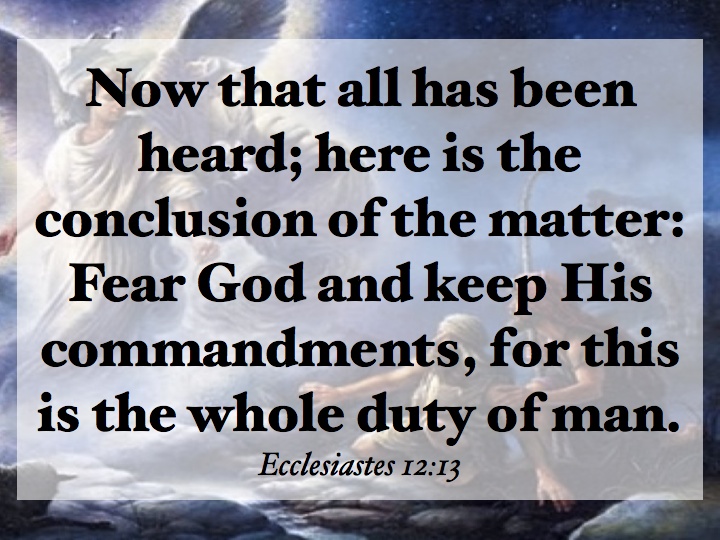
Now all has been heard; here is the conclusion of the matter: Fear God and keep His commandments, for this is the whole duty of man. (Ecclesiastes 12:13).

We should be living for the approval of an Audience of One. 

We should be longing to hear, “Well done, good and faithful servant” from our Creator. 

We should be listening only for the applause from nail-scarred Hands. 

“The remarkable thing about fearing God is that when you fear God you fear nothing else, whereas if you do not fear God you fear everything else.” —Oswald Chambers

If you have missed any of the messages in our Fear Not! series, you can find them all by clicking here.

Respecting Elected Officials

During our prayer time yesterday, I was contemplating the Apostle Peter’s instruction to, “Fear God, and respect the king” (1 Peter 2:17).

  • How do I respect the king (or the other elected officials in my city, state, and country)?
  • Does respect mean saying “yes” to every law that’s passed?
  • Can I be respectful and still disagree with those in elected office? How?

During our hour of prayer at the church last night, I was really wrestling with how I as a Christian should show respect to those in authority in our governments. Here are the nine things the Holy Spirit showed me.

I can show respect to those in authority by:

  1. Not forgetting that God placed them in their office (Daniel 4:25).
  2. Praying for them regularly (1 Timothy 2:1-2).
  3. Obeying all laws that aren’t immoral (Luke 20:25; Acts 5:29).
  4. Disobeying laws that are immoral (Esther 4:16; Acts 4:19).
  5. Holding them to biblical standards (Proverbs 8:15).
  6. Insisting they uphold the United States Constitution (Ecclesiastes 8:2).
  7. Reminding them that God’s wisdom is the ultimate standard (Proverbs 8:22-23).
  8. Requiring them to honor their promises, unless those promises conflict with God’s Word or the Constitution (Esther 1:13; 8:8).
  9. Speak to and about them without complaining or arguing (Philippians 2:14-15).

(Check out all of the above passages by clicking here.)

I’m working on living these out. What do you think?

If You’re Going To Do It, Then Do It

Have you ever watched someone attempt something they really didn’t want to do? Like when a parent asks a child to pull weeds in the garden—they go grumbling, dragging their feet, finding excuses to delay starting, pull a couple of weeds, and then complain about the heat. Is it any wonder that the job takes twice as long and is completed half as well as it should have been?!?

Solomon wrote this:

Whatever your hand finds to do, do it with all your might… (Ecclesiastes 9:10).

In other words, it’s like my Mom used to always remind me: If anything’s worth doing, it’s worth doing well!

Don’t go halfway. Put all you’ve got into it and get it done. And done well.

I think Solomon (and my Mom) would have loved Seth Godin’s blog post called Outsmart

Outsmart

or…

Outlead

Outcare

Outmaneuver

Outinvest

Outlisten

Outconnect

Outgive

Outlearn

Outwork

Outspend

Outrespect

Outinnovate

Outrisk

Outpersevere

Outinspect

Outproduce

Outrisk

Outlove…

In my opinion, no one should work harder, more enthusiastically, better, smarter, and more lovingly than one who calls themselves a follower of Jesus Christ. Check out my ongoing series of posts on godly leadership.

Sharp Enough?

Long before Stephen Covey wrote about Habit 7: Sharpening The Saw, Solomon saw the value of taking time to sharpen the saw.

Using a dull ax requires great strength, so sharpen the blade. That’s the value of wisdom; it helps you succeed. (Ecclesiastes 10:10)

What are you doing TODAY to gain wisdom?

J. Wilbur Chapman asked F.B. Meyer, “What is the matter with me? So many times I fail, so many times I am powerless.”

Dr. Meyer responded, “Have you ever tried breathing out three times without breathing in once?”

What are you doing TODAY to breathe in?

Look at the mower in the summer’s day, with so much to cut down ere the sun sets. He pauses in his labor—is he a sluggard? He looks for his stone, and begins to draw it up and down his scythe, with rink-atink, rink-atink, rink-atink. Is that idle music—is he wasting precious moments? How much he might have mowed while he has been ringing out those notes on his scythe! But he is sharpening his tool. And he will do far more when once again he gives his strength to those long sweeps which lay the grass prostrate in rows before him. —Charles Spurgeon

What are you doing TODAY to sharpen yourself?

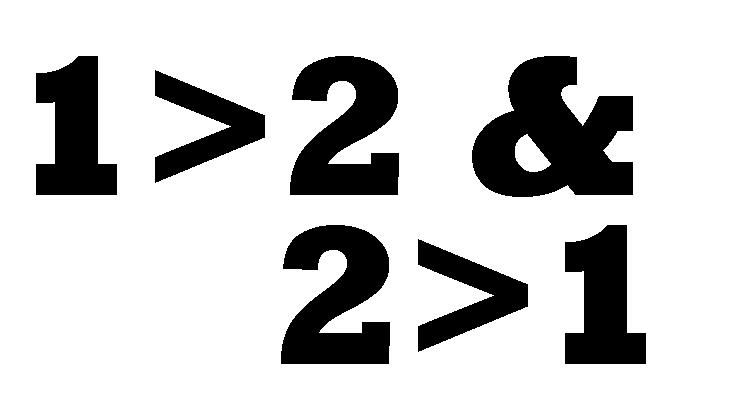
1>2 & 2>1

Listen to the podcast of this post by clicking on the player below, and you can also subscribe on AppleSpotify, or Audible.

I know this sounds like confusing—maybe even illogical—math, and it probably sounds a bit like a contradiction, too. But hang with me.

Two verses from the sometimes-confusing book of Ecclesiastes say just this: 1 is greater than two, and two is greater than one.

Check them out for yourself:

1>2One handful of peaceful repose is better than two fistfuls of worried work.

2>1Two people are better off than one, for they can help each other succeed. If one person falls, the other can reach out and help. But someone who falls alone is in real trouble.

When it comes to working hard to get stuff: 1>2. It’s far better to have less and enjoy it more.

When it comes to meaningful relationships: 2>1. It’s far better to have the time to invest in more intimate relationships.

Never, ever, EVER let the pursuit of stuff get in the way of your important relationships.

To have more satisfying relationships, always keep this in mind: 1>2 [stuff] so that 2>1 [relationships].

►► Would you please prayerfully consider supporting this ministry? ◀︎◀︎

Don’t Get Left Behind

This post is especially for the men (but, ladies, feel free to read along too).

No, I’m not talking here about the series of Left Behind books that tell a story about people who may miss out on the rapture of the Church. I’m talking about you leaving the protection of your friends and being exposed to a serious defeat.

Most times when I am counseling men who have given in to a temptation, or those who are battling the same old perplexing problems, I find a common theme. It’s not something new—it’s been around a long, long time.

Take this for example:

In the spring of the year, when kings normally go out to war, David sent Joab and the Israelite army to fight the Ammonites.

You probably know the rest of this sad story: David cannot contain his lust for Bathsheba (another man’s wife) so he seduces her, sleeps with her, gets her pregnant, and then kills her husband to try to cover it up. But look where it all started: David was alone. When he normally would have been with his brothers-in-arms, he stayed behind.

I’m a big believer in accountability, so I’ve written before about a brother who makes sure I stay on the straight-and-narrow. What about you? Are you trying to stay pure all by yourself? Are you battling temptations on your own?

Two people are better off than one, for they can help each other succeed. If one person falls, the other can reach out and help. But someone who falls alone is in real trouble. Likewise, two people lying close together can keep each other warm. But how can one be warm alone? A person standing alone can be attacked and defeated, but two can stand back-to-back and conquer. (Ecclesiastes 4:9-12)

Don’t try to go into battle all by yourself. If David—a man after God’s own heart—couldn’t win on his own, what makes you think you can?

Anger That Crosses The Line

Last night in our Bible study we looked at some words that David penned when he was angry. He was on the run from his son Absalom, and it seemed like everywhere he turned people were after him, or slandering him, or just doing their best to make him miserable. Yet in two back-to-back Psalms David says, “I lay down every evening and get a great night of rest.”

His sweet sleep comes from a moment of reflection before dozing off. He says:

In your anger do not sin; when you are on your beds, search your hearts and be silent. Selah.

  • Did my anger today cross the line into sin?
  • Am I allowing the time for the Holy Spirit to search my heart?
  • When the Holy Spirit points out where my anger crossed the line, do I justify my anger, or am I silent?

How do we know if our anger has not crossed that line and become sin?

Aristotle wrote, “Anybody can become angry—that is easy; but to be angry with the right person, and to the right degree, and at the right time, and for the right purpose, and in the right way—that is not within everybody’s power and is not easy.”

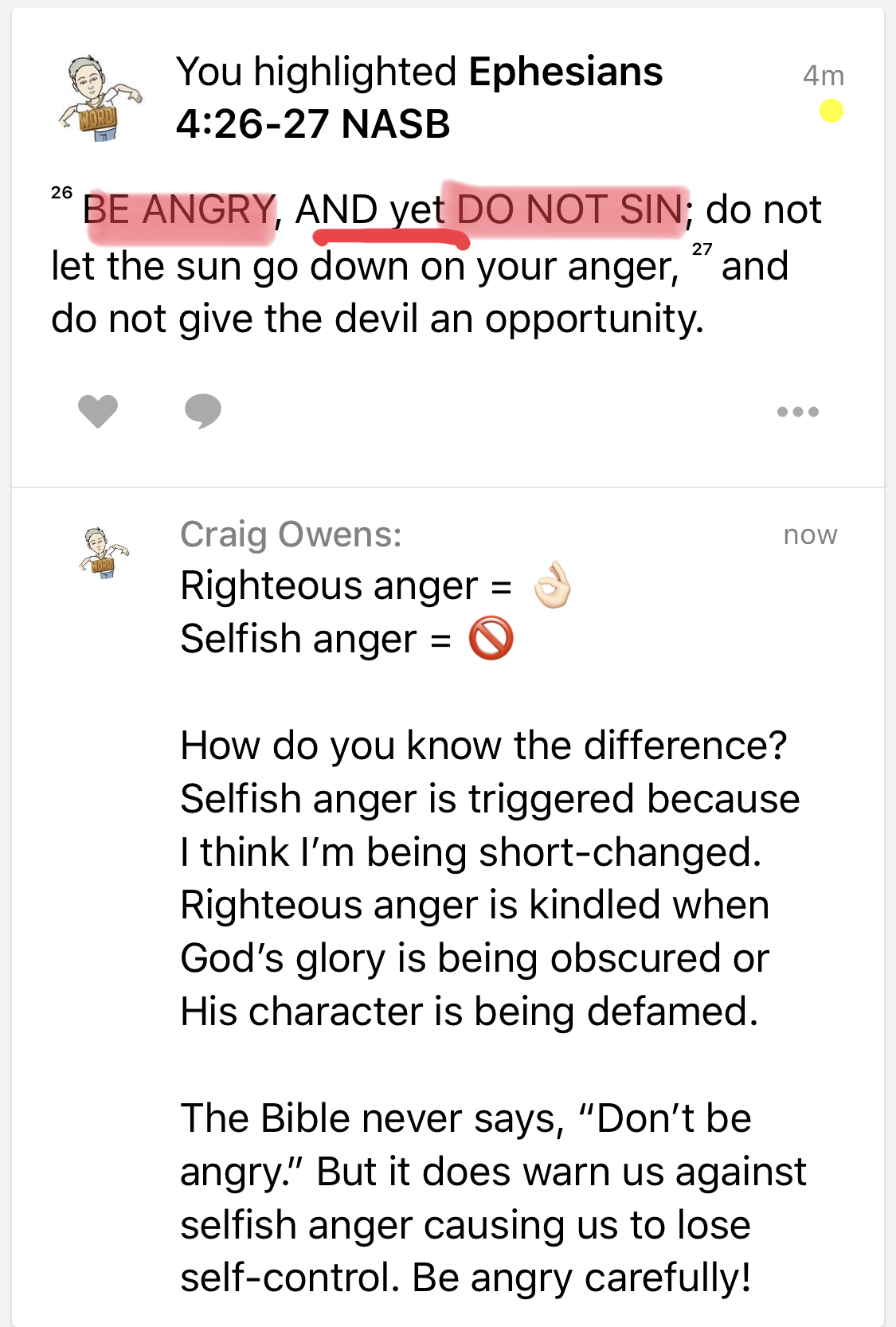
Being angry is not the issue. David said it (and Paul quoted it in Ephesians 4:26): “Be angry; just don’t sin.” God gets angry, but He does not sin. Jesus, in His public ministry, got angry, but He did not sin. We need to search our hearts to make sure our anger has not crossed the line to sin. We have to be angry in a godly way.

I see at least four ways to become angry without crossing the line into sin:

1.  Selfless Anger = anger at sin, but not angry at the sinner.

Love is not rude, it is not self-seeking, it is not easily angered, it keeps no record of wrongs. Love does not delight in evil but rejoices with the truth. (1 Corinthians 13:5, 6)

2.  Slow Anger = lengthen your fuse a bit.

Do not be quickly provoked in your spirit, for anger resides in the lap of fools. (Ecclesiastes 7:9)

My dear brothers, take note of this: Everyone should be quick to listen, slow to speak and slow to become angry, for man’s anger does not bring about the righteous life that God desires. (James 1:19, 20)

Good advice from Thomas Jefferson: “When angry, count to ten before you speak; if very angry, a hundred.”

3.  Protective Anger = when sinners entice others to join them in their sin. God is sad when people leave Him; He is angry at them when they take others with them.

But they put God to the test and rebelled against the Most High; they did not keep His statutes. Like their fathers they were disloyal and faithless, as unreliable as a faulty bow. They angered Him with their high places; they aroused His jealousy with their idols. When God heard them, He was very angry; He rejected Israel completely. (Psalm 78:56-59)

4.  Righteous Anger = against those who are keeping others from coming closer to God.

For I endure scorn for Your sake, and shame covers my face. I am a stranger to my brothers, an alien to my own mother’s sons; for zeal for Your house consumes me, and the insults of those who insult You fall on me. (Psalm 69:7-9)

This verse was recalled by Jesus’ disciples when they saw Him get angry and clear out the Temple in Jerusalem. Jesus was angry because of the religious clutter that was keeping God’s house from being a house of prayer for all nations.

I think everyone is familiar with the acrostic WWJD = What Would Jesus Do?

I’d like to propose something similar: WGGA = Would God Get Angry?

This is a great question to ask to make sure our anger does not cross that line into sin. Get angry—in a godly way—and do not sin.