More Than A Carpenter (book review)

more-than-a-carpenterHolidays are usually really good times for Christians to start up a conversation about their faith. Especially Christmas. C’mon, Christ’s name is the main part of CHRISTmas, right?! But I realize as well that some folks are reluctant to begin such a conversation because they think they might be at a loss as to what to say. This is where More Than A Carpenter by Josh McDowell and Sean McDowell will be an excellent ally.

Christians and atheists alike found More Than A Carpenter compelling reading when it was first published nearly 40 years ago. Now the book has been given a makeover, incorporating new discoveries that have further validated the book’s content, and adding a new chapter by Sean McDowell specifically addressing the “new atheists.”

Jesus is an historical character. He actually lived and walked and died and was resurrected in places that are verified by historical records. And yet Jesus was so much more than merely a person in history. His life impacted history in ways that are still being discovered today. His life is still changing the trajectory of people’s lives today.

Clearly Jesus was much more than merely a first century carpenter! 

In easily-readable language, Josh and Sean arm you with all of the evidence you will need to have compelling conversations about Jesus.

  • You will learn about the historical accuracy of the authors who recorded the details of Jesus Christ’s life.
  • You will learn what science, philosophy and archeology verify about His life.
  • You will get insight into the arguments that some atheists use to deny Christ’s deity, and how you can offer alternative facts to counteract those arguments.
  • And you will hear about Josh’s personal life-changing encounter with this Carpenter from first-century Israel.

This is a phenomenal book for you to read as we head into this CHRISTmas season. This is also a great resource for you to put into the hands of someone who is skeptical or even antagonistic toward the claims of Christians. In short: you will be better prepared to have meaningful conversations with others after you have read More Than A Carpenter!

I am a Tyndale book reviewer.

If you would like to access a ton of great resources associated with More Than A Carpenter, I highly recommend you check out the Josh McDowell Ministry’s store by clicking here.

Thursdays With Oswald—A New Perspective Of Calvary

Oswald ChambersThis is a weekly series with things I’m reading and pondering from Oswald Chambers. You can read the original seed thought here, or type “Thursdays With Oswald” in the search box to read more entries.

A New Perspective Of Calvary

     If Jesus Christ were only a martyr, His Cross would be of no significance; but if the Cross of Jesus Christ is the expression of the secret heart of God, the lever by which God lifts back the human race to what it was designed to be, then there is a new attitude to things. … 

     There are any number of amateur skeptics, and the men who are seeing the difference between “believing their beliefs,” and “believing God,” men, who, through the turmoil and the stress, are seeing that rationalism is not the basis of thing. According to the Bible, the basis of things is tragedy, and the way out is the way made by God in Redemption. The New Testament does not say that the human race is evolving, but that the human race is a magnificent ruin of what it was designed to be. …

     Paul says the fundamental revelation of the New Testament is that God redeemed the whole human race when they were spitting in His face, as it were. … 

     The majority of people who have never been touched by affliction see Jesus Christ’s death as a thing beside the mark. When a man gets to his wits’ end and things go hard with him, his thick hide is pierced and he is stabbed wide awake, then for the first time he begins to see something else—“At last I see; I thought that He was stricken, smitten of God and afflicted; but now I see He was wounded for my transgressions.” … 

     Jesus Christ did not come to give us pretty ideas of God, or sympathy with ourselves; He came from a holy God to enable men, by the sheer power of His Redemption, to become holy.

From The Shadow Of An Agony

Oswald Chambers wrote these words in the midst of The Great War (what we now refer to as World War I), when everyone’s belief in rationalism was shaken to the core. Tragedy has a tendency to do that to us.

Chambers says that trouble in this world should point us to the unshakable, inescapable truth that this world is “a magnificent ruin of what it was designed to be,” and the only security and hope we have is a new life with God though the Redemption Jesus paid for at Calvary.

May any pain, suffering, or confusion you feel in this world help you see the Cross of Christ in a whole new light.

6 Quotes On Being Poor In Spirit From “The Blessing Of Humility”

The Blessing Of HumilityAs I stated in my review of Jerry Bridges’ book The Blessing Of Humility, reading through these thoughts slowly—Beatitude by Beatitude—would bring about the most life-changing impact. In that spirit, I will be sharing some noteworthy quotes one Beatitude at a time. Here are some quotes on blessed are the poor in spirit (Matthew 5:3)…

“The Greek word that Jesus used for ‘poor’ is the word ptochos. It is used to describe not ordinary poverty but abject poverty. Ptochos is not like my parents struggling to make ends meet [during the Great Depression]. Rather it describes a person who is completely destitute and helpless to do anything about it.”

Spirit refers to one’s inner being, our self-awareness. Specifically here it means how we evaluate ourselves with regard to our own spiritual condition. This abject poverty of spirit comes from our awareness of our own dreadfully sinful condition.”

“In the Beatitudes Jesus is talking about the character traits of those already in the kingdom. And He says we should be poor in spirit. It should be the ongoing daily attitude of one who is growing spiritually. Believers who are growing continue to see more sin in their lives. It is not that they are sinning more; rather they are becoming more aware of and more sensitive to the sin that has been there all along. … And it is the realization that even the sins, which seems so minor in our eyes, would bring us under the wrath of God, were it not for the atoning blood of Christ shed for us on the Cross, that should cause us to be poor in spirit.”

“Those who are poor in spirit…see Christ’s blood and righteousness as their hope not only for eternity but for God’s favor each day. They groan over their sin and earnestly pursue holiness but they do not trust in their holiness. Instead they say, ‘We are unworthy servants; we have only done what was our duty’ (Luke 17:10).”

“The person who is poor in spirit has a deep, awe-filled reverence for God and His Word.”

“We live in a culture that promotes self-esteem. And I am concerned that this attitude has permeated the body of Christ. We see ourselves as better than we are. We look at sinful society around us, and we can be like the Pharisee who prayed, ‘God, I think You that I am not like other men’ (Luke 18:11).”

Quotes on the next Beatitude will be posted soon. Stay tuned…

4 Quotes On Selfless Sacrifice From “The Seven Laws Of Love”

The Seven Laws Of LoveIn The Seven Laws Of Love, Dave Willis gives us some highly practical, biblically-based counsel for investing in all of our relationships. Normally when I share quotes from books, I share all of them at once, but for this book I felt like it would be good to share these quotes a bit more slowly, to give you time to read them and apply them.

The seven laws Dave identifies are:

  1. Love requires commitment (read the quotes here)
  2. Love selflessly sacrifices
  3. Love speaks truth
  4. Love conquers fear
  5. Love offers grace
  6. Love brings healing
  7. Love lives forever

From law #2, here are some quotes on selfless sacrifice—

“That’s the beautiful irony of love. The only way we can truly keep it is to give it away.”

“First Lieutenant Alonzo Cushing was a twenty-two-year-old officer in the Union Army during the Civil War when he made the ultimate sacrifice. The young West Point graduate was in charge of six cannons and more than one hundred men during the Battle of Gettysburg. His small force found itself trapped in the middle of the battlefield during the Confederate Army’s infamous assault known as Pickett’s Charge. The full force of the rebels was closing in on Cushing and his men. The young officer had already been shot twice and was critically wounded. He had every right to retreat to safety, but he recognized the magnitude of the moment. Instead, he ordered the cannons moved to the front lines, and he limped forward to lead a counterattack. His courage and tenacity inspired the men around him, and they fought back valiantly before Cushing was shot again. The final shot proved to be fatal. The sacrifice of one young man turned the tide of a battle, which turned the tide of war, which ultimately held a nation together.”

“We don’t make our sacrifices for recognition; we make our sacrifices for love. When love moves you to sacrifice, you can rest assured that lives will be changed and eternity will be impacted.”

“Many people believe they have put their faith in Jesus, but they also believe they have to earn what He did for them on the Cross. Here’s the good news: when Jesus was hanging on that Cross, dying to save you, He did not use His dying words to say, ‘Earn this.’ Do you know what He said instead? He said, ‘It is finished!’ Did you catch that? It is finished. That means done, complete, sealed, finished! That’s God’s gift of grace. Jesus has done all the work already. You couldn’t possibly earn it even if you tried with everything you had, and God never expected you to.”

Check out my review of The Seven Laws Of Love by clicking here.

Watch for more quotes from the other laws of love explained in this book throughout the next few days.

Thursdays With Oswald—What Prayer Does In Us

Oswald ChambersThis is a weekly series with things I’m reading and pondering from Oswald Chambers. You can read the original seed thought here, or type “Thursdays With Oswald” in the search box to read more entries.

What Prayer Does In Us

     Prayer is the point where the reality of God merges with human life. Until we are born from above, prayer with us is honestly nothing more than a mere exercise; but in all our Lord’s teaching and in His own personal life, as well as in the emphasis laid on prayer by the Holy Ghost after He had gone, prayer is regarded as the work (see John 14:11-13). … 

     If prayer is the highest reach of communion possible between Almighty God and the Son of Man, what part ought prayer to play in our lives? … 

     Prayer is not meant to develop us, but to develop the life of God in us after new birth.

From The Psychology Of Redemption

In another lesson, Chambers reminds us that prayer is easy for us because it cost Jesus so much to make it possible for us.

Jesus knew the value of prayer, which is why it was an essential priority all throughout His earthly life. Now we have access to the same Almighty God through the name of Jesus. Yes, Jesus is interceding for us, but we don’t have to stop there—we should never stop there!—because Christ’s death and resurrection makes a way for us to go right into Almighty God’s presence.

Prayer is powerful! Prayer brings the life of God right down into our own souls.

So… what part ought prayer to play in your life?

12 Quotes From “The Place Of Help”

The Place Of HelpAs always, any Oswald Chambers book I read is thoroughly highlighted. There is always so much great content! On this blog, I have a weekly series called “Thursdays With Oswald” where I share quotes and thoughts from his book I’m currently reading. Be sure to check that out. Below are just a few of the quotes I noted from The Place Of Help. (By the way, you can read my review of this book by clicking here.)

“This is the age when education is placed on the very highest pinnacle. In every civilized country we are told that if we will educate the people and give them better surroundings, we shall produce better characters. Such talk and such theories stir aspirations, but they do not work out well in reality. The kingdom within must be adjusted first before education can have its true use. To educate an unregenerate man is but to increase the possibility of cultured degradation.”

“Not what the disciple says in public prayer, not what he preaches from pulpit or platform, not what he writes on paper or in letters, but what he is in his heart which God alone knows, determines God’s revelation of Himself to him. Character determines revelation (see Psalm 18:24-26).”

“Our Lord never gives private illuminations to special favorites. His way is ever twofold: the development of character, and the descent of Divine illumination through the Word of God.”

“The voice of the Lord listened to in darkness is so entrancing that the finest of earth’s voices are never afterwords mistaken for the voice of the Lord.”

“Jesus Christ distinctly stated that He came to do the will of His Father. ‘I must work the works of Him that sent Me.’ His first obedience was not to the needs of men, but to the will of God. He nowhere chose the altar of His sacrifice, God chose it for Him. He chose to make His life a willing and obedient sacrifice that His Father’s purpose might be fulfilled. … ’For we preach not ourselves, but Christ Jesus as Lord, and ourselves as your servants for Jesus’s sake,’ as Paul says in 2 Corinthians 4:5. We are the servants of men, says Paul, not primarily because their needs have arrested us, but because Jesus Christ is our Lord.” 

“If you become a necessity to a soul you have got out of God’s order, your great need as a worker is to be a friend of the Bridegroom. Your goodness and purity ought never to attract attention to itself, it ought simply to be a magnet to draw others to Jesus.”

“Suppose you talk about depending on God and how wonderful it is, and then others see that in your own immediate concerns you do not depend on Him a bit, but on your own wits, it makes them say, ‘Well, after all, it’s a big pretense, there is no Almighty Christ to depend on anywhere, it is all mere sentiment.’ The impression left is that Jesus Christ is not real to you.” 

“The highest Divine love is not only exhibited in the extreme amazement of the tragedy of Calvary, but in the laying down of the Divine life through the thirty years at Nazareth, through the three years of popularity, scandal, and hatred, and furthermore in the long pre-incarnate years (cf. Revelation 13:8).”

“The Cross is the supreme moment in Time and Eternity, and it is the concentrated essence of the very nature of the Divine love. … The Self-expenditure of God for His enemies in the life and death of our Lord Jesus Christ, becomes the great bridge over the gulf of sin whereby human love may cross over and be embraced by the Divine love, the love that never fails.” 

“Christian experience does not mean we have thought through the way God works in human lives by His grace, or that we are able to state theologically that God gives the Holy Ghost to them that ask Him—that may be Christian thinking, but it is not Christian experience. Christian experience is living through all this by the marvelous power of the Holy Ghost. The Holy Ghost working in me does not produce wonderful experiences that make people say ‘What a wonderful life that man lives’; the Holy Ghost working in me makes me a passionate, devoted, absorbed lover of the Lord Jesus Christ.”

“It is not the baptism of the Holy Ghost that changes men, but the power of the Ascended Christ coming into men’s lives by the Holy Ghost that changes men. The baptism of the Holy Ghost is the evidence of the Ascended Christ.” 

“There is only one Lover of the Lord Jesus and that is the Holy Ghost; when we receive the Holy Ghost He turns us into passionate human lovers of Jesus Christ. Then out of our lives will flow those rivers of living water that heal and bless, and we spend and suffer and endure in patience all because of One and One only.”

More quotes from this book coming soon…

Life Or Death?

Life or deathSince Jesus predicted His death on a Cross, and His resurrection from the dead three days later, and since that really happened(!), I think that it would be wise to consider the other words Jesus said!

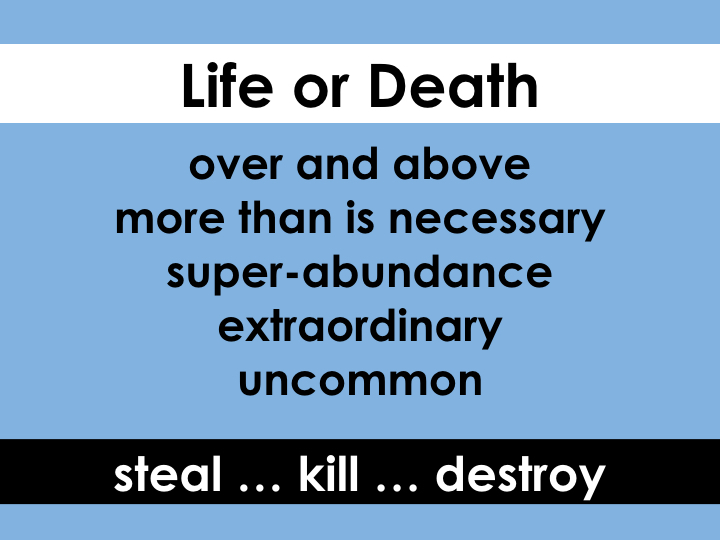
Here’s an important one—The thief cometh not, but for to steal, and to kill, and to destroy: I am come that they might have life, and that they might have it more abundantly (John 10:10).

It’s a pretty clear distinction: One way brings death and the other way brings life. But not just any kind of life.

The Greeks had three words for “life”—

  1. Bios from which we get our word biology. We can see when something is alive because of its biological growth.
  2. Psuche from which we get our word psychology. Plants might be biologically alive, but they don’t have the psychological life of a human.
  3. Zoe. This is the word Jesus used in John 10:10. It’s the word that means “life force” or better stated it’s God’s life.

God is a Triune God: Father, Son, and Spirit. When God created humans, we were created in His “trinity” image—Let Us make man in Our image (Genesis 1:26). Adam was created with bios, psuche, and zoe life. God told Adam and Eve that if they sinned, they would die (Genesis 2:17). When they did eat that forbidden fruit, they remained biologically and psychologically alive, but the zoe life force was cut off.

Jesus came to restore that! He came to bring us back to the state God originally intended for us, which meant He had to go to the Cross to become our sin, so that we could be forgiven and brought back to life.

Placing your faith in Jesus Christ’s work on the Cross means a complete about-face. The devil wants to steal from you, kill you, and destroy your soul for eternity. But Jesus came that you could have zoe in a way that was above-and-beyond, super-abundant, extraordinary and uncommon!

To get this life, Jesus asks us to do something that He did—If anyone would come after Me, he must deny himself and take up his cross and follow Me (Matthew 16:24).

Jesus isn’t calling for our hands and feet to be nailed to a wooden Cross. But He is calling for our selfish thoughts to be crucified (Matthew 16:23), and for us to give no more attention to our old sinful life.

I think this passage in Romans captures that thought so well—

Could it be any clearer? Our old way of life was nailed to the Cross with Christ, a decisive end to that sin-miserable life—no longer at sin’s every beck and call! What we believe is this: If we get included in Christ’s sin-conquering death, we also get included in His life-saving resurrection. We know that when Jesus was raised from the dead it was a signal of the end of death-as-the-end. Never again will death have the last word. When Jesus died, He took sin down with Him, but alive He brings God down to us. From now on, think of it this way: Sin speaks a dead language that means nothing to you; God speaks your mother tongue, and you hang on every word. You are dead to sin and alive to God. That’s what Jesus did. That means you must not give sin a vote in the way you conduct your lives. Don’t give it the time of day. Don’t even run little errands that are connected with that old way of life. Throw yourselves wholeheartedly and full-time—remember, you’ve been raised from the dead!—into God’s way of doing things. Sin can’t tell you how to live. After all, you’re not living under that old tyranny any longer. You’re living in the freedom of God. (Romans 6:6-14)

The choice is yours: the rip-off, destruction, and death the devil offers OR the abundant, overflowing, extraordinary, more-than-is-needed, zoe life that Jesus offers.

Life or death. Your choice.

Your Sorrow Will Turn To Joy (book review)

Your Sorrow Will Turn To JoyHoly Week is always a good time to slow down to take a closer look at the events leading up to Christ’s crucifixion and resurrection. I never want to “go through the motions” and miss out on some new revelation of all that Jesus did for us. An excellent companion for this journey is Your Sorrow Will Turn To Joy by the writers at Desiring God.

This book covers the eight days of Holy Week, from Palm Sunday to Resurrection Sunday. Each day has an insightful reading selection for both the morning and evening. The authors pulled together the accounts from all four of the Gospels, to offer unique insights and observations on each step of Christ’s journey to the Cross, the grave, and the empty tomb. As I read, I marveled again at the amazing love God showered on us!

The good folks at Desiring God have made this book available free of charge in its ebook format. Otherwise, the paperback can be purchased at a nominal cost.

Pick up a copy and read through it on the next Holy Week, and I promise you will see something fresh about the joy that Christ’s finished work on Calvary brings to those who will believe in Him!

3 Possibilities For An Empty Tomb

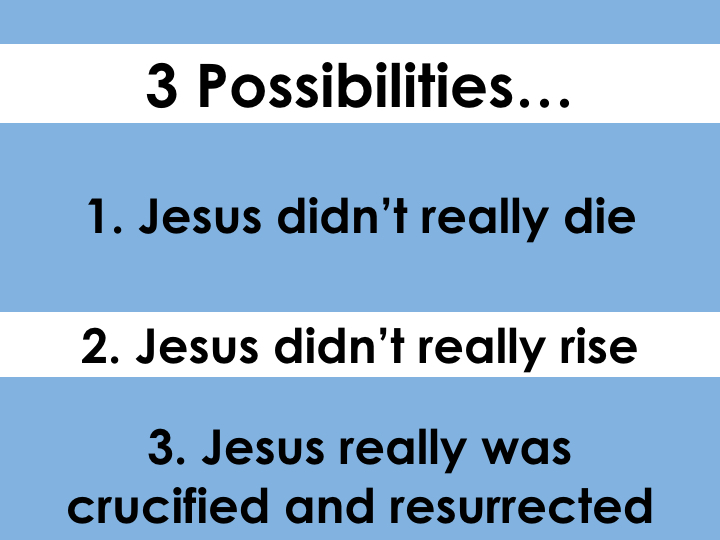
3 possibilitiesLast week we explored the validity of the evidence for the accuracy of the biblical accounts for the life of Jesus (you can check that out here). You might be one who says, “Okay, I think Jesus was a good Man, but I think it’s a bit of a stretch to believe that anyone could be raised from the dead after three days.” I think that’s a reasonable thing to explore…

If the tomb where Jesus was placed is really empty, then there are only three possibilities for us to consider.

(1) Jesus didn’t really die.

  • It’s hard to imagine anyone could go through the intense torture Jesus did prior to His crucifixion unscathed.
  • The crucifixion process itself is one of the most gruesome forms of execution man has ever invented.
  • As a result, forensic science shows that Jesus most likely died of a heart attack. The mention in John 19:34 of the blood and water that flowed from Christ’s body is an indication of the cardiac distress His body experienced.
  • Men who were followers of Jesus handled His dead body, and undoubtedly would have checked for any signs life (John 19:38-40).
  • A Roman centurion reported to the Roman governor Pilate that Jesus had in fact died (Mark 15:43-45).
  • Extra-biblical historians, many of whom were unfriendly to Jews and Christians, reported Christ’s death as an historical fact.

(2) Jesus didn’t really rise.

  • Some have claimed that Christ’s followers “saw” Jesus only in a grief-induced hallucination. The problem is, Jesus appeared to individuals, small groups, and large groups multiple times and in multiple settings over the course of 40 days (1 Corinthians 15:3-8).
  • At least one of Christ’s closest followers said he wouldn’t be convinced by verbal testimony alone, but needed to touch Christ’s body for Himself (John 20:24-28).
  • The disciples were afraid and lacked any military training that would have allowed them to get past the trained soldiers guarding the tomb (Matthew 27:62-66; 28:11-15).

(3) Jesus really did die on a Cross and was raised back to life.

Arthur Conan Doyle’s Sherlock Holmes rightly said, “When you have eliminated the impossible, whatever remains, however improbable, must be the truth.”

Real-life cold-case detective J. Warner Wallace explains how detectives use abductive reasoning to examine all of the evidence and infer to the most reasonable explanation from that. As a result, Detective Wallace says about this third explanation:

“The last explanation (although it is a miraculous, supernatural explanation) suffers from the least number of liabilities and deficiencies. If we simply enter into the investigation without a pre-existing bias against anything supernatural, the final explanation accounts for all of the evidence without any difficulty. The final explanation accounts for the evidence most simply and most exhaustively, and it is logically consistent…. The final explanation is also superior to all other accounts (given that it does not suffer from all the problems we see with the other explanations).” —J. Warner Wallace, Alive

The truth is Jesus loved you so much that He had to die for you. He had to pay the penalty for your sins. And God loved His Son so much, that He raised Him back to life. Jesus can live in you now, and you can live with Him forever, if you will simply believe what He did for you on Calvary.

Jesus left an empty tomb behind to show how powerful His love and life is!

Good Friday—It Is Finished

Your Sorrow Will Turn To JoyThis is from a chapter in Your Sorrow Will Turn To Joy, and is probably one of the best depictions of Good Friday I have read. Jon Bloom writes—

It is Friday, April 3, A.D. 33. It is the darkest day in human history, though most humans have no clue of this. In Rome, Tiberius attends to the demanding business of the empire. Throughout the inhabited world, babies are born, people eat and drink, marry and are given in marriage, barter in marketplaces, sail merchant ships, and fight battles. Children play, old women gossip, young men lust, and people die. 

But today, one death, one brutal, gruesome death, the worst and best of all human deaths, will leave upon the canvas of human history the darkest brushstroke. In Jerusalem, God the Son, the Creator of all that is (John 1:3), will be executed. 

The Garden 

The Jewish day dawns with night, and never has it been more fitting, since today the hour has come and the power of darkness (Luke 22:53). Jesus is in Gethsemane, where He has prayed with loud cries and tears, being heard by His Father (Heb. 5:7) whose will will be done. Jesus hears noises and looks up. Torches and hushed voices signal the arrest party’s arrival. 

Jesus wakes His sleepy friends who are jarred alert at the sight of their brother, Judas, betraying his Rabbi with a kiss. Soldiers and servants encircle Jesus. Peter, flushed with anger, pulls out his sword and lunges at those nearest Jesus. Malchus flinches, but not enough. Blinding pain and blood surge where his ear had been. Voices speak, but Malchus only hears the screaming wound, which he’s grabbed with both hands. He feels a hand touch his hands and the pain vanishes. Under his hands is an ear. Stunned, he looks at Jesus, already being led away. Disciples are scattering. Malchus looks down at his bloody hands. 

The Sanhedrin 

Jesus is led brusquely into the house of Annas, a former High Priest, who questions Him about His teaching. Jesus knows this informal interrogation is meant to catch Him disoriented and unguarded. He is neither, and gives this manipulative leader nothing. Rather, He refers Annas to his hearers and is struck with irony by a Jewish officer for showing disrespect. Frustrated, Annas sends Jesus on to his son-in-law Caiaphas, the current High Priest. 

At Caiaphas’s house the trial gets underway quickly. Morning will come fast. The Council needs a damning verdict by daybreak. The examination proceeds as bleary-eyed Sanhedrin members continue to file in. 

The trial has been assembled hastily and witnesses haven’t been screened well. Testimonies don’t line up. Council members look disconcerted. Jesus is silent as a lamb. Irritated and impatient, Caiaphas cuts to the quick: “I adjure You by the living God, tell us if you are the Christ, the Son of God” (Matt. 26:63). The hour has come. Charged in the name of His Father to answer, Jesus speaks the words that seal the doom for which He had come to endure (John 12:27): “You have said so. But I tell you, from now on you will see the Son of Man seated at the right hand of Power and coming on the clouds of heaven” (Matt. 26:64). 

In a moment of law-breaking (Lev. 21:10) politically religious theater, Caiaphas tears his robes in feigned outrage and thinly concealed relief over Jesus’s blasphemy. He declares the trial’s end with, “What further testimony do we need? We have heard it ourselves from His own lips” (Luke 22:71). 

As the sun breaks over Jerusalem’s eastern ridge, Judas swings from his own belt, Peter writhes in the grief of his failure, and Jesus’s face is streaked with dried blood and saliva from the pre-dawn sport of the temple police. The Council’s verdict: guilty of blasphemy. Their sentence: death. But it’s a sentence they cannot carry out. Rome refuses to delegate capital punishment. 

The Governor 

Pilate’s mood, already sour over the Sanhedrin’s sudden insistent intrusion so early in the morning, worsens as he grasps the situation. They want him to execute a Galilean “prophet.” His seasoned instincts tell him something isn’t right. He questions Jesus and then tells the Council, “I find no guilt in this Man” (Luke 23:4). 

A game of political chess ensues between Pilate and the Sanhedrin, neither realizing that they are pawns, not kings. Pilate makes a move. As a Galilean, Jesus falls under Herod Antipas’s jurisdiction. Let Herod judge. Herod initially receives Jesus happily, hoping to see a miracle. But Jesus refuses to entertain or even respond. Antipas, disappointed, blocks the move by returning Jesus to Pilate. 

Pilate makes another move. He offers to release Jesus as this year’s annual Passover pardoned prisoner. The Council blocks the move. “Not this man, but Barabbas!” they cry (John 18:40). Pilate is astounded. The Sanhedrin prefers a thief and murderer to this peasant prophet? 

Pilate tries another move. He has Jesus severely flogged and humiliated, hoping to curb the Council’s blood thirst. Again the move is blocked when the Council insists that Jesus must be crucified because “He has made Himself the Son of God” (John 19:7). Check. Pilate’s fear grows. Jesus’s divine claim could threaten Rome. Worse, it could be true. Roman deities supposedly could take on human form. His further questioning of Jesus unnerves him. 

One last move. Pilate tries to persuade the Sanhedrin to release Jesus. One last block and trap. “If you release this Man, you are not Caesar’s friend. Everyone who makes himself a king opposes Caesar” (John 19:12). The Council has Pilate where they want him: cornered. Checkmate. 

And the triune God has the Council, Pilate, and satan where He wants them. They would have no authority over the Son at all unless it had been given them from above (John 19:11). Fallen Jews, Gentiles, and spiritual powers unwittingly collaborate in executing the only innocent death that could possibly grant the guilty life. Checkmate. 

The Cross 

Morning wanes as Jesus stumbles out of the Praetorium, horribly beaten and bleeding profusely. The Roman soldiers had been brutal in their creative cruelty. Thorns have ripped Jesus’s scalp and His back is one grotesque, oozing wound. Golgotha is barely a third of a mile through the Garden Gate, but Jesus has no strength to manage the forty-pound crossbar. Simon of Cyrene is drafted from the crowd. 

Twenty-five minutes later, Jesus is hanging in sheer agony on one of the cruelest instruments of torture ever devised. Nails have been driven through His wrists (which we only know about because of the doubt Thomas will express in a couple days—see John 20:25). A sign above Jesus declares in Greek, Latin, and Aramaic who He is: the King of the Jews. 

The King is flanked on either side by thieves and around Him are gawkers and mockers. “Let Him save Himself, if He is the Christ of God, His Chosen One!” some yell (Luke 23:35). One dying thief even joins in the derision. They do not understand that if the King saves Himself, their only hope for salvation is lost. Jesus asks His Father to forgive them. The other crucified thief sees a Messiah in the mutilated man beside him, and he asks the Messiah to remember him. Jesus’s prayer is beginning to be answered. Hundreds of millions will follow. 

It is mid-afternoon now and the eerie darkness that has fallen has everyone on edge. But for Jesus, the darkness is a horror He has never known. This, more than the nails and thorns and lashings, is what made Him sweat blood in the garden. The Father’s wrath is hitting Him in full force. He is in that moment no longer the Blessed, but the Cursed (Gal. 3:13). He has become sin (2 Cor. 5:21). In terrifying isolation, cut off from His Father and all humans, He screams, “Eli, Eli, lema sabachthani,” Aramaic for “My God, My God, why have You forsaken Me?” (Matt. 27:46; Ps. 22:1). No greater love (John 15:13), humility (Phil. 2:8), or obedience (Heb. 5:8) has ever or will ever be displayed. 

Shortly after 3:00 P.M., Jesus whispers hoarsely for a drink. In love, He has drained the cup of His Father’s wrath to the dregs. He has born our full curse. There is no debt left to pay and He has nothing left to give. The wine moistens His mouth just enough to say one final word: “It is finished” (John 19:30). And God the Son dies. 

It is the worst and best of all human deaths. For on this tree He bears our sins in His body (1 Pet. 2:24), “the righteous for the unrighteous, that He might bring us to God” (1 Pet. 3:18). And now it is finished.