At Last!

Jesus is our atonementThe Day of Atonement was a very special day for the Jewish people. It was called by some the Sabbath’s Sabbath, as it was the most holy day of the year. It was the day everyone looked forward to, because finally they could have forgiveness for their sins.

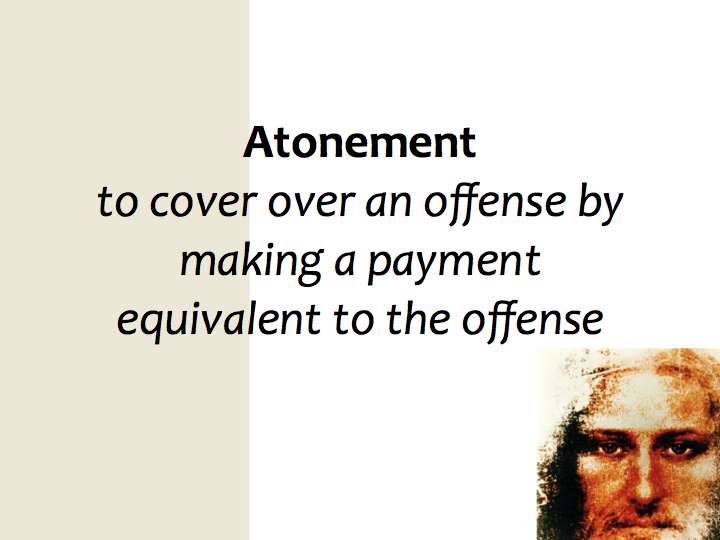
The word atonement in the Hebrew meant that a payment was made that was equivalent to the offense that was committed. The offense was huge: Sin was open rebellion against Almighty God, it was to spit in the face of our Heavenly Father, it was to slap away His hands that were reaching out to embrace us. Nothing short of a death could atone for that sort of offense!

So the high priest would go through an elaborate ceremony of washing himself and putting on special garments that were only to be worn on this Day of Atonement. Because the high priest was also a sinner himself, his first sacrifice was a bull. The blood from this sacrifice was taken by the high priest into the Most Holy Place of the temple to cover his own sins, before he could even approach God to ask for the forgiveness of the sins of anyone else.

After having completed this step, the high priest could then proceed. He would sacrifice a goat as a sin offering for the people. As he did with the bull’s blood, he would take the goat’s blood back into the Most Holy Place to ask God to show mercy toward people who had sinned, to turn away His holy wrath against their rebellion. Then the priest would lay his hands on a second goat, one that was still alive, and confess all of the sins of the people. This goat (called the scapegoat) was then taken out into the desert. This symbolized the removal of the people’s guilt, making it possible for them to be in relationship with God once again.

This was repeated year after year after year. It was repeated because the people continued to sin. It was repeated because these rituals were only a shadow of what God really wanted to accomplish. David wrote about the futility of these sacrifices—

Sacrifice and offering You did not desire—but a body You have given me—burnt offerings and sin offerings You did not require. Then I said, “Here I am, I have come—it is written about me in the scroll. I desire to do Your will, my God; Your law is within my heart.” (Psalm 40:6-8)

A beautiful thing happened through the ministry of Jesus on earth. Jesus came to be both the perfect high priest (one without sin, who did not need to purify Himself), and the perfect sacrifice. Jesus is called the once for all sacrifice of atonement for us, as He embodied the cry David made nearly 1000 years earlier. Hebrews 10:5-7 says that the words uttered by David prophetically were repeated by Jesus: “Here I am, I have come—it is written about me in the scroll. I desire to do Your will, my God; Your law is within my heart. I will be the once for all sacrifice.”

When Jesus told us the the new covenant was in His shed blood on Calvary’s Cross, He was saying that no longer would we have to wait until the Day of Atonement to find forgiveness; no longer would we have to wait upon an imperfect earthly priest to offer a sacrifice for us; no longer would we have to carry around the guilt of our sin and feel separated from God’s presence while waiting for a special ceremony. AT LAST! We can have immediate forgiveness, eternal redemption, and an everlasting relationship with God because of what Jesus did for us once for all!

As you celebrate Holy Week, be thrilled with the truth that Jesus’ death on the Cross makes it possible for you to have complete atonement. Our Savior has redeemed us AT LAST!

If you have missed any of the messages in this series called Who Is Jesus?, you can find them all here.

Are You Worthy Of God’s Favor?

Listen to the podcast of this post by clicking on the player below, and you can also subscribe on AppleSpotify, or Audible. 

Today some call her “the holy mother” and revere her as a saint. But 2000 years ago, Mary saw herself as only an ordinary, faceless, fame-less, Israelite girl.

  • She came from Nazareth (a town of which people said, “Can anything good come from Nazareth?!”)
  • Nazareth was in the region of Galilee (an area of which people said, “No one special has ever come from Galilee”)
  • She was pledged to be married (probably a marriage that she had no say in)
  • And she was a young teenager

What did Mary think of herself? We can infer her self-image from what went on her mind when God’s angel greeted her with the words, “Greetings, you who are highly favored! The Lord is with you.”

She was greatly troubled and wondered what kind of greeting this might be. Psychologists today would describe Mary’s response as inner dissonance—the feeling that something is not quite right, but she couldn’t put her finger on exactly what was wrong. The phrase greatly troubled is a single Greek word which means agitated and perplexed by doubts.

In short: the way the angel greeted Mary didn’t jive with the way Mary saw herself (see Luke 1:26-38).

Mary, like many of us still today, didn’t think she was worthy of God’s attention, let alone His special blessings.

But the word the angel used when he said she was highly favored is a wonderful word! It’s root word is grace, and it only appears twice in the New Testament. This word means God’s grace which is constantly reaching out to us, even when we’re unaware of it. Look at the other passage where this word is used—

God decided in advance to adopt us into His own family by bringing us to Himself through Jesus Christ. This is what He wanted to do, and it gave Him great pleasure. So we praise God for the glorious grace He has poured out on us who belong to His dear Son. (Ephesians 1:5-6 NLT)

How amazing! God wants to adopt you! It’s something that brings Him great pleasure, so He constantly pours out the blessing of His grace on us!

Are you worthy of God’s favor? YES!! Not because you did anything to earn it, but because Jesus paid the price for you on the Cross.

Now you need to respond the way Mary did. The angel told Mary to “Fear not!” The verb tense implies that Mary needed to stop fretting about her (un)worthiness, and simply accept the grace that God was extending to her. In other words, she needed to see herself as God saw her.

Mary’s response should be our response: “I am the Lord’s servant. May it be to me as you have said.”

If you have missed any of the messages in our Fear Not! series, you can find them all by clicking here.

►► Would you please prayerfully consider supporting this ministry? My Patreon supporters get behind-the-scenes access to exclusive materials. ◀︎◀︎

Fixed Thoughts

Listen to the podcast of this post by clicking on the player below, and you can also subscribe on AppleSpotify, or Audible.

Since the children have flesh and blood, [Jesus] too shared in their humanity so that by His death He might destroy him who holds the power of death—that is, the devil…. Because He Himself suffered when He was tempted, He is able to help those who are being tempted. … Therefore, holy brothers, who share in the heavenly calling, fix your thoughts on Jesus…. (Hebrews 2:14, 18; 3:1)

Jesus defeated every temptation as a Man. He didn’t use His prerogatives as God to defeat the devil’s temptations; He faced them as we do: as a Man in the flesh.

Therefore, I need to fix my thoughts on Jesus. 

[Think carefully about Jesus in the New Living Translation] 

Jesus defeated—destroyed!—the devil by His death. Did God die? No! But the Man part—the human part of Jesus—died on the Cross. Then God raised Jesus from the dead. Was God dead? No! The Man part of Jesus was dead, and the Man part was resurrected.

Therefore, I need to fix my thoughts on Jesus. 

[Thoughtfully and attentively consider Jesus in the Amplified Bible] 

Jesus alone is able to help me. I cannot defeat the devil or his temptations on my own. Jesus defeated the devil’s temptation by His total reliance on the Father, and I can gain a victory over temptation by no other means.

Therefore, I need to fix my thoughts on Jesus. 

[Look carefully at Jesus in the God’s Word translation] 

Jesus suffered through temptation, but He was victorious and without sin. I too suffer through temptation, but He is able to help those who are being tempted! He can help me be victorious too!

Therefore, I need to fix my thoughts on Jesus. 

[Fix your eyes and mind upon Jesus in the Greek Dictionary] 

Where are your thoughts today? If they are on what you can do to defeat temptation, you’ll be disappointed in the outcome. Fix your thoughts: turn your full attention to Jesus!

►► Would you please prayerfully consider supporting this ministry? My Patreon supporters get behind-the-scenes access to exclusive materials. Like this video where I talk about the logic in Psalm 119. ◀︎◀︎

Thursdays With Oswald—A Moral Lavatory

This is a weekly series with things I’m reading and pondering from Oswald Chambers. You can read the original seed thought here, or type “Thursdays With Oswald” in the search box to read more entries.

A Moral Lavatory

     The Bible does not deal with sin as a disease; it does not deal with the outcome of sin, it deals with the disposition of sin itself. … We have cheapened the doctrine of sin and made the Atonement a sort of moral ‘lavatory’ in which men can come and wash themselves from sin, and then go and sin again and come back for another washing. …

     All Heaven is interested in the Cross of Christ, all Hell terribly afraid of it, while men are the only beings who more or less ignore its meaning.

From Biblical Ethics

This hits me in two areas.

First, as a sinner saved by grace. I am so grateful for the gift of grace. I want to treat this gift with all of the gratitude I can. It was purchased for me with such a high price: The blood of the sinless King of kings. May my sin break my heart as much as it breaks my Heavenly Father’s heart. I’m grateful grace is there when I blow it, but I don’t want to blow it ever again.

Dietrich Bonhoeffer described cheap grace like this:

“Cheap grace is the preaching of forgiveness without requiring repentance, baptism without church discipline, Communion without confession, absolution without personal confession. Cheap grace is grace without discipleship, grace without the Cross, grace without Jesus Christ, living and incarnate. … Cheap grace is the grace we bestow on ourselves.”

Second, as a pastor who teaches about the atonement and grace. I know that I will have to give account before God if the people who hear me teach about these gifts are ones who “ignore its meaning.” I want to do everything I can to make sure everyone who listens to me understands the inestimable value of the Cross of Jesus Christ.

In his book Costly Grace, Jon Walker writes:

“Costly grace justifies the sinner: Go and sin no more. Cheap grace justifies the sin: Everything is forgiven, so you can stay as you are.”

Grace is powerful stuff. May we always treat it that way.

Free To Be A Slave

I just love the oxymorons in the Bible! Without the spiritual component, these statements appear to make no sense at all. But through the lens of God’s Word, they are energizing!

Like this one: I can be free to be a slave.

Usually we think of freedom in terms of, “I’m free to do whatever I want to do.” In the natural this is freedom; but in the spiritual it’s slavery.

Think of it this way. When I say, “I’m free to do whatever I want to do,” I’m saying that I am in charge. But I am sinful … selfish … envious … short-sighted … petty … vengeful … and a whole laundry list of other nasty things. So when I want to do what I want to do—when I think I’m free to control my own life—I’m still a slave. A slave to sin.

There’s a price for this “freedom” to be my own boss. The price is death (see Romans 6:23).

But because of what Jesus did for me on the Cross, I don’t have to have this “freedom” that leads to death. I can be free to be a slave. Check this out:

But now you are free from the power of sin and have become slaves of God. Now you do those things that lead to holiness and result in eternal life. (Romans 6:22)

I have a choice to make:

  1. I can choose to call my own shots (so-called “freedom”), and have to pay the penalty of death; or,
  2. I can choose to be a slave of God, and receive His gifts of holiness and eternal life.

I’m choosing option #2!

How about you?

Torn Veil

Our Where’s God? Easter drama reached its climax when the veil in the temple was torn by Christ’s death on the Cross. All three of the synoptic gospels record this—

At that moment the curtain in the sanctuary of the Temple was torn in two, from top to bottom. (Matthew 27:51; also see Mark 15:38 and Luke 23:45)

This was so significant in answering the question “Where’s God?” The veil prevented anyone from going into God’s presence (except the high priest on the Day of Atonement). This made God’s presence something of a mystery: Does God see me? Does He care about me? How do I get to God? Can I even approach Him? Would He receive me or would He reject me?

The best way to remember the definition for atonement is like this: at-onement.

In one moment, when Jesus said, “It is finished,” all that separated us from God was removed! And we can now live forgiven! We can now be at onement with God!

The veil not only literally and physically hung in the temple, but it figuratively and spiritually hangs in our hearts. This is what the Apostle Paul writes—

But their minds were made dull, for to this day the same veil remains when the old covenant is read. It has not been removed, because only in Christ is it taken away. Even to this day when Moses is read, a veil covers their hearts. But whenever anyone turns to the Lord, the veil is taken away. Now the Lord is the Spirit, and where the Spirit of the Lord is, there is freedom. And we, who with unveiled faces all reflect the Lord’s glory, are being transformed into His likeness with ever-increasing glory, which comes from the Lord, Who is the Spirit. (2 Corinthians 3:14-18)

Jesus Christ’s death on the Cross allowed the Heavenly Father to tear apart the physical veil in the temple. Have you allowed the Holy Spirit to tear apart the spiritual veil in the temple of your heart? Here’s how you can know that the veil has been torn apart—you can notice that you are being transformed more and more into Christ’s likeness.

That’s the significance of the torn veil! That’s the power of Christ’s atonement!

If you missed any of the message in our Where’s God? series, you can find them all here.

Christ’s Passion

Listen to the podcast of this post by clicking on the player below, and you can also subscribe on AppleSpotify, or Audible.

Good Friday is almost too heavy for me to comprehend. It’s only “good” as we view it now, after the resurrection of Christ. Looking at Calvary at the moment is so humbling.

See how the patient Jesus stands,
Insulted in His lowest case!
Sinners have bound the Almighty hands,
And spit in their Creator’s face.
 
With thorns His temple gored and gashed
Send streams of blood from every part;
His back with knotted scourges lashed,
But sharper scourges tear His heart.
 
Nailed naked to the accursed wood
Exposed to earth and heaven above,
A spectacle of wounds and blood,
A prodigy of injured love!
 
Hark! how His doleful cries affright
Affected angels, while they view;
His friends forsook Him in the night,
And now His God forsakes Him too!
 
Behold that pale, that languid face,
That drooping head, those languid eyes!
Behold in sorrow and disgrace
Our conquering Hero hangs, and dies!
 
Ye that assume His sacred name,
Now tell me, what can all this mean?
What was it bruised God’s harmless Lamb,
What was it pierced His soul but sin?
 
Blush, Christian, blush: let shame abound:
If sin affects thee not with woe,
Whatever life is in thee found,
The life of Christ thou doest not know.
—Joseph Hart, 1759

“Believer in Jesus, can you gaze upon Him without tears, as He stands before you the mirror of agonizing love? He is at once fair as the lily for innocence, and red as the rose with the crimson of His own blood. As we feel the sure and blessed healing which His stripes have wrought in us, does not our heart melt at once with love and grief? If ever we have loved our Lord Jesus, surely we must feel that affection glowing now within our bosoms.” —Charles Spurgeon

I hope you will join me in soberly and lovingly contemplating the amazing love of our Savior Jesus!

►► Would you please prayerfully consider supporting this ministry? My Patreon supporters get behind-the-scenes access to exclusive materials. ◀︎◀︎

Thursdays With Oswald—Love Comes With Hatred

This is a weekly series with things I’m reading and pondering from Oswald Chambers. You can read the original seed thought here, or type “Thursdays With Oswald” in the search box to read more entries.

Love Comes With Hatred

     Love to be anything at all must be personal; to love without hating is an impossibility, and the stronger and more emphatic the love, the more intense its obverse, hatred. God loves the world so much that He hates with a perfect hatred the thing that switched men wrong; and Calvary is the measure of His hatred. The natural heart of man would have argued—“God loves the world that of course He will forgive its sin”: God loved the world that He could not forgive its sin.

From Biblical Ethics

God had to allow Jesus to become all of your sins and my sins, so that those sins which He hates so much could be nailed once for all to the Cross. Without the Cross, there could be no forgiveness.

Because He hated sin so much, Jesus chose to personally identify with us, and carry our sins away from us. God could not merely look away from our sin, so He allowed Jesus to take away our sin.

Such perfect hatred … such wondrous love!

Love For A Traitor

Listen to the podcast of this post by clicking on the player below, and you can also subscribe on AppleSpotify, or Audible.

Just a couple of hours before He would be arrested and so cruelly mistreated, Jesus had one last meal with His disciples. The meal began after Jesus had assumed the lowest of all positions, and washed all of His disciples’ feet.

Then He took the cup, gave thanks and offered it to them, saying, “Drink from it, all of you.” (Matthew 26:27)

Do you realize that this “all of you” included Judas the traitor?

Judas, the betrayer of Jesus, was there. He ate the bread and drank the wine of the first Communion. Jesus washed Judas’ feet. The traitor was right there when Jesus said, “This is My Body broken for you. This is My blood spilled for you.”

But it’s even heavier to think that He also said to me, “Drink of this cup, Craig.”

For Jesus surely saw my sin and my betrayal before He went to the Cross. I was the traitor, and He washed my feet. I betrayed Him by my sin, and He told me to eat and drink the reminders of His suffering for me.

How can I ignore such wondrous love?

How could I ever treat lightly such a sacrifice?

How could I ever hang on to my betraying sins in light of the forgiveness He purchased for me?

Jesus loved me—the traitor, the betrayer—and died for me. What a beautiful Savior!

My friend Dilip has released his debut album The Great Reversal (I hope you will buy this amazing CD), but I love the words of his song Beautiful Jesus:

All my words cannot describe just how beautiful You are
Earthly love cannot compare to the Perfect Love that bled and died
Beautiful Jesus, I stand in awe of You
Beautiful Jesus, I’m captivated by Your wondrous love
So I bow my knee, humbled by this mystery
How can it be? King of Majesty, You rescued me
You gave it all for me
More than I could ask for
All I ever need is You, Jesus, Lover of my soul
 
►► Would you please prayerfully consider supporting this ministry? ◀︎◀︎

Backcasting

Psalm 22 is a prayer of raw desperation. I love how transparent David is with his emotions. Many people would hide this sort of thing: never daring to admit that they had doubts. But David freely admits that he’s frustrated by what is happening—or actually not happening—in his life.

I see three points of David’s desperation:

  1. God, why don’t You answer me (vv. 1-2).
  2. God, why don’t You defend my honor (vv. 6-8).
  3. God, why don’t You rescue me (vv. 11-18).

Do you think David had a right to say these things against God? Remember Jesus said them too!

Do you think David was over-reacting when he said these things? Remember Jesus said them too!

David truly, deeply, felt these things. He truly believed that God wasn’t answering him, or defending him, or rescuing him. At least, AS HE THOUGHT GOD SHOULD!

But David says something VITAL after each of his points of desperation. It’s summed up in one conjunction each time…

  • Yet (vv. 3-5).
  • Yet (vv. 9-10).
  • But (vv. 19-21).

In all of these David recalls past history. David looks to the past to help him look to the future.

He BACKCASTS so that he can have a better FORECAST!

Looking back gives David assurance of God’s faithfulness. This assurance gives David hope for the future. So now look how he responds in his present desperate situation:

  • I will declare Your name (v. 22a)
  • I will praise You (v. 22b)
  • He calls others to join him in praise (v. 23)
  • He realizes that God has not hidden His face… but He has listened to his cry for help (v. 24)
  • He decides to praise God in spite of the temporary disappointments, giving all glory to God (vv. 25-31)

This is what is called a typio-prophetic Messianic psalm: what David experienced, Jesus would both experience and fulfill. So although Jesus cried out, “My God, My God, why have You forsaken Me,” He too could backcast to forecast and get the strength He needed to persevere

Let us fix our eyes on Jesus, the Author and Perfecter of our faith, Who for the joy set before Him endured the Cross, scorning its shame, and sat down at the right hand of the throne of God. (Hebrews 12:2)

This is why I’m a big believer in journals: writing things down now will give you ammunition for future trials. Then when you are in those trials, you can backcast to get a better forecast of the hope for God’s deliverance. That will give you joy in the present, just like David. And just like Jesus!