Listen to the podcast of this post by clicking on the player below, and you can also subscribe on Apple, Spotify, or Audible.
Leaders earn some of their credibility when they lead through difficult or chaotic times. But it is also during these times that a leader can un-do all of the good things that he had already accomplished.
On a recent episode of The Craig And Greg Show, Greg Heeres and I discussed how leaders can learn to control their reaction. In this clip, I share one simple strategy that has been so helpful for my leadership growth.
Listen to the audio-only version of this podcast by clicking on the player below, or scroll down to watch the video.
As a leader, you have the great responsibility, and privilege, of setting the tone for your team. One of the biggest ways you set the tone for your organization is how you react to stressful situations. Remaining calm through adversity signals to your team that they can remain calm as well, and provides amazing stability to your organization. In this episode, Greg and I discuss this topic and give helpful tips that will enable you to better control your reactions.
[0:30] When the going gets tough, the tough get going. But what do leaders do during tough times?
[2:51] When a leader panics, the team cannot be calm.
[3:24] Greg has a great analogy for the world of nature that can help leaders.
[5:08] What happens if a leader’s anger erupts?
[7:53] Our teammates watch our responses closely in tense times and in our reflection times after the intense activity.
[10:15] Leaders have to learn how to control the emotional extremes.
[12:35] Insecure leaders tend to react a little too intensely, and their teams will learn to follow their example.
[13:28] Both pre-planning and reflection will help leaders avoid an over-the-top reaction.
[18:04] Reactions that are too quick usually create additional problems. Thoughtful responses are always healthier.
[20:22] Macro and micro situations require different responses from leaders, so leaders need to learn to quickly assess the situation.
[23:00] I suggest the most important thing for leaders to work on to avoid overreactions.
[25:16] Greg shares a quote with his own helpful modification.
Check out this episode and subscribe on YouTube so you can watch all of the upcoming episodes. You can also listen to our podcast on Spotify and Apple.
“When we are foolish and young, we need more rules. As we mature, we can be trusted with extended boundaries. The wiser we are, the more we appreciate those boundaries and the less they offend us. Offense at law, accountability, hedges, and boundaries is an indicator of immaturity. The wiser we are, the more unafraid and appreciative we are of those who hold us to account.” —Dick Brogden, in Proverbs: Amplified and Applied
“When public policy begins to encroach on the Christian’s freedom and duty to proclaim the Good News, or to bring the benefits of the Gospel to the community, believers must continue our mission nonetheless and be ready to bear whatever punishments those in authority may choose to inflict. Christians do not seek suffering, but we must not shun it, particularly when by our suffering we can work for public policies more in line with the centrality of the Gospel for the wellbeing of all people.” —T.M. Moore
The Golden Rule—treat others as you would want to be treated—applies to the way you treat yourself too. Stop beating yourself up when you make a mistake. You probably don’t beat up others when they stumble, so extend the same grace to yourself. Practice healthy, affirming self-talk. Check out this full conversation from episode 68 of The Craig And Greg Show.
“A thought, a sword, and a spade should never be allowed to rust.” —Irish Proverb
Dr. C. John “Jack” Collins uses some thoughts from C.S. Lewis to help us learn a little better how to read Genesis 1-11. He writes, “We should approach any biblical passage with the conviction that God inspired the Bible to be the right tool for its job. If we can get a good idea of what kind of tool our passage is, we can discern what job God intended it to perform. And that means we need to be willing to adjust what we’re looking for and be willing to find other ways of addressing some questions.”
“Failure to pray is simple unbelief. We must repent of our unbelief and take up the work of prayer with greater devotion and dedication. We shall not be able to realize progress in Christ’s Kingdom, or in returning our nation to a greater experience of justice and goodness, apart from prayer. Prayer is the starting point for public policy. Prayer must be the sustaining power of public policy. And prayer in the form of worship will be the outcome of public policies, forged in prayer, which lead to a peaceful, godly, dignified, true, and Gospel-friendly society.” —T.M. Moore
This is just one example of the power of a leader’s storytelling. Check the full conversation Greg and I had on The Craig And Greg Show. I have lots of new content every week, which you can check out on my YouTube channel.
“We are all born ignorant, but one must work hard to remain stupid.” —Benjamin Franklin
George Jeffreys was born with a limiting speech impediment, but with the empowering of the Holy Spirit, George and his brother Stephen led incredible Pentecostal revivals in England and Wales. They were said to be the greatest evangelists since George Whitefield and John Wesley. Someone asked Jeffreys how long a revival should last, and he responded, “Thank God, a revival started in my heart 30 years ago, and it has never stopped; it will never end.” He continued by saying, “As long as Jesus is kept in the front, and made the center of fellowship and blessing and unity, the revival will never end.” Check out this mini biography about his life.
John Stonestreet uses the example of C.S. Lewis’ Aslan to talk about how God can speak to us through our pain. John writes, “Pain is never the point of God’s plans, any more than it is the purpose of physical exercise. Never pushing ourselves to the point that it hurts means never improving our health. On the other hand, seeking pain is more likely to do harm than to aid our wellbeing. In and of itself, pain is not good, but it is meaningful. Pain indicates that something is wrong and needs to be addressed.”
“The best way to make a dream come true is to wake up.” —Dame Anna Wintour
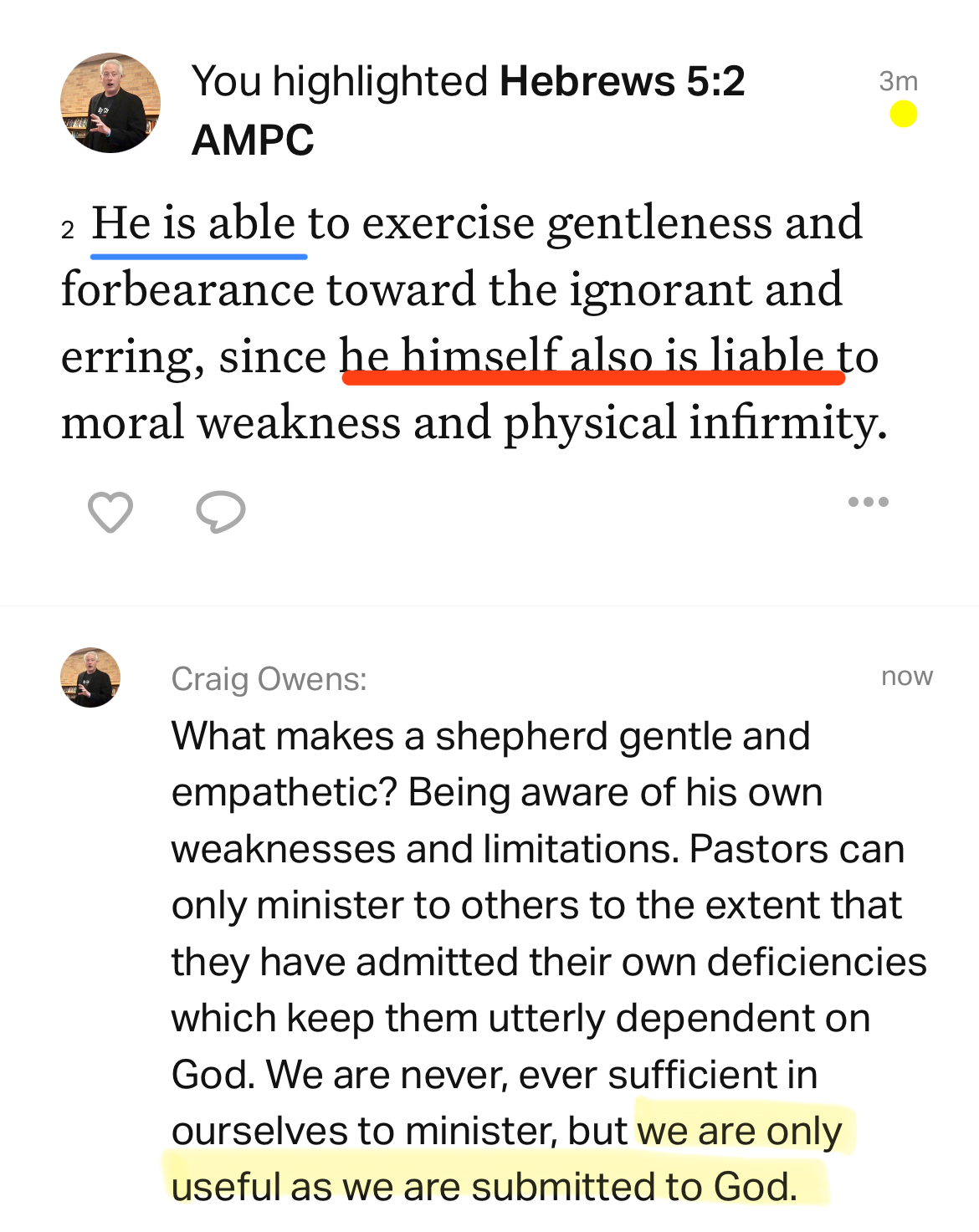
Because of the extensive prayer, research, and work I put into my book Shepherd Leadership, I am frequently drawn to passages of Scripture that reinforce the idea of pastors as shepherds. I was meditating on Hebrews 5:2 the other day, and I shared some of my thoughts with some of my pastor friends.
Listen to the audio-only version of this podcast by clicking on the player below, or scroll down to watch the video.
Everyone loves stories! Whether it be a book, movie, or even a friend’s tall tale, we love hearing stories because they connect with us on a deeply personal level. As leaders, we can use stories as a powerful tool to connect with our staff and help reinforce the point we’re trying to make. Stories aren’t just for kids, they’re a vital part of effective communication.
[0:10] “Once upon a time there was a podcast…”
[0:48] Stories portray the point better than just telling someone what to do.
[5:59] Vision casting sticks better with a story instead of a “talking point.”
[7:43] Stories are more compelling than facts. Leaders need to listen to the stories of their teammates.
[10:39] Stories are under-utilized by far too many leaders.
[12:04] Stories set the stage for everything else the leader is going to share next. But we better be sure the story is true!
[13:28] Paul Harvey illustrates how a good story can expand a leader’s influence.
[15:30] Stories get a reaction and lock it in our brains.
[16:48] Stories bridge the gap between people.
[17:28] Is storytelling a gift, a skill, or both?
[19:42] We need to tell our stories so that others can connect to their own stories.
[21:32] Leaders, you have a great story to tell! We can help coach you in how to tell your story even better.
Check out this episode and subscribe on YouTube so you can watch all of the upcoming episodes. You can also listen to our podcast on Spotify and Apple.
Healthy leaders look in the mirror first before they confront a teammate on something that needs to change. Check out the full conversation Greg and I had on The Craig and Greg Show about defeating the two-headed leadership killer of ignorance and arrogance. I have lots of new content every week, which you can check out on my YouTube channel.
“I am often, I believe, praying for others when I should be doing things for them. It’s so much easier to pray for a bore than to go and see him.” —C.S. Lewis, Letters to Malcolm: Chiefly on Prayer
“The greatest weapon against stress is our ability to choose one thought over another.” —William James
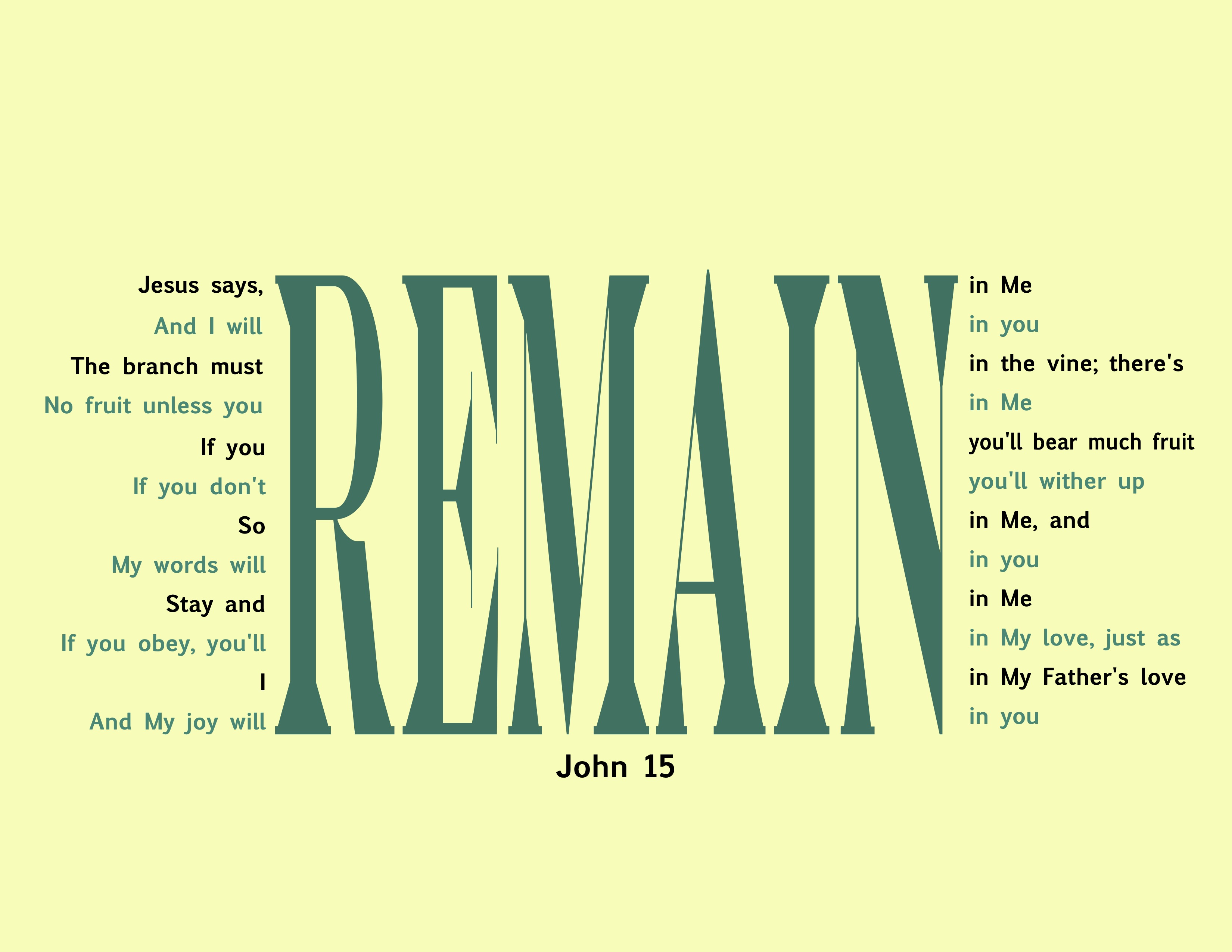
The most empowered and empowering person is the one who remains in Jesus.
“Whereas three or more incidents of intense stress within a year (say, serious financial trouble, being fired, or a divorce) triple the death rate in socially isolated middle-aged men, they have no impact whatsoever on the death rate of men who cultivate many close relationships.” —Daniel Goleman, Richard Boyatzis & Annie McKee, Primal Leadership
T.M. Moore has an outstanding series of posts on how Christians should interact with the governments in the lands in which they live. I highly recommend this series to you. T.M. wrote, “We have seen that justice is a jewel of many facets. In its obligatory facet, justice requires that we love our neighbors simply because they are made in the image of God. We must regard them, and do with them, as we wish to be regarded and done with ourselves. In its preventive facet, justice demands that we use forethought in all our actions to make sure, as far as possible, that our neighbor or his property is not injured by what we do. Distributive justice encourages us to share generously with our neighbors and others in need. Restorative justice comes into play when the balance of neighbor love has become disturbed and the one guilty of disturbing it is required to set things right again. Each of these forms of justice, grounded in the Law of God, is very much a part of life in our society today. It is simply mindless or prejudicial to insist that we should have no input from Scripture or the Law of God, either in the public square or in the making of public policy. Our nation was founded on Biblical principles of justice, and to deny this is to rewrite history past and to put in jeopardy history to come.”
The Greek word translated as “consider” in Hebrews 3:1 means to observe closely, to consider attentively, to fix your eyes or mind upon it. In its context, this verb is usually directing us to the end result of being in awe, kindling a renewed faith, and being rejuvenated with a new resolve to move forward.This is what happens especially when we consider Jesus❣️
The Holy Spirit loves to give us those “lightbulb moments” when the Word of God almost leaps off the page! I have lots of new content every week, which you can check out on my YouTube channel.
It has long been believed that some migratory animals use the earth’s magnetic force to help them navigate. Some researchers discovered that moths can see both the magnetic fields and the stars to plot their course. The lead researcher wrote, “If you have this tiny insect with a brain a tenth the volume of a grain of rice and eyes smaller than a pinhead, that they can do this is surprising.” The protein in their eyes that allow them to do this is unevolved—it’s always been there, implant from the beginning by our awesome Creator!
In the God Speaks Science reading plan on YouVersion, John Von Sloten wrote, “Creation is God’s first book. To read it we need science. Science is not the enemy of the Christian faith; it’s an ally! … We need to read biblical creation references with the Author’s omniscience and original intent in mind. To do that, we need science. … What if you try to connect the next scientific truth you encounter to an attribute of our ever-near God? If everything comes from God’s mind, then everything has something to say about God’s nature.”
Competitive leaders need to keep both winning and losing in perspective. Check out the full conversation Greg and I had about competition on The Craig and Greg Show.
Listen to the audio-only version of this podcast by clicking on the player below, or scroll down to watch the video.
Every good leader is competitive. From dollars earned to patients treated, there isn’t a leader out there who isn’t constantly trying to improve their numbers and outdo the competition. However, the wrong kind of competition can fester and create an unhealthy workplace. In this episode, Greg and I discuss how fostering healthy competition in your organization is vital to your success.
[0:14] I am the best host on this show!
[1:52] Leaders need to be competitive but also need to keep it at a healthy level.
[3:42] Not every team member will have the same competitive drive as you.
[4:35] Leaders need to be competitive with themselves.
[7:40] Too much internal competition can be detrimental to the organization.
[8:32] Greg tells a tee-ball story highlighting how your team members innately wonder, “How are we doing?”
[11:50] I have used Six Sigma initiatives to foster positive competition in my organizations.
[13:24] Resilience doesn’t show up until adversity appears.
[16:26] Make halftime adjustments.
[17:32] Cutthroat leaders get short-term results, but their organization suffers in the long run.
[19:53] Giving 100% and failing is difficult, but it’s worse to not know what you could have accomplished.
[21:04] When you win, act like you’ve won before. When you lose, act like you’ll win again.
[22:49] Compete for achievable outcomes.
[24:38] Greg likes to win, but he’s learned more from his losses.
[25:34] It’s impossible to grow without competition.
[28:10] We would love to coach you to help you be a better competitive leader.
Check out this episode and subscribe on YouTube so you can watch all of the upcoming episodes. You can also listen to our podcast on Spotify and Apple.
Listen to the podcast of this post by clicking on the player below, and you can also subscribe on Apple, Spotify, or Audible.
On a recent episode of The Craig And Greg Show, Greg and I were sharing with leaders how to reframe their fears. In this clip, I discuss the importance of making sure we aren’t hampering a new situation with an old fear.
Sextortion is when someone demands money or other favors in exchange for not sharing an explicit photo or video of the targeted victim. The sextortion of minor children runs into the thousands every month. Axis reported, “Most targets of sextortion are teen boys, who seem to be more likely than girls to send an explicit selfie to someone they aren’t having a romantic relationship with. Anonymous scammers will reach out to their target over social media, engaging in a flirtation and eventually asking for nudes.” Axis also shared these helpful resources, “Families can prepare by telling their teens about resources like TakeItDown, a free service which will remove nudes from the internet within two days, and the 24/7 Crisis Text Line, which connects teens with professional counselors via text at any time.”
“First, government is not God; instead, government is God’s servant for the good of those served. And second, the people are not God, and therefore must not be allowed the last word on what defines the terms of ‘good’ public policy. Only God can define what is good for people, for He alone is good (Mark 10:18; Psalm 119:68).” —T.M. Moore
“Since the Roe v. Wade U.S. Supreme Court decision more than 50 years ago, almost 40% of all abortions in America have been in the Black community, resulting in erasing the lives and destinies of an estimated 23 million Black babies.” The National Black Fellowship is aggressively working to change this.
“You gain strength, courage and confidence by every experience in which you really stop to look fear in the face. You are able to say to yourself, ‘I have lived through this horror. I can take the next thing that comes along.’ You must do the thing you think you cannot do.” —Eleanor Roosevelt
J. Warner Wallace uses forensic evidence to demonstrate why we should believe the New Testament was written much closer to the time of the actual event than most skeptics believe. Check out this video.