Poetry Saturday—See How The Patient Jesus Stands

See how the patient Jesus stands,
Insulted in His lowest case!
Sinners have bound the Almighty hands,
And spit in their Creator’s face.

With thorns His temple gored and gashed
Send streams of blood from every part;
His back’s with knotted scourges lashed,
But sharper scourges tear His heart.

Nailed naked to the accursed wood
Exposed to earth and heaven above,
A spectacle of wounds and blood,
A prodigy of injured love!

Hark! how His doleful cries affright
Affected angels, while they view;
His friends forsook Him in the night,
And now His God forsakes Him too!

Behold that pale, that languid face,
That drooping head, those languid eyes!
Behold in sorrow and disgrace
Our conquering Hero hangs, and dies!

Ye that assume His sacred name,
Now tell me, what can all this mean?
What was it bruised God’s harmless Lamb,
What was it pierced His soul but sin?

Blush, Christian, blush: let shame abound:
If sin affects thee not with woe,
Whatever life is in thee found,
The life of Christ thou doest not know. —Joseph Hart

Why Did Jesus Take Your Punishment?

“Christ lived the life we could not live and took the punishment we could not take to offer the hope we cannot resist. Why? Jesus was angry enough to purge the temple, hungry enough to eat raw grain, distraught enough to weep in public, fun-loving enough to be called a drunkard, winsome enough to attract kids, weary enough to sleep in a storm-bounced boat, poor enough to sleep on dirt, radical enough to get kicked out of town, responsible enough to care for His mother, tempted enough to know the smell of satan, and fearful enough to sweat blood.

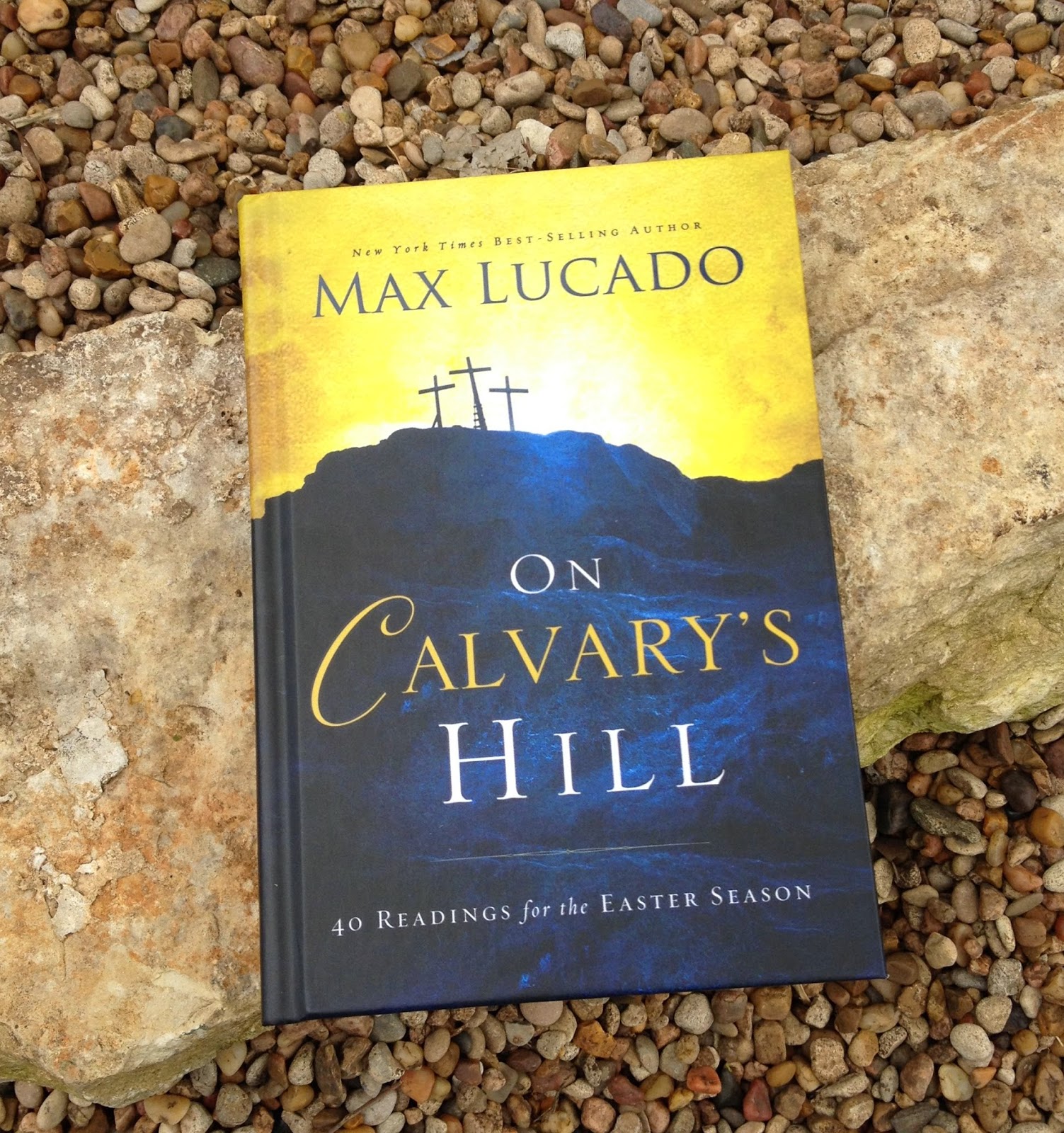
“Why? Why would heaven’s finest Son endure earth’s toughest pain? So you would know that ‘He is able…to run to the cry of…those who are being tempted and tested and tried’ (Hebrews 2:18, AMP). Whatever you are facing, He knows how you feel. When you turn to Him for help, He runs to you to help. Why? He knows how you feel. He’s been there. He’s not ashamed of you. Nor is He confused by you. Your actions don’t bewilder Him. Your tilted halo doesn’t trouble Him. So go to Him.” —Max Lucado, in On Calvary’s Hill

7 Quotes From “On Calvary’s Hill”

Max Lucado has given us a treasure-trove of insights into the Passion Week! Here are a few quotes from On Calvary’s Hill, and also please check out my full review of this book by clicking here.

“Jesus knows what these men are about to do. By morning they will bury their heads in shame and look down at their feet in disgust. And when they do, He wants them to remember how His knees knelt before them and he washed their feet. . . . He forgave their sin before they even committed it. He offered mercy before they even sought it.”

“The next time the fog finds you, remember Jesus in the Garden. The next time you think that no one understands or cares, reread the fourteenth chapter of Mark and pay a visit to Gethsemane. And the next time you wonder if God really perceives the pain that prevails on this dusty planet, listen to Him pleading among the twisted trees. The next time you are called to suffer, pay attention. It may be the closest you’ll ever get to God. Watch closely. It could very well be that the hand that extends itself to lead you out of the fog is a pierced one.”

“How did Jesus endure the terror of the crucifixion? He went first to the Father with His tears. He modeled the words of Psalm 56:3: ‘When I am afraid, I put my trust in You’ (NLT). Do the same with yours. Don’t avoid life’s Gardens of Gethsemane. Enter them. Just don’t enter them alone. And while there, be honest. Pounding the ground is permitted. Tears are allowed. And if you sweat blood, you won’t be the first. Do what Jesus did; open your heart.”

“O Conquering One, I gladly open wide the gates of my life and ask You to enter. You see where the enemy has invaded and done his damage. Come, Lord Jesus, come, and speak Your words of truth and power into my life and cleanse my temple. In Your name, Jesus, amen.”

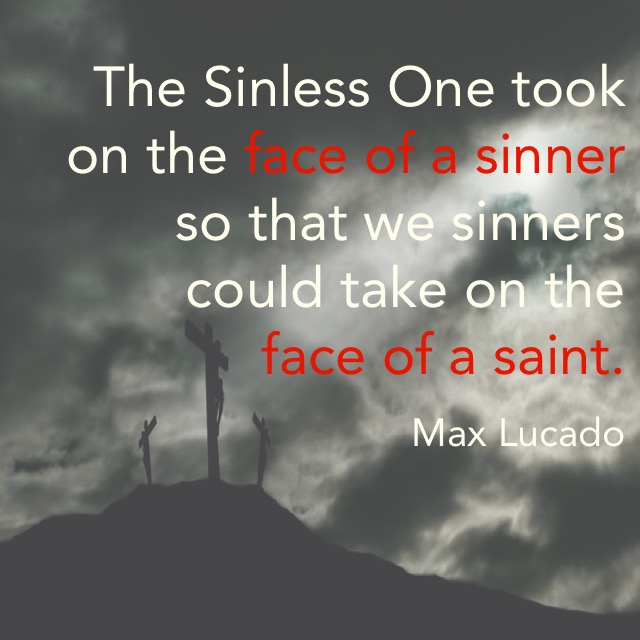
“The sinless One took on the face of a sinner so that we sinners could take on the face of a saint.”

“What you and I face daily, He never knew. Anxiety? He never worried! Guilt? He was never guilty! Fear? He never left the presence of God! Jesus never knew the fruits of sin . . . until He became sin for us. He did it for you. Just for you.”

“Jesus’ love does not depend on what we do for Him. Not at all. In the eyes of the King, you have value simply because you are.”

On Calvary’s Hill (book review)

Max Lucado has written several books concerning the week leading up to Christ’s crucifixion and resurrection. In On Calvary’s Hill, you will be treated to 40 of the best looks from all of these previous books into what was happening during this pivotal week.

Max Lucado has both a firm grasp of Scripture, and a keen imagination to “read between the lines” of the biblical accounts. God has truly gifted him with the skill to take his readers behind the scenes, and even into the very thoughts of the key characters in the many stories that make up the big story of Christ’s Passion.

These forty entries make excellent reading during the Lent season, to help you appreciate more fully the work Jesus did for us on Calvary. But, honestly, this book could be read at any time during the year and still have immense value to those who want to know more about what Jesus accomplished on the Cross.

Don’t miss this book!

Poetry Saturday—The Monster Death

Break off your tears, ye saints, and tell
How high your great Deliverer reigns;
Sing how He spoiled the hosts of hell,
And led the monster death in chains:
Say, Live forever, wondrous King!
Born to redeem, and strong to save;
Then ask the monster, Where’s thy sting?
And, Where’s thy victory, boasting grave? —Isaac Watts

Who Can Bridge The Gap Between God And Man?

Listen to the podcast of this post by clicking on the player below, and you can also subscribe on AppleSpotify, or Audible. 

Mankind was created good and upright in God’s image and given dominion over everything God had created (see Genesis 1:26-28; Psalm 8:3-8). But man was not given dominion over himself (Genesis 2:15-17).

As Oswald Chambers said, “The temptation came to him on this line—‘Disobey, and you will become as God.’ Man took dominion over himself and thereby lost his lordship over everything else. According to the Bible, the disposition of sin is my claim to my right to myself” (see Genesis 3:1-7).

“And sure enough, they then had knowledge of good and evil, but it was from the standpoint of becoming evil and remembering how good they once were” (Nancy Guthrie). Their disobedience created an unbridgeable gulf between God and man. 

There were other consequences of their sin too:

  • Consequence #1—They realized they were naked, making them ashamed of themselves and ashamed to be in God’s presence.
  • Consequence #2—They feared God and tried to hide from Him.
  • Consequence #3—They couldn’t accept responsibility for what they did because that acceptance would mean they would also be responsible for bridging the gulf, something they were utterly unable to do.
  • Consequence #4—They were completely separated from God. Now there was nothing that they could do except work, have children, raise a family, and try to make the best of things.

Even in the midst of this despair, God foreshadowed the hope that would be their salvation. First, God promised that their offspring would one day crush satan’s head. Then God sacrificed an innocent animal and used those skins to make more permanent clothes for Adam and Eve, foreshadowing what Jesus would do.

Adam must have glimpsed this ray of hope because he then named his wife Eve, which means life!

But who could bridge this chasm? Who could be a mediator between God and man? The only possible candidate would have to be Someone who was both fully God and fully Man—that is Jesus Christ!

Only Jesus can fully and eternally cover our nakedness, remove our fear and shame, and present us without sin before His Father (see Jude 24 and Romans 5:6-11).

If, as Oswald Chambers says, sin is my claim to my right to myself, then salvation is God’s right to myself because I have surrendered to the reconciling work of Jesus.

“Believers in Christ are seen by God exactly as Christ is seen by God,” wrote Ann Voskamp, because those who believe in Jesus are clothed in His righteousness!

If you haven’t surrendered yourself to God’s right to you, what’s holding you back from doing that today? If you have surrendered yourself to God, don’t ever let satan lie to you about your nakedness, shame, or unworthiness—you are “Christ’s friend, God’s child, Spirit’s home!” (Ann Voskamp).

►► Would you please prayerfully consider supporting this ministry? My Patreon supporters get behind-the-scenes access to exclusive materials. ◀︎◀︎

What If Jesus Had Been Physically Weak?

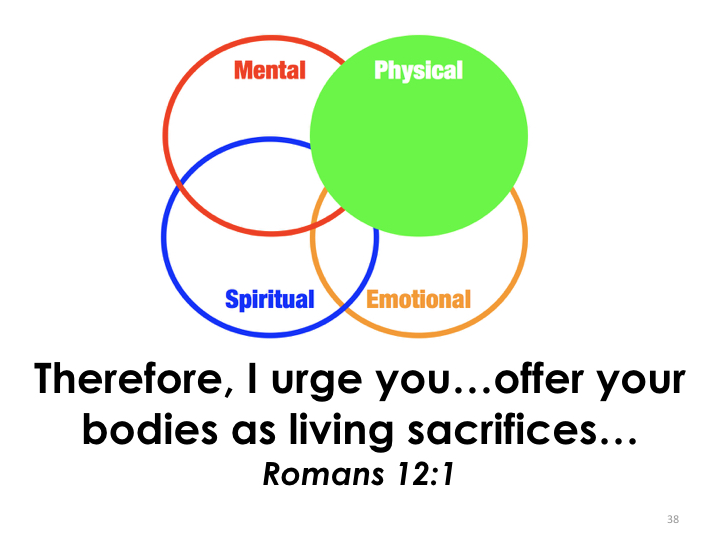
physical-healthWe have been exploring the whole health of Jesus, as Dr. Luke recorded it in Luke 2:52. In this verse Luke tells us that Jesus grew in wisdom (mental health), stature (physical health), in favor with God (spiritual health) and in favor with men (emotional/social health). Being unhealthy in any one of these areas will ultimately pull down the health in all of the areas.

The life of Jesus shows us that we, too, must strive to live wholly healthy lives.

Yesterday at Calvary Assembly of God, Scott asked a challenging question: “What if Jesus hadn’t been strong enough to make it to the top of Calvary’s hill?”

Think about the excruciating torture Jesus went through—

  • He was sleep deprived.
  • He was dehydrated from His intense prayer time in Gethsemane, where He sweat blood.
  • He was emotionally depleted from having all of His friends abandon and deny Him.
  • He was beaten multiple times by temple guards and Roman soldiers.
  • He was brutally whipped to the point that His back muscles and nerves were exposed.
  • He had thorns crushed into His scalp.
  • He had His beard ripped out.
  • He had to carry a 60- to 90-pound wooden crossbeam nearly 650 yards uphill.

All of this took place before He had metal spikes slammed through His wrists and ankles, and then was hoisted up rudely into the air to be suspended from His Cross.

Jesus went through all of that for you and me. In making it all the way to the point where He said, “It is finished,” He fulfilled every prophesy concerning His death.

The only way Jesus could have made it through this is if He was at optimal physical health.

If Jesus had died from exhaustion or heart attack or loss of blood before He was actually nailed to the Cross, how many of the prophesies would have been left unfinished? He needed to keep His physical body in tip-top shape throughout His entire earthly life in order to be ready for this one crucial moment.

Being physically weak makes it difficult for us to…

  • …think clearly (mental health)
  • …concentrate on the things of God (spiritual health)
  • …control our emotions and respond appropriately to other people (emotional/social health)

So we, like Jesus, must work on our physical health. God has a plan for your life. In order for you to fulfill all God has in mind, you must be wholly healthy. Are you taking care of your physical body? If you’re not, you are slowly robbing all of the other areas of your life of the strength they need.

If you’re not as physically healthy as you could be, what are you willing to do differently?

Check out this 3-minute clip where Scott asks us what physical health changes we’re willing to make for God’s glory…

Love Re-members

love-re-membersChristians often talk about God in terms of the “Trinity.” That is, the One True God revealed in three Persons: Father, Son, and Holy Spirit.

This is sometimes a difficult concept to grasp, especially since the word Trinity doesn’t specifically appear in the Bible. But make no mistake, just because the word isn’t there doesn’t mean it’s not true. Consider…

  • God’s Three-in-One nature is first exhibited when man is created (Genesis 1:26).
  • When the prophesy is given about Jesus being born in human flesh, He is given all the titles of the three Persons of the Godhead (Isaiah 9:6).
  • At Christ’s baptism we see Jesus in human form, we see the Holy Spirit descending as a dove, and we hear the Father’s voice announcing His approval of His Son (Matthew 3:16-17).
  • Jesus Himself said He would ask the Father to send the Holy Spirit to the Christians (John 14:16).
  • And just as Jesus ascended into Heaven, He told His followers to baptize people into all three Persons of the Godhead (Matthew 28:19).

But I think the best expression of the Trinity is revealed in three simple words. John talks about how all three Persons of the Trinity are involved in the life of a Christian. And then he sums it all up in three words—

“GOD IS LOVE”

Each Person of the Godhead is encouraging and illuminating and pointing to the other Persons in the Trinity. Love is perpetually being received and given. We humans are created in God’s image … we are created to receive and to give God’s love. That’s why John tells us that we know and rely on the love God has for us (that’s the receiving part), and that whoever lives in love lives in God, and God in him (that’s the giving part).

When Adam and Eve sinned, they were dis-membered from God. As a result, every human in their natural state longs for connection with God and others, but feels separated, isolated, unloved, and even unlovable.

Love re-members! 

Jesus came to be broken and crushed and to feel the pain of separation from God. It was out of this brokenness that He could do the work of re-membering us to the fullness of the Trinity.

When Jesus shared His last supper with His disciples, He took bread (which is made from broken wheat kernels) and wine (which is made from crushed grapes). He told us as often as we eat the bread and drink the wine we are to remember how He was broken and crushed for us.

Remembering Christ’s work on the Cross re-members us to the fullness of the Trinity. 

Sin and satan want to keep us feeling separated, unloved, and unloveable. But when we were the least worthy of His love, God—Who IS love—was broken and crushed to re-member us to Him.

If you feel lonely, separated, isolated, unloved or unloveable, I urge you to remember what Jesus did for you. He loved you enough to be broken and crushed for your re-membering to all of God’s love.

Check out this video where I explain this amazing thought in more detail…

7 Quotes From “The Philosophy Of Sin”

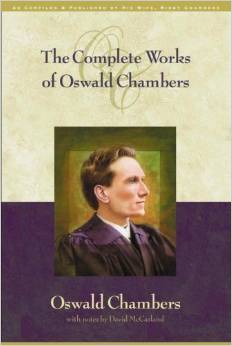
The Complete Works Of Oswald ChambersOswald Chambers always makes me think deeply, but The Philosophy Of Sin was a graduate-level, deep-thinking book on theology and philosophy for me! Check out my review of this book by clicking here. Below are some quotes I especially enjoyed.

“To people who are satisfied on too shallow a level the Bible is a book of impertinences, but whenever human nature is driven to the end of things, the Bible becomes the only Book and God the only Being in the world.”

“The life of nature is neither moral nor immoral; our bodies are neither moral nor immoral, we make them moral or immoral. Our Lord had a body, and we read that He hungered; it was not a sin for Him to be hungry, but it would have been a sin for Him to have eaten during the forty days in the wilderness, because His Father’s word at that time was that He should not eat. It is not a sin to have a body, to have natural appetites, it is a sin to refuse to sacrifice them at the word of God.”

“Lust simply means, ‘I must have this at once’; it may be a bodily appetite or a spiritual possession. The principal lust works on is, ‘I must have it at once, I cannot wait for God’s time, God is too indifferent,’ that is the way lust works.”

“If all Jesus Christ can do is to run a parallel counteraction with what satan can do, His right name is ‘Culture,’ not ‘Savior’; but His revealed nature was stated by the angel to Mary, and repeated over and over again, ‘Thou shalt call His name Jesus; for He shall save His people from their sins.’ The slight views of salvation, the sympathetic drifty views that all Jesus Christ can do is to put in us a principle that counteracts another principle, will cause anyone who is got to the last limit to blaspheme God for a thing like that. It all comes from a flimsy, wrong view of sin. If that is all He can do, what is the good of calling Him Savior? … It is sin that He came to cope with; He did not come to cope with the poor little mistakes of men, they cope with their own mistakes; He came to give them a totally new stock of heredity, that is, He came to implant into them His own nature, so that satan’s power in the soul is absolutely destroyed, not counteracted.”

“This aspect of the death of Jesus takes us into a spiritual domain beyond the threshold of the thinking of the majority of us. The cry of the Cross, ‘My God, My God, why hast Thou forsaken Me?’ is unfathomable to us. The only ones—and I want to say this very deliberately—the only ones who come near the threshold of understanding the cry of Jesus are not the martyrs, they knew that God had not forsaken them, His presence was so wonderful; not the lonely missionaries who are killed or forsaken, they experience exultant joy, for God is with them when men forsake them: the only ones who come near the threshold of understanding the experience of God-forsakenness are men like Cain—‘My punishment is greater than I can bear’; men like Esau, ‘…an exceedingly bitter cry’; men like Judas. Jesus Christ knew and tasted to a fuller depth than any man could ever taste what it is to be separated from God by sin.”

“How Jesus Christ does cleanse our conscience! It is freedom not only from sin and the damage sin has done, but emancipation from the impairing left by sin, from all the distortions left in mind and imagination.”

“The conscience formed in us by the Holy Spirit makes us amazingly sensitive to the things that tell against the honor of God.”

I’ll be sharing other quotes from this book in the near future, and I also share an extensive passage from the current Chambers’ book I am reading every Thursday. If you want to be notified when those quotes are posted, please enter your email address in the box to the right and click “Sign me up!”

I share quotes from Oswald Chambers and other inspirational authors daily on both Tumblr and Twitter.

Thursdays With Oswald—A New Perspective Of Calvary

Oswald ChambersThis is a weekly series with things I’m reading and pondering from Oswald Chambers. You can read the original seed thought here, or type “Thursdays With Oswald” in the search box to read more entries.

A New Perspective Of Calvary

     If Jesus Christ were only a martyr, His Cross would be of no significance; but if the Cross of Jesus Christ is the expression of the secret heart of God, the lever by which God lifts back the human race to what it was designed to be, then there is a new attitude to things. … 

     There are any number of amateur skeptics, and the men who are seeing the difference between “believing their beliefs,” and “believing God,” men, who, through the turmoil and the stress, are seeing that rationalism is not the basis of thing. According to the Bible, the basis of things is tragedy, and the way out is the way made by God in Redemption. The New Testament does not say that the human race is evolving, but that the human race is a magnificent ruin of what it was designed to be. …

     Paul says the fundamental revelation of the New Testament is that God redeemed the whole human race when they were spitting in His face, as it were. … 

     The majority of people who have never been touched by affliction see Jesus Christ’s death as a thing beside the mark. When a man gets to his wits’ end and things go hard with him, his thick hide is pierced and he is stabbed wide awake, then for the first time he begins to see something else—“At last I see; I thought that He was stricken, smitten of God and afflicted; but now I see He was wounded for my transgressions.” … 

     Jesus Christ did not come to give us pretty ideas of God, or sympathy with ourselves; He came from a holy God to enable men, by the sheer power of His Redemption, to become holy.

From The Shadow Of An Agony

Oswald Chambers wrote these words in the midst of The Great War (what we now refer to as World War I), when everyone’s belief in rationalism was shaken to the core. Tragedy has a tendency to do that to us.

Chambers says that trouble in this world should point us to the unshakable, inescapable truth that this world is “a magnificent ruin of what it was designed to be,” and the only security and hope we have is a new life with God though the Redemption Jesus paid for at Calvary.

May any pain, suffering, or confusion you feel in this world help you see the Cross of Christ in a whole new light.