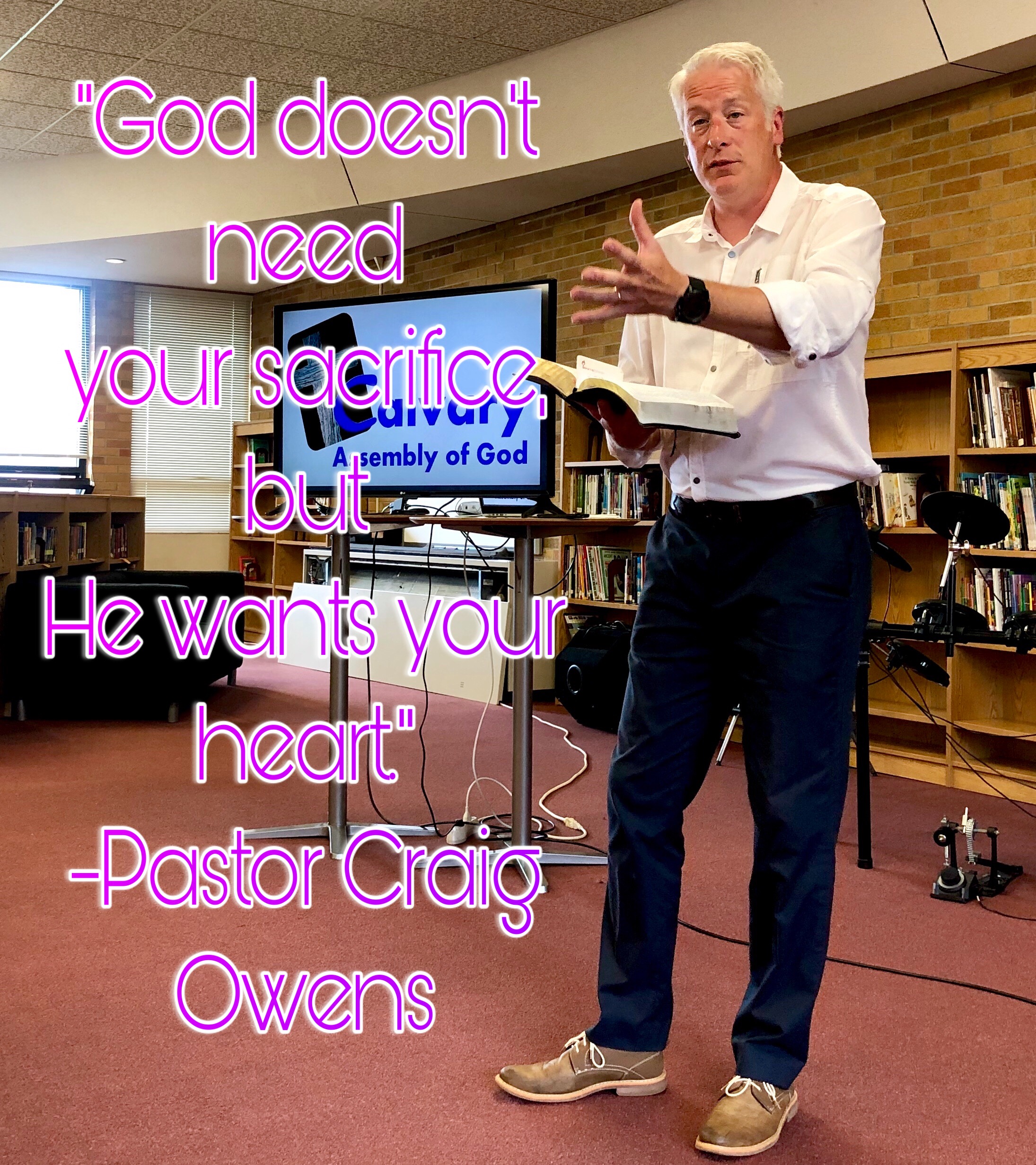
I am always blessed to sit under the ministry of Jeff Hlavin! These are some of my notes from his message Calvary Assembly of God on Sunday, but you really should watch the whole message.
The kingdom of heaven is like a treasure hidden in the field, which a man found and hid; and from joy over it he goes and sells all that he has, and buys that field.Again, the kingdom of heaven is like a merchant seeking fine pearls, and upon finding one pearl of great value, he went and sold all that he had, and bought it. (Matthew 13:44-46)
There are at least two possible perspectives about the meaning and the application of these two parables:
First Perspective: Jesus is the One who finds and seeks.
The field is the world, and Jesus paid the price for the whole field/world to be His.
Second Perspective: We are the ones doing the discovering.
Jesus provides Himself as the Treasure of treasures. So taking up our cross to follow Him is not a morbid thing. There is overwhelming joy because of the extravagant treasure that is ours when we do so!
1. It’s about our response to discovering His Kingdom.
2. It’s about our appropriate response to His Kingdom.
3. It’s about the whole-hearted appropriate response which the Kingdom of God requires.
4. It’s about the value of His Kingdom.
5. It’s about the primacy of His Kingdom.
Three Observations:
Both individuals are alike in that…
Both of them know there is more to life than what they have. Neither one of them considers what they’re doing as a sacrifice because of what they’re gaining!
Both of them recognize what is missing when they find it.
Both of them recognize that what they have found is of far more inestimable value than everything else they have.
Speaking in tongues as the Spirit enables you is the unmistakable, objective, outward, initial physical evidence. The Bible makes clear that continuing to pray in tongues has huge benefits for both our personal prayer lives and for the corporate church body. But don’t stop there!
The initial, outward evidence is primarily for the individual Christian—it’s a way of knowing that you know that you have indeed been baptized in the Spirit. But there also needs to be some everyday evidence for others that testifies to them that something is different about your life.
Consider the disciples of Jesus before and after being baptized in the Holy Spirit…
Their vocabulary
Before being baptized in the Spirit they said stupid things because they didn’t know what to say (Mark 9:5-6) But after being baptized in the Spirit there was no more foot-in-mouth disease. Just as the Holy Spirit enabled them to praise God in an unlearned tongue, He also empowered their natural dialect. The same Greek word is used in Acts 2:4 (enabledby the Holy Spirit), 2:14 (Peter addressed the crowd), and 26:25 (what I am saying is true and reasonable).
Before they argued about who was the greatest. Afterward, they gladly gave all that they had to others (Mark 9:33-34; Acts 2:44-45).
Their boldness in the face of adversity
Before they abandoned Jesus, ran away, and hid in locked rooms. Afterward, there was no intimidating or silencing them (Acts 4:8, 13, 18-20).
Their understanding of Scripture
Before they had virtually no understanding of Scripture’s application. Afterward, they understood how to apply God’s Word in almost every situation (Acts 2:16, 33-35; 4:24-26).
Jesus promised that the baptism in the Holy Spirit would empower us TO BE His witnesses (Acts 1:8). Not just to do things for Him. There’s nothing wrong about doing Jesus-glorifying things, but in themselves, they are too short-sighted. Jesus doesn’t want us empowered to do things, but TO BE a living, breathing, walking, talking witness of a life transformed by His power. That’s the reason why I say to you again and again: Don’t stop at salvation. Press on and press in to be baptized in the Holy Spirit so that you can BE an empowered, transformed and transforming witness for Jesus!
That Pentecost Sunday immediately following Christ’s resurrection forever changed what Pentecost stood for. From this point forward, Christians who have encountered the Holy Spirit as those 120 followers of Jesus did now call themselves Pentecostal. (Check out Acts 2:1-12, 16, 22-24, 37-39.)
If you had been present on that day, there were three pieces of evidence you would have noticed:
Wind—this is the Greek word pneuma, which is the same as the Hebrew word ruach. This is the impartation of the Spirit that brings a true life connection to the Trinity (Genesis 2:7). This power was foretold by Jesus when He promised, “you will receive power when the Holy Spirit comes on you…” (Acts 1:8a).
Fire—this was foretold by John (Luke 3:16). This fire was to light up our witness to a dark world (Matthew 5:14-16). Again Jesus promised, “you will receive power to be My witnesses…” (Acts 1:8b).
Tongues—this fulfilled the promise of Jesus, “to be My witnesses…to the ends of the earth” (Acts 1:8c).
Some have tried to call this speaking in tongues an “ecstatic utterance,” or just nonsensical gibberish. But notice the descriptions Luke gives: each one heard them speaking in his own language(v. 6), each of us hears them in his own native language (v. 8), and declaring the wonders of God in our own tongues (v. 11). Luke lists visitors from over 15 different places around the world that heard their native tongue being spoken by these native Galileans. Luke pointed out that these Spirit-baptized Christians spoke like this as the Spirit enabled them (v. 4b).
Two types of vocabulary are happening here—language (vv. 6, 8), which is the Greek word dialektos, and tongues (vv. 4, 11), which is the Greek word glossa.
Dialektos is a learned language. Glossa can also be learned, but it’s not something that one just casually picks up. The Greeks said glossa is “not a word of everyday speech but one belonging to dignified and elevated discourse.” The Greeks called glossa the language of prophets, wisemen, and philosophers.
“But,” you might say, “speaking in tongues sounds weird!” Yes, it does. As N.T. Wright said:
“God acts completely unexpectedly—as He always said He would.”
Remember this—God is God. He is uncontainable, indefinable. If we can define Him, He is not God, but we are. He always does things “out of the box”—at least out of our box, not His! Like sending His Son born of a virgin, and empowering Jesus to restore sight to one born blind, and enabling Jesus to cure someone who contracted leprosy, and even reversing the laws of biology to bring Jesus back to life!
So it’s not unexpected that the baptism of the Holy Spirit is accompanied by someone praising God in a dialect they have never learned.Speaking in tongues as the Spirit enables you is the unmistakable, objective, outward, initial physical evidence of the baptism in the Holy Spirit.
Jesus wants us to have rivers of living water flowing—bursting!—out of us. This living water can flow out of anyone who has the Spirit IN them! Don’t wait another day: be baptized in the Holy Spirit.
There is a Pentecostal Christian woman that we first meet in the Book of Acts, and then we see her name scattered throughout Paul’s letters. She may be the most prominent woman among all of the Apostle Paul’s companions and probably is responsible for spreading the Gospel more and farther than any other woman recorded in the Bible.
Scripture doesn’t tell us if she had children of her own but she is certainly the spiritual mother of more Christians than we will ever be able to count!
Prisca is her birth name. She is a Jew, and most likely a freeborn Roman (just as Paul was). She is from the prominent Acilius family, so combined with Prisca her name is called Priscilla. She married Aquila and they both worked as leather makers (also known as tentmakers).
Let’s take a look at Priscilla’s travel itinerary—
Pricilla left Rome because of Emperor Claudius’ decree in 49 AD and traveled to Corinth, where she met Paul (Acts 18:1-3, 11, 18-19).
After spending almost 2 years with Paul in Corinth, they traveled to Ephesus with Paul, where she met and mentored Apollos (Acts 18:24-26). Apollos became a trusted friend to Paul; in fact, Paul calls him a synergos (where we get our English word for synergy). In other words, Paul thought his ministry was more effective because of his partnership with Apollos, but that is all thanks to Priscilla’s involvement!
Priscilla returned to Rome sometime after Claudius’ death in 54 AD. She probably returned home to prepare the way for Paul’s visit there (Romans 1:10-11; 15:23-24; 16:3).
And at some point she returned to Ephesus, probably to help Timothy as he pastored the church there (2 Timothy 4:19).
Here are 5 lessons we can learn from Priscilla’s life—
Be baptized in the Holy Spirit. This is what she taught to others, so it is undoubtedly how she lived as well.
Use the gifting God has given you. Except for one place, Priscilla is always listed first ahead of her husband. This is unprecedented anywhere else in the New Testament. That tells us that despite what the Greco-roman culture tried to enforce, Priscilla was the predominant teacher/preacher in her family.
Work hard. Priscilla had to be fairly well-to-do to be able to travel to at least three major cities and to host churches in her home, and yet we see her working with her hands to provide for her family and for the church.
Be bold. Jesus said the baptism in the Holy Spirit would give us boldness, and Priscilla demonstrated that powerfully (Romans 16:4).
Be synergistic. Paul also called Priscilla a synergos. Paul used this word sparingly for people who had put everything on the line for the sake of the Gospel. He used synergos for people like Apollos, Timothy, Titus, and Luke. Priscilla is the onlywoman who gets this invaluable term.
We don’t know if Priscilla was a biological mom, but she was definitely a spiritual mom. She was empowered by the Holy Spirit, and probably is responsible for spreading the Gospel more than any other woman recorded in the Bible. You can follow in her footsteps!
The Holy Spirit is vital in everything concerning a Christian’s life.Dr. Donald Stamps emphatically said it this way:
“It is essential that believers recognize the importance of the Holy Spirit in God’s redemptive purpose. Many Christians have no idea what difference it would make if there were no Holy Spirit in this world. Without the Holy Spirit there would be no creation, no universe, no human race (Genesis 1:2; Job 33:4). Without the Holy Spirit there would be no Bible (2 Peter 1:21), no New Testament (John 14:26; 15:26-27; 1 Corinthians 2:10-14), no power to proclaim the gospel (Acts 1:8). Without the Holy Spirit there would be no faith, no new birth, no holiness, no Christians at all in the world.”
Sometimes I think we have in our mind that the “old” in Old Testament somehow means outdated or no longer applicable to our lives, and the “new” in New Testament should be our sole focus. But Jesus affirmed again and again that all of the Scriptures—what we now refer to as the Old Testament—all point to Him.
The outpouring of the Holy Spirit on that Pentecost Sunday was not something new to the New Testament Christians. He was always a part of a believer’s life. Even 1000 years before Christ’s public ministry, David knew the importance of the Holy Spirit in both salvation, and in living a consistently holy lifestyle (Psalm 51:10-12, 143:10).
If Jesus needed the baptism in the Spirit to empower Him, direct Him, and give Him success, how much more do we need this?! That’s why Jesus imparted the Holy Spirit to His followers at their moment of salvation, but then admonished them to eagerly expect the baptism in the Holy Spirit as well (John 20:22; Luke 24:49; Acts 1:8).
Quite simply Jesus is saying—DON’T STOP AT SALVATION
Jesus didn’t, the apostles didn’t, Paul didn’t, Apollos didn’t, the Ephesian Christians didn’t, I didn’t, and you shouldn’t either!
The Feast of Pentecost was an annual celebration for Jewish people for a long time, with nothing really noteworthy happening. Until…
…on the Day of Pentecost that took place just 10 days after Jesus ascended into heaven, a new breed of Christian was unleashed on the world. Those followers of Jesus who were baptized in the Holy Spirit on that day begin living a lifestyle that we now refer to as Pentecostal.
Most people were familiar with water baptism is an outward sign of an inward commitment. It’s not something that was new to Christianity: Greek philosophy teachers and Jewish rabbis baptized their followers. So did John the baptizer (or the Baptist).
But John, as the forerunner of Jesus, promised that there would be something more—a baptism in the Holy Spirit that Jesus would bring. Jesus Himself said this baptism was so important that He didn’t want His followers to even attempt to begin to evangelize the world until they received this baptism (Luke 3:3, 16; 24:44-49; Acts 1:4-8).
What is important about this Holy Spirit baptism? What are its origins? To answer these questions, we have to go back to the very beginning of Time itself. When God created humans, the Holy Spirit was breathed into us, giving us a living soul (Genesis 1:26, 2:7). This Spirit-breath set us apart from all other living creatures (Job 33:4, 32:8; Proverbs 20:27).
We were created to be intimately connected with God, but our sin severed that. Our hearts became sin-calloused and selfish and stone-hard toward God.
The Cross of Jesus allowed us to be reconciled to God. By placing our faith in what Jesus did for us on the Cross, we could receive forgiveness of our sins. We were now saved from the penalty of our sins, but Jesus wanted more for us—He wanted us also to be saved to a new life that was as intimately connected to God’s heart as His life was.
So Jesus told His followers to wait and pray for the promised baptism in the Holy Spirit.
They prayed. And on that Day of Pentecost, they were indeed baptized in the Holy Spirit (Acts 2:1-4). Actually, the word filled literally means “fulfilled”—the baptism in the Holy Spirit fulfilled what Jesus had promised.
From that day forward, those who are baptized in the Holy Spirit are called Pentecostal people. I know there are some who would argue that was only for “back then,” but let me tell you from personal experience that there is no other way that I would try to live the Christian life than by being an unashamed Pentecostal!
Jesus wants us to not only be water baptized to announce our faith in Him for forgiveness of sins, but also to be baptized in the Holy Spirit to empower us to live holy, extraordinary, fulfilling lives. If you haven’t been baptized in the Holy Spirit, you can be simply by asking God (Luke 11:13).
Pentecost for over 1500 years was a celebration in Jerusalem that brought in Jews from all over the world. But on the Day of Pentecost that came just ten days after Jesus ascended back into heaven, the meaning of Pentecost was forever changed!
Followers of Jesus—now empowered by an infilling of the Holy Spirit—began to take the good news of Jesus all over the world. These Spirit-filled Christians preached the Gospel and won converts to Christ even among hostile crowds, performed miracles and wonders, stood up to pagan priests and persecuting governmental leaders, and established a whole new way of living as Christ-followers.
We, too, can be Pentecostal followers of Jesus Christ today. We can experience an anointing and an empowering in our lives that turns ordinary Christianity into extraordinary Christianity!
Please join me this Sunday as we begin a series of messages called We Are: Pentecostal. You can find a map here, or if you live too far away to join us in person, be sure to check out our Facebook Live broadcasts every Sunday morning.
The foundational claim of Christianity is Jesus died AND rose to life again. The Apostle Paul says that if the resurrection didn’t happen, anyone who claims to be a Christian is in a world of hurt (1 Corinthians 15:3-4, 14, 17-20).
“But resurrected from the dead?! Really? I believe in facts. I believe in the laws of science.” Me too! But I also believe that the supernatural is not the opposite of belief in the natural. Just like Paul said, “Why should any of you consider it incredible that God raises the dead?” (Acts 26:8).
Noted astronomer Allan Rex Sandage said, “It is my science that drove me to the conclusion that the world is much more complicated than can be explained by science. It was only through the supernatural that I can understand the mystery of existence.”
And C.S. Lewis added, “How can anything be seen to be an exception till the rules are known? … Nothing can seem extraordinary until you have discovered what is ordinary. Belief in miracles, far from depending on an ignorance of the laws of nature, is only possible in so far as those laws are known.”
Let me give you a simple example. Suppose I divide $5 evenly between two of my buddies. The laws of mathematics dictate that both of them will have $2.50. But what if one of my friends, through some sleight of hand, steals some of my other friend’s money? The fact that one of them now has more than half doesn’t change that mathematical law that $5 divided evenly is two sets of $2.50.
The mathematician as a mathematician doesn’t know how likely one friend is to steal some of the other friend’s money. For that answer, he has to ask someone else. The changing of the outcome does not negate the laws. In fact, the more certain we are of the laws of mathematics the more clearly we know that something outside of them “interfered.”
Concerning Jesus, there are three undeniable facts—
It appears the laws of biology have been interfered with, that a supernatural miracle has occurred. The supernatural fact that Jesus was resurrected does not change the biological fact that death is irreversible. We just didn’t expect the outside influence. Just like we didn’t expect one friend to steal money from another friend.
What does this mean for you and me? It means that you can trust God’s word. All of it! Jesus told us that He would die by crucifixion and that He would be resurrected three days later (John 10:18; Matthew 20:19).
If that word came true, we can also trust this word: We can have our sins forgiven and receive God’s gift of eternal life—just as Christ was raised from the dead through the glory of the Father, we too may live a new life (Romans 6:4).
The law of sin says: All of us have sinned and fallen short of God’s standard. The unbreakable law of sin is that the penalty for unforgiven sin is eternal death. That law cannot be broken, unless there is a Supernatural interference—a miracle!
Jesus interfered. He took our sins upon Himself. He supernaturally switched places with us and let the death penalty fall on Himself. And if we believe in that, we can have our sins forgiven and receive what we didn’t expect—eternal life with God!
What a God we have! And how fortunate we are to have Him, this Father of our Master Jesus! Because Jesus was raised from the dead, we’ve been given a brand-new life and have everything to live for, including a future in heaven—an inheritance that is kept in heaven for you, pure and undefiled, beyond the reach of change and decay (1 Peter 1:3-4 MSG & NLT)
Listen to the podcast of this post by clicking on the player below, and you can also subscribe on Apple, Spotify, or Audible.
Jesus is on His passionate journey toward the Cross. Every step on this journey is a step of love.
After Jesus finished His last supper with His disciples, they all went to one of their favorite places to pray—the Garden of Gethsemane. It was a place they all knew well. Including Judas, who had been looking for an opportunity to turn Jesus over to the religious authorities when He was out of the public eye.
Jesus knew this time was coming (Matthew 10:33-34; John 13:1, 3; 18:4), and His knowing prompted His serving. So we can say that His foot-washing service was as much a reminder to Himself as it was to His followers.
But let us never forget that through all of this horrific, inhumane mistreatment and torture, Jesus remains the King of kings, the Son of God. In fact, very God Himself.
The Jewish religious leaders knew this too (John 8:54-59; 10:31-33). And without “knowing it” the soldiers that came to arrest Jesus knew it as well.
Just look at the absolute authority of the King of kings. Grown men—religious leaders and hardened soldiers—fall to their knees at just three words: “I am He.”
Christ’s kingdom has overruling authority. It collects no taxes, it has no standing army, it requires no checks-and-balances because its Sovereign IS Truth and Love. This unequaled, unrivaled power was contained in Jesus—“You would have no authority over Me unless it was given you from above.”
Which makes His submission to Pilate and others even more amazing! One word from Him could have crushed legions and toppled governments—yet for love’s sake, He submitted. Let that sink in—Sovereignty submitted.
What appeared to be the cruelty of man was the sovereignty of God.
No one can take My life from me. I sacrifice it voluntarily. For I have the authority to lay it down when I want to and also to take it up again. For this is what My Father has commanded. (John 10:18)
“Christ’s death was not the death of a martyr, who sinks at last overwhelmed by enemies, but the death of a triumphant conqueror, who knows that even in dying He wins for Himself and His people a kingdom and a crown of glory.” —J.C. Ryle
Christ has bought us out from under the doom of that impossible system by taking the curse for our wrongdoing upon Himself. For it is written in the Scripture, “Anyone who is hanged on a tree is cursed” (as Jesus was hung upon a wooden Cross). (Galatians 3:13 TLB)
Sovereign love submitted to the cruelty of man SO THAT you and I could be saved from the inescapable doom that will inevitably crash down on us. Jesus loved us so much that He allowed the Cross to happen to Him.
The question now remains—what are you doing with this sovereign love?
Do you know Jesus as your Savior? Have you received this gift He willingly, lovingly purchased for you on the Cross?
Jesus is journeying toward the Cross. On Thursday, it’s His last opportunity to impart His most important thoughts to His disciples. He is about to be arrested, and everything is about to go sideways for the disciples—“this isn’t the way this is supposed to happen!”—and Jesus needs to prepare them with the truth they will need to sustain them through this.
“I have eagerly desired to eat this Passover with you before I suffer,” Jesus says (Luke 22:15).
So Peter and John are sent to make arrangements for the Passover meal, but one of the arrangements that they overlooked was the host duties—washing the feet of each guest, anointing them with perfume, and giving them a welcoming kiss.
As they are eating dinner, Jesus makes four important statements:
“One of you will betray Me”
“All of you will abandon Me”
“I will rise again and restore you”
“I have prayed for you”
These statements get the disciples arguing about who’s going to betray Jesus—“It’s not me, is it?!”—and over how faithful they are—“I would never abandon Him!” Ultimately they begin to argue over who is the greatest disciple among them.
Jesus not only explains to them how the servant is greater than the master in God’s sight (Luke 22:24-27), but He then becomes the living example of that when He washes their feet (John 13:1-5, 12-17).
Here’s an important principle—Only secure people can lovingly serve others.
Insecure people don’t like to serve others because they feel they are being misused, or taken advantage of, or that others will look down on them.
Jesus “knew” (John 13:1, 3) how much power His Father had given Him, making Him secure enough to serve. Security really means, “I am loved by God, and I know who I am in Him.”
Jesus served out of love: the profound love that He knew His Father had for Him. He gave His disciples the same mandate: Serve others out of love for Me and show the world that you are My disciples (see John 13:34-35).
When Jesus ate this last supper with His disciples, He instituted a remembrance celebration that we now call Communion. The root word is “commune” which the dictionary defines as a “conversation with profound intensity and intimacy.”
This is the type of intimate relationship Jesus had with His Father, and this is the type of relationship He calls us to with Him. The broken bread of Communion reminds us that Jesus can make whole any broken area that would keep us from communing with Him. The cup of Communion reminds us that Jesus can instantly and fully forgive any sin that would keep us from communing with Him.
Jesus set the example—we are to commune with our Heavenly Father through the way He made by His broken body and His shed blood. It’s out of this communion that we are empowered by His love, and then feel secure enough to serve others in love too.