


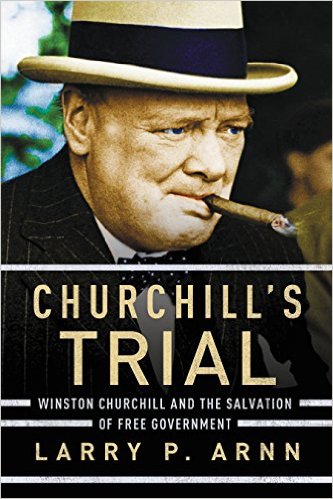
 In Churchill’s Trial, Larry Arnn has given us a fascinating look at Winston Churchill’s battle to keep freedom alive, both in the moment of crisis and after the crisis has passed. You can read my full book review by clicking here. Below are a few of the quotes I highlighted as I read.
“Mankind has never been in this position before. Without having improved appreciably in virtue or enjoying wiser guidance, it has got into its hands for the first time the tools by which it can unfailingly accomplish its own extermination. That is the point in human destinies to which all the glories and toils of men have at last lead them. They would do well to pause and ponder upon their new responsibilities. Death stands at attention, obedient, expectant, ready to serve, ready to shear away the peoples en masse; ready, if called upon, to pulverize, without hope of repair, what is left of civilization. He awaits only the word of command. He awaits it from a frail, bewildered being, long his victim, now—for one occasion only—his master.” —Winston Churchill
“Science is necessary, and also science is a master. As the human ability to make grows, the human ability to control the engines by which we make diminishes. The logical problem is relentless: we may stay as we are and lead shorter lives of pain and trouble, or we may use our capacity to make our lives easier and safer. If we do that we will gain power, and we can use that power against ourselves.” —Larry Arnn
“No material progress, even though it takes shapes we cannot now conceive, or however it may expand the faculties of man, can bring comfort to his soul.” —Winston Churchill
“We must never cease to proclaim in fearless tones the great principles of freedom and the rights of man which are the joint inheritance of the English-speaking world and which through Magna Carta, the Bill of Rights, the Habeas Corpus, trial by jury, and the English common law find their most famous expression in the American Declaration of Independence. …
“All this means that the people of any country have the right, and should have the power by constitutional action, by free unfettered elections, with secret ballot, to choose or change the character or form of government under which they dwell; that freedom of speech and thought should reign; that courts of justice, independent of the executive, unbiased by any party, should administer laws which have received the broad ascent of large majorities or are consecrated by time and custom. Here are the title deeds of freedom what should lie in every cottage home. Here is the message of the British and American peoples to mankind. Let us preach what we practice—let us practice what we preach.” —Winston Churchill
“There is enough for all. The earth is a generous mother; she will provide in plentiful abundance food for all her children if they will but cultivate her soil in justice and in peace.” —Bourke Cockran
“Human relations are not a contest in which the advantage of some requires the disadvantage of others. That means in turn that government need not have the authority to allocate resources, at least not comprehensively. A government with such power would be in one sense at war with any citizens who have more than others, effectively with all citizens but the few poorest.” —Larry Arnn
“In republics, the greater danger is that the majority may not sufficiently respect the rights of the minority.” —James Madison
“He who molds public sentiment goes deeper than he who enacts statutes or pronounces decisions.” —Abraham Lincoln
“Democracy properly understood means the association of all through the leadership of the best.” —Winston Churchill
“Our hearts will ache…if we have not a vision above material things.” —Winston Churchill
“If men were angels, no government would be necessary. If angels were to govern men, neither external nor internal controls on government would be necessary.” —James Madison
“We now watch the workings of a written Constitution enforced by a Supreme Court according to the letter of the law, under which anyone may bring a test case challenging not merely the interpretation of the law, but the law itself, and if the Court decides for the appellant, be he only an owner of a few chickens, the whole action of the Legislature and the Executive becomes to that extent null and void.” —Winston Churchill
More quotes coming soon…

![Light & Truth [Acts]](https://craigtowens.com/wp-content/uploads/2016/02/light-truth-acts.jpg)


 Craig T. Owens
6 More Quotes From “Light & Truth—Acts and the Larger Epistles”
February 17, 2016 — Craig T. Owens“We are described as feeble men, bearing on our shoulders a burden too heavy to be borne; the Holy Spirit comes up to us; not exactly to take away the burden; nor to strengthen us under it; but to put His own Almighty shoulder under it, in the room of, and along with ours; thus lightening the load, though not changing it; and bearing the heavier part of it with His own Almightiness. Thus it is that He ‘helps’ our infirmities; making us to feel both the burden and the infirmity all the while that He helps; nay, giving us such a kind and mode of help, as will keep us constantly sensible of both.” [Romans 8:26]
“How real, how true, how fast must that love have been. Here is its sincerity demonstrated. Here are its dimensions measured. What is its height? The answer is, ‘He spared not His Son.’ What is its depth? ‘He spared not His Son.’ What is its length? ‘He spared not His Son.’ What is its breadth? ‘He spared not His Son.’ Nay, He delivered Him up. Nay, He laid our sins upon Him; He made Him a curse for us. The more that we meditate on this one gift, the more does its greatness display itself. It passeth all measurement and all understanding.” [Romans 8:32]
“Prayer takes for granted that God is full, and we are empty; that He is infinitely full, and we unspeakably empty. … Prayer takes for granted that there is a connection between His fullness and our emptiness. The fullness is not inaccessible. It is not too high for us to reach, or for it to stoop. It is not too great for us, nor too distant, so as to be incommunicable. There is a connection, and it has been established by God Himself; it is a divine medium of communication: ‘Ask, and you shall receive.’ Prayer takes for granted that we are entitled to use this channel.” [Romans 12:12]
“If you are Christians then, be consistent. Be Christians out and out; Christians every hour, in every part, and in every matter. Beware of half-hearted discipleship, of compromise with evil, of conformity to the world, of trying to serve two masters. … Half-hearted Christianity will only dishonor God, while it makes you miserable. There is abundance of Christianity, so-called, in our day. Who does not call himself a Christian? But who cultivates the holiness, the blamelessness, the devotedness, the calm consistency of a follower of Christ? Who hates sin as it ought to be hated? Who separates from the world as he ought? Who follows Christ as He ought to be followed? Who walks in the footsteps of the holy Son of God?” [1 Corinthians 1:8]
“Let us walk worthy [of the blessings in Christ Jesus]; as men who really believe it; happy, holy, unworldly, zealous, generous, loving. Let us carry the consciousness of our calling into everything—great or small; into business, daily life, recreations, reading, education, everything; maintaining our true position before men; manifesting our proper character; letting the world know our prospects, and doing nothing inconsistent with what we profess to be now, and with what we shall be when the Lord comes.” [1 Corinthians 1:9]
“Thus, then, is our whole earthly life, in all its parts, to be regulated by the magnitude of the eternal. Things present must be subordinated to those which are to come, the seen to the unseen, the earthly to the heavenly. It is by the light of the coming glory that we must walk while here. It is from the clock of eternity that our time is to be always taken. Arrange your business, your recreations, your duties with reference to the invisible and unending future. Live, speak, work, move, as those who believe that the things which are seen are temporal, but the things which are not seen are eternal.” [1 Corinthians 7:29-31]
The first set of quotes I shared from this book can be read here. And my review of this book is posted here.
Share this: