The Blessing Of Being There

Listen to the podcast of this post by clicking on the player below, and you can also subscribe on AppleSpotify, or Audible. 

Luke had previously spent a little time with the apostle Paul (Acts 16:10-18), but near the end of the historical record in the Book of Acts, we see Luke with Paul almost continually. 

(Check out all of the Scriptures in this post by clicking here.)

The reason we can tell this is because of the pronouns “us” and “we.” From Acts 20:5—21:18, 27:1—28:16, these two pronouns are used over 80 times! 

Luke probably joined Paul in Greece (20:2) and was with him when they arrived in Jerusalem. After Paul’s arrest, transport to Caesarea, and being bound over for his hearing before Caesar, Luke is still there (27:1). Luke remains with Paul throughout the entire journey to Rome, and is still with him as the Book of Acts closes. 

Paul calls Luke a faithful friend (2 Timothy 4:11). Today, people know this man who wrote the Gospel of Luke and the Book of Acts as a preeminent historian. It is God’s perfect provision and timing that links together the lives of Paul and Luke at such a pivotal time. 

Quite simply stated: Paul is blessed by Luke just being with him. 

Not only does Luke preserve the accurate historical record of Paul’s missionary journeys, but it appears that Luke is actively involved in Paul’s letter writing to the churches. Luke uses more unique Greek words in the New Testament than any other writer. But many of the words that appear more than once are found only in the historical works of Luke and the letters of Paul. I can almost imagine Paul dictating a letter, and then pausing to ask his educated friend Luke, “What is the Greek word that means such-and-such?” Luke’s thoughtful, Spirit-inspired reply is then included in these important letters for the early churches. 

This should be a great encouragement to us still today that God has us where we need to be, and with the people that need us in their lives. 

What skills do you have? Who has God put in your life? How can your talents be a blessing to those people? 

Simply doing what God has gifted you to do with those whom He has placed in your life is both a blessing to your companions and is pleasing to your God. 

I pray that you will find a way to use your God-given talents to be a blessing to those around you. Perhaps the blessing will simply be you being there for your friends as they journey through their life. 

►► Would you please prayerfully consider supporting this ministry? My Patreon supporters get behind-the-scenes access to exclusive materials. ◀︎◀︎

Encouraging Others In The Storm

Listen to the podcast of this post by clicking on the player below, and you can also subscribe on AppleSpotify, or Audible. 

Have you ever been going through a storm in your life and wondered, “God, why are You allowing me to go through this?” 

The Scriptures I reference in this episode are Acts 27; Jonah 1; Acts 23:11.

I talk more about encouragement in the storms of life in my posts Hope in the Storms and Hard Times. And I talk more about Jonah’s storm in the post Not the Answer I was Expecting. 

My book When Sheep Bite is available here. 

►► Would you please prayerfully consider supporting this ministry? My Patreon supporters get behind-the-scenes access to exclusive materials. ◀︎◀︎
The Glorious Gospel

Listen to the podcast of this post by clicking on the player below, and you can also subscribe on AppleSpotify, or Audible. 

Paul opens his letter to the saints at Rome with two powerful words: the gospel (Romans 1:1).

(Check out all of the biblical references in this post by clicking here.)

The word gospel simply means the good news about the salvation that comes only through Jesus.

Paul loves this word! 

Interestingly, although we refer to the first four books of the New Testament as “The Gospels,” the word itself barely appears: 

  • Matthew—4 times 
  • Mark—8 times 
  • Luke—0 times 
  • John—0 times

And even though these four opening books are the Gospels about Jesus, He Himself only uses the word nine times, with the other three times attributed to someone else mentioning what Jesus was doing. 

Peter only uses this word twice (Acts 15:7; 1 Peter 4:17). And John uses it just once (Revelation 14:6). 

Paul, however, uses this word 64 times! 

It becomes such a part of who he is and how he thinks, that he calls it “my gospel” twice (Romans 2:16, 16:25) and “our gospel” three times (2 Corinthians 4:3; Colossians 1:23; 2 Thessalonians 2:14). 

For Paul and for us this Good News is—

  • God’s promises fulfilled 
  • salvation power 
  • the fullness of God’s blessing 
  • the opening of mysteries 
  • the guide for godly living 
  • glorious light 
  • the expression of God’s grace 
  • the standard of all truth 
  • a key part of the Christian’s spiritual armor 
  • the empowerment for ministry 
  • the anchor of unshakable hope 
  • the means by which we experience Christ’s glory 
  • the only door to life and immortality 

For those of us who have been called to preach this Gospel, these thoughts should both humble and empower. 

For those of us who have been saved by believing this Gospel, these thoughts should cause us to desire to know more, and more, and more about our Savior. 

What a glorious Gospel this is! 

►► Would you please prayerfully consider supporting this ministry? My Patreon supporters get behind-the-scenes access to exclusive materials. ◀︎◀︎
Time For A Self-Check

Listen to the podcast of this post by clicking on the player below, and you can also subscribe on AppleSpotify, or Audible. 

Have you ever heard this little saying: “To live above with saints we love, oh, that will be glory. But to live below with saints we know, well, that’s a different story”? I’ve found that it’s sometimes true! 

We love Psalm 133:1-3 when the saints are all together. What a great “selling point” to invite someone to be a part of the Christian community! But Psalm 41:7-9 is kind of embarrassing as David talks about former friends who have hurt him deeply. 

(Check out all of the Scriptures in this post by clicking here.)

But being bitten by a fellow sheep is a reality we all have experienced, and, sadly, we will probably have to deal with again in the future. There is a natural way we tend to react when we’ve been bitten, but there is also a supernatural response that the Bible consistently calls us to. This is the God-glorifying way we all need to strive for. 

In Acts 23, Paul is standing before the Sanhedrin. He opens his remarks by simply saying he has a clear conscience before God, and the high priest immediately orders that Paul be smacked on the mouth! That seems like a bit of an over-reaction on the part of the high priest, but maybe it was a bit of show of force to let Paul know who was really in charge. Paul responded with an immediate—and natural—reaction when he says, “God will slap you!” 

Paul is an old man by this time. He’s been through shipwrecks, beatings, imprisonments, gone without food, traveled more miles than he can count, and preached more sermons than he can remember. His body was giving out on him, and his eyesight was especially weak. Clearly, Paul didn’t realize to whom we was addressing his remarks. But when he became aware, he immediately owned up to his mistake. Paul offered no excuses or justifications, just a quick, simple, sincere apology. 

When you have been bitten (slapped) by another sheep, you should ask: 

  • Could I have provoked them by something I said or did? 
  • Could I have hurt them by something I didn’t say or do? 

David prayed a great prayer in Psalm 139:23. But this prayer is only effective if we are willing to accept that we may have been the agitator that led to the bite. In the last words that Job speaks in the Book of Job, he is very introspective. Check out all of the “If I have” statements throughout Job 31. 

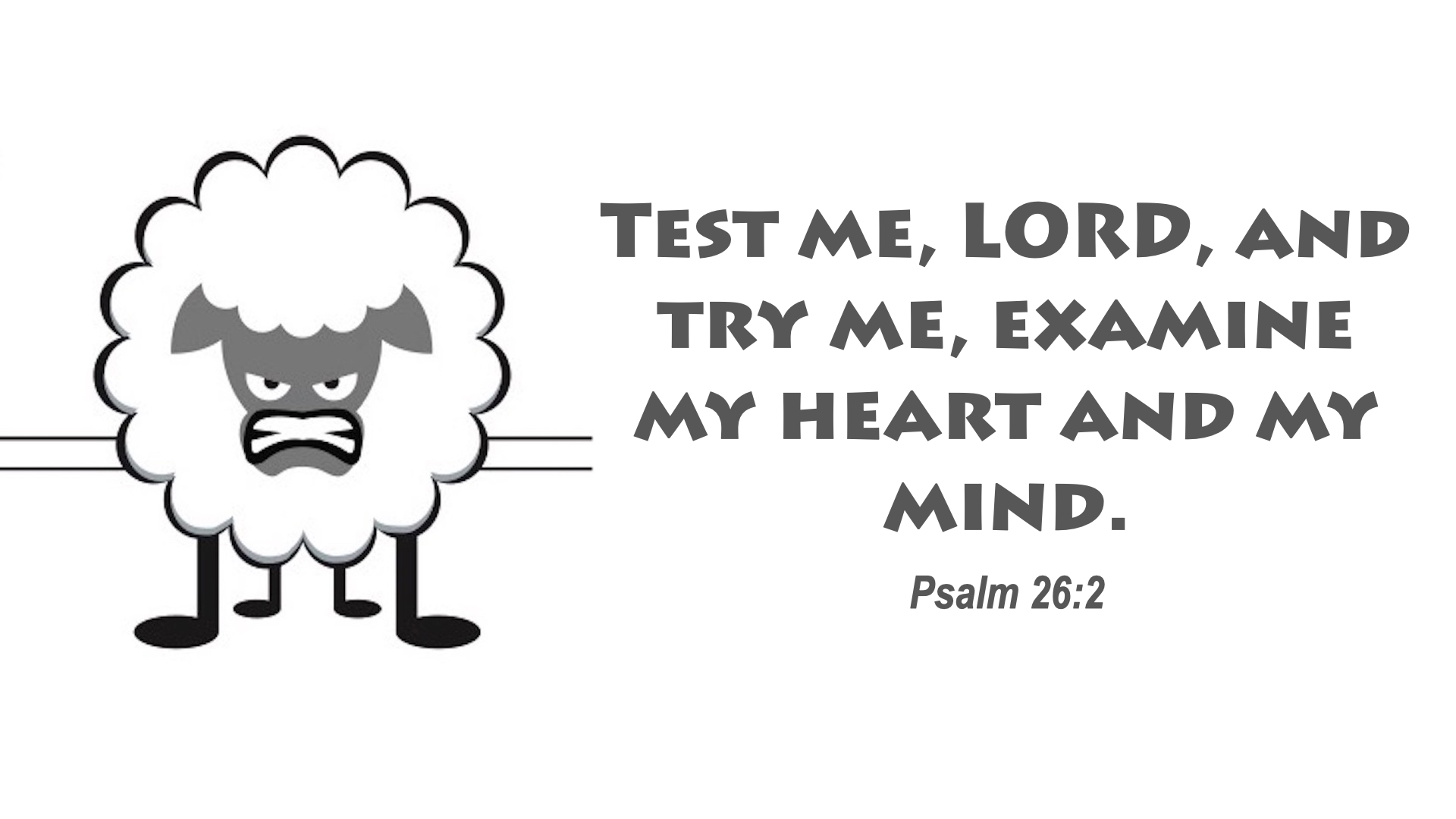
In Psalm 26:2, David invites the Holy Spirit to check him three times! 

  • test me = scrutinize me 
  • try me = assay me 
  • examine me = refine me in the fire 

When we are bitten, we should be open to the possiblity that God is using this bite to get my attention—to make me aware of a fault in my life or something that’s been in a blind spot. 

So we should consider the following: 

  1. Has this kind of bite happened more than once? From different sheep? 
  2. Has a spiritually wise person attempted to address this with me before? 
  3. Do I ever admit that I’m at fault, or is it always the other person’s fault? 
  4. Do I find myself making a list of why they should apologize to me? 
  5. When was the last time I apologized to someone else? 

If the Holy Spirit reveals something in us, He will also empower us to make the change and make amends. The natural response is to place all the blame on others. The supernatural response to pray Psalm 26:2 before responding. 

If we react only the natural way, it is a lose-lose for us and for the whole pasture. But if we learn to respond in a supernatural way, it becomes a win-win for everyone. Listen to the wise words of King Solomon—

He who heeds instruction and correction is not only himself in the way of life but also is a way of life for others. And he who neglects or refuses reproof not only himself goes astray but also causes to err and is a path toward ruin for others. (Proverbs 10:17 AMPC) 

Let’s all strive for the supernatural response that is a win-win for the whole Kingdom of God! 

Please follow along with all of the messages in this series by clicking here. 

P.S. If you are a pastor, you may want to check out my book When Sheep Bite.

►► Would you please prayerfully consider supporting this ministry? My Patreon supporters get behind-the-scenes access to exclusive materials. ◀︎◀︎
The Testimony Of Our Unified Worship

Listen to the podcast of this post by clicking on the player below, and you can also subscribe on AppleSpotify, or Audible. 

When Christians put aside some of their minor differences and are unified in their worship, it becomes a testimony to a watching world.

This whole series of looking at the Songs of Ascent comes from Psalms 120-134, but I especially notice the unity in Psalm 133.

This unity is seen during the outpouring of the Holy Spirit on the day of Pentecost recorded in Acts 2. But unity is not the same thing as conformity, as I shared in this message.

►► Would you please prayerfully consider supporting this ministry? My Patreon supporters get behind-the-scenes access to exclusive materials. ◀︎◀︎
Wolf Deterrent

Listen to the podcast of this post by clicking on the player below, and you can also subscribe on AppleSpotify, or Audible. 

As Paul is on his way to Jerusalem, he makes time to meet with the leaders of the Church in Ephesus. An important reminder Paul gives them comes from the example he lived out while he was in Ephesus: “For I have not hesitated to proclaim to you the whole will of God” (Acts 20:27). 

Some translations say “the whole counsel of God,” but I like the simple, straightforward wording in the KJV: “all the counsel of God.” In other words, Paul’s textbook was everything in the Scriptures. 

One of Paul’s traveling companions was Luke, who made frequent use of the Greek word boulē, which is translated “counsel.” He is the only Gospel writer to use this word, and then he uses it seven more times in the Book of Acts. Putting together Luke’s usage of boulē with the three other appearances in the New Testament, we can come up with a good overview of what Paul meant by “the whole will of God.” 

Boulē tells us that…

  • God’s purpose always prevails (Acts 2:23, 4:28, 5:38, 13:36; 1 Corinthians 4:5; Ephesians 1:11) 
  • Man’s counsel can be flawed (Luke 23:51; Acts 27:12, 42) 
  • God’s counsel if immutable (Hebrews 6:17) 
  • Men who mutate God’s counsel are the wolves that seek to destroy the flock (Luke 7:29-30; Acts 20:27-31)

(Check out all of these Scriptures by clicking here.)

Paul warned these Ephesians leaders: 

Keep watch over yourselves and all the flock of which the Holy Spirit has made you overseers. Be shepherds of the church of God, which He bought with His own blood. I know that after I leave, savage wolves will come in among you and will not spare the flock. Even from your own number men will arise and distort the truth in order to draw away disciples after them. So be on your guard!… (Acts 20:28-31, emphasis added) 

In my book When Sheep Bite I have a chapter called’ Driving Away the Wolves.’ In that chapter I point out—

  There is a phrase that is often associated with the behavior of wolves: a lone wolf. Normally, wolves travel and live in packs. The phrase “lone wolf” is associated with those who leave in order to find a mate, carve out their own territory, and then form their own pack. 

   Jesus said that His sheep hear His voice and follow Him. Lone wolves hear the shepherd’s voice but ignore it to follow their own pursuit of forming their own pack. Remember that these lone wolves don’t want to stay alone: they want to build their own following.

Jesus said we could spot imposters—wolves in sheep’s clothing—by their fruits (Matthew 7:15-20). Two evident fruits are: 

  1. Mutating the immutable counsel of God’s Word to suit their own needs 
  2. Ignoring or criticizing the whole counsel of God’s Word that godly shepherd leaders faithfully teach and preach

For shepherd leaders and their flocks, the whole counsel of God’s Word is the best wolf deterrent you can find! Another passage from my book says—

   David’s beautiful description of the Good Shepherd in Psalm 23 has a phrase that sounds unusual to my ears. He writes, “Your rod and Your staff, they comfort me.” How can such wooden instruments bring comfort to sheep? When the sheep know their shepherd has the rod of God’s Word in his hand and is skilled at using it, the sheep are far more relaxed around the shepherd. This is because a shepherd’s rod is not used against the sheep, but only against the enemies of the sheep. 

   Throughout the Old Testament, the rods in the hands of leaders were the symbol of their God-appointed authority (think of the staffs of Moses and Aaron). Those rods were symbolic of the words God had spoken to these shepherds to empower them to lead His sheep. In the New Testament setting, the Bible is described in similar terms. Shepherds are directed to correctly handle the rod of God’s Word, knowing that His Word is the only thing that can reliably care for the sheep by teaching, rebuking, correcting, and training (2 Timothy 2:15, 3:16). The sheep will welcome this; the wolves will fight against this. 

Pastors, immerse yourself in the whole counsel of God’s Word. Not just the parts that are comfortable for you or pleasant to preach about, but all of God’s Word! This will strengthen the rod of leadership God has given you, it will bring health and comfort to the sheep in your flock, and it will be a strong deterrent against the wolves that would seek to infiltrate your pasture. 

I would also humbly recommend that you pick up a copy of my book When Sheep Bite to help resource you to heal from old or ongoing injuries, and to fortify you to remain faithful to the call God has on your ministry. 

►► Would you please prayerfully consider supporting this ministry? My Patreon supporters get behind-the-scenes access to exclusive materials. ◀︎◀︎
How Paul “Reasoned” With Unbelievers

This is the audio of an exclusive video that I shared with my Patreon supporters. We are currently in a series of lessons learned from Paul’s second missionary journey. This is the third lesson in this series.

Paul was very consistent and systematic in each city he visited. One of the consistent words Luke records about Paul is “reasoned.”

What does that word mean? Are there lessons from Paul’s example we can apply to our lives today? I think there is something very important and easily accessible for all Christians who want to be able to share their faith with unbelievers.

The Scriptures I reference in this video—Acts 17:1-5, 11, 16-31; 18:4, 18-19; Acts 8:26-39; Luke 24:13-45.

I also mentioned a blog post The Point of the Gospel. You can find that here.

My Patreon supporters get exclusive content, as well as early access to content that will be shared publicly at a later date. You can have access to all of this for just $5 per month. Your support will get you immediate access to not only this video, but all of the previous videos as well.

The Unexpected Slap

Listen to the podcast of this post by clicking on the player below, and you can also subscribe on AppleSpotify, or Audible. 

Have you ever walked through a door that God so obviously opened just to get smacked by the people on the other side? Let’s talk about the lessons we can learn from that.

The biblical passages I reference in this video are Acts 16:6-40; Psalm 126:4-5; Hebrews 12:2-3; Galatians 6:9.

The blog post I mentioned in this video is The Value of Journaling.

Get more information on my book When Sheep Bite here.

►► Would you please prayerfully consider supporting this ministry? My Patreon supporters get behind-the-scenes access to exclusive materials. ◀︎◀︎
3 Hindrances To Prayer

Listen to the podcast of this post by clicking on the player below, and you can also subscribe on AppleSpotify, or Audible.  I am sometimes amazed at how much Jesus accomplished in just a little over three years of public ministry. What I would have expected to see is a Man burning the candle at both ends—up early, working hard without any breaks each day, very little (if any) leisure time, and then burning the midnight oil.  But instead we see Jesus never seeming to be rushed or exhausted. He takes time for meals with friends, time away from the crowds, and still in just a short period of time He fulfilled hundreds of ancient prophecies and trained His followers to take the Gospel around the globe!  One of the keys is His priority. Notice that I said priority and not prioritieS. Jesus was singularly focused on His Father’s glory and He showed total dependence on Him. I think one of the most telling verses is Mark 1:35: “Very early in the morning, while it was still dark, Jesus got up, left the house and went off to a solitary place, where He prayed.”  If Jesus needed prayer to start His day, how much more do we need this!  Scottish pastor Robert Murray McCheyne wrote in his journal, “Rose early to seek God, and found Him whom my soul loveth. Who would not rise early to meet such company?” 

(Check out all of the Scriptures in this post by clicking here.) 

So why don’t we treat prayer like this? I think there are three main hindrances to keep us from making prayer a priority.  (1) Self-reliance. A common phrase we use is, “I need to get to work.” But this puts the emphasis on me—my plans, my abilities, my work ethic. I believe I can do more than pray, but I also believe that I shouldn’t do anything until I have prayed.  Prayer, therefore, is a reminder of my utter God-reliance.  God has a better plan than we do. God has more wisdom than we do. God has more strength than we do. So wouldn’t it be better to ask Him what we should be doing, how we should be doing it, and then ask Him for the strength to do it?  When we have this focus, our prayer time will keep us aligned with His plans and empowered with His wisdom and strength. Look at a couple of examples.
  • Sarah knew how to believe God because He showed how He kept His promise in His perfect timing (Genesis 21:1-2). 
  • Mary knew how to pray and behave in alignment with God’s word (Luke 1:31-38). Her prayer shortly after this is sautéed in Scripture, showing how she relied on God to keep His Word (vv. 46-55). 
  • Saul of Tarsus (who became Paul the apostle) had assurances of God’s direction for his life at almost every turn (Acts 9:15-16, 20:22-24, 21:10-14, 23:11, 27:21-25). Then he writes to his friends at Philippi how God received the glory throughout this whole process (Philippians 1:12-14, 25-26). 
We can live and pray with the same assurance that God is completely in control (Isaiah 55:8-11; Romans 8:26-28).   (2) Distractions. When Martin Luther was asked about his plans for the next day he said, “I have so much to do that I shall spend the first three hours in prayer.” That sounds unrealistic to most of us, but that is because we call too many things “priorities.” We need a singular priority: The knowledge of God’s will and the help that only God can give.  Stephen Covey has a very helpful tool that I use regularly: the urgent/important grid. Bible reading and prayer time is most decidedly a Quadrant II activity. We make time for these important activities by removing unimportant activities from Quadrant IV. The Bible frequently couples a “take off” with a “put on” (see 1 Corinthians 13:11; 2 Timothy 2:4; Ephesians 6:11-18), which should prompt us to ask, “What’s one thing I can take off of my Quadrant IV and put on that time for prayer in Quadrant II?”  (3) Uncertainty. Sometimes we may wonder if our prayers are doing anything. Maybe we think we are not praying the “right way” or perhaps we wonder if we are praying for something in alignment with God’s will or only our own selfishness.  The only two things Jesus said were the “wrong ways” to pray were praying to show off, and babbling like pagans (Matthew 6:5-8). As we read in Romans 8, the Holy Spirit will help us pray, if we will let Him.  One way we pray in alignment with God’s will is to pray using the Scripture. The Bible is our Prayer Book. Pastor Timothy Keller wrote, “Your prayer must be firmly connected to and grounded in your reading of the Word. This wedding of Bible and prayer anchors your life down in the real God. … Without immersion in God’s words, our prayers may not be merely limited and shallow but also untethered from reality.”  So here are three steps we need to implement to counteract those three hindrances to a consistent, meaningful prayer life: 
  1. Listen to yourself pray—replace the “I have to” with “God, I trust You to direct me and help me.” 
  2. Track your time in each quadrant and identify just one Quadrant IV activity you can replace with prayer. 
  3. Start turning Scripture into prayers. 
I will be elaborating more on the idea of using the words of the Bible to form on our prayers as we continue our series Our Prayer Book.  ►► Would you please prayerfully consider supporting this ministry? My Patreon supporters get behind-the-scenes access to exclusive materials. ◀︎◀︎
No Such Thing As Karma

When the natives saw the creature hanging from his hand, they began saying to one another, “Undoubtedly this man is a murderer, and though he has been saved from the sea, justice has not allowed him to live.” However, Paul shook the creature off into the fire and suffered no harm. (Acts 28:4-5) 

The residents of Malta thought the apostle Paul was experiencing karma. 

The idea of “karma”—blessings or penalties for our good or bad deeds—has been a human mindset since the beginning of time. 

This is really the mindset among Job’s three friends: Good things always happen to good people and bad things always happen to bad people. Except Job’s friends were wrong. We know this because we see behind the scenes in Heaven at the beginning of the story, and we hear God reprimand these men at the end of the story.

“Karma” isn’t how God operates. God fulfills His plan, regardless of what people do or don’t do. 

In this story in Acts 28, God had promised Paul, “You must testify about Me in Rome,” so Paul was invincible until that promise from God was fulfilled.

To chalk things up to “karma” is to deny God’s sovereign plan. We have to guard our minds against this kind of thinking because it slips in so naturally. A part of renewing our minds (Romans 12:1-2) is not jumping to our conclusion, but trusting that God is sovereignly at work. 

You may also want to check out these related blog posts: