Listen to the podcast of this post by clicking on the player below, and you can also subscribe on Apple, Spotify, or Audible.
When you’ve been at a church service have you ever asked yourself, “What are we doing here? What exactly is ‘church’? What are we supposed to be doing?”
Some people think church is saints going out to tell people about Jesus, and some people think church is saints coming together to hear about Jesus (see Matthew 28:19-20; 1 Corinthians 11:18). I think this is an either-or trap.
I think a better way of looking at this is “both-and” and “so that”: BOTH coming to a gathering of believers so that we can be equipped to go out AND going out to tell people about Jesus so that we can bring new disciples into the church.
Our foundational truth statement says: The Church is the Body of Christ, the habitation of God through the Spirit, with divine appointments for the fulfillment of her great commission. Each believer, born of the Spirit, is an integral part of the General Assembly and Church of the Firstborn, which are written in heaven.
To help us see where we play a vital role in all of this, the Bible gives us three pictures of the church:
All of these pictures speak of multiple parts making up one unified, healthy whole. Remove any part or any function, and the whole thing is diminished. All of these pictures also speak of intentionality. No one becomes healthy by accident, or builds a sound structure by accident, or enjoys a fulfilling marriage by accident. Health, soundness, and fulfillment all result from being intentional about our choices and interactions.
I believe these three pictures also help us see what the church isn’t and is.
A healthy church isn’t about numbers
A healthy church isn’t about the day of the week that we meet
The first Church in the New Testament showed us how they followed the example of Jesus. Before trying to fulfill the Great Commission of going into all the world, they first obeyed the directive from Jesus to stay in Jerusalem until they were empowered by the Holy Spirit. Then we see an intentionality, and an empowerment, and a complete reliance on the Holy Spirit in everything they undertook from that point on.
It’s not about going to “my church” or going to “your church.” It’s about being the Church (with a capital “C”)—the Body of of Christ, the Building of Christ, the Bride of Christ.
Bottom line:
Christians are being the Church when they are intentionally living in a way that makes Jesus known.
Listen to the podcast of this post by clicking on the player below, and you can also subscribe on Apple, Spotify, or Audible.
What does it mean to be a Christian? Or maybe I should ask it this way: what do Christians do to show that they are indeed a Christian?
Lots of people have come up with must-do and must-not-do lists, but is this the way Jesus lived?
I love the simple summary of the life of Jesus that Peter gave: “How God anointed Jesus of Nazareth with the Holy Spirit and power, and how He went around doing good and healing all who were under the power of the devil, because God was with Him” (Acts 10:38). Jesus was so overflowing with love and the Holy Spirit that He couldn’t help but make a difference wherever He went.
It’s simple, but not easy. Look at how people lashed out at Jesus even while He was healing, teaching, loving, and forgiving.
Or what about the simple description Jesus gave of an activity that brought applause from our Master: “You saw someone who was hungry and you fed him” (see Matthew 25:34-40).
Simple, but not easy. Look at the logistical challenges in buying food, preparing it, and getting it to those who are indeed hungry.
The churches of the Cedar Springs Ministerial Association are trying to live out this simple Christianity through our weekend food program. Nearly half of the students in our school district are eligible for free or reduced meals, which means they are having breakfast and lunch provided to them at school Monday through Friday.
That also means that they are in need of food on the weekends. This is where our churches step in. We provide healthy breakfast, snack, and dinner items for these students to eat during the weekend.
It’s simple, but it’s not easy.
We need lots of help—from food and financial donations, to shoppers, to shelf stockers, to small teams who prepare breakfast and snack packs, to larger teams who assemble the whole weekend’s supply, to those who deliver the food to the school buildings. There are so many places to get involved.
If you live in West Michigan, would you please help us? We have set up a separate website to keep people updated on current food needs and volunteer opportunities. We also have a link for online financial gifts. If you would like to make a recurring donation, just $20 per month will provide healthy food for a student for the whole month. Whatever you can do with your time or financial support will be a blessing to so many!
Let’s take advantage of this simple way to show the love of Jesus to these families in our community.
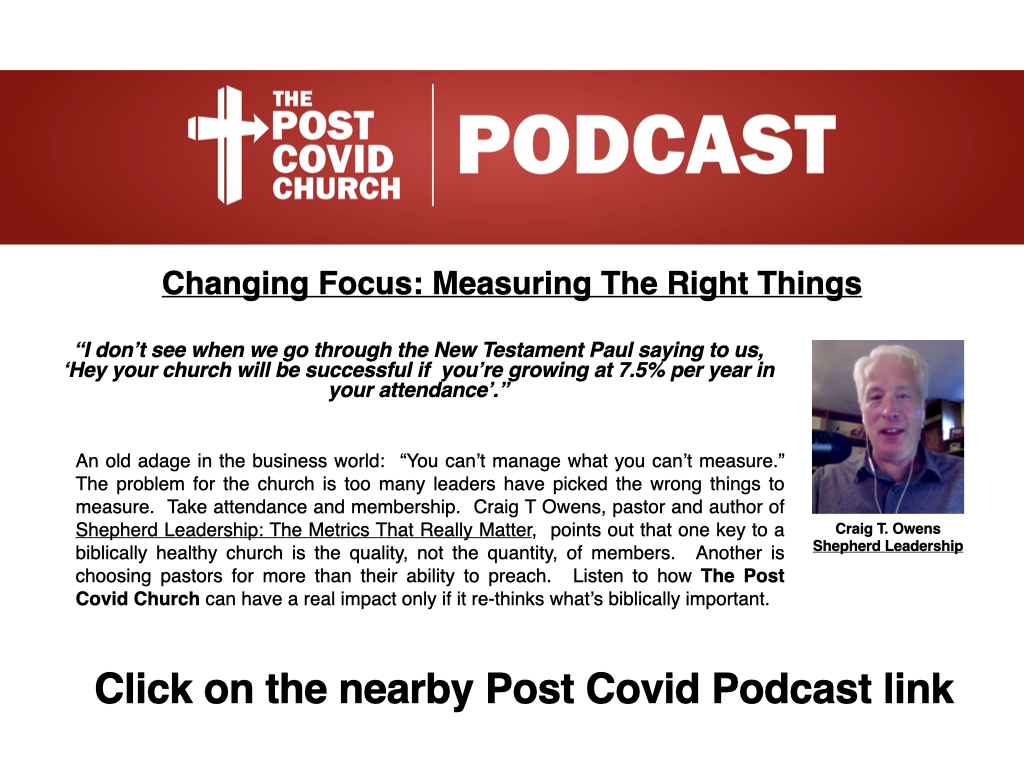
I was recently interviewed on The Post Covid Church Podcast.
In this episode, Stuart Kellogg and I discuss church leadership, my forthcoming book Shepherd Leadership: The Metrics That Really Matter, and even how church members can effectively talk to their pastor about some needed changes in their church. The episode is entitled Changing Focus: Measuring The Right Things and you can listen to it by clicking here. Stuart also provided a transcript of the entire interview—
Announcer
Welcome to the post COVID church podcast with your host, Stuart Kellogg.
Stuart Kellogg 0:12
Thank you for joining us. You know, since The Post Covid Church project is all about helping churches…our mission statement is Helping the church share more of the good news in the face of hostility, persecution and disinterest….Well, that can’t be done unless we spend a lot of time talking about leadership. Today, you’ll hear from a leader who’s focusing on helping churches to quit focusing on numbers, and start focusing on what matters.
Craig T. Owens is a pastor of Calvary Assembly of God in Cedar Springs, Michigan, the northern part of that northern state. He’s also worked in a variety of leadership positions in the for profit and nonprofit worlds. It’s given him a great perspective on how to help The Post Covid Church regain its influence to, as we say, here, not just survive, but thrive. Craig is an accomplished blogger, podcaster and author. He’s also as I mentioned, a pastor. We’ll be talking about what he’s learned and shared in his book, Shepherd Leadership, The Metrics That Really Matter. Craig and his wife, Betsy have three children. Welcome, Craig to The Post Covid Church Podcast.
Craig T. Owens
Thanks, Stuart. It’s great to be here with you.
Stuart:
Let’s jump right into the tough stuff. You say way, way too many pastors are measuring the wrong things. Please explain.
Craig
Yeah, you know, where this really kind of I guess started for me was when I have some well-meaning friends that would ask me, “You know, how are things going in your church?” And almost before I can answer their follow up question that is in their mind, I guess gauging whether I’m actually doing well or not was, ‘How many are you running on Sunday morning?” And I used to just answer that question. But then after a while, I began to say, “Alright, well, what if I said, 300?” And I get see him get really excited. And then I say, “What if I said, 20.” And they began to look a little confused. And so I said, “Well, let me clarify, what if I said, 300 that only show up on Sunday morning? And that’s it? I don’t see anything else happening the rest of the week. But what if I said 20, that not only showed up on Sunday morning, but throughout the entire week, I see them engaged, living out their faith actively involved. So you know, which would you rather have?” And they’re like, “Well, the 20.” And so I said, “So then why are you asking me? How many is showing up on Sunday morning? That is that the number that really matters? So are we counting the right things that we measuring the right things?” And you know, I just don’t really see when we go through the New Testament, I don’t see like, you know, Paul saying to us, “Hey, your church will be successful. If you’re growing at 7.5% per year in your attendance.” That’s never been the biblical metric for success.
Stuart
Well, is it because we’re in America, and that’s the American way, counting grow?
Craig 3:03
I think that’s part of it. And I think the other part and again, you know, when I wrote the book, I told my editor, I said, right up front, “Listen, check me on this, I don’t want to be on a soapbox sounding like I’m preaching at people, I want to help people.” And so I think a lot of this stuff, people were very well-intentioned. When we look at churches, and even parachurch nonprofit organizations, for the most part, the boards are made up of people from the corporate world. And so their natural mindset, the way that they think all of the time is in those quantifiable things that you can measure, they look at a bottom line, or they look at how many widgets or they look at, you know, they’re things that they can count. And so I think they’re well-intentioned, when they are then speaking to their pastor or the leader of their nonprofit organization and say, “Hey, show us what is how you’re being successful here.” And they’re almost forcing them to start counting things.
Stuart
Well, to use your example, you’re still counting by saying we have 30 who are engaged. It’s just that you’re counting a different activity.
Craig 4:18
I use the words really, I’m looking for things that are more quality than I am quantity. I mean, quantity’s fine, but not by itself. You know, we could use the example of Philip in the book of Acts. He goes to Samaria and he is preaching there, people are getting saved. Demons are being cast out, people get healed. And then God takes him from there, out into the wilderness. And at first, it appears to Philip he doesn’t even have a mission. It’s just get on this road that goes to Gaza through the desert. If we’re in worldly standards, you know, we would say Philip looks like he really took a step backwards. He went from a church if you will a congregation of hundreds to go where? But perhaps it was that maybe Philip’s way of talking to that Ethiopian official was the one guy that was going to be able to help him connect.
Here’s what I’m reading in the Old Testament scripture and connect that to Jesus. And so we wouldn’t say that that was a step backwards. That was where God needed Philip to go. But, you know, I, I think that sometimes we just go, well, it’s got to it, things have to keep moving up. The dollars got to go up, the donors have to go up, the attendance has to go up. But toward what end? What are we trying to accomplish with that?
Stuart
As the church re-gathers now, should leaders start by rethinking their mission, how to impact the culture and make disciples and from that, the numbers will follow?
Craig
Yes. So I think that, especially for leaders of churches, and this is why I called the book Shepherd Leadership, because when you think in terms of a shepherd and a flock, shepherds don’t reproduce more sheep. The role of the shepherd is to take the sheep to the place where there’s a healthy environment, help the sheep get healthy, so that they can reproduce. And so it’s not necessarily again about, “Okay, how many sheep do I have here?” Well, you might have a whole bunch of them, and they’re unhealthy. So it’s, how healthy are the sheep? If there’s, if there’s lots of them, great. I’m not, you know, again, I don’t mean to be preaching at somebody and saying, “You should never have a large church or a large organization.” That’s, that’s not it. I’m just saying we shouldn’t say I’m successful, because it’s big. We want it to be really God-honoring healthy sheep-producing sheep.
Stuart 6:53
My guest, Craig T. Owens pastor, author, leadership, podcaster. And about to be published Shepherd Leadership, The Metrics That Really Matter.
George Barna, who has been studying the church for a generation plus, told me one big problem is that senior pastors get their jobs by being really good preachers and teachers, not because they’re great leaders. Do you agree? And if so, what should churches do?
Craig
Yeah, I totally agree. I’ve laughed with people about that before. I’m like, you know, we could spend like hours interviewing a potential pastor for a church. And really it comes down to how does he preach on Sunday? And so you’re like, “So you’re going to pick the way that he can speak publicly for 30 minutes?” Doesn’t necessarily, that’s not an indication of the the rest of the the week that he’s interacting with people.
You know, you had a previous guest on that was talking about in Ephesians, chapter four, that there are gifts that God gives to the church. And I paraphrase, so this will kind of dated but Dwight Eisenhower when he was President, he said, “If we ever think of the United States as one leader and 158 million followers, it wouldn’t be the United States.” I think the same thing in the church. If we think of it as just being one pastor, one minister, and then the rest of the congregation, t’s not really a healthy church.
I see myself as the shepherd. Yes, I minister to people, but my main goal, according to Ephesians, four, God, Jesus gave these gifts to the church to prepare the people to do the works of service, prepare them to minister. So really, my focus should be on, I want my whole congregation to be ministers. I don’t want them to just think of, “well, Craig Owens, is the minister here.” No, I’m not the minister. I’m one of the ministers. I might be the pastor the shepherd. But I’m not the only minister.
Stuart
So that means giving up control, delegating and finding talent in the pews.
Craig
Absolutely. Because I, I’ll be the first to admit I don’t do everything well. There are some things that the people say, you know, just stop doing that. It’s not very good. And so then there’s other people that God has equipped them and gifted them and say, “Boy, this is right in your strength zone.” This is how you’re going to be a key part of the body of Christ by using your gifts to minister this way.
Stuart:
How can lay leaders or members best take the initiative and help a pastor be a better shepherd leader if the pastor isn’t, or isn’t open to change?
Craig: 9:40
Well, you know, that’s a tough one because I know that there are some pastors that have the mentality that they are the final authority in the church and they’re really not open to input from other people. So I have usually said to people, you know, they’re like, I think I need to leave my church or I want to help my pastor. Change something. And the bottom line is like for myself, I’m not going to change unless I want to change, if I’m open to wanting to change. And if I don’t have that kind of humility, or that posture, the words that other people speak aren’t going to do anything to me.
So I think that that has to be the first spot is that a senior pastor, any senior leader needs to be out among the people all the time and admit your mistakes, and let people know, “Hey, I was no good in this area. That’s why I’m reading this book, or why I’ve gotten a mentor.” Those kind of things will send the signals, “Hey, I’m teachable. I’m open, I’m willing to hear what other people have to say to me.” Or, as you mentioned, when a senior pastor gives up some of their authority when they take their hands off some things that sends a signal. So I’d say if somebody’s a leader, a lay leader in a church, and they’re not seeing those kind of things, I’d be really cautious about approaching because, you know, you might be stepping on some toes there. But if you hear those kind of statements coming from that pastor, that leader, then they probably are open to having further conversations.
Stuart
What are some success stories you’ve seen at organizations you’ve consulted with?
Craig
Well, you know, I’ll tell you one of the organizations I just recently worked with, it was really eye-opening for me was, I was seeing it was a pregnancy Resource Center. And I saw this huge disconnect between the staff and the board. They were all friendly, they all got along, but you could just see that they weren’t on the same page. And as I just kind of sat back during one time, was just kind of observing. I realized that all of the board members, were all business owners.
And so I spoke to him like this. I said, “You know, in your business, if you made a $10,000 investment in your company to buy a new piece of equipment, or hire somebody or something like that, you would be looking at at the end of your fiscal year, at the bottom line financially, how did that affect us?” And you know, they all kind of agreed with that. So I said, “But now as a board member here, if you go out and raise $10,000, for this pregnancy Resource Center, they’re going to spend all $10,000 there’s not going to be any money left over at the end. But how many women that were abortion-minded? Might they have convinced to keep their child? What value would you put on that life that was saved?” And they just really kind of were all speechless. And so I said, “So that’s where I think that the disconnect is, is you guys are raising money. And then you’re expecting to see something that you can, like, ‘Oh, hey, look at the bottom line.’ And you might not see that, but you do see a life that was saved? And can you put a value on that? Of course, you can’t. It’s, it’s priceless.”
And, and that organization since that time, what’s been amazing, is that when the board went out and started their fundraising efforts, again, they were a now with this total mindset of saying to the staff, “What can we do as we raise this money, so that you can better get the message out to women who are in that crisis place.” And so it was just that little shift of thinking on their part. And then I watched Unity as that that staff in that board then got on the same page, and realize what it was that they were actually working for is not just you know, paying off a mortgage, or, you know, having nicer furniture in there, or that sort of thing. But it was creating a place where they could change people’s minds who were maybe leaning towards abortion to change the other way. So I think it’s never really been big changes. When I’ve consulted with people, it’s just dropping that one seed, how does it look? And then when people get it, because, as I said earlier, I think those board members, I think a lot of those people, everybody is well-intentioned. They just you just got to get maybe you’re speaking a slightly different accent. Let’s get everybody on the same page. And that’s what I love being able to do.
Stuart
Well, would an analogy in the church be “Christ said the mission is making disciples. So everything we do should be focused on doing that. making disciples.”
Craig 14:51
Yeah, I think that, you know, like I joked with one church, they were like, “Hey, do you have any ideas how to grow the church?” And I said, “Well, define grow for me.” And they really couldn’t. So I said, I offered a very tongue-in-cheek suggestion I said, “You’re right here on the main road and you have a big marquee out front. So why don’t you put a sign up that says free $50 gift certificate for all first-time visitors, you should have the church packed on Sunday morning.” And they all were like, “No, no.” I said, “Oh, that’s not what you meant by grow. Okay, so now that we got that out of the way, you know, let’s focus: What does grow really mean?”
So even if it’s just one person, you know, can you move them to the next step in their leadership development, ultimately, having them become disciple makers themselves and raising up other disciple makers. That, that sounds like a better plan for grow than just, “let’s, you know, turn on the lights and do some really cool stuff that makes people come in and go, ooh, you have a lot of people there.” But are you moving them towards becoming disciple makers?
Stuart
And a key part of what you’re talking about is communication.
I’ve really noticed that leaders tend to gravitate toward one pole or the other. The confident leader, you know, knows that God has a call on their life. I use a simple phrase, God chose me. So I would say, Okay, well, God’s the one who chose me. So I, I’m confident in that. But if that confidence is not balanced by humility, that leader can come across as so hard-charging, so focused on the goal that I think that sometimes people have a hard time approaching or getting around them for fear of, “Well, what if I get in the way am I am I going to get run over?” That would be I’d be the first to admit, that’s the way that I’m naturally wired. So I have to deliberately find ways to serve the servants, I have to find ways to do things that other people find distasteful. To do whatever that is, you know, certainly serving alongside the church custodians or, you know, you’re just you’re finding your ways to make sure that you’re sending again, that message to everybody else, “Hey, it’s not like I’ve arrived on some level. And these other tasks are beneath me.” Now, if Jesus, who in John chapter 13, it says that he knew that God had placed everything under his power. So John 13 opens with us seeing that Jesus is the most powerful person and he knew it, and his very next action is to stoop down and begin to wash feet.
Did he want to do that? I don’t, you know, that’s not a very pleasant task. But he delighted in being able to serve those people that were around him. And so I think that if you find yourself being that overly confident leader, you know that you tend towards that poll, you’re really going to have to make the extra effort to add humility, to your confidence.
Stuart
You’re a blogger, podcaster writer, you’re also a pastor. What gives you the greatest joy as a senior pastor?
Craig:
Well, that’s an easy one. I love when I can just sit back and just watch, especially like Sunday morning. I’ve often joked, like when we kind of have a greeting time, or whatever, and people are going around, even like, the start at the beginning, when people are arriving. If If I didn’t go up front, or send somebody up front and say, “Let’s start now”, they would just keep going all morning. And I just listen in, you know, here’s somebody over here talking about, yeah, I’ve got this medical concern. I’m not sure what’s going on. And a couple people say, well, let’s pray. You know, somebody said, I just got foot surgery coming up. Can we help get to the store to get groceries for you?
You know, I just those are the kinds of conversations that I overhear, or when we’re out in the community, just watching the way that, you know, totally on their own, I watched our youth group, organize a time where they all got garbage bags, and they just went around the school campus and just started picking up all the trash that was around the school campus. That’s the most thrilling thing for me as a pastor to just say, you know, there it is, in a real simple, tangible way. They’re exhibiting the love of Jesus. They’re saying, “This is our community. We didn’t make the mess. We’re more than happy to clean it up, clean it up.” You know, there’s somebody that’s in need, we don’t need to, you know, “Let’s call the church office and organize what we’re right here. Let’s just take care of it. We’ll get meals to that person. We’ll pray for him. We’ll take them to a doctor’s office.” You know what, whatever it is I that is the biggest thrill for me.
Stuart 19:58
That sounds kind of biblical.
Craig
Yeah, just sounds like that Acts chapter 2, you know, when everybody’s together taking care of each other.
Stuart
What a time for that to happen. Thanks for sharing. How can folks find out more about you your ministry and creative work?
Craig:
craigtowens.com is my blog. Just about every day I’m blogging, devotional thoughts or books I’m reading or different things like that. There’s a separate page on there that talks about that book.
And then I’m more than happy to I love dialoguing with people. My email is real simple. It’s just craig@craigtowens.com
Stuart
The contact information will be in the transcript of this podcast. Just go to the website, www.thepostcovidchurch.com, click on the title, Changing Focus Measuring the Right Things. There it is. Thank you, Craig, for joining me today.
Craig
My pleasure.
Stuart
This is the 50th Post Covid Church episode. Thank you for taking part and listening. I’d love to hear from you. Ideas feedback, anything: stuart@thepostcovidchurch.org I mentioned the website www.thepostcovidchurch.com You can go there and find all the archive material from the last year. I so appreciate your support. I’m Stuart Kellogg.
Announcer
Thank you for listening to The Post Covid Church Podcast. You can find much more at The Post Covid Church group on Facebook or on the website, http://www.thepostcovidchurch.com
Listen to the podcast of this post by clicking on the player below, and you can also subscribe on Apple, Spotify, or Audible.
Many churches recognize a various numbers of ordinances within their worship services. The dictionary gives two definitions of the word ordinance that are helpful for us: (1) a rule to be followed, and (2) something believed to be ordained (or made holy).
There are two ordinances that we celebrate: baptism in water and holy communion.
Water Baptism
This wasn’t a practice invented by Christians, but teachers had been baptizing their students for years as an outward sign of followership. Not only did various members of the Israelite community come to John to be baptized, but even Jesus desired to be water baptized (Matthew 3:5-6, 13-17).
Why would Jesus need to be baptized? Look at how Jesus replied to John, “It should be done, for we must carry out all that God requires” (Matthew 3:15 NLT), or in the NIV: “to fulfill all righteousness.”
Jesus came to be our High Priest. One of the requirements for the priest was “he must bathe himself in water before he puts” on the ceremonial robes that were to be worn in the tabernacle (Leviticus 16:4). Jesus also came to be our perfect sacrifice, so He needed to be like us in every single way. If Jesus wasn’t water baptized, not “all righteousness” would have been fulfilled.
Jesus was also baptized as an example for us. We, too, are priests in God’s Kingdom that need to be washed for our priestly service (1 Peter 2:9; 3:20-21).
Our foundational truth statement on this is: “The ordinance of baptism by immersion is commanded by the Scriptures. All who repent and believe on Christ as Savior and Lord are to be baptized. Thus they declare to the world that they have died with Christ and that they also have been raised with Him to walk in newness of life.”
Jesus gave us this rule to follow for new Christians: “baptizing them in the name of the Father and of the Son and of the Holy Spirit” (Matthew 28:19). This is also what Peter announced to the new believers on the Day of Pentecost: “Repent and be baptized, every one of you, in the name of Jesus Christ for the forgiveness of your sins” (Acts 2:38).
Communion
Sometimes called The Last Supper or The Lord’s Supper, the Israelites had continued to celebrate the Passover (Exodus 12) with unleavened bread and wine—symbolizing the body and the blood of the sacrificial lamb which saved them from death.
Our foundational truth statement on this is: “The Lord’s Supper, consisting of the elements—bread and the fruit of the vine—is the symbol expressing our sharing the divine nature of our Lord Jesus Christ, a memorial of his suffering and death, and a prophecy of His second coming, and is enjoined on all believers ‘till He come!’”
Jesus, while celebrating Passover with His disciples, showed how Passover had been pointing to His First and Second Advents (Luke 22:13-20; 1 Corinthians 11:23-26).
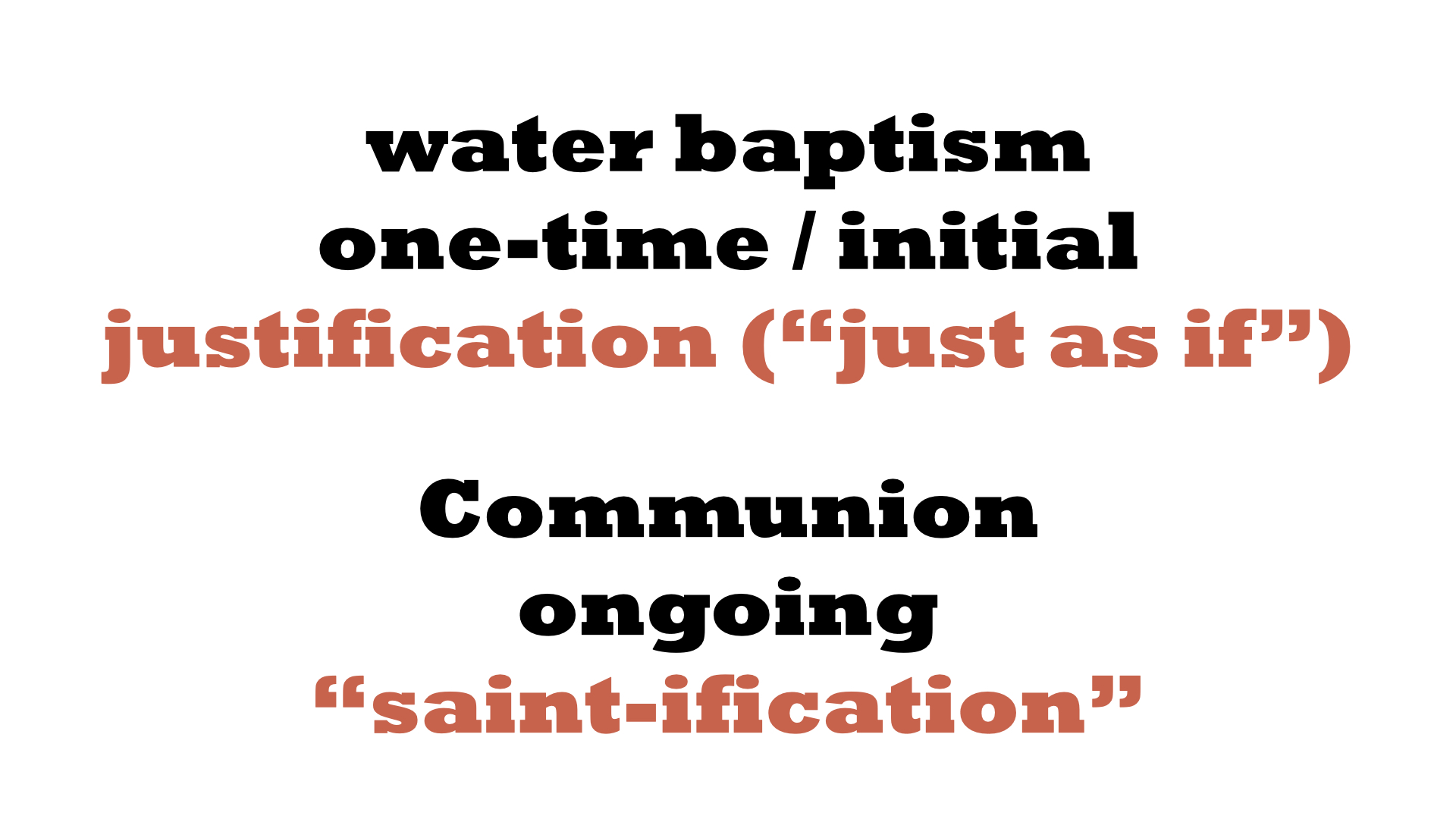
Both of these ordinances have reminders in them of our new life in Christ:
Communion is an ongoing celebration “until He comes,” just as our sanctification (“saint-ification”) is an ongoing process. This looks ahead to what Jesus willcomplete when we are glorified in Heaven.
This is a weekly series with things I’m reading and pondering from Charles Spurgeon. You can read the original seed thought here, or type “Thursdays With Spurgeon” in the search box to read more entries.
Listen to the podcast of this post by clicking on the player below, and you can also subscribe on iTunes or Spotify.
Sent To Show Jesus To The World
And the glory that You gave Me I have given them, that they may be one just as We are One: I in them, and You in Me; that they may be made perfect in one, and that the world may know that You have sent Me, and have loved them as You have loved Me. (Jesus, in John 17:22-23)
The essence and cause of the glory that the Father gave the Son was, first of all, that He endowed Him with the Holy Spirit. ‘God does not give the Spirit by measure. The Father loves the Son, and has given all things into His hand’ (John 3:34-35). The Holy Spirit descended upon our Lord in His baptism and abode upon Him so that in the power of the indwelling Spirit He lived, spoke, acted, and in all that He did, the Spirit of God was manifest. …
Now this glory, our Lord has given to all His disciples. Upon each true disciple, the Spirit of God rests according to his measure. If we have not the anointing to the fullest, it is either from lack of capacity or by reason of our own sin, for the Spirit of God is given to the saints—He dwells with us and will be in us always. My brothers and sisters, I would to God we realized this, that the glory of the Holy Spirit that was given to Christ is also given to us, so that it is ours to think, to feel, to speak, to act under His guiding influence and supernatural power! What are we apart from the Holy Spirit? How can we hope to convince even one man, much less the world, that God has sent His Son unless the Holy Spirit is with us? …
If men would see God, let them look at Jesus, for there is He to be seen! And with bated breath we add—let them look at Christ’s people, for there also is God revealed! It is the glory of the saints that they are the mirror of the divine character! …
Christ Jesus was sent to reveal the Father, sent to reclaim the wandering souls of men, sent to seek and to save the lost. And this is exactly what every true Christian is sent into the world to do. He is commissioned to reveal God in his every act and word. He is commissioned to win back rebellious hearts. He is commissioned to save the sons of men and bring them up out of the horrible pit into which their sins have cast them. …
Jesus was the Son of God, and He overcame the world in the power of His Sonship. Now, this glory that the Father gave Him, He has given us, that we, too, may be accepted; that we, too, may have access; that we, too, may have prevalence in prayer; that we, too, may have the Spirit of Adoption; and that we, too, may trample upon sin and overcome the hosts of darkness. This is the glory that rests upon all the faithful!
Listen to the podcast of this post by clicking on the player below, and you can also subscribe on Apple or Spotify.
For they have devoured Jacob and devastated his homeland. (Psalm 79:9)
This verse is at the middle of this psalm, which in Hebrew literature makes it the central theme of this psalm. Asaph describes something that is not a very pretty situation.
Asaph says “they” have done this. But to whom have they done it? To the Israelites? Yes, but it goes deeper than that. Or should I say it goes higher than that? “They” have actually done these terrible things to God Himself—
Your inheritance is invaded
Your temple is destroyed
Your servants are attacked
Your name is dishonored
insults are hurled at You
In the New Testament, Jesus said His followers should expect persecution. But notice that Jesus said this persecution was because of Him. “They” are not really attacking Christians, but “They” are attacking Jesus Himself. When Jesus revealed Himself to the persecutor of Christians named Saul of Tarsus, He said to him, “Saul, why do you persecute Me?”
Asaph recognizes “They” are attacking God, so he also expects that God will deal with them—
may Your mercy meet us
may Your name be glorified
may Your strong arm be revealed
may Your sheep be protected
may You be praised forever
When—not if—persecution comes our way, we must remember to shift our paradigm from “They” to “You.” “They” are not to be feared, but God is to be feared and reverenced. “They” don’t get the final word, but God, “You” get the final and decisive word. When the attacks come because you stand for Christ, take your eyes off of your persecutors and put them on your God.
Listen to the podcast of this post by clicking on the player below, and you can also subscribe on Apple or Spotify.
Don’t you wish that you could clean things up and they would stay clean? After you get everything set the way you like it, why can’t it just stay that way? Quite simply, things can’t stay clean and pristine because of the Law of Entropy. Entropy is the measure of disorder in a system, and the Law of Entropy says that unless sufficient energy is applied, an ordered system will always move toward disorder. This is as true spiritually as it is in physics.
God created a perfectly ordered system both physically and spiritually, but man’s sin brought in disorder, disease, and decay. It gets so bad that just three chapters after man’s first sin we read, “The Lord saw how great the wickedness of the human race had become on the earth, and that every inclination of the thoughts of the human heart was only evil all the time” (Genesis 6:5).
Throughout history, there have been revivals, reformations, and awakenings where people see the disorder and decay that sin has brought to their lives and they want to return to God. The pain of entropy causes people to repent, and the Spirit of God moves in with sufficient energy to restore. Sadly, unless the Holy Spirit’s energy is continually applied, entropy will again begin to run its downward course.
Jesus not only came to reverse the entropy of sin (see Isaiah 9:2, 49:9; John 1:5, 8:12), but He sent us out into a sinful world to do the same thing. Jesus told us that we are salt that reverses entropy’s decay and we are light that reverses entropy’s darkness (Matthew 5:13-14). Jesus also told us that there’s no way we can maintain this entropy-reversing energy on our own—we need the Holy Spirit’s empowerment (Luke 24:49; Acts 1:8). [Check out all of these verses by clicking here.]
Paul talked about this same idea in 2 Corinthians 3. He contrasts the ministry of the Old Testament with its fading glory, and the ministry of the New Testament with terms like moreglorious, surpassing glory, and ever-increasing glory.
Do you realize that Spirit-filled Christians never have to long for “the good ol’ days”? Being baptized in the Holy Spirit means, as Paul reminds us, that we are perpetually being transformed into the image of Jesus and we are therefore reflecting more and more of His glory. Every day can be more glorious than the day before. We don’t have to experience any entropy in our spiritual walk.
This isn’t because of our actions. Paul says, “not that we are competent in ourselves…but our competence comes from God. … [We] are being transformed into His likeness with ever-increasing glory, which comes from the Lord, who is the Spirit.”
Spirit-filled Christians are the agents of change in the world IF we are being transformed by the Holy Spirit. In other words, we will tend toward entropy (and uselessness) unless we have the Spirit’s energy continually applied to our lives.
Being transformed is an ongoing, continual process. We have to have the energy of the Holy Spirit continually at work on us personally to keep us from entropy. And then we’ll be able to reflect that entropy-defeating light to a dark world.
I’ve said this before, but I’m going to keep on saying it: Don’t stop at salvation—be baptized in the Holy Spirit. Don’t let entropy decay your salt or dim your light. Let the Holy Spirit help you reflect the light Jesus so that you can reverse the entropy of a dark, sinful world.
A person filled with the Holy Spirit cannot help but make a difference wherever they go! Look at how Peter summed up the earthly ministry of Jesus:
And you know that God anointed Jesus of Nazareth with the Holy Spirit and with power. Then Jesus went around doing good and healing all who were oppressed by the devil, for God was with Him. (Acts 10:38 NLT)
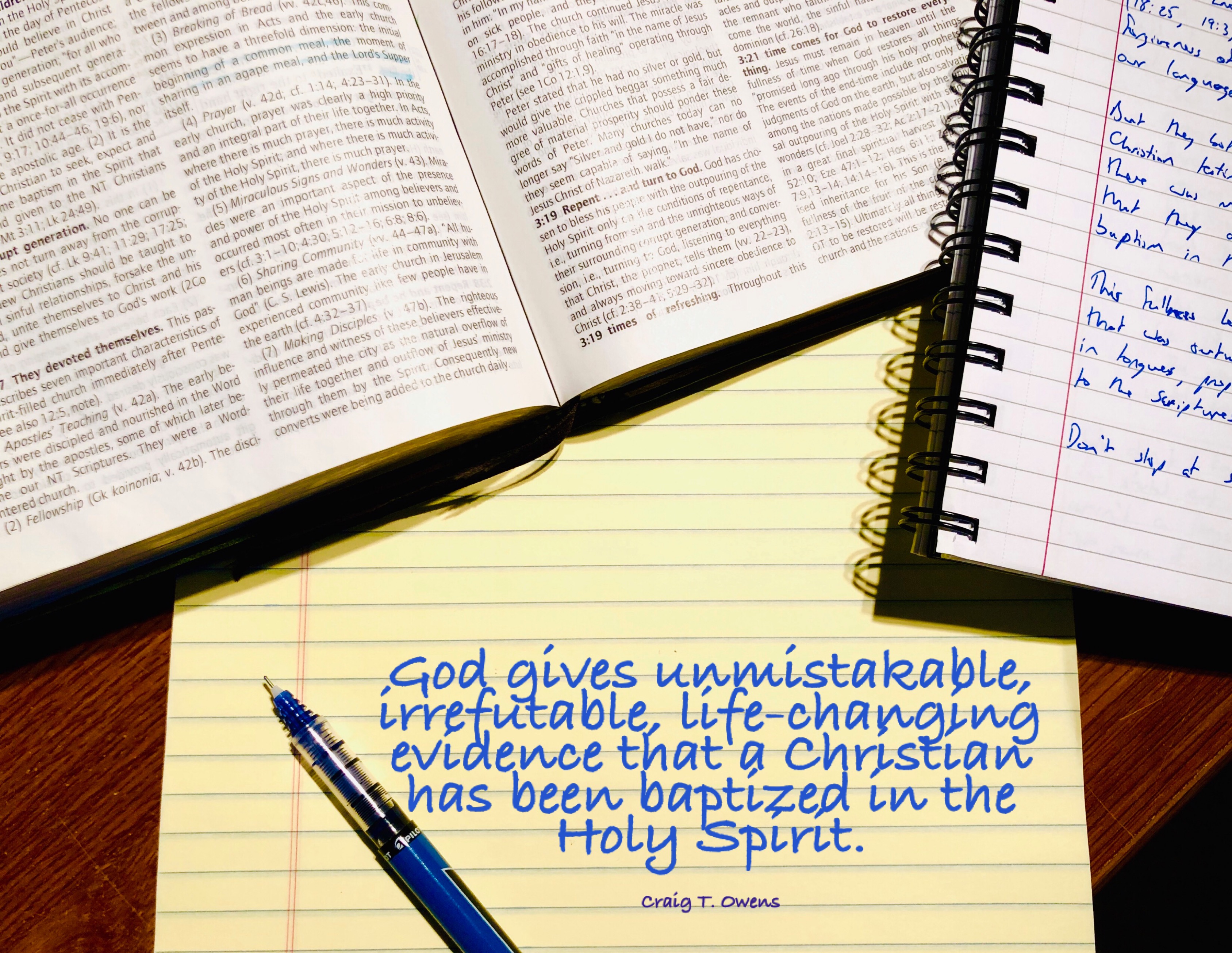
The continuous action of Jesus was doing good and healing those who were diseased in body and soul. This is supposed to be the continuous action of the followers of Jesus too. The baptism of the Holy Spirit is an empowerment for the continuous, unmistakable, irrefutable action of those anointed by Him.
Andrew Murray commented on the miraculous healings that were recorded in the Book of Acts, “This was the continuous experience of the early church. … The abundant outpouring of the Spirit produced abundant healings.” Indeed it did! Check out the continuous miraculous action that Luke records in Acts.
Listen to the podcast of this post by clicking on the player below, and you can also subscribe on Apple or Spotify.
The baptism in the Holy Spirit is what Pentecostal Christians frequently refer to as our distinctive doctrine. Notice I said distinctive, not better. Can someone go to heaven without being baptized in the Spirit? Yes! But I’ve found that living in this distinctive empowerment makes the journey to heaven so much more productive and joyful.
After the resurrection of Jesus, everything took on a whole new meaning, because the “light” had been turned on in the Old Testament palace. All of the practices that Jews had been observing for thousands of years suddenly had a new illumination in the New Testament.
Pentecost had always been a celebration 50 days following the Passover. In the Old Testament, the law was given from Sinai on the fiftieth day after the deliverance from Egypt, so in a sense, the appearance of God on Sinai was the birthday of the Jewish nation. In the New Testament, the first outpouring of the Holy Spirit on the first Pentecost after Jesus ascended to heaven was the birthday of the Christian nation for all people.
One of our foundational truths says: “All believers are entitled to and should ardently expect and earnestly seek the promise of the Father, the baptism in the Holy Spirit and fire, according to the command of our Lord Jesus Christ. This was the normal experience of all in the early Christian Church.”
And another foundational truth is a corollary: “The baptism of believers in the Holy Spirit is witnessed by the initial physical sign of speaking with other tongues as the Spirit of God gives them utterance.”
God has always confirmed His presence with signs and wonders. From the signs in Egypt to convince Pharaoh that Jehovah was greater than the Egyptian gods to the ministry of Jesus. In fact, Peter said that the signs and wonders done by Jesus were God’s authentication of His ministry (see Luke 5:17-26; Acts 2:22; Acts 10:38).
R.A. Torrey noted, “The baptism of the Holy Spirit always imparts power for service…. The baptism of the Holy Spirit is the Spirit of God falling upon the believer, taking possession of his faculties, imparting to him gifts not naturally his own, but which qualify him for the service to which God has called him.”
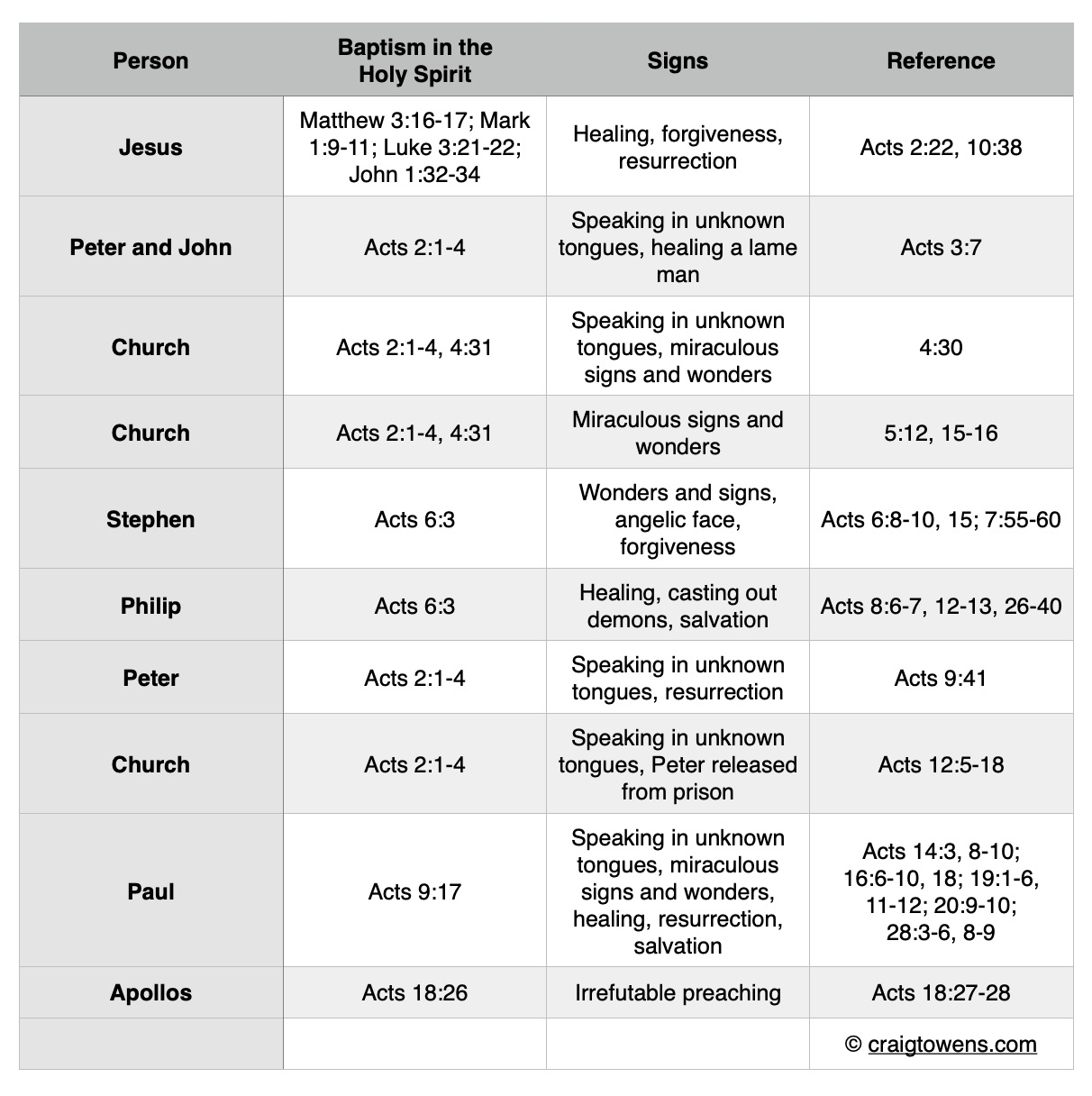
Check out this chart that walks us through the book of Acts to see how God authenticated the ministry of those who were baptized in the Holy Spirit by performing signs and wonders through them:
When a Christian is baptized in the Holy Spirit there are two types of evidence:
Initial evidence—typically speaking in a language that hasn’t been studied but has been supernaturally given by God.
Ongoing evidence—I would sum this up in the word sanctification (or as I like to remember it by saying “saint-ification”). This is the lifestyle change, the empowered living, and even the miraculous that cannot be counterfeited by man’s efforts alone.
Let’s not try to put God in a box—telling Him when, where, how, and through whom He can work. Instead, let’s yield ourselves entirely to Him by letting the Holy Spirit empower us to be effective, unmistakable witnesses for Jesus Christ.
I will be relaunching our series called We Are: Pentecostal in two weeks. Please follow along with all of the messages in this series by clicking here for the details.
Listen to the podcast of this post by clicking on the player below, and you can also subscribe on Apple or Spotify.
Some really silly guys did a series of videos called “Neature Walk” because they wanted to share how neat is nature! In episode one Vic sees a tree that he really likes and says, “Score! This is an aspen tree. You can that it’s an aspen tree because of the way it is.” This is either circular reasoning or an obvious statement. “Just look at this thing. You can tell it’s this thing because it looks and acts like this thing.”
I feel a lot like this when I look at the first part of our third foundational truth statement: “We believe in the Deity of the Lord Jesus Christ.” (As a side note, I covered the second part of this statement—“As God’s Son, Jesus was both human and divine”—in another post, which you may find here.)
Check this out: the definition for Deity is the divine character of God, and the definition for divine means things relating to the Deity. In saying we believe Jesus is God we are really saying, “You can tell that Jesus is God because of the way He is.”
In order to make this definition work, we need evidence for both the divinity and the deity of Jesus. That being said, let me remind you of J. Warner Wallace’s instruction on faith. There is:
Blind faith—believing in something without evidence
Unreasonable faith—believing in something in spite of the evidence
Reasonable faith—believing in something because of the evidence
Here is some evidence that I think makes it reasonable to believe that Jesus is divine:
Virgin birth—Isaiah 7:14; Luke 1:34-35; Matthew 1:22-23
Sinless life—Isaiah 53:4-6, 9; Hebrews 7:26-27; 1 Peter 2:22
I think the best evidence for the Deity of Jesus is the connection He Himself made between the “Jehovah” titles of the First Testament and His “I AM” statements in the Second Testament:
Jehovah Jireh (I Am Your Provider) → I am the Bread of Life (John 6:35)
Jehovah Rapha (I Am Your Healing) → I am the Resurrection and the Life (John 11:25-26)
Jehovah Nissi (I Am Your Source) → I am the Vine (John 15:5)
Jehovah Shalom (I Am Your Peace) → I am the Light of the world (John 8:12)
Jehovah Raah (I Am Your Shepherd) → I am the Good Shepherd (John 10:11)
Jehovah Sabaoth (I Am Your Wall Of Protection) → I am the Gate (John 10:9)
Jehovah Tsid-kenu (I Am Your Righteousness) → I am the Way, Truth, and Life (John 14:6)
Jehovah Shammah (I Am Here) → I am the Alpha and Omega (Revelation 1:8; 22:13).
We cannot claim that Jesus was born of a virgin, or lived a sinless life, or did miracles, or died and rose again and then not believe He is God. We cannot pick and choose the parts of Jesus we want.
The apostle Paul reminded us that someday “at the name of Jesus every knee should bow, in heaven and on earth and under the earth, and every tongue acknowledge that Jesus Christ is Lord, to the glory of God the Father” (Philippians 2:11-12).
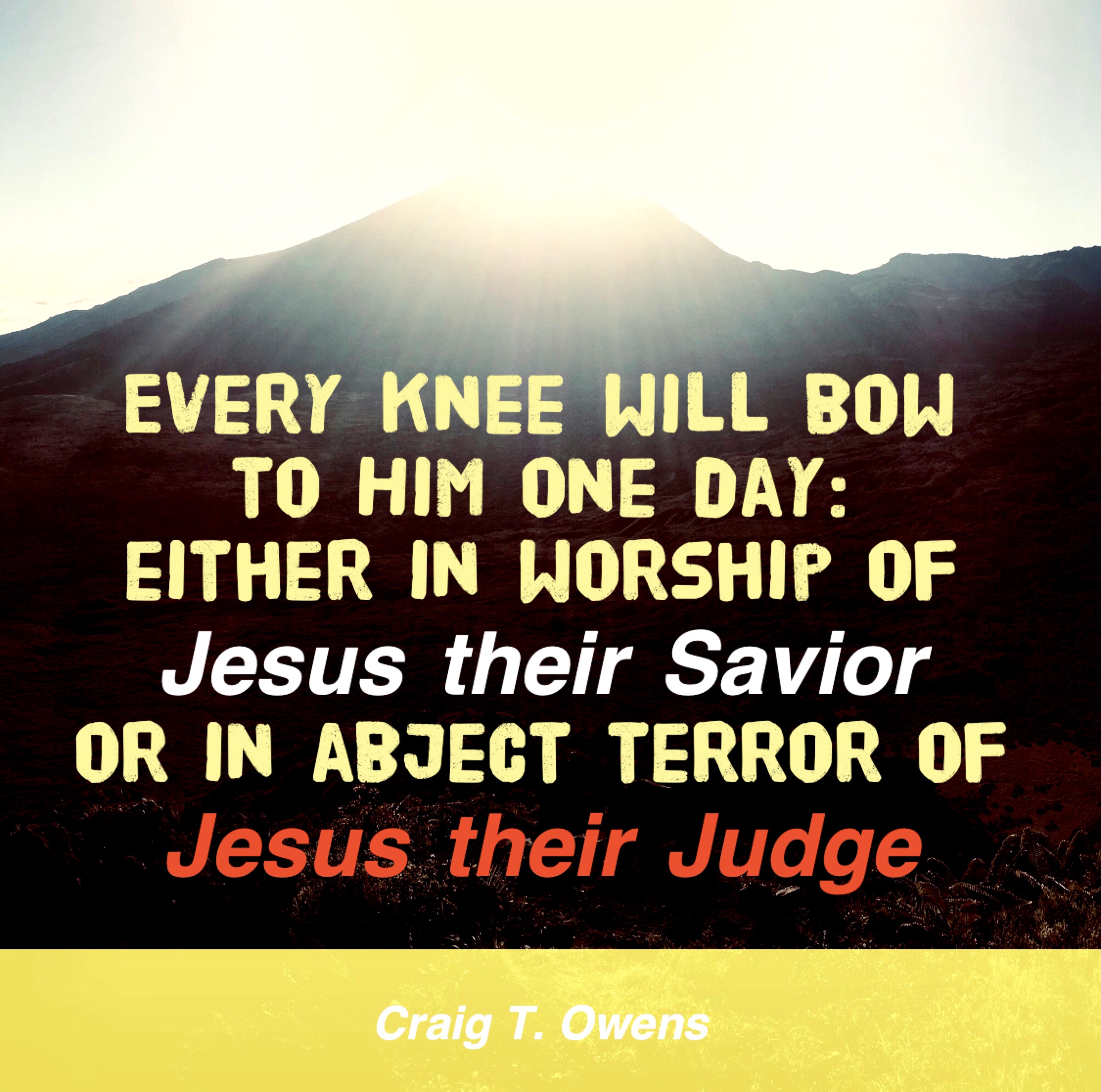
Every knee will bow to Him one day: Either in worship of Jesus their Savior, or in abject terror of Jesus their Judge.
I pray that you believe in Jesus as your Lord and Savior today… don’t wait another moment!



 When you’ve been at a church service have you ever asked yourself, “What are we doing here? What exactly is ‘church’? What are we supposed to be doing?”







 Craig T. Owens