We can look back to learn or we can look back to relive. Looking back to learn is healthy, but looking back in regret to try to relive our past is unhealthy and unproductive. Learning vs. reliving makes all the difference. See my full message on this mental health thought here. I have lots of new content every week, which you can check out on my YouTube channel.
“I’ve learned one thing: You only really get to know a person after a fight. Only then can you judge their true character.” —Anne Frank
Lenny Esposito is an outstanding Christian apologist. Check out this podcast where Lenny discusses the historical facts about the crucifixion and resurrection of Jesus Christ.
“Life with God is not immunity from difficulties, but peace in difficulties.” —C.S. Lewis
“I believe it will only be known on the Last Day how much has been accomplished in missionary work by the prayers of earnest believers at home.” —James Fraser
This is a good reminder from Axis for parents with students returning to school. The heading of this section of Axis’ weekly Cultural Teanslator is “Back to Backpacking.”
“What it is: As a new school year begins, teens might have mixed feelings of excitement, anxiety, and feeling overwhelmed.
How to approach this season: As Hannah King writes in Christianity Today, all seasons of transition bring with them an element of loss. Starting a new school year might mean making new friends, meeting new teachers, or starting a new curriculum. It can also mean the loss of free time, increased stress levels, and more difficulty creating intentional moments as a family. For parents, the beginning of a new school year might also feel like a reminder that time with their teens living at home is dwindling down, a feeling which can bring its own set of griefs, pressures, and regret. King recommends allowing space for teens and adults to name the things they’re disappointed about or not looking forward to, noting that repressed sadness can keep us from ‘entering freely into [the] joy’ of a new thing.
“Start the conversation: What will you miss the most about this summer?”
“Either you deal with what is the reality, or you can be sure that the reality is going to deal with you.” —Alex Haley
Listen to the podcast of this post by clicking on the player below, and you can also subscribe on Apple, Spotify, or Audible.
Jesus began to speak to them in parables… (Mark 12:1).
What Jesus relates here in the 12th chapter of Mark’s Gospel is only the fourth parable that Mark records, and as the final parable that Jesus shares, it brings His public ministry to a close.
Jesus concludes this parable by quoting from Psalm 118. This Psalm is the last of the “Hallel Psalms” that were sung at the conclusion of the Passover celebration. This song specifically looks eagerly forward to the arrival of the Messiah. It contains the words that the crowd used on Palm Sunday: “Lord, save us! Lord, grant us success! Blessed is He who comes in the name of the Lord” (Psalm 118:25-26). By quoting from the same Psalm—that was perhaps hundreds of years old, but had just been sung and shouted by the crowd—Jesus was claiming to be the Messiah longed for in that Hallel Psalm.
As you may recall, these shouts from the crowd and the activities of Jesus as He cleansed the temple got the religious leaders riled up! They, in essence, asked Jesus, “Who do You think You are?!” His answer is contained in this parable of Mark 12.
At the conclusion of this parable, the religious leaders “knew He had spoken this parable against them” (Mark 12:12).
Pastors, if you want to deliver soul-shaking, life-transforming, eye-opening, heart-melting sermons, you must follow this example of Jesus: Stick with the Scripture!
We don’t need to try to be clever or witty or even memorable. We just need to speak the Word of God that is inspired by the Holy Spirit, and then allow the Holy Spirit to illuminate that inspired Word to each person’s needs. As Randy Pope noted, “Preaching is not talking to people about the Bible; it is talking to people about themselves from the Bible.”
I don’t want to try to make my voice impress people, but I am desperate for God’s voice to impact people. Nearly every week as I prepare a sermon, I’ll pray this prayer from Oswald Chambers: “In my preaching, cause Thy glorious voice to be heard, Thy lovely face to be seen, Thy pervasive Spirit felt.” My dear pastor, I would encourage you to make this your prayer as well.
My courage and my success are directly tied to my obedience of God’s Word. The life of Joshua is just one example. Check out this full message here. I have lots of new content every week, which you can check out on my YouTube channel.
“Christ is more of an Artist than the artists. He works in the living spirit and the living flesh; He makes men instead of statues.” —Vincent van Gogh
Bryan Windel echoes something I’ve frequently said on this blog, “The Bible is rooted in real history. This is why archaeology is such a valuable tool; it helps us uncover the biblical world and provides us with important background knowledge about the people, places, and events described in the text.” Bryan was a part of a dig at Shiloh (where Joshua and Samuel play key roles) and he shares some of his observations and discoveries.
“I trained four years to run nine seconds, and people give up when they don’t see results in two months.” —Usain Bolt
“Those who have turned the tide of history have turned it by means of prayer. This should be the motto of every follower of Jesus Christ. Never stop praying, no matter how dark and hopeless it may seem.” —Billy Graham
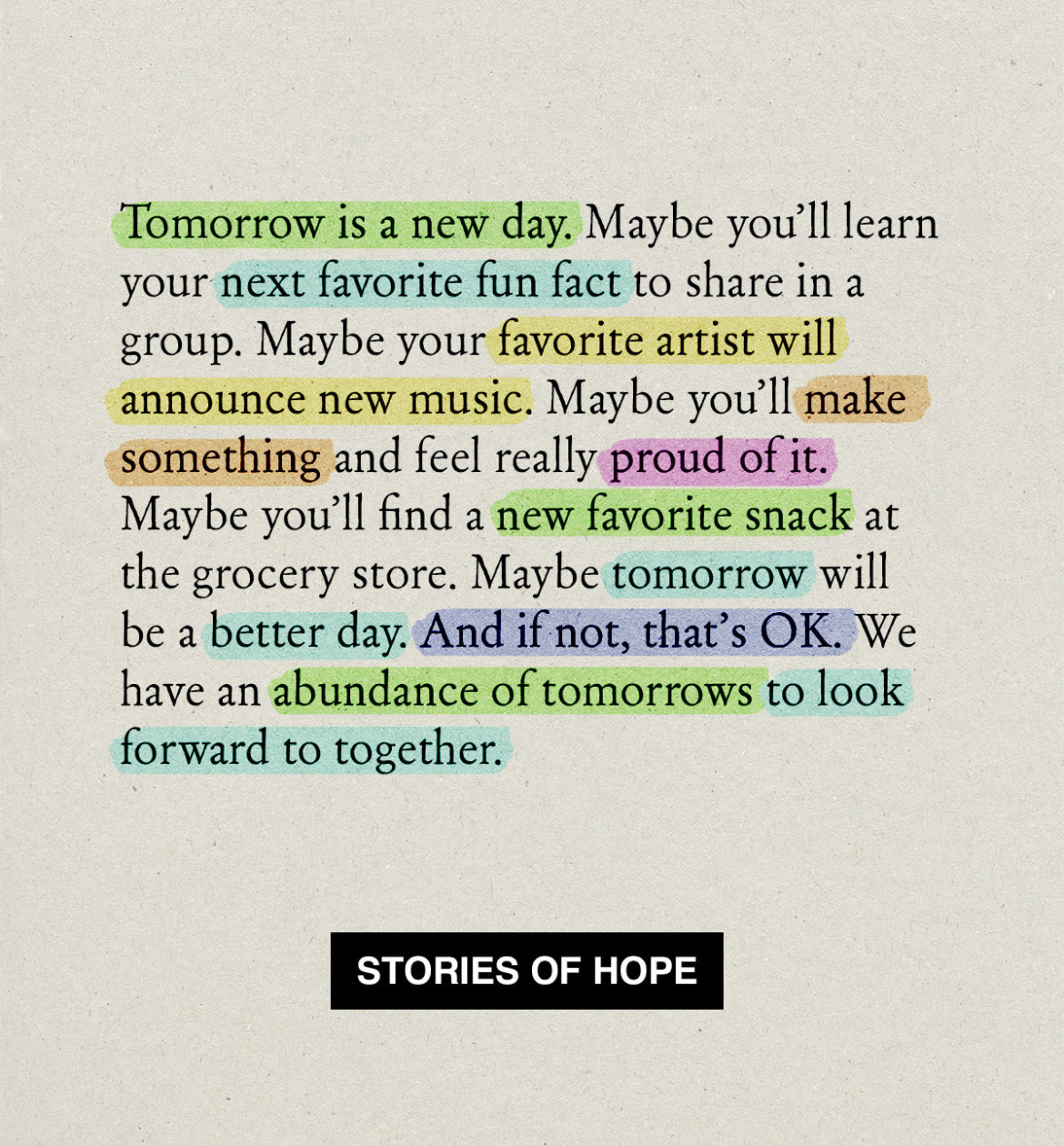
I love these stories of hope from To Write Love On Her Arms. They have lots of great words of encouragement for you to share with others.
Never forget that we live among giants. Greg and I would like to encourage you to honor those who gave their lives so we could enjoy the freedom that we have today 🇺🇸 And be sure to check out all of my videos on my YouTube channel.
I am always fascinated by the latest discoveries that scientists are making. Especially when the complexities show the intimate involvement of a loving, all-wise Creator! The Institute for Creation Research reported a new discovery: “Who isn’t curious, at some level at least, about how human brains process all the complicated inputs and outputs that our daily lives require? Neurobiologists take that curiosity to the top floor. Their recent discovery of a new function for certain neurons has suddenly added a new dimension to these tiny processors along with a new take on how they came to be in the first place.”
“All life is an experiment. The more experiments you make, the better.” —Ralph Waldo Emerson
When someone wants to “grow” an organization, what exactly does that look like? Is growth only numeric or is it something that’s perhaps a bit more difficult to count? The leader needs to have this clear in their mind, and they need to regularly communicate this metric to their team. I unpack this in greater detail in my book Shepherd Leadership. Check out more of this message here. And be sure to check out all of my videos on my YouTube channel.
It appears that creativity is largely fueled by two things: proper sleep and finding your “sweet spot” each day. If you are an early bird, protect that creative time. If you are a night owl, don’t try to become an early bird to emulate someone else, but lean into your productive time. Check out this full post.
I love reading, but even I have trouble finding time to sit down with my books. But this insight from John Piper totally rejuvenated my thinking about reading. “Suppose that you can read about 250 words a minute. Now, that’s not real fast; most of us can do that—250 words a minute. And suppose that you set aside fifteen minutes a day to read a great book—a classic or some book that you’d been longing to read that would help you grow in your wisdom, your understanding. Now, fifteen minutes a day for 365 days is 5,475 minutes a year. Now, you multiply 5,475 times 250, and you get 1,368,750 words that you could read in a year at fifteen minutes a day. Now, an average book has about 300 to 400 words on a page. So we’ll take 350, which is kind of in the middle, and divide that into 1,368,750. And you know what you get? You get 3,910—almost 4,000 pages a year. An average book has about 200 pages. You see the implication of that? You could read twenty books by this time next year by setting aside fifteen minutes a day.”
An ancient Hebrew inscription consisting of 48 letters was discovered on Mt. Ebal in Israel and is centuries older than any known Hebrew inscription from ancient Israel. This is yet another archeological discovery that speaks to the historicity of the Bible.
T.M. Moore wrote one of the endorsements of my book Shepherd Leadership. His thoughts here about the role of godly shepherds is right on the mark: “The work of shepherds consists of helping the people of God to connect with Him—to know, love, fear, and serve Him in every area of their lives. This work cannot be fulfilled by one who is merely a good speaker, an effective organizer, or an inspiring motivator. This work must be done by one who truly knows the Lord. For unless we know the Lord, the Lord will not know us, and He will not honor our labors.”
You are one-of-a-kind! There has never, ever been anyone like you, and there never will be. God made you on purpose and for a purpose. And God wants to reveal the purpose He has for your life. You be you—that is how God is most glorified through you.
Listen to the podcast of this post by clicking on the player below, and you can also subscribe on Apple, Spotify, or Audible.
A teacher of the law asked Jesus an important question. In essence, he asks, “There are a lot of commandments in the Scripture. If I have to give a student the most basic of instruction, which of the commandments is the most vital?”
The response from Jesus is especially important for two reasons:
Which commandments He listed
The relatively few words He spoke
Check out His short reply—
The most important one, is this: “Hear, O Israel: The Lord our God, the Lord is one. Love the Lord your God with all your heart and with all your soul and with all your mind and with all your strength.” The second is this: “Love your neighbor as yourself.” There is no commandment greater than these. (Mark 12:29-31)
In this sermon from Jesus, He speaks a total of 57 words. Notice the breakdown of the words He spoke:
Words from Scripture: 40 words
His own words: 17 words
I wonder how many times we get this reversed? How many times do we share a short passage from the Bible and then use a whole bunch of our own words to try to explain the Scripture? Do we think the Holy Spirit needs our help to illuminate the inspired Word?
Solomon warned twice of the dangers of “many words” (Ecclesiastes 5:3, 7), and Jesus said that if we think a lot of words spoken in prayer makes that prayer effective, we are really just babbling (Matthew 6:7).
The teacher of the law is astounded at this sermon Jesus delivered. He speaks almost as many words as Jesus (52 words), but nearly all of his words are simply repeating what Jesus had said. Jesus said this man’s synopsis of His message was “wise” and indicated that he was “not far from the kingdom of God” (Mark 12:32-34).
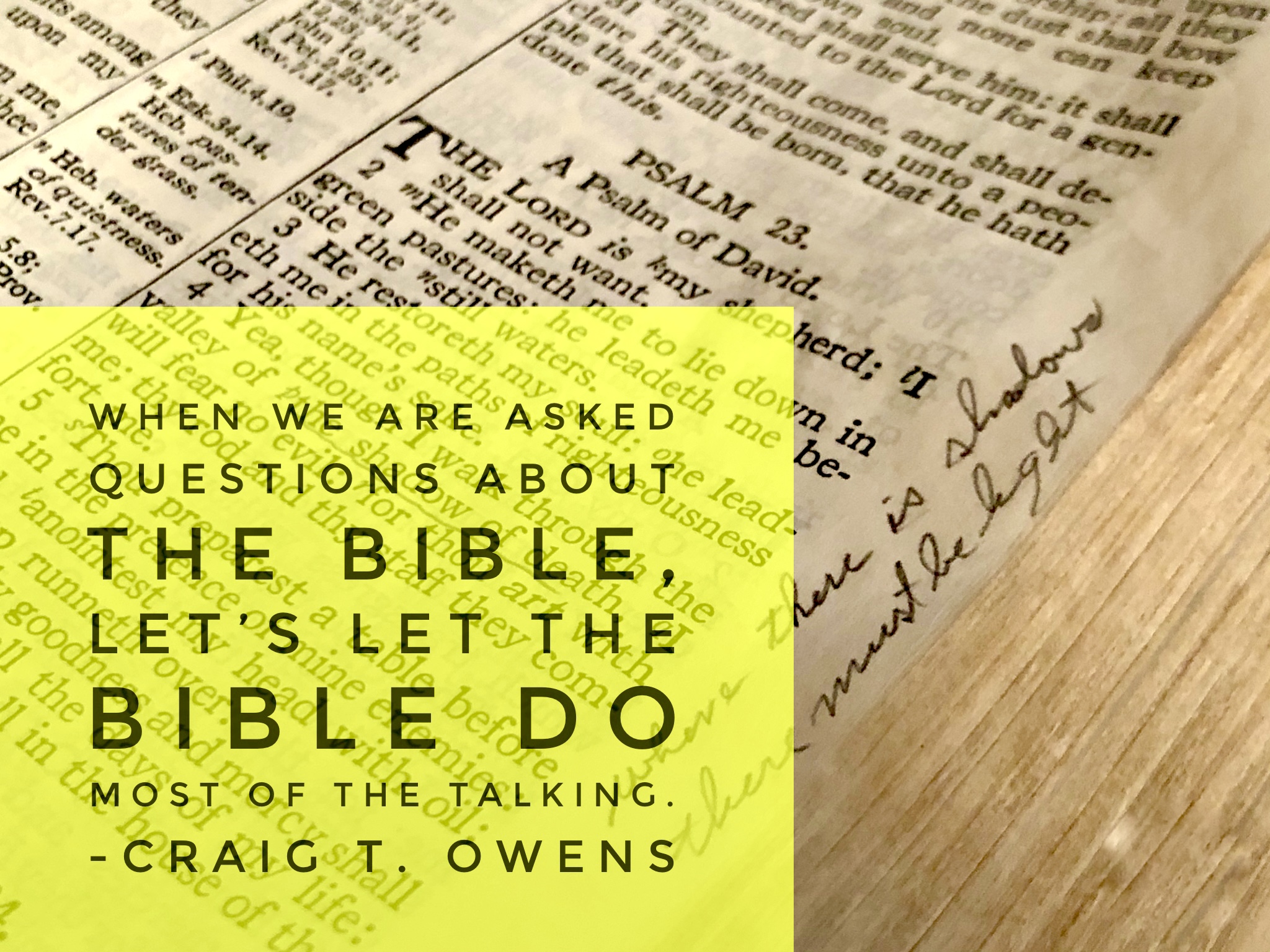
When we are asked questions about the Bible, let’s let the Bible do most of the talking. Let’s be careful that our attitude is not one of trying to “help” the Holy Spirit, but let’s rely on the Holy Spirit to help us know what Scripture to quote, what limited commentary to share, and when to be silent to allow the Word to do its irresistible work.
Shepherds individualize their care. Good shepherd leaders don’t have a one-size-fits-all approach for everyone around them. Good shepherd leaders know how to individualize the care that each and every person needs.Check out my book Shepherd Leadership where I go into more detail about these kinds of leaders.
“The Bible really seems to clinch the matter when it puts the two things together into one amazing sentence. The first half is, ‘Work out your own salvation with fear and trembling’—which looks as if everything depended on us and our good actions: but the second half goes on, ‘For it is God who worketh in you’—which looks as if God did everything and we nothing. I am afraid that is the sort of thing we come up against in Christianity. I am puzzled, but I am not surprised. You see, we are now trying to understand, and to separate into water-tight compartments, what exactly God does and what man does when God and man are working together. And, of course, we begin by thinking it is like two men working together, so that you could say, ‘He did this bit and I did that.’ But this way of thinking breaks down. God is not like that. He is inside you as well as outside: even if we could understand who did what, I do not think human language could properly express it. In the attempt to express it different Churches say different things. But you will find that even those who insist most strongly on the importance of good actions tell you you need Faith; and even those who insist most strongly on Faith tell you to do good actions.” —C.S. Lewis, on Philippians 2:12-13
“My religion consists of a humble admiration of the illimitable superior spirit who reveals Himself in the slight details we are able to perceive with our frail and feeble mind.” —Albert Einstein
The safest place to vent our hurts and frustrations is in God’s presence. He is not going to fall off His throne when you tell Him what’s really in your heart (because He already knows!). But it can bring healing to your hurt when your ears hear what’s really going on in your heart.
This is the most-viewed reel I have ever shared on Instagram! The Bible isn’t a bunch of “once upon time” stories but they are actual events at actual moments in history. Check out how Jesus verifies the historicity of the Bible.
“All obedient believers are near akin to Jesus Christ. They wear His name, bear His image, have His nature, are of His family. He loves them, converses freely with them as His relations. He bids them welcome to His table, takes care of them, provides for them, sees that they want nothing that is fit for them: when He died He left them rich legacies, now He is in heaven He keeps up a correspondence with them, and will have them all with Him at last, and will in nothing fail to ‘do the kinsman’s part’ (Ruth 3:13), nor will ever be ashamed of His poor relations, but will confess them before men, before the angels, and before His Father.” —Matthew Henry
Even skeptics of the claims of the Bible cannot help including biblical themes in their books, movies, plays, and TV shows. I discussed that in this apologetic video—
This is a weekly series with things I’m reading and pondering from Charles Spurgeon. You can read the original seed thought here, or type “Thursdays With Spurgeon” in the search box to read more entries.
Listen to the podcast of this post by clicking on the player below, and you can also subscribe on Apple, Spotify, or Audible.
This Bible Is God’s Bible
Here lies my Bible—who wrote it? I open it, and I find it consists of a series of tracts. The first five tracts were written by a man called Moses. I turn on and I find others. Sometimes I see David is the penman, at other times, Solomon. Here I read Micah, then Amos, then Hosea. As I turn further on, to the more luminous pages of the New Testament, I see Matthew, Mark, Luke, and John, Paul, Peter, James and others. But when I shut up the Book, I ask myself who is the author of it?
Do these men jointly claim the authorship? Are they the compositors of this massive volume? Do they between themselves divide the honor? Our holy religion answers, ‘No!’ This volume is the writing of the living God. Each letter was penned with an Almighty finger. Each word in it dropped from the everlasting lips; each sentence was dictated by the Holy Spirit. Albeit that Moses was employed to write his histories with his fiery pen, God guided that pen. It may be that David touched his harp and let sweet Psalms of melody drop from his fingers, but God moved his hands over the living strings of his golden harp. It may be that Solomon sang canticles of love, or gave forth words of consummate wisdom, but God directed his lips, and made the Preacher eloquent. If I follow the thundering Nahum when his horses plow the waters, or Habakkuk when he sees the tents of Cushan in affliction, if I read Malachi, when the earth is burning like an oven, if I turn to the smooth page of John, who tells of love, or the rugged, fiery chapters of Peter, who speaks of the fire devouring God’s enemies; if I turn to Jude, who launches forth anathemas upon the foes of God, everywhere I find God speaking. It is God’s voice, not man’s. The words are God’s words, the words of the Eternal, the Invisible, the Almighty, the Jehovah of this earth. This Bible is God’s Bible.
From The Bible
I love God’s Book! I hope you love it and love is Author more and more.
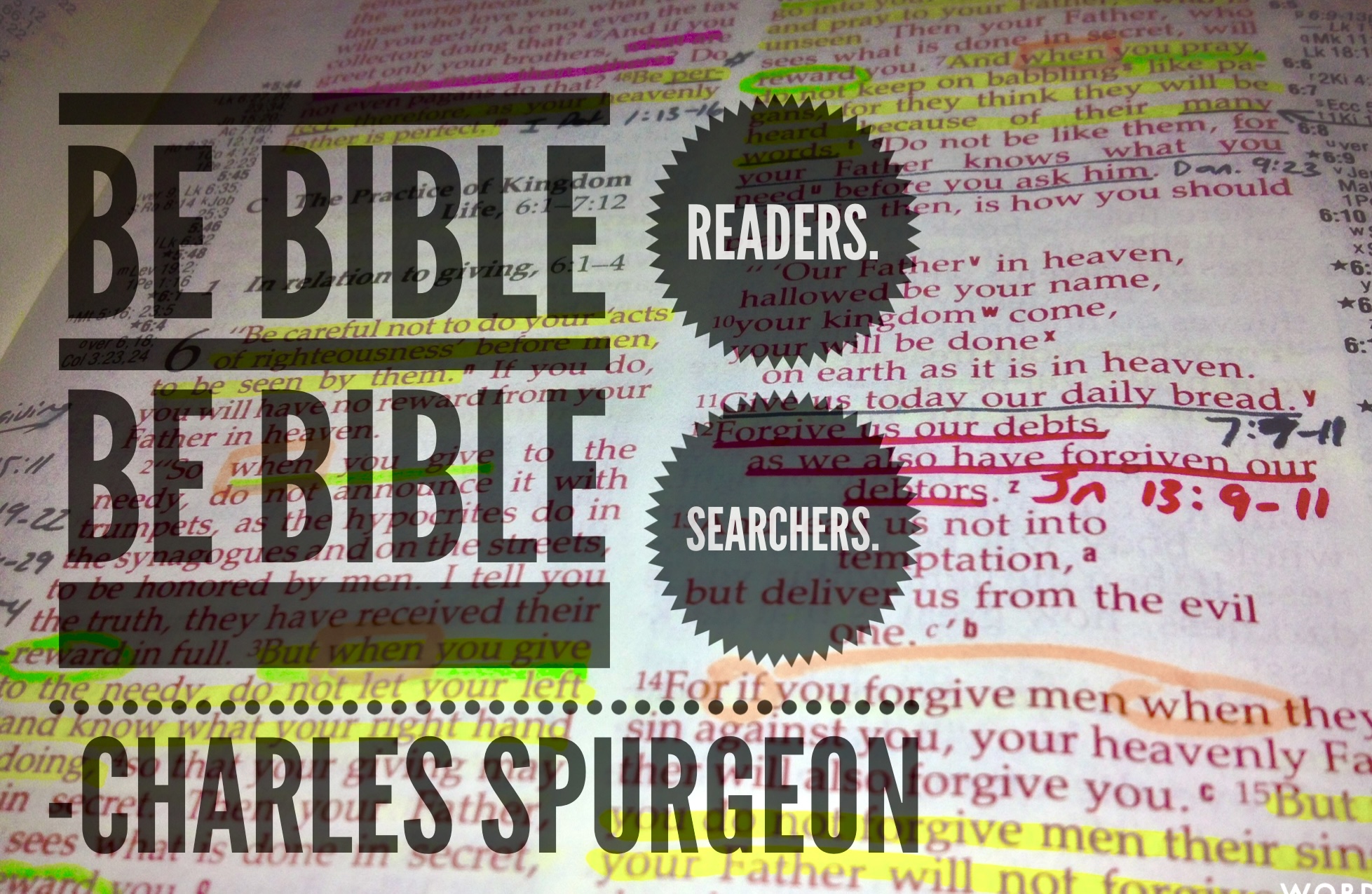
One final word from Charles Spurgeon: “Be Bible readers. Be Bible searchers.”







 Craig T. Owens