The Advent “Nicknames” Of Jesus

Most of us who have nicknames didn’t receive them at birth, but they were given to us later on. It might have been because of a memorable incident, or even a character trait that we are known for.

But think about Jesus. Even before His first Advent, He was given numerous “nicknames” or titles that foretold what He was going to do. In the Christmas carol “O Come O Come Emmanuel” four of Christ’s nicknames/titles are key for us today.

It’s so important for us to look back at these First Advent titles because they give us perspective for today and hope for Christ’s Second Advent.

Paul makes it clear that we are living in a time of both already and not yet. We have redemption (Ephesians 1:7), and we are waiting for the day of redemption (Ephesians 4:30). Jesus has already paid for our freedom (First Advent), but we are still awaiting the rewards that will come with His Second Advent.

O come, O come…

  1. …Emmanuel

Literally, this means “God is with His people.” The prophesy was originally given to the prophet Isaiah (see 7:14 and 8:6-10), but it was repeated when Jesus was born (Matthew 1:23). Only One Who was fully God and fully Man could pay the price for our ransom from sin.

  1. …Rod of Jesse 

David, the son of Jesse, prayed, “Who am I, Sovereign Lord, and what is my family, that You have brought me this far?” (2 Samuel 7:18). Yet God was going to continue to keep David’s family line alive (although at times it looked like the dead stump of a long-forgotten tree) to give a throne to Jesus as the King of kings that would once and for all crush satan’s tyranny.

  1. …Dayspring 

When I think of Dayspring, I think of light exploding immediately into the darkness (Isaiah 9:2 and Luke 1:77-78). Jesus Himself told us of His victory over the darkness: I have told you these things, so that in Me you may have [perfect] peace and confidence. In the world you have tribulation and trials and distress and frustration; but be of good cheer [take courage; be confident, certain, undaunted]! For I have overcome the world. [I have deprived it of power to harm you and have conquered it for you] (John 16:33, AMP).

  1. …Key of David

Only Jesus holds the key to open wide our heavenly home (Isaiah 22:22; Revelation 1:8)!

What do you need? 

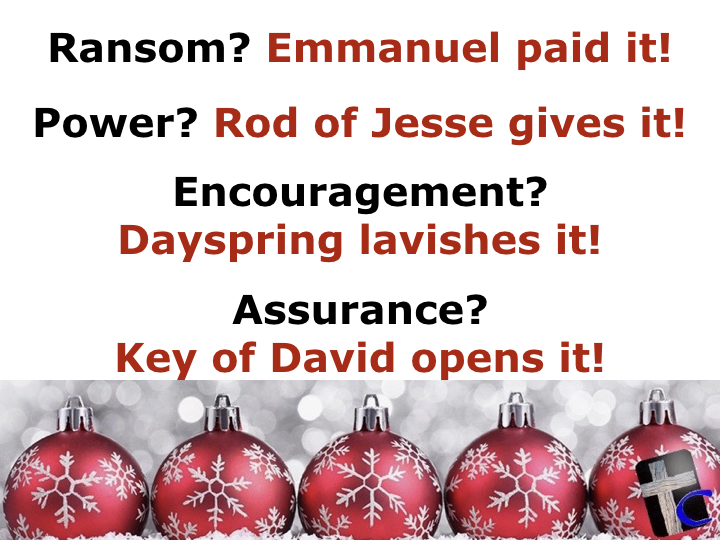
  • Ransom? Emmanuel paid it! 
  • Power to defeat satan? The Rod of Jesse gives it! 
  • Encouragement to press on? The Dayspring lavishes it! 
  • Assurance of your eternal home in Heaven? The Key of David opens it! 

All our longings—all our O come! O come!—are satisfied in Jesus. His First Advent is the already, and His Second Advent gives us hope for the not yet.

If you’ve missed any of the other Christmas carols we have already looked at, you can check them out by clicking here.
11 Quotes From “Interpretation Of The Scriptures”

In my review of A.W. Pink’s book Interpretation Of The Scriptures, I noted that any student of the Bible will benefit from reading this exceptional book. The quotes I want to share today are for that universal audience, but I will also be sharing some additional quotes soon that are specifically aimed at those who are Bible teachers or pastors.

“God does not ask for blind credence from us, but an intelligent faith, and for that three things are indispensable: that His Word should be read (or heard), understood, and personally appropriated.”

“Moreover, the obscurity is not in them [the Scripture], but in the depravity of our nature which resists the holy requirements of God, and the pride of our hearts which disdains seeking enlightenment from Him.”

“It has pleased God to furnish His people with gifted instructors, and instead of haughtily ignoring them we ought (while testing their teaching—Acts 17:11) to accept thankfully whatever help they can afford us.”

“Methods of Bible study are only of relative importance; but the spirit in which it is studied is all-important. It calls for no argument to prove that a spiritual book calls for a spiritually minded reader. … Only where there is honesty of soul and spirituality of heart will there be clearness of vision to perceive the Truth; only then will the mind be capable of discerning the full import of what is read. … None but the Spirit of Truth can write God’s Law on my heart. Here, then, is the first and most essential qualification for understanding and interpreting the Scriptures, namely a mind illumined by the Holy Spirit.”

“That which conflicts with what is taught, plainly and uniformly, in the Scriptures as a whole, and which whole is set before us as the alone rule of our faith and obedience. This requires from the expositor not only a knowledge of the general sense of the Bible, but also that he takes the trouble to collect and compare all the passages which treat of or have a definite bearing upon the immediate point before him, so that he may obtain the full mind of the Spirit thereon. Having done that, any passage which is still obscure or doubtful to him must be interpreted by those which are clear. No doctrine is to be founded on a single passage.”

“By divorcing a verse from its setting or singling out a single clause, one may ‘prove’ not only absurdities but real falsities by the very words of Scripture.”

“The word for ‘search the Scriptures’ (John 5:39) signifies diligently to track out, as the hunter does the spoor of animals. The interpreter’s job is to bring out the sense and not merely the sound of the Word.”

“To a very large extent, and far more so than any uninspired book, the Bible is a self-explaining volume: not only because it records the performance of its promises and the fulfillment of its prophecies, not only because its types and antitypes mutually unfold each other, but because all its fundamental truths may be discovered by means of its own contents, without reference to anything extra or outside itself.”

“Assuredly God has not subordinated His Word to our reason for us to accept only what commends itself to our judgment. Nevertheless, He has furnished His people with this faculty, and though insufficient of itself it is a valuable aid in the understanding of Truth. While reason is not to be made the measurer of our belief, yet it is to be used as the handmaid of faith, by comparing passage with passage, deducing inferences and drawing consequences according to the legitimate laws of logic.”

“The concordance will stand [the Bible reader] in far better stead than the best dictionary.”

“There is a middle ground between hastily condemning or accepting, namely to weigh carefully and prayerfully what is presented, testing it by other passages and by our own experience.”

Interpretation Of The Scriptures (book review)

Bible reading and Bible study will be of immeasurable benefit to the reader if the Scriptures are interpreted correctly. Fortunately for us, A.W. Pink gives us some timeless principles for doing just this in his book Interpretation Of The Scriptures.

Pink acknowledges something that the Apostle Peter also acknowledged: sometimes the passages we read in the Bible can be challenging to understand. But Pink quickly adds, “God does not ask for blind credence from us, but an intelligent faith, and for that three things are indispensable: that His Word should be read (or heard), understood, and personally appropriated.”

In this book, Pink systematically gives us guidelines for the proper and effective interpretation of the the Scriptures. He does so by using many of the age-old maxims of logic and hermeneutics, but he also emphasizes the invaluable role the Holy Spirit plays in our Bible reading times. After all, the Holy Spirit was the One who inspired the writing of the Scriptures, so He is best able to illuminate the true meaning to our hearts and minds.

This is NOT a book exclusively for pastors and Bible teachers (although both will be greatly benefitted by studying this text), but it is for anyone who wants to read the Bible accurately, with an eye toward correctly applying the principles that God gives us.

I’m not sure how many times I have read through the Bible in my life, but while reading Interpretation Of The Scriptures I noticed a new attention to concepts and insights that I had previously overlooked. I highly recommend that all serious readers of the Bible read this book as well.

Looking Ahead To The Second Advent

Celebrating Advent means both looking back at Christ’s First Advent in Bethlehem and looking ahead to His Second Advent at the end of time. Faith in the First Advent fuels hope in the Second Advent. Let’s take a look at the events leading up to and surrounding Christ’s Second Advent to help us appreciate what was begun at His First Advent.

Overarching all of the end times events is a Christian’s blessed hope: “The resurrection of those who have fallen asleep in Christ and their translation together with those who are alive and remain unto the coming of the Lord is the imminent and blessed hope of the church.”

The word “rapture” doesn’t appear in Scripture, but we get this word from the Latin word raptu, which comes from the Greek word harpazo. We first see it when Philip is “caught away” from the Ethiopian’s presence in the desert (Acts 8:39). This is the same word Paul uses when he says that Christians will be “caught up” to meet Christ in the air (see 1 Thessalonians 4:13-17).

Note that the rapture of the Church is not the Second Coming of Christ. His Second Coming takes place at the end of the period known as the Tribulation when Jesus returns to earth as a conquering King and establishes His Millennial Reign on earth (Revelation 19:11-16; 20:1-4).

During Christ’s Millennial Reign, the devil and his cohorts are locked up until the end of the 1000-year reign and are allowed to tempt people one final time. The devil will succeed in tempting quite a few people, as he will once again muster a sizable army to attack Christ and His followers. This decisive battle will culminate in the final judgment.

“There will be a final judgment in which the wicked dead will be raised and judged according to their works. Whosoever is not found written in the Book of Life, together with the devil and his angels, the beast and the false prophet, will be consigned to the everlasting punishment in the lake of fire” (Revelation 20:11-15).

After this will come the New Heavens and New Earth where Christians will commune with God for ever and ever (Revelation 21:1-5, 22-27; 22:1-5, 12-21).

In light of Christ’s First Advent in Bethlehem, and His soon return (His Second Advent), how are Christians to live? In a word: HOPEFUL!

In all of these passages discussing the end times, hope-filled words are used—

  • therefore encourage each other with these words
  • wait for the blessed hope—the glorious appearing of our great God and Savior 
  • stand firm … let nothing move you
  • Jesus says, I am coming soon! My reward is with Me

Jesus also pointed out that Heaven is a place “prepared for you since the creation of the world,” while Hell is “prepared for the devil and his angels.” GOD WANTS YOU WITH HIM IN HEAVEN!

As you rejoice in the First Advent, remember that Christ’s First Coming was to provide a way for you to have your sins forgiven and be able to spend eternity with Him. So as we look forward in hope to Christ’s Second Advent we say with the Apostle John, “Amen. Come, Lord Jesus!”

Saturday In The Psalms—God’s Voice Of Peace

Lord, You have been favorable … You have forgiven … You have covered all their sin. Selah (Psalm 85:1-2).

God’s favor, forgiveness, and covering of sin. Justice would say that God doesn’t have to do any of these things. The people sinned—they violated the holy law—and thus deserve death. But pause and consider this [that’s what Selah means]: God instead shows His favor, deliverance, and forgiveness. All His anger has been turned away!

How do we respond to this? The psalmist asks for restoration and revival. Revival comes when we turn back to God and turn away from our sin, and here we see God initiating revival … making revival possible.

Listen to God’s voice: He speaks peace, which allows us to experience revival. Jesus didn’t say, “Go and sin no more; I do not condemn you.” No! He said, “Neither do I condemn you, now go and sin no more” (John 8:11).

The removal of the wrath of condemnation makes the revival of the soul possible!

Once we hear God’s voice of peace, we can then know His…

  • … mercy
  • … truth
  • … righteousness
  • … goodness
  • … pathway
  • … freedom

God, You are so good! So loving, kind, merciful! Showing Your favor to all who will listen to Your words of peace!

A Leader’s Confidence

Give ear to my words, O Lord, consider my meditation. Give heed to the voice of my cry, my King and my God, for to You I will pray (Psalm 5:1-2).

When David prays, he prays with confidence—he is confident that God will hear him.

Where does his confidence come from? From these two truths about the nature of God:

  1. You are a God who takes no pleasure in wickedness (v. 4), so David must confess his sin quickly.
  2. In fear of You I worship (v. 7), so David doesn’t have to cower before God wondering if God will forgive his sin.

David didn’t take the condition of his soul for granted (v. 5), but he came quickly into God’s presence because he knew of God’s mercy to forgive.

Not only was David confident that God would hear his prayer, but he also eagerly anticipated receiving…

  • …God’s answer to his prayer
  • …God’s joy
  • …God’s blessing
  • …God’s protection

A mark of a godly leader is one who prays confidently and then eagerly expects God to answer.

If you want confidence in your earthly leadership, do what David modeled: Enter God’s presence quickly and confidently, and then eagerly anticipate what God is going to do!

This is Part 16 in my series on godly leadership. You can check out all of my posts on this topic by clicking here.

The Power To Turn Worry Into Worship

Anxiety makes people feel overwhelmed. We over-burden ourselves with worries like…

  • Can I do it?
  • Am I good enough?
  • Do people really like me?
  • What if I fail?

Jesus said, “Which of you by being anxious can add a single hour to his span of life? If then you are not able to do as small a thing as that, why are you anxious about the rest?” Jesus went on to say that this type of worry and anxiety was exactly the opposite of what His followers should be doing: “People who don’t know God and the way He works fuss over these things.”

Instead, Jesus said, we are to turn our focus on Him: “Your Father already knows your needs. Seek the Kingdom of God above all else, and He will give you everything you need.” (see Luke 12:22-31)

Instead of worrying … pray!

My friend Josh Schram said,

“When we worry, we communicate to God that we don’t really trust Him to take care of us.”

OUCH!

You might be saying, “If I’m supposed to pray every time I worry about something, I’d be praying all the time!” You know what? That’s actually a good thing because it’s exactly what the Bible instructs us to do—

Always be joyful. Never stop praying. (1 Thessalonians 5:16-17)

Give all your worries and cares to God, for He cares about you. (1 Peter 5:7)

Don’t worry about anything; instead, pray about everything. Tell God what you need, and thank Him for all He has done. (Philippians 4:6)

“We have the power to turn our…

  • anxiety into prayer
  • worry into worship
  • struggles and trials into testimonies.” (Josh Schram)

Are you using that power God has given you? Don’t let worry cause you to feel overwhelmed. Keep turning your worries over to God again and again and again and again….

Saturday In The Psalms—Generations

I will utter dark sayings of old, which we have heard and known, and our fathers have told us. We will not hide them from their children, telling to the generation to come the praises of the Lord… (Psalm 78:3-4).

If George Santayana* was right about the dangers of unlearned history lessons for the general population, he identified something even more vital for those who follow God.

Asaph recounts a history of God’s people where God blessed them, the people became complacent in His blessing, until they turned from God and became subject to His wrath. The cycle, sadly, repeats again and again.

Asaph wants today’s generation to learn this lesson and to break this cycle. 

He calls on this generation to continually remind the next generation of God’s blessings for obedience, and God’s judgment for disobedience—

Make them known to their children (v. 5).

The children who would be born, that they may arise and declare them to their children (v. 6)

For today’s parents this means…
No complacency. 
No assumptions. 
No letting kids “figure it out on their own.” 
Constant diligence.
Constant communication.

May this generation speak words of life to the generation to come!

* George Santayana said, “Those who do not learn from history are doomed to repeat it.” And he also noted, “A child educated only in school is an uneducated child.”


Transforming Grace (book review)

Not too long ago I read that the song “Amazing Grace” was the best-known song in the entire world. People who know Jesus as their Savior certainly can attest to how amazing grace is. But what about after someone becomes a Christian? What happens with grace then? Jerry Bridges dives into this topic with his eye-opening look at Transforming Grace.

In the opening lines of the preface, Bridges states, “The Bible teaches we are not only saved by grace, but we also live by grace every day of our lives.” This is a concept that many Christians miss, and as a result feel like they are living their lives on what Bridges calls “the performance treadmill.” In other words, far too many Christians mistakenly think that God’s grace saved them, but now it will be their own righteous works that will keep them saved.

In 13 chapters, Bridges dismantles the “performance” mindset and helps Christians see the freedom and joy that come from a proper understanding of how grace transforms and empowers our lives every day.

To help transfer Bridges’ lessons into everyday application, I also highly recommend getting a couple of friends together for this journey. Not only read Transforming Grace together, but then take some time to work through the discussion guides for each chapter. These guides will give you some Scriptures to ponder, and some discussion-starting questions to talk about with your friends. This time will help you go from learner-to-liver with the concepts of transforming grace.

I am a NavPress book reviewer.

A Surprising Way To Relieve Stress

Paul writes some pretty straightforward words to the Christians at Philippi about how to overcome anxiety.

Just to be clear, we’re not talking about a problem-free nor a stress-free life. That’s simply not possible. Our bodies were created to deal with stress in a healthy way. But stress that is unhealthy, or unnecessarily prolonged, or not flushed properly from the body becomes anxiety. Anxiety is the culprit responsible for a whole list of bad things!

When we face a stressor, our bodies release a hormone called cortisol. The main function of this hormone is to prepare us to fight or flight. Sometimes this looks like over-engaging in problem-solving, and sometimes it looks like a complete withdrawal from life. Sometimes cortisol leads to sleeplessness and a diminished appetite, and sometimes it makes people sleepy and craving comfort food.

But the bottom line is the fight-or-flight response is very me-focused!

The strategies Paul lists for us take the focus off me and put it on God. He especially counsels us to pray to God and to praise God. Between these two healthy responses is something unexpected. He writes, “Let your gentleness be evident to all. The Lord is near.”

What in the world does gentleness have to do with relieving stress?!

First, let’s consider the motivation: The Lord is near. I think this could mean:

  1. The Lord’s name is near, as in we are called “Christians” and so we should act in a way that glorifies God.
  2. The Lord is near to help us.
  3. The Lord’s return is closing in where we will have to give an account of how we have lived our lives.

Then there is this word gentleness. This word means:

  • moderation
  • considerate of others
  • patience toward our situation and toward others
  • or as The Message says: Make it as clear as you can to all you meet that you’re on their side, working with them and not against them.

Cortisol is naturally removed from our physical bodies through rest and exercise. Anxiety is naturally removed from our emotional lives the same way—resting in God’s presence (honk!) and gently and considerately exercising a blessing for someone else.

THE BEST WAY TO DE-STRESS IS TO BLESS! 

When anxiety builds:

  1. Honk
  2. Bless
  3. Repeat

Don’t let stress win by making you self-centered. Defeat stress and anxiety by praising God and blessings others. And then make that a daily habit!