9 Quotes From “Shepherding God’s Flock”

T.M. Moore has given pastors a phenomenal training resource in Shepherding God’s Flock. Please be sure to check out my full book review by clicking here. 

“The work of church leaders today—and especially of that class of leaders called elders, with which this study is concerned—has been shaped and conditioned more by the temper of our times than by the teaching of God’s Word.” 

“According to Paul, any church that does not have in place elders—and other leaders working with them—who are functioning as shepherds is a church that is not in order.… A church without a strong ministry of shepherding is a flock without genuine pastoral care, oversight, and equipping. It may be very active, even happy, and may be ‘growing’ in what some consider impressive ways. But without shepherding as the framework and integrating dynamic, such a church will always be something less than what God intends.” 

“Where the work of shepherding is being faithfully pursued, the gospel goes forth with power, lost sheep are located, and the flocks of God grow as He adds new souls to the fold.” 

“Where faithful shepherds are at work, the Lord’s sheep will be well fed. Both milk and the meat of the Word will be their daily diet, according to the needs and callings of each. Well-fed sheep are healthy, strong, and fruitful in their own contributions.” 

“The work of shepherding begins in relationships of mutual love and trust, spiritual friendships where sheep and shepherd know, love, and care about one another.” 

“Only when the people feel known and loved, and only when they know and love those who are called to lead them—only then will they be willing to follow where the shepherds of the church are seeking to take them.” 

“In the Christian life, people tend to live up to or achieve, not the level of their abilities, for their abilities are virtually limitless, given the presence of the indwelling Spirit of God. Rather, they tend to live up to the level of their vision—of what they see for their lives in Christ. Unless we are leading them into God’s vision for their lives, the people of God will settle for something less than the prize of the upward call of God in Christ Jesus.” 

“When temptation arises we can follow one of two courses. Either we will fall through temptation into sin, or we will grow through temptation into a higher stage of sanctification. … The shepherd’s task is twofold: first, he must help the Lord’s sheep to recognize temptation, by grounding them firmly in the law and Word of God; second, he must equip and encourage them in finding the way of escape from temptation, so that they may grow as the Lord intends.” 

“Jesus’ approach to bearing witness was thus energetic, proactive, continuous, compassionate, and pioneering. Should we expect anything less from the shepherds He has left to bring other lost sheep into His fold?”

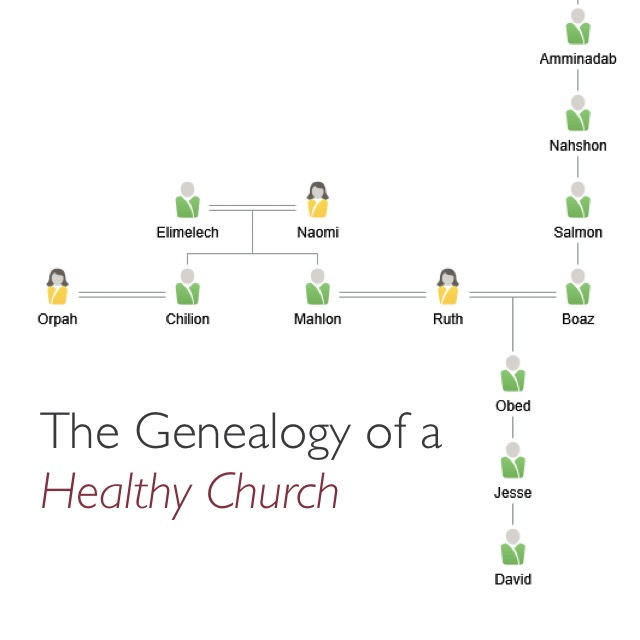
The Genealogy of a Healthy Church

And the things you have heard me say in the presence of many witnesses entrust to reliable people who will also be qualified to teach others. (2 Timothy 2:2)

Paul list four generations in this healthy church—Paul ➡️ Timothy ➡️ faithful Christians ➡️ others. 

We all have a role to play, and every role is vital in a healthy church. Are you a…

Paul: a first generation Christian that needs to start the ball rolling?

Timothy: one who needs to pass along what you have learned to the next generation?

faithful Christian: someone that is actively living out what has been taught to you?

member of the Body of Christ: one that needs to reach out to someone who isn’t a part of the Body yet?

Every single role is indispensable if the Church is going to remain healthy. If any part of this genealogy is lost, the whole Church suffers.

Missionary God, Missionary Bible (book review)

Technically speaking, Missionary God, Missionary Bible by Dick Brogden is a pre-book. It is being released through 2019 as a daily email and then it will be published as a book next year. But I urge you to jump in on these stirring thoughts today! 

God is a missions-minded God, so it makes sense that the Bible would be a missions-centered text, speaking to the hearts of both those who don’t know Jesus as Savior yet, and to the hearts of those Christians who should be missional in their lives. 

Dick is a veteran missionary, and he brings his decades of ministry experience to this monumental work. Dick is using The Chronological Study Bible to take us through the Bible in one year and to look at every text through a missionary lens. The Chronological Study Bible is a fascinating read in itself, as it places the biblical texts in the order in which the events happened, but then when Dick’s insights are added to those historical events, something even more powerful stirs in my heart. 

Each day’s devotional also includes a prayer focus for an unreached people group, along with the vital statistics about these precious people who need to hear the Good News of Jesus. 

This study Bible, read alongside Dick’s missional insights, and then combined with a prayer for a group that needs to receive the Gospel, makes for a life-changing devotional time. You will definitely want to get the book when it is published, but please don’t wait until then to begin to have your missionary heart enlarged and engaged in this fantastic daily study. 

You can subscribe to the daily emails by clicking here.

Thursdays With Spurgeon

Nearly 10 years ago I began a series of posts called “Thursdays With Oswald,” in which I shared the thoughts that were working their way through my heart and mind as I journeyed through the complete works of Oswald Chambers. Now, almost a decade later, I have finished all 1500 pages of his wisdom. 

I think it is wise to frequently spend time with the “old guys”—those whom the years have proven their godly wisdom to be true. So I am now moving on to another prolific writer and speaker, the man called the Prince of Preachers: Charles Haddon Spurgeon. 

As with my series with Oswald Chambers, I will be sharing some passages from the Spurgeon book or sermon I am reading. On some, I will offer some thoughts that I’m contemplating in light of that reading, and on others, I will simply let the Prince’s words speak for themselves. 

Let me begin with three simple quotes: 

“The words of God have more power over me than ever David’s fingers had over his harp strings.” 

“It is better to preach five words of God’s Word than five million words of man’s wisdom.” 

“There is a power in God’s gospel beyond all description.”

I love how completely Spurgeon’s thoughts are grounded on God’s Word! Spurgeon had no formal theological training, but he expounded on Scriptures as few ever did or ever have. 

Growth Problems

…the number of disciples was increasing… (Acts 6:1).

Growth is a nice problem to have. But it is still a problem that needs to be addressed, or else the growth can implode an organization. 

In this instance, the early Christian church was growing rapidly and attempting to address the need for getting food to widows. Apparently, some of the widows were being overlooked in that food distribution. 

To start the ball rolling on solving this growth problem, the apostles gave some simple parameters: We will focus on preaching, the rest of you should select administrators to oversee the food ministry (vv. 2-4). The job description was pretty simple too—they must have a good reputation, be full of the Holy Spirit, be wise, and (this is implied) be willing to serve.

Notice the trust the church leaders placed in that congregation: 

  • seek out from among you
  • they chose
  • they set them [the candidates] before the apostles

The congregation was pleased by both the apostles’ plan and the level of trust that was conferred on them. It appears that seven men were the unanimous selection of both the congregation and the church leaders. 

After these men were installed in their new administrative roles, look at the results:

  • more preaching
  • more salvations
  • more inroads into the Jewish religious leadership sect
  • more people fed
  • more miracles performed
  • and more persecution from those threatened by the church’s rapid growth

It’s interesting to note that Luke uses the word added to talk about the church’s growth in chapters 1-5, but after this growth problem is successfully resolved, Luke stops using added and only uses multiplication terminology. 

When handled the right way, growth problems—or any problems, for that matter—lead to more growth. 

A mark of a godly leader is one who handles growth problems correctly. 

This is part 36 in my series on godly leadership. You can check out all of my posts in this series by clicking here.

The Infographic Bible (book review)

I love studying the Bible! I enjoy reading it in different translations, consulting my atlas to see where certain events took place, studying the culture of the biblical settings, and even diving in to the Hebrew and Greek definitions of words. But I’ve never seen the biblical story portrayed as uniquely and so visually beautiful as Karen Sawrey has done it in The Infographic Bible.

The subtitle of this work is “visualizing the drama of God’s Word,” and Karen does this in ways you have never seen before. 

The Infographic Bible flows in the same order as the Biblical text, except that there is very little text involved. You will see how the biblical books were compiled and then walk through God’s story in both the Old and New Testaments.

In graphics that typically span the full two-page spread (and sometimes even more), you will see in vivid colors, bold designs, and memorable graphics how God set about to redeem His people and tell His story. You will see the two Genesis accounts of Creation portrayed side-by-side, you will understand genealogies better by seeing their timelines flow through generations, you will appreciate the biblical themes and fulfilled prophesies, and you will look forward to the hope of things to come in Revelation. 

There is so much to discover in this book! The Infographic Bible is a coffee-table-size book, and the beautiful graphics inside will definitely make it a conversation piece to leave on display for your guests. I commend Karen Sawrey for her outstanding work, and I highly recommend this book to you.

Thursdays With Oswald—Hear And Do

Oswald ChambersThis is a weekly series with things I’m reading and pondering from Oswald Chambers. You can read the original seed thought here, or type “Thursdays With Oswald” in the search box to read more entries.

Hear And Do

     The emphasis in these verses [Matthew 7:24-29] is laid by our Lord on hearing and doing. … We hear only what we listen for. Have we listened to what Jesus has to say? Have we paid any attention to finding out what He did say? Most of us do not know what He said. If we have only a smattering of religion, we talk a lot about the devil; but what hinders us spiritually is not the devil nearly so much as inattention. We may hear the sayings of Jesus Christ, but our wills are left untouched, we never do them. … 

     Pay attention to His words, and give time to doing it. Try five minutes a day with your Bible. The thing that influences us most is not the thing that we give most time to, but the thing that springs from our own personal relationship, that is the prime motive that dominates us. … 

     “Build up your character bit by bit by attention to My words,” says Jesus, then when the supreme crisis comes, you will stand like a rock. … If a man has built himself up in private by listening to the words of Jesus and obeying them, when the crisis comes it is not his strength of will that keeps him, but the tremendous power of God. … All you build will end in disaster unless it is built on the sayings of Jesus Christ; but if you are doing what Jesus told you to do, nourishing your soul on His word, you need not fear the crisis whatever it is. … 

     There is a tendency in all of us to appreciate the sayings of Jesus Christ with our intellects while we refuse to do them. … 

     The Holy Spirit’s voice is as gentle as a zephyr, the merest check; when you hear it do you say, “But that is only a tiny detail, the Holy Spirit cannot mean that, it is much too trivial a thing”? The Holy Spirit does mean that, and at the risk of being thought fanatical you must obey. … What does it matter what anyone thinks of us as long as Jesus Christ thinks we are doing the right thing, as long as we can hear Him say, “Well done, good and faithful servant”?” 

From Studies In The Sermon On The Mount

Hear/read God’s Word → Listen to how the Holy Spirit tells me to apply it to my life → Then apply it to my life → Repeat this process again tomorrow… 

Studies In The Sermon On The Mount (book review)

Many people have called Christ’s Sermon on the Mount the most profound sermon ever preached. It would be hard to argue that conclusion! Reading the Sermon is one thing, but living it out is something entirely different. Oswald Chambers helps us live out these amazing words in his book Studies In The Sermon On The Mount. 

Not only did Chambers provide us with an excellent commentary on this Sermon, but his life showed his devotion to practicing what he preached. At a memorial service for Chambers in December 1917, a close friend described Oswald’s life as “the finest commentary on the Sermon on the Mount I know.” May that be said of all Christians! 

This is one of the finest commentaries I have read on this life-patterning sermon that Jesus gave us. It’s a great read, but it is also quite challenging at times. To be honest, Chambers’ thoughts are so deeply profound at points that it takes several readings to grasp the implications. But it is worth your effort! 

A colleague of Chambers—J.F. Knapp, who founded God’s Bible School in Cincinnati, OH, where Chambers taught for seven months in 1907—described it better than I could: 

“‘But,’ says some simple soul, ‘I don’t understand [Chambers].’ The more is the pity. Leave then the evening newspaper, the book of religious wonder-tales, the high-flown writing watered with adjectives, but empty of thought or power, and read these pages again and again until the truth soaks through to your innermost consciousness. … To heed the words of our Lord’s Sermon on the Mount as interpreted by Oswald Chambers will transform holiness people into holy people, and faithless verbosity into Christian humility. Unto which glorious result God speed the day!”

To Knapp’s words I can only add “Amen!” If you want to understand the Sermon On The Mount better, you shouldn’t miss out on this premier Oswald Chambers book. 

Resurrection Appearances

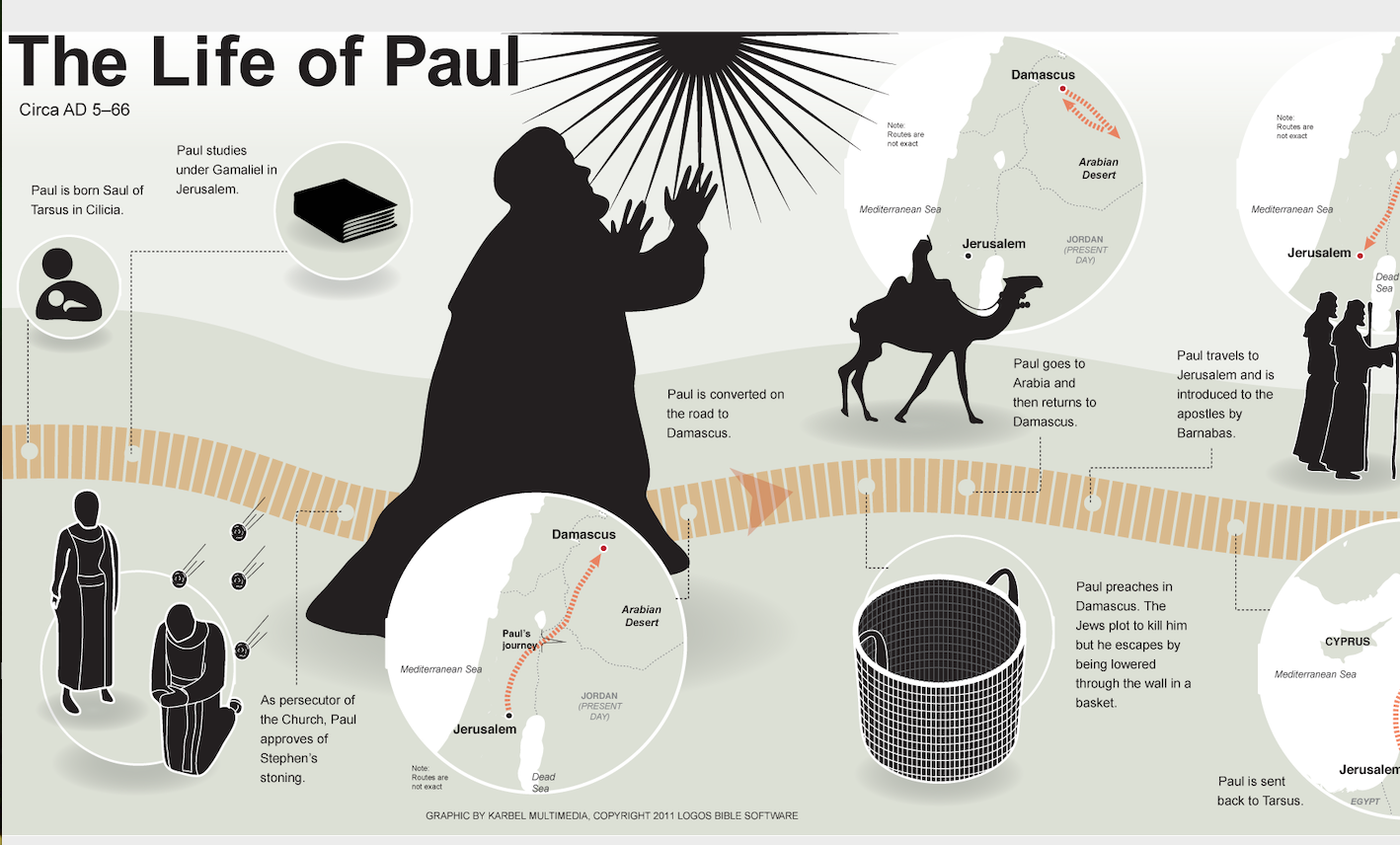
The appearances of Jesus after His resurrection aren’t just limited to the four Gospels (Matthew, Mark, Luke, and John), but also in the books of Acts and 1 Corinthians. Check out this infographic from The Infographic Bible by Karen Sawrey. 

(click the image to zoom in)

Jesus appeared at…

  • A—an empty tomb in the Garden at Golgotha in Jerusalem (Matthew 28:1-10; Mark 16:9-11; John 20:1-18)
  • B—on the road to Emmaus (Mark 16:12-13; Luke 24:13-32)
  • C—in Jerusalem (Luke 24:33-35; 1 Corinthians 15:5)
  • D—at a house in Jerusalem (Mark 16:14-20; Luke 24:36-53; John 20:19-23; 1 Corinthians 15:5)
  • E—at a house in Jerusalem (John 20:26-29)
  • F—by the Sea of Galilee (John 21:1-23)
  • G—on the Mount of Galilee (Matthew 28:16-20; Mark 16:14-20)
  • H—location unknown (1 Corinthians 15:6)
  • I—location unknown (1 Corinthians 15:7)
  • J—location unknown (1 Corinthians 15:7)
  • K—on a road to Damascus (Acts 19:1-9, 22:6-11, 26:12-18; 1 Corinthians 15:8-9)

Thursdays With Oswald—Do You Have The Goods Or Just The Label?

This is a weekly series with things I’m reading and pondering from Oswald Chambers. You can read the original seed thought here, or type “Thursdays With Oswald” in the search box to read more entries.

Do You Have The Goods Or Just The Label? 

     Our Lord makes the test of goodness not only goodness in intention, but the active carrying out of God’s will. Beware of confounding appearance and reality, of judging only by external evidence. …  

     The baptism of the Holy Ghost turns men into the incarnation of what they preach until the appearance and the reality are one and the same. … He does in us what Jesus did for us. … 

     Human nature is fond of labels, but a label may be the counterfeit of confession. It is so easy to be branded with labels, much easier in certain stages to wear a ribbon or a badge than to confess. Jesus never used the word testify; He used a much more searching word—confess. ‘Whosoever therefore shall confess Me before men…’ [Matthew 10:32-33]. The test of goodness is confession by doing the will of God. ‘If you do not confess Me before men,’ says Jesus, ‘neither will your Heavenly Father confess you.’ Immediately we confess, we must have a badge, if we do not put one on, other people will. Our Lord is warning that it is possible to wear the label without having the goods; possible for a man to wear the badge of being His disciple when he is not. Labels are all right, but if we mistake the label for the goods we get confused.

From Studies In The Sermon On The Mount

Some people only wear the labels—they use the name “Christian” without ever surrendering to the lordship of Jesus. Oswald Chambers reminds us that these are the people to whom Jesus will say, “I never knew you” (Matthew 7:21-23). 

Listen to the Holy Spirit. He can make sure that your preaching your living are one and the same. You and I don’t want to just testify that we are disciples of Jesus, but we want to be the living incarnation of all that Jesus did and taught.

Labels are fine (if other people put them there), but just make sure you have the goods! I’ll say it again: Listen to the Holy Spirit and immediately obey what He points out to you.