Undeniableness

…we cannot deny it (Acts 4:16)

The healing of a 40-year-old man who has been lame from birth is truly undeniable! But the Sadducees (the truly religious elite) took issue with the fact that Peter and John were then telling people about God’s resurrection power (which they did not believe).

It was undeniable that…

  • … the lame man was healed
  • … Peter spoke boldly with the help of the Holy Spirit
  • … Peter and John’s eloquence in spiritual matters was not bookish learning but divine illumination
  • … Peter and John had been with Jesus
  • … Peter and John could not be silenced by threats
  • … the admiration of the crowd following the healing and Peter’s sermon
  • … God was glorified

So what did the church do? They prayed for more “undeniableness” to be demonstrated by God through their lives!

They knew none of these threats took God by surprise, but they all happened as God had “determined before to be done” (v. 28). So they said, “We are Your servants in this—do more undeniable things through us. Enable us to speak Your Word boldly, and empower us to do signs and wonders in the name of Jesus” (vv. 29, 30).

And God answered that prayer!

What about us? Are we willing to pray that prayer today? Will we allow God to do undeniable things through us? Persecution may follow, but so will God’s glory, and saved souls, and healed people!

For more evidence of the unmistakable evidence that follows Spirit-baptized Christians, check out this post.

Thursdays With Oswald—Do You Pass The Tests?

Oswald ChambersThis is a weekly series with things I’m reading and pondering from Oswald Chambers. You can read the original seed thought here, or type “Thursdays With Oswald” in the search box to read more entries.

Do You Pass The Tests?

     In these verses [Matthew 7:15-20] Jesus tells His disciples to test preachers and teachers by their fruit. There are two tests—one is the fruit of the life of the preacher, and the other is the fruit of the doctrine. The fruit of a man’s own life may be perfectly beautiful, and at the same time he may be teaching a doctrine which, if logically worked out, would produce the devil’s fruit in other lives. It is easy to be captivated by a beautiful life and to argue that therefore what he teaches must be right. Jesus says, “Be careful, test your teacher by his fruit.” The other side is just as true, a man may be teaching beautiful truth and have magnificent doctrine while the fruit in his own life is rotten. We say that if a man lives a beautiful life, his doctrine must be right; not necessarily so, says Jesus. Then again we say because a man teaches the right thing, therefore his life must be right; not necessarily so, says Jesus. Test the doctrine by its fruit, and test the teacher by his fruit.

From Studies In The Sermon On The Mount

Yes, we should test our teachers and preachers by: (1) the fruit of their life, and (2) the fruit of their doctrine. But all Christians should also make sure our own lives pass the same test. 

Chambers goes on to share these thoughts—

“It is appallingly easy to pretend. If once our eyes are off Jesus Christ, pious pretense is sure to follow. … We have to beware of pretense in ourselves. It is an easy business to appear to be what we are not.” 

“If we say we are right with God, the world has a perfect right to watch our private life and see if we are so. … Fruit-bearing is always mentioned as the manifestation of an intimate union with Jesus Christ (John 15:1-5). … Jesus Christ makes publicity the test; He lived His own life most publicly (John 18:20). … It is God’s law that men cannot hide what they really are. If they are His disciples it will be publicly portrayed.” 

“God’s spiritual open air is the Bible. The Bible is the universe of revelation facts; if we live there our roots will be healthy and our lives right.” 

We need to always listen to the voice of the Holy Spirit when we ask, “Am I passing these two tests of true fruitfulness?” 

Love Securely

Jesus is journeying toward the Cross. On Thursday, it’s His last opportunity to impart His most important thoughts to His disciples. He is about to be arrested, and everything is about to go sideways for the disciples—“this isn’t the way this is supposed to happen!”—and Jesus needs to prepare them with the truth they will need to sustain them through this. 

“I have eagerly desired to eat this Passover with you before I suffer,” Jesus says (Luke 22:15).  

So Peter and John are sent to make arrangements for the Passover meal, but one of the arrangements that they overlooked was the host duties—washing the feet of each guest, anointing them with perfume, and giving them a welcoming kiss. 

As they are eating dinner, Jesus makes four important statements:

  1. “One of you will betray Me”
  2. “All of you will abandon Me”
  3. “I will rise again and restore you”
  4. “I have prayed for you”

These statements get the disciples arguing about who’s going to betray Jesus—“It’s not me, is it?!”—and over how faithful they are—“I would never abandon Him!” Ultimately they begin to argue over who is the greatest disciple among them. 

Jesus not only explains to them how the servant is greater than the master in God’s sight (Luke 22:24-27), but He then becomes the living example of that when He washes their feet (John 13:1-5, 12-17). 

Here’s an important principle—Only secure people can lovingly serve others. 

Insecure people don’t like to serve others because they feel they are being misused, or taken advantage of, or that others will look down on them. 

Jesus “knew” (John 13:1, 3) how much power His Father had given Him, making Him secure enough to serve. Security really means, “I am loved by God, and I know who I am in Him.”

Jesus served out of love: the profound love that He knew His Father had for Him. He gave His disciples the same mandate: Serve others out of love for Me and show the world that you are My disciples (see John 13:34-35).

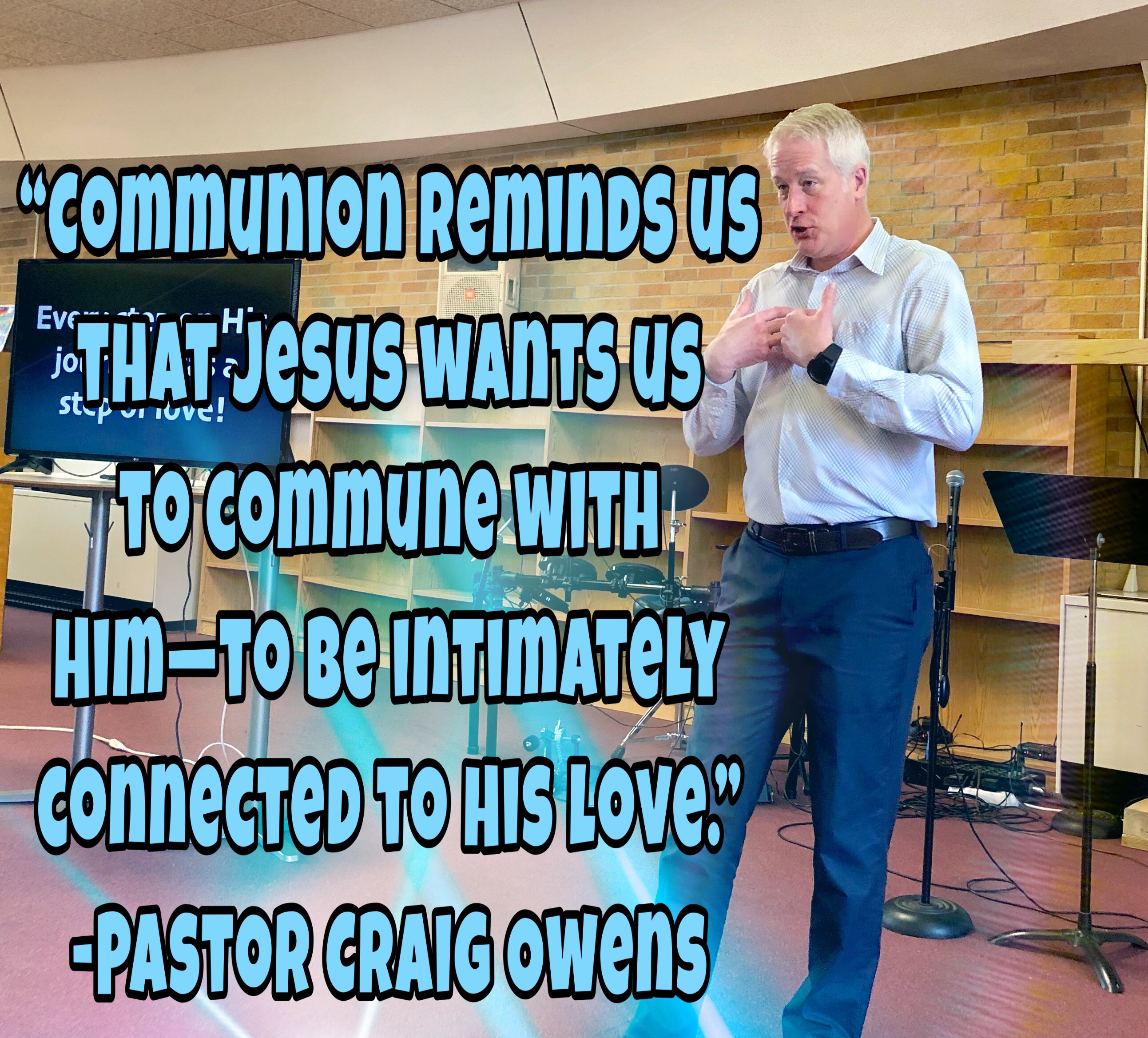
When Jesus ate this last supper with His disciples, He instituted a remembrance celebration that we now call Communion. The root word is “commune” which the dictionary defines as a “conversation with profound intensity and intimacy.” 

This is the type of intimate relationship Jesus had with His Father, and this is the type of relationship He calls us to with Him. The broken bread of Communion reminds us that Jesus can make whole any broken area that would keep us from communing with Him. The cup of Communion reminds us that Jesus can instantly and fully forgive any sin that would keep us from communing with Him. 

Jesus set the example—we are to commune with our Heavenly Father through the way He made by His broken body and His shed blood. It’s out of this communion that we are empowered by His love, and then feel secure enough to serve others in love too. 

Thursdays With Oswald—Spiritual Grit

Oswald ChambersThis is a weekly series with things I’m reading and pondering from Oswald Chambers. You can read the original seed thought here, or type “Thursdays With Oswald” in the search box to read more entries.

Spiritual Grit

     Salvation is God’s “bit,” it is complete, we can add nothing to it; but we have to bend all our powers to work out His salvation. It requires discipline to live the life of a disciple in actual things. “Jesus knowing…that He was come from God, and went to God,…took a towel…and begin to wash the disciples’ feet” [John 13:1, 4]. It took God Incarnate to do the ordinary menial things of life rightly, and it takes the life of God in us to use a towel properly. … And we can do it every time because of the marvel of God’s grace. …  

     A stoot hairt tae a stae brae (i.e. a strong heart to a difficult hill). The Christian life is a holy life; never substitute the word “happy” for “holy.” We certainly will have happiness, but as a consequence of holiness. Beware of the idea that so prevalent today that a Christian must always be happy and bright, “keep smiling.” That is preaching merely the gospel of temperament. If you make the determination to be happy the basis of your Christian life, your happiness will go from you; happiness is not a cause but an effect that follows without striving after it. … 

     There is something in us that makes us face temptation to sin with vigor and earnestness, but it requires the stout heart that God gives to meet the cares of this life. I would not give much for the man who had nothing in his life to make him say, “I wish I was not in the circumstances I am in.” “In the world you will have trouble; but be of good cheer! I have overcome the world” [John 16:33]—“and you will overcome it too, you will win every time if you bank on your relationship to Me.” Spiritual grit is what we need.

From Studies In The Sermon On The Mount

If you have placed your faith in what Jesus did for you on Calvary, and if you have asked the Father to forgive you of your sins, then His Holy Spirit resides in you. 

Therefore, you have all that you need to be successful every single time. The question is: Am I using the spiritual grit that God gives me to be holy? Or am I merely looking for a way to be happy? 

Keeping In Step

But He needed to go through Samaria (John 4:4). 

Jesus was never late, never early, never out of position, never scrambling to catch up. 

He kept in step with the Holy Spirit so that He was exactly where He needed to be when He needed to be there. Whether it was battling satan, helping a soon-to-be-embarrassed wedding party, talking with a lonely Samaritan woman, raising a widow’s dead son to life, or walking toward Jerusalem (see Luke 4:1, 7:11, 19:1; John 2:1, 4:4). 

Others have experienced this too. Like when Ruth “happened” to be in the right farmer’s field at the right time, or when Philip was on the right road at the right time (see Ruth 2:3; Acts 8:27).

A mark of a godly leader is one who keeps in step with the Holy Spirit. 

If we live by the Holy Spirit, let us also walk by the Spirit. If by the Holy Spirit we have our life in God, let us go forward walking in line, our conduct controlled by the Spirit. (Galatians 5:25 AMP)

Holy Spirit, You know where I need to be today. Let me not grumble at what I may call “detours” or “delays,” but help me to submit to Your direction and Your timing. I want to keep in step with You. 

This is part 35 in my series on godly leadership. You can check out all of my posts in this series by clicking here.

What Are You Doing With God’s Story?

…You could have no power at all against Me unless it had been given you from above… (John 19:11)

As Daniel says, “The Most High is sovereign over all the kingdoms of the earth, and He gives them to whom He pleases.” 

God is sovereign. All of History is His story!

Pilate tried to change the story—twice he said, “I find no fault in Him” (vv. 4, 6). But still his caving in to the chief priests fulfilled His story.

The soldiers were looking for personal gain (v. 24), and yet their greed unwittingly fulfilled His story.

Jesus knew what was happening, and purposely let people treat Him a certain way to fulfill His story (vv. 28-30, 36-37). 

God is still telling His story today.

The question is—am I willfully fighting against it (like Pilate), or ignorantly fulfilling it (like the soldiers), or obediently submitting to it (like Jesus)?

Thursdays With Oswald—We Must Do The Doing

Oswald ChambersThis is a weekly series with things I’m reading and pondering from Oswald Chambers. You can read the original seed thought here, or type “Thursdays With Oswald” in the search box to read more entries.

We Must Do The Doing

     Our Lord warns that the devout life of a disciple is not a dream, but a decided discipline which calls for the use of all our powers. No amount of determination can give me the new life of God, that is a gift; where the determination comes in is in letting that new life work itself out according to Christ’s standard. 

     We are always in danger of confounding what we can do with what we cannot do. We cannot save ourselves, or sanctify ourselves, or give ourselves the Holy Spirit; only God can do that. Confusion continually occurs when we try to do what God alone can do, and try to persuade ourselves that God will do what we alone can do. We imagine that God is going to make us walk in the light; God will not; it is we who must walk in the light. God gives us the power to do it, but we have to see that we use the power. God puts the power and the life into us and fills us with His Spirit, but we have to work it out. “Work out your own salvation,” says Paul, not, “work for your salvation,” but “work it out”; and as we do, we realize that the noble life of a disciple is gloriously difficult and the difficulty of it rouses us up to overcome, not faint and cave in. It is always necessary to make an effort to be noble. …

     Things that are worth doing are never easy. … It is a noble life and a difficult life. God works in us to do His will, only we must do the doing; and if once we start to do what He commands we find we can do it, because we work on the basis of the noble thing God has done for us in Redemption.

From Studies In The Sermon On The Mount

It’s a simple question that all Christians should ask themselves—“Am I doing the doing?” 

It’s never, “Am I working for my salvation?” but it’s always, “Am I working out my salvation because of all that the Redemption has enabled and empowered me to do?” 

Am I Interruptible?

Time after time, Jesus was on His way someplace when someone “interrupted” Him. But was it really an interruption? Do we ever hear Jesus saying, “Not now, I’m busy with someone else”? No! 

Jesus said that every step He took during the day was directed by His Father, so Jesus is our example for dealing gracefully with any “interruptions” by those who need help.

If I pray as Jesus taught—“Your kingdom come, Your will be done on earth as it is in heaven”—then the people He sends my way are never interruptions. Instead, they are people who also need to experience God’s kingdom for themselves, and since God has allowed them to cross my path, that means that God entrusts me with the privilege of showing them God’s kingdom love.

If I am God’s servant, that means I must be interruptible by my Master. 

A servant doesn’t get up in the morning and sit around waiting for the master to tell him every single task to be done that day. The servant gets up and gets busy with what needs to be done. 

But neither does the servant put off the master’s request because he’s busy with a task. The servant doesn’t respond, “I’ll get to that request after I finish what I’m doing,” but instead the servant responds immediately to the master. The master’s requests have priority. 

So too with me. I get up and get busy, but my heart is listening for my Master to “interrupt” me (although it’s not truly an interruption!) with someone who is in need. 

May my heart always be ready to say an immediate “yes!” to anyone my Master sends across my path today. 

9 More Quotes From “Expository Thoughts On The Gospels”

Bishop J.C. Ryle wrote a commentary on the Gospels nearly 200 years ago, and it still stands as a phenomenal Bible study resource. Check out my full review by clicking here. 

“When do men make others stumble? … Professing Christians do it whenever they bring discredit on their religion by inconsistencies of temper, of word, or of deed. We do it whenever we make our Christianity unlovely in the eyes of the world by conduct not in keeping with our profession. The world may not understand the doctrines and principles of believers, but the world is very keen-sighted about their practice. … Men will judge by what they see far more than by what they hear.” 

“Every true-hearted Christian who tries to do good in the world must make up his mind to be treated like his Master. He must never be surprised to find that the self-righteous and the worldly-minded dislike His ways.” 

“We shall discover by experience that all is not gold that glitters, and all are not true Christians who make a loud profession of Christianity. The language of Christianity is precisely that part of religion which a false Christian finds it most easy to attain. The walk of a man’s daily life, and not the talk of his lips, is the only safe test of his character.” 

“It is not in reality an astonishing thing that there should rise up so many who call in question the truth of the Bible. The marvel is rather that in a fallen world the sect of the Sadducees should be so small.” 

“Here, if anywhere, we need the heart of a little child and the prayer ‘open my eyes’ (Psalm 119:18). Let us beware on the one side of that lazy indifference which turns away from all prophetical Scripture on account of its difficulties. Let us beware on the other side of that dogmatical and arrogant spirit which makes men forget that they are students, and talk as confidently as if they were prophets themselves.” 

“To suffer patiently for Christ is far more difficult than to work actively. To sit still and endure calmly is far more hard than to stir about and take part in a battle. Crusaders will always be found more numerous than martyrs.” 

“The true cure for a dull memory in religion is to get deeper love toward Christ, and affections more thoroughly set on things above. We do not readily forget the things we love, and the objects which we keep continually under our eyes. The names of our parents and children are always remembered. The face of the husband or wife we love is engraved on the tablets of our hearts. The more our affections are engaged in Christ’s service, the more easy shall we find it to remember Christ’s words.” 

“Let it be a settled principle in our minds, in reading the Bible, that Christ is the central sun of the whole Book. So long as we keep Him in view we shall never greatly err in our search for spiritual knowledge. Once losing sight of Christ, we shall find the whole Bible dark and full of difficulty. The key of Bible knowledge is Jesus Christ.” 

“He that desires to read his Bible with profit must first ask the Lord Jesus to open the eyes of his understanding by the Holy Spirit. Human commentaries are useful in their way. The help of good and learned men is not to be despised. But there is no commentary to be compared with the teaching of Christ. A humble and prayerful spirit will find a thousand things in the Bible which the proud, self-conceited student will utterly fail to discern.” 

You can also check out some other quotes that Bishop Ryle shared on the Gospels of Matthew, Mark, Luke, and John. 

Jesus Prepares Us For The Path

In His final week of ministry leading up to the Cross, Jesus got the most out of every minute He had. 

After a busy Monday where He cleared the temple, Jesus went back to Bethany, where He spent the night, only to return to the same temple courts Tuesday morning to teach His disciples. 

Tuesday is a preparation day. This is His last day in public before His trial and crucifixion and He has many final words to impart to His followers. Much of His teaching comes in response to the increasing onslaught from the religious leadership, who are desperately trying to find a way to silence Him once and for all.

It’s important to note that Jesus doesn’t prepare the path for us, but He prepares us for the path. 

Jesus prepares us for… 

1. OPPOSITION

Not only did Jesus face opposition, but He told His followers that we would too (see Matthew 5:11; 10:17-22). Indeed as Jesus sat in the temple courts teaching on this Tuesday, group after group of religious leaders attacked Him (Matthew 21:23; 22:15, 23, 34-35). There are many lessons we can learn, but here are a few important takeaways: 

    • Answer entrapping questions with a question of your own. 
    • You don’t have to answer everything people ask you.  
    • Either-or questions probably need a both-and answer. 
    • The better we know the Scriptures, the better we can know those both-and answers.
    • Consider the source of the questioner. 
    • We shouldn’t have an unhealthy obsession with nonessential things. 
    • Love fulfills the law. 
    • When we teach in love, some people will finally get it.

2. DAILY LIVING

Between all of the entrapping questions, Jesus taught some valuable lessons. 

    • The power of faith-filled prayer
    • Obedience to God is valuable whenever it happens and in whomever it occurs 
    • We are only stewards of God’s resources 
    • The ugliness of hypocrisy

3. END TIMES EVENTS

Jesus doesn’t want us to be surprised, so He tells us upfront what is coming. Some of what He teaches here would have partial fulfillment in about 30 years when the Romans besieged Jerusalem, but the ultimate fulfillment is still to come—Matthew 24-25; Mark 13; Luke 21. 

Christ’s passionate journey was out of love for us. Which means everything He taught us was for our benefit. To honor Him, we need to know the Scriptures and God’s power (Matthew 22:29). 

So we study the Word of God to get to know the God of the Word. Keeping our eyes on Jesus will keep us prepared for the path ahead of us, no matter how rough it is.