Halley’s Study Bible (book review)

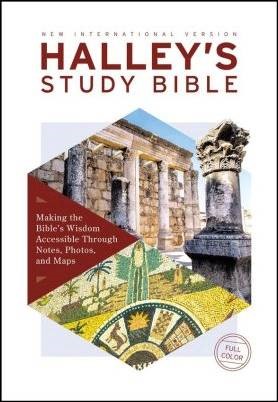
I believe Halley’s Bible Handbook may have been the first Bible study resource I got my hands on when I was a pre-teen. It was a slender book but packed with insights that even this third-generation Pentecostal boy hadn’t heard before. So I was quite intrigued when I heard about Halley’s Study Bible. 

Let me get something out of the way right upfront. I’m a blogger for the BibleGateway Blogger Grid (sometimes called #bgbg2 on Twitter), so I’m occasionally offered a free book in exchange for my honest book review. However, there are more books that I pass on than books I agree to review. Since I am already working my way through the Faithlife Illustrated Study Bible, I wasn’t too eager to dive into another study Bible just yet. But I’m so glad I did! 

Reading Henry Halley’s concise overview of each book of the Bible was nostalgic for me, reminding me of what initially intrigued about his handbook: taking voluminous information and giving such a clear, concise overview. 

The study notes on each page offer fascinating insights, and the unique perspective Halley offers of the people, places, and practices chronicled in the pages of Scripture are unparalleled. And what I especially appreciate is Halley’s whole-Bible approach. By that, I mean his ability to show you a theme that originates in the Old Testament and finds its fulfillment in the New Testament, showing how all of the Bible is interconnected. 

If you are looking for a new way to study your Bible, I highly recommend Halley’s Study Bible to you. 

I am a HarperCollins book reviewer. 

Thursdays With Spurgeon—In Pursuit Of Truth

This is a weekly series with things I’m reading and pondering from Charles Spurgeon. You can read the original seed thought here, or type “Thursdays With Spurgeon” in the search box to read more entries.

In Pursuit Of Truth 

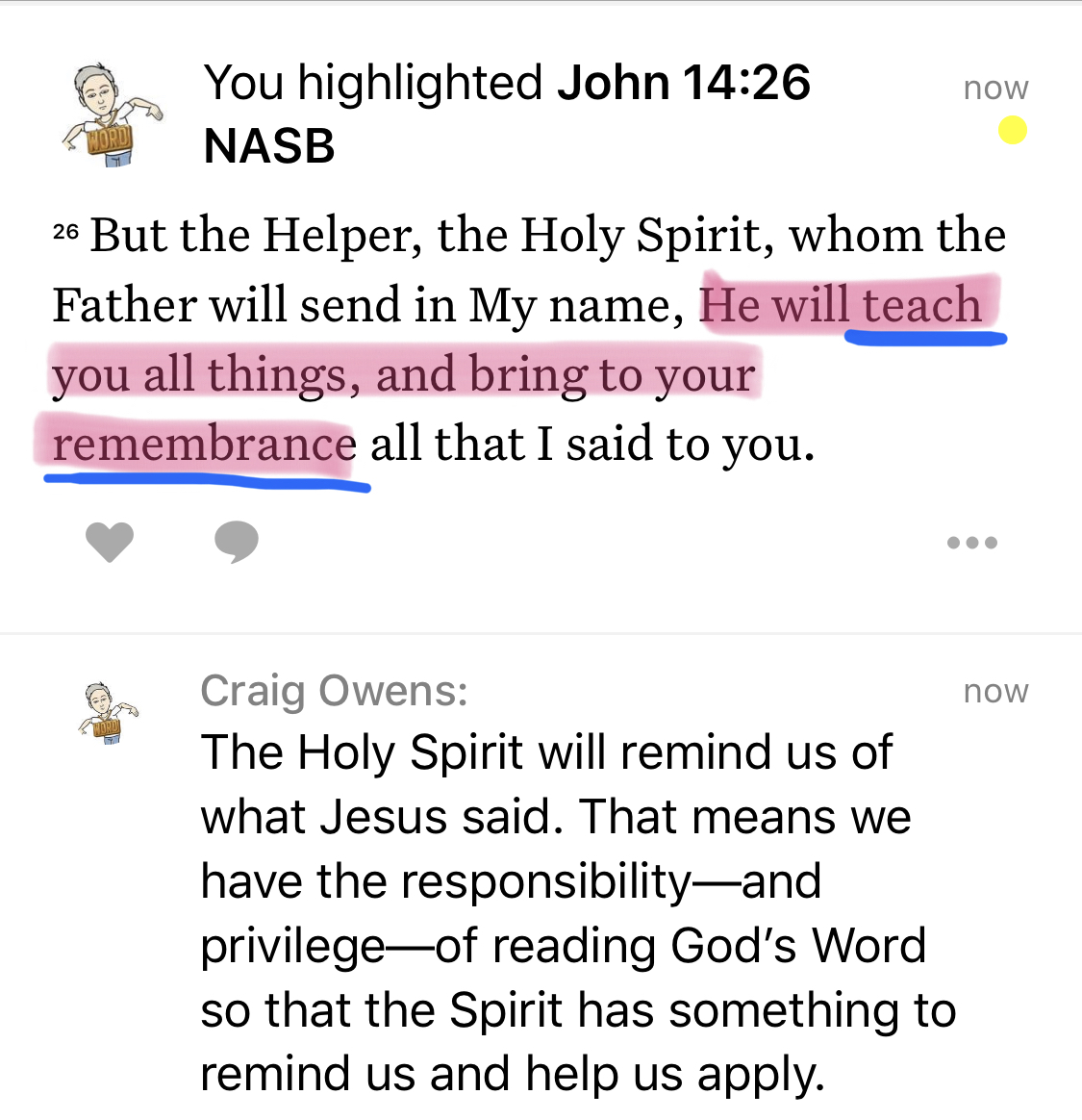
     The disciples had been instructed concerning certain elementary doctrines by Christ, but He did not teach His disciples more than what we should call the ABCs of religion. He gives His reasons for this in the twelfth verse: ‘I still have many things to say to you, but you cannot bear them now’ [John 16:12]. His disciples were not possessors of the Spirit. They had the Spirit so far as the work of conversion was concerned, but not as to the matters of bright illumination, profound instruction, prophecy, and inspiration. Jesus says, ‘I am now about to depart, and when I go from you, I will send the Comforter to you. You cannot bear these things now. Howbeit, when He, the Spirit of truth, is come, He will guide you into all truth’ [John 16:13]. The same promise that He made to His apostles stands good to all His children. …  

     We think it is right that the Christian ministry should be not only arousing but instructing, not merely awakening but enlightening, that it should appeal not only to the passions but to the understanding. We are far from thinking doctrinal knowledge to be of secondary importance. We believe it to be one of the first things in the Christian life, to know the truth and then to practice it. …  

     What we call curiosity is something given us of God impelling us to search into the knowledge of natural things. That curiosity, sanctified by the Spirit, is also brought to bear in matters of heavenly science and celestial wisdom. … A true Christian is always intently reading and searching the Scriptures that he may be able to certify himself as to its main and cardinal truths. …  

     Depend on this: The more you know of God’s truth, all things being equal, the more comfortable you will be as a Christian. …  

     Knowledge of truth will make us very serviceable in this world. We will be skillful physicians who know how to take the poor distressed soul aside, to put the finger on his eye and take the scale off for him that heaven’s light may comfort him. … There is nothing like the real truth and the whole truth to make a man useful.  

From The Holy Spirit: The Great Teacher 

Throughout the public ministry of Jesus, the Gospels tell us of His apostles simply not understanding that Jesus was fulfilling Old Testament prophecy in all that He was doing. But all of that changed after the Day of Pentecost when then followers of Jesus were baptized in the Holy Spirit! 

Beginning with Peter’s sermon on the Day of Pentecost and throughout the rest of the New Testament, we see how the Christians took Old Testament Scriptures and applied them in the new understanding the Holy Spirit gave them of the work of Jesus. As a result, radical changes began to take place not only within the Church but throughout society as well. 

As Spurgeon noted, “The same promise that He made to His apostles stands good to all His children.” That promise of the Holy Spirit’s empowerment, illumination, creativity, and application of Scripture is still available for all Christians today! 

Don’t limit your Christian testimony or your effectiveness in the world by keeping the Holy Spirit relegated to some unknowable, mysterious work. Allow Him to be the driving force in all that you think and do! 

I have a whole series of messages on the power of Pentecostal Christians you can read by clicking here and here.

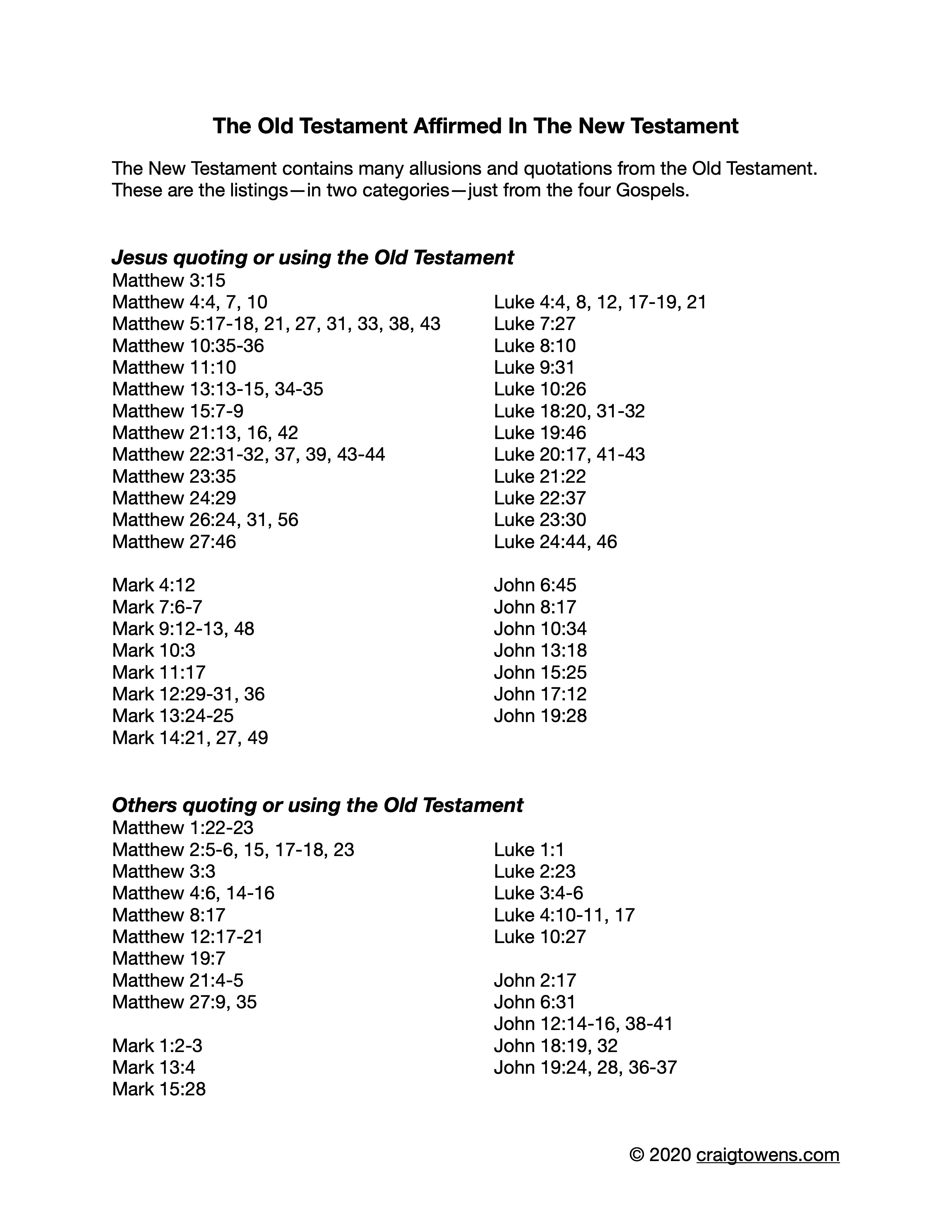
The Old Testament Affirmed In The New Testament

(click image for a larger view)

Sometimes, instead of referring to the two major divisions of the Bible as the Old Testament and the New Testament, I prefer to use the First Testament and the Second Testament. This helps me remember that “Old” doesn’t mean outdated and “New” doesn’t mean forgetting what came before it. 

I love how B.B. Warfield describes the First Testament as being like a mansion with richly-decorated, beautifully-ornate rooms, but which are dimly lit. With Christ’s Advent described in the Second Testament, the light is turned on and we can now appreciate the beauty that was always there! 

Sadly, there are far too many people who see the two divisions of the Bible as separate. In reality, the First Testament is affirmed over and over again in the Second Testament. In fulfilled prophesy alone, there is an abundance of evidence! 

But let’s get even more obvious: In just the four Gospels there are at least 100 direct mentions or quotations of passages from the Old Testament. Clearly, both Jesus and the Gospel writers saw the First Testament as an integral part of Christ’s ministry. 

Check out this list that I compiled and look up the references for yourself (a great place to look up Scriptures is on BibleGateway.com). 

If you would like to download a PDF version of this list, click here → Old Testament affirmed in the New Testament ← If you would like to use this document in a teaching session, just be sure to mention that you downloaded it from craigtowens.com. Thanks! 

More resource for your Bible study: 

“Alas!” To “Aha!”

Listen to the podcast of this post by clicking on the player below, and you can also subscribe on AppleSpotify, or Audible.

…oh no… (2 Kings 6:5, 15). 

The words “Oh no!” are actually a single word in the Hebrew language (Hebrew: ‘ahahh) that has been transliterated into English as “Aha!” 

But I think the old English translation is better in this context: ALAS! 

ALAS is usually a painful realization of the situation, not a cry of enlightened discovery. Here are the other times that this Hebrew/English word for ALAS! is used: 

  • Joshua said it after his army was defeated at Ai 
  • Gideon said it after realizing he had been face-to-face with God 
  • Jephtha cried it out after he knew that his daughter would have to be sacrificed
  • King Joram uttered this when he realized his troops and animals had no water in the desert 
  • Jeremiah said this to God after he was called to be a prophet, and after he was asked by God to speak countercultural words (he actually said ALAS! four times!) 
  • Ezekiel also cried out ALAS! four times when God asked him to do or to watch difficult things 
  • Joel cried it out when he saw the Day of the Lord quickly approaching 

(check out the above references by clicking here) 

In all of these ALAS! painful moments, these men were at their wits’ end, at the end of their own abilities—they couldn’t do anything to help themselves. 

In all of these ALAS! moments, they came to just one important realization: Only Yahweh can help me. That realization is truly the AHA! of an enlightened discovery! 

Calling on God turns a painful ALAS! moment into a God-glorifying AHA! moment. God alone can provide where no one else can.

Don’t despair in the ALAS! times, but cry it out loud to the only One who can help you, and then watch to see how He alone will turn your situation into a defining, God-glorifying AHA! testimony. 

►► Would you please prayerfully consider supporting this ministry? ◀︎◀︎

Thursdays With Spurgeon—Be A Reflector

This is a weekly series with things I’m reading and pondering from Charles Spurgeon. You can read the original seed thought here, or type “Thursdays With Spurgeon” in the search box to read more entries.

Be A Reflector 

For it is the God who commanded light to shine out of darkness, who has shone in our hearts to give the light of the knowledge of the glory of God in the face of Jesus Christ. (2 Corinthians 4:6) 

     It is by the heart that we know God and Christ, and as our affections are purified, we become sensible of God’s presence in Christ. … Our beholding Him has purified the eyes that have gazed upon His purity. His brightness has helped our eyesight so that we see much already and will yet see more. …  

     Why did not everybody see the glory of God in Jesus Christ when He was here? It was conspicuous enough. Answer: It matters not how brightly the sun shines among blind men. … What, then, has happened to us? To eternal grace be endless praise! God Himself has shined into our hearts. That same God who said, ‘Light be,’ and light was, has shined into our hearts! … If you can delight in God in Christ Jesus, then remember, no man can say that Jesus is the Christ but by the Holy Spirit, and you have said it [Matthew 16:13-17]! …  

     You must not hoard up the light within yourself—it will not be light to you if you do. Only think of a person when his room is full of sunlight saying to his servant, ‘Quick, now! Close the shutters and let us keep this precious light to ourselves.’ Your room will be in the dark, my friend! … 

     A man of God, when he receives the light of Christ, can become so perfect a reflector that to common eyes, at any rate, he is brightness itself! … Scatter your light in all unselfishness. Wish to shine, not that others may say, ‘How great he is,’ but that they, getting the light, may rejoice in the Source from which it came to you and to them.

From The Glory Of God In The Face Of Jesus Christ

As the old hymn reminds us, “’Twas grace that taught my heart to fear, and grace my fears relieved; how precious did that grace appear the hour I first believed.” It is by God’s grace alone that we have been given light to see Jesus and to place our faith in Him! 

That light continues to grow within us the longer we gaze at the glory of God in the face of Jesus. Immerse yourself in the Gospels. Don’t read your Bible just to know the Word of God, but read to get to know the God of the Word better. Let the Holy Spirit purify your vision. 

Then you will become a reflector of God’s glory. The love and light of God are too wonderful to hoard to yourself! Ask God to bless you with a greater capacity to reflect the light of His Son to a dark, groping world.


The EGO That God Blesses

Have you ever noticed that it seems a lot easier to say, “God bless you” than it does to say, “God bless me”? Why is that? 

Do I feel unworthy of His blessing? If I am a Christian, I need to remind myself that I am in Christ, and He is in me, and He has brought me into the Father. This means that I am as blessed as the Father blesses the Son (John 14:20; Ephesians 1:3-6). God is blessed by our being blessed! 

Or perhaps I feel that “God bless me” is an arrogant prayer, while saying “God bless you” is a humble prayer. There is an EGO that God always blesses, and He delights to show us what that is!   

In Hebrew literature, the key point is found in the middle of a poem or story. In Psalm 67, that would make the middle verse: May the nations be glad and sing for joy, for You rule the peoples justly and guide the nations of the earth. Selah. (v. 4)

The nations rejoice because God judges fairly and God guides the nations. Selah—pause and take that in. The natural attitude is actually a God-negative attitude—“I prefer to be in charge … I don’t like anyone telling me what to do!” But the unnatural attitude is a God-positive attitude—“I trust God more than I trust me, so I’m glad He is in charge … I trust God to judge justly more than I trust world institutions, so I’m glad He is the final Judge!” 

This is very good news: Only God can rule and judge correctly! Men have biases and agendas; men are selfish and self-seeking; men seek their own glory and their own advancement. So the psalmist wants us to Selah/pause to remember that only God can lead and judge in a way that brings Him glory and brings us blessing. God is blessed by our being blessed! 

Working outward from verse 4, we see verses 3 and 5 are identical, teaching us that our God-honoring desire should be for all peoples in all nations to experience the blessing of an intimate relationship with God. 

A similar theme is sounded in the “bookend” verses of 1-2 and 6-7: We are asking God to bless us so that “all the ends of the earth will fear Him.” Once again we Selah/pause to consider this: Do I have the right EGO to request this blessing? Remember: There is an EGO that God always blesses.  

In his book Lead Like Jesus, Ken Blanchard identifies two types of E.G.O.s in our relationship with God:

  • Negative E.G.O.—Edging God Out 
  • Positive E.G.O.—Exalting God Only

The negative EGO says things like, “Bless me” and “Shine on me.” The positive EGO says, “Bless me so that I can be a blessing to others” and “Shine Your light on me so that others will see You.” 

Jesus told us to not let the light of our life be hidden. We are blessed by God so that we can be a blessing to all of the peoples in all of the nations. We desire that all may know the joy of serving a Righteous King. We want everyone to know the praise that comes from Exalting God Only. 

Oh God, be merciful to me. Cause Your face to shine on me. Bless me indeed so that I may teach others to fear You, so that they may come to know You as their All-Righteous, Good, and Loving King! 

If you have missed any of the messages in this series exploring the Selahs in the Psalms, you can find the full list of messages by clicking here. 

Thursdays With Spurgeon—Seeing God In Jesus

This is a weekly series with things I’m reading and pondering from Charles Spurgeon. You can read the original seed thought here, or type “Thursdays With Spurgeon” in the search box to read more entries.

Seeing God In Jesus 

For it is the God who commanded light to shine out of darkness, who has shone in our hearts to give the light of the knowledge of the glory of God in the face of Jesus Christ. (2 Corinthians 4:6) 

     Paul knew not merely God, but God in Christ Jesus! Not merely ‘the glory of God,’ but ‘the glory of God in the face of Jesus Christ’ (2 Corinthians 4:6). The knowledge dealt with God, but it was Christward knowledge! He pined not for a Christless theism but for God in Christ! This, beloved, is the one thing that you and I should aim to know. …  

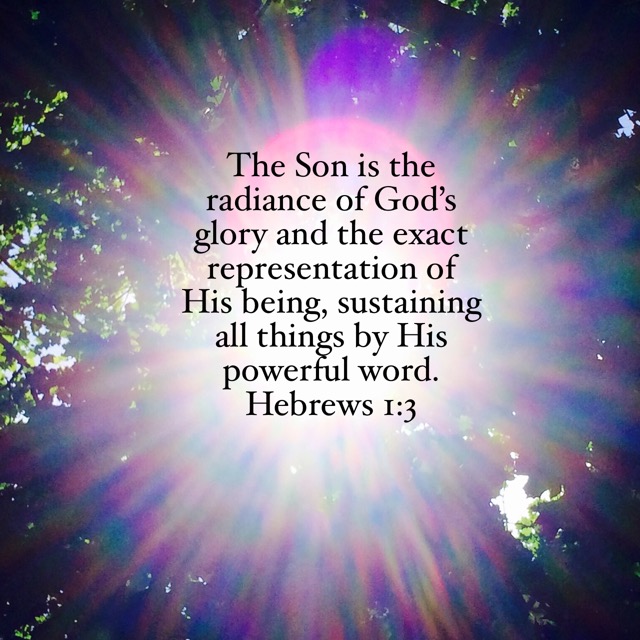
     Even when your thought sweeps round the stars and circumnavigates space, you feel that heaven, even the heaven of heavens, cannot contain Him. Everything conceivable falls short of the inconceivable glory of God! When you come, however, to gaze upon the face of Christ Jesus, how different is the feeling! Now you have a mirror equal to the reflection of the eternal Face, ‘in Him dwells in the fullness of the Godhead bodily’ (Colossians 2:9). His name is ‘Wonderful, Counselor, Mighty God’ (Isaiah 9:6). He is the image of God, ‘the brightness of His glory and the express image of His person’ (Hebrews 1:3). If your conception of Christ is truthful, it will coincide with the true idea of God and you will exclaim, ‘This is the true God and eternal life’ (1 John 5:20). Like Thomas, you will salute the wounded Savior with the cry, ‘My Lord and my God!’ (John 20:28). …  

     How softly breaks the divine glory through the human life of Jesus; a babe in grace may gaze upon this brightness without fear! When Moses’ face shone, the people could not look at him, but when Jesus came from His transfiguration, the people ran to Him and saluted Him! Everything is attractive in God in Christ Jesus! In Him we see God to the fullest, but the Deity so mildly beams through the medium of human flesh that mortal man may draw near and look and live. 

From The Glory Of God In The Face Of Jesus Christ

If you would like to know God more intimately, look more closely at Jesus. 

Read through the Gospels slowly, focusing on what Jesus was saying and doing. Let the Holy Spirit transport you to those dusty Israelite roads, where you can walk with Jesus and get a new glimpse of the majestic glory of God.

Trespassers

Psalm 59 is the prequel to David being betrayed by the Ziphites as well as the incident in the cave between himself and King Saul. 

This psalm is also called an imprecatory psalm, which is the theological way of saying, “Get ‘em, God!” Since King Saul has sent assassins to try to kill David, you can understand why David is praying this way. But I sort of wonder why he inserts a Selah pause after two rather angry-sounding sentences in verses 5 and 13. 

When we are reading—or even praying—an imprecatory prayer, here are some important things to keep in mind: 

  • This prayer is inspired by the Holy Spirit. All of the words in the prayer, including the Selah pauses, are directed by the Holy Spirit. Getting our angry thoughts out in God’s presence is the safest place to vent. 
  • This is a prayer for justice because an injustice has been done, not just a prayer because David is upset with someone. 
  • Since this prayer says, “Get ‘em, God,” it’s a prayer that turns matters over to God as the Ultimate Judge, taking the judgment out of my hands. 

Really this is a prayer that seeks to balance something vital: The desire to see evil punished while at the same time desiring to see all evildoers come to salvation. 

Think of it this way: When I sin, do I want to meet a God of justice or a God of mercy? Since we are to treat others the way that we would want to be treated, if I want to receive God’s mercy, I have to desire that for others too. Even those evildoers who have hurt me. 

David’s first Selah pause comes after saying that he is innocent of any offense or wrongdoing. When we pray an imprecatory prayer, we would do well to ask the Holy Spirit to search our hearts to reveal any trespasses we have committed (see Psalm 19:12-13; 139:23-24). 

David’s second Selah pause comes after he says, “Then it will be known to the ends of the earth that God rules over Jacob.” Is my “Get ‘em, God” prayer a desire for me to be seen as the overcomer or for God to be seen as glorious? 

As long as my focus is on my trespassers, my focus is off my God. 

I cannot be consumed by thoughts of “them” because then I rob myself of thoughts of Him! 

So when you get angry enough at someone who has trespassed against you that you want to pray a “Get ‘em, God” prayer, Selah pause and pray, “Holy Spirit… 

  • …show me my trespasses; 
  • …help me forgive my trespassers; and
  • …help me to focus on my God, and not on my trespassers or my forgiven trespasses.” 

If you have missed any of the other messages in our Selah series, you can find links to all of them listed here. 

Thursdays With Spurgeon—Stick To The Revealed Word Of God

This is a weekly series with things I’m reading and pondering from Charles Spurgeon. You can read the original seed thought here, or type “Thursdays With Spurgeon” in the search box to read more entries.

Stick To The Revealed Word Of God

Remember your leaders, who spoke the Word of God to you. Consider the outcome of their way of life and imitate their faith. Jesus Christ is the same yesterday and today and forever. Do not be carried away by all kinds of strange teachings. It is good for our hearts to be strengthened by grace, not by eating ceremonial foods, which is of no benefit to those who do so. (Hebrews 13:7-9) 

     From the connection it is evident that our text refers to the teaching of Christ, who is ‘the same yesterday, today, and forever.’ This is not according to the so-called development folly. Theology, like every other science, is to grow, watered by the splendid wisdom of this enlightened age, fostered by the superlative ability of the gentlemen of light and leading of the present time, so much superior to all who came before them! 

     We think not so, brothers and sisters, for the Lord Jesus Christ was the perfect revelation of God. … In previous ages, God has spoken to us by His prophets, but in these last days He has spoken to us by His Son [Hebrews 1:1-2]. Now as to that which was a complete revelation, it is blasphemous to suppose that there can be any more revealed than has been made known in the Person and work of Jesus Christ, the Son of God! … And as He shuts up the book that contains the written revelation, He bids you never dare to take from it, lest He should take your name out of the Book of Life! And never dare to add to it, lest He should add to you the plagues that are written in this book [Revelation 22:18-19]!

From The Unchangeable Christ 

BEWARE when someone tells you they have discovered some new revelation from God that they—and they alone—have uncovered. God’s Word doesn’t need anyone’s “help.” 

But DO pray before you read the Bible to ask the same Holy Spirit that inspired the Word of God to now illuminate it to your mind as you read and study. 

(P.S. Oswald Chambers had some sobering words about false prophets.)


Thursdays With Spurgeon—Thoughtful Meditation And Application

This is a weekly series with things I’m reading and pondering from Charles Spurgeon. You can read the original seed thought here, or type “Thursdays With Spurgeon” in the search box to read more entries.

Thoughtful Meditation And Application

Remember your leaders, who spoke the word of God to you. Consider the outcome of their way of life and imitate their faith. Jesus Christ is the same yesterday and today and forever. (Hebrews 13:7-8) 

     Observe, then, that God’s people are a thoughtful people. If they are what they are to be, they do a great deal of remembering and considering. … I wish, in these days, that professing Christians remembered and considered a great deal more, but we live in such a flurry, hurry, and worry, that we do not give time for thought. …  

     Our great Master never aimed at originality—He said that He did not even speak His own words, but the words that He had heard of His Father [John 12:49]. He was docile and teachable. As the Son of God and the Servant of God, His ears were open to hear the instructions of the Father, and He could say, ‘I always do those things that please Him’ (John 8:29). … 

     There is no difference whatever in the relationship of the Lord Jesus Christ to His people at this time! He is just as ready to comfort us tonight as He was to comfort those with whom He dwelt when here below! Sister Mary, He is as willing to come down to your Bethany and help you in your sorrow about Lazarus as He was when He came to Martha and Mary whom He loved! Jesus Christ is just as ready to wash your feet, my brother, after another day’s weary travel through the foul ways of this world. He is as willing to take the basin and the towel and to give us a loving cleansing as He was when He washed His disciples’ feet! Just what He was to them, He is to us! Happy is it if you and I can truly say, ‘What He was to Peter, what He was to John, what He was to Magdalene, that is Jesus Christ to me—the same yesterday, today, and forever.’ 

From The Unchangeable Christ 

If Charles Spurgeon thought the 19th century was a time of “flurry, hurry, and worry,” what adjectives might describe the supersonic, multi-tasking, get-everything-done-now 21st century?! 

Today, more than ever, we need to take time to reflect on God’s Word. Read it slowly. Put yourself in the story. What would you have observed if you were there? What would you have felt? Look around at the others who were there: how would they have perceived what was happening? 

You don’t meditate on God’s Word so that you can find something original, but you meditate so that the Holy Spirit can reveal the original truths that are already there! The Holy Spirit can show you how to apply the Bible to your life, if you will only slow down to give Him time to do so. 

Don’t race through your Bible reading time—slow down and take it all in. Then let the Holy Spirit work out what He has helped you put in your heart and mind.