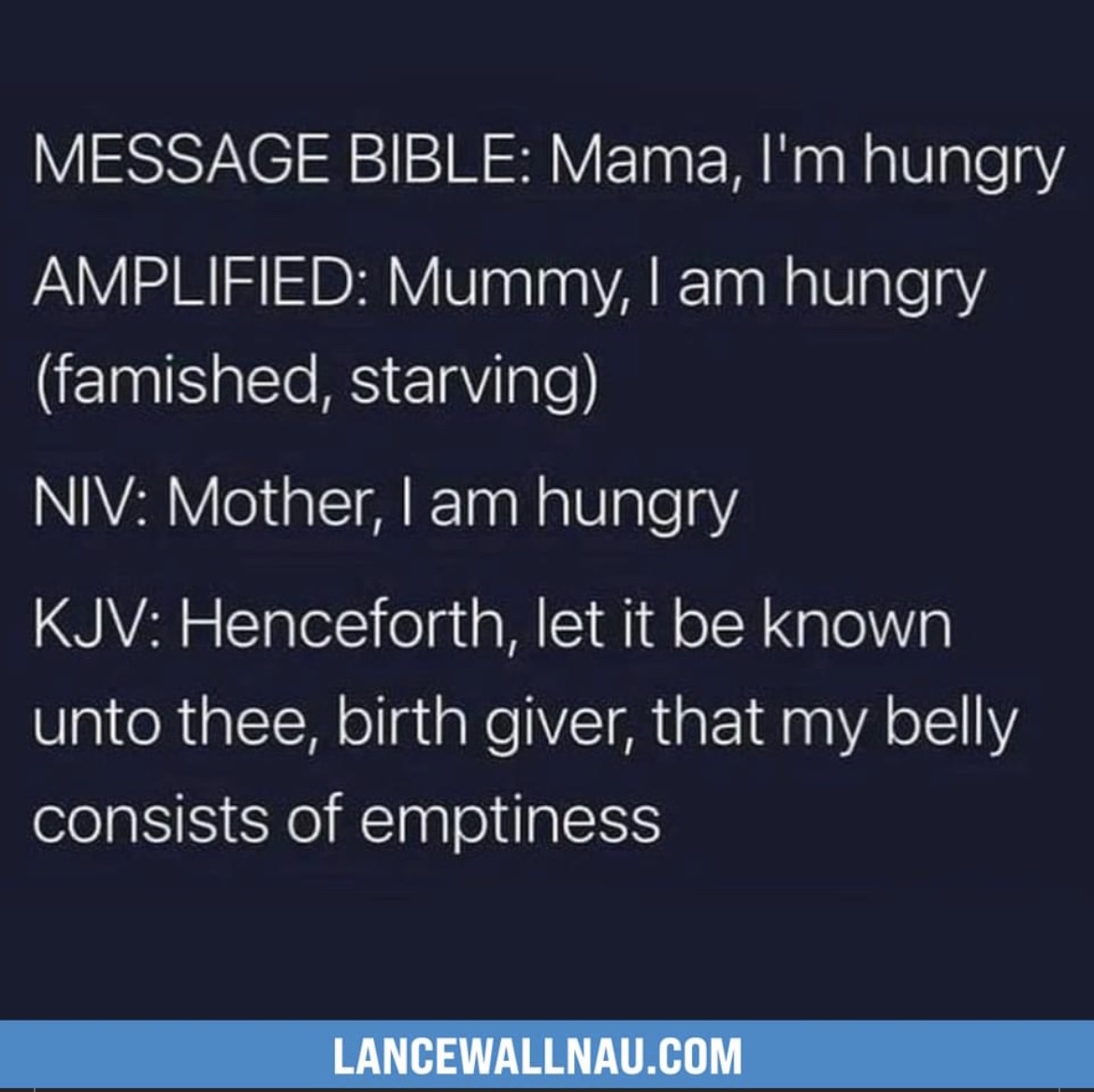
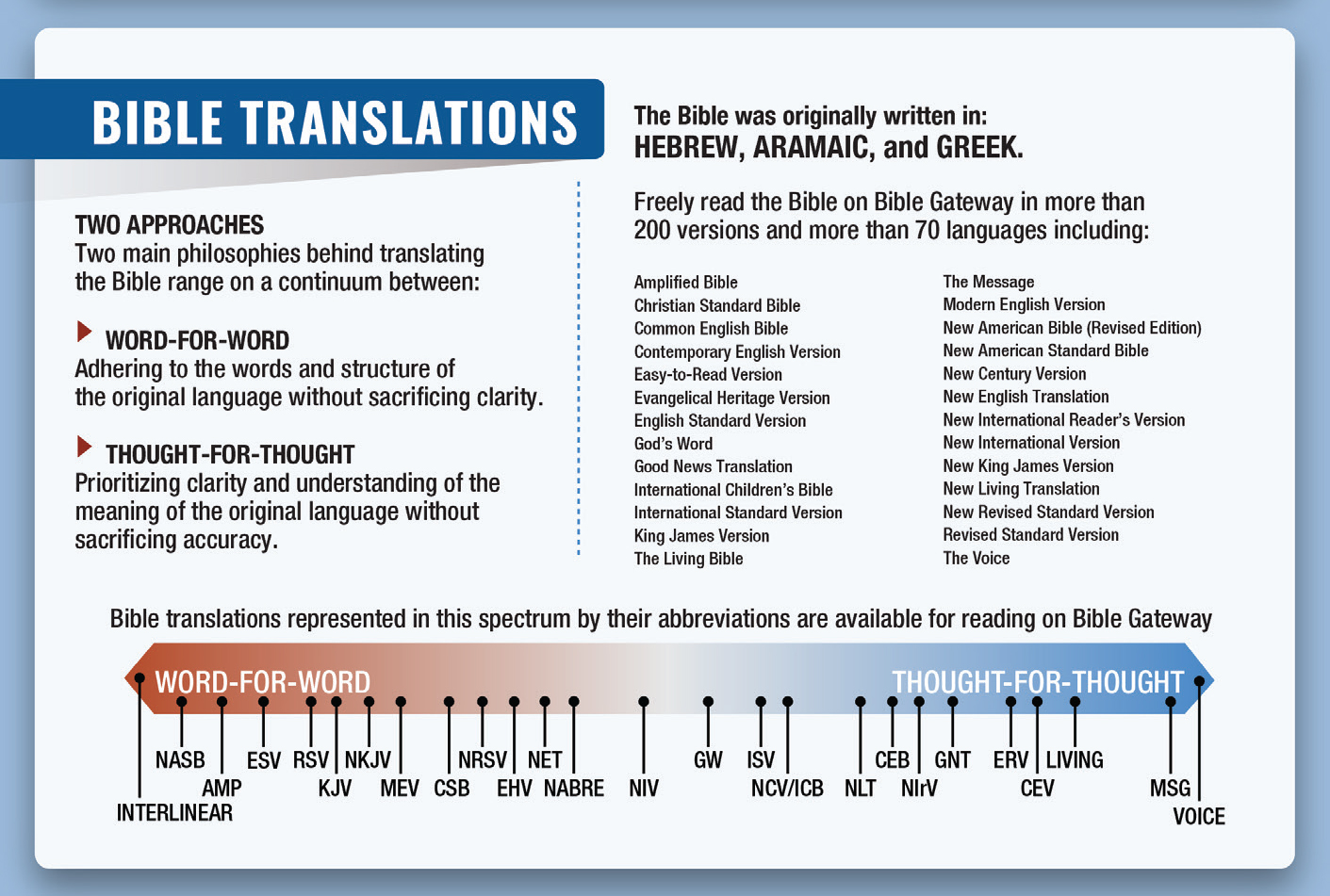
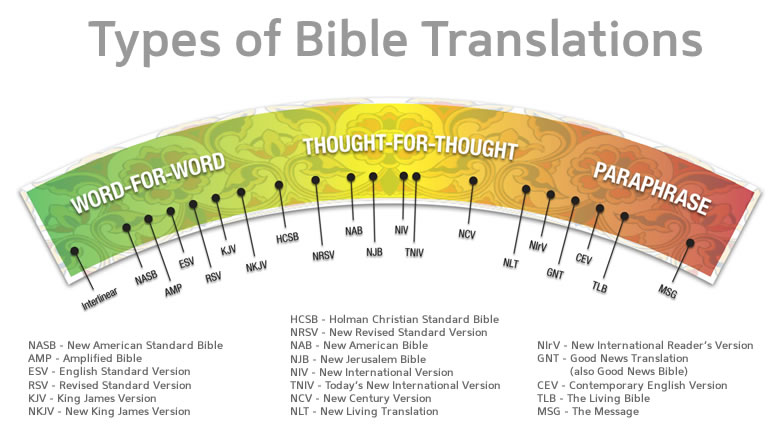
There are so many quality translations of the Bible to help us read God’s Word profitably, but many people ask me about the origin of each of these translations. I have shared three views of biblical translations below—two serious and one comical way of looking at them.
They only caution I would point out is a translation or paraphrase that is from a single person’s point of view. The Bible itself talks about success that comes from the combined wisdom of counselors, so a single-person paraphrase does open itself up more to the author’s whims than to true scholarship.
“Love of the Word appears preeminently in our Lord and Savior Jesus Christ. He read it publicly. He quoted it continually. He expounded it frequently. He advised the Jews to search it. He used it as His weapon to resist the devil. He repeatedly said, ‘The Scripture must be fulfilled.’ Almost the last thing He did was to ‘open their minds so they could understand the Scriptures’ (Luke 24:45). I am afraid that man cannot be a true servant of Christ, who has not something of his Master’s mind and feeling towards the Bible.” —J.C. Ryle, Bible Reading
“The character of our praying will determine the character of our preaching. Light praying will make light preaching. …The preacher must be preeminently a man of prayer. His heart must graduate in the school of prayer. In the school of prayer only can the heart learn to preach.” —E.M. Bounds, Power Through Prayer
“Some pastors and preachers are lazy and no good. They do not pray; they do not read; they do not search the Scripture. … The call is: watch, study, attend to reading. In truth you cannot read too much in Scripture; and what you read you cannot read too carefully, and what you read carefully you cannot understand too well, and what you understand well you cannot teach too well, and what you teach well you cannot live too well. … The devil … the world … and our flesh are raging and raving against us. Therefore, dear sirs and brothers, pastors and preachers, pray, read, study, be diligent.” —Martin Luther
Listen to the podcast of this post by clicking on the player below, and you can also subscribe on Apple, Spotify, or Audible.
Go down to the potter’s house, and there I will give you My message (God speaking to Jeremiah).
Jesus was masterful in using visual illustrations—common, everyday things—to illustrate the biblical truth He wanted to teach. God does the same thing with Jeremiah.
God instructs Jeremiah to simply go to the potter’s house and watch. Jeremiah obeyed: “I went down to the potter’s house, and I saw him working” (v. 3). It was after taking in this scene that God could speak to Jeremiah a sermon illustration. Jeremiah says, “Then the word of the Lord came to me” (v. 5).
Not only did God help Jeremiah prepare his sermon with a visual illustration, but God also prepared Jeremiah for the follow up conversation. God knew how the people would respond to Jeremiah’s message, and He again gave him the words to speak ahead of time (vv. 12-17).
God knows His sheep better than we do. He knows what they need to hear, and how best to make His message stick. Jesus said,
“I have never spoken on My own authority or of My own accord or as self-appointed, but the Father Who sent Me has Himself given Me orders concerning what to say and what to tell. And I know that His commandment means eternal life. So whatever I speak, I am saying exactly what My Father has told Me to say and in accordance with His instructions.” (John 12:49-50 AMP)
We pastors and evangelists dare not try to prepare a message on our own!
Samuel Johnson prayed something that I pray every time I sit down to prepare a sermon: “Almighty God, my Heavenly Father, without Whose help labor is useless, without Whose light search is in vain, invigorate my studies.”
Seeking God’s help in our sermon preparation should be our very first action every single time.
Listen to the podcast of this post by clicking on the player below, and you can also subscribe on Apple, Spotify, or Audible.
I love reading, and I love sharing my love of good books with others! Here is a list of the books I read and reviewed in 2021. Click on a title to be taken to that review.
But let’s look at this from another angle: Before there was an Old Testament and a New Testament, what did those who lived in the days of Jesus call what we now refer to as “the Old Testament”? They called it Scripture.
Here’s a clip from a recent sermon where I discuss more in-depth why our New Testament is really the best commentary we have on the Old Testament:
I invite you to check out a couple of other resources:
Listen to the podcast of this post by clicking on the player below, and you can also subscribe on Apple, Spotify, or Audible.
Proverbs 10 begins with these words, “The proverbs of Solomon…” (Proverbs 10:1).
Over the next six chapters (184 verses) Solomon generously employs the contrasting conjunction “but” 144 times—that’s nearly 80 percent of these verses! He clearly tells us the blessings of trusting God’s wisdom contrasted with the pitfalls of trusting our own wits.
I am also intrigued by the 21 verses where Solomon uses the amplifying conjunction “and.” These proverbs give us either the double advantage of leaning into God’s wisdom, or the double whammy of trying to do it our own way.
I’ll let you read through these six chapters and notice the contrasting conjunction “but” for yourself, but in this blog post I want to especially direct your attention to some of the “and” statements. I’ve listed these in three categories.
(1) The double whammies—
malicious people cause grief to others AND ruin to themselves (10:10)
trusting mortals is short-lived AND self-defeating (11:7)
a quick-tempered person does foolish things AND is hated (14:17)
(2) The double blessings—
a generous person prospers AND is refreshed (11:25)
a righteous life is a blessed life now AND an eternal life forever (12:28)
fearing God brings security for you AND gives your children a sure refuge (14:26)
(3) And these mixed proverbs using both a whammy and a blessing—
a righteous person is rescued from trouble AND it falls on the wicked instead (11:8)
a prudent person is praised AND the one with a warped mind is despised (12:8)
evildoers are trapped in their own evil AND innocent people escape evil (12:13)
There is so much wisdom to be gleaned not only in these words of Solomon, but throughout the entire Bible. Take your time and soak it in as you read the Scripture for yourself.
Here are some of the other posts I’ve shared that may help you in your Bible study time:
However you do it, and whatever tools you may use, get into your Bible every single day, and then let the Word of God get into you too. I can promise you this: Your time in God’s Word will absolutely change your life!
As regular readers of this blog probably know, on Saturdays I like to share poems that I have read during the week. One place I encounter poetry on a regular basis is in my daily Bible reading. But if you have read the Bible, no doubt you have discovered what I have discovered: ancient Hebrew poetry is very different from the poetry we usually read!
I found this helpful chart explaining the parallelism of Hebrew poetry in my Faithlife Illustrated Study Bible, and I thought you might benefit from it too.
If you would like to download this chart, I have shared it as a PDF here → Parallelism
My blog now has over 5300 posts (and growing!), and I wanted to find a way to make these posts more accessible to busy people. So this blog is now a podcast so you can listen while you’re on the go!
Listen to the podcast of this post by clicking on the player below, and you can also subscribe on Apple, Spotify, or Audible.
When the righteous thrive, the people rejoice… (Proverbs 29:2).
I have read hundreds of leadership books and biographies of history’s most influential leaders. But no book even comes close to the leadership principles I discover on an almost daily basis in my Bible. Without a doubt, my Bible is my go-to leadership Book!
A great place to start mining leadership principles is the book of Proverbs. Take time to study just one of the 31 chapters each day, and you will be astounded at the leadership insights you will have gleaned by the end of the month.
Take Proverbs 29 as an example. Reading through this chapter, I’m reminded that:
righteous leadership causes people to rejoice
a leader builds stability through consistent justice, but bribes or showing favoritism undermines a leader’s foundation
leaders who speak up for those without a voice of their own will continue to exert influence long after their tenure is over
wise leaders energize people when they share a compelling vision
justice comes through a righteous leader, but ultimate justice come from God
I even read an important warning for leaders who make it their goal to lead righteously: Bloodthirsty men hate a man of integrity and seek to kill the upright (v. 10).
But even on the heels of that warning I read this assurance to continue to lead righteously: Fear of man will prove to be a snare, but whoever trusts in the Lord is kept safe (v. 25).
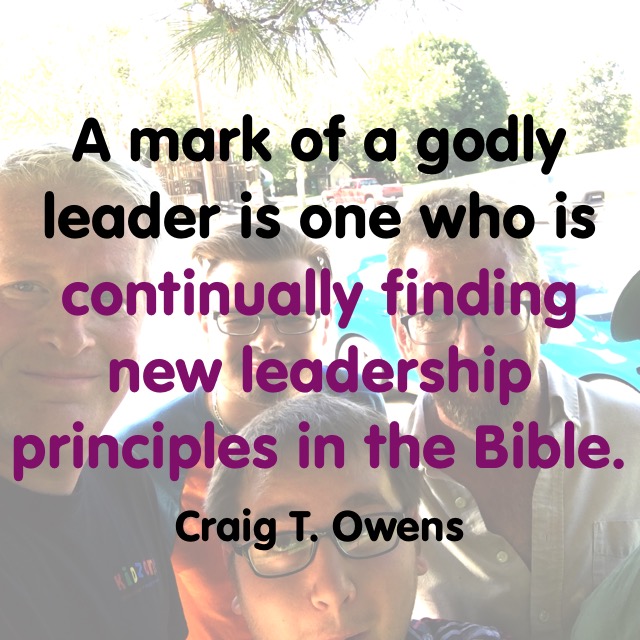
A mark of a godly leader is one who is continually finding new leadership principles in the Bible.
Try it for yourself and see how applying God’s wisdom will increase your influence as a leader.
This is part 58 in my series on godly leadership. You can check out all of my posts in this series by clicking here.
Sometimes the naming of things gives us an inaccurate picture of the thing being named. For instance, many people think the “old” in Old Testament means outdated or perhaps updated by the “new” in the New Testament. When in fact, both Testaments are needed to give us the full picture of God’s love and glory.
A similar thing happens with the headings “major prophets” and “minor prophets.” It makes it sound like the major prophets have something major to say to us, while we could take or leave the minor messages of the minor prophets.
In reality, they were given these headings simply because of the volume of writing—the five major prophets consist of 182 chapters, whereas the 12 minor prophets only have 67 chapters. The volume of their writing may be minor, but their content carries major messages of meteoric power!











 Craig T. Owens
The Best Commentary On The Old Testament
December 8, 2021 — Craig T. OwensListen to the podcast of this post by clicking on the player below, and you can also subscribe on Apple, Spotify, or Audible.
But let’s look at this from another angle: Before there was an Old Testament and a New Testament, what did those who lived in the days of Jesus call what we now refer to as “the Old Testament”? They called it Scripture.
Here’s a clip from a recent sermon where I discuss more in-depth why our New Testament is really the best commentary we have on the Old Testament:
I invite you to check out a couple of other resources:
►► Would you please prayerfully consider supporting this ministry? ◀︎◀︎
Share this: