Keep me from lying to myself; give me the privilege of knowing your instructions. (Psalm 119:29 NLT)
We all have a tendency to judge others by what they said or did, but we usually judge ourselves by what we intended to say or do. This is the essence of self-deception: lying to ourselves.
In verse 18, the psalmist asks for his eyes to be open to the truth in God’s Word; in verse 29 the prayer is for him to see if he is truly applying that truth. We could personalize this prayer: “Give me the privilege of knowing that I am really applying Your instructions to my life.”
Give me understanding and I will obey Your instructions; I will put them into practice with all my heart (v. 34). May the Holy Spirit prompt me to do this today. Amen!
Listen to the podcast of this post by clicking on the player below, and you can also subscribe on Apple, Spotify, or Audible.
Jude calls Christians to contend for the faith without contention and without compromising the truth. Last week we learned that one of the first disciplines to help us do this is: Study God’s Word and then study it some more.
What do we mean by using the word “study”?
Paul counsels his friend and protege to study God’s Word (see 2 Timothy 2:15 in the KJV). But the word study (Greek: spoude) simply means diligence aimed at a goal. So what’s the goal? To contending for the truth (2 Timothy 2:14-18, 22-26). Jude is addressing a similar issue ( see Jude 4).
Just as Paul told Timothy to stick with “the Word of truth,” Jude says we need to be reminded of God’s Word (Jude 5).
Jude is writing to people who probably have first hand—maybe even eyewitness experience—knowledge. They have either heard it from someone who was right there, or perhaps from a friend who heard it from someone who was there. And yet, certain godless men have already slipped in among you and are teaching lies.
Jude goes back to Scripture (vv. 5-7):
Israelites delivered from Egypt rebelled against God and died in the wilderness
angels who were in God’s presence were expelled from heaven and await an eternity in hell
the residents of Sodom and Gomorrah experienced deliverance from Abraham but chose to debase themselves
Jude says, “In the very same way, these dreamers pollute their own bodies” (v. 8) by changing “the grace of our God into a license for immorality” (v. 4).
So we study the Scripture to apply it first to our own lives (James 1:22-25).
Jude uses four examples of people who knew the Word of God intimately, but in their pride wouldn’t apply it to themselves: Lucifer, Cain, Balaam, and Korah (vv. 9-11).
The devil—pride is what turned Lucifer into satan.
The way of Cain—God warned him about sin crouching at his door, but he ignored it.
Balaam’s error—he tried to calculate how close to disobeying he could get without actually disobeying because he wanted earthly rewards.
Korah’s rebellion—the Greek word for “rebellion” is antilogia: literally anti + Logos, or contradicting the Word of God.
Jesus warned the most learned men of His day against this (John 5:39-40) and we need to humbly receive God’s Word in order apply to our lives.
If I don’t diligently study the Scripture, I cannot apply it to my life and I am doomed to repeat the same fatal errors. I must study God’s Word diligently so that it can change me. Only then may I teach others (1 Timothy 1:3-7).
If you’ve missed any of the other messages in this series from the Book of Jude, you can find them all here.
Listen to the podcast of this post by clicking on the player below, and you can also subscribe on Apple, Spotify, or Audible.
The definition of salvation comes from Romans 10:9. When we believe in our heart that Jesus paid the penalty for our sins and we confess that with our mouth, we are now justified. I can now stand before God just as if I had never sinned. But the Christian life is more than merely going to heaven at some point. It’s about glorifying God and pointing others to Jesus while we’re on our way to heaven.
Paul wrote to saints in Corinth (1 Corinthians 1:2; 2 Corinthians 1:1) but he also called them “mere human beings” in 1 Corinthians 3:1-3. Paul points out that there is a difference between viewing this life from a worldly viewpoint and a biblical viewpoint (2 Corinthians 5:16).
A naturalistic world view is constantly shifting as new discoveries are made. A biblical worldview knows there is nothing new under the sun, that everything is addressed in Scripture.
In order to not view this world through the lens of “mere human beings” we have to read, study, meditate on, and apply the whole counsel of God’s Word. We put it in and the Holy Spirit helps us live it out. Just like our prescription glasses won’t do a thing to correct our vision of they aren’t on our face, Scripture won’t help us navigate this world in a God-glorifying way if we haven’t put it in our heart.
Each day before I ready my Bible I pray Psalm 119:18, which asks the Holy Spirit to open my eyes to the amazing things in Scripture. I read, I journal, and I pray over the passage that I have read. Then the Holy Spirit makes good application of that Scripture (John 14:26, 16:13; 1 John 4:6). I want to be sure to read the whole counsel of God’s Word, not just cherrypicking my favorite parts. And I always want to be going deeper (Hebrews 6:1).
One place that we see contrasting world views—the natural worldview versus the biblical worldview—is in 2 Timothy 2:14-19.
Natural worldview #1—quarreling about words
Biblical worldview #1—correctly handling the Word of truth
Natural worldview #2—engaging in godless chatter
Biblical worldview #2—standing on the firm foundation of Scripture
The results of a biblical worldview are amazing:
A sure foundation (Matthew 7:24-27)
The attention of others (Matthew 7:28-29)
Useful treasures to share with others (Matthew 13:52)
A strong defense against critics (Acts 6:9-10; Psalm 119:99)
Let’s not get stuck in the “mere human being” level of a natural worldview, but let’s commit to studying our Bibles diligently so that the Holy Spirit can develop a robust biblical worldview in us. This worldview is fruitful, joyful, and enhances our testimony.
Follow along with all the other messages in our series on B.A.S.I.C. Christianity by clicking here.
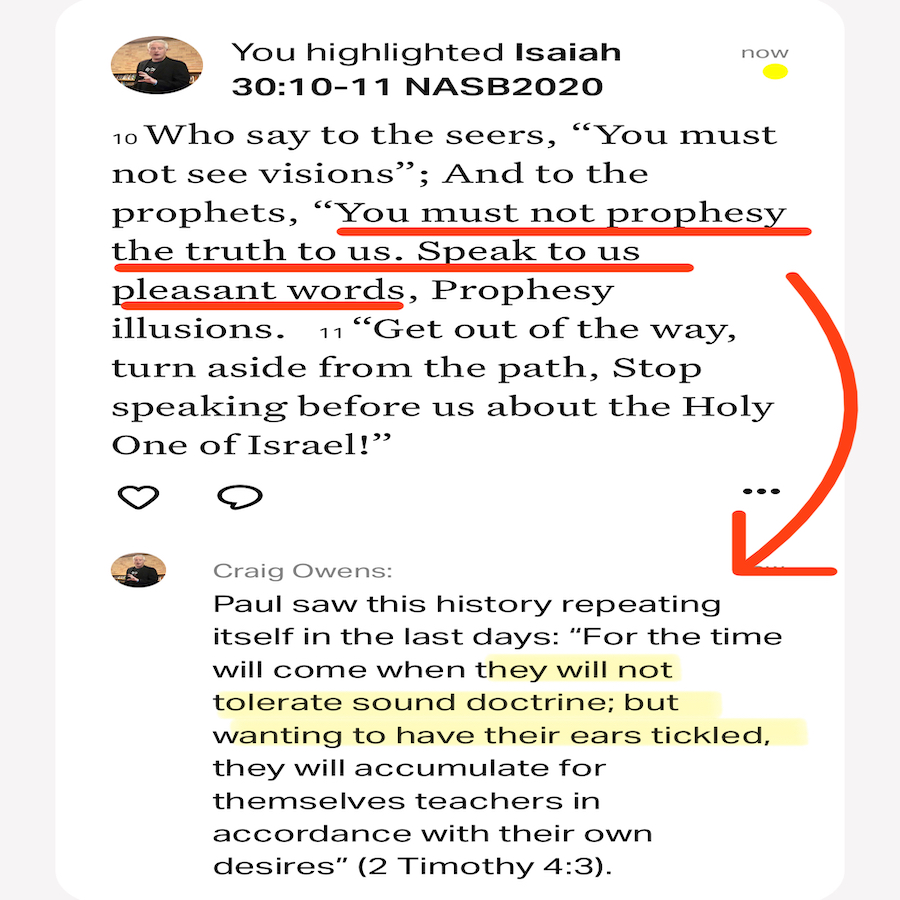
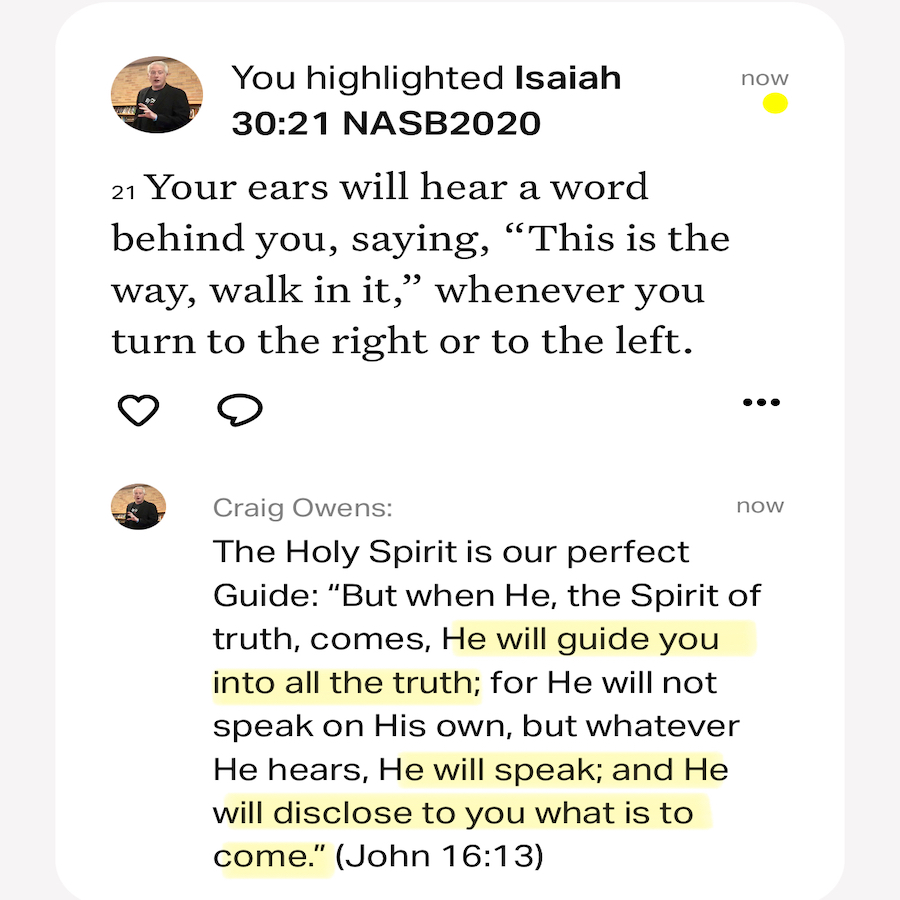
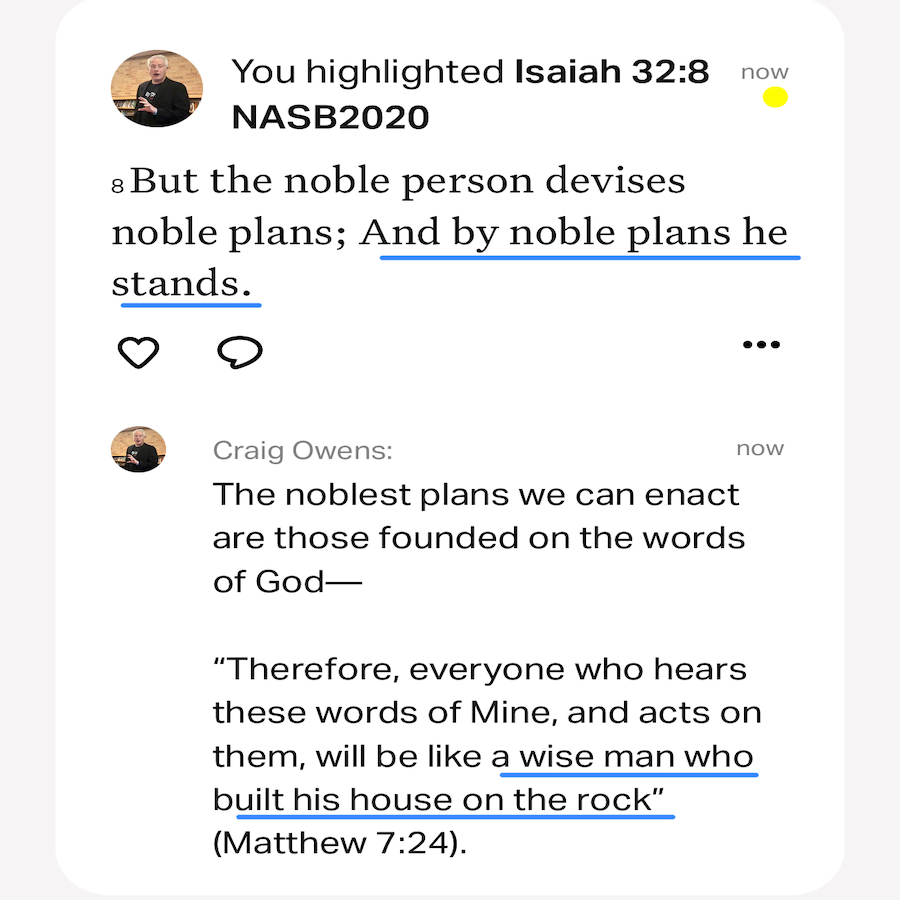
Something stood out to me quite clearly the other day as I highlighted several verses from Isaiah and was reminded of their complementary verses scattered throughout the New Testament. Always remember—
Listen to the podcast of this post by clicking on the player below, and you can also subscribe on Apple, Spotify, or Audible.
Last week I challenged you to free up some time in your schedule so that you could begin to apply these six spiritual disciplines we are going to discuss.
Let’s keep in mind why we are learning and working on these disciplines. The key phrase is “so that”: I’m going to get stronger so that I have something to give to others, so that they will have something to give to others (and to me), and on and on it goes. Each of us needs all of us, and all of us need each of us!
I love to read. In fact, I’m usually reading several books at the same time. Without a close second, my favorite book is my Bible. I say “my Bible” because I’ve made it mine—it’s underlined, circled, notated, and marked. It’s the Book I’m in every day, and it’s the Book that helps me glean the best knowledge from all the other books I read.
G.K. Chesterton, the famous British writer, was once invited to a meeting of the leading intellectuals in England. They were discussing what one book they would want to have with them if they were shipwrecked on an island. Everybody expected Chesterton to say, “My Bible.” But when it came to his turn to speak, Chesterton said, “If I were shipwrecked on a desert island, I’d like to have Thomas’s Guide to Practical Shipbuilding.”
Chesterton wasn’t saying the Bible wouldn’t have been of benefit to him on that island, but he was saying that those who study the Bible have the most practical insights! The Bible doesn’t just have lofty ideas, but it gives us heavenly wisdom that is highly practical to our everyday lives.
The first spiritual discipline we are considering in our series Saints Together is: Studying our Bible. Notice I didn’t say just to read the Bible, but to really study the Book of books.
The apostle Paul wrote, “So then faith comes by hearing, and hearing by the Word of God” (Romans 10:17). How do we know our faith is growing? It must be tested. Look at what James had to say about growing our faith—“the testing of your faith produces perseverance” (James 1:3).
Testing really comes down to this: Does what I believe work in my everyday life? Can I truly put what the Bible teaches me into action? James went a little deeper with this in James 2:17-19.
Allow me to share four indispensable components of our Bible study time. You will notice that for all of these components, I am giving you verses from the 119th chapter of the Psalms. This single chapter mentions God’s Word in every single one of its 176 verses. As an added bonus, this chapter is divided into twenty-two 8-verse sections. Scientists tell us that if you do anything for twenty-one days in a row, you will have gone a long way toward making it a permanent habit. So reading one section of Psalm 119 every day is a great place to start on this spiritual discipline of studying your Bible.
Here are the four components:
(1) Read the Word. You cannot study something you haven’t read. I would suggest you pray before reading (Psalm 119:18, 33). I’d also suggest you leverage the power of your brain using a well-worn path by setting aside the same time, same place, and same method of study every day.
(4) Live out the Word. Apply it by allowing it to make a change in your life. Notice the action words in Psalm 119:1-4: walk … keep … walk … fully obey…. Or as God said to Joshua—
“Keep this Book of the Law always on your lips; meditate on it day and night, so that you may be careful to do everything written in it. Then you will be prosperous and successful.” (Joshua 1:8)
This is how Jesus lived His life and it’s also how He said the Holy Spirit would help us live our lives in a God-glorifying way (John 12:49-50, 14:26).
Every day we should be living out the living Word of God!
Listen to the podcast of this post by clicking on the player below, and you can also subscribe on Apple, Spotify, or Audible.
Jesus began to speak to them in parables… (Mark 12:1).
What Jesus relates here in the 12th chapter of Mark’s Gospel is only the fourth parable that Mark records, and as the final parable that Jesus shares, it brings His public ministry to a close.
Jesus concludes this parable by quoting from Psalm 118. This Psalm is the last of the “Hallel Psalms” that were sung at the conclusion of the Passover celebration. This song specifically looks eagerly forward to the arrival of the Messiah. It contains the words that the crowd used on Palm Sunday: “Lord, save us! Lord, grant us success! Blessed is He who comes in the name of the Lord” (Psalm 118:25-26). By quoting from the same Psalm—that was perhaps hundreds of years old, but had just been sung and shouted by the crowd—Jesus was claiming to be the Messiah longed for in that Hallel Psalm.
As you may recall, these shouts from the crowd and the activities of Jesus as He cleansed the temple got the religious leaders riled up! They, in essence, asked Jesus, “Who do You think You are?!” His answer is contained in this parable of Mark 12.
At the conclusion of this parable, the religious leaders “knew He had spoken this parable against them” (Mark 12:12).
Pastors, if you want to deliver soul-shaking, life-transforming, eye-opening, heart-melting sermons, you must follow this example of Jesus: Stick with the Scripture!
We don’t need to try to be clever or witty or even memorable. We just need to speak the Word of God that is inspired by the Holy Spirit, and then allow the Holy Spirit to illuminate that inspired Word to each person’s needs. As Randy Pope noted, “Preaching is not talking to people about the Bible; it is talking to people about themselves from the Bible.”
I don’t want to try to make my voice impress people, but I am desperate for God’s voice to impact people. Nearly every week as I prepare a sermon, I’ll pray this prayer from Oswald Chambers: “In my preaching, cause Thy glorious voice to be heard, Thy lovely face to be seen, Thy pervasive Spirit felt.” My dear pastor, I would encourage you to make this your prayer as well.
Listen to the podcast of this post by clicking on the player below, and you can also subscribe on Apple, Spotify, or Audible.
Jesus began to speak to them in parables… (Mark 12:1).
This is only the fourth parable that Mark records, and as the final parable that Jesus uses in this Gospel, it brings His public ministry to a close.
Jesus concludes this parable by quoting from Psalm 118. This psalm is the last of the “Hallel Psalms” to be sung at the conclusion of the Passover celebration—it is the psalm that looks eagerly to the Messiah‘s arrival. It contains the words that the crowds just used on Palm Sunday: “Lord, save us! Lord, grant us success! Blessed is He who comes in the name of the Lord” (Psalm 118:25-26; Mark 11:9-10).
At the conclusion of this parable, the religious leaders “knew He had spoken this parable against them” (Mark 12:12).
This is important for pastors as they prepare their sermons, but it’s also important for every Christian. We face challenges every day. The Holy Spirit can give us the timeliest of words. The Word of God is the inspired message for us. It is just as relevant and applicable today as it was the day the words were penned. The same Holy Spirit who inspired the authors of Scripture is the same Holy Spirit in us today who will illuminate and apply the Word for us (John 14:26).
Let’s not find our “timely word” from the ever-changing attitudes and opinions of culture, but let us continually go back to the unchanging, always-timely, always-relevant Word of God. That is the only place to find the timeliest of words every single time!
Listen to the podcast of this post by clicking on the player below, and you can also subscribe on Apple, Spotify, or Audible.
I enjoy reading devotional books that are based on passages of Scripture, but I get quite frustrated when there is more devotional thought than there is Scripture. This is decidedly not the case in Dick Brogden’s devotional book Proverbs: Amplified And Applied.
Full disclosure: Dick Brogden is my cousin, so I may be just slightly biased on this book. But I don’t think my bias in any way contradicts my statement about the volume of Scripture contained in this powerfully insightful devotional work.
Dick has taken the Book of Proverbs and gone deep on every single verse. Each note is a treasure trove of insights, cross-references to other biblical concepts, and action steps that can immediately become a prayer request or a daily goal.
Let me give you an example. Provers 2:7 says, “He holds success in store for the upright, He is a shield to those whose walk is blameless.” Dick’s amplification and application for this verse says—
“Wisdom is a supply and a defense. Wisdom gained now provides in the present and protects in the future. God in His benevolence stockpiles wisdom for us. He gives neither Spirit nor wisdom by measure. He delights to flood, saturate, fill, overwhelm, and lavish the spirit of wisdom, counsel, discernment, and understanding upon us. When we walk in the light, in integrity, it is as if we have a library card that allows us free checkout of heaven’s daily living manuals. Our integrity is what gives us access to all the stored-up wisdom of God. Integrity also shields us from the attacks of folly. The grandest folly comes wrapped in deceptive intelligence. The devil is able (cunning angel of light that he is) to make foolish things seem wise. We are able to see through his disguises and be shielded from his traps when we have a legacy of continually checking out, reading, and applying God’s insight. It is the familiarity with the feel of the true that helps us recognize the false.”
I’m reading through the Book of Proverbs very slowly this year, allowing Dick’s commentary to help me let these principles sink in deep. For those who love the wisdom of Proverbs, I would greatly encourage you to get a copy of Dick’s book for yourself.
This is a weekly series with things I’m reading and pondering from Charles Spurgeon. You can read the original seed thought here, or type “Thursdays With Spurgeon” in the search box to read more entries.
Listen to the podcast of this post by clicking on the player below, and you can also subscribe on iTunes or Spotify.
Context Is King
And the glory that You gave Me I have given them, that they may be one just as We are One: I in them, and You in Me; that they may be made perfect in one, and that the world may know that You have sent Me, and have loved them as You have loved Me. (Jesus in John 17:22-23)
Some words serve many uses and have many meanings. We are very apt to make mistakes if we give the same sense in all places to the same word. The word world throughout Scripture is used with a very remarkable variety of meaning, and one had need to have his wits about him and to read carefully in order to know what is the precise source of the term in each place where it occurs. …
I say again, the word world, therefore, has many shades of meaning ranging from that jet black meaning in which the world lies in the wicked one—‘Love not the world, neither the things that are in the world’ (1 John 2:15)—upward to the milder sense in John 1:10, ‘He was in the world, and the world was made through Him, and the world did not know Him.’ And yet higher to the bright meaning, ‘The kingdoms of this world have become the kingdoms of our Lord and of His Christ’ (Revelation 11:15). It is not in the worst sense that our text speaks of the world, but in the same manner as we find it used in such passages as these: ‘The Lamb of God who takes away the sin of the world!’ (John 1:29). ‘God was in Christ reconciling the world to Himself, not imputing their trespasses to them’ (2 Corinthians 5:19). And again in 1 John 2:2, ‘And He Himself is the propitiation for our sins, and not for ours only but also for the whole world.’
It is certain that ‘God so loved the world that He gave His only begotten Son, that whoever believes in Him should not perish but have everlasting life’ (John 3:16), and we cannot suppose that the great Redeemer would refuse to pray for those whom He was given. I understand in this particular place by the word world the whole mass of mankind upon the face of the earth who are not as yet converted. …
For the sake of the world, He would have the church in a high state of holy beauty and strength. May His gracious prayer be answered in all of us by the working of the Holy Spirit! … Our wish is to bring multitudes to the Savior and to conquer province after province of this revolted world for King Jesus. ‘Let the whole earth be filled with His glory’ (Psalm 72:19) is a prayer that we cannot, we dare not, we would not fail to pray!
From The Glory, Unity, And Triumph Of The Church
When we are studying our Bibles, we must remember that context is so vital. We have to read each inspired word in its proper context so that we know how to believe, think, live, and pray. I urge you to slow down in your Bible reading—aim for better and richer comprehension than to just try to read a lot in one sitting. Sometimes in my own personal Bible study time, I may spend several minutes just thinking about one phrase, and that may be the only part that I read on that particular morning.
However you read your Bible, make sure you are reading each part in its proper context. Pray before you begin reading and ask the Holy Spirit—Who inspired the Scriptures—to illuminate them to your heart and mind. These thoughtful Bible studies will do more to grow your spiritual maturity than simply rushing through your reading time.
This is a weekly series with things I’m reading and pondering from Charles Spurgeon. You can read the original seed thought here, or type “Thursdays With Spurgeon” in the search box to read more entries.
The Holy Spirit Is Our Teacher
The question arises: How may I know whether I am enlightened by the Spirit’s influence and led into all truth? First, you may know the Spirit’s influence by its unity. He guides us into all truth. Second, by its universality. He guides us into all truth. …
The true child of God will not be led into some truth but into all truth. When he first starts he will not know half the truth. He will believe it but not understand it. He will have the germ of it but not the sum total in all its breadth and length. There is nothing like learning by experience. A man cannot set up for a theologian in a week. Certain doctrines take years to develop themselves. …
It needs but little intellect to be taught of God. If you feel your ignorance, do not despair. Go to the Spirit, the great Teacher, ask His secret influence, and it will come to pass that He will guide you into all truth. …
Whenever any of our brethren do not understand the truth, let us take a hint as to the best way of dealing with them. Do not let us controvert with them. I have heard many controversies but never heard of any good from one of them. … Few men are taught by controversy, for ‘a man convinced against his will is of the same opinion still.’ Pray for them that the Spirit of truth may lead them into all truth. Do not be angry with your brother, but pray for him. Cry, ‘Lord! Open his eyes that he may “behold wondrous things from Your law”’ (Psalm 119:18).
From The Holy Spirit: The Great Teacher
The Holy Spirit wants to help us understand the Book that He inspired. Jesus said that the Holy Spirit would guide us into all truth (John 16:13).
Since all of God’s Word is inspired, use all of God’s Word. Don’t get bogged down in a single verse or passage, but ask the Spirit to show you the full counsel of the Bible.
Learn how to handle difficult passages in a productive way (check out this post).
Strive for unity among fellow believers.
Avoid controversies among fellow believers and non-believers. Simply present the Word of God and let the Spirit do the work that needs to be done.
May our study of Scripture with the Spirit’s help bring illumination, empowerment, and unity.



 Keep me from lying to myself; give me the privilege of knowing your instructions. (Psalm 119:29 NLT)






 Craig T. Owens
Proverbs: Amplified And Applied (book review)
January 10, 2023 — Craig T. OwensListen to the podcast of this post by clicking on the player below, and you can also subscribe on Apple, Spotify, or Audible.
Full disclosure: Dick Brogden is my cousin, so I may be just slightly biased on this book. But I don’t think my bias in any way contradicts my statement about the volume of Scripture contained in this powerfully insightful devotional work.
Dick has taken the Book of Proverbs and gone deep on every single verse. Each note is a treasure trove of insights, cross-references to other biblical concepts, and action steps that can immediately become a prayer request or a daily goal.
Let me give you an example. Provers 2:7 says, “He holds success in store for the upright, He is a shield to those whose walk is blameless.” Dick’s amplification and application for this verse says—
“Wisdom is a supply and a defense. Wisdom gained now provides in the present and protects in the future. God in His benevolence stockpiles wisdom for us. He gives neither Spirit nor wisdom by measure. He delights to flood, saturate, fill, overwhelm, and lavish the spirit of wisdom, counsel, discernment, and understanding upon us. When we walk in the light, in integrity, it is as if we have a library card that allows us free checkout of heaven’s daily living manuals. Our integrity is what gives us access to all the stored-up wisdom of God. Integrity also shields us from the attacks of folly. The grandest folly comes wrapped in deceptive intelligence. The devil is able (cunning angel of light that he is) to make foolish things seem wise. We are able to see through his disguises and be shielded from his traps when we have a legacy of continually checking out, reading, and applying God’s insight. It is the familiarity with the feel of the true that helps us recognize the false.”
I’m reading through the Book of Proverbs very slowly this year, allowing Dick’s commentary to help me let these principles sink in deep. For those who love the wisdom of Proverbs, I would greatly encourage you to get a copy of Dick’s book for yourself.
►► Would you please prayerfully consider supporting this ministry? My Patreon supporters get behind-the-scenes access to exclusive materials. ◀︎◀︎
Share this: