How Christianity Changed The World (book review)

Listen to the podcast of this post by clicking on the player below, and you can also subscribe on Apple or Spotify.

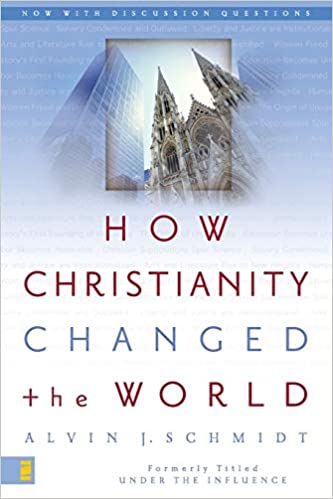
Alvin Schmidt claims, “No other religion, philosophy, teaching, nation, movement—whatever—has so changed the world for the better as Christianity has done.” And I quite believe him. He lays out the evidence to back up this bold claim in his book How Christianity Changed The World. 

A few years ago I presented a series of messages to make the case for the resurrection of Jesus. One of the pieces of evidence I presented was the cultural engagement of Christians whose lives had been transformed by a personal relationship with the resurrected Jesus Christ. Alvin Schmidt’s book is like taking this single point of mine and putting it on steroids! 

Using the reports of first-person observers from the first century all the way through present day, Mr. Schmidt shows how there is not a single part of the culture that hasn’t benefitted from the involvement of those who live out the Christian principles they have discovered in the Bible. From the care of the sick and elderly, to the elevation of women and marriage, to art, and architecture, and music, and medicine, and science, and education—every sphere of life has been improved by practicing Christians. 

I would highly recommend reading this book and then keeping it close at hand to share with those ignorant or skeptical of the claims of Christianity. As William Barclay noted, “Anyone who asks the question, ‘What has Christianity done for the world?’ has delivered himself into a Christian debater’s hands. There is nothing in history so unanswerably demonstrable as the transforming power of Christianity and of Christ on the individual life and on the life of society.” To that, I add a hearty Amen! 

Please get a copy of How Christianity Changed The World for your library. 

►► Would you please prayerfully consider supporting this ministry? ◀︎◀︎

The Historicity Of The Gospels

Listen to the podcast of this post by clicking on the player below, and you can also subscribe on Apple or Spotify.

I’m intrigued by the way the four Gospel writers have recorded the dying declarations of Jesus:

  • Father, forgive them—only in Luke 
  • Today you will be with Me in paradise—only in Luke 
  • Dear women, behold your son—only in John 
  • My God, My God, why have You forsaken Me?—only in Matthew and Mark (and this is the only dying declaration they record) 
  • I thirst—only in John
  • It is finished—only in John
  • Father, into Your hands I commend My spirit—only in Luke 

This is an excellent apologetic for the legitimacy and authenticity of the historical record. 

You know that when your friends are at an important event, not everyone notices the same thing or even to the same extent as the others. 

Cold-case detective J. Warner Wallace has pointed out that when he’s conducting an investigation, he separates the eyewitnesses from each other exactly so they don’t get their stories to “match.” Detective Wallace is able to get the full story precisely because of the differences in each of the accounts. 

This is why the Gospel writers’ accounts ring true: they tell us the same historical event from their unique perspectives. It’s only by reading all of them that we get the full picture. If the death and resurrection of Jesus had been a conspiracy, these writers clearly would have collaborated to “get their story straight” ahead of time, and as a result, we would have four identical stories. 

The historicity of Jesus as told in the Bible is spot-on and completely trustworthy! 

►► Would you please prayerfully consider supporting this ministry? ◀︎◀︎

Resurrection Appearances Of Jesus

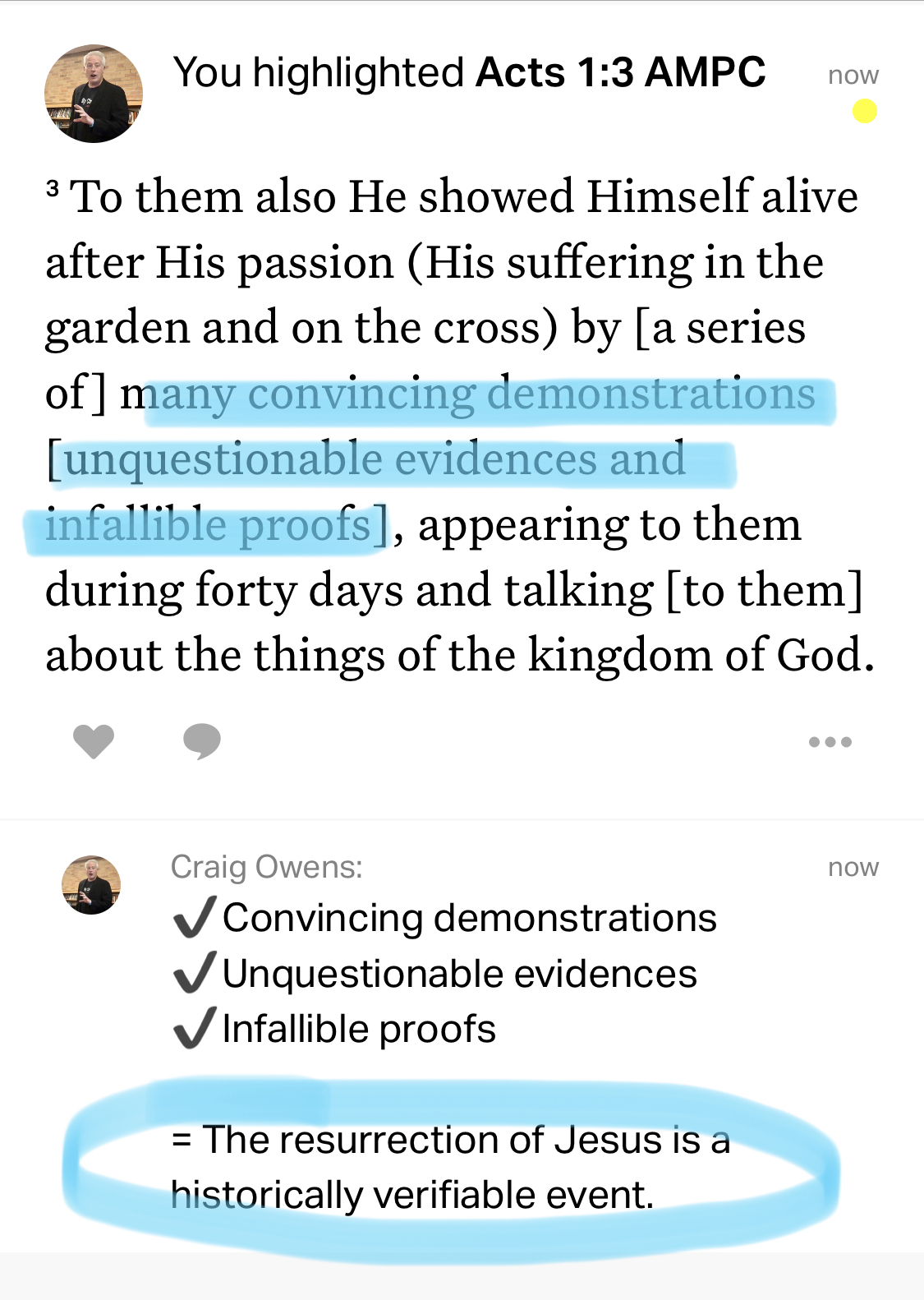
Jesus gave us ample evidence of His bodily resurrection. This is a recreation of a chart found in The Quest Study Bible:I also previously shared an infographic from The Infographic Bible. The historicity of the life, death, and resurrection of Jesus is firmly established making it a historically verifiable event.

Book Reviews From 2020

What Christians Believe (book review)

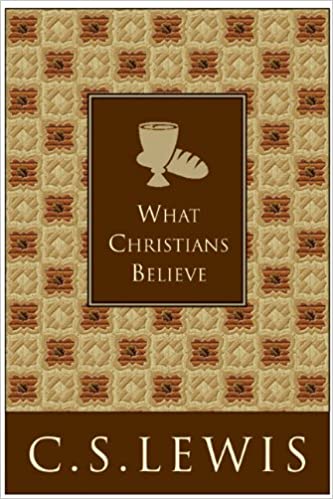
C.S. Lewis remains my all-time favorite author. His ability to explain concepts of theology is unparalleled in both his own time and into modern times. What Christians Believe is a classic case in point. 

During World War II, the BBC was looking for something both inspirational and educational to carry on their airwaves to the British troops abroad and the war-weary British citizens on the home front. They discovered a little-known professor of literature that presented something so fresh and revitalizing that his notoriety immediately skyrocketed throughout England! Part of what he presented as a series of audio essays for the BBC is captured in this book What Christians Believe. 

One of the things I enjoy about Lewis is his ability to simplify complex topics without feeling like he is “talking down” to you. What theologians had made so complex and out-of-reach to many of the uneducated, Lewis made accessible to a vast audience.

If you have a friend or family member that has asked you about your Christian faith, but doesn’t see to “get it” when you explain it, the short essays in this book may be just the thing to get the conversation started again. Better yet: read the chapters along with them and then get together for a time of discussion. I think you will be pleased with the doors that C.S. Lewis may open for deeper understanding and more productive conversations about your Christian faith. 

9 Quotes From “Starlight And Time”

Starlight And Time by Dr. Russell Humphreys is a fascinating read for Creation apologists! Check out my full book review by clicking here. 

“The Creator, who sees the end from the beginning (Isaiah 46:10, Revelation 22:13, John 8:58, and more) is outside of time. Time is a created feature of His universe, like matter and space. It is interesting that the equations of GR [general relativity] have long indicated that time itself had a beginning.” 

“The Bible lays a good foundation for a young-earth relativistic cosmology.” 

“In this new picture of the cosmos, gravity and black hole physics play a central role. In particular, an experimentally-measured general relativistic effect, called gravitational time dilation by some authors, causes clocks (and all physical processes) to tick at different rates in different parts of the universe. … By this effect on time itself, God could have made the universe in six ordinary days as measured on earth, while still allowing time for light to travel billions of light-years to reach us by natural means. The theory also appears to explain the two other major cosmological phenomena we see: the red shifts of light from distant galaxies and the cosmic microwave background radiation. Thus, this biblical foundation appears to lead to a young-earth cosmology which is consistent with Einstein’s general theory of relativity and astronomical observations. As measured by clocks on earth, the age of the universe today could be as small as the face-value biblical age of about 6000 years.” 

“We don’t study Genesis in order to know the mind of Moses; we study to know the mind of God.” 

“We now have very good scientific reasons to think that the amount of carbon dioxide in the pre-flood atmosphere was many times greater than today. That would produce a strong greenhouse effect, a warm climate, and as a bonus, stimulate plant growth to produce the large amount of plant life we find in the fossils. The additional ordinary carbon in the biosphere would dilute carbon 14, so that the pre-flood 14C/12C ratio would be considerably lower due to that effect alone, thus explaining the “old” post-flood radiocarbon dates. In addition, we have evidence suggesting that the earth’s magnetic field was at least ten times greater before the flood than now. That would enable the geomagnetic field to be a very effective shield for cosmic rays, thus greatly reducing the production of carbon 14, making the pre-flood world a healthier place, and further explaining post-flood radiocarbon dates.” 

“Gravitational time dilation causes clocks (and all physical processes) to tick at different rates in different places. This means we must consider which set of clocks the Bible is referring to when it makes statements about time.” 

“[God’s] intention, among other things, was to give markers in the sky which would allow us to clearly measure periods of time in terms of the earth’s rotation and the earth’s movement around the sun, and thus he further defines ‘days’ and ‘years’ [Genesis 1:14-15]. In other words, God quite reasonably tells us periods of time in terms of our own frame of reference, not in terms of some otherworldly frame of reference, as some authors would have it. So Genesis 1, Exodus 20:11, and other passages are telling us that God made the universe in 6 days E.S.T.—Earth Standard Time.” 

“According to the best physics and cosmological knowledge we have today, these ideas lead directly to the conclusion that our cosmos expanded out of a white hole (a black hole running in reverse). As a consequence, gravitational time dilation caused clocks (and all physical processes) both inside and outside the event horizon (the border of the white hole) to tick at vastly different rates from one another in different places.” 

“This paper covers a great deal of scientific territory unfamiliar to many readers. But the bottom line is simple: God used relativity to make a young universe.” 

Starlight And Time (book review)

Creationists (especially young-Earth creationists) have often been stymied to reconcile the biblical evidence for the creation of Earth with the astronomical evidence of observable stars and universes being billions of light-years away. As D. Russell Humphreys notes in his book Starlight And Time, “Good science requires that we try to reconcile both the young-earth data and the cosmological data.” 

So how can both things be true: an Earth that was created 6000 years ago and a distant star appearing to be billions of light-years old? Using the theories of general relativity applied to the best cosmological data, Dr. Humphreys presents a novel hypothesis that appears to accommodate all of the data we have gathered. 

The equations of general relativity have always indicated that time itself had a beginning, which means we have to be open to the idea that something outside of Time—outside of our universe—had a hand in the beginning of our universe. Dr. Humphreys does an excellent job of unpacking these equations to show how accurately they end up being in agreement with the biblical account of Creation. In fact, he notes that “as measured by clocks on earth, the age of the universe today could be as small as the face-value biblical age of about 6000 years.”

I’ll admit that physics wasn’t my favorite subject in school. However, after leaving school I was determined to get a better grasp on it, and found myself actually enjoying the studies of physics and cosmology. With my rudimentary grasp of these concepts, I still struggled to conceive the impact of all the equations that Dr. Humphreys laid out, but that didn’t keep me from being astounded at how well his theory fits all the evidence. 

The physics equations shouldn’t stop you from picking up a copy of this book either. In fact, if you enjoy creationist apologetics, this book needs to be on your “must read” list. 

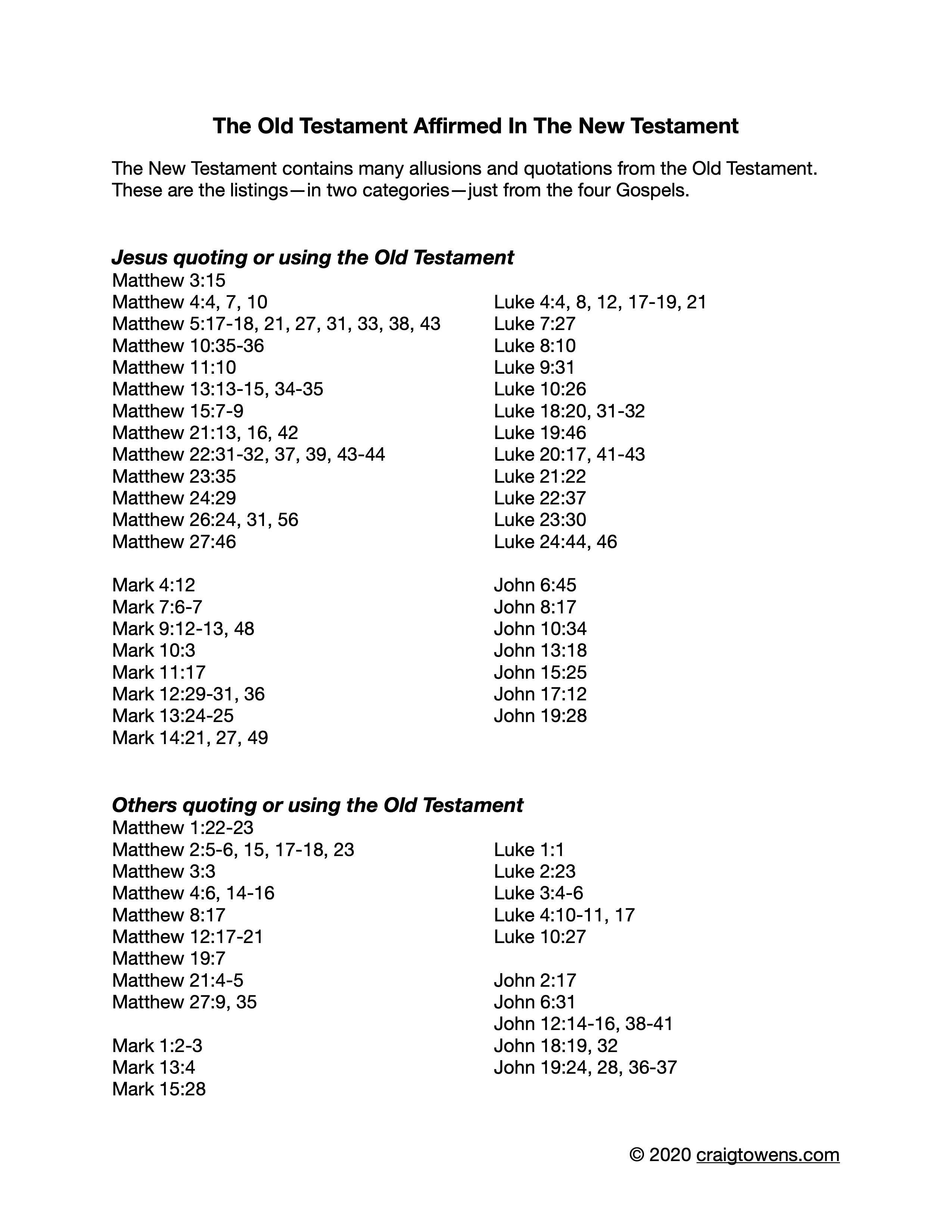
The Old Testament Affirmed In The New Testament

(click image for a larger view)

Sometimes, instead of referring to the two major divisions of the Bible as the Old Testament and the New Testament, I prefer to use the First Testament and the Second Testament. This helps me remember that “Old” doesn’t mean outdated and “New” doesn’t mean forgetting what came before it. 

I love how B.B. Warfield describes the First Testament as being like a mansion with richly-decorated, beautifully-ornate rooms, but which are dimly lit. With Christ’s Advent described in the Second Testament, the light is turned on and we can now appreciate the beauty that was always there! 

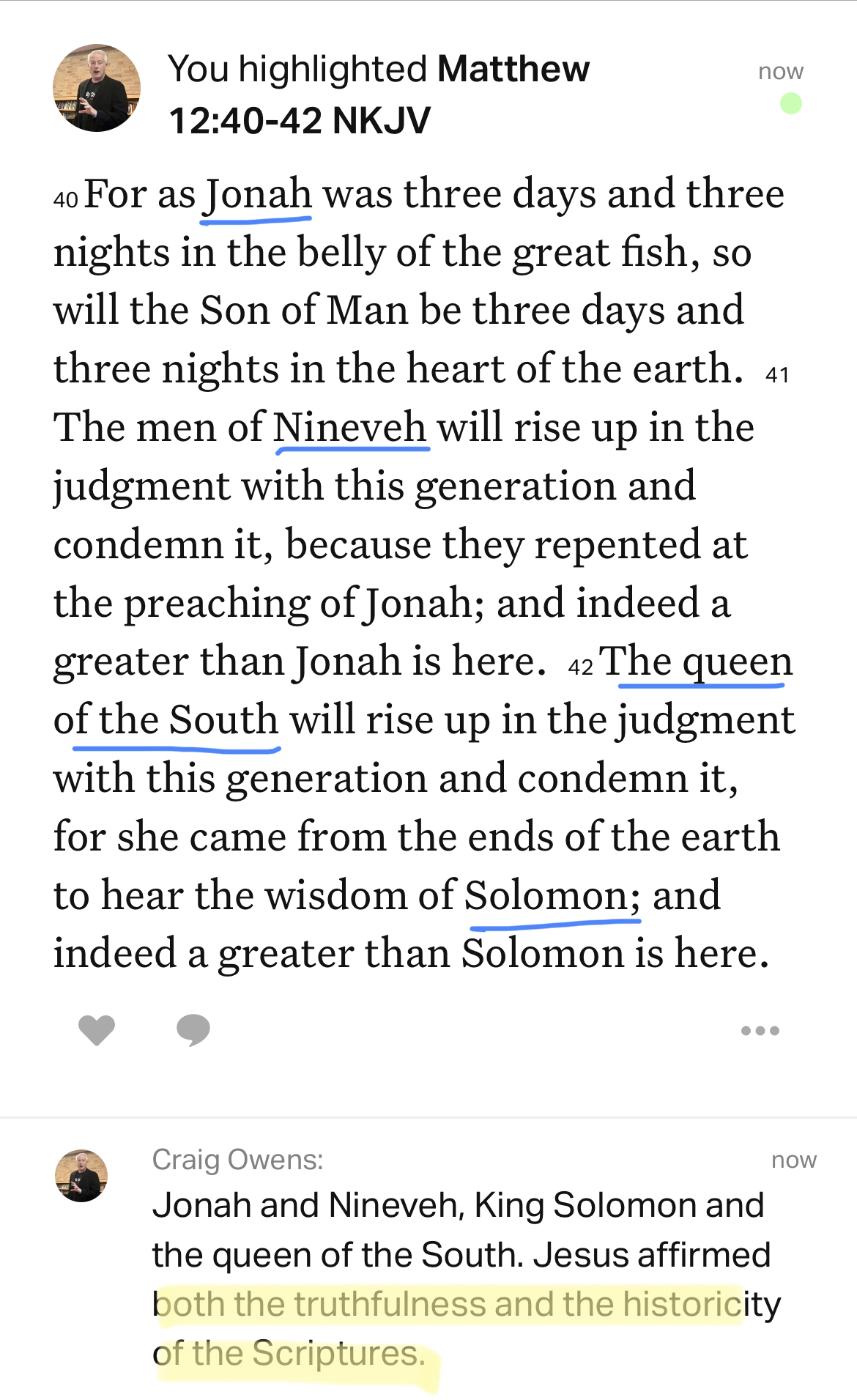
Sadly, there are far too many people who see the two divisions of the Bible as separate. In reality, the First Testament is affirmed over and over again in the Second Testament. In fulfilled prophesy alone, there is an abundance of evidence! 

But let’s get even more obvious: In just the four Gospels there are at least 100 direct mentions or quotations of passages from the Old Testament. Clearly, both Jesus and the Gospel writers saw the First Testament as an integral part of Christ’s ministry. 

Check out this list that I compiled and look up the references for yourself (a great place to look up Scriptures is on BibleGateway.com). 

If you would like to download a PDF version of this list, click here → Old Testament affirmed in the New Testament ← If you would like to use this document in a teaching session, just be sure to mention that you downloaded it from craigtowens.com. Thanks! 

More resource for your Bible study: 

Book Reviews From 2019

Two Bits Of Evidence

“We have two bits of evidence about the Somebody. One is the universe He has made. If we used that as our only clue, then I think we should have to conclude that He was a great artist (for the universe is a very beautiful place), but also that He is quite merciless and no friend to man (for the universe is a very dangerous and terrifying place). The other bit of evidence is that Moral Law which He has put into our minds.

“And this is a better bit of evidence than the other because it is inside information. You find out more about God from the Moral Law than from the universe in general just as you find out more about a man by listening to his conversation than by looking at a house he has built. Now, from this second bit of evidence, we conclude that the Being behind the universe is intensely interested in right conduct—in fair play, unselfishness, courage, good faith, honesty, and truthfulness.” —C.S. Lewis, in Mere Christianity