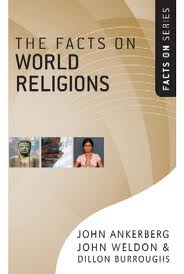
As a Christian, I have always taken seriously the admonition of the Apostle Peter to, “Always be prepared to give an answer to anyone who asks you the reason for the hope you have. Do this with gentleness and respect” (1 Peter 3:15). Not being able to answer is unacceptable, and so I want to diligently study. The Facts On World Religions by John Ankerberg, John Weldon & Dillion Burroughs is just the book to help me in this pursuit.
The Facts On is a well-researched, well-footnoted, helpful guide to learn the basic information on four of the world’s predominate religions: Christianity, Islam, Hinduism, and Buddhism. For all four religions the authors give a broad overview in the categories of:
What are this religion’s central beliefs?
How did this religion originate?
Is the founder of this religion who he claimed to be?
Are this religion’s scriptures reliable?
Having each religion covered in the same four categories make a side-by-side comparison much easier. Although this book is not an in-depth study, every chapter is heavily notated to make it easy to find additional study materials on each religion. The last section of the book is a summation of the findings and addresses the questions: Is all religion good? Is only one religion fully true? Are Christians intolerant to say Christ is the only way? What are the consequences for believing the way these religions teach?
All in all this book is a very handy guide for any student who wants to be prepared to give an answer.
Check out this video from Greg Koukl on why Christians should defend their faith…
These are links to articles and quotes I found interesting this weekend.
Donald Miller posted why he doesn’t attend a local church service. I found his arguments shaky. Here are a couple of good rebuttals: What We Talk Like When We Talk About God
How did dinosaurs become extinct? Here’s one view (although I’m not sure it is any more plausible than the account of the biblical Flood): Did Dark Matter Kill The Dinosaurs?
“Life is either a daring adventure or nothing.” —Helen Keller
“Many people preach and teach. Many take part in the music. Certain ones try to administer God’s work. But if the power of God’s Spirit does not have freedom to energize all they do, these workers might just as well stay home. Natural gifts are not enough in God’s work. The mighty Spirit of God must have freedom to animate and quicken with His overtones of creativity and blessing.” —A.W. Tozer
“To be humble, and, like a little child, afraid of taking a step alone, and so conscious of snares and dangers around us, as to cry to [God] continually to hold us up that we may be safe, is the sure, the infallible, the only secret of walking closely with Him.” —John Newton
“One of principle that today’s intellectuals most passionately disseminate is a vulgar relativism, ‘Nihilism with a happy face.’ For them it is certain that there is no truth, only opinion: my opinion, your opinion. They abandoned the defense of the intellect…. Those who surrender the domain of the intellect make straight the road to fascism. Totalitarianism…is the will-to-power unchecked by any regard for truth. To surrender the claims of truth upon humans is to surrender Earth to thugs…. Vulgar relativism is an invisible gas, odorless, deadly, that is now polluting every free society on earth. It is a gas that attacks the central nervous system of moral striving…. ‘There is no such thing as truth,’ they teach even the little ones. ‘Truth is bondage. Believe what seems right to you. There are as many truths as there are individuals. Follow your feelings. Do as you please. Get in touch with yourself….’ Those who speak in this way prepare the jails of the twenty-first century. They do the work of tyrants.” —Michael Novak
This address from C.S. Lewis was broadcast on the BBC in 1944. Sadly, this is the only one of his radio talks that have survived. But the good news is these talks form the bulk of C.S. Lewis’ amazing book Mere Christianity.
I’m always fascinated by the solid apologetics for the accuracy of the Bible. This short video from BibleMesh—Is The Old Testament Reliable And Accurate?—is well worth your time…
Josh McDowell is an amazing apologist! He has a tremendous knack for being able to “put the cookies on the bottom shelf.” By that I mean that he can make complex topics accessible to a wider audience than most authors. In Did The Resurrection Happen … Really? he and Dave Sterrett do just that with some great arguments for and against the death and resurrection of Jesus Christ.
This book is classified as fiction, because fictional characters are having a discussion at a fictional university about the deep subjects of life and death, and life after death. Although the characters are fictional, the questions being discussed are real, and the sources quoted in defense of each side of the argument are all non-fictional.
McDowell and Sterrett (who are Christian apologists) don’t dumb-down the arguments against the claims of an actual physical death and an actual physical resurrection. They quote from some of the most well-known proponents of these arguments, and then thoughtfully and persuasively rebut those claims.
Because this book is written in a conversational style, it bring the reader right into the coffee chats of the characters. It also helps the reader see how he/she could have a similar dialogue with others who question the biblical account of the crucifixion and resurrection of Jesus Christ.
The book is well footnoted, so curious readers can dig deeper and research further. But don’t let this fact lead you to believe that this is a heady, academic book. As I mentioned earlier, McDowell and Sterrett definitely make these concepts accessible to a wide audience.
This would be an excellent book to read if you have friends who are skeptical to the biblical account. It would also be a very good resource for those preparing to attend a university where the faculty might be more antagonistic toward the biblical worldview. In any case, it was a very enjoyable and educational book.
Listen to the podcast of this post by clicking on the player below, and you can also subscribe on Apple, Spotify, or Audible.
Could it really be this simple? Could it be that Jesus died and rose again just like the Bible says? Or does it need to be more complicated than that? Are there other theories that seem to fit the facts?
At the feast of Pentecost where Jewish people from all over the world convened in Jerusalem just 50 days after the resurrection of Jesus, Peter stood up to address them:
He began, “Fellow Jews and all of you who live in Jerusalem…” (Acts 2:14). He addressed both local residents and guests from faraway lands.
Peter began by saying, “Jesus of Nazareth was a Man accredited by God to you by miracles, wonders and signs, which God did among you, as you yourselves know” (v. 22). No one shouted Peter down or disputed this claim. Quite possibly because there were those in this audience who had personally seen or experienced one of Jesus’ miracles.
The he announced, “God has raised this Jesus to life, and we are all witnesses of the fact” (v. 32). Anyone could have easily refuted this claim because the tomb of Jesus was within walking distance of where they were standing, and yet no one disputed this claim.
A short time later, after healing a lame man outside of the temple, Peter and John were hauled before the Sanhedrin (the rulers and elders of the people [Acts 4:8]). This was the very group who had convinced the Roman governor Pontius Pilate to have Jesus crucified.
They addresses this group by saying, “It is by the name of Jesus Christ of Nazareth, Whom you crucified but Whom God raised from the dead, that this man stands before you healed” (v. 10). Once again, they didn’t dispute this, but they just told them to stop preaching in this name of Jesus (v. 17).
Paul was a devout member of this Jewish religious leadership until he had a personal encounter with Jesus. It became awfully difficult for Paul to argue that Jesus was dead, when he had personally seen Him and talked with Him!
Paul’s former colleagues had him arrested to stand trial before the Romans. The Roman governor Festus noted that the claims of the Jews against Paul were “about a dead man named Jesus Who Paul claimed was alive” (Acts 25:19). This is nearly 30 years after the resurrection of Jesus occurred. King Agrippa didn’t scoff this off. In fact, Paul said he was glad to talk to the king since “the king is familiar with these things…. I am convinced that none of this has escaped his notice, because it was not done in a corner” (Acts 26:26). Again, Agrippa didn’t dispute the claim of Jesus’ resurrection, but simply accused Paul of trying to convert him to Christianity.
There is something in our hearts that wants the resurrection to be true.
We don’t want to work all our lives for nothing.
We don’t want to invest in a relationship, only to have that end when the other person dies.
We want there to be something more. We want there to be something that makes sense of the world.
Only the resurrection of Jesus the Christ helps us make sense of life. Only His resurrection gives us lasting hope.
An old song by the band Kansas says:
Deep within the hardest heart
There is something there that knows
There’s a hunger life can never fill
Til you face the One Who rose
There were two followers of Jesus who were out for a walk on the evening of the day of the resurrection. They, too, were trying to figure out if the news reports they heard about Jesus’ resurrection was fact or fiction. Jesus met them on the road (although they didn’t recognize Him) and He walked and talked with them. He explained how all of the things in the Bible pointed to these facts: a Savior would come, a Savior would die, and a Savior would be raised to life again. As Jesus sat down to eat with them, they recognized Who He was, and then He disappeared from their sight. As they hurried back to tell the other disciples, they said, “Didn’t our hearts burn within us as He talked” (Luke 24:32).
Does it take faith to believe the biblical resurrection story? Yes!
Does it take faith to believe the conspiracy theories? Yes!
But I believe that not only is the resurrection account more plausible, but it’s more satisfying too. The resurrection of Jesus rings true because IT IS TRUE, and because you were created by God to believe this truth so you could be in a relationship with Him forever.
Earlier this week I reviewed Questions Christians Hope No One Will Ask Them (you can read my review here).
I wanted to share some of my favorite quotes from this book:
“When we fail to answer someone’s questions and objections, we become just one more excuse for them to disbelieve.”—Walter Martin
“I cannot believe that our existence in this universe is a mere quirk of fate. … We are truly meant to be here.” —Paul Davies, a physicist, cosmologist, and atheist
“Consider what you’d need for a protein molecule to form by chance. First, you need the right bonds between the amino acids. Second, amino acids come in right-handed and left-handed versions, and you’ve got to get only left-handed ones. Third, the amino acids must link up in a specified sequence, like letters in a sentence. Run the odds of these things falling into place on their own and you find that the probabilities of forming a rather short functional protein at random would be one chance in a hundred thousand trillion trillion trillion trillion trillion trillion trillion trillion trillion trillion. That’s a ten with 125 zeroes after it! And that would only be one protein molecule—a minimally complex cell would need between three hundred and five hundred protein molecules. … To suggest chance against those odds is really to invoke a naturalistic miracle.” —Stephen Meyer, a Cambridge-trained philosopher of science
“Here’s the key point to remember: there never was a time when the earliest community of followers of Jesus did not regard Him as far, far more than a good teacher.” —Mark Mittelberg
“If a good God made the world, why has it gone wrong? … My argument against God was that the universe seemed so cruel and unjust. But how had I got this idea of just and unjust? A man does not call a line crooked unless he has some idea of a straight line. What was I comparing this universe with when I called it unjust? If the whole show was bad and senseless from A to Z, so to speak, why did I, who was supposed to be part of the show, find myself in such violent reaction against it? … Thus in the very act of trying to prove that God did not exist—in other words, that the whole of reality was senseless—I found I was forced to assume that one part of reality—namely my idea of justice—was full of sense. Consequently, atheism turns out to be too simple. If the whole universe has no meaning, we should never have found out that it has no meaning: just as, if there were no light in the universe and therefore no creatures with eyes, we should never know it was dark. Dark would be without meaning.” —C.S. Lewis









 Craig T. Owens